January 14, 2005
Apple's PC Strategy & Big Profits Underline Macworld, Dell Declares iPod a Fad, While Creative Says New Shuffle a Big Let Down
-
Apple CEO Steve Jobs is taking the concept of "mini" to the Mac computer and a flash-based iPod.
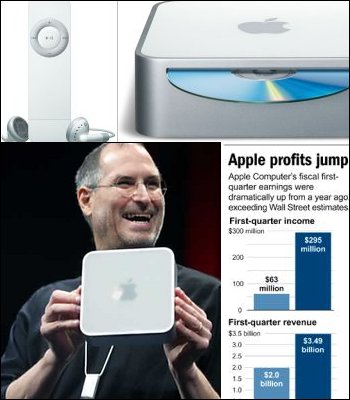
During his keynote Tuesday at the Macworld conference and expo here, Jobs introduced a Mac computer that almost fit into the palms of his hands and that is Apple Computer Inc.'s latest answer for Windows users wanting to switch platforms.
"People understood the iPod mini, and I think they'll understand the Mac mini as well," Jobs said, referring to the 4 GB iPod launched at last year's Macworld.
The Mac mini will be available Jan. 22 in two models that start at $499, Jobs said. It comes without a monitor, keyboard or mouse, instead connecting with a user's existing equipment.
"We supply the computer, and you supply the rest," Jobs said. "We want to price this Mac so that people thinking of switching will have no more excuses."
Apple also is making the iPod even smaller than the iPod mini. Jobs launched the iPod shuffle, Apple's entry into the flash player market that incorporates its song-shuffling technology.
The iPod shuffle began shipping from factories Tuesday. On one end, it includes a USB 2.0 connector that also can be fitted with a lanyard for wearing it around one's neck.
"It is smaller than most packs of gum, and it weighs about same as about four quarters, or under one ounce," Jobs said.
The iPod shuffle comes in a 512 MB and a 1 GB model, priced at $99 and $149, respectively. Along with digital music, it can double as a USB drive and lets users determine how much memory to devote to each function, Jobs said.
Not everything was about miniaturization during Jobs' keynote. He also introduced Apple's productivity suite replacement for AppleWorks in a move that could pit Apple more directly against Microsoft Corp.'s Office suite for the Mac.
The iWork suite builds atop Apple's existing Keynote software for creating presentations by also providing a word processor called Pages. AppleWorks had become outdated because it was developed before the move to Mac OS X and long before Apple's digital-media suite, called iLife, existed.
"We created [iWork] from the ground up to take full advantage of Mac OS X and iLife," Jobs said.
iWork is slated for release on Jan. 22, with pricing at $79. It will include Keynote 2, an update that adds 10 new design themes and expanded animation features.
As for Pages, Jobs called it "word processing with an incredible sense of style."
That's because it not only provides standard word-processing functions but also comes with 40 Apple-designed templates for creating everything from a form letter or brochure to a family newsletter or menu, Jobs said.
In a demonstration, Phil Schiller, Apple's vice president of worldwide product marketing, showed how the templates open with placeholder text, graphics and folders and let users grab photos from iPhoto to insert them into documents. The templates also automatically adjust when users add, move or resize elements.
While announcing few new features for the operating system, he recapped the major changes coming in Tiger, including the Spotlight search capability, Dashboard and an update to QuickTime 7 media player.
Jobs demonstrated some of the information "widgets" planned for Dashboard. Dashboard is a feature that lets user toggle to a display of a range of small applications that can display common information or perform quick tasks.
The widgets included a world clock, dictionary, thesaurus, calculator, measurement converter, and flight and stock trackers. Hundreds of third parties also are creating Dashboard widgets, such as an eBay Inc. auction tracker that Jobs displayed.
"This has evolved into something we think will be a big hit in Tiger," Jobs said of Dashboard.
Discussing Tiger's much-anticipated Spotlight search capabilities, Jobs downplayed the raft of other desktop-search tools hitting the market such as those from major search companies like Google Inc., Yahoo Inc. and Microsoft Corp.s' MSN unit.
Spotlight's key difference, Jobs said, is that it is integrated throughout the Mac OS and into applications such as Apple Mail.
"They're great, but they're nowhere near as great as Spotlight because when you build it into the core OS, you can do things you can't do with a tool sitting to the side," Jobs said.
Meanwhile, stores will open an hour early to support introduction of the new $499 Mac Mini this coming Saturday, when they're introduced, and this might just get PC users like me to make the final switch:
-
That's the hope of Apple whose approximately 100 retail stores are opening an hour early on Saturday as the highly touted and low-priced Mac mini computer and iPod Shuffle portable music player go on sale.
Analysts are betting Apple's mini might just tempt users of rival Microsoft Corp.'s Windows to switch operating systems and go with the Mac and its Mac OS X operating system.
That transition hasn't happened yet despite Apple's "Switch" advertising campaign and in spite of the success of the iPod portable digital music players. More than 10 million have been sold since their introduction more than three years ago. Apple's portion of the worldwide PC market was 2 percent in the fourth quarter, according to preliminary figures from market research firm IDC.
"I believe the Mac mini is actually going to have more of an impact on Apple's market share position than their digital music efforts have so far," said IDC analyst Roger Kay.
Echoing the sentiment, Needham & Co. analyst Charlie Wolf wrote to clients: "The iPod's only failure so far has been its inability to stimulate meaningful purchases of Macintoshes."
With the Mac mini, that could change, and Wolf now estimates that 11 percent of those who have iPods and PCs that use the Windows operating system may shell out the $499 for a Mac mini now that they're available. Before the mini, Wolf had predicted 4 percent could switch.
Apple is opening its stores at 9 a.m. local time on Saturday. Store personnel contacted by Reuters in California, Colorado, Florida and New Jersey said they had been receiving a slew of calls about the mini and the Shuffle.
The Shuffle is Apple's smaller, cheaper version of its market-leading iPod and holds either 120 or 240 songs, costing $99 and $149, respectively.
"Some of this is true demand, but I think some of it's orchestrated, too, by Apple," said Stephen Baker, an analyst at NPD Group.
Apple has long been criticized for pricing itself out of the mainstream with its sleek products, but, now, Apple is changing course.
"The Mac mini opens up lower price points for people who would like to try the Mac platform, and that's long been one of my chief complaints about Apple—the high price," IDC's Kay said.
Steve Jobs, co-founder and chief executive of Cupertino, California-based Apple, said last week, "People who are thinking of switching will have no excuse." Jobs introduced the mini, which comes without a display, keyboard or mouse, at the company's annual trade show on Jan. 11.
Starting at $499, the mini, which is 6.5 inches square and 2 inches tall, is Apple's cheapest computer ever.
Some analysts have said that Apple's blow-out fourth-quarter results offered clear proof of the "halo effect" of iPod sales boosting Mac sales. Kay said he was not so sure.
Apple's fourth-quarter share of the worldwide and U.S. PC markets rose by a mere 0.1 percentage point each, to 2.0 percent and 3.4 percent, respectively.
"That's not a whole lot of share gain, but will the Mac mini help them gain some more?" Kay asked. "I would certainly think so."
But will the new products really gain traction in the marketplace? eWeek's David Coursey thinks so:
-
Here's my immediate reaction:
Mac mini: A $499 Mac ought to be the ultimate "switcher" box. Not that most Windows users actually switch to Macintosh, but many have bought a Mac for use at home. Buy a KVM (keyboard/video/mouse) switch, and the Mac mini can share mouse, keyboard and screen with your PC. This gets users a Mac without a lot of work and for a minimal investment.
Having this machine in the Apple product line allows Mac fanatics to tell their Windows friends that instead of upgrading their Windows machine, they should add a Mac to their desktop or home—and save money in the process.
The downside of the Mac mini may be performance in the graphics-intensive applications toward which Mac users tend to gravitate. I want to see an independent, hands-on review before committing to a final score, but as a preliminary grade, I think an "A" is right on target. I'm about ready to pull out my credit card for this one.
iWork: So, this is the Microsoft Office competitor Apple was rumored to be releasing? Clearly, that's not what this is. But I am looking forward to using iWork nevertheless. First, Keynote is a very useful presentation package, and I've been looking forward to a new version.
Second, the Pages word processor is intended to be a tool that offers more layout options than a word processor without the complexity of desktop publishing. That's a need I often have. For $79, I'd be willing to take a chance on this one. Meanwhile, the Office competitor, if it exists, must wait for another day. A B+ seems appropriate.
iLife '05: Maybe there are features here that I really want and would be willing to pay for, but the Apple Web site isn't very convincing. This looks like Apple's bid to sell customers annual releases of popular software with only minor changes to functionality.
Nevertheless, keep the price low enough, $79 in this case, and some customers will buy. It's hard to upgrade applications whose main virtues are simplicity and a limited feature set, but Apple seems to manage. This one gets a C+, but might be hard-pressed to do better.
iPod shuffle: When I bought my first iPod, it was because the MP3 players available at the time were low-capacity and took a long time to fill with music, thanks to a low connection speed to the desktop.
The iPod Shuffle is low capacity, compared with a "real" iPod, but fortunately it connects at swift USB 2.0 speeds, as well as at the much slower USB 1.1 rate used by the first MP3 players.
Apple is trying to make a virtue out of the fact that the device lacks a screen by making it sound like random playback is an advantage. I don't think so. But I am sure they will sell a zillion of these—just not to me. I give it a C-.
I am sure those still washed in the glow of Steve's keynote will rate all of these products, and especially the iPod shuffle, a full letter grade or higher than I have. But I've been following Apple long enough (and have become cynical enough) that I think I've called these about right.
And now, I am off to order my new Mac mini. Yes, sometimes even I succumb—and at a distance, too.
As for the ongoing controversy over the Think Secret fan site being sued by Think Different, Jim Nash from InformationWeek summed it up nicely in its daily newsletter today:
-
There are missteps that we all make because we don't see something coming, and there are missteps that some of us make because we don't see the big picture. Apple Computer appears to be making the latter in suing a 19-year-old Internet entrepreneur who has the audacity to be a successful journalist.
Harvard undergrad Nicholas M. Ciarelli has for six years operated the Think Secret site, at which he posts product information before Apple wants it released. This is a game that business journalists play with vendors, and more publicity-savvy execs know how to play it well: They do everything in their considerable power to keep secrets secure. When reporters still get the goods, the smarter execs shrug it off and move on.
When Apple subsidizes Macs for schools, it's buying loyalty and, it hopes, market share. But suing a member of that target customer base for being a (perhaps overzealous) Mac enthusiast may send the wrong message to the people Apple wants as customers.
Let's hope that doesn't get in the way of success for an innovative product line. The ThinkSecret.com lawsuit, however, continues to percolate, as 19-year-old Nick Ciarelli seeks out help for his legal defense, including saying, "is that so wrong" to leak previews of tech products, like the rest of the press does with great regularity:
-
Is the technology press abandoning one of its wounded on the battlefield? Where is the righteous indignation on behalf of Nicholas Ciarelli aka Nick dePlume? Mr. Ciarelli is the 19-year old publisher of ThinkSecret.com, a Web site that Apple is suing over an article about a once top-secret $499 Mac. Mr. Ciarelli, a Harvard University student of Cazenovia, N.Y., is now looking for free legal help. He is seeking protection under the First Amendment, although he is not named as a defendant. Going after a member of the press could become a public relations problem for Apple. Technology companies are no strangers to this kind of mildly aggressive journalistic scrutiny.
The technology press has made its bones on breaking stories about not-yet-released products. To a large extent, that's the definition of a breaking story in the tech press. According to Apple, the company is protecting its right to "innovate and surprise and delight people with great products," so they reserve their right to secrecy. But there is also such a thing as freedom of the press. And in the tech world, the two have coexisted fairly well until now. All of the dailies ran the bare bones, just-the-facts wire story of the lawsuit—no editorial comment, no in-house story. Maybe the technology press just needed a moment to catch its breath after having to cover two very exhilarating trade shows back to back.
Meanwhile, Apple's MP3 player rivals were dissing the champ of the category after the screenless Shuffle was announced:
-
The chief executive officer of Creative, the maker of one of the leading contenders to the iPod's crown, has called the iPod shuffle "a big let down", accusing Apple of rehashing "a four year old product… worse than the cheapest Chinese player."
In an interview with Channel NewsAsia, Creative CEO Sim Wong Hoo, claimed the company was not worried about the potential threat posed by Apple's entry into the flash music player market. He called the iPod shuffle "[like] our first generation MuVo One product, without display, just have a shuffle feature."
And, Sim claimed, the product was not likely to impress other competitors. "I think the whole industry will just laugh at it, because the flash people -- it's worse than the cheapest Chinese player. Even the cheap, cheap Chinese brand today has display and has FM. They don't have this kind of thing, and they expect to come out with a fight; I think it's a non-starter to begin with."
According to Apple, the company sold over 4.5 million iPods over the quarter leading up to Christmas, double that of Creative's Zen player – the iPod's nearest competitor. Sim claimed the company was prepared to spend up to $100 million in marketing funds in order to catch up with the iPod.
Plus, there's no love lost between Apple and Dell, as Dell CEO Kevin Rollins called the iPod nothing more than a fad:
-
The chief executive officer of Dell has claimed that the success of the iPod amounts to "a fad", adding that Apple "isn't in the same league" as his own company.
In an interview with Silicon.com, Kevin Rollins claimed the product faced an uphill struggle to capitalize on the success of the iPod and sustain it into the future, drawing parallels with Sony's Walkman. "It's interesting the iPod has been out for three years and it's only this past year it's become a raging success. Well those things that become fads rage and then they drop off. When I was growing up there was a product made by Sony called the Sony Walkman – a rage, everyone had to have one. Well you don't hear about the Walkman anymore. I believe that one product wonders come and go. You have to have sustainable business models, sustainable strategy."
Rollins also claimed that Apple had "done a nice job" with the iPod, but was less impressed with the Mac mini. "It might take some [sales] here and there, but Apple's market share in the global computer business has really shrunk pretty far," he claimed. Despite the number of headlines grabbed by the product, Rollins added, Apple remains a niche player and "isn't in the same league" as Dell.
But all this pales in the glare of Apple's stellar financial results - my brother Derek curses the day I told him to buy AAPL - languishing around 20 a year ago it's in the low 70's today:
-
As the Mac faithful continue to pack the ongoing Macworld Expo in San Francisco, Apple Computer Inc. on Wednesday offered the public some further good news about the company's progress. Boosted by the success of the iPod, the company reported its highest-ever quarterly revenue and net income in its first fiscal quarter.
For the quarter, ended Dec. 25, Apple reported total revenue of $3.49 billion, up from $2.01 billion in the year-ago quarter, a leap of 74 percent. Analysts had forecast revenue of a bit over $3 billion. Apple's net profit grew even more: $295 million, compared with $63 million for the year-ago quarter.
The success of the consumer music player was the difference. Announced by CEO Steve Jobs in his Tuesday keynote address at Macworld, Apple sold about 4.6 million iPods during the quarter, a more than 500 percent rise over the same period last year.
Still, in a conference call with financial analysts Wednesday afternoon, Apple chief financial officer Peter Oppenheimer stressed the positive growth in computer sales.
He said the company shipped 1,046,000 Macintosh units, a 26 percent increase over the year-ago quarter.
The leaders in the CPU field were the iMac and iBook series aimed at consumers and education, up 101 percent and 35 percent compared with the year-ago quarter. Sales of the Power Macintosh G5 rose 7 percent over the previous quarter, while PowerBook G4 sales dropped 29 percent, despite a speed bump in the fall.
The executive said sales to the education market grew 11 percent, bringing its highest quarterly total for that market in seven years.
Questions regarding the success of a "halo," or multiplier effect for CPU sales from its success with the audio player, were posed by analysts. Apple has targeted these "switchers" from the Windows platform in the past several years.
While avoiding a direct answer on the subject, Oppenheimer pointed to the increasing number of such customers in Apple stores. In the quarter, more than 40 percent of Mac buyers in the stores were "new to the Mac," he said.
Best of luck to the Mac-faithful - competition, as we know, is good for innovation, so keep up the good work!
- Arik
Posted by Arik Johnson at January 14, 2005 09:34 PM | TrackBack "Competitive Intelligence applies the lessons of competition and principles of intelligence to the need for every business to gain awareness and predictability of market risk and opportunity. By doing so, CI has the power to transform an enterprise from also-ran into a real winner, with agility enough to create and maintain sustainable competitive advantage."
