November 21, 2004
Sears & Kmart: Can Two Wrongs Make a Right?
-
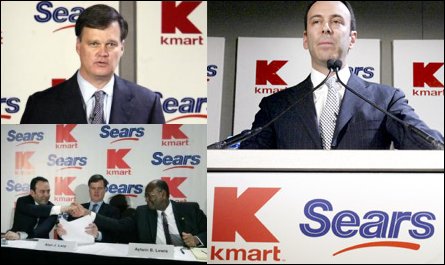
Kmart Holding Corp., the discount chain pulled from bankruptcy by hedge fund operator Edward Lampert, will buy Sears, Roebuck & Co. for $10.85 billion in a bold play to revive two of America's best-known, but long-struggling, retail brands.
The deal, the fourth-biggest retail merger ever, will form the third-largest U.S. retailer by sales. Known as Sears Holdings, it will have $55 billion in annual revenue, nearly 3,500 retail stores and 394,000 employees. Both company names will be used on stores, but some Kmart stores will convert to the venerable Sears nameplate.
Shares of the two companies, both former No. 1's in the U.S. retail industry, surged as they outlined plans to stem sliding sales and battle rivals like Wal-Mart Stores Inc., now the world's biggest retailer.
Some analysts said the deal could set off a wave of consolidation in the retail sector, where smaller players are struggling to survive against the industry leaders.
"This will trigger a lot of activity in the retail sector, with toys and possibly home furnishing companies coming together to become stronger," said Gary Ruffing, head of retail services at management consulting group BBK Ltd.
Others were skeptical that two flagging retail giants, which appear long past their prime, could join forces and challenge such a dominant competitor as Wal-Mart.
"The problem is they are missing a key ingredient -- sales growth," Darrell Rigby, head of the retail practice at consulting firm Bain & Co. "They haven't been able to solve their sales problems separately. Can they solve them jointly?"
The merger was the work of Kmart's billionaire chairman, Edward Lampert, whose ESL Investments Inc. hedge fund is the largest shareholder in both Kmart and Sears. Lampert told an investors' meeting that Sears was as good a company as its rivals but needed to be moved out of malls and into free-standing stores.
"Sears in a Kmart box...ought to do very, very well," said Lampert, who will be chairman of Sears Holdings.
He sees Sears, with its 1,971 stores and annual revenue of $41 billion, as the stronger of the two brands, with Kmart struggling to differentiate its 1,504 stores from other discounters but boasting a cash-rich, debt-free business.
Sears Chief Executive Alan Lacy said several hundred Kmart stores could be converted into off-the-mall Sears Grand stores, accelerating a new one-stop-shopping concept where Sears offers foods as well as apparel and home appliances.
The merger, which should be completed by next March if shareholders approve, is expected to lead to annual savings of $500 million within three years and maybe some real estate sales, the companies said. No details were given on job cuts. Sears employs 250,000 people and Kmart about 144,000.
Under terms of the deal, Kmart shareholders will receive one share of Sears Holdings stock for each Kmart share. Sears shareholders will have the right to choose either $50 in cash or 0.5 share of Sears Holdings for each of their shares.
Lampert has built up a huge cash pile by selling off some Kmart real estate since taking the company out of bankruptcy in May 2003, even selling about 50 stores to Sears as it tried to move away from malls where it has 870 of its stores.
Even so, analysts were divided over the motive for the merger and questioned the merit of combining two ailing companies.
"This entire deal is designed to pile up cash, and Lampert will then liquidate his position or buy something else and do the same thing all over," said Erik Gordon, a marketing professor at Johns Hopkins University, expressing skepticism over the future of Sears Holdings.
"Whether putting together two struggling retailers will create enough value and synergies to make a good retailer is a major question," UBS analyst Gary Balter wrote in a note to clients.
Sales at Kmart fell 14 percent in its fiscal third quarter, the company said on Wednesday. Sales at stores open at least a year -- a key gauge of retail strength known as same-store sales -- rose 1.9 percent in October after six straight months of declines. Sears is battling to keep its No. 1 slot in appliance sales against Home Depot and Lowe's Co.
Kmart, which sells brands like Martha Stewart Everyday and Jaclyn Smith and has annual revenue of about $19 billion, on Wednesday posted a 12.8 percent drop in third-quarter sales.
But investors welcomed the deal. Sears shares rose 17.2 percent to $52.99 on the New York Stock Exchange on Wednesday, while Kmart gained 7.7 percent to $109 on the Nasdaq. Wal-Mart shares slipped 1.1 percent to $56.24.
Shares of Martha Stewart Living Omnimedia Inc. rose 6.3 percent to $18.49. Cross-merchandising between Kmart and Sears will boost the number of outlets selling Martha Stewart goods.
Standard & Poor's said it will likely cut its ratings on Sears debt to "junk" after the deal, down from "BBB," the second-lowest investment-grade rating, at present. S&P said both Sears and Kmart "lag their peers in terms of store productivity and profitability."
Sears shares have rocketed in the past two weeks following news that real estate investment trust Vornado Realty Trust Inc. had acquired a 4.3 percent stake in the company, which highlighted the value of Sears' vast property holdings.
Lampert said Vornado had not been involved in the deal.
Lacy will be chief executive of Sears Holdings, while Kmart Chief Executive Aylwin Lewis will become CEO of Sears Retail.
So, unless some sales growth gets underway, whether Lampert can put “Sears in a Kmart box” and do well, is up for grabs.
- Arik
Posted by Arik Johnson at November 21, 2004 01:32 PM | TrackBack "Competitive Intelligence applies the lessons of competition and principles of intelligence to the need for every business to gain awareness and predictability of market risk and opportunity. By doing so, CI has the power to transform an enterprise from also-ran into a real winner, with agility enough to create and maintain sustainable competitive advantage."
