January 10, 2004
The BBC: an Alternative for the American Public's Media Attention-Span

In the wake of what many Americans feel has been a pandering patriotism to the U.S. invasion/liberation of Iraq, the American media establishment seems to have a new competitor to deal with these days – the BBC.
After discovering BBC programming available overnight on public broadcasting and on demand through the Internet, many of our more urbane citizenry are finding the less patronizing and far more venerable British media icon a better truth-teller than our own broadcast news sources. But, who could blame them… there’s just something about that British accent that lends itself to severe credibility.
I found an interesting article in the December/January issue of the American Journalism Review that speaks to the subject of "the Beeb’s" newfound American admiration - read the whole piece, but here's an excerpt:
-
The British Broadcasting Corp. can certainly relate to American media outlets in one stark way: The radio and television behemoth has been embroiled in a journalistic controversy that threatens to damage its credibility, change the way it does business and, most likely, result in the ouster of a few employees.
For media buffs, the New York Times' springtime of discontent segued nicely into the BBC's summer of the same. A governmental inquiry led by Lord Hutton explored the events surrounding the suicide of David Kelly, a weapons expert who was an anonymous source for an explosive BBC report on the British government's claims about Iraq's weapons of mass destruction. The radio segment, by correspondent Andrew Gilligan, charged the government with "sexing up" a September 2002 dossier and further alleged 10 Downing Street knowingly inserted a false claim that Iraq could launch its WMD in 45 minutes.
Soon Kelly was identified as the source of that report. Shortly thereafter, he told his wife he was going for a walk and never returned. His body was found the morning of July 18.
While American news audiences didn't see much coverage of the inquiry, the British press was full of front-page stories, loads of commentary and, in the broadcast media, reenactments of the proceedings. Internal e-mails, reporters' notes and the diary of Alastair Campbell, Prime Minister Tony Blair's director of communications and strategy, were brought forth as so much dirty laundry, and neither the government nor the BBC came off looking particularly good. The Hutton inquiry even set up its own Web site, www.the-hutton-inquiry.org.uk, to give the public a look at the mounds of testimony.
Says John Tusa, former managing director of the BBC World Service: It "made the summer riveting."
Hutton's final report won't be released until late December or January, providing more time for speculation on how badly it will criticize the BBC's journalism and the government's political maneuverings.
But beyond the shared experience of having its credibility on the line, the BBC is quite different from the American networks. There's the sheer size - 41 overseas bureaus, 3,700 news employees. There's the public confidence - yes, confidence. The British tend to trust the BBC more than the government, not less. They reserve the bulk of their cynicism for politicians instead of reporters. The BBC even has not one, but two cute little nicknames--Auntie, or more commonly, the Beeb.
During the war in Iraq, reportorial differences became distinctly recognizable. The BBC was more likely to be accused of being an enemy of the state than a patriotic cheerleader. A number of American viewers and listeners, dissatisfied with what they saw on the U.S. networks, tuned in or logged on to the BBC Web site in search of a different journalistic tack. Viewership of the BBC World News bulletins, aired on public broadcasting stations in the U.S., rose 28 percent during the early weeks of the war.
But, it’s not just the cosmopolitan accents; many BBC fans cite the World Service as a more reliable – and more objective – source of opinion in what many feel has become a near completely entertainment-oriented broadcast news culture from homegrown sources.
Maybe American news media should consider their most sophisticated demographics a bit more deeply. We certainly don’t get the same global feel here in the States that Brits and others enjoy on BBC and I think an important demographic defection is underway when one’s most important news consumers find European opinions more compelling than the ones at home.
- Arik
January 09, 2004
Wheels & Gadgets: 2004 Consumer Electronics Show Hits Las Vegas & 2004 North American Auto Show Wraps in Detroit
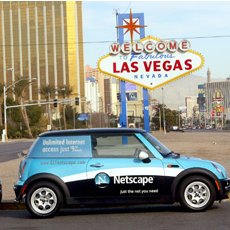 Another week of gadget porn is underway as the 2004 Consumer Electronics Show in Las Vegas gets going, even as the 2004 North American Auto Show in Detroit rolls on. Both exhibitions highlight the renewal of hypercompetitive strategy reminiscent of the pre-bubble 90’s, where product design is once again the key differentiator among a crowded field of competitors.
While the coolest of technologies bubble over in Vegas, it seems the cutthroat market for television sets has been renewed, fueled by the hottest Christmas season in recent memory squarely focused on a new class of thin, low-cost plasma and LCD TVs from fresh competitors like Gateway, HP, Dell and other computer firms. Even chip giants like Texas Instruments and Intel are pushing DLP and LCOS technologies as next-generation solutions for the converged and connected home.
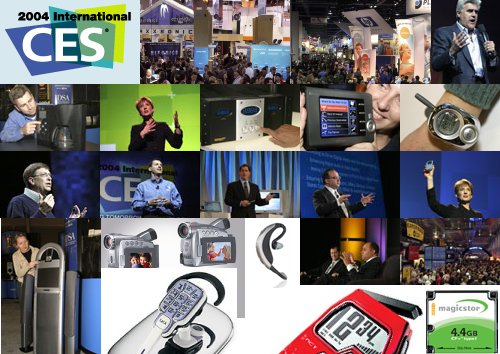
Bill Gates’ opening keynote, punctuated by his first pairing with surprise guest Jay Leno since the Windows 95 launch "back in the day", introduced the first new breed of SPOT watches in what one observer commented:
-
Watches say something about us. Rolex says power, Hamilton says suave, Seiko says thrifty. SPOT says stupid.
Panasonic launched a new line of plasma TVs with HDTV included (finally), while Sharp announced plans to add Wi-Fi to its line of LCD TVs and Thomson rolled out an amazingly cool looking 70" DLP that's less than 7" thin.

Toshiba introduced the world’s smallest hard drive, delivering multi-gigabyte capacities for mobile devices. Acer America sped past the competition with its stunning Ferrari 3000 Notebook entry. Netscape launched a new low-cost Internet service and Canon introduced everything from new multifunction printers to camcorders.
WHEW! For more, read these recaps from PC Magazine or from USAToday.com
Meanwhile, in Detroit, competition is heating up over an ever-more-demanding car market that needs to keep growing even as the taste for used cars is the worst in recent memory. Low-interest financing keeps driving ever-bigger SUVs alongside cutting-edge hybrid gas-electric vehicles from Honda and Toyota to hit a more mature North American market.

The model year 2005 promises to be the year of the muscle car, with horsepower taking over the spotlight at 2004’s NAIAS. Ford appears to be back with a vengeance with new cars from Aston Martin, Volvo, Jaguar and Land Rover as well as the new "Project Daisy" initiative to create a new high-performance sports coupe to rival the Mustang – there’s a good video on all of the details. And, the Ford F-150 took top honors as 2004’s North American Truck of the Year. Meanwhile, Infiniti added to its All-Wheel Drive lineup with a new Full-Size QX56 Luxury SUV and G35 Sedan AWD, and Toyota launched a hybrid SUV.
Here are a few more links I found interesting:
- General Motors: Driving Away the Competition
- New York Times Auto Show Coverage
- Automakers Go All Out in Search for New Look
- Hyundai Targeting U.S. Growth
- Hip-Hop Style Mixes with Hot-Rod Culture
- Nissan: U.S. Crucial to Future Success
I really wish I had business in the Motor City this month (instead I'm visiting lovely Philly, the week after the Eagles beat my beloved Packers).
CES in Vegas is always too short in my opinion and NAIAS can seem too long, but it was definitely a treat a couple of years ago when I was in Detroit for a conference and got to see both production and concept models adorning the exhibitions – truly, a beautiful thing.
- Arik
January 08, 2004
Yahoo! vs. Google: Round One in the New Search Engine Wars

Yahoo! is ditching Google as its main search engine "perhaps as early as the first quarter", the WSJ reports. The paper's sources are an unnamed marketing outfit who says they have been briefed on the switch by Yahoo!
This will come as little surprise to anyone. The only question was when the contractual agreements between the two companies would end.
While Yahoo! is a shareholder in privately-held Google, it owns its own search engine technology, courtesy of the acquisitions of Inktomi and the consumer business of FAST. It also owns the world's biggest paid-for search listings business, Overture. All three were bought over the last year or so.
Google is becoming a serious rival to Yahoo!, as a portal in its own right, and as the purveyor of Adwords, Overture's most formidable competitor by far. :
But what’s the impact of the switch on the searching public - and more importantly for the companies, those wishing to be found? In an article I found on the Jupiter Web site Clickz:
-
The impact: SEM [search engine marketing] just got much more expensive for anyone using Inktomi's (Yahoo's) CPC-based program. Companies using Search Submit could reap huge rewards without incremental costs... if Inktomi allows Search Submit customers entry into Yahoo! when the change is made. But don't bank on it.
If you're a marketer whose not paying to submit your site to Inktomi and whose site isn't found in MSN or HotBot, over the next three months whatever traffic you enjoyed from Yahoo! (via Google) will disappear.
For some, this is great news. It means new, increased traffic from Yahoo! for many who never ranked well in Google. For others, Yahoo! just got too expensive.
Yahoo! and MSN combined drive roughly 45 percent of all search referral traffic, according to StatMarket. Google and those powered by Google drive another 45 percent.
Inktomi will be as important as Google for many marketers, at least for a few months.
We believe there's a strong likelihood MSN will launch its own search engine and drop Inktomi in the fourth quarter of this year. Rumors are circulating MSN may not offer a paid-inclusion program (though that may change), so organic MSN traffic may no longer cost per click come year's end.
There’s even been speculation Microsoft might buy Google, and with a likely IPO in the not-too-distant future, priced at estimates as high as a $15 billion market cap, Microsoft might be the only one who can afford it with the mountain of billions Gates & Co. are sitting on now.
- Arik
January 07, 2004
TiVo Defends Against DVR Competitor EchoStar by Suing Over "Time Warp" IP
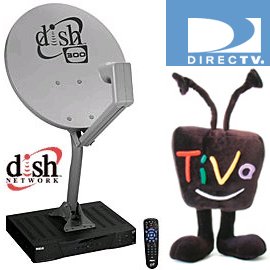
It would appear TiVo is serious about protecting its rapidly eroding monopoly in the DVR market from cable and satellite companies using DVR as a differentiating feature for their services. They’ve decided to sue EchoStar, the satellite company that seems to be growing most quickly in the DVR category, even as TiVo’s DirecTV goes head-to-head with EchoStar’s Dish Network.
Both TiVo and Dish hit the one millionth subscriber mark recently, so TiVo’s growth has slowed by comparison with EchoStar’s in the category. Here’s a excerpted backgrounder and deeper dive from CNET on the subject:
-
San Jose-based TiVo said EchoStar's technology violates its "multimedia time warping system" patent, which it received in May 2001 from the U.S. Patent and Trademark Office. Some set-top boxes used with EchoStar's satellite service come with DVR capabilities.
Defending its patents are crucial to TiVo, which has been emphasizing its licensing business as a complement to its services operations. The company counts major consumer electronics makers such as Pioneer, Sony and Toshiba as licensees.
"We've invested in building a comprehensive patent portfolio to protect our intellectual property, and as the DVR category grows, we will be aggressive in protecting those assets," TiVo CEO Mike Ramsay said in a statement. "The success of our licensing business clearly demonstrates the value the industry has placed on TiVo's technology. It's important that we protect our IP for TiVo and our licensees."
TiVo is seeking monetary awards and an injunction against future sales of DVRs by EchoStar. EchoStar representatives declined to comment Monday and said they had not seen the suit. TiVo has a partnership agreement with EchoStar rival DirecTV, a deal that contributes significantly to TiVo's revenue.
The patent in question, which TiVo filed for in 1998, is described by the company as an "invention allowing the user to store selected television broadcast programs while the user is simultaneously watching or reviewing another program." TiVo has been awarded 40 patents and has more than 100 applications pending, according to the company. The suit was filed in a federal district court in Texas.
TiVo may also be experiencing competition in the DVR market from cable provider Comcast, which in early December said it planned to add TiVo-like features to its service by the end of 2004, using Motorola set-top boxes.
TiVo filed a patent infringement suit against EchoStar Communications Corporation in the federal district court of Texas, alleging that the satellite television service provider is violating TiVo's "Time Warp" patent, which was issued in May 2001.
Key TiVo inventions protected by the Time Warp patent include a method for recording one program while playing back another, watching a program as it is recording, and a storage format that supports advanced TrickPlay capabilities. TrickPlay allows live television broadcasts to be paused, fast-forwarded, rewound, replayed or shown in slow motion.
"We take great pride in the fact that TiVo has created and developed the technology that revolutionises the way people watch television," said Mike Ramsay, CEO of TiVo. "We've invested in building a comprehensive patent portfolio to protect our intellectual property and as the DVR category grows, we will be aggressive in protecting those assets."
"The success of our licensing business clearly demonstrates the value the industry has placed on TiVo's technology. It's important that we protect our IP for TiVo and our licensees," continued Ramsay.
In the late 1990s, TiVo innovated digital video recording, or DVR, technology, which pretty much out-does anything your old VCR can do. Although the TiVo brand, like Kleenex and Xerox, has become synonymous with the product category, other versions of the DVR have been developed by ReplayTV, EchoStar and some cable services. And, many analysts even think TiVo will be outflanked by its competitors.
Still, the DVR revolution that many thought would happen by now really hasn't. It is estimated that DVRs are in fewer than 3 million homes. And, with about 110 million TV homes in the United States, TiVo and its rivals obviously still have a long way to go.
The suit comes several months after EchoStar's Dish Network service introduced a new version of its digital video recorder that allows its subscribers to record one program while playing another.
The market is "growing rapidly and growth is accelerating," said TiVo chief executive Mike Ramsay. "We're very concerned that competitors like EchoStar might use our technology against us."
TiVo has been awarded 49 patents and has more than 100 patents pending, the company said. TiVo said it registered the patent in July 1998, and the government awarded it in 2001.
"If it's determined that people are infringing on our property, we will protect it," Ramsay said. "We really picked our timing to coincide with the growth of this market."
DVRs contain a computer hard drive enabling television viewers to record programs and watch them later or to pause, rewind and slow down live programs. They provide more viewing options and easier interaction than traditional videocassette tape recorders. Forrester Research of Cambridge, Mass., says nearly 3 million American homes have DVRs, a number the firm estimates will grow to more than 40 million in four years.
EchoStar is the largest provider, with more than 1 million subscribers using its DVRs. TiVo reached the 1 million subscriber mark in November, but many of those customers subscribe to EchoStar competitor DirecTV, which has a licensing agreement with TiVo. Cable companies have sold roughly 500,000 DVRs, according to Forrester.
"We're at a moment when this is about to really take off," said Forrester analyst Josh Bernoff. "It's the perfect time to sue. If they waited much longer, it would be too late."
Bernoff said TiVo may be hoping to extract a per-box fee of $1 or $2 from EchoStar. Whether it can depends on the court, which will determine if EchoStar borrowed heavily from TiVo's innovations or developed the technology on its own, he said.
Most analysts, however, are dubious about TiVo's chances of fighting off a rising tide of similar technologies being deployed by both satellite and cable operators. Skeptics also note that lawsuits rarely work as a revenue stream, as Gemstar-TV Guide discovered to its chagrin over the past few years of failed patent suits for its onscreen TV program guide.
TiVo is struggling to maintain its brand lead as it faces increasing competition from cable operators that are rolling out integrated DVRs built by set-top makers Scientific Atlanta and Motorola. TiVo's lucrative distribution deal with satellite leader DirecTV is also in jeopardy as new owner News Corp. is widely expected to start pushing its own DVR box while marginalizing or reducing the royalty rate it pays to TiVo. Currently, some 709,000 DirecTV subs have a TiVo box.
The future of TiVo may be uncertain, but the "TiVolution" has never been more accessible than it was this holiday season. TiVo once required an upfront investment of hundreds of dollars. But, as new competitors continue to emerge, most people can now try the new way of watching and recording television for far less.
In late December, ReplayTV lowered the price on its cheapest machine to $149 and stopped forcing consumers to buy three years of service upfront, cutting the initial cost by more than $300. Time Warner Cable this year began rolling-out of a service that has a TiVo-like DVR built into the cable box and costs less than $10 a month. Some of Cox Communications' customers already have cable DVR service, and Comcast plans to roll it out to all of its subscribers next year.
But even satisfied early adopters have learned not to expect the world. Changing channels can be slow and most machines can't record on one channel while you're watching another. When the hard drive fills up, the systems make up their own minds about what to delete, usually the oldest recordings.
Why has the TiVo concept taken so long to take hold? Like a lot of cool-yet-cutting-edge technology, it can be hard to understand how useful the service is until you actually try it or see it in action. There's also uncertainty over whether start-up services such as ReplayTV, owned by D&M Holdings, and TiVo will survive over the long haul - or whether cable and satellite versions will ultimately corner the market.
So, in months ahead it's sure to be interesting to see how this fight shakes out and whether TiVo can leverage its patent portfolio to discourage other competitors from eating their lunch.
- Arik
January 06, 2004
Agri-Trust: Did Monsanto & Pioneer Hi-Bred Collude to Illegally Fix Genetically Modified Seed Prices?

According to sources at Monsanto and Pioneer Hi-Bred, senior executives from both companies met repeatedly in the mid- to late-1990’s and agreed to charge higher prices for GM seeds. The companies responded to charges of illegal price fixing by acknowledging the meetings but saying they were engaged in negotiations about legitimate changes to an existing licensing agreement. Here’s an long excerpt from the New York Times that explains the situation more completely:
-
Interviews with former and current executives of major seed companies, along with company documents, however, show that through much of the 1990's Monsanto tried to control the market for genetically altered corn and soybean seeds. Monsanto spent billions in the 1980's to invent specialized seeds and sold the rights to make them to big seed companies like Pioneer.
More than a dozen legal experts contacted by The New York Times say that if the goal of the talks between the rivals was to limit competition on prices, they would have violated antitrust laws.
The talks, which occurred from 1995 to 1999, involved licenses that let Pioneer sell altered seeds developed by Monsanto, which is based here. In those talks, according to interviews with dozens of executives and court and other documents, the companies discussed prices, swapped profit projections and even talked about cooperating to keep the prices of genetically modified seeds high.
The talks involved top executives at both companies, including Robert B. Shapiro, then Monsanto's chief executive, and Charles S. Johnson, then Pioneer's chief executive, as well as Richard McConnell, now president of Pioneer, and Robert T. Fraley, now Monsanto's chief technology officer, according to company officials and documents. Together, Pioneer and Monsanto control about 60 percent of the nation's $5 billion market for corn and soybean seeds.
Also in the late 1990's, Monsanto pressured at least two other big seed companies to coordinate their retail pricing strategies with Monsanto's, former chief executives at those companies said. The executives, who ran Novartis Seeds and Mycogen, said they rejected Monsanto's entreaties as anticompetitive and potentially illegal.
Analysts estimate that more than $10 billion worth of genetically altered seeds have been sold in the United States since they were commercialized in 1996. Monsanto and Pioneer did not have to succeed in actually raising retail seed prices to have violated the Sherman Antitrust Act, legal and economic experts say; just agreeing to coordinate prices is against the law.
Companies found to have violated federal antitrust law could be subject to criminal fines and civil class-action litigation. In the civil lawsuits, courts can award triple monetary damages.
"If they're talking to Pioneer about raising the ultimate price to the farmers, that's illegal," said Austan Goolsbee, a professor of economics at the University of Chicago and a former Justice Department consultant on antitrust issues. "Monsanto shouldn't care about the final price. They should only care about the royalty payments they receive from Pioneer."
Royalty payments were at the heart of the matter. Before it realized how successful altered seeds would be, Monsanto sold the technology to some companies, including Pioneer, for relatively modest sums. When the seeds proved to be a hit, Monsanto tried to renegotiate many of those deals to ensure that the seeds sold for higher prices, executives and records show.
Monsanto said it brought up those early agreements only in the context of negotiating a licensing deal with Pioneer for new seeds that Monsanto was developing.
"Monsanto did offer to expand and revise existing licenses with Pioneer," Lori J. Fisher, a Monsanto spokeswoman, said in an e-mail message. "In the context of a potentially new license for technology, it is absolutely within the law to discuss the price and the means of compensation to the licensing party."
Pioneer, a division of DuPont, also denied that the discussions were used to fix prices. "We set our own prices," it said in a statement. "We do it independently, and without consultation with our competitors." It added that it believed that all of its talks with Monsanto about technology licensing were "legitimate and appropriate business negotiations" intended to benefit its customers. "Pioneer at no time engaged in illegal or inappropriate activity regarding the prices of our products," it said.
Some leading antitrust experts, however, said the talks resembled an effort to suppress competition on retail prices for seeds, though they cautioned that they had not seen documents in the case.
Before Monsanto struck the 1992 and 1993 licensing agreements with Pioneer, it had monopoly rights to its technology and could set any price it wanted. But once Pioneer bought the licenses, it became Monsanto's competitor and, legal experts say, the companies were no longer supposed to talk about how much to charge.
"Once you've created the competition," said George Hay, a law professor at Cornell University, "you can't take other steps to snuff it out."
The Justice Department is already looking into whether Monsanto engaged in anticompetitive action in the herbicide market, which it dominates with its Roundup weed killer.
The department is aware of the seed pricing talks, according to government officials. But it is unclear if a formal inquiry has begun. A department spokeswoman declined comment.
And a group of farmers filed a class-action lawsuit against Monsanto in 1999, accusing it of several misdeeds, including seeking to organize a cartel to control the market for biotech seeds. In September, a federal judge here dismissed some claims, but not the accusation of price fixing. The farmers' lawyers have appealed the judge's rulings.
Monsanto began its work on seeds in the 1980's, when it applied the emerging science of genetic engineering to agriculture. One idea was to develop soybeans impervious to Roundup, which would let farmers attack weeds without killing crops. Another idea was to make a type of corn with its own insect repellent, to save the cost and trouble of killing pests.
The company spent hundreds of millions of dollars on these and other projects, and when the first altered seeds were ready for market, it sold the rights to produce and market them. Pioneer was one of the first to sign up, paying $450,000 in 1992 for nonexclusive rights to altered soybean seeds. In 1993, Pioneer paid $38 million for nonexclusive rights to the biotech corn.
Monsanto officials initially viewed the deals as a vote of confidence in biotechnology, former executives said. But soon after, some senior executives complained that the technology had been sold too cheaply.
"I left in '93, and they tried to undo the deal," said Geert Van Brandt, a former Monsanto executive who helped negotiate the 1993 agreement. "They wanted more money; they wanted to have their cake and eat it, too."
By 1995, Monsanto revamped its licensing program to what some executives called a value capture system to reap bigger profits. Under this system, companies that licensed the technology had to require farmers to sign a grower licensing agreement that forbade them to replant seeds saved from harvest. Monsanto also required the companies to charge a technology fee for every bag of biotech seed; licensees were to collect the fee and pay it back to Monsanto.
Most big seed companies — including several that Monsanto has since acquired — agreed to use the system, which legal experts say is a legitimate exercise of Monsanto's licensing and patent rights.
But one major company was absent from the program: Pioneer, which already had the right to sell Monsanto's altered soybeans and corn. Worried that Pioneer might undercut prices being charged by other licensees, Monsanto asked Pioneer to renegotiate the 1992 and 1993 deals, according to executives involved in the talks.
"We bought Roundup soybeans for about $500,000," said Thomas N. Urban, the former chairman and chief executive of Pioneer. "They hated us. Every time we had a meeting, they'd say, `You need to pay us more.' We said, `Why?' "
Monsanto executives wanted to make their pricing system an industry standard, according to former industry executives.
"We had commercial concerns about somebody willfully trading away the value of the technology," said Arnold Donald, Monsanto's former president and a leading figure in the Pioneer negotiations. "If Pioneer and Asgrow went out and charged a normal seed price and didn't put any value on the technology, in that scenario, we have no value."
Asgrow is the nation's biggest soybean seed producer; Monsanto bought it in 1997 for $240 million. Mr. Arnold said he believed that what Monsanto did was legal.
Pioneer, however, was reluctant to go along, according to current and former Pioneer executives, because it saw no advantage in collecting a separate fee for its rival and because it worried about offending customers by adopting the grower agreement, effectively forcing them to buy new seed every year.
But former executives who were briefed on the talks say that Pioneer considered acceding to Monsanto's proposal in exchange for more advanced seeds and for getting the underlying genetic engineering expertise, called enabling technologies, that Pioneer could use to develop new seeds by itself.
Monsanto balked at sharing that technology, according to lawyers and executives. Instead, it offered other incentives, including $25 million, if Pioneer would adopt the grower agreement and technology fee in 1995, according to lawyers. At one point, Monsanto also offered to let Pioneer keep the technology fee just so long as it charged one.
"We said, `Just go with our form and keep the money.' And they didn't want to go," said Mr. Donald, now the chief executive of Merisant, a Chicago company that makes artificial sweeteners.
When talking failed, Monsanto tried a threat. Former Monsanto executives said they told Pioneer they would withhold new technology from Pioneer if it did not renegotiate.
"We said, `You paid us; you have every right,' " Mr. Donald said. " `But now we have a value capture for the industry.' And we said, `If you want future technology from us, you need to honor it.' "
Monsanto and Pioneer, which is based in Des Moines, declined to discuss specifics of their talks.
In 1997 and 1998, Pioneer executives told Monsanto they would agree to simply charge an "elite" or premium price — in effect agreeing not to compete with Monsanto and its partners on price — in exchange for Monsanto's giving Pioneer access to new varieties of modified seeds and the technology to make others, according to people who have seen documents relating to this.
Mr. Shapiro declined to comment when reached by telephone. Other current executives of Monsanto and Pioneer who participated in the talks were not made available for comment by the companies.
In the mid- to late 1990's, Monsanto sought similar agreements from other rivals, according to former seed executives.
For example, Monsanto asked the seed unit of Novartis, the Swiss maker of drugs and nutrition products, to charge premium prices for its altered soybeans even though Novartis, like Pioneer, had a license to market them independently, according to former executives.
"They came to us; they did pose that question," said Ed Shonsey, the former chief executive of Novartis's crop science unit. "We felt it was inappropriate. We refused."
In 1995, Monsanto asked Mycogen, which is based in San Diego, not to compete with Monsanto or its partners on the price of biotech seeds in exchange for access to some of Monsanto's patented technologies, according to former executives and others who were close to the talks.
Carlton Eibl, former chief executive of Mycogen, said Monsanto also sought to combine its seed technology with Mycogen's to bring his company into Monsanto's pricing system.
"They wanted us to license enough of their technology so they could control pricing under the G.L.A.," he said, referring to Monsanto's grower licensing agreement. "That was a fundamental thing about controlling price that we did not agree with. No matter how you look at it, it was anticompetitive." Mycogen later was acquired by Dow Chemical.
Monsanto denied it sought an agreement on price with either Novartis or Mycogen; it said it was simply engaged in licensing negotiations.
Being from the Midwest and close to a lot of farmers (and many more FORMER farmers, including my father and his fathers before him), this might not be so infuriating if seed companies weren’t so harsh with their farmer-customers on the "grower agreement" policies cited above.
For example, it’s an illegal violation of a company’s intellectual property to attempt to preserve seed-corn for planting from year to year, a practice which had been routine for farmer’s in years past. Seed companies test fields for evidence of detectable genetic signatures to curb the practice.
- Arik
January 05, 2004
Ed Zander Takes the Helm at Motorola to Face Challenging Rivals
 Ed Zander takes the helm at one of America’s mightiest corporations today, the first time an outsider has had the wheel at Motorola. After Galvin’s white-knuckled race through the dot-com bust, the ex-Sun president and COO faces a TON of competitive challenges. Here’s are a couple of excerpts, the first from InternetNews.com, to bring you up-to-speed on what’s ahead:
-
Motorola is bringing on former Sun Microsystems President Edward Zander as its new chairman and chief executive officer, a move that brings an outsider to lead the former number one cell phone maker.
The 56-year-old Zander takes over on Jan. 5 at a time when Motorola has slipped to third in handset revenues behind Nokia and Samsung Electronics.
During a conference call discussing his new position, Zander's comments reflected his goals in the new position. "Motorola should own wireless," he said. "I don't consider this to be a turnaround. Maybe a turn-up, or something like that."
Zander replaces Christopher B. Galvin, grandson of Motorola founder Paul V. Galvin, who announced his retirement in September. Mike Zafirovski, who was a finalist for the top position, will remain as president and chief operating officer (COO) of Motorola.
John Pepper, Jr., director and chairman of the Motorola CEO search committee, said Zander "knows technology and knows how to commercialize it. He has a realistic view of the challenges we face."
In the first half of the 1990's, the Schaumberg-Ill.-based Motorola sold more than half the world's cell phones. Much of that market share faded away by the late 1990's, however, and in August of 2000, the company laid off approximately 60,000 workers. The restructuring returned Motorola to profitability, but the company has yet to regain its market dominance.
In October of this year, Motorola decided to spin off its semiconductor division with an IPO sometime next year.
"Motorola is a global icon with a powerful base of technology, customers and employee assets that are invaluable to millions of users everyday," Zander said. "There is a coming big opportunity in the global communications space and Motorola is leader in digital convergence."
Zander was president and COO of Sun Microsystems (Quote, Chart) until June 2002, when he resigned after it became apparent he would not be selected as the company's CEO. He joined Sun in 1987 and helped lead the company to $18 billion in revenues, overseeing Sun's manufacturing, research and development, and sales and marketing.
Prior to becoming to Sun's COO, Zander served as president of the company's software group, where he led the development and marketing of Solaris and led Sun's network management, PC integration, and software product suites.
"A lot of our growth at Sun was working with the Nokia, Motorola and other wireless companies," Zander said. "We worked with Motorola with Java inside their phones and with 3G. Five years ago, Motorola was the hottest company in the world and then we all got hit with the downturn."
Zander also said he would bring execution and accountability to Motorola.
"We've got to pick our spots and deploy our resources worldwide," he said. "If you visit any part of the world, they are not putting up telephone poles. They are going wireless."
ZDNet.com had an December interview with Zander that gets us inside his head a bit:
-
Ed Zander is known as a bulldog, and he'll get the chance to prove it again in his new role as CEO of Motorola.
Few doubted that Zander would one day run a major technology company. In 15 years climbing through the ranks at Sun Microsystems, the Brooklyn, N.Y., native built a solid reputation as a hands-on operations guy with marketing smarts and unflagging energy, qualities that made him a rising star on every tech CEO recruiter's short list.
He left Sun in July 2002, after playing second fiddle to Sun CEO Scott McNealy for nearly five years and having no further prospects for internal advancement. This summer, he joined private equity firm Silver Lake Partners in time to help take struggling hard disk maker Seagate Technology public again.
At Motorola, Zander will replace Christopher Galvin--the grandson of Motorola's founder--who announced in September that he would resign once the board installed a successor. The move entails relocating to Motorola's headquarters in Chicago, where Zander will have to hang up his beloved golf clubs for much of the winter.
Zander has taken on what many analysts consider to be a hard case. Motorola is a 75-year-old technology icon that's stumbled, by some measures badly, racking up $6 billion in losses and shedding 50,000 jobs in the past three years. Over the decades, the company has become known for developing major new technology but also for blowing some golden opportunities.
In an interview with CNET News.com editors Michael Kanellos and Evan Hansen, Zander discussed his plans for Motorola, the vision thing, lessons from Sun and the reasons for his departure.
Q: What is your vision for Motorola? Some people think of Motorola as a cellular company. Others see it as a communications company, and overall the image becomes sort of nebulous.
A: I think that's the issue. In some respects, they (the company) let the organization define the company and not the company define the organization.
What attracted me were five things. One, you're staring at a $26 billion, Fortune 59 world icon. Very few guys in their lifetime get that offer. Second: wireless, mobility, communications, convergence, voice over IP--this is a company that is rich in where the industry is going. The opportunities are awesome.
The third thing that attracted me was the fact that they have a $3.5 billion R&D portfolio with a lot of patents. The fourth thing was a global brand. You can go to China; you can go to Europe, Africa, anywhere in the world and mention the word "Motorola." They've got a brand. It may not be the best in the world right now, but it is a global brand.
And the fifth thing is that I really liked the people. They want to win, and (they) have a 75-year heritage of coming up with innovative things, and they want to go kick butt in the marketplace.
What are the big challenges facing the company?
They need to operate and behave like a fast, execution-minded, results-oriented, accountable-type organization. They need to, as you said, define (themselves). When you say "Microsoft," you don't think "Xbox." It is a software company. The same thing with Cisco, the same thing with IBM.
We did the same thing at Sun. In the early '90s we had these operating companies. One of the things I did in 1995 was to define Sun around the Internet and Internet computing. I think that led to a lot of our success. (The old structure) was good for '91, '92 because it let us get into services and software, but it ended up being a real mess because guys like you ended up defining Sun by SunSoft and SNCC and all those other weird names and logos. Sun didn't mean anything anymore.
The important thing here is that we've got to get "Motorola" to mean something. I don't know what that is yet. I know it is somewhere in the world of communications. I look at that M logo every day now, and I think "mobility." These guys really understand mobile communications. But I don't know if that M is mobility or wireless or digital convergence.
Then there are the other businesses. The government business is a multibillion-dollar business. Every government in the world--security, police, fire--uses Motorola. The auto industry is an awesome business.
And the cell phone business would be phenomenal today. It's great stuff, but it just should have been there sooner. The execution in the handset business, if it were a little better off, that would be an awesome business.
They've decided to spin off the semiconductor business, and we will do that from time to time. Some things will be spun; some things will be acquired. The important thing about building a great company is defining what you are good at.
What are your three top priorities right now?
It's - and I'm not trying to put you off - but it's learn, listen and communication. Just before I came (to this interview), I spoke to 400 VPs, and they don't want to hear what my priorities are, because I have no credibility. They want to hear my style and what I value--it is all the mushy stuff. I've got to first sit down and take a Ph.D. in Motorola and then I will be able to size up "Are we in the right business?" Today was the first time I was in the building and saw where the bathroom was. You've got to get that information first.
Do you have an idea how long it might take to size up the company?
I read Lou Gerstner's book a little while ago and thought it was pretty good. Lou took a lot of heat from the analysts at first. They wanted to know what his 90-day plan was and what his vision was. Lou just concentrated first on execution and low-hanging fruit. His big idea--don't break up the company--came a while later. And that is what you do. You try to add value where you can quickly, and the big ideas come.
I don't know whether it is three months or six months. I do know I am not going to just sit around and listen to slide shows. I am going to be out talking to customers and partners. I am going to meet employees.
Chris Galvin said he was stepping down because of a difference of opinion between himself and the rest of management. He's said that he wanted to concentrate on voice, while others have talked about integrating data services into phones. Can you shed some more light on this difference?
I wish I could but I had one conversation with Chris for 20 minutes and did not discuss it with the board. Chris is a good guy, and he is going to help me learn the business.
What is the urgency to the turnaround? We're talking about a company that has lost more than $6 billion and shed 50,000 employees.
Unlike most companies in telco today, they have a strong balance sheet. They have been cash flow positive for the past 15 quarters. They are growing revenue. This is not a company where I have to face liquidity issues. We do, though, have to do a better job and have a sense of urgency.
"Urgency" is kind of an interesting word because Motorola's had a reputation for years as a slow-moving company. One of the rules of the semiconductor industry is that the upturn is over when Motorola announces it is building a fab (chip-fabrication plant). They were No. 1 in cell phones, and Nokia took over. Is that the reputation that's out there?
You know, you make mistakes. We all do. Look at Dell 10 or 12 years ago. (Motorola's) government business is going well. The automotive business is going great. The cell phone thing, sure, they probably didn't see digital as quick as they perhaps should have.
I'm going to side with you. The camera phone should have been out a few months ago, and those are all market-share points. You've got to be maniacal about execution, but they have got a franchise, and the nice thing about the handset business is that the market share jumps around.
Do you think it boils down to a cultural issue?
Stay tuned. I don't know, but there is a sense of urgency or else the board would not have taken action. Chris Galvin is a very, very important figure within Motorola, and this was a tough decision.
Geographically, where is the biggest opportunity?
You get out of North America and you find that any developing country that wants to accelerate their (gross domestic product) is not putting in telephone poles. The Galvin family landed in China early, and they have incredible presence in that geography.
What do you think the role of Linux might be at Motorola? You weren't known to a big fan of Linux at Sun.
Actually, I was a big fan of Linux. Even though I left because I had done that job for four to five years and wasn't going to move up, I bought Cobalt (a Linux server appliance company). The market was changing. There were kids coming out of college, lots of start-ups. I also saw what commodity microprocessors had achieved. When we bought Cobalt, we basically told the executive team and the board that we had to get behind Linux big, but I left soon after, and people just didn't agree with me.
Sun should have owned Linux and should have owned the community. It is Unix and all Unix developers should have been Sun developers with Linux.
How did you end up at Motorola anyway?
It was like everything else in life: totally something you would never look for. I was happy with Silver Lake and my lifestyle. I didn't look at a whole bunch of opportunities. But as an operating guy you know there is always something that could tweak you a little bit.
I think it was the middle of October. I got a call from a recruiter and said, "Nah. I don't know," but I was intrigued. A week later I got a call, and they asked if I would have dinner with John Pepper and Larry Fuller, two of the board members. I think that was Oct. 26. I had a great dinner. I told my wife, "These guys are pretty good, and Motorola is Motorola." I met the rest of the search committee in New York--which happens to include the former CEO of J.P. Morgan. They fired away for three hours. I thought, "My god, I haven't done this in years."
And then it was the end of November, before Thanksgiving, when they told me I was one of the finalists. There was an internal candidate and a strong external candidate. Over Thanksgiving I had a staff meeting with my wife and two sons, my son's wife, my sister and of course, most importantly, my 94-year-old mom. She's 94 and can't see. I said to her, "Mom, what do you think I should do?" She's been telling me for 10 years, "Stop working. Get some rest. You are killing yourself." But she said to me, "I think you ought to go do this." Then the family voted.
Things happened pretty fast. I didn't see a deal until a week ago. It culminated last Sunday.
But, I thought the most interesting part of this story is where Chris Galvin, outgoing CEO, ranked with BusinessWeek – aboard the list of the year’s worst managers:
-
He had the right name, but Christopher B. Galvin never could come up with the right formula to spark growth at Motorola Inc., the electronics giant his grandfather founded 75 years ago. During his seven-year tenure, Motorola lost ground to Nokia in its flagship cell-phone business, watched much of its wireless-networking gear become irrelevant, and saw its chip unit battered by industrywide slumps. The cerebral, 53-year-old Galvin blamed outside influences: a lackluster economy, the telecom spending spiral, and SARS. But in the end, he turned in his walking papers on Sept. 17 when he realized he would never see eye to eye with the board on how to create a more nimble, innovative company.
Good luck Ed. I know a lot of folks at Motorola – and many more who used to be – who are pulling for you.
- Arik
January 04, 2004
Spirit Rover Touch-Down on Mars Bodes Well for NASA & Space Business
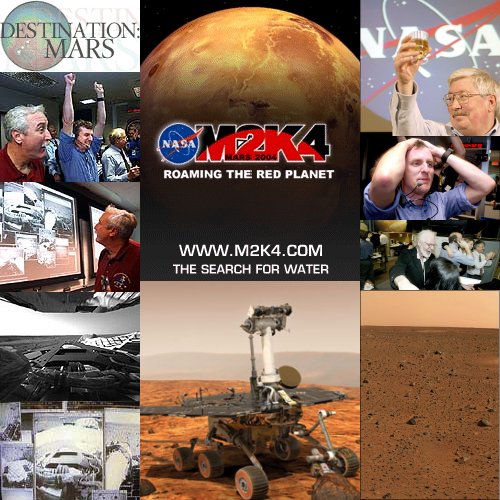
NASA scored a big win with its successful touch-down of the Mars "Spirit" Rover and that’s sure to mean a new emphasis for the aerospace business, to say nothing of NASA itself, after a season of tough going. After hitting the "sweet spot" of their dry-lakebed LZ, the first pictures back are really something, and when "Opportunity" lands in coming weeks, the buzz is sure to be complete.
The implications are broad ranging for the U.S. – and international – economy, as well; consider Boeing’s current interests in the International Space Station, as well as talk of new money to be spent sending people to Mars, as well as colonizing the Moon.
And, while the current rover is solar-powered – a distinct disadvantage for operating at night and a factor that will ultimately lead to the demise of the costly rover in short order – future rovers might be powered by a nuclear engine, a component Boeing is hoping to sell NASA in the very near future.
With that, here’s an excerpt from USAToday.com that briefs the story for us:
-
NASA said it hopes to release the initial batch of color photos today — the first from the surface of Mars in seven years. NASA began receiving its second batch of black-and-white pictures from its Spirit rover late Sunday.
Spirit's descent was textbook perfect Saturday night, with elated mission controllers recontacting the craft minutes after it bounced to a landing at 11:51 p.m. ET.
"We're back," said NASA administrator Sean O'Keefe. "I am very, very proud of this team, and we're on Mars."
Ten out of 13 earlier Mars landings from the United States and other countries ended in failure, so this was a significant victory for NASA, which has been under a cloud since the explosion of shuttle Columbia almost a year ago.
"It's an astonishing success. ... Virtually every single thing went right, including landing right-side up so that we could get photos and mosaic panoramas within the first few hours," said William Hartmann of the Planetary Science Institute in Tucson, author of A Traveler's Guide to Mars.
Mission controllers at NASA's Jet Propulsion Laboratory pronounced their craft in good health Sunday.
Spirit landed facing south on a smooth, cratered plain marked by whirlwinds of dust, in "fantastic" position to roll off its airbag-shrouded landing craft, JPL engineers said. The rover will begin rolling slowly over the crater floor next week, analyzing soils and rocks for the next three months.
The mission's principal investigator, Steven Squyres of Cornell University, said his team planned to check out almost every instrument aboard the rover before planet analysis begins. "We've got plenty to keep us busy between now and then," he said.
Scientist Jennifer Trosper said Spirit is encountering 20% less than expected of the solar energy needed to charge its batteries because of high levels of dust. Less energy may eventually force the team to prioritize Spirit's jobs, she said.
About the size of Connecticut, Gusev Crater, where Spirit landed, is several billion years old and notched by a channel that appears to have been carved by water. Spirit and its twin, Opportunity, which is set for a Jan. 24 landing at a different site, may answer questions about whether watery conditions were sufficient for life.
"NASA very much needed a success, and this is an extraordinary one," said space policy expert John Logsdon of George Washington University, a member of the panel that investigated the space shuttle crash. "Sean O'Keefe said NASA is back. And this has been a great moment. But there is still lots ahead for NASA in getting itself back into order," he added.
Meanwhile, British scientists report no contact with Beagle 2, which was supposed to have landed Christmas Day. The European Space Agency's Mars Express orbiter, Beagle's mothership, will be in position to start trying to contact the lost lander on Wednesday.
Meanwhile, the LA Times puts next steps (and the financials) in a bit clearer perspective:
-
Spirit will spend the next nine days checking out its internal systems, charging its batteries, and photographing the site before it finally rolls off its landing platform and begins its geological work.
Spirit is the most ambitious effort yet to roam the surface of another planet. It is part of a small fleet of spacecraft sent toward Mars in an effort to answer one of the most captivating questions in science: Has there been life on other planets?
Spirit and its twin, Opportunity, are the most sophisticated of the spacecraft, and hopes are high that they will provide a bounty of information.
The stakes were even higher because NASA's last two Mars missions, the Mars Climate Orbiter and the Mars Polar Lander, failed in 1999. A third mission planned for 2001 was canceled when outside reviewers concluded the agency was attempting too much with too few resources.
The two new missions, costing $820 million together, have consumed the energy of hundreds of scientists and engineers for the last four years and destroyed the recent holidays for mission controllers.
Reporters were camped out in JPL's newsroom waiting for the fateful moment of arrival and hundreds of thousands of people were watching on the Internet.
Earlier Saturday, the JPL campus exuded more excitement than anxiety as four years of intensive efforts were perched on the knife edge between success and disaster.
Small knots of employees joked and talked in the bright sunshine of the lab's central campus; even top mission managers seemed upbeat and relaxed.
That almost preternatural sense of calm was described by JPL Director Charles Elachi as essential to the mission's success.
"We are nervous," he said. "But when you feel you have done your best, you've done everything possible, then it's important to be calm — because there may be decisions and judgments to make."
All the years of preparation paid off.
A planned last-minute course correction proved unnecessary because the craft was already on a "bull's-eye" course for its targeted landing site in Gusev Crater.
"This is essentially perfect navigation," said JPL's navigation team chief, Louis D'Amario. "We couldn't possibly have hoped to do better than this."
But the team did have to make some last-minute adjustments in the landing program to take into account a dust storm on the opposite side of Mars.
Because dust absorbs more sunlight than the planet's surface, Mars' upper atmosphere was about 10% to 15% warmer and thinner than normal, said mission manager Mark Adler.
The lander's parachute was therefore reprogrammed to open 13 or 14 seconds earlier than originally planned to ensure that the craft didn't crash into the surface, he said.
JPL's scientists and engineers were confident that they had done everything they could to prepare for Spirit's landing - a harrowing maneuver that Theisinger described as the riskiest part of the mission.
Mission controllers call the entry "six minutes from hell" because the spacecraft's speed had to be reduced from 12,000 mph to effectively zero. The craft relied on a parachute and retrorockets to slow its descent before bouncing to a halt on its cocoon of air bags.
The whole process had to be handled autonomously by Spirit's on-board computer. Earthbound controllers could only sit back and watch. And worry.
"It was six minutes from hell, but in this case we said the right prayers and we got up to heaven," said Ed Weiler, NASA's associate administrator for space science.
Spirit's successful landing gives a boost to the spirits of planetary scientists, who have recently witnessed more failures than successes with Mars missions.
Last month, Japan conceded that its Nozomi orbiter had failed because of navigational and equipment problems. Its mission was aborted.
The fate of Britain's Beagle 2 lander, carried to Mars aboard the European Space Agency's Mars Express orbiter, is still in doubt.
Beagle 2 was scheduled to land in the Isidis Planitia basin late Christmas Eve Pacific time, but controllers have not been able to make contact with the craft and many fear it is lost.
Mars Express did go into orbit, however, and controllers have been altering its path so that it can attempt to make contact with Beagle. They are scheduled to begin those efforts today.
NASA's two rovers, Spirit and Opportunity, were launched last year to take advantage of Mars' closest approach to Earth in 60,000 years, a celestial alignment that brought it within 35 million miles of Earth.
The armada marks the beginning of humanity's strongest effort yet to determine whether life has ever existed on Mars.
Whether there’s life on Mars – or in Boeing’s stock – or not, at the very least check out the slide show from the New York Times – it’s cool! More is promised in the weeks ahead as NASA’s "search for water" (to say nothing of the search for good PR) intensifies. Hey, at least they came up with a hip project name - and Web site - in "M2K4".
- Arik
 "Competitive Intelligence applies the principles of competition and lessons of intelligence to the need for enterprise awareness and predictability of market risk and opportunity. CI has the power to transform an enterprise from also-ran into real winners with agility enough to create and maintain sustainable competitive advantage."
