January 03, 2004
Bankruptcy & Debt: New Year's Resolutions & the Christmas Spending Hangover Worse Than Ever
 "It's the week after Christmas and there's worry about... the savings are empty and credit's maxed out."
Don’t blame me, I borrowed that…
But, speaking of borrowing, financial anxiety isn't supposed to be part of the holiday tradition. Neal Conan and his guests talked recently about why bankruptcy and foreclosures are on the rise and the outlook for some is worse than usual. Part of the explanation is that credit card marketshare is a lot tighter these days – about 75 percent of consumer debt is held by just five banks; 20 years ago, it would’ve taken 25 banks to support that amount of debt. So, listen in online – it’s a good discussion.
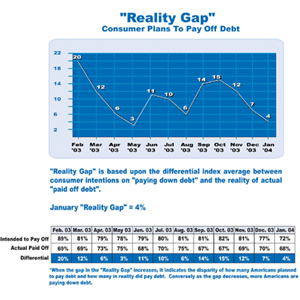
Meanwhile, I did a little research and found some details from Cambridge Consumer Credit Index about the goal of getting out of debt having taken top priority among New Year’s Resolutions.
-
More than one quarter (28%) of all Americans say getting out of debt is their top New Year's resolution, closely followed (27%) by the perennial favorite of losing weight and exercising more, according to the Cambridge Consumer Credit Index. In January 2003, losing weight and getting out of debt were tied at 29%. In January 2002, losing weight was the top resolution of 30% of Americans versus 28% whose first priority was reducing debt.
This year, 15% want to get a more secure or better job, up by 4 percentage points from 2003. 13% want to improve their personal relationships, up by two points from 2003. Only 7% plan to reduce drinking and smoking, down by 4 percentage points from last year.
"This is the first time in the history of the Cambridge Consumer Credit Index that more Americans say that reducing debt is a higher priority than losing weight or exercising more. These results provide ample testimony to the increasingly heavy burden that debt is perceived to be by American consumers who continued to take on billions of dollars in additional credit in 2003. The large increase in a desire for more secure employment also shows that, despite many signs of economic growth, many Americans still do not feel secure in their jobs," says Jordan Goodman, spokesperson/financial analyst for the Cambridge Consumer Credit Index.
According to Chris Viale, Chief Operating Officer, Cambridge Credit Counseling Corporation, "At the beginning of each new year we see an increase in calls from consumers seeking help in eliminating debt. It is reassuring to know that many people don't just resolve to improve their financial lives, but take the necessary steps to make it happen. At Cambridge Credit, we urge consumers to make debt reduction a top priority and include all of their debt obligations in the budget forecasts that they may be developing for 2004."
These findings are the result of monthly nationwide telephone poll of 1000+ adults conducted by ICR/International Communications Research in the past week, sponsored by the Debt Relief Clearinghouse.
The overall Cambridge Consumer Credit Index dropped by six points from December to 59. The Index rose in one of the three composite questions. The "Reality Gap," which is the difference between the amount of debt consumers say they will pay off in the next month versus the amount of debt they actually paid off a month later, narrowed to 4 percentage points from 7 points in December. That is just one point higher than the all-time low of 3 points reached in May 2003. A month ago, 72% of Americans planned to pay off debt, while a month later 68% actually did so.
The Cambridge Consumer Credit Index is a forward looking economic indicator gauging consumer spending and debt. It is released on the fifth business day of every month to coincide with the Federal Reserve Board's G19 release of consumer credit outstanding data.
In conjunction with the Index, the Cambridge Credit Counseling Corp. is releasing its monthly survey of people who have called in for credit counseling services over the past month. Cambridge representatives ask callers for the primary reason that they found it necessary to get help with their debts now. Of the 570 people who answered, this was the order of their responses:
1. I am frustrated with high bank rates and fees (33.3%)
2. My income has been reduced from a lower salary, less overtime or layoff (23.3%)
3. I want to improve my ability to achieve future financial goals like buying a house or saving for retirement (11.8%)
4. Other reasons (8.2%)
5. My lack of financial education caused me to take on too much debt (8.2%)
6. I got into too much debt by overspending (6.8%)
7. Large medical expenses forced me to take on huge debts (5.8%)
8. My recent divorce or widowhood forced me to take on large debts (2.5%)
The Cambridge Consumer Credit Index number is a composite of these three questions:
1. In the past month, have you taken on more debt or paid off debt?
The Index reads 64 on this question, an increase of four points from December.
In January, 32% of Americans say they have taken on more debt, with 21% taking on a little and 12% taking on a lot more debt. Conversely, 68% of Americans have paid off debt, with 51% paying off a little and 17% paying off a lot.
2. In the next month, do you anticipate taking on more debt or paying off debt?
The Index reads 42 on this question, a drop of fourteen points from December. In January, 21% plan to take on more debt, with 5% planning to take on a lot and 16% planning to take on a little debt. Conversely, 79% plan to pay off debt, with 59% paying off a little and 19% paying off a lot. In December 28% planned to take on debt and 72% planned to pay off debt.
3. In the next six months, do you expect to take on debt because you are thinking of making a major purchase such as a car, education, appliance, medical procedure, furniture or carpeting?
The Index reads 72 on this question, a drop of six points from December. In January, 36% of Americans plan to take on more debt to make such purchases, with 10% taking on a lot of debt and 26% taking on a little more debt. In contrast, 64% of Americans plan to pay off debt in the next six months, with 43% expecting to pay off a little and 21% expecting to pay off a lot. In December 39% of Americans planned to take on more debt, while 61% planned to pay off debt.
"The results of the Cambridge Consumer Credit Index survey indicate that consumers are planning to cut back on their use of credit, as is to be expected after the holiday spending spree. But it is interesting to note that the cutback in planned use of credit in the next month is far less severe than a year ago when the economy was much weaker and uncertainty over the potential war with Iraq was still high. In January 2003, the Index reported a "Next month" level of 22,compared to 42 this year, showing that consumers are much more confident now in their willingness to take on more debt," says Jordan Goodman, spokesperson for the Index.
The Index survey is conducted by ICR (International Communications Research) of Media, Pennsylvania in the week prior to the release of the index. Over 1000 households are polled based on random-digit dialing, with all demographic and regional groups in America fairly represented. The Index has a margin of error of plus or minus three percentage points.
Speaking as someone who financed his business on his credit cards, pay ‘em off as fast as you can – and, though it’s troubling to see so much home equity being liquidated to catch up on structural household deficits like this, those interest rates won’t be low forever… I only hope the U.S. economy hasn’t been too artificially supported by debt-financed consumer-spending. If the economy recovers in 2004 as I suspect it will – and everybody sticks to these resolutions – we’ll hopefully be alright.
- Arik
January 02, 2004
MTV vs. Fuse: Music TV Competitors Spar Over Video Exclusivity

Here’s a story I’ve been watching for a few months now, ever since Fuse launched last May as the first serious challenger to MTV. One reason I like Fuse is their creative advertising, but the real appeal is that they play actual videos at a time when MTV is increasingly filled with cheap reality-TV content.
As for their promo strategy, Fuse as a startup music-television competitor to Viacom's MTV needed to build viewership on a small budget, so it tried a "Save a music video campaign" highlighted with Sally Struthers parodying her well-known "Save the Children" campaign. Pasted to a Viacom-owned billboard opposite MTV's headquarters, the billboard got big free-media attention-span for its bold challenge to MTV.
Meanwhile, MTV has recognized the threat and has started fighting back. I noticed this article from Rolling Stone about the turf war going on between the competitors:
-
When the upstart music channel Fuse officially launched last spring, MTV general manager David Cohn told Rolling Stone the new competitor didn't scare him. "That 'Where are the music videos on MTV?' thing?" Cohn said. "I'm not sure anybody's that fussed about it." But in late December, industry sources were complaining that MTV had started turning up the heat on its competition, enforcing exclusivity contracts that keep some artists' videos off Fuse.
"We pay millions of dollars to the labels to support the production of videos," says MTV spokeswoman Jeannie Kedas. "We take a handful of exclusives a year, and it gives major exposure to the artist." MTV reaches 87 million households; Fuse reaches 34 million. Though Fuse is the smaller fish, one prominent manager points out that artists value the channel's commitment to playing videos: "It's more like MTV used to be. It's cooler and more irreverent."
MTV exclusives are nothing new. But before Fuse, the twenty-two-year-old video network had no real competition. Label and management insiders say that, in recent months, MTV has become pushier about its demands. "They're using our bands to get in a war among themselves," says one label source. Bands such as P.O.D. and Puddle of Mudd got around the rules by filming live performances at Fuse's studios.
MTV's Kedas says the network rarely asks for exclusive rights on a video. "We're not exercising those rights any more aggressively because of Fuse," she says. Kedas argues that since Fuse doesn't pay the labels the millions of dollars in licensing fees that MTV does, it's only fair that MTV should occasionally demand a blockbuster video for its exclusive use. In the past year, Kedas says, MTV has taken fewer than a dozen exclusives, including Radiohead's "There There," Beyonce's "Crazy in Love," Blink-182's "Feeling This," Limp Bizkit's "Eat You Alive" and Linkin Park's "Numb."
Fuse president Marc Juris downplays the turf war with MTV, saying there are plenty of videos to go around: "It's not about owning content - it's about owning a voice which makes that content take on greater meaning to our audience. Competition is everywhere. But if I was to think it's only MTV I have to worry about, I'd be thinking pretty narrowly."
The New York Post had an interesting article on the subject too:
-
MTV is taking notice of upstart rival music channel Fuse.
Fuse, a 24-hour music video channel owned by Cablevision's Rainbow Media, has slowly been garnering buzz within the music industry this year for doing what critics say MTV has strayed from: airing a constant flow of music videos.
"It's a refreshing change of pace that you have this new channel that will offer a healthy dose of competition to the world of music videos," said one music industry executive.
But while Fuse is still an ant compared with its giant rival, MTV has lately been playing a behind-the-scenes game of hardball - using its clout to steer artists away from Fuse, according to music industry sources.
For one thing, MTV has long had deals with music labels that allow the network to pay a fee to lock up exclusivity on videos to keep them off the airwaves on other networks. MTV, sources say, has lately been exercising its exclusivity rights more often.
For example, MTV has locked up exclusivity on many popular videos recently - including ones by Linkin Park, Puddle of Mudd, P.O.D. and Beyoncé, sources say. While record labels collect a fee for this, music industry execs say that not being able to air the videos simultaneously on Fuse hurts the labels' ability to market their artists.
A spokesperson for MTV said the network decides on exclusivity "based on audience tastes and wants, not based on what another network may or may not be doing."
Marc Juris, president of Fuse, told The Post, "I'm from the Bronx, and this feels like a good old-fashioned turf war. We feel like 50 Cent - been shot nine times but we're still singing."
But the battle extends beyond videos. Just last week, Linkin Park, a band signed to Warner Bros. Records, bowed out of a deal with Fuse that would have had the network sponsor its upcoming tour after MTV intervened, according to music industry sources.
Sources close to the situation say that Linkin Park first offered the sponsorship to MTV, but the network declined. The band then began negotiating with Fuse, and a deal was close at hand before MTV stepped in and made it known that such a sponsorship with Fuse would hurt the band's relationship with MTV, according to sources.
An MTV spokesperson denied this, saying, "We did not ask any band or artist to decline tour sponsorships."
MTV has also reacted negatively toward artists who have appeared on Fuse shows to promote new albums before they appeared on MTV, sources say.
For example, MTV was outraged last month when Blink-182 went on Fuse first, sources say.
Fuse, formerly called "muchmusic usa", was relaunched under the new name in May.
It is on the air in 34 million homes in the country, and has deals with DirecTV, EchoStar and most major cable operators except Comcast, the nation's largest. It is currently in negotiations with Comcast about a carriage agreement.
MTV is owned by media giant Viacom, which also owns music channel VH1 and Black Entertainment Television, which also airs music videos.
And, finally, the Miami Herald had a somewhat deeper LA Times feed posted on the subject as well:
-
MTV built itself into an entertainment powerhouse by keeping an ear tuned to pop-music trends. The channel probably doesn't like what it's hearing now: the footsteps of a competitor.
Since its debut seven months ago, Fuse has been steadily picking up music video viewers. Viacom, which owns MTV, is playing hardball in response, industry sources say, exercising a provision in contracts with record labels that requires them to provide music videos for Viacom's exclusive use.
Executives at the five major record conglomerates won't talk publicly about the move. Privately, they're griping about what they say is MTV's bid to strong-arm them in order to keep its near-monopoly status in the music TV business.
The labels agreed to the exclusivity provisions in contracts signed years ago. But executives say those deals were signed back when MTV had little serious competition.
MTV has claimed exclusive rights to some eagerly awaited clips, including Radiohead's "There There," Beyoncé Knowles' "Crazy in Love," Limp Bizkit's "Eat You Alive," Puddle of Mudd's "Away From Me," Blink-182's "Feeling This," and Linkin Park's "Numb."
Under the labels' contracts, the Viacom network can air a video exclusively for as long as six months, sources say.
MTV's position as the dominant force in music television has never before been seriously challenged. In 1994, major record companies launched plans to start their own 24-hour music channel but scrapped the idea in the face of a Justice Department antitrust inquiry.
Right now, Fuse's reach is limited. It is available through cable and satellite systems in about 34 million households, while MTV2 is in 50 million and MTV is in more than 86 million.
But Fuse has been winning points among music executives and media analysts.
"Fuse has been very successful in establishing a relevant brand in a very short period of time," said Jack Myers, a media analyst and publisher of the Jack Myers Report. "MTV is in a position of being forced to pay attention."
The upstart channel is emerging as an MTV rival at a time when the music industry is suffering from a three-year slide in CD sales.
"Given the current crisis in the music industry, it's a shame that anyone would seek to prevent the work of today's artists from getting to as many people as possible," said Marc Juris, president of Fuse Networks, which is owned by Cablevision Systems Corp.
Relations between MTV and the labels recently have been tense. Music executives say they are tired of footing bills that seem to benefit MTV as the companies' fortunes decline.
For instance, a label pays to produce a music video and to cover a wide array of other expenses, including the costs of an artist's travel to MTV events, stage sets at the events and other fees whenever the artist appears on the channel. MTV pays the label's licensing fees, about $5 million a year for the bigger companies, but music executives say that doesn't come close to covering their expenses.
For MTV, the arrangement has been rewarding: By keeping its programming costs low, it has generated some of the biggest profit margins in the media world - an estimated 56 percent this year on sales of $929 million, according to Kagan World Media.
Lately, some labels have refused to pay the costs of some high-profile acts' appearances; labels also have been offsetting their costs by cutting product placement deals with companies such as General Motors Corp. and Verizon Communications Inc. without MTV's approval.
Whether there will be changes in the channel's deals with the labels is unclear. Viacom's MTV division has a contract with every major record conglomerate that guarantees the channel exclusive permission to air for a certain period of time a percentage of the music videos a company produces each year. MTV can claim exclusive rights to as much as 20 percent of a label's videos in some instances, sources said. In return, they said, MTV offers the record company free advertising spots.
MTV executives declined to discuss details of the channel's contracts. A spokeswoman said MTV decides when to claim exclusive rights to a video based on an assessment of audience taste, "not what any other network may or may not be doing." For popular acts, she said, "it only makes sense for us to want to brand with the artist."
Cablevision started Fuse in May, revamping a lackluster channel called MuchMusic USA that Cablevision had owned since 2000.
"Whether anybody wants to admit it or not, the Fuse is becoming a player," said one artist representative who spoke on condition of anonymity. MTV "is seeing a spark, and they want to keep them from playing."
Parent Viacom is supposedly insisting on enforcing the little known provision, which requires major labels to give MTV exclusive access to music videos. While executives at the five major recording companies are being pretty tight-lipped about it, privately they're admitting that they did sign the contracts, back when MTV had no serious competition.
The music industry has been beaten-up by the three-year slump in CD sales and Mark Juris, president of Fuse Networks, said: "Given the current crisis... it's a shame anyone would seek to prevent the work of today's artists from getting to as many people as possible."
Branding Fuse as something more than anti-MTV didn't mean just shooting arrows over the wall of the leading brand. It led the channel to create a TV identity to beat MTV’s already clichéd rebellion in favor of some really way-out imagery. New York's TeamHeavy, the channel's creative department, decided to skip over the traditional logo-oriented branding strategy. Fuse’s logo changes design from one promo spot to the next and takes on pretty interesting forms, with "the four letter word they don't want you to hear" appearing in a broad array of formats.
Contrasting MTV’s traditional logo, the "Shave the Children" spot graphic above combines electric razors shaving the Fuse name into the chest-hair of an ape-man drawn as a B&W textbook-style illustration. But without having watched Fuse, it's impossible to say whether or not it delivers on its music vid promises, so check it out.
- Arik
January 01, 2004
Fortune 100 Best Companies to Work For
Happy New Year!
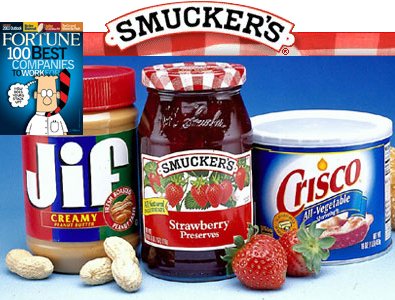
As we kick off another new year, I call today on Fortune to give us their annual list of the "100 Best Companies to Work for" – and topping the list is J.M. Smucker:
-
Jam and jelly maker J.M. Smucker & Co. made the top spot in Fortune magazine's 2004 ranking of "Best Companies to Work For," an annual list released Monday. It's the first time a manufacturer has made No. 1 on the top 100 list. Last year, Smucker ranked No. 8.
Run by two brothers, the Orrville, Ohio-based company is a "throwback to a simpler time," according to Fortune. Employees said the company treats them like family, with a corporate culture based on objectives including: "Listen with your full attention, look for the good in others, have a sense of humor, and say thank you for a job well done."
Legal services firm Alston & Bird took the second spot, inching up from No. 3 last year. Among the benefits its employees said they appreciated were maternity leave of up to three months at full salary for mothers - and fathers if they're primary caregivers. Alston & Bird also provides an on-site child-care center that costs an average of $500 a month.
Rounding out the top 5 "Best Compaies" were, in order, home decor retailer Container Store, financial services firm Edward Jones, and commercial bank Republic Bancorp.
Republic managed to climb to No. 5 from last year's No. 17 spot, after awarding 300 employees trips to Aruba, Cancun, or the Dominican Republic last year. Edward Jones, falling to No. 4 from last year's top spot, added 1,500 employees in the past year and hasn't had a single layoff in 34 years, according to the report.
To arrive at its list of best companies to work for, Fortune randomly selected 46,526 employees from 304 candidate companies to fill out a survey created by the Great Place to Work Institute. Each candidate company also filled out a questionnaire detailing its people policies, practices, and philosophies. The employee portion accounted for two-thirds of the total score, according to Fortune's report.
Software maker Adobe, engineering and construction company TDIndustries, software maker SAS Institute, family-owned supermarket Wegmans Food Markets, and chipmaker Xilinx made the bottom half of the top 10 companies, in that order.
Check out the full list at Fortune.com, then go get a job at one.
- Arik
December 31, 2003
Forbes 400 Best Managed Big Companies 2004

Since it’s New Year’s Eve and all, I decided to mooch off Forbes and supply the supreme list of companies to be admired – Best Buy tops the list this year and duly-so. Check ‘em all out for yourself.
Here’s hoping everyone had as blessed a 2003 as I did and I wish you a very Happy and Prosperous New Year in 2004.
- Arik
December 30, 2003
FedEx Acquiring Kinko’s to Compete with UPS and Mail Boxes Etc Stores
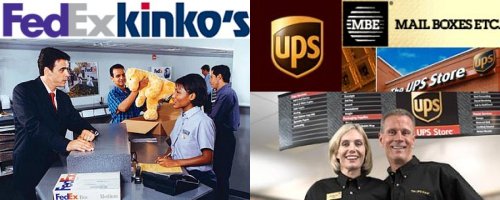
Just when you thought the holiday madness was over, FedEx announced today it’s paying $2.4 billion in cash to buy privately held business services provider Kinko's in a deal set to close in the first quarter of 2004. Of course, they’re a little late the party after the 2001 acquisition by top competitor UPS of Mail Boxes Etc. franchise operations, successfully rebranded as UPS Stores just this past April. But, it’s a step in the right direction, if FedEx hopes to keep a part of the retail interface to foot-traffic looking to ship from a local storefront. In the Motley Fool excerpt below, some of the logic (and competitive desperation) of the deal gets explained:
-
Soon, FedEx will offer its shipping options in 1,200 Kinko's stores (it currently has outlets in 134 Kinko's stores through a pre-existing agreement). The acquisition will help FedEx grab shipping business from the small- and medium-sized business market as well as from consumers who have fulfilled their other document needs in the stores.
Kinko's has been branching out from its humble beginnings as a copy center. It's no longer just about producing brochures, manuals, and business cards. Now, it offers its business customers some pretty fancy solutions in many of its locations, including Wi-Fi Internet hot spots and videoconferencing. For 2003, Kinko's expects to report $2 billion in revenues (though the acquisition won't add to FedEx's earnings until fiscal 2005).
With the high price tag comes the expanded retail presence and high-profile name brand that seems sure to usher in some built-in customers for FedEx. Over the last several years, the delivery company has suffered from a sluggish shipping business as the economy took a nosedive, and from heated competition from rival UPS and even the U.S. Postal Service.
Earlier this month, Fool LouAnn Lofton reported on FedEx's lackluster second quarter. A higher-than-expected number of employees jumped at the chance to take FedEx up on its early retirement package, resulting in a charge.
While the Kinko's acquisition might be a good idea, it's not original. In 2001, UPS bought Mail Boxes Etc. for about $185 million, a franchise that currently has 4,000 locations. With the possibility that UPS is indeed winning the market-share battle, one might wonder what took FedEx so long to tap into this market. However, by capitalizing on Kinko's well-known brand and non-franchise stores, the deal could deliver some excitement to FedEx shareholders.
What took so long indeed?! And why wait until after Christmas? Time to absorb and assimilate, I imagine. I looked back at what UPS had to say about the MBE deal, following April’s successful rebranding:
-
"The UPS Store is a significant step in UPS's strategy to strengthen its brand presence and expand access to our services for small businesses and individual consumers throughout the U.S.," said Rocky Romanella, vice president of UPS retail services. "The UPS Store extends competitive UPS pricing along with the outstanding customer service that has become synonymous with MBE franchisees over the past 20 years."
"This is an unrivaled combination of convenience, reliability and price," added Mathis. "We feel The UPS Store will transform the retail shipping industry."
"The franchising sector has never seen re-branding on this scale," said Don DeBolt, president of the International Franchise Association. "To see one of the world's largest companies working alongside a leading franchiser is historic on its own."
There are no plans to change the trade name of MBE's international locations. Currently, MBE has more than 1,000 units outside the U.S.
The UPS Store and Mail Boxes Etc. together comprise the world's largest franchise network of retail shipping, postal and business service centers, with more than 4,000 locations around the world. Mail Boxes Etc., Inc., a UPS company, franchises The UPS Store and MBE retail locations. In the United States, The UPS Store and MBE locations are independently owned and operated by licensed franchisees of Mail Boxes Etc., Inc. Outside the United States, locations are owned and operated by MBE master licensees or their franchisees.
So, what the UPS deal a better bet than FedEx’ Kinko’s move? It was certainly cheaper, even if they don’t have the asset base, due to the franchising model. This should be interesting to see who grows revenue more quickly… and retail outlets!
- Arik
December 29, 2003
Toilet Paper Wars: Charmin vs. Quilted Northern vs. Cottonelle
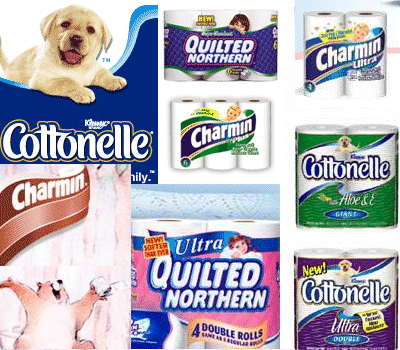
Going "head-to-head" (get it?) in the bathroom tissue business, we’ve got P&G versus Kimberly-Clark versus Georgia-Pacific in a new promotional war of international proportions, with P&G’s Charmin taking it up a notch. This isn’t Mr. Whipple’s TP business, as the New York Times excerpt that follows describes:
-
In the $4.7 billion business that is bathroom tissue, there is not a whole lot that separates one toilet paper from another. Since toilet paper is a commodity we all must buy - and do so, often without much brand loyalty - companies go to unusual lengths to get their messages across.
Procter & Gamble, to promote its Charmin brand, has begun showing up at state fairs to encourage people to use special "Charminized" rest rooms, which are not only clean but stocked with P.& G. products. Outside the restrooms, the Charmin bear dances and mugs to entertain the crowd.
And there's Georgia-Pacific, which this month weaved its Quilted Northern bathroom tissue into the regular programming of "The View," the morning gab fest on ABC.
Next up, on Jan. 5, Georgia-Pacific will introduce a $10 million campaign, created by DDB Worldwide in New York for Angel Soft tissue, including commercials introducing David and Larry, "bathroom angels" who perform such good deeds as restocking depleted toilet paper rolls. The company is the largest bathroom tissue marketer in the country, with a 38.9 percent volume share, according to Nielsen data provided by Georgia-Pacific.
But Quilted Northern - the company's biggest brand, with about a 21.5 percent share of the total market - still trails the category leader, Charmin, by about three percentage points. Cottonelle from Kimberly-Clark has about a 12.7 percent share.
The commonplace nature of toilet paper results in widespread discounting and promotional activity among manufacturers and retailers. That tends to erode brand image in a category where the last really notable advertising icon was Charmin's Mr. Whipple, who last appeared regularly in the 1980's.
"It's one of those categories where retailers will football on price, so it's been very difficult for true product benefits - making a better toilet paper - to translate into higher prices," said Paul Crnkovich, partner at Cannondale Associates, of Evanston, Ill. "The ultimate definition of brand equity is how much more you'll spend for Product A than Product B."
After P.& G. retired Mr. Whipple, the company spent years searching for an effective strategy that would differentiate Charmin. The company even brought Mr. Whipple out of retirement in 1999, but that did not last.
Several years ago, P.& G.'s longtime agency, D'Arcy Masius Benton & Bowles, turned to an animated bear to restore some pride to the Charmin franchise. (P.& G. last year moved the Charmin account to Publicis Worldwide, part of the Publicis Groupe.) The Charmin bear originally appeared in broadcast spots but has more recently been seen at state fairs and festivals, alongside the Potty Palooza, a 32-foot truck with 12 fully outfitted rest rooms, featuring hardwood floors, sinks, floral scents - and Charmin tissue, of course. P.& G. provides the truck as an alternative to portable latrines. While people line up to use the Potty Palooza, the Charmin bear dances and entertains the crowd.
In this case, the bear is extending the message of Charmin's broadcast commercials, in which he does the "Cha-cha-cha Charmin" dance.
"It gets people interested in the bath tissue category," a P.& G. spokeswoman, Celeste Kuta, said. "It's usually a low-involvement category." The bear, she added, "does it in a way you couldn't do with real people."
If Charmin's message remains playful, Quilted Northern opts for a somewhat more earnest approach, with the slogan, "It's Quilted Because We Care." A spot currently in rotation features a cartoon character named Wanda who doesn't care about quilting and, indeed, blows her nose into the quilt stitched together by the other characters, horrifying everyone. In the end, though, Wanda was just a nightmare conjured up by one of the quilters. DDB Worldwide, a New York agency that is part of the Omnicom Group, has the Quilted Northern account.
Kimberly-Clark's Cottonelle brand also stakes out a claim to caring in its marketing, via the slogan, "Looking Out for the Family." The company uses a Labrador retriever puppy to convey that small dogs, like families, need to be treated gently, a company spokesman said. J. Walter Thompson in New York, part of the WPP Group, has the Cottonelle account.
What can I say? Since I’m the grocery buyer in our house, I tend to get whatever’s cheaper and I don’t clip coupons, but that puppy is a lot cuter than the bear in my opinion… or Mr. Whipple.
- Arik
December 28, 2003
Green Bay Packers Keeping Playoff Hopes Alive
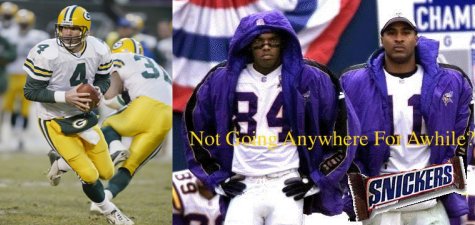
In what proved to be a pretty unlikely, but very exciting turn of events (assuming you’re a Packer fan… but then, who isn’t?), the Packers made the playoffs to represent for the NFC North! After a week in which quarterback Brett Favre’s father passed away, people are talking about their less-important win over the Broncos, while the Vikings lost a heartbreaker in Arizona, as if it’s Super Bowl destiny… but then, a lot of other teams will stand in Green Bay’s path on the way to Houston.
I found the perfect recap of the playoff weekend from none-other-than Boomer Esiason, posted on the Packers’ Web site, reminding us all that, not only did the Packers need to win, the Vikings needed to lose:
-
Watching the Vikings lose to the Cardinals Sunday wore me out - and I didn't even play. What a wild day for the NFL. Wasn't it Mike Holmgren who asked for divine intervention after his Seahawks beat the 49ers a day earlier? Well, guess what? The unexpected actually did happen. The Seahawks have Saints to thank; the Packers can thank the Cardinals.
There were smiles and cheers in Green Bay, while tears were shed in Minnesota. This season-ending loss to the Cardinals will be hard to forget for the Vikings' faithful and will be forever remembered in the annals of team history. If you watched the Vikings-Cardinals game from start to finish, you probably could never have predicted the outcome.
With a series of events that started to unfold last Monday night in Oakland, events too unbelievable to explain, it is now the Green Bay Packers who represent the NFC North in the playoffs. As the Packers were crushing the Broncos in Green Bay on the final day of the regular season, the lowly Cardinals were inflicting a final mighty blow to the Vikings in Arizona. What a way for Dave McGinnis to go out. With his career in Arizona finished, McGinnis is able to savor a memorable final victory over a heavy favorite that needed a win to make the playoffs.
What in the world was going on Sunday? It's hard to explain. My initial thought was that there's definitely a guardian angel flying over the Green Bay Packers and their quarterback, Brett Favre.
How else can we explain what happened in Arizona? These things just don't happen - a fourth-down, game-winning 24-yard touchdown pass on the game's final play by the Arizona Cardinals? Are you kidding me? Quickly, answer this: Who threw the pass and caught it? Answer: Josh McCown to Nate Poole. Now see if you remember that next year at this time.
As Vikings players fell to the ground in complete disbelief in Arizona, pandemonium erupted at Lambeau Field. News of the Cardinals' game-winning touchdown spread like wildfire through the stadium as Packers fans gripped their portable radios and watched the luxury box televisions to confirm what they had just heard. Packers players got the sense that something must have happened in Arizona, as they could not understand why their fans were cheering so loudly for the two-minute warning. Let the postseason party begin in Green Bay.
Uh-oh! Wait a minute! The final play is under review in Arizona. They're waiting in Green Bay for final word from Arizona ... and finally, the ruling stands: touchdown. I wonder how many people thought of Irvin Favre, Brett's father, at that moment. I know I did.
It has been an awfully tough week for Favre, except for maybe the football game Monday night against Oakland and the scrimmage against Denver on Sunday - at least that is how the Denver Broncos viewed the game against the Packers. It was what took place between these two games that tested Favre.
And, in fitting post-win gloating, a friend sent me the following poem:
The Last Week of Football
‘Twas the last week of football, and all through the game,
The Packers were winning, the Broncos were lame.
The Vikings were playing the Cards without care,
In hopes that the post-season soon would be there.
The NFC North they had all but wrapped up,
An eleven point lead should have been quite enough.
I still watched the Packers, but to my dismay,
What a shame that another game they would not play.
At the two-minute warning there arose such a chatter,
I quickly switched channels to see what was the matter.
From CBS to Fox, I used the remote,
And saw that game end on this wonderful note:
The Cards had just scored with two minutes to go,
It seemed that the lead, the Vikings might blow.
Then what to my wondering eyes might appear,
But a recovered on-side kick, one more thing to cheer.
The seconds ticked by as I started to wheeze,
The Vikings’ defense looked a lot like Swiss cheese.
And then on the very last play of the game,
Came a miracle touchdown, Lambeau Field was on flame!
You see, our own fans had now heard of that score,
As the shock did wear off, they started to roar.
It began to sink in as to what this did mean,
The Vikings had lost, eighteen – seventeen.
The coach who had blown a six-and-oh start,
Was whining and wailing and eating his chart.
When it became clear that he’d brought on more shame,
His thoughts turned to whom could he possibly blame?
Was it Culpepper, Kleinsasser, Hovan, or Moss?
Or was it McCombs, the team’s arrogant boss?
He looked at his list, and was checking it twice,
But the obvious choice was himself, Mike Tice.
So the Packers did clinch the NFC North,
And into the playoffs they would venture forth.
And Packer fans cheer with this holiday cry,
Happy Christmas to all, but to the Vikings Good-Bye!
Bravo! Now, they have to beat the Seahawks under their old (Super Bowl winning) coach Mike Holmgren… At least it’s at home in Title Town.
- Arik
 "Competitive Intelligence applies the principles of competition and lessons of intelligence to the need for enterprise awareness and predictability of market risk and opportunity. CI has the power to transform an enterprise from also-ran into real winners with agility enough to create and maintain sustainable competitive advantage."
