December 20, 2003
RIAA Dealt a Blow in Verizon Decision
 The Recording Industry Association of America was dealt a major setback in the U.S. Court of Appeals for the D.C. Circuit this week, curbing its ability to sue file-sharers who trade pirated songs.
The court decided that the industry could not force Internet service providers to turn over names of subscribers who trade music because the current law, written in 1998, only allows the industry to request information about subscribers who keep copyrighted material on their ISP's servers, something present-day peer-to-peer file-sharing programs do not do. "It is not the province of the courts ... to rewrite the [law] in order to make it fit a new and unforeseen Internet architecture, no matter how damaging that development has been to the music industry," the author of the majority opinion wrote. The music industry will now have to go through the more cumbersome process of actually initiating lawsuits against anonymous users before the courts can force their identities to be revealed.
Here’s an excerpt from the New York Times:
-
The sharply worded ruling, which underscored the role of judges in protecting privacy and civil rights, is a major setback to the record companies in their efforts to stamp out the sharing of copyrighted songs through the Internet. It overturns a decision in a federal district court that allowed the music industry to force the disclosure of individuals simply by submitting subpoenas to a court clerk without winning a judge's approval.
Until yesterday's ruling, the industry could seek information on file traders without filing a lawsuit or even appearing before a judge, a streamlined procedure that opponents of the industry said did not protect Internet users' rights.
"It's a huge victory for all Internet users," said Sarah Deutsch, vice president and associate general counsel for Verizon Communications, which brought the suit against the Recording Industry Association of America to protect the identities of its Internet customers. "The court today has knocked down a very dangerous procedure that threatens Americans' traditional legal guarantees and violates their constitutional rights."
The appeals court did not directly raise those constitutional issues in its decision. The judges said they were "not unsympathetic" to the industry's troubles in limiting music piracy "or to the need for legal tools to protect those rights." But in a decision that focused narrowly on the nuts and bolts of copyright law, they said that the music industry had gone too far.
Cary Sherman, the president of the recording association, said that the case "is inconsistent with both the views of Congress and the findings of the district court." Mr. Sherman said that his organization would continue to sue those who violate copyrights. It "doesn't change the law, or our right to sue," he said. "It just changes the way we get the information."
The decision is online and is pretty interesting reading. Verizon deserves a few words of thanks from the general public, in my opinion, not because songs will go unprotected, but because Verizon saw how slippery a slope the RIAA’s policy could really be.
- Arik
December 19, 2003
RealNetworks Sues Microsoft for Unfair Competition
RealNetworks said yesterday it’s suing longtime rival Microsoft, accusing the software titan of unfairly promoting its own software for playing audio and video on computers and over the Internet.
-
In an antitrust complaint filed in federal court in San Jose, California, RealNetworks claimed that Microsoft "pursued a broad course of predatory conduct over a period of years by abusing its monopoly power, resulting in substantial lost revenue and business for RealNetworks." RealNetworks is seeking more than one billion dollars in damages and unspecified injunctive relief measures. "We believe that we have a very strong case against Microsoft," RealNetworks Chief Executive Rob Glaser told reporters on a conference call.
Microsoft rejected RealNetworks claims, saying that there was "vibrant competition" in the digital media player marketplace and that it would respond forcefully to RealNetworks' allegations in court. "Real(Networks) claims to be the No. 1 provider of digital media solutions, with massive distribution of its software and more than 1 million player downloads a week," said Microsoft spokesman Jim Desler, "Thus, this is a case where a leading firm is seeking to use the antitrust laws to protect and increase its marketplace share and to limit the competition it must face."
Seattle-based RealNetworks said that its lawsuit was complementary to an ongoing European Commission investigation into Microsoft's activity involving media-playing software and that it was cooperating with the EC. European Union regulators are wrapping up a five-year probe to determine whether Redmond, Washington-based Microsoft used its monopoly position to boost its share of the media player market. RealNetworks has testified in recent EC hearings.
The two companies, based in the Seattle area, have met frequently in courtrooms over the last five years. Glaser, a former Microsoft executive, founded RealNetworks nearly a decade ago to sell software that allows users to listen to audio and video content on their personal computers.
The two companies were once on good terms, with Microsoft making a $30 million investment in RealNetworks in 1997, but the relationship turned sour after Glaser testified against Microsoft in the U.S. government's antitrust case.
In Thursday's filing, RealNetworks said Microsoft used its monopoly power, which was recognized by the U.S. courts, to force "every Windows user to take Microsoft's media player, whether they want it or not."
RealNetworks, which has been branching out into online content subscription services, sells its media player as a downloadable software product or with a monthly subscription.
RealNetworks said its its complaint that Microsoft went from having no presence in the streaming media business in 1997 to surpassing RealNetworks' digital media player market and usage in the United States in 2002.
Bob Kimball, RealNetworks' vice president and general counsel, said his legal team chose to file its suit in San Jose, California, the heart of Silicon Valley where most of Microsoft's competitors are based, because many of the witnesses are nearby. RealNetworks said it had already spent more than $1.5 million on the litigation during the current quarter and expects to spend $12 million next year.
Meanwhile, Microsoft defended its business practices in the multimedia market:
-
"There is vibrant competition in this marketplace and Real Networks' own reported growth shows that they have thrived on Windows and many other operating platforms," Microsoft said in a statement.
Part of Real Networks' case is based on business conduct similar to what U.S. courts have declared illegal in other Microsoft antitrust cases, such as failure to disclose interface information and placing restrictions on PC manufacturers, said Bob Kimball, Real Networks vice president and general counsel, in the statement.
Such antitrust litigation typically takes about three years with a trial, Real Networks said. Microsoft, for its part, said that computer makers can install and promote any media player on their PCs and that it does not restrict consumers from using any media player. The company called Real Networks' move "rear-view mirror litigation."
"These issues are a rehash of the same issues that have already been the subject of extensive litigation and a tough but fair resolution of the government antitrust lawsuit," Microsoft said in the statement, in turn accusing Real Networks of using antitrust laws "to protect and increase its market share and limit the competition it must face."
Attorneys who have been involved in other legal action against Microsoft said they could see Real Networks' lawsuit coming given its involvement in advising the Department of Justice and the various states in their antitrust cases against Microsoft. "It's not a surprise at all," said Richard Grossman, a partner at Townsend and Townsend and Crew LLP, in San Francisco, and co-lead counsel in a California class-action case that led to a $1.1 billion settlement with Microsoft. "Certainly Real Networks has been at the forefront of those concerned about Microsoft's anti-competitive conduct."
In browsing Real’s Web site today just to re-familiarize myself with a company that had, to be honest, dropped off my radar awhile ago, I found a solid explanation of their competitive advantage over Microsoft, which it seems to consider weaker in many areas than RealNetworks own products. That said, given such an unfair competitive advantage over Microsoft, it might leave some wondering what Real’s lawsuit is really arguing. Here's their top 10 list of advantages:
-
HELIX VS. MICROSOFT: YOU DECIDE
RealNetworks® pioneered streaming media on the Internet in 1995 and has been the leader in technology and business innovations ever since. Today, thousands of the world's leading enterprises, infrastructure service providers, and media companies manage media creation, delivery, security and playback with RealNetworks' end-to-end systems technology.
Why do these companies continue to select solutions from RealNetworks rather than using bundled media software from Microsoft? Review the facts below and decide for yourself whether RealNetworks or Microsoft creates more revenue and cost savings opportunities for your organization.
1. RealNetworks Helix Universal Servers deliver four times more Windows Media streams than Windows Media Servers
In June of 2002, RealNetworks contracted an independent testing facility to benchmark our Helix Universal Server against the Windows Media Technology 4.1 Server. The results were dramatic — Helix Universal Server serves Windows Media better than Windows Media Server. In addition, if you take into account Microsoft's claims regarding performance improvements in their Windows Media 9 Series Beta, RealNetworks Helix Universal Server still delivers nearly double the performance and is shipping commercially today.
2. Is "free" really free?
Because Windows Media is packaged with the Windows operating system, people mistakenly assume that it's free. To use "free" Windows Media software you have to be a paid customer of the Windows operating system. If you want to use the latest Windows Media features, and you have not paid for the latest operating system release, you're out of luck. And to build a robust distributed network for delivering Windows Media, you'll have to pay for expensive third party software or appliances.
3. Helix Universal Server supports all major media formats on an open system, Windows Media is a proprietary, OS-based system.
The RealNetworks Helix Universal Server offers full support for over 55 formats and datatypes - now including streaming Windows Media to Windows Media Players and QuickTime to QuickTime players and MPEG-4 to MPEG-4-enabled players, including the RealOne Player. These products also now offer native support for MPEG4 and MP3 audio.
4. Helix Universal Server runs on 11 operating systems — Windows Media runs on one.
Customers appreciate being able to make their own decision on operating system based on existing resources, skills or their best judgment around security and other issues. The latest version of Windows Media is available with Windows 2000 and Microsoft's upcoming Series 9 release is expected to be available only on the .NET server. This means that with the Helix Universal Server, you will be able to deliver RealMedia and Windows Media from more Windows-based operating systems that you can with Windows Media.
5. Helix Universal Servers slash the cost to deliver both RealNetworks and Windows Media by more than 40%.
Only RealNetworks allows companies to deliver RealMedia, Windows Media, QuickTime and MPEG 4 from a single delivery infrastructure.
6. Helix Universal Server makes delivery of Windows Media reliable
From encoder to server, from server to server or from server to player, the RealNetworks system can be configured redundantly to provide a fail-over feed in the event of a network or equipment outage. Windows Media simply does not have this capability.
7. Consumers overwhelmingly prefer RealVideo 9 to Windows Media Video
By a 16 to 1 Margin, Consumers Favor RealVideo® over Windows Media Video for Better Video Image Quality, Smoother Motion and Overall Viewer Preference — Key Labs, May 2002.
8. How will you reach all platforms and consumer electronic devices?
The Helix DNA Client is at the core of RealNetworks embedded devices strategy. Designed for non-PC devices with constrained footprints and requirements, the Helix DNA Client can support any codec and format. Since its launch in October 2002 the Helix DNA Client has had tremendous success in the market and is being used by tens of thousands of developers as the core media engine for their device or application. The Helix DNA Client, along with the RealAudio and RealVideo codecs, is being ported and optimized for a wide range of devices including mobile handsets, PDAs, set top boxes, home gateways, audio/video servers, and others. In addition, RealNetworks has many relationships with Consumer Electronics manufacturers, chipset / processor / DSP providers, 3rd party software developers, RTOS providers, and others. All are using the Helix DNA Client as their primary multi-format media engine.
9. Can you buy a complete solution for content distribution from Microsoft?
The Helix Universal Server and Helix Universal Gateway offer an integrated content distribution system. Now, from a uniform architecture, digital media can be propagated either proactively or as needed in real time to any place on the network. With Microsoft, you would have to purchase an expensive third party solution for distributed content delivery.
10. How many security breaches can you live with?
RealNetworks has the best security track record in the industry not only because our system has been designed to leverage the intrinsic reliability and security inherent in the most robust operating systems, but because we also offer the most secure digital rights management system available. The RealNetworks Helix Digital Rights Management uniquely offers native, end-to-end and renewable security to unique, tamper resistant playback clients. Because of Microsoft's dependence on the Windows operating system, any OS bugs or breaches will adversely affect the entire infrastructure, including their media server.
Sounds a lot like Netscape a few years ago, doesn't it?
- Arik
December 18, 2003
Windows vs. Lindows

Microsoft is defending itself against another operating system threat in the form of Lindows.com, the San Diego-based company that now faces a penalty of 3 million Swedish Kronas (about $409,000) if it violates a temporary injunction Microsoft was awarded against the company in a Stockholm (Sweden) City Court on Wednesday.
Lindows must stop selling its Linux-based desktop OS products in Sweden, billed as an easy-to-use alternative to Windows, that allegedly violate Windows trademarks, including terms such as "Lindows", "Lindows.com" and "LindowsOS". The legal move to Europe, follows Microsoft’s filing suit in the U.S., an action which is set to go to trial in early 2004.
Meanwhile, Microsoft and Lindows have been going at it on other fronts as well. A Web site set up by Lindows allows California consumers to electronically (and much more easily) file for a share of the $1.1 billion class action settlement by the state against Microsoft, which Microsoft says violates the terms of the settlement. Here’s an excerpt from the article on the Lindows Web site that addresses the issue of settlement rebate vouchers:
-
The clock is ticking for owners of Microsoft products who want to claim their share of the $1.1 billion class-action antitrust judgment against the company. In January, Microsoft agreed in San Francisco Superior Court to pay that amount to California customers to settle 27 lawsuits that accused the software maker of harming consumers with an illegal monopoly.
Much of the $1.1 billion will go to businesses, many of which have bought so much software they will qualify for a rebate of more than $1 million, Crew said. A San Diego Microsoft competitor has come up with another way of processing refunds, but the Redmond, Wash., software maker is trying to block it.
Lindows.com, which sells a version of the Linux operating system, is offering to process vouchers on behalf of customers who use them to buy $50 to $100 worth of software from its Web site at www.msfreepc.com. Although class members can't get their refunds until next summer, Lindows.com is allowing people to get their software free or at a discount right now through the program. It's even giving away a free low-end PC, which it normally is priced at $169, to the first 10,000 people who use the site to claim their vouchers.
Microsoft calls the offer "deceptive" and warns that Lindows .com may not get reimbursed for claims it processes for class members in this unorthodox way. "Right now, the way that (Lindows.com's offer) works is not the way the claims procedure works," said Microsoft spokeswoman Stacey Drake. "We are concerned that the Lindows site misuses the California court-approved process as a marketing tool."
The process for redeeming claims by mailing in a paper form was negotiated between Microsoft and the plaintiffs' attorneys at Townsend and Townsend. But Lindows.com chief executive Michael Roberts said the paper claims process is too inconvenient. "Microsoft made it a very complex process. They don't want people to take advantage of the settlement, because if they don't, Microsoft pays out less money," Roberts said.
Microsoft will get to keep one-third of any unclaimed funds in the settlement, with the remaining two-thirds going to needy California public schools. Like class members, the schools will get vouchers they can use for a wide variety of tech hardware or software.
But Microsoft's Drake said Lindows.com's online process makes it too easy to make a claim, making it more likely that people without legitimate claims will file. Crew, the plaintiffs' attorney, said he has no problem with the Lindows.com system. "We don't see any kind of deception or fraud," he said.
Lindows.com has promised that customers will be allowed to keep the software they bought with the virtual vouchers, whether or not it gets reimbursed through the settlement. In the end, Crew said, the issue of whether Lindows. com gets paid will not be up to him or Microsoft, but the court-appointed administrator who will process all the voucher claims. "The claims administrator has to decide," he said. "That's their job."
In November, Microsoft had filed a court motion to force Lindows to take the site down:
-
As part of the California settlement, consumers who purchased Microsoft products between Feb. 18, 1995, and Dec. 15, 2001, can apply to receive vouchers for refunds on future purchases of computer products and software after filling out a series of forms. The MSfreePC.com site prompts consumers to answer a series of questions to see if they qualify for a portion of the settlement. If they do, they then can access the Lindows desktop Linux operating system and other software that competes with the Microsoft platform.
Microsoft, in its latest court motion, wants any claims from MSfreePC.com to be rejected because it says the antitrust settlement requires consumers to physically sign claims forms, while the site only requires a digital signature. Microsoft also says that consumers must essentially transfer their claims to Lindows.com in order to receive access to software in violation of the settlement agreement's rules.
Lindows.com defended its MSfreePC.com site on Monday, saying that it meets the "letter and the spirit of the antitrust settlement."
Lindows.com CEO Michael Robertson, in a statement, criticized Microsoft for using digital signatures itself while disputing their validity in the antitrust settlement and said that Microsoft's actions are an attempt to reduce the amount its pays out. Lindows.com plans to submit a rebuttal to Microsoft's motion within the next two weeks.
Along with the rejection of claims from MSfreePC.com, Microsoft also wants the administrator of settlement claims to tell consumers that the Lindows.com site is not authorized and point them to the official settlement Web site, www.microsoftcalsettlement.com, and to mail the paper claim forms to any consumers whose claims are rejected in the Lindows.com dispute.
Since the Swedish court ruling last week, European resellers have been caught in the crossfire, with Lindows distributors throughout the continent being threatened with legal action until the Lindows name is changed:
-
The injunction is the latest salvo in an increasingly nasty war in which Microsoft appears determined to quash the Lindows name permanently. "What we're asking Lindows to do is to change its name," says Microsoft spokesman Jim Desler. "It is Lindows.com that put these [European] resellers in a compromising position by their deliberate infringement on our trademark."
Lindows.com Chief Executive Officer Michael Robertson isn't one bit happy. "It is another example of Microsoft attempting to eradicate all competition through any means," Robertson told a group of European resellers. "While they say they invite competition, behind the scenes they seem willing to take any actions - including blatant extortion - to squash competition."
In November, resellers in the Netherlands got tangled up in their own Lindows skirmish. They cried foul after receiving telephone calls from Microsoft allegedly threatening them with possible legal action if they continued to sell the maverick, Linux-based operating system.
On Nov. 25, Dutch reseller Hans de Vries, owner of DV Computer Systems, informed Robertson that Microsoft was about to drag his company into litigation against the Lindows name in the Netherlands. "What I understand from that phone call is that they want that I stop selling Lindows OS computers," de Vries wrote in an e-mail message. "I don't like this but when they are taking this to court and involve me then I must stop selling Lindows OS because I don't have the money for lawyers," de Vries continued.
An angry Robertson branded the threats as "blatant extortion" and responded by jetting to Amsterdam, kicking off a weeklong trip designed to support international resellers of LindowsOS who have, according to a Lindows.com statement, "endured harassment from Microsoft."
Microsoft's tactics are not keeping Robertson from moving ahead with a new product. "We're now launching LindowsOS 4.5 in Europe as a show of support for our resellers, who Microsoft is threatening with legal action if they continue to sell Lindows.com products," says Robertson.
As for Microsoft's view of the operating system itself, Desler says there's no problem. "There are many Linux-based operating systems out there, and we don't have an issue with any of them. The only problem we have with Lindows is the name. This is a clear case of trademark infringement."
In the United States, however, that question has yet to be decided. On Dec. 20, 2001, Microsoft filed a complaint in the U.S. District Court for the Western District of Washington against Lindows.com, alleging trademark infringement, trademark dilution, unfair competition and unfair business practices.
At that time, Microsoft requested a preliminary injunction enjoining Lindows.com from using the Lindows trademark "in the promotion, advertising, marketing, or sale of a software product in competition with Windows." Two subsequent rulings denied Microsoft's request for an injunction, and raised questions about whether the term "windows" is a protectable trademark. A jury trial to determine the trademark's validity is slated to begin in March 2004.
Robertson is no stranger to controversy: In 1997, he launched the digital music Web site MP3.com. Facing its own legal battles, the site was purchased by Vivendi Universal and, in November 2003, sold to CNET Networks Inc.
So, the real question revolves around whether Windows is a Microsoft trademark then. I don't know of many computer applications that would be so inextricably linked to Microsoft - other than maybe "office". But, if Microsoft loses this fight on those grounds, they've certainly done themselves more harm than good...
- Arik
December 17, 2003
Return of the King: Christmas' Top Film, a Big Best Picture Contender at Oscars

"The Lord of the Rings: The Return of the King" opens today and there's already a glowing review from Slate.com. It'll be a tough film to beat this Christmas week as Peter Jackson unleashes his final installment of Tolkien's trilogy on the movie-theater competition.
Plus, when all the fighting's done, I think Jackson & Company will kill 'em at the Academy Awards in February too, walking away with the Best Picture Oscar for 2003.
- Arik
December 16, 2003
Abercrombie & Fitch: Accusations of Racism in Sales Staff Hiring

CBS News’ program "60 Minutes" did a piece recently by Morley Safer on Abercrombie & Fitch and accusations of racism in their hiring practices for in-store sales associates – essentially that, the company excludes people of color from jobs, hoping to sell clothes to a particular (racial) demographic… e.g., white. The excerpt below is from the conclusion of the piece, but you can read it all for yourself online. In light of their recent pulling of the controversial catalog in the past few days, this other bit of bad press is probably not what they were hoping for as a Christmas present.
-
After bankruptcy and buyouts a few years ago, Abercrombie decided on a major face and body lift. Out went the camping gear - and off came the clothes.
Abercrombie’s image is now party-loving jocks and bare-naked ladies living fantasy lives. Nubile young store "greeters" stripped down during the holidays to boost up sales. Flipping through their catalogs, you now might wonder what Abercrombie is selling. Could it be clothes?
"Sex sells with any age group, and that’s what they’re trying to do," says Elizabeth Nill, a sophomore at Northwestern University. Elizabeth and her friends feel that Abercrombie & Fitch has a certain something.
"I would describe it as the all-American look. I know it's very cliché," says Elizabeth. "But I don't think there's really any other way to describe it."
In fact, she enjoyed shopping there so much that she is often asked if she wants a job. She says it’s happened to her about five times, in three different stores.
And it’s not by accident. Abercrombie & Fitch wants a sales force that reflects what’s up on its walls - cool yet seductive.
"The skirts are getting shorter. The tops are getting smaller," says Elizabeth. "That seems to be the trend and Abercrombie is going with that."
But Abercrombie & Fitch, the reputation that it once had was a very classical, classy look. That’s long gone. Now, the provocative strategy aimed at teens and twenties has done wonders for Abercrombie’s bottom line. And of course, the more parents are outraged, the bigger the sales. And now with more than 600 stores and annual revenues well over $1 billion, Abercrombie & Fitch has become just about the largest teen retailer on the block - and a mainstay of "Generation Y" couture, and even its music.
But all that fair hair and skin has made them a juicy target. They’re being taken to court, accused of racial discrimination in their hiring. Does Abercrombie’s all-American look exclude some Americans?
"All-American doesn't mean all-white," says Jennifer Lu, a student at University of California, Irvine and a former salesperson at a Costa Mesa store. Lu and several other young people say they couldn’t get a job or were fired because their "look" was not consistent with the Abercrombie "look."
"It’s dominated by Caucasian, football looking, blond hair, blue eyed males. Skinny, tall," says Lu. "You don't see any African American, Asian Americans And that's the image that they're portraying and that they're looking for."
Lu says she was fired after corporate officials visited the store, and according to her, didn’t like what they saw: "A corporate official had pointed to an Abercrombie poster and told our management at our store, ‘You need to have more staff that looks like this.’ And it was a white Caucasian male on that poster."
She says shortly thereafter that several Asian-American salespeople were fired and replaced with white males.
Anthony Ocampo says blacks, Asians and Latinos were sometimes hired by Abercrombie, but he says "the greeters and the people that worked in the in-season clothing, most of them were white, if not all of them were white. The people that worked in the stockroom, where nobody sees them, were mostly Asian American, Filipino, Mexican, Latino."
Ocampo worked four years ago as a sales rep at an Abercrombie store during his Christmas break from Stanford University. He says he assumed his job would still be available when he returned home that summer, but when he turned up for work he found out he lost his job.
"’We're sorry. We can't rehire you because we already have too many Filipinos working at this store,’" recalls Ocampo. "Too many Filipinos. That was her exact words … I was speechless. I didn't really know what to say. I've never seen racism that explicit prior to that."
The closing quote from the piece: "... their all-American image does not mean all white. That's not right. That's not legal," says Lu. "That's what we grew up learning all-American to be. All-American, a melting pot. Not all white."
- Arik
December 15, 2003
Miller Lite vs. Coors & Bud: the Low-Carb Campaign & Lite's Sudden Sales Surge
 Miller Lite's pushing its low-carb qualities, playing to the diet trends of the past few years, has it seeing a dramatic sales increase lately challenging Coors Light, which finished last year as the country's number two beer, to top brew Bud Light. Here's an excerpt from AdAge:
-
Sales for long declining Miller Brewing Inc. brand have risen in the past 13 weeks, since the brewer launched TV spots comparing its carbohydrate and calorie content to rival Adolph Coors Co. and Anheuser-Busch brands. Industry insiders credit the campaign for the boost.
"Bud Light and Coors Light are vulnerable and this is the first time we've been able to say that in years," crowed a southwestern Miller distributor.
Miller Lite's volume gain in both supermarkets and convenience stores outpaced both Bud Light and Coors Light for the 13 weeks ended Nov. 22, according to AC Nielsen data. Miller Lite rose 0.6 of a share point, while Bud Light's volume share was up half a point and Coors Light fell 0.2 share points. In convenience stores, Miller Lite's share was up 0.1 point, while Bud Light and Coors Light were flat.
More surprising, in both channels, Miller Lite drove total Miller sales up to lead the three breweries in share growth, while Coors was flat to down and Anheuser-Busch's share dropped 0.7 share points. That's a big turnaround, since Miller has declined since it relinquished the top beer spot in 1994 to Bud Light.
"It would be fair to say Miller has flip-flopped [brand positions] with Coors," said one multibrand distributor in the Central U.S.
Coors, however, isn't sitting still. Last week the brewer broke a new spot attempting to advance its own low-carb message. In the spot, Coors asserts the difference between its brand and Miller Lite is just 1.8 carbohydrate grams, which can be burned off doing a slow dance. The week before, Coors said it would launch a super-premium low-carb brand called Aspen Edge early next year.
"Some marketers are misleading consumers about carbohydrates," said a Coors spokeswoman. "Consumers ... are surprised to learn that Coors Light has only 5 grams of carbs for a 12 ounce serving."
Those close to Coors acknowledge that Miller is making a dent in their share. "Coors was down last year so this is not fair to attribute all of the softness on Coors Light to Miller but Miller has clearly exacerbated Coors problems," said an executive close to Coors.
Miller has been spending heavily to achieve the gain. The brewer has pushed out at least a dozen spots in as many weeks to promote Lite. "Spending is way up," said a Miller spokesman, to about equal "what Anhesuer-Busch spent last year at this time."
Ironically, observers credit Anheuser's Michelob Ultra for carving out the niche that is helping Miller Lite. "We were seeing 2% to 3% declines prior to Michelob Ultra and now we're seeing double digit growth," said the multibrand distributor.
"Every time Michelob Ultra runs an ad it helps Miller Lite," added the distributor.
Now, that's ironic - piggybacking Lite on top of rival Michelob's Ultra, that is - an unintended side-effect of the low-carb trend that launched Ultra into the brand stratosphere, despite the taste. It's even more interesting that Lite made no product adapatation to meet the trend, so it's a cheap repositioning from a product development perspective - in other words, they got lucky by having a beer with only 3.2 carbs to begin with. Here's another excerpt:
-
In addition, Miller Lite Dec. 5 broke a new branding spot called "Epidemic" from WPP Group's Y&R Advertising, Chicago, that ramps up the "uncompromised taste" position. In the spot, a guy sitting in bar drinking a competitive beer looks at it and says, "I can't taste my beer." Others chime in and run into street shouting "I can't taste my beer." The spot ends with three enjoying their beer, which turns out to be Miller Lite.
- Arik
December 14, 2003
Capturing Saddam Hussein: Implications for Geopolitical Scenarios, Debt Restructuring, Competing for Iraqi Reconstruction Business & the American Race for President
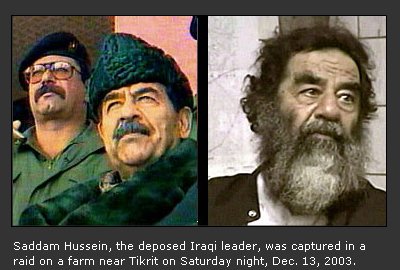
With the capture of Saddam Hussein at 8:26 p.m. Baghdad time on Saturday night, in an operation code-named Red Dawn, the dynamics of every question surrounding Iraq was suddenly altered, and the ex-post-facto analysis is a fascinating resurfacing of the field for a number of competitive battles from a business perspective, as well as highlighting a major intelligence success just when it was needed the most.
A member of Saddam Hussein’s Tikriti clan, captured in a raid on a Baghdad safehouse on Friday as U.S. intelligence began targeting mid-level family members and other allies, told interrogators he could be hiding at one of two farms near the town of Ad Dwar, just ten miles from Tikrit and even nearer to Hussein's birthplace, Uja. Curiosly, U.S. troops had searched that same area only two weeks ago. Soldiers first thought they might’ve missed Saddam again, but when they saw two men running away, the C.O. conducted a more thorough search. Hussein was found six feet below a concealed Styrofoam hatch over a ventilated crawlspace.
What will Iraq look like, geopolitically, now that the spectre of a return-to-power by the Iraqi tyrant has been lifted? Since Iraq is a post-WWI artifice constructed from Britain's imperial pull-out in the 1930's, Saddam Hussein fulfilled the role of dictator in a state so culturally schizophrenic because of Kurdish, Sunni and Shia nationalities that perhaps only a dictator could hold it together. The geopolitical question now is whether Iraq will follow the Yugoslavian Model (decades of civil war as the artifical state eventually fails and fractures anyhow) or the Spanish Model (using inherent strengths, such as Spain's unifying religion, to strengthen the political ties that bind them)?
Gen. Raymond Odierno, commander of the Fourth Infantry Division that caught Hussein thanks to "actionable intelligence" created by joint CIA-Special Operations "Task Force 121" described their approach: "We tried to work through family and tribal ties that might have been close to Saddam Hussein," Odierno said, as quoted in the WP. "As we continued to conduct raids and capture people, we got more and more information on the families that were somewhat close to Saddam Hussein. … And finally we got the ultimate information from one of these individuals."
The Bush administration wanted to confirm Saddam Hussein's identity before leaking rumors could steal their thunder or a case of mistaken identity made them look foolish – the former happened after the deaths of his two sons, Uday and Qusay. Hussein’s scruffiness helped from a psy-ops perspective. "Our planning was good," the director of strategic communications for the Coalition Provisional Authority told the New York Times. "But Saddam helped it immeasurably in the long run. He contributed in ways we never dreamed possible - he allowed himself to get into such a disheveled state and to look so haggard."
Meanwhile, the U.S. Army is already making hay of the juicy tidbits of intel found in Saddam's briefcase:
-
Saddam Hussein's capture is already reaping dividends for the U.S. military, providing intelligence that allowed U.S. soldiers to capture several top regime figures and uncover rebel cells in the capital, a U.S. general said Monday.
The U.S. military hopes Saddam will clear up allegations that he had chemical and biological weapons and a nuclear weapons program, said U.S. Army Brig. Gen. Mark Hertling of the 1st Armored Division. "I certainly think some of that will come out," Hertling said in an interview with The Associated Press. "I think we'll get some significant intelligence over the next couple of days."
Since Saddam's capture on Saturday, U.S. Army teams from the 1st Armored Division have captured one high-ranking former regime figure - who has yet to be named - and that prisoner has given up a few others, Hertling said. All the men are currently being interrogated and more raids are expected, Hertling said.
The intelligence that led the military to the men came from the first transcript of Saddam's initial interrogation, and a briefcase of documents Saddam carried with him at the time of his arrest, Hertling said. "We've already gleaned intelligence value from his capture," Hertling said. "We've already been able to capture a couple of key individuals here in Baghdad. We've completely confirmed one of the cells. It's putting the pieces together and it's connecting the dots. It has already helped us significantly in Baghdad." The intelligence has also given the U.S. military a far clearer picture of the guerrillas' command and control network in the city, and has confirmed the existence of rebel cells whose existence was previously only suspected, Hertling said.
From the initial batch of successes, Hertling said it was apparent that Saddam still played some role in leading the anti-U.S. insurgency. "I'm sure he was giving some guidance to some key figures in this insurgency," Hertling said. Hertling said the 1st Armored Division had also received intelligence from other sources on attacks Monday in Baghdad. The division received tips earlier in December that a spate of car bombings would start in mid-December. "We have some intelligence that things are going to happen," Hertling said.
Hertling said he hopes Saddam will divulge secrets on everything from mass grave sites to the whereabouts of missing regime figures and "past sins of the regime we may not even know about." "We certainly can gather intelligence he has on the organization of the insurgency, who their leaders are, how the cells are performing, how they're being commanded and controlled, who's funding them and what their connections are to crime," Hertling said.
And, the American intelligence community has been vidicated after a long couple of years of less-than-stellar performance:
-
For American intelligence agencies, the capture of Saddam Hussein is a much needed vindication after many months of failures and frustrations, Bush administration officials and members of Congress said Sunday.
The agencies' standing was brought to a low ebb by a long line of setbacks, including the failure to anticipate the attacks on Sept. 11, 2001; the unsuccessful search for unconventional weapons in Iraq; and the inability to find Mr. Hussein or Osama bin Laden. But that string has ended in the dirt hole where Mr. Hussein was finally found, not far from his birthplace.
Although it was American soldiers who unearthed Mr. Hussein, it was the intelligence community, including the Central Intelligence Agency and its military counterparts, that set them on the right path, beginning with a new analytical effort begun in late November to draw up a list of just who might be hiding him.
As American generals, diplomats and President Bush himself announced the capture in Washington and in Baghdad on Sunday, intelligence officials, including George J. Tenet, the director of central intelligence, were nowhere to be seen. But Mr. Bush himself used his televised address in part to praise what he called "the superb work of intelligence analysts who found the dictator's footprints in a vast country."
Behind the scenes, the C.I.A. and its counterparts have scored some important victories, including work that has led to the killing and capture of high-ranking members of Al Qaeda. But since the Sept. 11 attacks, the intelligence agencies' public record has been checkered at best, beginning with what a Congressional review called a failure to connect the dots in analyzing intelligence that could have provided warnings of the hijackers' intentions. Mr. bin Laden, the Qaeda leader, has succeeded for more than two years in eluding a hunt by the military and intelligence agencies.
The intelligence agencies are now widely seen as having overestimated the threat posed by Mr. Hussein's government before the war, in particular saying that it had stockpiled prohibited weapons, which so far have not been found. During the war itself, two failed attempts to decapitate Iraq's Baathist leadership with airstrikes aimed at Mr. Hussein on March 19 and April 7 underscored the limitations of information provided by the agencies.
Against that backdrop, senior members of Congress who have been critical of the C.I.A. in recent weeks went out of their way on Sunday to give the intelligence agencies what they called their due.
"Saddam's capture is a direct result of unprecedented cooperation and joint effort on the part of our intelligence analysts, operators in the field and our military," said Senator Pat Roberts, a Kansas Republican and chairman of the Senate Intelligence Committee. He said they "deserve a great deal of credit and our gratitude."
Senator John D. Rockefeller IV of West Virginia, the top Democrat on the Senate Intelligence Committee, described the capture as both "a remarkable achievement" and "a classic intelligence operation of persistence and analysis."
C.I.A. officers have played a major part in the supersecret military Special Operations teams, including Task Force 121, that were given the leading role in tracking down Iraqi leaders. In recent weeks, the information gathered by the C.I.A., the Defense Intelligence Agency and the intelligence arms of the military services has been closely shared among the agencies through a new cooperative arrangement in Baghdad.
It was human intelligence, rather than the kinds of information gathered by spy satellites or eavesdropping, that led the United States to Mr. Hussein, the senior American officials said.
Human intelligence was always the weakest link for the United States in Iraq, American officials say, and that capability deteriorated during the 1990's as a result of deep budget cuts. Before the United States invaded Iraq last March, the agencies drew up lists of the Iraqi officials whom they most hoped to capture. But it was apparently not until last November, after months of work in developing new intelligence about Iraq, that a new list pointed the American search effort in the direction that finally proved fruitful.
"I suspect that it will be some time before a settled peace resides in Iraq," said Representative Porter J. Goss, a Florida Republican and chairman of the House Intelligence Committee. "Nevertheless," he said of the insurgents, many of them loyal to Mr. Hussein, who have been attacking Americans, "this is the beginning of their end."
Saddam’s capture comes even as President Bush was defending a policy stance last week to prohibit prime contracts – or even competition for them – in the lucrative post-war Iraqi reconstruction from going to countries that opposed the Iraqi war.
Indeed, this policy recently drew the ire of Germany, France and Russia, as James Baker, the supremely qualified deal-making friend of the Bush family, takes to the road to restructure Iraq’s international debt (Baker’s potential conflicts of interest in this new role were explained in a NYT editorial last week).
I believe the reconstruction lockout and the debt question is intimately linked – it’s a bargaining chip, rather than an irony. Baker can use it to negotiate debt restructuring in return for allowing German, French and Russian firms access to competition for reconstruction contracts.
The New York Times also has a really interesting account of a meeting Sunday afternoon between Saddam Hussein, L. Paul Bremer III, the American civilian administrator of Iraq; and Lt. Gen. Ricardo Sanchez, the top military commander in Iraq, along with four Iraqi leaders: Mowaffak al-Rubaie, a Governing Council member ; Ahmad Chalabi, a council member and head of the Iraqi National Congress; Adnan Pachachi, a council member who was the foreign minister before Hussein came to power; and Adel Abdel Mahdi, who represents the Shiite religious body, the Supreme Council for the Islamic Revolution in Iraq.
Finally, Saddam's capture also opened an opportunity for other Democratic candidates for President to slam Howard Dean, who has based much of his campaign on opposition to the war in Iraq. "The fact is that if Howard Dean had his way, Saddam Hussein would still be in power today, not in prison," said Connecticut Senator Joe Lieberman, a leading Democratic backer of the war.
This was the second big event in a week that shook up the Democratic race. Just Tuesday, former Vice President Al Gore endorsed Dean, citing his opposition to the Iraq war. Missouri Rep Dick Gephardt said in a statement, "I supported this effort in Iraq without regard for the political consequences because it was the right thing to do... I still feel that way now and today is a major step toward stabilizing Iraq and building a new democracy." But, retired General Wesley Clark still thinks going to war in Iraq was unnecessary. "It seems to me that all of the concerns that I have voiced about Iraq remain I stand by every concern," Clark said in a conference call from The Hague, where he was testifying in the U.N war crimes trial of former Yugoslav President Slobodan Milosevic. Democrats have been slamming Bush for failing to capture Saddam and Osama bin Laden, in spite of months of manhunting. Ohio Representative Dennis Kucinich and activist Al Sharpton said the United States must now focus on getting our troops home and out of Iraq.
The LA Times had a nice analysis of how the Democratic pack will try to use Hussein's capture against front-runner Howard Dean longer-term. Having Hussein in custody could cause problems for the Democrats if their presidential nominee is, like current front-runner Howard Dean, defined by opposition to the war. This all follows a steady upswing in economic indicators, with the stock market and overall growth increasing substantially this fall, strengthening President Bush considerably. Greater stability in Iraq and a recovering economy would provide for a peace and prosperity environment that will make him very tough to beat. Here's an excerpt:
-
But its reverberations could be felt immediately in the Democratic race for the nomination, where Dean has surged ahead over the last six months in part by stressing his opposition to the war in Iraq.
Since Bush declared the end of major combat operations in Iraq in May, the Democratic race has been heavily influenced by a complex dynamic: Any reversal in Iraq that strengthens the Democrats against Bush also has strengthened Dean, the most vocally antiwar of the major candidates, against the rest of the field.
The question now may be whether the reverse is true — whether good news in Iraq will be bad news for Dean. The candidates chasing him quickly made clear that they hoped so.
Kerry, who only days ago was stressing the similarity between Dean's views and his own in the period before the war, insisted Sunday that the capture raised questions about Dean's foreign policy judgment. Kerry suggested that Hussein's capture validated his 2002 vote for the congressional resolution authorizing the war.
"This is a time that underscores that, if we are going to beat George Bush, we need somebody who has experience and who got this policy right," Kerry told reporters in Davenport, Iowa.
Without criticizing Dean by name, aides to Clark also insisted that Hussein's capture showed the need for a candidate with credentials to compete with Bush on foreign policy.
"Today's development reinforces that the major issue in the 2004 election is going to be national security," said Chris Lehane, a senior Clark strategist. "The Democrats need a candidate who can meet the commander-in-chief test in next year's election."
Lieberman took the hardest line, denouncing Dean, praising the capture in unqualified terms — "Hallelujah, praise the Lord," he said on NBC's "Meet the Press" — and calling for Hussein to be tried before a body that could sentence him to death.
On his campaign plane during a flight from Palm Beach to San Francisco on Sunday afternoon, Dean declined to respond to the comments made by his rivals. "Today is not a day for politics," Dean said. "Today is a day for celebration."
It should be telling to see where this takes us in the months ahead. For the Iraqi people, it really is a day to celebrate. The spectre of Saddam has been lifted and, psychologically at least, the country can begin to heal from a generation of murder, theft and lies at the hands of a tyrant.
- Arik
 "Competitive Intelligence applies the principles of competition and lessons of intelligence to the need for enterprise awareness and predictability of market risk and opportunity. CI has the power to transform an enterprise from also-ran into real winners with agility enough to create and maintain sustainable competitive advantage."
