December 13, 2003
AT&T and Qwest Jump Aboard VoIP Bandwagon, Following Time Warner Cable Deal with Sprint & MCI
 AT&T and Qwest both joined the VoIP fray, along with Sprint and MCI's allegiance with Time Warner Cable, carving out the entry of big telecom into the emerging, fast-growth market that is rapidly commoditizing their existing local and long-distance businesses. The only question I have is, what took them all so long? I've had Vonage service for over nine months now as my primary landline after my cable company - Charter - couldn't say when they'd start rolling VoIP dialtone to my highspeed cable modem line. If you're a cable company thinking of entering this market, the calendar just got a lot tighter.
My thoughts are that this most recent round of initiatives is the Telecom Act coming home to roost in the free-for-all world of Internet communications. Regardless, it’s good to see some competition for Vonage in the space, as the plans promise to lower the cost of phone service more broadly and include new features (which I’m already used to, thanks very much), like the ability to check voice mail or program call-forwarding requests on the Web. But, until now, VoIP has been pretty much a niche service, as fewer than 200,000 Americans use Internet phone service as their primary line, according to TeleGeography.
But, that penetration is sure to soar in 2004. Besides the announcements made this week, the nation's biggest phone company, Verizon, plans to deliver a consumer Internet phone offering within the next six months. Here’s a press excerpt on recent events, that explains the technology pretty well too:
-
"The giants getting into the business gives Voice Over IP credibility," said Guzman & Co. analyst Pat Comack, using the technology's official name. "People will give it a shot now. All of a sudden, this is not a toy anymore."
But while the Internet phone bandwagon swells, the full-fledged revolution seems several years away. For now, only the roughly 20 percent of U.S. households that have broadband Internet access can use the technology.
Perhaps most importantly, special steps have to be taken to make the Internet phone systems connect to 911 dispatch centers or work in blackouts like the old-fashioned phone network can.
"I'm not going to pretend that we're ready to solve those problems," AT&T spokesman Gary Morgenstern acknowledged Thursday. "We're working on that."
Other providers say they have addressed those issues. Internet phone pioneer Net2Phone, which is focusing on helping cable companies deliver the service, boasts that it also has overcome the technical hurdle of letting law enforcement officials set wiretaps, which phone companies are required to allow.
Traditionally, a phone conversation is converted into electronic signals that follow an elaborate network of switches in a dedicated circuit. Long-distance calls cost more because regional carriers have to be paid for originating and terminating the calls.
The new technology has a terribly nerdy name, Voice over Internet Protocol - or Voice over IP or just "VoIP" - but its premise is pretty simple.
When a call is made, the sounds are converted into packets of data that take diverging paths around the Internet or private networks, just like e-mails or Web pages. The packets get reassembled as sound on the other end of the call. The sound quality sometimes strays from perfection - though it has come far in recent years and is expected to get even better.
The process is cheaper because it cuts some or all long-distance access charges out of the equation - though that is a contentious issue under consideration by the Federal Communications Commission. It also helps big businesses save money because they can use their expensive data networks to make phone calls instead of only shuttle files around. And because voice is sent like any other kind of data, new videoconferencing services and Web-based phone messaging applications are possible. The address book in an e-mail program can dial a number with the click of a mouse.
Combine all those elements, and VoIP represents a tidal wave.
Providing service costs Vonage about 1 cent a minute; AT&T probably could do it for about seven-tenths of a cent because it has its own vast data network, says UBS Warburg analyst John Hodulik.
With such low costs, charging for long-distance by the minute will probably give way to "all you can eat" plans. For example, Time Warner Cable lets its Internet customers in Raleigh and Portland make as many calls as they want for $39.95 a month.
Also, cable TV companies increasingly will use VoIP to sell phone and broadband service in an attractively priced "bundle" that makes customers less likely to leave. In response, phone companies might have to accelerate plans to upgrade to fiber-optic lines that can carry a huge amount of bandwidth, including ultra-fast Internet and high-definition TV.
In the meantime, the billions of dollars worth of copper phone wires spread across the country figure to gradually become obsolete. AT&T stopped investing in the old-style "circuit-switched" infrastructure several years ago, opting instead to build only data networks.
"It's not a question of if," said Forrester Research analyst Charles Golvin. "It's a question of when."
The earlier announcement by Time Warner Cable that it is working with Sprint and MCI to offer phone service using VoIP is one of the surest signs yet that cable companies are going to war with the local phone industry. Here's another excerpt (paraphrased):
-
While other cable companies sell phone service to their customers in selected markets, the deal announced last Monday is the first time VoIP will roll to nearly nationwide phone service by a cable company.
"We've moved out of the talking stages and into the reality," said Jeff Kagan, an independent industry analyst based in Atlanta. "2004 is going to be the year cable and phone companies get into each other's business and start competing."
At a switching station, the calls will be transferred to either the MCI or Sprint phone networks and into the traditional format that reaches most phone users. Improving quality gives cable companies an efficient way to break into the phone business. Meanwhile, telephone providers are increasingly going after the cable companies by cutting prices on digital subscriber line (DSL) high-speed Internet service and by bundling satellite TV service with local phone bills.
Sprint and MCI said they were in talks to facilitate phone service for other cable providers but provided no other details. "It's a whole new business for Sprint and MCI to get into," Kagan said. "It helps to diversify the business. It's a whole new revenue stream for Sprint and MCI and it's a huge opportunity because Time Warner is just one of many cable companies they can work with. This is just what the long-distance industry needed." The companies provided no details about how much the deal was worth.
Time Warner's cable and high-speed data customers in Portland and Raleigh pay $39.95 for unlimited local, in-state and domestic long distance calling. Customers that don't receive other Time Warner services pay $49.95 a month for phone service. Time Warner Cable spokesman Keith Cocozza said prices will remain similar when the program is expanded nationally. "What we've always wanted to do is offer our customers a wider range of services for the best value," Cocozza said. He said voice-over-IP "allows us to get into a market we haven't been in."
Martin Dunsby, an analyst at consulting firm inCode Telecom Group, noted that the technology also provides consumers with other options because the calls are carried by lines that can handle other kinds of data as well. That makes picture messaging and video conferencing possible.
"Really, it means more choice for consumers," Dunsby said. "Instead of having to go to the local phone company for phone service and cable company for cable you can go to a range of providers for a range of services."
It's a shrewd move that allows Time Warner Cable to leap a big hurdle, by using Sprint and MCI to provide interconnection facilities, long distance traffic, 911 service, relay systems and operator services. The service, which will be called Digital Phone, includes unlimited local, in-state and domestic long distance, and customers who add the service will be able to keep their existing phone numbers. Time Warner Cable has 10.9 million subscribers in 27 states. A spokesman for Sprint said the 17 markets that Sprint will service are about half of the total markets covered by the three-year agreement. MCI will cover the rest.
VoIP trials have varied a lot in how they packetize voice, and few carriers are ready to move directly to an IP-based client using the Session Initiation Protocol, or SIP, in phones or PCs. Instead, most services will use existing analog handsets, converting to packet at an aggregation gateway.
Even this partial offering carries immediate benefits, as in the case of AT&T, which can offer flat-rate service for both local and long-distance by transporting all voice traffic as packets. One financial analyst who covers AT&T said "the first impact will be to create more vicious competition between interexchange and local carriers, with prices dipping so low [that] some carrier operating expenses could suffer. The second impact will be to hammer the specialized long-distance providers who use a leased interexchange carrier. Without direct access to transport, they won't be able to meet the VoIP challenge."
Following a ruling by Minnesota's Public Service Commission regarding regulation of VoIP services from Vonage, Qwest will offer VoIP service in Minnesota, using either IP phones or analog phones with adapters, linked to DSL modems. The service, already available in some Minneapolis-St. Paul neighborhoods, will be expanded to most of Qwest's 14-state region in the first half of 2004. AT&T announced it would offer IP-based local and long-distance phone service to its customers with broadband access, enabling most services within 2004.
My analysis: the real killer app here is Unified Messaging, not Bundled Services. It should be interesting to see where commoditization takes prices next year - and the effect it'll have on the growth wireless telecoms have enjoyed of late - still, I think anybody who competes on price instead of features is probably doomed. I've found that a VoIP landline and a cell phone I can auto-forward it to if I don't pickup at home, makes for a real - and cheaper - telecom solution.
- Arik
December 12, 2003
The Medicare Drug Benefit & Why Seniors Are So Spoiled
 In the wake of the Medicare drug benefit legislation President Bush signed this week, I was browsing Steve Chapman's biting piece on Slate, "Meet the Greedy Grandparents: Why America's Elderly are so Spoiled". As we look forward to future generations of Americans having footing the bill for today's free drugs to keep aging Baby-Boomers chugging along into their hundreds, the subject of entitlements for seniors - whether that's ensuring the Social Security safety net or making sure drug companies don't profit unfairly by "forcing our seniors to choose between whether to buy food or their arthritis medicine" (in the words of our President) - we should consider remember that senior citizens have never had it so good in these United States, and if not for their huge voting bloc, they wouldn't be so well off.
Here's a choice excerpt:
-
From gratefully accepting a basic level of assistance back in the early decades of Social Security, America's elderly have come to expect everything their durable little hearts desire. They often get their way, as they did recently when years of complaints finally induced Congress and the president to agree to bear much of the cost of their prescription drugs. From the tenor of the debate, you would think these medications were a terrible burden inflicted by an uncaring fate. In fact, past generations of old people didn't have to make room in their budgets for pharmaceuticals because there weren't many to buy. If you suffered from high cholesterol, chronic heartburn, or depression, you were left to primitive remedies, or none. Today, there are pills and potions for just about any complaint—except the chronic complaint that many of them are pricey. It's not enough to be blessed with medical miracles. Modern seniors also want them cheap, if not free.
Here's another:
-
Why do we keep indulging the grizzled ones? The most obvious reason is that they are so tireless and well-organized in demanding alms. No politician ever lost an election because he was too generous to little old ladies. A lot of people are suckered by the image of financially strapped seniors, even though the poverty rate among those 65 and over has been lower than that for the population as a whole since 1974. But it's not just the interests of old coots that are being served here. Young and middle-aged adults tend to look kindly upon lavish federal generosity to Grandma because it means she won't be hitting them up for help. Paying taxes may be onerous, but it's nothing compared to the cost, financial and otherwise, of adding a mother-in-law suite to the house. Working-age folks also assume that whatever they bestow upon today's seniors will be likewise bestowed on them, and in the not too distant future. It's not really fair to blame the greatest generation for this extravagance. They are guilty, but they have an accomplice.
And, finally:
-
To fund all the obligations of the Social Security system, payroll taxes will have to more than double by 2040—on top of whatever it costs to buy all those prescription drugs. At that point, our children will realize the trick we've pulled and start to hate our guts. That would be a cruel blow to a generation that thinks of itself as the most wonderful parents in history.
Maybe today’s twentysomethings should start getting out the vote a little better than they’re used to, if for no other reason than to raise attention for their own future plight in having to pay for today's senior gravy train.
- Arik
December 11, 2003
Juan Valdez vs. Starbucks: Colombian Coffee Growers Expanding Direct Channel to American Consumers
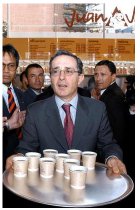 Colombia's President Alvaro Uribe is shown here serving coffee during the inauguration of a new Juan Valdez coffee shop in Bogotá, yesterday. The Colombian Coffee Federation, representing half a million coffee growers, inaugurated its flagship coffee shop with plans to open 10 others in the United States and elsewhere to compete with companies like Starbucks. The shops are a part of the federation's efforts to alleviate the suffering of coffee farmers devastated by the continuing collapse in global coffee prices, which has forced many growers to turn to cultivating of illicit crops, such as heroin or cocaine, to survive.
Here's an excerpt from the AP story:
-
In a bold attempt at saving small-scale coffee growers who have been hit by a collapse in coffee prices on worldwide markets, the Colombian Coffee Federation is selling its coffee and other goods at its own shops bearing the name and image of Juan Valdez, its signature character. On Wednesday, the group inaugurated its flagship coffeeshop, and plans to expand into the United States and beyond.
While prices for a latte or espresso top $2 at most of the world's trendy java retailers, coffee growers see only a few pennies of the profits, as much of it goes to middlemen or vendors. By eliminating some of the intermediaries, the federation hopes to ensure a larger part of the income for its members. The first Juan Valdez coffeeshops abroad are scheduled to open in New York and Panama by mid-2004, offering Colombian coffee in various forms, coffee beans, cakes and Juan Valdez accessories like T-shirts and bags. Ten are planned for the first phase.
Colombian President Alvaro Uribe helped open the sleek, spacious flagship shop in Bogotá’s financial district Wednesday by serving the first cups of coffee from a silver tray. It is the ninth store to open in Colombia in the past year bearing the name of Juan Valdez, the smiling, mustachioed coffee farmer sporting a straw hat and brown poncho who has appeared worldwide in numerous Colombian coffee ads.
Juan Valdez's shops in Colombia have quickly gained popularity since the first one opened at Bogotá’s international airport in December 2002, with $3.7 million dollars in coffee sales, the federation said. In trendy coffee bars in the United States, only one or two cents from the sale of each cup of coffee makes its way back to the farmers, the Colombian Coffee Federation said. The federation wants to ensure that Juan Valdez shops will generate returns of between four and five cents per cup to the farmers. Colombian coffee farmers each own a stake in the shops, whose profits are also being used to build schools, roads and hospitals in Colombia's coffee-growing region. "With this program, we are creating one of the most efficient mechanisms to transfer value from quality coffee straight to the growers," the coffee federation said in a statement.
However, Juan Valdez will likely face stiff competition abroad from the likes of Starbucks and other major coffee competitors, and the global coffee crisis shows no sign of easing. But Juan Valdez could prove popular with customers aware of the plight of coffee growers. Starbucks spokeswoman Audrey Lincoff brushed off fears of competition. "We have said always that we believe there's room for many different coffee houses," she said.
 However, all other variables being equal, I think I would probably cross the street to get my mocha-frap from a J.V. shop, versus a Starbucks... the belief alone that I'm not exploiting coffee growers or forcing them into the cocaine or heroin business, is reason enough for me.
- Arik
P.S. - So, who is Juan Valdez, anyhow? Here's a history, plus biosketch on Carlos Sánchez, who protrays J.V.:
 In 1959, the National Federation of Coffee Growers of Colombia selected the advertising agency Doyle Dane Bernbach to launch a campaign for Colombian Coffee. The agency then created the fictitious character Juan Valdez, to symbolize and personify the more than 300,000 hardworking and dedicated Colombian "cafeteros" (coffee farmers) that depend on coffee for their livelihood. In 1969, Carlos Sánchez of Medellín, Colombia, was chosen to replace José F. Duval, a New York based actor, who had until then portrayed Juan Valdez. Mr. Sánchez has been Juan ever since and is now one of the longest living fictitious characters for any advertising product. A coffee farmer himself, Carlos Sánchez was born in Fredonia, a small town which lies in the largest coffee producing region of Colombia, Antioquia. He currently resides in Medellín, where, when not portraying Juan Valdez, he makes silkscreens in his Graphic design studio and continues to maintain a small coffee farm, where many weekends are spent with his family.
December 10, 2003
NAM Study Cites External Non-Production Costs As Primary Competitive Challenge Facing U.S. Manufacturers

The National Association of Manufacturers, or NAM, citing a new study sponsored by St. Louis-based Emerson Electric, and produced in partnership with Manufacturers Alliance/MAPI, said:
-
"External, non-production costs add approximately 22 percent to unit labor costs of U.S. manufacturers (nearly $5 per hour worked) relative to their major foreign competitors, and are the primary competitive challenge facing manufacturers and their workers," said Jerry Jasinowski, President of the National Association of Manufacturers.
"This report comprehensively documents these extra costs – corporate tax rates, employee benefits, tort litigation, regulatory compliance and energy – and estimates them at approximately 22 percent of the price of production for U.S. firms relative to our nine most important trade competitors," Jasinowski said. "These external costs are twice the size of the average direct labor costs of U.S. manufacturers, and are a major factor in our loss of trade and jobs."
"U.S. manufacturing has demonstrated the ability to overcome pure wage differentials with trading partners through innovation, capital investment and productivity," said James Berges, President of EMERSON. "But when the additional external costs described in this paper are piled on, the task becomes unmanageable, even in the best companies."
"There are many self-proclaimed friends of manufacturing expressing concern who are nowhere to be seen when these excessive non-production costs are on the table," said Jasinowski. "Taken together, external non-production costs have offset a large part of the 54 percent increase in productivity achieved since 1990. It is imperative that our elected representatives at all levels take a hard look at the costs created by their actions – and sometimes lack of action – and the impact on our economy. We simply must forge a more pro-worker, pro-manufacturing climate if our industrial leadership is to be maintained and strengthened."
Use the following link, if you'd care to read the original study, entitled How Structural Costs Imposed on U.S. Manufacturers Harm Workers and Threaten Competitiveness. It's interesting reading.
- Arik
December 09, 2003
Supermarkets, Antitrust & Union Busting: Can Anything Save Grocery Stores from Wal-Mart?
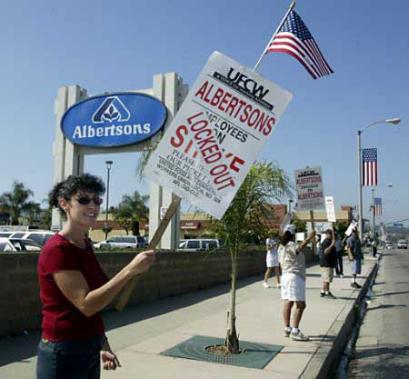
Even as major supermarket chains in California have been trying to get health care insurance concessions from labor as they desperately try to compete with the likes of Wal-Mart, California's attorney general is investigating whether three supermarket chains involved in the labor dispute with 70,000 Southern California grocery clerks have broken antitrust laws by forming a financial pact.
The three supermarket operators - Safeway Inc., Kroger Co. and Albertsons Inc. - were issued subpoenas Monday by Attorney General Bill Lockyer's office, demanding they reveal the details of a mutual-aid pact, which the companies reportedly made to share revenue so they could reduce losses in the event of a labor strike. The chains have declined to give specifics on the arrangement, which has become a factor in the weeks since the United Food and Commercial Workers' union decided to pull picket lines from Kroger's 249 Ralphs' stores on October 31st. Ralphs has seen a surge in customers ever since.
Meanwhile, talks have broken down in the grocery strike this week:
-
Labor negotiations between grocery companies and picketing Southern California grocery workers have broken off and no new talks are scheduled, officials said. About 70,000 grocery clerks went on strike or were locked out Oct. 11 at nearly 860 Ralphs, Albertsons, Vons and Pavilions stores from San Diego to San Luis Obispo. Negotiations with a federal mediator had resumed Dec. 2 between the companies and representatives of the United Food and Commercial Workers union. The talks broke off Sunday evening without a comprehensive offer put forth by the union, said Stacia Levenfeld, a spokeswoman for Albertsons.
The dispute centers on a demand by the supermarket chains that workers shoulder a larger portion of their health care insurance costs. With the strike and lockout entering its ninth week, UFCW International President Doug Dority said he is calling major UFCW local unions from the United States and Canada to a "summit" in Southern California. Union officials said they will mobilize the 1.4 million members of the union to increase strike activity.
The grocery companies in a joint statement said they "are no longer willing to absorb all costs related to maintaining health care benefits" and want to introduce a "modest level of cost sharing."
The companies also are offering a reduced wage and benefit program for workers hired on or after Oct. 6, 2003 to help them "face the enormous challenge of the changing competitive landscape." The national supermarket companies that run the chains — Albertsons Inc., Kroger Co. and Safeway Inc. — say they face pressure from Wal-Mart, Costco and other so-called big box supermarket operators who can sell goods at lower prices because they don't pay as much for their employees' health benefits.
Fact is, labor and managment are in this together. The survival of supermarkets as a business is in question when faced with the stiffness of competitive pressure from Wal-Mart and the sooner labor figures this out, the better chance they'll have a job to return to.
- Arik
December 08, 2003
Boeing vs. Airbus: Airbus Comes Out On Top

The aerospace industry has suddenly gotten really interesting. The week after Boeing's CEO Phil Condit quit the company amid the latest round of ethical misdeeds, Airbus vice president for market forecasts, Adam Brown, told reporters at the Dubai Air Show that his company had 55 percent of the market against 45 percent for Boeing, taking orders for 263 aircraft since the beginning of the year - 47 more than Boeing, crowning Airbus "the world's leading supplier" of commercial jets. Airbus, based in the French city of Toulouse, says it has sold 4,854 aircraft to 186 companies since its inception in 1970.
But Chicago-based Boeing remains unshaken. "There is no question this year they will be delivering a few more aircraft than us, but we are not concerned about one downturn year," Boeing's marketing vice president, Randy Baseler, told The Associated Press:
-
Promoting the A380, marketed as the world's largest passenger aircraft, Airbus said Monday its new carrier is the future of airline growth. The 555-seat plane, designed to fly nonstop for long hours, is scheduled for its first flight in 2005, with deliveries set to begin in early 2006. There have been 129 orders for the craft from 11 countries, including Dubai-based Emirates airline and Doha-based Qatar Airways. "Based on our experience we see nothing on the horizon which can cost-effectively supersede the aircraft we offer today," Brown said.
In its separate news conference, Boeing expressed skepticism about Airbus' market forecasts, saying airlines usually handle growth in air travel by increasing frequencies and nonstop flights, not plane sizes. Boeing also says the A380's size would require airport adjustments and changes in the way airlines do business. Baseler said the future is for smaller jets. "On the global scale, we see market fragmentation — or 'point-to-point' operations_ continuing, which means airlines will rely more and more on smaller airplanes," he said. Baseler said this is why Boeing believes the future of its 250-seat 7E7 Dreamliner, which is planned for 2008, is promising. Brown said Boeing seems to be "in a parallel universe," adding that the A380 has had "the biggest market response to any jet" in numbers of orders.
Meanwhile, I found another biting commentary on Slate.com about the Boeing's recent slide, "Jet Lag: How Boeing Blew It"... here's an excerpt:
-
...as Boeing managers tried to fit McDonnell Douglas into the corporate mix, Airbus took off. One story has it that an Airbus executive boasted in 1997 that his company's sales would easily surpass Boeing's by 2003. Phil Condit, attending the same meeting, laughed. Now Airbus holds a huge lead over Boeing in orders; in 2002 and 2003, Airbus commanded nearly 60 percent of the global market—precisely the dominant share that Boeing enjoyed back when Condit was so amused.
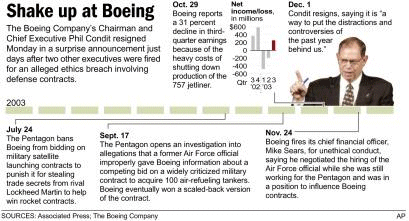
Boeing's plummet matters in a big way, and not just for Boeing. The company has long been a major exporter: A single order of 747s (most of which sell for around $200 million) is capable of putting a sizable dent in the U.S. trade deficit, which likely will surpass $500 billion for 2003. Those fat orders now are essentially gone. Sales of 747s have screeched to a halt since Airbus announced plans to build the 550-passenger A380, due to fly in early 2005.
The sight of a European or Asian airport packed with 747s and 777s says one thing about the United States. Those same airports crammed with Airbus A340s—and, before long, with mammoth A380 superjumbo jets—say another. Boeing's diminished clout in commercial aviation is also bad news for the U.S. airline industry, which may soon find itself with only one viable source of aircraft: Airbus. Goodbye to all the sweet deals the airlines extracted from Boeing or Airbus when the two were fiercely competing.
To save itself, Boeing needs to accomplish two feats. One is to mend fences with the Pentagon and save the deal under which it will build 100 767 jets to serve as midair tankers (the only hope for the aircraft, which no commercial customer now wants). That may not be terribly hard; the Air Force really, truly wants those tankers, and even John McCain's blustering over the deal isn't likely to impede it.
But the other more important challenge for Boeing is to get back to basics in commercial aviation, which after all is what built the company during the 1960s and 1970s. Whether Boeing is up to the task is far from clear. After fiddling in recent years with notions for a supersized 747 and a fast jet called the "sonic cruiser," Boeing has decided its savior will be a jet called the 7E7 "Dreamliner." This twin-engine, 220-seat jet is supposed to give airlines a comfortable, superefficient plane that dovetails nicely with the move away from hub-and-spoke airline flight patterns and toward the point-to-point flights preferred by customers.
Ironically, says Paul Czysz, a professor emeritus of aeronautics at St. Louis University, that might have been found in the McDonnell Douglas archives. During the 1980s and 1990s, engineers there developed what is called the "blended wing"—a variation on the flying-wing model used in the B-2 bomber. Basically, a blended wing is simply a fat wing with the engines and tail fins attached to it—no long skinny tube with the wings stuck on the side. It's an ideal design for commercial aircraft—even more fuel efficient than the proposed 7E7, capable of carrying huge loads, easily switched between passengers and cargo and back. Should any U.S. aviation company actually build a commercial version, says Czysz (full disclosure: He's a former McDonnell Douglas guy), no other airliner could compete. Boeing toyed with something a little like the blended wing with its proposed sonic cruiser, but scrapped that in the wake of Sept. 11 and the collapse of commercial aviation.
The 7E7, offered in its place, is certainly a safer bet. But if the Dreamliner isn't a winner—and there is no clear evidence that it will offer airlines something that Airbus can't—the odds are good that Boeing will be out of the commercial aircraft business in 10 years. To leapfrog Airbus, Boeing needed to roll the dice. Instead, its new culture of soaking the taxpayers for military goodies while playing it safe on the commercial-aircraft front may have cost Boeing its future and blown a hole in the U.S. economy that never will close.
Undoubtedly, without the competition between Boeing and Airbus over the past 30 years, the flying public as well as our militaries would be worse off, so I sincerely hope Boeing can start getting its act together... for the good of its shareholders, the U.S. economy and that of global aviation.
- Arik
UPDATE: On Wednesday 10 December, AP reported from Paris that Airbus said it has been gathering information on public aid to Boeing to check whether Washington has breached an agreement with Brussels, and is particularly concerned about pledges of U.S. government support for its U.S. rival's planned new fuel-efficient passenger jet, the 7E7 "Dreamliner."
-
"We're following very closely what's happening with the 7E7 and forwarding the information we are gathering to the EU authorities," Airbus spokesman David Voskuhl said. He was speaking after French daily Le Figaro on Wednesday quoted Airbus CEO Noel Forgeard voicing concern over Boeing funding. "We want European Union countries to know what's going on," Forgeard was quoted as saying.
Under the terms of a 1992 bilateral accord on civil aviation, the United States and the European Union pledged that government loans would not be allowed to exceed 33 percent of total investment by their respective aerospace companies. Since then, however, both sides have repeatedly accused each other of breaking the deal.
Airbus is concerned about government loans and subsidies promised to the Japanese companies lined up for about one third of the manufacturing work for the 7E7. These include Japanese engineering firms Mitsubishi, Kawasaki and Fuji.
Boeing spokesman Todd Blecher said he found it "ironic" that Airbus was raising concerns about potential support for the 7E7, given "the billions of dollars in subsidies Airbus has received for more than 30 years."
"It's premature for anyone anywhere to speculate on the specific funding mechanism our partners might use for the 7E7," Blecher said.
ANOTHER UPDATE: On Tuesday 16 December, Boeing announced it would begin booking orders for the new 7E7 Dreamliner.
-
"This is a capital-intensive business and this aircraft is a gamble, but it's a smart gamble," said John Murray, an analyst who covers Boeing for Delaware Investments, which owns Boeing shares. "If they didn't do it, Airbus would be standing alone in this business in 40 years."
Without the 7E7, analysts say Boeing would be relegated to also-ran status in the two-horse race with Airbus, which has become the world's most prolific jetliner maker with a backlog of 1,467 jet orders compared with Boeing's 1,112.
Airbus officials have called the 7E7's improvements over Boeing's current jets minor, saying price discounts on the competing A330-200 could eliminate any advantage the 7E7 might bring for airlines.
"When Airbus says they are going to offer discounts, they are already admitting theirs is an inferior product," said Randy Baseler, vice president for marketing at Boeing's commercial jet unit.
Airbus Chief Commercial Officer John Leahy said the A330-200 would beat the 7E7 and win at least half the 1,800 jet orders he expects for mid-sized jets over the next 20 years, expressing surprise that Boeing would spend so much money just to match the A330.
"If the question is: If they bring out the 7E7 what are we going to do, the answer is nothing. We are very content to stay with our A330-200," Leahy told Reuters.
The 7E7 would replace the slow-selling 757, which Boeing is discontinuing, and the 767 line, which has slowed to just one aircraft per month to sustain production until a controversial order for 100 U.S. Air Force fuel tankers is finalized.
The company had considered about 20 locations for a 7E7 assembly plant, eliciting a wide range of offers to cut taxes and build new roads and facilities, including a $3.2 billion aerospace industry package from the state of Washington.
The 7E7 will create just 800 to 1,200 Boeing jobs in Washington, but thousands more will go to local suppliers and state officials were determined to keep the jet business at home after Boeing moved its headquarters to Chicago in 2001.
"It would be more devastating to our economy and our government coffers if Boeing did not build the 7E7 in our state," Washington Gov. Gary Locke told Reuters by telephone. "We would have seen the gradual relocation of Boeing commercial activities to another state, and the loss of 130,000 direct and indirect jobs."
December 07, 2003
Sun's Java Desktop System (JDS) Going After Microsoft Windows & Office
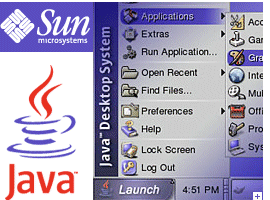 Sun Microsystems seems to be coming on strong of late, especially targeting Microsoft Windows/Office dominance with its Java Desktop System, based on Linux, StarOffice, Mozilla and GNOME. With recent wins at Wal-Mart and with the government of China, it looks like the desktop might get interesting again. I'll spare the excerpts, but here are a few links:
- Sun's JDS Rivals Windows, Office
- What's Behind Microsoft's Office Moves?
- Sun's Scheme for Desktop Domination
- Sun Shines on China
- Sun Pushes Harder on Everybody's Buttons
- And, a full compilation of articles on the subject by eWEEK
Now, this sounds familiar... Java and Mozilla, at least - didn't Netscape try this back in '96? Whether this could be Sun's strategy for tomorrow is less certain, but we are sure to see price commoditization if things catch on, and they've got the CFO's ear now with a pricing model that beats the pants off Microsoft's. Let's hope they don't screw it up - we'll all be better off if competition can be restored to the desktop software universe.
- Arik
 "Competitive Intelligence applies the principles of competition and lessons of intelligence to the need for enterprise awareness and predictability of market risk and opportunity. CI has the power to transform an enterprise from also-ran into real winners with agility enough to create and maintain sustainable competitive advantage."
