December 06, 2003
Sneaker Wars: Nike & Adidas Toe-to-Toe
 I found a great article in the Oregonian that captured the level of competitive rivalry going on between Adidas and Beaverton-based Nike:
-
The hundreds of Adidas-Salomon sales reps meeting to celebrate the company's new Switzerland office grew silent as executive Michael Rupp began venting. For half an hour, Rupp, in charge of the sneaker company's central European business, assailed their complacency. If things don't change, Adidas might become an also-ran, Rupp says he told the gathering.
Shoppers still buy more Adidas gear in Europe than any other brand, but Nike is narrowing the gap, even selling more sneakers. And it's gaining in Germany, Adidas' home country and the world's third largest economy.
"We have to fight for our future," Rupp says he told his crew in June. It's time to launch into "forward-oriented attack mode." The sneaker wars are escalating across Europe.
Beaverton-based Nike, the biggest company with headquarters in Oregon and the state's lone Fortune 500 firm, sees Europe as its next conquest, having defeated Adidas in the United States. Adidas, whose U.S. operations are based in Portland, has heeded the battle cry.
The industry's two biggest titans face enormous pressure to capture Europe. Their shareholders continue to demand profit, sales and stock-price gains. But in recent years, Nike and Adidas have found diminishing returns in a mature U.S. market, the world's largest for athletic shoes and clothing. Nike did more business outside the United States for the first time in its last fiscal year. And after several years of stagnation, Adidas expects its U.S. sales to fall this year.
Here's another excerpt:
-
Research shows that Nike needs to downplay its status as a big American brand to stem backlash that accelerated with this year's war in Iraq, unpopular in much of Europe. On the other hand, Adidas must attract a generation of consumers who, unlike their parents, weren't raised on a sneaker diet limited to German brands.
Adidas' challenges Through much of the mid-20th century, Adidas owned Europe. Hometown rival Puma -- like Adidas, based in the northern Bavarian village of Herzogenaurach, Germany - was its biggest threat for decades.
Nike changed everything.
At first, Adidas shrugged off Nike's 1968 birth. But then it watched with increasing alarm as Nike grew into a powerhouse that sold about as many sneakers in the United States as Adidas, Reebok and New Balance combined.
Marketing itself as an unconventional American alternative, Nike entered Europe about two decades ago. By 1998, it had elbowed out Adidas as the No. 1 sneaker seller. And since then, Nike has narrowed Adidas' edge in overall sales, which count clothing and equipment. Today, Adidas realizes it's dangerous to rely on tradition, habit and brand loyalty.
Resentment from the U.S.-led war in Iraq and a wave of corporate scandals have begun to undermine American brands abroad, especially well-known ones such as Nike, according to a study released in July by RoperASW. As a result, the firm found, the percentage of Germans who regularly use or own a Nike product dropped to 29 percent this year from 49 percent in 2002. The percentage fell to 38 percent in France, down from 45 percent.
Indeed, Nike's European sales have flagged over its last three fiscal quarters, compared with year-earlier periods, currency exchange-rate fluctuations aside.
Nike officials, however, dispute the Roper findings and deny that anti-U.S. sentiment has cut sales. They point to a 21 percent rise in European orders for delivery by January -- again, without accounting for currency changes.
And, finally:
-
To secure future growth, the company is revamping its methods. Rupp told his sales force in September to spend more "quality time" with Adidas' 1,000 largest retail clients. The move will cut face time with smaller customers by almost a third, but Rupp says they won't be ignored. By the end of the year, they will be able to place orders faster using automated machines. The changes will result in a few layoffs, Rupp says.
Adidas also has stepped up its "Winning in Europe" campaign, a 2000 initiative to establish Adidas as the clear European leader by 2006. A headline on a recent 20-page campaign newsletter reads: "Watch out competition -- Adidas is back to take the lead in Europe." Stories highlight successes, such as Italy, and problem areas, such as the Nordic nations, where "there is a growing sense of urgency," according to the newsletter. "Sales have been declining since 1998, weakening our position and threatening our clear market leadership."
One new tactic involves reducing the array of Adidas products by 30 percent by 2006. The company believes that fewer models will lead to lower product-management costs, higher profits and more time to refine forecasts. Already this year, Adidas has eliminated walking shoes and reduced its tennis shoe assortment from 19 to 14 models. "It's a full onslaught battle to grow the brand -- any way, shape or form," says Glenn Bennett, Adidas-Salomon's executive board member in charge of global operations.
It seems Adidas gets the competitive threat Nike represents on its home turf; too bad it's too late to save some of its markets abroad and the "full onslaught battle" had to be such a defensive one.
- Arik
p.s. - It seems the year-old unrest between Foot Locker and Nike has finally been put to bed, thanks to an 18-year-old basketball superstar, LeBron James, who secured his endorsement with $90 million bucks. That, and the retro-style trend that Nike will deliver on exclusively for its biggest buyer, in the form of "20 Pack"... your guess is as good as mine.
December 05, 2003
Bush Lifts Tariffs on Steel & Averts a Trade War

President Bush announced that he finally succumbed to his advisors' counsel and lifted the 21-month-old steep tariffs on imported steel that had riled trading partners in both Europe and Asia. Here's an excerpt from the Washington Post:
-
The action, although expected, marked a rare about-face for an administration not noted for reversing course. And it brought angry reactions from labor unions and executives in the steel-producing states of West Virginia, Ohio and Pennsylvania, all of which were closely contested in the 2000 presidential election and are expected to be battlefields in 2004.
The tariffs, which were as high as 30 percent when imposed 21 months ago, were lifted at midnight, 15 months before their scheduled expiration. Bush said the tariffs had done their job, stemming a flood of cheap steel imports long enough to allow U.S. producers to consolidate and get back on their feet.
In a written statement read by his press secretary, the president also noted that economic circumstances have changed markedly since the tariffs were imposed. Surging demand for steel has boosted prices, and a weakening dollar has made U.S. steel exports more competitive in the global market, administration officials said.
"I took action to give the industry a chance to adjust to the surge in foreign imports and to give relief to the workers and communities that depend on steel for their jobs and livelihoods," Bush said. "These safeguard measures have now achieved their purpose, and as a result of changed economic circumstances it is time to lift them."
Administration officials had signaled that the tariffs would be lifted as far back as mid-September. Bush's economic team had united in a push to lift them, arguing that they had cost more jobs among steel users than they had saved among steel producers. Even Bush's political advisers, who had been instrumental in imposing the tariffs last year, had concluded that they may have backfired politically. Then in November, the World Trade Organization ruled the tariffs illegal, allowing other countries to prepare to impose retaliatory tariffs this month.
Shortly after the White House announcement, the European Union withdrew its threat to impose tariffs on about $2 billion of U.S. exports.
The Commerce Department will closely monitor steel shipments into the United States and continue licensing imports, so the administration can react if there is a surge of cheap imports, Bush said. The president, however, offered no additional aid to the industry or its workers.
That elicited a sharp response from steel producers, which had hoped for more assistance or a phaseout of the tariffs rather than an immediate lifting. Publicly, steel officials were muted in their criticism. Thomas J. Usher, the chairman and chief executive of U.S. Steel Corp., who had just hosted Bush at a campaign fund-raiser earlier this week, said he was "delighted" to hear that the Commerce Department will "aggressively monitor" steel prices. In public comments, other steel executives were similarly understanding.
The New York Times, notes moves of the World Trade Organization and the European Union, which determined that the best way to beat back the tariffs would be to go after American exports from states deemed more crucial to Bush's re-election efforts, such as Florida citrus and Michigan's automobiles. "For the first time in his nearly three years in office, the president, who has often reveled in the exercise of American power, finally met an international organization that had figured out how to hit back at the administration where it would hurt," the Times notes.
Still, organized labor thinks the decision stinks:
-
Leo W. Gerard, president of United Steelworkers of America, vowed to make Bush pay a political price for his "betrayal of American steel workers and steel communities."
"We're not going to give up," he said. "We're going to fight like hell for justice."
Mark Glyptis, president of the Independent Steelworkers Union, vowed that his union "will now work very hard to make sure George W. Bush joins the ranks of the unemployed next year."
"What we've now told the world today is, 'You're welcome to come abuse us, to come and abuse our trade law,' " Gerard said, because "we're going to cave in when you threaten to retaliate."
U.S. Trade Representative Robert B. Zoellick said yesterday that the decision was made independently of the threats of retaliatory tariffs.
And, lifting tariffs here have made it more confusing to interpret the administration's trade policy:
-
Just last month, the administration slapped import quotas on some Chinese textile imports, in what is widely seen as a first installment of actions against Chinese apparel, and this month, it is expected to take action against imports of Chinese bedroom furniture.
Zoellick portrayed the tariff decision in different terms. In the past 18 months, he said, the federal government had assumed $8.2 billion in pension benefits from 14 bankrupt steel companies. U.S. steel exports in August were 49 percent higher than they were a year earlier, and Bush had proven that he is willing "to help people that are knocked off their feet."
"You've got about 150,000 steel workers in this country, and they can thank this president for having a chance to compete in the future," he said.
Steelworkers responded with their own statistics: 225,000 steelworkers with lost health benefits, thousands more who have lost all or part of their pensions, the federal Pension Benefit Guaranty Corporation teetering under the weight of its new steelworker benefit responsibilities, and companies still on the edge of viability.
- Arik
December 04, 2003
For FAO Schwarz, Christmas Looks Like A Humbug
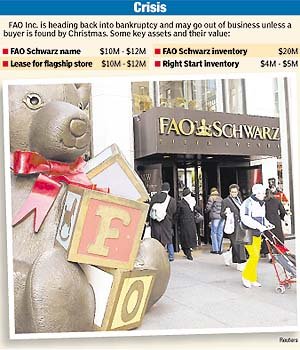 Venerable retailer FAO appears poised for liquidation, even as the toy-shopping season approaches for Fifth Avenue's FAO Schwarz.
Zany Brainy is already being liquidated and FAO Schwarz and The Right Start are right-around-the-corner, if a buy-out can't be arranged before December 15th. Here's an excerpt:
-
...hefty competition, especially from discounters willing to slash prices, was too much for FAO. The company said in November it had instructed a banker to find a buyer for the business.
One likely suitor is Saks Inc., which invested $5 million in FAO and operates boutiques under the FAO name in some of its department stores, a person familiar with the situation said.
Another possible bidder could be Target, which has made a reputation of acquiring well-known brands like Isaac Mizrahi, this person said.
Julia Bentley, a Saks spokeswoman, didn't return a phone call seeking comment. A Target spokesman couldn't be reached.
FAO is racing the clock, given that the value of its inventory quickly loses value after the Christmas season.
As a result, the company said if a deal is not completed by Dec. 15 it could be forced to quickly sell the remaining assets of FAO Schwarz and The Right Start, including inventory, trademarks and leases.
That scenario would open the door to a wider range of buyers, including private equity firms and toy manufacturers interested in licensing the FAO Schwarz name, but not in running retail stores, analysts said.
The main assets for the 15-store FAO Schwarz chain include rights to the name, controlled by the FAO Schwarz Family Foundation, with an estimated value of $10 million to $12 million; the lease to the flagship Fifth Avenue store ($10 million to $12 million); and the inventory ($20 million). All told, the company could be worth $45 million to $55 million, analysts said.
- Arik
December 03, 2003
Rival Tortilla Makers Sue Over Supermarket Shelf Slotting
 In search of a story today, I found out about this Tortilla flap in Harris County (Texas) District Court with a bunch of small, independent tortilla entrepreneurs are going up against a dominant competitor from Mexico to try and keep them from putting them all out of business by giving kick-backs to supermarkets.
From the Houston Business Journal:
-
The outcome of a current court battle between rival tortilla makers could affect the way product space is allotted on supermarket shelves. The trial began late last month over an antitrust lawsuit filed in Harris County District Court in July of 2001 by a group of 18 tortilla makers, including three in Houston.
The suit claims Dallas-Based Gruma Corp., a subsidiary of Mexican conglomerate Gruma S.A. de C.V., conspired to monopolize the sale of tortillas in various markets by using its dominant size to extract concessions from retailers. The group of small, independent tortilla producers seeks $70 million in damages. The case is significant on several fronts, legal sources say. A final verdict either way would set a strong precedent for future antitrust litigation.
Another primary focus, especially among attorneys, is the potential affect on "slotting fees," payments made by producers to retailers for the purpose of gaining preferential exposure for products ranging from toothpaste and tortillas to soft drinks and detergent. The financial stakes are also high. The $5 billion tortilla industry serves one of the fastest-growing food products in the country.
Rick Davolina of Davolina and Eureste LLP, one of several firms representing the tortilla makers, says the entrepreneurs took legal action to protect their interests. "We think it's a very significant case because the clients are all small business people who have been in the tortilla business for a long time," says Davolina. "Most of them are family-owned and have managed to grow their business."
Also representing the tortilla makers is Thomas Stanley of local firm Eastham Watson Dale & Forney LLP, who recently won a $14 million judgment against The Coca-Cola Co. on behalf of five independent soft-drink bottlers in a similar case over anti-competitive practices.
According to the lawsuit, the defendants:
1.) Controlled or tried to control the economic viability of competitors through financial payments to retailers.
2.) Unfairly used the company's buying power to influence where products landed on store shelves and, by extension, illegally controlled the fate and competitiveness of other products.
3.) As a result, the suit claims, Gruma and its associated companies "have eliminated or substantially reduced the availability and visibility of competing tortilla products ..."
Such restrictions allegedly have shut the smaller rivals out of a lucrative market. Tortillas have become big business in recent years. Nearly a third of the U.S. bread market belongs to tortillas, according to claims by the Dallas-based Tortilla Industry Association. The organization's membership includes more than 175 tortilla manufacturers, industry suppliers, distributors and companies with interests in the tortilla industry from around the world.
Antitrust attorney David Donaldson of Austin-based George & Donaldson LLP says the impact on future antitrust litigation will depend on how far the case is taken. If there is a high-dollar judgment favoring the independent tortilla makers that is then sent to the Texas Court of Appeals, it could set a precedent for how lawyers around the state argue on behalf of clients. "Our system recognizes that a company can get as big as it can get as long as it operates legitimately," says Donaldson.
- Arik
December 02, 2003
Subway Chooses Coke over Pepsi
 Coke will become the exclusive supplier of fountain drinks to Subway Restaurants, putting an end to the chain's partnership with the Pepsi unit of PepsiCo, The New York Times said on November 27th:
-
The deal, effective in 2005, will put Coke fountain drinks in Subway's 20,000 restaurants around the world, according to the Times. Pepsi had been the primary provider of fountain drinks served in the chain since 1988, although Coca-Cola supplied about 15 percent of the restaurants with fountain drinks, bottles and cans, the paper said.
Officials at Subway said they began evaluating the company's beverage business about a year ago and decided a single beverage distributor would best meet its needs, the report said. The officials said they chose Coke because they felt that it would help Subway with marketing, innovation and global distribution, according to the article.
- Arik
December 01, 2003
Handspring's Treo 600: A Hot Product with a Big Flaw
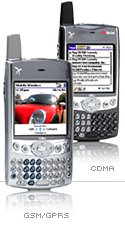 Pretty, aren't they?
With Christmas coming up, I thought I'd highlight one of the gadgets that's sure to be on a bunch of wish-lists this season: Handspring-ne-PalmOne's Treo 600. Sporting a VGA digital camera, quad-band GSM or CDMA models, QWERTY thumb-board, SDIO expansion and a Palm 5 OS, this is the coolest entry in the smart-phone category.
Unfortunately, it'll sell like hotcakes - despite what I believe is perhaps the silliest product oversight in mobile communications. This thing has no removeable battery! Not only do cell-phones run out of charge, PDA's make power demands even more robust, and now I can't even carry a spare around to bail me out in a jam.
Furthermore, batteries eventually wear out and won't take a charge any longer. If I'm gonna shell out $600 bucks for a Treo 600 (that must be how they price 'em, eh?) at least let me amortize that investment over a few years of product life. I don't think PDA-makers can afford (yet) to build in planned obsolecence like that.
Although I know I'm not the only one who feels this way, it's a shame this product will sell so well - it's falsely reinforcing to the manufacturer that the issue doesn't matter. This had been my must-have gadget of the season, but until it comes with a replaceable battery, it's off my list for good.
- Arik
November 30, 2003
Verizon Wireless Winning, Sprint PCS & AT&T Wireless Getting Hit by Number Portability
Just a quick story today turned up a week after WNP went into effect, from Asbury Park Press, Verizon Wireless appears to be gaining from the new law, while AT&T Wireless and Sprint PCS seem to be losing:
-
To determine which U.S. wireless companies were winning the most customers this week, Wachovia Securities Inc. analyst Jennifer Fritzsche visited stores.
RBC Capital Markets analyst Jonathan Atkin contacted retail-chain owners and managers. Legg Mason Wood Walker Inc.'s Craig Mallitz surveyed colleagues. Bob Egan of market researcher Mobile Competency extracted figures from mobile-phone carriers.
They turned up similar results: Verizon Wireless, the biggest U.S. mobile-phone company, is winning customers in the wake of a rule that allows users to keep their phone numbers when switching providers. AT&T Wireless Services Inc. may be losing them.
"Verizon Wireless stores had the most traffic," Fritzsche wrote in a research note on Tuesday, after visiting 15 stores in Chicago on Monday. "AT&T Wireless and Sprint PCS seemed to be the carriers where people wanted to switch from."
Verizon Wireless and its competitors have declined to say how they've fared since the U.S. Federal Communication Commission number mandate took effect Monday, forcing analysts and investors to gather anecdotal evidence. Analysts had picked Bedminster-based Verizon Wireless as a likely winner before the rule began, saying its network is the most reliable.
RBC's Atkin, who's been in touch with owners and managers of retail chains encompassing about 400 stores, said AT&T Wireless and Cingular Wireless LLC have received a "disproportionately large number" of requests to switch.
Verizon Wireless -- a joint venture of Verizon Communications Inc. and Vodafone Group PLC -- and Nextel Communications Inc. have gained more subscribers than they've lost, he said.
Egan made the same observations, based on store visits and tallies from five of the six largest U.S. carriers: Verizon Wireless, Cingular, Sprint, Nextel, and T-Mobile USA.
Albert Lin, an analyst at American Technology Research Inc. in San Francisco, studied reports from telecommunications-software suppliers such as Amdocs Ltd. and Convergys Corp., which are monitoring activity in phone-number switches.
Verizon Wireless is gaining the most customers, followed by Reston, Va.-based Nextel and Overland Park, Kansas-based Sprint PCS, he said. Cingular Wireless, AT&T Wireless and Deutsche Telekom AG's T-Mobile unit are losing clients, Lin said.
"We believe that our message of the largest and most reliable network is resonating in the marketplace," Verizon Wireless spokesman Jeffrey Nelson said.
Nextel spokesman Christopher Doherty said it's hard to distinguish whether customers coming in to buy Nextel service would have done so without number portability.
"It's been busy, but it's also one of the busiest shopping times of the year for wireless," Doherty said.
"We'll let the results speak for themselves," T-Mobile spokesman Richard Brudvik-Lindner said. "Opinions right now are all over the map, and we're not going to get into playing the horse race game on this."
Well, I can tell you this: not as many people switched as were expected to, and most of the carriers had a decent strategy in place from an advertising perspective. I think most people are waiting to see what the first-movers experience is before swapping service. Frankly, I think it's silly to give anybody a cell phone number - my home phone service - VoIP provider Vonage - will forward unanswered calls automatically.
- Arik
 "Competitive Intelligence applies the principles of competition and lessons of intelligence to the need for enterprise awareness and predictability of market risk and opportunity. CI has the power to transform an enterprise from also-ran into real winners with agility enough to create and maintain sustainable competitive advantage."
