August 14, 2004
Heads Roll at HP as Fiorina Pink Slips Three Top Execs from Enterprise Server & Storage Business

Dell's server sales were the real boost, after introducing a new, eighth-generation of PowerEdge servers, which features stronger processors and enhanced systems-management software. Sales gained across the Americas, Europe, the Middle East and Africa and in Asia-Pacific and Japan. "Global product shipments increased 19 percent, sharply faster than for the rest of the industry," Dell said. Profitable growth in China during the period included a 41-percent jump in server shipments. Across the Americas, Dell's sales grew 16 percent and it added nearly two points to its leading United States market share, with shipments increasing at more than twice the average of other companies.
-
Chairman and CEO Carly Fiorina said Mike Winkler will replace Peter Blackmore as executive VP of the Customer Solutions Group; Jack Novia will replace Jim Milton as the group's senior VP and managing director for the Americas region; and Bernard Meric will replace Kasper Rorsted as the group's senior VP and managing director of Europe.
Winkler has served as chief marketing officer and will retain that role. Novia was senior VP and general manager of the HP Technology Solutions Group. Meric was senior VP of the Imaging and Printing Group for the Europe, Middle East, and Africa region. An HP spokesman said he wasn't aware of any other planned changes.
"It's pretty clear that heads will roll," says Jonathon Eunice, an analyst with Illuminata. "If you're a customer with certain personal relationships with some of the people inside that organization, you'd better brace for change. Anyone with responsibility within that organization is at risk."
Executives on the hot seat could include Ann Livermore, an executive VP who earlier this year was placed in charge of the Technology Solutions Group, which includes Enterprise Servers and Storage, and Bob Shultz, senior VP and general manager of the Network Storage Solutions business unit, Eunice says.
"Execution issues cost us, and we are therefore making immediate management changes," Fiorina said in the statement.
Solid results by the company overall "were overshadowed" by the Enterprise Servers and Storage Group's performance, where revenue was down 5% year to year and down about 15% compared with the second quarter, she said. The segment suffered an operating loss of $208 million, after revenue declines of 8% year over year in its Business Critical Server business and 15% in its storage business.
Fiorina pointed to three issues that led to problems, resulting in shortfalls in revenue of about $400 million and operating profit of about $270 million. The company "executed poorly" on the migration to a new order-processing and supply-chain system, which led to missing some sales opportunities. The problems also required the company to take special measures to ensure deliveries, including fulfilling some direct orders by its channel partners and expediting orders with air shipment, which led to erosion of gross margins.
Second, there were channel-management issues in Europe, including overly aggressive discounting and a transition to centralized claims process. The channel claims process has been resolved, Fiorina said.
The company also experienced declines in average selling prices in its storage business.
New introductions within HP's storage business in May, as well as those planned for September, are expected to strengthen the company's position in that business, Fiorina said.
Overall, the Enterprise Servers and Storage unit should return to profitability in the fourth quarter, she said.
The company reported earnings of $586 million, or 19 cents per share, on revenue of $18.9 billion in the quarter ended July 31. That compares with earnings of $884 million, or 29 cents per share, on revenue of $20.1 billion in the previous quarter, and earnings of $297 million, or 10 cents per share, on revenue of $17.3 billion in same quarter a year ago.
The company said revenue in personal systems grew 19 percent year-over-year, and sales in imaging and printing rose 8 percent. The company's enterprise servers and storage posted a 5 percent revenue decline, but sales in HP services and software grew 12 percent and 17 percent, respectively.
"Although we are satisfied with our performance in Personal Systems, Imaging and Printing, Software and Services, these solid results were overshadowed by unacceptable execution in Enterprise Servers and Storage. We therefore are making immediate management changes. We are also accelerating our margin improvement plans in this business. With these changes, we expect our server and storage business to return to profitability in the fourth quarter," said Fiorina.
So, where's the problem - can we blame it on logistics (e.g., the SAP implementation)? Or culture...?
Chuck Kokoska, president of The Computer Specialists (TCS), a Whitesboro, New York-based HP Gold partner, said he has seen a number of problems with shipping delays for a wide range of products, including servers and storage. "I don't know if this will solve the problem," Kokoska said. "There seems to be a major gap between the direction from upper management and the implementation at middle management. The problem pervades the entire organization. There has to be a fundamental change to move back toward the Compaq spirit of 'can-do' vs. the HP spirit of 'we'll think about it.' "
The irony of HP's computer woes was not lost on analysts. HP prides itself on its consulting services division, which helps businesses deploy technology and had third-quarter sales of $3.5 billion, a 12 percent increase over last year.
"HP likes to promote its own internal IT environment and execution as an example of what's possible with customers using their own technology," said Frank Gillett, a Forrester Research analyst. "The bottom line is, yes, it is embarrassing."
HP faces competitive pressure at both the high and low ends of its lines of business. In PCs and inexpensive servers, it competes against Dell and its efficient manufacturing and direct distribution. In larger systems, it competes against IBM's full line of products and its massive consulting business. And top storage competitor EMC saw its earnings rise 33 percent in its most recent quarter. "The industry rap about HP is that they're stuck in a difficult spot," Gillett said. And, in a slow growth market with so many different wars to fight, companies like Dell will continue to take share away from companies like HP.
Hopefully everyone's philosophical about it. I found this presentation of Blackmore's from a year ago introducing the "Darwin" reference architecture, alongside the company's new "Demand More Accountability" ad campaign featuring the Charles Darwin quote below:
-
It is not the strongest of the species that survive nor the most intelligent, but the one most responsive to change.
- Arik
August 13, 2004
Tale of Two Cars: Once-High-Flying Saturn & Mitsubishi See Red in Struggle for Traction
Then, there’s Saturn, a personal beef for me that goes back more than a dozen years when, fairly fresh out of college, I was sold on Saturn as a company, a product and a philosophy. I eagerly awaited the day I would strut into the showroom and buy a brand new Saturn (whatever-it-was) and join the club! Except, when I walked in to test-drive one of the new models (at Saturn of Eau Claire Wisconsin, so we’re clear…), I got treated like gum on the bottom of the salesman’s shoe, who apparently didn’t take me for a serious buyer and essentially told me to buzz off. Since that day, I’ve sworn I’d NEVER buy a Saturn, if they were the last car company on Earth!
So, it is not without some schadenfreude that I read a pair of New York Times articles last week detailing both companies’ recent troubles in sustaining themselves in business.
For Saturn, it was the recall of some 246,233 (pretty much all) Vue sport utility vehicles when it was discovered in June that, in two rollover tests, the National Highway Traffic Safety Administration was unable to provide a rollover rating because the vehicle's rear suspension system collapsed.
That’s a “different kinda car” alright! Not once, twice:
-
General Motors, the world's largest automaker, took steps on Thursday to mitigate problems both under the hood and in its financial reports.
John M. Devine, G.M.'s chief financial officer, said at an industry management conference here that the company would recall all the Saturn Vue sport utility vehicles it has made since their introduction in 2001. The announcement came a week after regulators said the vehicle's suspension had broken during new federal rollover tests.
"When we see something, we fix it - we jump on it right away," Mr. Devine said. "If you look at our quality record, we're not pleased with this and we're working very hard to make sure it doesn't happen again."
Adding to this costly recall news, GM (alongside Ford and Chrysler) has spent a ton of money elsewhere this year trying to cover healthcare costs, a huge disadvantage to competitiveness, all while Toyota seems to be the real engine of growth in the American auto industry:
-
G.M. had more recalls in the first four months of the year than in all 2003. In a securities filing, it said Thursday that it had spent $400 million more than expected in the first half of the year to cover the cost of recalls.
The Vue was developed before a new government rollover test. Regulators have begun tests on new cars and trucks in an effort to reduce rollover-related fatalities, which now stand at more than 10,000 a year. They tested two versions of the Vue and the suspensions broke on both vehicles, halting the tests.
"It's a very aggressive test that went beyond, frankly, what we had tested," Mr. Devine said, adding, "The fix is to beef up the suspension system, and we're doing just that."
Consumer advocates had called for G.M. to initiate a recall.
"I think General Motors made the right decision," said Joan Claybrook, the president of Public Citizen. "It was the only decision."
Mr. Devine also reiterated how tough financial conditions were for domestic manufacturers, particularly because of high health care costs. Total costs for the Big Three automakers - G.M., the Ford Motor Company and the Chrysler division of DaimlerChrysler - reached $8.5 billion last year. G.M., the company with the most retirees, accounted for more than half of that.
"We in the U.S. have a serious competitive disadvantage that we have to deal with," Mr. Devine said.
High health care costs have limited the Big Three in slowing the advance of foreign competitors chipping away at market share. The president of Toyota, Fujio Cho, said on Wednesday that his company had been expanding so rapidly that its North American managers, especially those with training in its quality processes, were stretched thin, leading Toyota to make its regions more self-reliant on their own quality experts.
"Instead of having ample time to work with a small American management team, we are now rushing to add managers to handle new plants in Texas, Tennessee and Mexico," Mr. Cho said in a speech.
The Vue had been one of the bright spots in GM’s product portfolio, but these latest tests by NHTSA might sideline that success:
-
Rollovers have been an area of increasing scrutiny because of surging sales of S.U.V.'s and pickup trucks, which are more prone to roll over than passenger cars because of their higher ground clearance.
This year, the traffic safety agency has been conducting its first rollover tests on a track. Previously, the agency used a mathematical formula, factoring in a vehicle's specifications, to predict rollover risk. Congress ordered the agency to devise a track test after nearly 300 people died in rollovers of Explorers equipped with Firestone tires in the late 1990's.
In the new tests, conducted at speeds of 35 to 50 miles an hour, vehicles are driven through as many as 10 maneuvers known as fishhooks. The maneuver simulates the kind of jarring swerve that might happen when vehicles drift off the road and then the drivers overcompensate while trying to recover.
The suspension of the four-wheel-drive Vue failed at 45 m.p.h., according to the agency's summary; the summary said the two-wheel-drive Vue had "a similar rear suspension failure" but did not say at what speed.
Several S.U.V.'s and pickup trucks have tipped up on two wheels during the new tests, indicating an imminent rollover risk. Vehicles do not actually roll over on the test track because they are equipped with metal wings, known as outriggers, to protect the test drivers.
Sales of the Vue were up nearly 17 percent in the first half of the year, according to the Autodata Corporation, as consumers appeared to consider smaller, more fuel-efficient S.U.V.'s in light of higher gas prices.
For G.M., the world's largest automaker, the Vue test results are the latest problem in what has been a difficult year for recall-related issues. The company recalled more vehicles in the first four months of this year than it did in all of 2003, costing it $200 million more than it expected in the first quarter.
Meanwhile, in Mitsu territory, the "turnaround" continues:
-
With American sales of Mitsubishi, once one of the hottest car brands, in a free fall, the company's executives are trying to engineer a turnaround.
It could not come too soon for dealers and employees. "June was a terrible month. I sold 10 cars," said Maria Prendergast-Lunn, general manager of Auddie Brown Mitsubishi in Florence, S.C., 80 miles from the major metropolitan center of Columbia. A year ago the dealership sold 75 Mitsubishis a month.
Sales started picking up this month, but even so Ms. Prendergast-Lunn expects the dealership to sell only half the number of vehicles it did a year earlier. "I'm hoping to end July with 35 or 40 sales," she said.
Other dealers are struggling as well. The market share of Mitsubishi Motors North America, the United States unit of the Japanese automaker, has been halved in just a year, to 0.8 percent last month from 1.5 percent in June 2003, according to the Autodata Corporation. In June, the company's sales dropped 45.7 percent, to 12,301.
Mitsubishi announced last week that it would lay off 1,200 employees, or about a third of its work force in Normal, Ill., site of its American plant, where it produces the Galant sedan, the Eclipse sporty coupe car and the Endeavor sport utility vehicle.
Mitsubishi has also decreased its advertising. For years it pitched the brand to young consumers with cheap financing and emotional eye-catching ads set to the music of Average White Band, Iggy Pop and Republica. That strategy created some of its trouble because it suffered a high default rate on the loans. Analysts say that Mitsubishi needs to write off about $1 billion in bad loans.
"We were a brand on sale," said Finbarr J. O'Neill, the American company's chief executive, in a telephone interview. Mr. O'Neill, the former chief executive of Hyundai Motor America, was hired last September to succeed Pierre Gagnon who was blamed for the aggressive financing.
"Now we need to establish natural demand for the products," Mr. O'Neill said.
The American sales slump has been a big factor in the struggles of the Japanese parent company, but not the only factor. Mitsubishi has also suffered from a cover-up of defects in its cars and trucks for decades.
In April, Mitsubishi's minority owner, DaimlerChrysler, decided not to invest any more money in the troubled carmaker, and Mitsubishi had to scramble for money to cover its debts. The Phoenix Capital Company, a Tokyo-based investment firm, bought a third of the company, replacing DaimlerChrysler as the controlling partner.
The parent company's financial and quality problems make Mr. O'Neill's battle to reverse the fortunes of Mitsubishi tougher. The American unit has only two new models coming in the next several months, a redesigned Eclipse sport coupe and a small truck built by Chrysler.
"It takes time to get all of this done," Mr. O'Neill said, "and we also are under financial pressures."
He added: "We are doing what we need to do. I just wish I could speed up time."
Mr. O'Neill is familiar with time-consuming turnarounds. When he took over as chief executive at Hyundai in 1998, the brand was on the skids. It was selling fewer than 100,000 units a year, and dealers were disgruntled. Over the next six years, Mr. O'Neill pushed hard to solve the company's quality problems, offering one of the industry's longest and most extensive warranties. This year, Hyundai's sales have had double-digit increases, and the brand has snagged top spots on quality surveys.
At Mitsubishi, Mr. O'Neill is using some of the same strategies. Earlier this year, he introduced a 100,000-mile warranty on vehicles, and he is promoting it this summer.
"I want to get rid of any objections that people may have had with our cars," Mr. O'Neill said.
He said the company also had to focus on "what is Mitsubishi's reason for existence?" His answer is to cast Mitsubishi's vehicles as performance-driven alternatives to some of the country's most respected brands.
"I like to think there's a little bit of Evo in all of our cars," Mr. O'Neill said, referring to the Lancer Evolution, a small but powerful car that has won at the World Rally Championships and is a favorite among young adults who "tune" their car's engine for higher horsepower and performance.
Advertising for the redesigned 2004 Galant midsize sedan introduced earlier this year, pits the car against the Toyota Camry in a high-speed crash avoidance test. The cars follow two semi-trucks from which two men are throwing everything from bowling balls to barbecue grills in front of the two fast-moving cars. Each car swerves to miss the obstacles. Finally, two old cars fall out of the back of the semis and the Galant and the Camry swerve to miss them. The Galant deftly maneuvers around them while the Camry is left in the dust.
On the company's Web site, Mitsubishi also claims that the Galant brakes faster from 70 miles an hour to zero than Camry and Accord and accelerates faster from zero to 60 miles an hour. Automotive Marketing Consultants Inc., which conducts tests to support advertising claims, said its tests had verified Mitsubishi's claims.
This summer, seeking to get people behind the wheel of its vehicles, Mitsubishi is inviting thousands of consumers to re-enact the tests at special "ride-and-drive" events in 10 cities.
The hands-on tactic has become increasingly popular with automakers. General Motors and Audi have offered 24-hour test-drives.
Ms. Prendergast-Lunn credits the new advertising and the new warranty for drawing more buyers in July. "I feel that this campaign is the best that we've ever done," she said. "We've put out the best warranty, and if that doesn't bring people in, I don't know what will."
But branding experts and other dealers say that the warranty and the side-by-side comparisons are going to be a hard sale against well-established brands.
"It's tough to win by contrasting your features against the competition when you are trying to reinvent a brand," said Erich Joachimsthaler, chief executive of Vivaldi Partners, a brand-consulting firm in New York.
"Consumers already have made up their minds," he said, "and it's tough for consumers to 'unlearn' what they think about a brand."
Some dealers also doubt that the comparison strategy will set Mitsubishi apart.
"You just can't go head-to-head with Toyota or Honda," said Ernie Boch Jr., owner of Boch Mitsubishi in Norwood, Mass., who is set to open a $5 million showroom in the coming months.
"Mitsubishi has to understand that it's a niche brand. They have to brand the car. They have to do something better than anybody else."
Whether Galant is better than Camry and Accord, I can’t say – but I can say, despite the Camry recall recently, they can’t be that much worse if, like me, you buy cars planning to drive ‘til the wheels fall off.
- Arik
August 12, 2004
Bush & Wal-Mart vs. Kerry & Costco
-
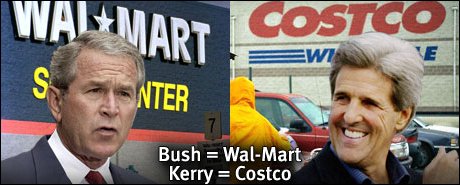
Like today's Democratic Party, Costco favors highly trafficked urban and edge-city locations—it has three stores in New York City. And it caters to a decidedly upscale crowd. As John Helyar reported in this excellent Fortune profile, the average salary of a Costco member is $95,333. The company's merchandise mix reflects the fact that its customers shop at discounters by choice, not by necessity. They're New Luxury suckers who like to save on staples, more Jean Chardonnay than Joe Six-Pack. As Helyar notes: "Costco is the U.S.'s biggest seller of fine wines ($600 million a year)." (Needless to say, "Moneybox" has been a member since 2000.)
Costco also has the sort of labor policy that would bring a smile to Barbara Ehrenreich's face. Pay starts at $10 an hour. About one in six employees is represented by a union, and workers receive nice health benefits. Sinegal has a non-zero-sum view of employee relations. Give people good jobs at good wages, and they'll be more likely to work harder, less likely to leave, and less likely to steal. As Helyar reported, Costco's turnover "is a third of the retail industry average of 64%," and "shrinkage"—the amount of inventory lost to theft—"is about 13% of the industry norm."
On the right: Wal-Mart Stores, Inc. Founded in Arkansas (a blue-turned-red state), it grew by spreading into the adjacent South and Great Plains. Like today's Republican Party, it focuses intensely on rural areas and generally avoids cities. (Republican conventioneers won't be able to shop at a Wal-Mart when they visit New York City.) As this Bloomberg story notes, "Sixty-seven percent of Wal-Mart's stores are in the 30 states that voted for Bush and Cheney in 2000."
The company's labor policies are state-of-the-art, for the 1890s. It has been investigated for hiring contractors who allegedly hired illegal aliens to clean Wal-Mart stores and for locking them inside overnight. (One wonders if the Wal-Mart employees who in April were bused in to hear Vice President Dick Cheney sing the company's praises at Wal-Mart's headquarters were similarly confined.) In June, a federal judge certified a class-action lawsuit filed on behalf of female Wal-Mart employees who claimed discrimination. The average wage at Wal-Mart, which has no unions and bitterly opposes raising the minimum wage, is lower than Costco's lowest wage. Turnover at Wal-Mart, according to the Economist, is 44 percent, meaning it "has to hire an astonishing 600,000 people every year simply to stay at its current size."
Costco's customers seem to have more disposable income at least... maybe it's an unintended effect of Bush's tax cut?
-
Consumers vote by shopping. And so far this year, they're voting more for Costco than Wal-Mart, yet another illustration of the Two Americas shopping theme. Costco's customers plainly have cash to spend. For the four weeks ended Aug. 1, Costco's same-store U.S. sales rose 9 percent; in the 48 weeks ended Aug. 1, they were up an impressive 10 percent. At Wal-Mart, the registers haven't been ringing quite so loudly. In its most recent four-week sales period, same-store sales rose a meager 2.4 percent. For August, Wal-Mart sees same-store growth of between 2 percent to 4 percent—about the same growth rate as the economy, if not slower.
I must confess, I've never been to a Costco before, but then I've led a sheltered life. Still, I've got some pretty rabidly anti-Bush family that are some of Wal-Mart's biggest cheerleaders... but then, we Midwesterners can be cheapskates sometimes too.
- Arik
August 11, 2004
Toys-R-Us... or R They?
-
Toys "R" Us Inc., battered by price wars from discounters, particularly Wal-Mart, is considering getting out of the toy business.
The nation's second-largest toy retailer behind Wal-Mart Stores Inc. announced plans Wednesday to restructure its toy business, but said it is considering selling the business outright as part of an effort to dramatically reduce operating and capital expenses.
The $11.6 billion company is also pursuing a possible spinoff of its fast-growing Babies "R" Us, whose 200 stores sell furniture, including cribs and bedding, as well as accessories. The company will begin operating the toy and baby business as separate entities in the meantime.
The Babies "R" Us division has been the company's growth vehicle, and has not been as vulnerable to discounters, Standard & Poor's credit analyst Diane Shand said in an S&P statement affirming its ratings on Toys "R" Us remained on CreditWatch with negative implications.
The company's U.S. toy division, however, has been inconsistent since the mid-1990s, when Wal-Mart ramped up its toy department as it also dramatically expanded the number of stores.
"Traditional toys have decreased in importance, as children are turning to video games, computer software, sporting goods, and music for entertainment at younger ages," Shand said.
Babies "R" Us, which represents 15 percent of the company's total revenues, posted sales of $1.76 billion, up nearly 11 percent, for the year ended Jan. 31. Meanwhile, the Toys "R" Us' U.S. revenues fell 4 percent to $6.48 billion. Toys "R" Us has 683 toy stores in the United States and 579 international toy stores. It also sells through its Internet sites.
The announcement "is extremely positive for investors, as one of the critical pieces to unlocking shareholder value in (Toys "R" Us) is separating its crown jewel, Babies "R" Us," said Mark Rowen, an analyst at Prudential Equity Group Inc.
It is anticipated that today's announcement comes preceeding some very, very weak results:
-
Toys "R" Us said Wednesday it would delay releasing its second quarter 2004 earnings until Aug. 23. The figures were to be released Monday. In the first quarter, the company's profit declined 48 percent in its fourth fiscal quarter, which ended Jan. 31 and covered a disappointing holiday sales season. Disappointing results continued into the first quarter, with the retailer posting a wider-than-expected loss and lower sales.
Poor holiday 2003 results helped lead to the bankruptcies of FAO Schwarz and K-B Toys.
Toys "R" Us has been retrenching for much of the last year to improve its bottom line. In November, it said it would close 146 freestanding Kids "R" Us clothing chain and 36 Imaginarium specialty toy stores, which sold educational toys, cutting up to 3,800 U.S. jobs.
So, maybe toys "R" not us? After the earnings release in a few days we'll see... but it'll be the coming holiday season, when we'll truly get to find out.
- Arik
August 10, 2004
Yahoo! vs. Google: Happy Together? (Round Two in Search Engine Wars)

-
As the day of its expected initial public offering approaches, search giant Google has settled two outstanding disputes with portal rival Yahoo! The settlement calls for Google to issue 2.7 million class A shares, which will be worth around $328 million if Google's stock prices at the mid-point of its expected range.
"We are pleased to have resolved these issues and with the terms of the agreement," said Steve Langdon, a Google spokesperson. A Yahoo! representative expressed a similar sentiment.
Google says it will have to take a one-time charge of between $260 million and $290 million in the third-quarter to account for the settlement. That will, the company says, result in its reporting a net loss for the quarter.
The most substantial issue laid to rest was a patent dispute over the business model and technology behind Google's AdWords program - by far the largest contributor to Google's revenues.
Overture Services, now owned by Yahoo!, filed suit against Google in April of 2002 alleging that Google infringed on U.S. Patent No. 6,269,361, "System and method for influencing a position on a search result list generated by a computer network search engine." Overture's patent protects bid-for-placement products as well as Overture's DirecTraffic Center account management system and tools. Google maintained the patent was "invalid and unenforceable."
The settlement reached today calls for Overture to dismiss the suit against Google and grant the rival firm a fully paid perpetual license to the patent, as well as to several related patent applications Overture holds. Google divulged these terms in an updated S1 filing with the Securities and Exchange Commission today.
The second dispute concerned the number of shares due under a branding and promotion agreement the two struck in June of 2000. In June 2003, Google says it issued around 1.2 million shares to Yahoo! under the terms of the warrant agreement, while Yahoo! contended it was entitled to more shares. Today's settlement sets aside this disagreement, as well.
The issuance of shares brings Yahoo!'s stake in Google up to 8.2 million shares, worth about $996.3 million if Google's stock prices at the mid-point of its range. Previously, Yahoo! owned 5.5 million shares, worth an approximate $668.3 million.
Google is reportedly preparing to make its initial public offering in the next two weeks. Widespread reports citing unnamed sources had pegged the IPO for this week, but glitches are said to have pushed things back. Google has registered to sell 25.7 million shares at a price between $108 and $135 per share. The company is taking bids in a Dutch auction at ipo.google.com.
The Associated Press last week reported that Google was delaying its IPO by a week because of logistical issues with its auction-based process. Meanwhile, Google earlier this month disclosed a legal snafu in the way it had issued more than 23 million shares to employees and consultants. And financial advisers and analysts have expressed concern that Google has overpriced its offering with its estimated selling price of between $108 and $135 a share.
"On the one hand, this clears up some questions for investors, but at the same time, the market has been bad, Internet stocks have been bad, and I think, so far, there's been lukewarm response in investing in Google," said Tom Taulli, co-founder of IPO-tracker Current Offerings.
The underlying question is whether this news, on top of all the other badness Google announced recently, will hurt an already aggressively priced offering. Yahoo! (an early investor in fledgling Google), can't really kick too hard, owning a stake in its most serious competitor - the settlement could net Yahoo as much as an additional $149 million at the high end of Google's expected IPO price range, and leave the company with a 4.1 percent stake in Google. After the IPO, Yahoo will also hold 4.95 million super-voting Google Class B shares, a 2.1 percent stake.
More interesting will be watching to see where the price goes in the day's following the IPO... there's a horde of investment bankers hoping it tanks so the whole Dutch-auction idea falls flat enough that they can get back to business as usual.
- Arik
August 09, 2004
South Korean Business Sees Gold in Olympic Games
South Korean companies like Samsung and Hyundai are big Olympic sponsors in Athens for the summer games starting next weekend:
-
Samsung Electronics Co. and Hyundai Motor Co., two of the meet's 32 international corporate sponsors, are poised to use the occasion as an opportunity to let themselves better known to worldwide spectators and TV viewers.
Samsung Electronics, the world's top memory chip manufacturer, is participating in the 2004 event as one of the main sponsors, called Olympic Partners.
The company first became an Olympic Partner in 1997, a year after group chairman Lee Kun-hee joined the International Olympic Committee (IOC).
Since that time it has poured an undisclosed amount of money into the Olympic Games as a sponsor while promoting its mobile handsets and wireless devices at the games.
For this year's event, it will be providing about 14,000 mobile phone handsets to IOC members, officials at the Olympics and reporters. Their handsets will provide real-time information on game schedules, results and other Olympics information using a service called Wireless Olympic Works.
Near the main Olympic Stadium, Samsung Electronics will set up a 1,057 square-meter facility to promote its products, including more than 200 mobile phones, and will provide free international calling services for visitors.
It will also set up large-sized logos and advertisements in stadiums and throughout Athens, which is expected to draw 1.5 million tourists.
It has also set up a 1.8-meter-tall replica of a mobile phone at Athens International Airport. The sponsorship that Samsung Electronics was awarded also allows it to set up advertisements with the Olympic logo on them in Olympic member countries throughout the world.
The company will further participate in the Olympic torch relay, which began June 4 and ends on August 13, taking the torch through 34 cities in 27 countries. Yun Jong-yong, the vice chairman of Samsung Electronics, will run in the torch relay in Athens on August 12.
Company Chairman Lee Kun-hee will leave South Korea Friday to participate in the Olympics' opening ceremony and an IOC meeting on August 13. Including the leadership, more than 400 Samsung officials will be at the two-week event.
Hyundai Motor became a National Sponsor in the automotive category for the Athens Olympics, participating as a sponsor for the first time. It was awarded the sponsorship in 2002.
For the Olympics, the automaker will be providing more than 500 vehicles, including Starex vans and the Equus sedan for athletes, reporters and other officials. It too will set up large advertisements at the event.
...and it's apparently having a deliterious effect on Samsung's operating profits:
-
While the companies are tightlipped about the exact amount that they paid, Kim said each company has to pay an average of $70 million to $100 million to win sponsorship rights and spends an additional $210 million to $300 million to market their products.
It is notable that such massive marketing spending occurred when Samsung Electronics' ratio of operating profit to sales declined in the information and telecommunications sector in the second quarter.
The company said at an investor relations session on July 16 that its sales and operating profit in the information and telecommunications sector for the second quarter this year were $4.19 billion and $686 million, respectively.
The company's ratio of operating profit to sales was 16 percent, down more than 10 percentage points from the previous quarter's ratio of 26.7 percent. This was the first time the company had a ratio of operating profit to sales below 20 percent since 2001.
Samsung Electronics attributed the decline to the increased marketing spending, which includes those for the Athens Olympics and others as well.
Cho Sin-hyeong, a company official in the media department, said marketing spending was "the main reason behind the decline."
"The spending includes marketing costs for the Athens Olympics, as well as marketing spending in other countries, mainly in the United States," Cho said.
The real argument is whether it's worth it. For Samsung, who's brand value in 1999 was estimated at $3.1 billion, 100th in the world, it finished 2003 at $10.8 billion and 25th place.
- Arik
August 08, 2004
DuPont Teflon: Does One of the Most Successful Products of All Time Make People Sick?

The New York Times article on DuPont and its potentially humongous liabilities from recent adverse health claims surrounding what has arguably been one of the most successful products in history - Teflon:
-
Teflon has been hugely successful for DuPont, which over the last half-century has made the material almost ubiquitous, putting it not just on frying pans but also on carpets, fast-food packaging, clothing, eyeglasses and electrical wires - even the fabric roofs covering football stadiums.
Now DuPont has to worry that Teflon and the materials used to make it have perhaps become a bit too ubiquitous. Teflon constituents have found their way into rivers, soil, wild animals and humans, the company, government environmental officials and others say. Evidence suggests that some of the materials, known to cause cancer and other problems in animals, may be making people sick.
While it remains one of DuPont's most valuable assets, Teflon has also become a potentially huge liability. The Environmental Protection Agency filed a complaint last month charging the company with withholding evidence of its own health and environmental concerns about an important chemical used to manufacture Teflon. That would be a violation of federal environmental law, compounded by the possibility that DuPont covered up the evidence for two decades.
DuPont contends that it met its legal reporting obligations, and said that it plans to file a formal response this week.
If an E.P.A. administrative judge does not agree, the agency could fine the company up to $25,000 a day from the time DuPont learned of potential problems with the chemical two decades ago until Jan. 30, 1997, when the agency's fines were raised, and $27,500 a day since then. The total penalty could reach $300 million. The agency is also investigating whether the suspect chemical, a detergentlike substance called perfluorooctanoic acid, is harmful to human health, and how it has become so pervasive in the environment. The chemical - which is more commonly known as PFOA or C-8, for the number of carbon atoms in its molecular structure - has turned up in the blood of more than 90 percent of Americans, according to samples taken from blood banks by the 3M Company beginning in the mid-90's. Until it got out of the business in 2000, 3M was the biggest supplier of PFOA. DuPont promptly announced it would begin making the substance itself.
What's more important than the immediate financial impact is the longer-term consequences to DuPont's image:
-
At the very least, the Teflon flap could damage DuPont's well-polished image. The 200-year-old company, based in Wilmington, Del., prides itself on its corporate values, and Mr. Holliday is a high-profile advocate of socially responsible business. "In the chemical industry, the critical thing is not only investor perception, but consumer trust," Mr. Pisasale said. "That can be very hard to build back."
In a preliminary risk assessment report released last spring, the E.P.A. said PFOA was a possible carcinogen, but did not advise that consumers stop using Teflon products. PFOA is used as a processing aid in making many Teflon products and and is not present in end products, such as cookware. But some researchers assert that some Teflon products can release PFC's, including PFOA, in the environment and in the human body. They contend that this could account for its wide presence in the environment and in the population.
A spokesman for W. L. Gore & Associates, which makes Gore-Tex, said the material it gets from DuPont does not break down into PFOA, but he conceded that the material could contain trace amounts and that there was still an open question about safety. "Are the downstream folks involved? Sure. We all want to find the sources and pathways here," the spokesman, Ed Schneider, said.
Most disturbing of all are the recently unsealed memoranda of DuPont's legal staff:
-
The class-action lawsuit, filed in Wood County, W.Va., the home of the Washington Works plant where DuPont has made Teflon for decades, has turned up a series of documents that DuPont had sought to shield as proprietary information. The latest came to light in May, when the West Virginia Supreme Court voted unanimously to unseal several DuPont memorandums from 2000 in which John R. Bowman, a company lawyer, warned two of his superiors - Thomas L. Sager, a vice president and assistant general counsel, and Martha L. Rees, an associate general counsel - that the company would "spend millions to defend these lawsuits and have the additional threat of punitive damages hanging over our head."
He added that other companies that had polluted drinking water supplies near their factories had warned him that it was cheaper and easier to replace those supplies and settle claims than to try to fight them in court. And those companies, he noted, had spilled chemicals that did not persist in the environment the way that PFOA does. "Our story is not a good one," he wrote in one memorandum. "We continued to increase our emissions into the river in spite of internal commitments to reduce or eliminate the release of this chemical into the community and environment because of our concern about the biopersistence of this chemical."
Another document summarizes the company's strategy for deflecting the PFOA issue and litigation. It offers various suggestions for improving credibility with employees, the community and regulators, such as "keep issue out of press as much as possible" and "do not create impression that DuPont did harm to the environment."
- Arik
 "Competitive Intelligence applies the principles of competition and lessons of intelligence to the need for enterprise awareness and predictability of market risk and opportunity. CI has the power to transform an enterprise from also-ran into real winners with agility enough to create and maintain sustainable competitive advantage."
