August 07, 2004
Weak Employment Report Puts Recovery in Question
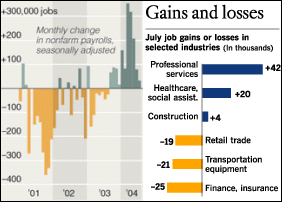
As you've probably heard by now, job growth news was out today and it was awful, leading most to decide the economy has definitely not "turned the corner" and John Kerry to claim it's making a u-turn.
After expectations of Wall Street analysts that the economy would add 240,000 jobs in July, the news fueled a predictable sell-off in securities as we all wondered what was driving prices higher even as people have supposedly less buying power.
Well, rising energy costs, for one, is being driven by fear and uncertainty, not any real supply and demand dynamics. The real question is, will the Fed raise interest rates again?
Sensing that the Fed might now back off additional rate increases, investors Friday bid up prices of Treasury notes and other government securities, which caused their interest rates, or yields, to fall. Ironically, lower rates tied to the weak job growth might help stimulate the economy further. That's because more people could jump into the market for mortgage loans, either to buy a house or to refinance their existing mortgage.
More interesting, the Labor Department's so-called Net Birth/Death Adjustment tabulates July as one of only two months in which there are more companies dying and taking jobs away than creating new jobs. The other month is January, when Labor takes out a massive number of jobs because it assumes a large number of companies die off after Christmas.
As a result of this cyclical phenomenon, it could've been reasonably predicted that, unless there was truly staggering growth in July, job growth would probably be flat at best.
I guess it pays to "run the numbas".
- Arik
August 06, 2004
"Vote for Change" Concert Tour Will Rock November Ballot Race
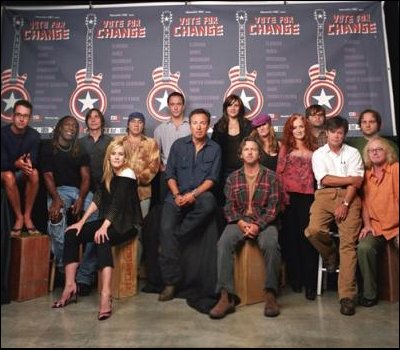
The eight-day "Vote for Change" tour begins October 1 in Pennsylvania. It will number up to 40 shows, with several concerts in each of nine key "swing states" taking place at separate venues on the same night, such as Florida, Ohio, Michigan and Missouri. The acts involved - Bruce Springsteen, Dave Matthews Band, R.E.M., Dixie Chicks, Pearl Jam and others - are united in the common goal of voting President Bush out of office in November. Plus, according to CNN/Money, it could raise as much as $44 million in addition to creating a lot of awareness among youth voters... no word yet whether Kerry gets the cash.
- Arik
August 05, 2004
What can the 9/11 Commission Learn from Toyota? Plenty

Slate.com had a good article by Duncan Watts on lessons for the 9/11 Commission on intelligence gathering, from business in the wake of disaster, specifically Toyota.
It's largely a critique of the recommendation to centralize ultimate responsibility and decision-making in the hands of a Cabinet-level intelligence czar as being historically tempting, but almost always wrong-headed:
-
When organizations fail, our first reaction is typically to fall into "control mode": One person, or at most a small, coherent group of people, should decide what the current goals of the organization are, and everyone else should then efficiently and effectively execute those goals. Intuitively, control mode sounds like nothing so much as common sense. It fits perfectly with our deeply rooted notions of cause and effect ("I order, you deliver"), so it feels good philosophically. It also satisfies our desire to have someone made accountable for everything that happens, so it feels good morally as well.
But when a failure is one of imagination, creativity, or coordination - all major shortcomings of the various intelligence branches in recent years - introducing additional control, whether by tightening protocols or adding new layers of oversight, can serve only to make the problem worse.
Watts then turns to the 1997 Toyota catastrophe of their only factory making brake valve assemblies burned to the ground and threatened to shutter the company and bring screeching to a halt all 15,000 per day auto production. "Clearly, then, Toyota, along with the more than 200 other companies that are members of the extended Toyota group, had ample incentives to find a solution."
-
they succeeded, but not in the way one might have expected. Rather than relying on the guidance and coordination of an inspired leader (control mode), the response was a bewildering display of truly decentralized problem solving: More than 200 companies reorganized themselves and each other to develop at least six entirely different production processes, each using different tools, different engineering approaches, and different organizational arrangements. Virtually every aspect of the recovery effort had to be designed and executed on the fly, with engineers and managers sharing their successes and failures alike across departmental boundaries, and even between firms that in normal times would be direct competitors.
Within three days, production of the critical valves was in full swing, and within a week, production levels had regained their pre-disaster levels. The kind of coordination this activity required had not been consciously designed, nor could it have been developed in the drastically short time frame required. The surprising fact was that it was already there, lying dormant in the network of informal relations that had been built up between the firms through years of cooperation and information sharing over routine problem-solving tasks. No one could have predicted precisely how this network would come in handy for this particular problem, but they didn't need to - by giving individual workers fast access to information and resources as they discovered their need for them, the network did its job anyway.
The central truth here is, it's much more important to build networks of informal and social relationships of people to get things done in the event of disaster and that, it's practically impossible to have a contingency plan for every surprise in business or in government. When surprises happen, it's more important to the survivability of the firm (and a nation's security) that its people come together to solve the problems created and get things back to normal as quickly as possible.
And, no centralized intelligence director can force that to happen.
- Arik
August 04, 2004
Google's IPO: Trouble Ahead?

Not only did Google illegally sell shares...
-
Google Inc. may have illegally issued more than 23 million shares of its stock to hundreds of employees and consultants, injecting an unexpected legal risk into the online search engine leader's highly anticipated IPO.
The Mountain View-based company disclosed the possible violations Wednesday in a prospectus offering to buy back the affected shares and outstanding stock options for a total of $25.9 million, including interest payments.
-
The lead Googlians say they're doing the IPO so investors can cash out, but as soon as that happens they will run the company without regard to the quarterly numbers that made Wall Street's heart go pitter-patter.
So Google will be just like a private company that isn't. And the people who buy the 9 percent of Google that's hitting the public market will be treated like … well, it could be like they don't own anything! That should make for really fun annual meetings.
For more than $100 a share, I say we should let Google keep its overpriced stock. Mark my words: Google is the Netscape of the new millennium. Well, the fall won't be so dramatic—Microsoft only sort of wants Google's head on a stick—but the selling shareholders are getting out while the getting's good. It's possible all the "odd" aspects of the stock offering are just PR stunts intended to more efficiently part fools from their money.
Something else I've noticed is the closer we get to the Google IPO the less useful Google has become. The bad guys have clearly learned to spoof the search engine, so much so that sometimes the first page or two of results are liberally salted with pages from other search engines claiming to be search results. It's also not as easy to find what I want on Google. I can't say why, but I am starting to look at using multiple search engines again. Maybe you really can't decide the relevance of a particular page based on how many other pages are linked to it.
Even the previously useful Google advertising of old now seems, likely as not, to be fill-in-the-customers'-search-term-here ads from eBay and other vendors who really don't have much to offer me.
Unless Google can do something quick to dramatically improve the quality of the results it presents, the search engine is in real trouble. But not to worry—most people won't pay attention during the IPO hype-storm, and no one will understand the real mess Google seems to be in until after a cool $3 billion has left investors' pockets.
Nice work if you can get it. And speaking of work, for the past few years the best and the brightest haven't been going to Microsoft or to other startups (what other startups?) but to Google, where the promise of riches awaited. After the IPO, Google will become a company of haves—new houses, new cars, early retirements—and have-nots—everyone else and most future hires.
That sort of environment is not particularly conducive to cooperation and harmony. I believe it was Apple where at one point the old-timers took to wearing buttons reading "FUIFV," as in "f-you-I'm-fully-vested." I am not sure how Google dealt with this in advance, but many IPOs have littered companies with perpetual underlings suddenly worth much more than their more recently hired bosses. Like I said, a post-IPO company can be a really interesting place to work.
Here's how I see the future: Google's star may continue to rise a bit, but then reality and the reality of being No. 1 and being everyone's target will hit home. Google will start to sink a bit—perhaps a big bit—just as Microsoft's new offering appears on the search scene. By that time, other search engines may have solved their problems, and customers will have noticed that Google isn't nearly as wonderful as it used to be. It's also possible that some third party will out-Google Google and come up with a better search engine, just as Google bested AltaVista (remember them?).
This could mean Google will be a short-lived phenomenon, at least as the Holy Grail of searching that it clearly used to be. Every day I use Google—and I do use it every day—it seems to be less useful to me than the day before.
At least it's doing good things for Silicon Valley...
-
Unlike Netscape, which went public to almost as much fanfare and celebration nine years ago, Google isn't being brought to a stock market unfamiliar with the Internet or the valley's technological wizardry. Silicon Valley has a history with investors, now. And for all the good—in terms of innovation and jobs—that has been created in the valley, there's some bad feeling, too.
That bad feeling—the slight aftertaste of being taken for a ride—is one reason politicians lump the valley with Enron when it comes to stock options. And it's worth remembering that sentiment when it comes time to consider Google's sale. Google has. The revised filing the company made with the Securities and Exchange Commission includes a section decrying the need to treat option grants as expenses.
So what's the most unusual thing about the Google offering? Unlike traditional stock offerings, Google's early shareholders—its backers, executives and other friends of the firm—can and are selling a great deal of stock. All told, those insiders are offering almost 10.5 million share of stock for sale at between $108 and $135 a share.
The company is selling a bit more, just about 14 million shares. A lot of rich people who acquired their stock at pennies per share are going to be even wealthier. And they are getting that way in a process that's being wildly (and correctly) described as being more open—and therefore more honest—than what's gone on before.
That's important. Because offerings like Google's have a way of starting trends. That could mean more "dutch auctions"—where the final price is set by the bidders—as tech companies try to follow in Google's shoes and do an end-run around the banking establishment and show shareholders the wonders of a disintermediated stock market. Clearly that's what Google founders Larry Page and Sergey Brin say as much in their "owners' manual" to shareholders.
-
In the dot-com era, IPOs were run as much for the benefit of the Wall Street underwriters as for the companies. Wall Street firms would set a price at which a company would sell shares to the broad investing public and distribute the shares. In practice, underwriters would dole out many shares to favored executives at client companies, or to hedge funds and mutual funds that threw a lot of trading business to the underwriters. By setting the price for dot-com stocks artificially low and by deciding who could get in on the IPO at the artificially low price, underwriters had a license to make their friends and clients rich in a matter of minutes, when frantic individual investors bid up the shares. (Before Eliot Spitzer came along, these conflicts of interest were known in Manhattan as "synergies.") In exchange for suppressing the offering price and thus depriving their client of needed capital, underwriters in most dot-com IPOs typically helped themselves to a fee totaling 7 percent of the offering.
But Google has largely cut out the underwriters. Its IPO is being structured as a Dutch auction. Any investor can submit a bid for as few as five shares. The underwriters will tally all the bids. They'll start at the top—$150, $200, whatever—and work their way down until all the shares are spoken for. That price then becomes the clearing price, which Google intends to use as the IPO price. There's no penalty for bidding high—if the clearing price is $140 and you bid $200 you'll pay $140. Those who bid under the clearing price get nothing.
Google's IPO price will thus be set naturally by all interested market participants, not artificially by underwriters. Google—and not well-connected investors—will receive the full benefit of investors' enthusiasm for the stock. To add insult to the injury of the chastened investment bankers, Google has decreed that it'll only pay a 3 percent underwriting fee.
In other words, Google has inverted the process. Almost by definition, the buying enthusiasm will peak before the stock starts trading. And today, you and I have the same chance as Warren Buffett, or Ford CEO William Ford, or a hedge fund manager, of getting in on Google's IPO. For precisely that reason Warren Buffett and Bill Ford and hedge fund managers probably won't be bidding. They have no angle, no leg up on the rest of us chumps.
And so most professional investors will likely boycott the offering. This is one of the reasons that TheStreet.com's James Cramer, a brilliant commentator and trader (but not one given to irony), has already dubbed the Google deal a fiasco. As Cramer implies, giving the stiff-arm to the professional investors who comprise a significant majority of the market, and who constantly have money to put to work, isn't an intelligent long-term investor-relations strategy. Professional investors in effect become salesmen for a company's stock. Selling stock without them is almost like Coca-Cola deciding to eschew the wholesale market (McDonald's, Marriott, college dormitories) and focus exclusively on selling six-packs to individual customers.
Google's IPO ensures that individual investors are treated fairly, as was frequently not the case in the 1990s. But it won't ensure that they'll make money. In fact, Google explicitly warns those seeking a quick buck not to bother: "We caution you not to submit a bid in the auction process for our offering unless you are willing to take the risk that our stock price could decline significantly." In fact, because of the auction process, the individual investors who absolutely positively must have this stock on the day of its offering may very well be buying at the top. At least some things never change.
- Arik
August 03, 2004
Doom 3: Can Carmack's "id" Reinvent Computer Games (as it did with the original, Doom)?
id Software released the much-anticipated "Doom 3" first-person-shooter on the world this week, to largely rave reviews:
-
“Doom 3,” the newest entry in game developer id Software’s horror hall of fame, is a departure of sorts. You still have hordes of demons after you. And that familiar click-click of the reloading shotgun remains. But over time, things have changed.
With previous id games, from 1993’s original “Doom” through 1994’s “Doom II” and 1996’s “Quake,” you were rewarded for shooting first and worrying about the consequences later. Now -- though you again play a Marine on Mars, facing a horde of demons unleashed from hell by scientific experiments -- you have to be careful not to eradicate a character who might hold a valuable clue to the secret to preventing a demonic assault on Earth.
“The first game didn’t have much depth,” says technical director John Carmack, who co-founded id in 1991 and was made wealthy by “Doom.” “Early on, we were just excited to get the basics, to get people scared or shocked at all.”
The original was groundbreaking. It established the success of the software marketing system known as shareware: The game was available free to download, swap and try, and customers paid to unlock higher levels. Some 20 million wound up playing the game. Subsequent id software games such as “Doom II,” “Quake” and “Return to Castle Wolfenstein” have sold a collective 15 million.
“Every game they have produced has set the standard for that time,” says fan Matthew Wood, 20, of Merritt Island, Fla. Since id announced last month that “Doom 3” -- after several long delays -- was finished and getting ready to ship, “time slowed down for many of us,” Wood says. “I pre-ordered the next day. ... ’Doom 3’ looks scary as hell. I cannot wait.”
“Doom” also popularized the “first-person shooter” concept: Players view the 3-D world through the eyes of the character on screen, wielding weaponry as if it were in their own hands.
Anti-violence activists decry the genre. “Desensitization is the classic problem that comes from these games’ point of view,” says Roy Fox, chairman of the department of learning, teaching and curriculum at the University of Missouri. He worries that children and teens will get access to the game, which is rated M for mature players, ages 17 and older. “It breeds the acceptance of violence.”
The action in “Doom 3” promises to be more intense than its predecessors, with effects and environments reminiscent of such movies as “Alien,” thanks to Carmack’s breakthrough method of realistically tying lighting and textures of objects to the player’s movements. “On a cinematic level, there’s depth and story,” says Carmack, who has already begun work on the next id game, an original title. “I’m extremely excited at how it turned out.”
One of the most anticipated games in years, “Doom 3” will have to battle for Game of the Year honors with “Half-Life 2,” a sequel to Valve Software’s 1998 top game. “It’s kind of a parlor game to discuss which is the most anticipated of the two,” says Dan Morris, editor of PC Gamer.
Together, the games could amount to a renaissance for a PC industry desperate to reclaim some of the glamour from console video games, which have been responsible for the bulk of the $10 billion video-game market. “This is going to swing the pendulum back our way,” Morris says.
In the September issue, Morris gives “Doom 3” the magazine’s highest rating in recent times (94 percent). “Its biggest breakthrough, after the technological side, is that it’s a compelling story,” he says. “The main purpose is not to shock you out of your seat but to draw you into a world and into a drama.”
“Doom 3” not only looks like a scary movie, it was developed like one. For this game, id Software recruited Matt Costello, who penned the stories for classic plot-driven games “The Seventh Guest” and “The Eleventh Hour,” to flesh out a script from which artists created storyboards, just as filmmakers do. “It allowed us to put all the action into the context of the story,” says id CEO Todd Hollenshead. “The players, when they play through the game, they will know where they are, they will understand the environment and will have a sense of purpose. We felt that was important.”
More fun though was Slate.com's piece on the designers behind the games, in this case, profiling John Carmack - dean of FPS genre game design.
- Arik
August 02, 2004
EDS Pays $135 Million to Buy Its Way Out of a Bad Deal

"EDS remains a tale of two cities," CEO Mike Jordan said in a press release. "Our ongoing business is now fully competitive, with increasing sales momentum reflected in our results as we lay the groundwork for further gains in 2005.
"At the same time, we continue to be burdened by the cleanup of past problem contracts, as exhibited by our lower cash flow guidance on Navy and the charge this quarter to terminate the company's 'other commercial contract.'"
So, just who is this 'other commercial contract' firm getting the $135 big ones? Well, nobody really knows for sure... but there is one top suspect:
-
EDS has paid $135m to pull out of a loss-making IT outsourcing contract, believed to be with US firm Dow Chemical.
The termination, effective from 1 August, was revealed in EDS's results for the quarter ended 30 June.
The Texas-based outsourcer recorded a 3.5 per cent rise in revenues to $5.24bn and an operating loss of $84m, compared with last year's $184m profit. However, the sale of the UGS PLM unit led to an overall post-tax profit of $270m, compared to $88m for the same quarter last year.
Buried in the earnings report was a one-line announcement that EDS has reached an "amicable agreement" to terminate a "commercial contract".
EDS is keeping tight-lipped on which company the loss-making contract was with but industry sources have named Dow Chemical as the number one suspect.
One source told silicon.com that the reason the name is being kept secret is that as a result of settling amicably EDS will get a shot at some BPO work from the firm in the next three to six months.
Dow Chemical, however, is also keeping tight-lipped and a spokeswoman would neither confirm nor deny it is the company in question. All she would say to silicon.com is that Dow has been in active conversation with EDS and is happy with progress.
Robert Morgan, business development director at outsourcing consultancy Morgan Chambers, said that whichever deal it is, it is likely to be part of a "hit list" of troublesome contracts drawn up by EDS CEO Michael Jordan back in February.
"Jordan ordered a review of accounts and those not performing had to produce a report. He has met with most of the CEOs of those companies to see if it is possible to retrieve the situation or not. Jordan is taking a very personal interest and this hit list has more than a dozen companies on it. This is the only one so far that has been settled like this," he said.
Anthony Miller, analyst at Ovum Holway, said in a statement that the results are a "tale of two halves" with duff contracts pulling down the bits of EDS's business that are improving.
"There's still a huge job ahead, not made easier by EDS first having to explain its credit rating downgrade to all of its major clients and prospects -- not the best way to have to start a sales call," said Miller. "Embattled, certainly, but beaten? Not by a long way."
- Arik
August 01, 2004
No Pain, No Gain: Post-DNC Kerry vs. Bush Polls
After the carefully scripted Democratic National Convention in Boston last week, the latest USAToday, CNN and Gallup poll shows Senator John Kerry lost ground while President George W. Bush gained in a number of key measurements, and that hasn't happened in a really long time. Fears about terrorism were the likely culprit to overshadow what should've been a double-digit gainer event for Kerry.
- Arik
 "Competitive Intelligence applies the principles of competition and lessons of intelligence to the need for enterprise awareness and predictability of market risk and opportunity. CI has the power to transform an enterprise from also-ran into real winners with agility enough to create and maintain sustainable competitive advantage."
