August 19, 2004
Dairy Queen’s "MooLatte" Product Moniker Controversy
 Over the past few weeks, Dairy Queen’s been running into a few rough spots with its new MooLatte coffee/ice-cream treat. The commercial to launch the drink was bashed by most marketing savvy ad critics; but, the more potent criticism has been the stunning resemblance between the words "MooLatte" and "mulatto":
-
The Houston Press, an alternative weekly in the New Times chain, agrees that the name of Dairy Queen's new frozen drink, the MooLatte, sounds so much like "mulatto" as to call into question the mental competence of Dairy Queen's corporate leadership. That the Minneapolis-based company would deliberately allude to the hoary stock character of the "tragic mulatto" in naming a drink of light brown hue is too ghastly a possibility to consider. But could DQ really be so dim as not to notice the similarities between "MooLatte" and "mulatto"? Houston Press staff writers Richard Connelly and Craig Malisow have laid out compelling evidence that it is.
Malisow, working under Connelly's close direction, placed a call to Dairy Queen spokesman Chad Durasa, whose name appeared on an Aug. 3 press release inviting residents of the Lone Star State to "bring your favorite cow" to Dairy Queen on Aug. 24 to receive a free MooLatte. Malisow's ensuing Ali G-style interview, as related in the Aug. 12 Houston Press, was so extraordinary that I felt compelled to ask both Connelly and Malisow whether any of it was made up. They assured me it was genuine. Here it is...
But, you'll have to visit Slate.com for the full interview - it's pretty good stuff... In searching around the DQ site this week, the MooLatte product line appears to have pretty much disappeared from view, as the company tries to figure out how to handle this, I’d reckon.
For me, having tried the Mocha MooLatte (more than once), I thought it rivaled the Starbucks Mocha Frap (Venti only for me, thanks)… but it wasn't until later that, I learned both drinks have somewhere around 700 calories, and all of ‘em of the bad-for-you variety. It seems DQ's otherwise deft move to expand the customer base by adding caffeinated beverages to the product mix may ultimately fail to impact the Starbucks horde to defect to the Brazier.
- Arik
August 18, 2004
Blockbuster Gunning for Netflix Movies-by-Mail Market
 Blockbuster jumped into Netflix's highly-profitable movie-by-mail sandbox last week, pushing its 25,000-title DVD rental library to Internet users and leaving fulfillment to the USPS. Blockbuster says it will begin offering an online movie-rental service beginning in 2005, and in addition to undercutting Netflix's subscription price, Blockbuster will offer two free in-store movie rental coupons per month, to try and juice their differentiation strategy.
Blockbuster’s entry represents at least an intensification on the initial Netflix counter-attack, which began in May and offered subscribers unlimited rentals with no late charges, but still required them to return movies to the stores from which they had been rented.
Can Blockbuster turn a buck in this new market? Netflix has diversity cornered in its eclectic rental library and in being first to market but with earnings of $2.8 million on $120 million in revenue for the second quarter, Blockbuster will need to compete on more than stocking big-name, new releases - it'll have to diversify its library, while moving to spark a price war.
-
The Blockbuster Online service will provide subscribers with unlimited DVD movie rentals in the mail, with up to three out at a time and no return dates or late charges. A monthly fee of US$19.99 will be charged, which undercuts Netflix's $22 monthly price to new customers.
The Blockbuster deal also includes two free in-store movie rental coupons per month. To promote the new service, Blockbuster has formed marketing alliances with MSN and AOL, which it claims will help it reach 75 percent of U.S. Internet users.
The online-rental service is part of a series of initiatives being implemented by Blockbuster in a bid to transform itself from a neighborhood-based movie rental business into an "anywhere anytime" entertainment operation that eventually will enable customers to rent, buy or trade movies and games, new or used, in-store and online.
In May, Blockbuster launched a store-based subscription service called "Movie Pass." The unlimited rental, no late-charge program requires customers to pick up and return the DVDs to the company's stores rather than get them by mail.
The Blockbuster Online service is expected to be fully integrated and combined with the store-based subscription programs in 2005, the company said. "If a customer is in our store and wants to return a movie they rented online, we'll be able to accommodate them," says Shane Evangelist, Blockbuster vice president and general manager of Blockbuster Online. "If a member rents primarily in-store, but wants a hard-to-find title we don't typically carry in-store, he or she will be able to go online and get it. It's a matter of maximizing convenience and choice."
With total revenues of just US$280 million industry-wide last year, the online subscription business represents only a small percentage of the $8.2 billion U.S. movie-rental market. "However, the online-rental business is growing, and Blockbuster believes it has the potential to appeal to several million U.S. households," the company says.
"The research we have seen from Kagan World Media suggests that the online-rental market will have 6.5 million customers in the U.S. by 2008, up from 2.5 million today," Evangelist told NewsFactor. "The reason the market is so small right now is that online movie rental is a new kind of business, and the service providers need to educate potential customers."
Netflix's success in the home-delivery DVD rental market has led other established retailers to offer a similar service. For example, Wal-Mart Stores has a low-cost unlimited offering, letting customers pay just $15.54 a month for up to two DVDs at a time or $18.76 a month for the three DVDs that Netflix and Blockbuster offer.
"There are also some smaller players in the market," Evangelist told NewsFactor. "But there are high barriers to entry. To become a major player, companies need to make a significant investment. Online movie rental is very capital intensive, as there is the cost of product, buying the customers, and also setting up the service infrastructure."
Blockbuster has set up 10 delivery centers across the U.S. so it can provide next-day delivery to its online customers, Evangelist said. "The way the service works is that you go to our Web site, select your three movies, and then we mail you the first one," he explained. "Once you have viewed the DVD, you mail it back to us in a pre-paid envelope, and we will then send you the next movie. Next year, once we have integrated the online service and the in-store subscription program, we will be able to use our stores to provide same-day delivery to online customers."
Blockbuster is the world's largest video and DVD rental chain, with nearly 9,000 outlets. U.S. media giant Viacom is in the process of selling off its 81 percent stake in Blockbuster.
"It is good for consumers that the DVD online-rental market is getting more competitive," Gale Daikoku, a retail analyst with GartnerG2, told NewsFactor. "It is about time that this happened. Netflix has been under pricing pressure since it put its prices up in June, and now Blockbuster has come in to undercut it.
However, Daikoku warns that Blockbuster's plan to integrate its mail-order service with the in-store program may face difficulties. "The in-store business model and customer experience is really very different from the mail order," she told NewsFactor. "Subscribers will expect to be able to drop off at the stores DVDs that they rented online, or even pick up DVDs from the stores that they had selected on the Web site. But will the I.T. system integration work properly? Will there be confusion about Blockbuster's various subscription programs?"
It seems to me this move can't have been exactly unexpected on Netflix's part - I mean, with all the barriers to entry, who else but Wal-Mart and Blockbuster are really in it to win it? There's one other company that has the infrastructure to make it work and possibly even overcome the Blockbuster advantages: Amazon.com.
- Arik
August 17, 2004
Viagra vs. Cialis & Levitra: Battling Ad Strategy Leaves Cialis Gaining on Viagra's Still-Solid Market Lead

-
Since the FDA's approval of Cialis and Levitra in 2003, television has become clogged with ads for ED (erectile dysfunction) drugs. In opposition to the "We are the Champions" Viagra ad that uses the Queen song to celebrate that triumphant feeling of getting free Viagra with every seventh prescription refill, the Cialis ad asks men the worrying question, "If a relaxing moment turns into the right moment, will you be ready?" Levitra's launch campaign included a partnership with the NFL and tried to entice men away from Viagra with a sex-as-sport pitch. This approach failed miserably, illustrating the difficulties of selling new ED drugs in the wake of Viagra's overwhelming market lead. Although Cialis and Levitra have been on the market for almost a year, Viagra still retains 75 percent of the $2 billion ED drug market, Cialis has managed to capture 14 percent and Levitra 11 percent.
After it received FDA approval in March 1998, Viagra had five straight years of being the only clinically tested ED medication available and immediately cornered the world market. Having no other similar products from which to differentiate itself, apart from a few herbal remedies of the "Horny Goat Weed" variety, Viagra didn't need to create an image for itself. Viagra's original advertising consisted of endorsements from spokesmen like Bob Dole; older respected men who basically said, "It's here. It works." Enthusiastic reviews from Hugh Hefner and other aging playboy types didn't hurt, either. Soon, Viagra was being used by all sorts of people, many of whom didn't even suffer from ED. Several years later, Viagra is so sure of its universal recognition and consumer brand-loyalty that it can joke about the high price of Viagra, while surreptitiously gloating over its market supremacy in the "We are the Champions" ad.
Viagra's reputation makes marketing Johnny-Come-Lately competitors like Cialis and Levitra an unusually tough challenge. As Robert Krell, president of pharmaceutical advertising company Krell Advertising says, "It's a monumental task for a new drug to take the lead away from the first drug to market". This is especially true in the case of Viagra. Since Viagra is already a potent and unfailing remedy for impotence in the popular imagination, alternative drugs are fighting an uphill battle against their own apparent redundancy. Why reinvent the wheel? A significant dimension of the marketing challenge that faces the makers of Cialis and Levitra is that they must re-establish the problem of impotence – a problem that many consumers see as already having been solved by Viagra – in order to offer their products as a cure. Impotence, however, is such an unpopular topic, that it is almost impossible for advertisers to refer to it without alienating the very consumer base they are trying to reach.
Levitra has now dropped the sporty, macho tone of its first campaign and created a new ad featuring an attractive brunette who addresses the camera confidentially to tell us a "secret" about her man: He has erection problems. But not to worry, "For him Levitra works," she confides, "just look at that smile." This ad eschews innuendo for a direct discussion of sexual performance, a daring but risky approach, which also limits the ad to evening slots. Whether or not this change helps Levitra's market share remains to be seen; what is significant is that the new ad focuses on the positive concept of sexual performance rather than the negative concept of impotence. Instead of a guy who can't even get his football in the hole, we are presented with a desirable woman whose Levitra-enhanced man has evidently pleased her and himself. This ad suggests that Levitra is about making a good thing better, not helping desperate men to "stay in the game." It also introduces the element of female approval, for although the woman tells us to look at her man's smile, it is her smile that counts.
Cialis differentiates itself from both Viagra and Levitra by offering a 36-hour window of efficacy. This beats Viagra's and Levitra's four-to-eight hour period, and allows Cialis to focus its advertising on timing rather than performance. The first series of Cialis ads showed a couple in bathtubs in a romantic, natural setting. and asked if the man was "ready" for this opportune moment. Like the ball-throwing Levitra ad, this Cialis ad uses fear as its basic motivator, but the fear has been shifted from the stark question of ability – can you do it? – to the less threatening question of preparedness; will you be ready when the time is right? This ad presupposes the existence of drugs like Viagra and Levitra, but implies the limitations of the time frame they offer: In a spontaneous moment of desire, do you want to have to pop a pill and wait an hour for it to take effect? In France, Cialis is already known popularly as "le weekender," a buzzword that suggests Cialis's potential to ultimately threaten Viagra's primacy in the market with its superior convenience.
My prediction based on this analysis is, there's a real competitive threat from Cialis to Viagra's market hegemony based on this differentiation and, ultimately, the ad strategy behind it.
- Arik
August 16, 2004
MicroStrategy vs. Business Objects: Both Claim Victory

One of the documents mishandled by Business Objects provided a detailed description of how MicroStrategy planned to compete against Business Objects, the leader in the business intelligence space after acquiring Crystal Decisions last year for $820 million.
Business Objects thought of the trade secret ruling in a somewhat more positive light. In its own statement, the software maker said the court found that a former Business Objects employee had misappropriated two documents, not the hundreds of files MicroStrategy had alleged were mishandled.
Business Objects further said the court issued a "very narrow" injunction ordering Business Objects not to use or distribute the documents and that it shot down MicroStrategy's request for attorneys' fees.
The same court also found in favor of Business Objects, rejecting MicroStrategy's earlier claims of patent infringement of U.S. Patent No. 6,260,050. It had earlier thrown out MicroStrategy's claim of tortious interference.
-
These were a “Competitive Recipe”, detailing MicroStrategy’s plan for dealing with its rival in the market, and a volume discount schedule, detailing thresholds at which MicroStrategy would give customers a discount.
The court therefore granted an injunction against Business Objects, prohibiting the company from possessing, using or disclosing the two trade secrets identified by the court.
The court refused to grant legal expenses to MicroStrategy and, in another ruling, dismissed a claim for patent infringement put forward by MicroStrategy.
Business Objects welcomed the judgment, commenting that the court had found only two cases of misappropriation out of the hundreds of examples put forward, and at the end of the day had issued only a “very narrow” injunction.
“This is an important victory for Business Objects, its employees, customers and shareholders," said Susan Wolfe, senior vice president and general counsel of Business Objects. "These decisions by the Court in Virginia confirm what we have maintained all along - that MicroStrategy's allegations and claims against Business Objects were essentially meritless."
“We are pleased with the court's decision,” responded MicroStrategy Vice President, Law and General Counsel, Jonathan F Klein. "Business Objects misappropriated our trade secrets, and the court issued an injunction prohibiting their use".
"Business Objects' suggestion that its misconduct involved only a single employee and two documents is contradicted by the court's extensive factual findings," he added.
A further patent infringement case between the parties is still ongoing.
-
MicroStrategy differed on its view of the decision, with company general counsel and VP for law Jonathan Klein saying he was "very pleased" that the ruling "validated our original purpose in bringing these claims."
Klein said the court's 61-page ruling details how internal MicroStrategy documents - including e-mails, presentations, sales reports and competitive intelligence focused specifically on Business Objects - were circulated widely among Business Objects employees, including some of its top executives.
"When I saw Business Objects' announcement this morning, I thought they could not possibly have read the same ruling I did," Klein said. Business Objects representatives were not immediately available for comment.
In the second decision, the court issued a formal order on a ruling it made last year. The ruling granted summary judgment in favor of Business Objects, rejecting patent infringement claims made by MicroStrategy.
Business Objects and MicroStrategy compete head-to-head in the business intelligence market, particularly in the area of reporting and analytics applications. Business Objects is the larger of the two companies, with sales of $560.8 million in the last calendar year, compared with $175.6 million for MicroStrategy.
Whatever your take on the outcome, the two are going to keep slugging it out over this last patent issue and we’ll see where all the dust settles. In the meantime, if you’re in the BI software business, it’s apparently time to review your non-compete/confidential-disclosure agreements… at least if you’re competing with these two.
- Arik
August 15, 2004
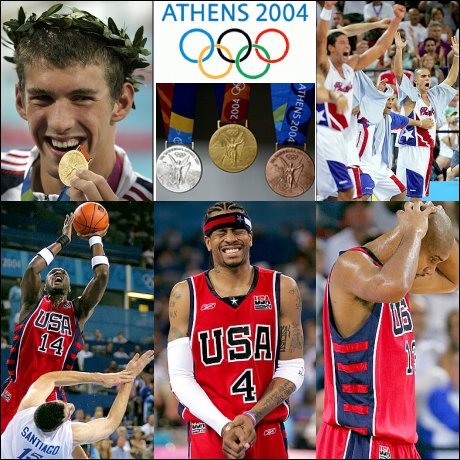
2004 Summer Olympiad Opens in Athens – U.S. Basketball Taken to the Woodshed
-
I didn't need to see Puerto Rico rout the United States to know that the world is playing great basketball; didn't need to see the United States shoot 35 percent to know that the team we've sent to the Olympics has no outside shooter, and maybe only an outside shot at the gold medal.
As compelling as "the world is catching up" angle may be, yesterday's loss was as much about Puerto Rico wanting to get the United States off its back - on a number of levels - as it was about the world catching up.
This was about a veteran Puerto Rican team wanting to win a gold medal and beginning the journey by beating a team that had beaten it like a drum. The game was more about that than about a continental shift.
Puerto Rico's 40-year-old center, José Ortiz, all but cautioned the United States team that this had better be the last time the Americans play a team for chumps. No one was saying it quite that bluntly, but that's what happened. "I'm not saying that they did not take us seriously," Ortiz said. "But they should understand that this kind of tournament is very intense, and also the rules are different."
Which rules? He smiled. The biggest rule is respect. "Don't take other teams lightly," Ortiz said. "That's my advice."
United States basketball players still believe they own the franchise. The reality is that they own half the franchise - the pizazz half. The rest of the world plays good, solid basketball.
That is the difference between the National Basketball Association and the rest of the world - and the gap that the United States team will have to bridge in the next 48 hours.
The world may play higher-quality basketball than the United States - if you define quality by playing textbook basketball. The United States, embodied by the National Basketball Association, plays more spectacular basketball. That's what the N.B.A. sells: spectacle. That's what the world buys, and why it loves the N.B.A.
The greatest cheers for the United States yesterday came on breakaway dunks and flashy passes and steals that ended with dunks.
That won't win a medal.
Everyone thought a 95-78 loss to Italy last month humbled the United States.
The team was shocked, but not humbled. These elite players come out of a culture of stardom that only intensifies as they get older. Before the game yesterday, when it was time for team photos, a mass of photographers gathered in front of the United States team. Only one photographer turned to snap the Puerto Rican team, until the United States team walked off.
Whether they've earned it or not, the United States players are still the glamour attraction, and for all those who will use yesterday's game as some type of measuring stick, the world is not catching up.
The United States lost to Puerto Rico, a proud team that had never beaten the United States in Olympic competition and lost by 25 points to the United States on July 31.
If Kevin Garnett, Jason Kidd, Tracy McGrady, Shaquille O'Neal and Kobe Bryant were playing, this might not have been much of a game, probably not much of a tournament either. The reason there is so much of a buzz around these Olympics is that those players are not in Athens, meaning that the United States is vulnerable.
This is a young American team, the youngest since the United States started using professional players, in the 1992 Barcelona Games. Allen Iverson, at 29 the oldest player on the team, has been through that arrogant phase, the phase when you think you can walk on water and dunk over anyone. His toughest job as this team's captain will be convincing his teammates that they can lose, in embarrassing fashion, that the sun doesn't rise in their backyards.
They've inherited a mantle of greatness that they did not earn.
Iverson has been worried about the cockiness of his young teammates.
"You can come in and think you're invincible and that nobody can beat you, and all you got to do is step out on the basketball court," Iverson said last week. "You need a lesson like that, that you're not invincible."
Any team that has Allen Iverson as its voice of reason is a compelling team indeed.
After its loss to Italy, the United States responded by defeating Germany, routing Serbia and Montenegro and beating Turkey twice.
I'm curious to see how the players will respond to yesterday's loss, especially with a game tomorrow against a Greek team that beat Australia by 22 points yesterday and will be playing in front of a frenzied crowd. Going into this tournament, Larry Brown, the coach of the United States team, said he wasn't sure his players had learned the lesson of humility. They haven't.
After yesterday's game, a dejected Brown questioned his team's desire.
"I think they played so much harder than we did," he said of the players from Puerto Rico. "The first day we got together as a group, we talked about respecting our opponents, realizing that these guys have played together, realizing that the game has gotten better all over the world and try and understand how important it is for them to represent their country and play the right way.
"The only thing we can do is find out what we're made of.
"This is a great opportunity for a group of guys to get together and figure out what it means to truly be a team. I'm anxious to see if we'll be able to do that."
He'll have plenty of company.
Otherwise, Daniel Gross had an interesting piece on Slate.com last week about predicting medal counts based on past success and future economic factors affecting competitiveness of athletes:
-
The countries of the former Soviet bloc, some of which have seen declines in living standards in the past 15 years, have continued to excel. The model projects impoverished Belarus, which won 17 medals in Sydney in 2000, to win 15 medals in Athens—the same number as prosperous Canada. The Soviet-era sports bureaucracies may have crumbled in Russia and its former republics, but the infrastructure that produced world-class wrestlers and gymnasts hasn't dissolved entirely.
The model foresees little change at the top. As they did in 2000, the United States (70), Russia (64), China (50), and Germany (45) are expected to take home the greatest number of medals. But look closely, and each Olympic titan is projected to take home substantially fewer medals than it did in 2000. And none is expected to fall further than the United States. What's more, the top 30 Olympic nations are projected to lose about 10 percent of their total. Meanwhile, the rest of the world—a large assemblage of Olympic also-rans—is expected to increase its medal take by 50 percent. As we were exerting our hegemony in the Middle East and Central Asia, were we (and our coalition partners) losing it in the high-jump pit and the swimming pool?
If so, there are two possible explanations. One is the pre-9/11 Thomas Friedman explanation. With the continuing flow of information, resources, and people all over the globe, those who excel at sports are increasingly able to train and compete against world-class competition. Kenyan distance runners receive scholarships to colleges in the United States, inner-city American fencers compete against aristocratic Europeans, Israel produces a world-class judoka, and Italy fields a competitive baseball team. The world today is a happy playground in which specialization and excellence are identified, developed, and rewarded.
The second is the Patrick Buchanan explanation: Lazy white FirstWorlders are about to be overwhelmed and outrun by hungrier, darker Third World residents. The model projects such big losses for established Olympic powers—and such big gains for nobodies—largely because of the influence of GDP growth. In the past four years, France and Germany have had comparatively little growth compared with, say, India and Mexico. So, France and Germany are projected to lose medals, while India's total is expected to rise from one to 10 (!) and our neighbor to the south could win 11 medals, up from six in 2000. We may think the rich are getting richer. But the poor are getting richer at a more rapid pace. "What's tended to happen is that the developing economies' share of the global economy is increasing over time, and perhaps these countries are becoming keener on participation in the Olympics," said Hawksworth.
Hawksworth produces another warning that echoes what one hears these days in economic circles: Look out for China. China may do better than expected in part because "with the Olympics coming up in Beijing in 2008, they seem to be setting a national priority," said Hawksworth. "They're kind of challenging the U.S. and Russia as the Olympic superpowers."
- Arik
 "Competitive Intelligence applies the principles of competition and lessons of intelligence to the need for enterprise awareness and predictability of market risk and opportunity. CI has the power to transform an enterprise from also-ran into real winners with agility enough to create and maintain sustainable competitive advantage."
