February 18, 2004
Edwards Surprises, Dean Drops Out After Wisconsin Democratic Primary
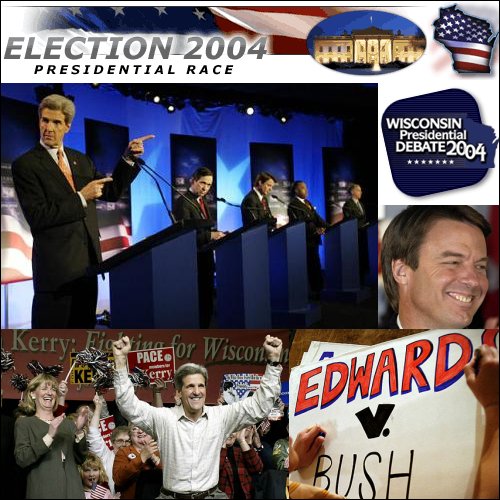
John Kerry thanked Wisconsin voters Tuesday for moving his campaign forward, but Edwards slyly suggested that the state had sent a message to the senator from Massachusetts: "Objects in your mirror may be closer than they appear."
Edwards might have his wish for a one-on-one contest, but Kerry may already be out of reach. The challenger faces a tough Super Tuesday. "If Edwards actually wanted to compete for the nomination, he needed to start drawing a contrast with John Kerry a month ago," said Steve Murphy, campaign manager for Missouri Rep. Dick Gephardt, who quit the race after finishing fourth in Iowa's Jan. 19 caucuses. "Democrats are coalescing around John Kerry right now … and they are eager to get onto the task of beating George Bush."
His most obvious target would seem blue-collar, non-college-educated voters sympathetic to his tough-on-trade message. However, his biggest surprise came from crossover appeal with Republicans and Independents that find him a seductive alternative to Kerry, despite rumors that Republicans only voted for him to delay the de facto selection of Kerry as the nominee, months ahead of the Democratic Convention.
Wisconsin's open primary and high turnout produced what was the largest and arguably the broadest electorate of the Democratic campaign. That proved critical to Edwards' performance, exit polls of voters showed, and now supplies the North Carolina senator with important bragging rights as he makes the case that he can expand the party's appeal as nominee.
"I think it means I can beat George Bush," Edwards said on CNN. "If we're going to win the general election we're going to have to win independents."
In the election night interview, Edwards pointed to Sunday's presidential debate (the top-rated program in its time slot in Milwaukee) and the endorsement of the Journal Sentinel, the state's biggest newspaper. The Capital Times of Madison also endorsed Edwards.
He also pointed to the issues of jobs and trade, issues he hit hard in a state that has bled 80,000 manufacturing jobs in the last three years. In ads and in the debate, he stressed populist themes and his opposition to NAFTA - the free trade agreement with Canada and Mexico that Kerry voted for a decade ago.
Edwards did not attack Kerry directly on the issue, but the exit polls suggested the debate over trade and jobs had boosted him. About three-quarters of Democratic primary voters saw U.S. trade with other countries as costing Wisconsin jobs.
And jobs and the economy was the leading issue among voters, chosen by about four in 10. Those voters who cared most about jobs and economy favored Edwards over Kerry; voters who cared more about health care or the war in Iraq favored Kerry.
In his speech to supporters Tuesday night in Middleton, Kerry also dealt with trade issues, promising to push for new protections in trade agreements and give "that fair playing field to workers across our country."
"And I'll tell you what we will outsource," Kerry said in his victory speech, in a line similar to one Edwards has used here. "We will outsource the Bush tax cut for the wealthy. We will repeal it so we can invest in health care and the education of our children."
Altogether, around 800,000 Wisconsinites voted in the Democratic presidential primary. (Bush, the only name on the GOP ballot, drew more than 100,000 votes.) That means about 20% of voting-age citizens participated in the Democratic contest, topping the turnout in every contest so far except New Hampshire on Jan. 27, where about 23% turned out. So, in raw numbers, Wisconsin's turnout far outstripped any previous primary or caucus, something not lost on this Wisconsinite, as the state moved up its primary specifically to have more of a voice in picking a nominee.
And it set the stage for what Edwards said he had long wanted after trying to break through what was once a crowded field: a clear two-way race with Kerry, played out over a relatively long period, until the next big primary day, March 2nd.
Going into Wisconsin, Edwards’ strategists saw an opportunity. There would be a full week to campaign in just one state with a history of favoring populists, as he’d promoted himself, and an electorate stacked with independents who, polls in other states showed, Edwards was attracting.
Meanwhile, Howard Dean decided to essentially end his presidential bid Tuesday after he placed a distant third, his 17th straight loss at the polls.
Though Dean is not going to formally drop out of the race, he is going to stop campaigning. The move would allow his supporters to continue to vote for him in the upcoming primaries and have a say at the Democratic National Convention in July.
His loss in Wisconsin came after the former Vermont governor virtually camped out in the state for 10 days, pleading with voters to reignite his faltering candidacy. At one point, he lashed out at Kerry, accusing the Democratic front-runner of supporting corrupt fundraising tactics and describing him as little better than President Bush. Despite the attention Dean showered here, crowds at his events dwindled and his aides grew grim.
So, despite Edwards relatively strong showing, I think it’s still clear that Wisconsin voters are in the same pragmatic mood as voters in other states. One thing’s for sure – we certainly got more attention than we usually do in presidential politics.
- Arik
February 17, 2004
Cingular Wins AT&T Wireless Competition: Vodafone Withdraws Amid Verizon Complexities

Vodafone ran up the bidding in a stroke of competitive gamesmanship unlike any in recent memory. I think it was a strategic masterpiece that will leave a pair of global competitors – SBC and BellSouth – trying to recover for years to come. Cingular thought it had to convince Vodafone that to beat them, they would have to vastly overpay. I really don’t think Vodafone was ever serious about a bid for AT&T Wireless; it was a ruse to make Cingular overpay instead.
But maybe in doing so, according to a false report in the early edition of the New York Times claiming Vodafone had won the competition to acquire AT&T Wireless, perhaps Cingular paid a bit more than it should have. Still, it clearly wasn’t in Vodafone shareholders’ best interest to win, what with a necessary exit from its Verizon Wireless partnership leaving a tax liability of $4 billion, beside the fact that Cingular has the best operating synergies, particularly in terms of technologies – a fact which essentially escaped most analysts looking at the situation.
No doubt, when Cingular Wireless on Tuesday won an auction for smaller rival AT&T Wireless Services with a late-night $41 billion offer that edged out Britain's Vodafone Group, it created the new U.S. wireless leader. The deal, worth $15 per share, was the largest all-cash offer in history and marked a 37 percent increase over Cingular's initial offer made last month. AT&T Wireless was an attractive target as the third-largest U.S. mobile phone operator with the second-highest revenue per customer, with a 17 percent marketshare. NTT DoCoMo had invested $10 billion in AT&T Wireless - although that investment was trading lately with a value about half that.
Another big advantage for Vodafone entering the race, whether they bought them or not, was the peek they got under the hood of a major competitor.
"I don't think they overpaid. It's definitely a bet for their future," said one telecom banker, who was not involved in the deal. "It's a huge wireless hedge. It will be the basis for more bundling (of other services) with the parent companies."
The combined company leapfrogs current U.S. market leader Verizon Wireless, giving it 46 million customers, annual revenues of more than $32 billion and a presence in 97 of the top 100 U.S. markets. Cingular's parents, Baby Bells SBC and BellSouth, see the growing wireless market as a key to offsetting the decline of their core local telephone operations.
The deal also marked the start of long-awaited consolidation in the crowded U.S. wireless market where six national brands and a handful of regional players are battling for market share as subscriber growth slows. As the Consumers Union slammed the deal, saying the merger would lead to higher wireless-calling rates and poorer service. I disagree.
Although the merger would shrink the number of national carriers to five companies, I personally doubt the deal would ease the industry's intense competition and price wars since each new subscriber becomes more difficult to find with half the country already owning a wireless phone.
"We think that the price we paid is a fair price. Yes, AT&T Wireless has some issues ... but we think the company was sound before those problems and we view the problems as being temporary in nature," Cingular COO Ralph De La Vega said.
In the fourth quarter, AT&T Wireless said it lost customers and missed out on several hundred thousand potential new subscribers due to technical and customer-service problems. Analysts expect other carriers to prey on AT&T Wireless's recent operational woes and possible distractions during the merger, before its close at year-end.
Cingular CEO Stan Sigman will run the combined company, while AT&T Wireless Chairman John Zeglis, who took the company public in 2001 when it was spun off from former parent AT&T Corp., said he would leave once the deal closed.
SBC and BellSouth plan to finance the deal with a bridge loan, which is a temporary loan used until long-term financing is secured, but Cingular said it was not considering an IPO, despite a probable divestiture of some of the parent companies’ operating assets, in order to raise cash.
As we all know by now, Cingular won the auction after it sweetened its offer at the 11th hour to clinch a deal it feared was slipping away to Britain’s Vodafone, the world's largest wireless carrier. Vodafone was pleased the company did not compete more aggressively for a deal that would have hurt its earnings and shares of Vodafone rose five percent in London. "The markets think it's a good thing that Vodafone hasn't overpaid, although in the long term, of course, it does leave them with a strategic problem in the United States," said global equity strategist Patrik Schowitz at HSBC.
Vodafone said it remained committed to its minority stake in Verizon Wireless, the largest U.S. wireless carrier. Its partner, Verizon Communications, said, "We've worked together well in the past and we will continue to work well together."
Japan's NTT DoCoMo, decided on Friday against bidding for AT&T Wireless, said it would weigh its options in the wake of the Cingular deal, which will give it cash in exchange for its 16 percent stake in the company. SBC and BellSouth said the deal would hurt their earnings through 2006. But a merged Cingular expects to save billions of dollars by cutting overlapping staff and assets, and it expects to generate positive free cashflow in 2005. De Le Vega also said Cingular did not believe it should be required to exit any markets to appease any regulatory concerns about its new size. "We don't think there should be any divestitures, with the number of competitors we have, we don't see why that would be a requirement," De La Vega said.
I think Vodafone made Cingular flinch.
Fears that mobile phone giant Vodafone could be dragged into a costly and protracted bidding war for AT&T Wireless appeared to be on the horizon when Cingular, their $35 billion bid. As a result, AT&T Wireless asked for higher bids from both companies, after Cingular last week opened the bidding at $30 billion. To compound the pressure, sources close to the bidding said AT&T Wireless wanted a quick deal.
Why my belief in the ruse? Vodafone had no chance of making similar cost savings to Cingular and it surely would have overpaid. Its only U.S. presence is the 45 percent stake in Verizon Wireless, which it would have to sell if it bought AT&T Wireless. Plus, investors were not convinced that the purchase made sense for Vodafone, especially if it has to get rid of its highly profitable Verizon stake. The real question was, were investors resigned to the likelihood that Vodafone CEO Arun Sarin was determined to buy AT&T Wireless to gain complete control of a U.S. operation?
Plus, in contrast to Verizon, the AT&T Wireless business is losing customers and money and would almost certainly require substantial investment by whomever buys them to put it back on a competitive footing, synergies with Cingular or no. AT&T lost 4 percent of its customer base in January alone, and operating income dropped by 20 percent compared with the same time last year, as the company reported a loss in the fourth quarter of 2003.
In the end, I think Cingular – and its shareholders – probably paid more than they had to; and Vodafone had a larger strategically-adverse impact on two global competitors – SBC and BellSouth – that will put it on stronger footing elsewhere in the world telecom market.
- Arik
 "Competitive Intelligence applies the principles of competition and lessons of intelligence to the need for enterprise awareness and predictability of market risk and opportunity. CI has the power to transform an enterprise from also-ran into real winners with agility enough to create and maintain sustainable competitive advantage."
