February 12, 2004
Disney & Comcast: House of Mouse Under Siege in Cable Bid to Reshape Media Landscape
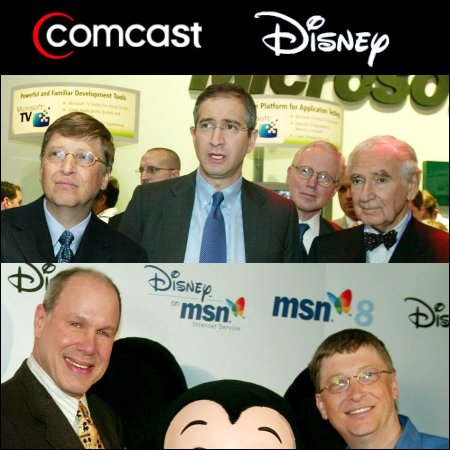
The Walt Disney Company kicked off a two-day analyst meeting yesterday at Disney World, just minutes before an impeccably-timed Comcast Corporation rolled out an unsolicited $54.1 billion takeover offer, sending Disney's stock up almost 15 percent by day's end, a level sure to continue for the foreseeable future.
Comcast took everybody by surprise - not least of which Disney itself, which never saw itself nearly as vulnerable as its amorous suitor seems to find it. We'll see what happens when Disney's board travels to Comcast's headquarters town of Philadelphia in March for its board meeting.
In the meantime, as Disney responded to the Comcast offer by politely patting them on the head and saying their board would consider the proposal, behind the curtains Disney was scrambling to plot a defensive strategy, get investment bankers hired and try to fend off what is likely to become a hostile suitor. Tactically, the quarterly earnings announcement, demonstrating much improved results, was moved up to try and blunt the impact of Comcast's own news conference.
It was an audacious move by Comcast in attempt to create what would become the world's largest media and entertainment company, leapfrogging more sizeable competitors Time Warner and Rupert Murdoch's News Corporation, both of whom have said they're not interested in competing (so far) with Comcast for Disney... However, I think it's safe to assume other suitors would emerge to either block the combination of Comcast's distribution channel with more than 21 million cable subscribers and Disney's TV and film franchises, including the ABC television network, ESPN and other cable networks, the Disney and Miramax movie studios, and Disney theme parks around the world. (That’s why Bill Gates appears in both photos above.)
But Comcast's bid won't come easily, if embattled CEO Michael Eisner has anything to say about it - and the likelihood of a takeover battle is largely responsible for Disney's stock move yesterday. Comcast is two-thirds Disney's revenue and owns or controls entertainment properties of its own, with cable channels such as E!, the Golf Channel and Outdoor Life Network, as well as its cable systems, and such a bid by the company for Disney really shouldn't have been such a big surprise. CEO Brian Roberts, son of the company's founder (both pictured with Gates above), nearly went after Vivendi Universal's TV and motion picture assets before they were sold to General Electric to be merged with NBC.
Its peers in the industry seem to approve. Viacom Chairman Sumner Redstone said the combination "would be a transforming event for Comcast, which would elevate it from a cable company to a media giant, and Brian is undoubtedly on the right track." He added, "But, for Disney, Eisner might justifiably take the position that the company is doing better, the earnings and stock are rising and that he does not need a merger partner."
But the key to understanding the deal is to first realize the new environment and competitive dynamics first established by Rupert Murdoch and News Corp.
In the future, media and communications will be dominated by hybrids such as News Corp., which recently acquired satellite-TV operator DirecTV, and Comcast has embraced this future as one where Disney and other programmers no longer hold the balance of power in distribution deals. The cable-TV business isn't just a collection of small family companies running regional outfits anymore and it has to compete with satellite-distribution companies (like DirecTV) that are also national in scope and with DirecTV under Murdoch's control, Disney simply can no longer compete without a distribution partner of comparable stature - a partner like Comcast.
Comcast's studio acquisition is designed to counter the competitive threat posed by News Corp., which controls both satellite television services around the world, 20th Century Fox Studio and the Fox News and Sports networks. Cable companies worry that Murdoch will develop exclusive Fox entertainment and sports content for its satellite operations, putting local cable services at a major disadvantage. But buying Disney gives Comcast a nice hedge against Murdoch, while positioning Comcast to offer advanced products, such as improved on-demand movie service to exclusive shows in the new high-definition television format.
Indeed, buying Disney would give Comcast a rich source of programming for video on demand and establish Comcast as the premiere company in the rapidly converging markets for delivering broadband Internet and video entertainment to households. That will help it fend off competition from other telecommunications and satellite companies that are vying for the same consumers.
Industry insiders commented that Time Warner was scheduled to hold a conference call with investment bankers yesterday afternoon to discuss the possibility of making a run at Disney, while Pixar Animation Studios' Steve Jobs was thought to be in active discussions with a range of parties, including cable operators and others, about putting together an alliance to grab Disney.
A Disney-Comcast combination touches virtually every aspect of a rapidly converging media and Internet landscape, from range and control of programming to cable-television rates to online services to concerns about indecent content. By acquiring Disney's ABC network, Comcast, with 22 million television subscribers, would in several U.S. cities operate the only cable system while also owning one or more of the local broadcast stations. The FCC used to bar firms from operating cable and broadcast facilities in the same market, but those rules were thrown out by a federal court in 2002 and the FCC decided not to rewrite them.
The possibility of a recapitalization could preserve Disney's independence by recruiting a partner like Microsoft or John Malone's Liberty Media to inject some cash into the company, but however remote a recapitalization seems, the perception of one is likely to be good enough to achieve the desired effect - that is to get Comcast to increase its bid.
Indeed, Comcast both expects and welcomes an auction process: "We encourage them to run an open process," said Dennis Hersch, Comcast's attorney at Davis Polk & Wardwell. "We feel pretty confident and think this is a great, logical combination." Comcast's confidence comes from a reputation for being a disciplined buyer unafraid to walk away from unreasonable expectations or too-rich prices, regardless of how logical or great the combination may be, having done so with both MediaOne and VUE.
At Comcast's crowded New York news conference yesterday announcing the offer, CEO Roberts said he'd approached Disney's Eisner on Monday about a merger of the companies, but that Mr. Eisner, without consulting Disney's board, had told him, "It was not of immediate interest to put this together." Roberts wrote to Disney's board yesterday that, "Given this, the only way for us to proceed is to make a public proposal directly to you and your board."
But, Comcast's initial bid will not be enough to draw Disney in to negotiate, as the all-stock offer values Disney's shares at $26.47 apiece, just a 10 percent premium over Disney's closing price of $24.08 on Tuesday. Disney's stock leapt up 14.6 percent yesterday, to $27.60, already putting it out of reach of Comcast's opening offer. Disney reported first-quarter earnings of 33 cents a share, which beat analyst mean expectations of 23 cents, as revenues rose 19% to $8.5 billion from $7.2 billion with parks and resorts, studio entertainment and media networks all making contributions. Indeed, I'd put fair value for Disney way above $30 a share, maybe as high as $35 - if Comcast closes this deal for anything less, it's getting a bargain.
Clearly, one of the biggest challenges to completing this deal will be public outcry against media consolidation. Here's an excerpt from the Washington Post that describes how the deal would likely be received by regulators and consumer groups:
-
Like other mega-mergers of media companies, the Comcast-Disney deal "may well pose a risk to competition in the marketplace of ideas and the diversity of news, information and entertainment available to the American public," Sens. Mike DeWine (R-Ohio) and Herb Kohl (D-Wis.) said in a joint statement. The two men head the Senate Judiciary subcommittee on antitrust.
Consumer advocates and many in Congress fear that such continuing consolidation will result in four or five companies gaining the ability to keep out competition and diversity while stifling localism.
Mark Cooper, research director of the Consumer Federation of America, said it is inevitable that media companies will race to get as big as possible as they are freed from ownership limits and rules that force them to share their networks. "This is the merger that the industrial policy of the [Bush] administration wanted," he said. "You get outrageous sameness" of programming.
Cooper and others say that cable rates have risen as much as 50 percent in the past 10 years and that Comcast's market power would only increase.
Regulators did attach several conditions to the DirecTV acquisition, including requiring News Corp. to provide local channels in DirecTV's top 210 markets by 2008. News Corp. also would have to submit to arbitration in disputes over how much it can charge rival networks for its Fox programming.
To some, the more ominous consequence of the Comcast deal would be in controlling Internet service. Comcast is the country's largest provider of high-speed Internet service via cable, with 5.3 million subscribers.
Increasingly, consumer groups and many technology heavyweights, such as Microsoft Corp., Apple Computer Inc. and Amazon.com Inc., have urged the FCC to ensure that the few major Internet service providers not be able to keep certain Internet content off their systems.
Suppose, for example, that Time Warner's cable Internet service decided to make it hard to get non-Time Warner movies online. Or Verizon's DSL Internet service decided it was not in its interest to let non-Verizon Internet telephone traffic over its network.
"As a content company, it [Disney] was a powerful force in favor of keeping the net neutral - so it could compete equally with other content companies to sell its content," said Stanford University law professor Lawrence Lessig. "But why compete when you've got control over the pipes?"
Internet service companies have repeatedly said they have no interest in content discrimination, saying it would only drive customers to seek alternatives.
And FCC Chairman Powell, who has championed deregulating the media and Internet industries, has resisted seeking network-neutrality rules. But in a speech last weekend, he for the first time sent a message to industry that "net freedom" is an important principle and that the FCC will be watching for violations. "As we continue to promote competition among high-speed platforms, we must preserve the freedom of use broadband consumers have come to expect," Powell said.
However unlikely between companies don't directly compete, regulators might scuttle it before it gets off the ground if it looks as though the deal might have a negative impact on consumer prices. "I don't know if Comcast will get Disney or not, it's a hostile bid," Michael K. Powell, FCC chairman told John McCain during Senate Commerce Committee testimony yesterday. "A merger of that magnitude will undoubtedly go through the finest filter at the commission as is possible, I assure you."
Further, Roberts managerial skill in the more turbulent world content programming is still relatively untested, reminiscent of the disastrous mega-media-mergers of the past – AOL with Time Warner and Vivendi with Seagram - a pair of deals that collectively squandered nearly a quarter of a trillion dollars of shareholder value.
After the blows Disney's suffered in the past year, from the board turmoil to the Pixar alliance crumbling, Eisner will not survive this challenge, and Comcast may prevail in the end - it became market leader among cable operators after a similarly hostile $50 billion transaction to acquire AT&T's cable operations, after a similar reaction by AT&T as Disney's, under interestingly similar circumstances among boards.
But Comcast has weaknesses of its own - Roberts family members have special shares that give them a 33 percent voting stake with financial ownership of only 2 percent, which could make an excellent excuse for Disney to reject the offer.
Comcast president Stephen Burke is a key player in pulling off this deal, having been a Disney executive for 12 years before joining Comcast in 1988 and was one of many once thought a possible successor to Eisner. Burke's father was a top exec at Capital Cities, which bought the ABC television network before it merged with Disney. Yesterday, Burke criticized the performance of several Disney divisions and predicted that Comcast would be able to increase the company's cash flow by between $800 million and $1.3 billion within three years.
The most interesting part of the developing story is whether a white knight will join the fray to compete and cobble together a deal with Disney. A renegade like Barry Diller has always wanted to own a network, but it's uncertain whether he's got the wherewithal to compete in a bidding war. And, Viacom, who owns CBS and Paramount, and GE, who is currently occupied integrating NBC with Vivendi’s Universal media empire, would both face regulatory scrutiny that would almost certainly kill any of their attempts. Likewise, cable competitors Cox and EchoStar don't have the resources to make a run and neither does Time Warner really. Murdoch's News Corporation has said he's not interested... which isn’t very surprising at the moment, but might change if he smells fear on either side.
Microsoft is perhaps the most intriguing possibility (thus the pics of Bill) - a combination that would make things interesting to say the least, but which would be fairly out of character for Microsoft, which prefers arms-length cooperation with content creators and distributors, despite relatively small investments in vehicles like MSNBC and Slate.com - plus, they've never done an acquisition of more than a couple of billion dollars. But, following last week's joint collaboration announcement between Disney and Microsoft on protecting digital content assets for distribution over the Internet, and the ample resources Microsoft has at hand ($53 billion in cash), the combination would be a powerful one.
Whatever happens, because Microsoft already owns 7.4 percent of Comcast, it would control some 4 percent of a combined Disney-Comcast. And, that could give Microsoft leverage over the course of the deal and afterward as it looks to push its software beyond the maturing market for personal computers and into the developing boom in digital entertainment. With the next version of Microsoft's market-dominant Windows OS not expected for another two years or more, digital audio and video will need to keep PC sales humming. Even a minority ownership in the combination would be enough to strengthen links between Microsoft's software, Comcast's distribution and Disney's entertainment assets.
"At one time Microsoft seemed very intent on expanding its media role, particularly when looking at the perceived threat of then AOL and Time Warner," said Joe Wilcox, analyst at Jupiter Media, "But right now, the company is now focusing on getting back to basics." Microsoft also proved to be a key player when Comcast acquired AT&T's cable business, exercising its influence both through its stake in Comcast and a $5 billion investment it made in AT&T.
In the end, timing is everything, and it will prove once again the quality and importance of good timing if Roberts can lure the board to the negotiating table, given the current perception of Disney weaknesses at the moment, not least of which has them lacking a poison pill to help block such an attempt. Whether we think this deal makes as much sense as the AT&T deal did in 2002 - after all, what does Comcast know about running theme parks, sports teams (hockey's Flyers and basketball's 76ers, notwithstanding) and merchandising to children - Comcast still buys content from companies like Disney and if they can pull it off, it will represent a change in perspective for everyone in the media sector, as scale and scope becomes paramount to compete with Murdoch and Comcast-Disney.
My final verdict: on balance, I think far from a done deal, but if Disney's stock price takes any hits and Comcast can boost its own - or Microsoft gets involved, it's over for Eisner. Can Disney compete without Comcast? Probably, but only if it can make an acquisition of its own - Cox is looking awfully attractive lately.
- Arik
February 11, 2004
Oracle vs. PeopleSoft: Department of Justice Signals Against Merger as PeopleSoft Rejects its Determined Rival’s Latest Bid in Hostile Takeover

One of the chief reasons I’ve been hesitant to opine any thoughts on the Oracle vs. PeopleSoft hostile takeover for the past eight months was because of the competitive dynamics of the industry and the likelihood that regulators might oppose the matter entirely, essentially mooting the point of any significant competitive analysis beyond FUD-factoring Larry Ellison against Craig Conway. This despite what appeared to be a warming of relations between the two firms in the past week, as Oracle upped its bid and PeopleSoft playing hard-to-get by teasing that the offer was still just not dear enough.
Lo and behold, in an announcement posted to PeopleSoft’s Web site last night, PeopleSoft revealed it had been informed by the U.S. Department of Justice that the staff of the Antitrust Division has recommended that the Department file suit to block Oracle's proposed acquisition of PeopleSoft and that the staff recommendation has been submitted to the office of the Assistant Attorney General pending a final decision no later than March 2nd, 2004.
The recommendation represents a significant victory for PeopleSoft and CEO Craig Conway, a former Oracle executive, who has predicted antitrust regulators would block Oracle from consuming his company. Conway had argued the takeover would hurt competition in the $20 billion market for business applications software used to automate a wide range of administrative tasks for companies large and small while Oracle had argued the deal would create a stronger competitor to German market leader SAP and a surging Microsoft as it enters that market.
On Monday, PeopleSoft had rejected Oracle's latest tender offer, coming late last week as Oracle raised its bid from $19.50 to $26 a share indicating Oracle was determined to complete the deal. This set the stage for a showdown at PeopleSoft's shareholder meeting on March 25, having called Oracle's $9.4 billion cash offer "inadequate" and issuing a more detailed analysis of its rejection of the bid, in the strongest indication yet that it might negotiate if the price was right. PeopleSoft said the bid valued it at a lower earnings multiple than other enterprise software companies and was below the price target set by analysts, implying a multiple of only 27-28 times earnings based on PeopleSoft’s expected earnings. By comparison, SAP trades at 32 times expected 2004 earnings, while Siebel, which is recovering from a deep earnings slump, stands at 46 times prospective earnings.
The analysis of the Oracle bid and PeopleSoft's decision to reverse its earlier position and make price rather than regulatory considerations the main argument for its rejection suggested that last week's renewed strategy from Oracle may have shifted the dynamics of the takeover battle. Before yesterday’s DOJ recommendation, PeopleSoft's shareholders would have been able to decide at next month's meeting whether they wanted the company to give more serious consideration to Oracle's offer, despite Oracle's complaints that PeopleSoft's poison pill takeover defense prevents it from taking control in the short term and essentially means shareholders have no power to influence the outcome of the bid.
However, that point is moot if regulators don’t approve and Oracle can’t win on appeal – so, here’s a quick run-down of the antitrust dynamics at work.
Throughout the DOJ’s probe, Oracle has essentially argued that competition is robust, with hundreds of mid-size and small software companies all competing to offer applications to handle different business administration needs. The company has argued that if it bought PeopleSoft, the combined company still wouldn't possess a number one market share position in any major business software category.
PeopleSoft, on the other hand, argued that the software market was far more narrowly defined, saying that a market for software "suites" exists in the form of prepackaged software applications designed to work together and that PeopleSoft, SAP and Oracle were the three principle competitors in that market, which would be reduced by one key player after an Oracle acquisition.
PeopleSoft has argued that Oracle launched its bid in June last year simply to disrupt its pending acquisition of JD Edwards and the market for business application software. Oracle, who dominates the database software market, ranks third in the biz-apps market behind PeopleSoft following its JD Edwards buy-out and the leader SAP. Investors had always anticipated that the merger could run into anti-trust problems with U.S. or European regulators, which was why PeopleSoft's shares had traded below Oracle's most-recent offer.
For those without knowledge of the full background here, it gets pretty interesting. In a statement, Oracle spokesman Jim Finn said the initial proposal to merge the business applications units of the two companies had come from PeopleSoft's Conway, who thought he should run the combined business. But when Oracle countered by offering to buy PeopleSoft, "Conway said he wouldn't sell at any price," Finn said. "He then began a long and intensive lobbying effort...(that) resulted in complicating and prolonging the Justice Department review of this merger." Finn added, "While no decision has yet been made, Oracle believes this merger will eventually be approved," indicating a fight ahead on appeal should a ruling come down officially against the merger.
In addition to the regulatory review, the merger is also being challenged in court by PeopleSoft and by the Attorney General's office of Connecticut. Oracle, in response, has a lawsuit pending against PeopleSoft over the actions it has taken to try to block the takeover, including "golden parachute" severance payments estimated at more than $60 million for Conway alone. Oracle also complained that a customer assurance program PeopleSoft put in place puts the company at risk of having to pay out up to $1.55 billion in the event of an Oracle takeover.
There’s little chance Assistant Attorney General Pate will ignore eight months of work by the Antitrust Division or the 200-plus depositions from PeopleSoft’s software customers saying how Oracle’s takeover would make their business software more expensive. The most important key conclusions however are that the department has defined the software market narrowly and has determined where there could be higher software prices as a result of a combination, after an earlier definition of the market in question as one for core financial and human-resources systems sold to large and complex organizations - a market served by only SAP, Oracle and PeopleSoft.
That means the department's conclusions on any anticompetitive effects would NOT be focused specifically on Conway's software "suites" argument, which PeopleSoft had said there was a market for shortly after Oracle launched its bid, which is what led many to believe suites were also the focus of the DOH probe.
Putting limits on the market definition to just financial and HR for large, complex businesses means that all those other pesky facts applying to any broader markets get tossed out as the DOJ skips over any markets for selling software to mid-size or small businesses, the market for customer relationship management and supply chain management, or anything on the database front. This all appears a decided advantage for Oracle, as well as the lack of any argument that Oracle has pricing power in the database market that it will be able to leverage into business applications software, similar to the way Microsoft's Windows monopoly has been tied to competing in other software markets, such as Web browsers and office-suite applications.
However, software license sales alone don’t account for all those billions in revenue generated by SAP, Oracle and PeopleSoft, as sales of software services, support and maintenance to existing customers generate annuity income every month once the customer makes a software purchase.
The DOJ is also concerned with whether new competitors could enter the market in the event that Oracle increased prices, and supposedly, the staff report will conclude that the price of new software licenses could be driven higher in the narrowly defined market if there are only two competitors, instead of three, and that few new suppliers will fill the gap in a market defined as "core HR and financial software for large customers".
On top of that, should the DOJ look at maintenance and support for existing PeopleSoft customers, Oracle could be seen to have a near-monopoly there, post-merger. Many believe a merged Oracle-PeopleSoft could generate a tremendous influx of new customers which the combined company could enforce its monopoly on. And, if the DOJ accepts that analysis, it will be virtually impossible to argue that any new company could enter and compete in delivering support and maintenance services on Oracle and PeopleSoft software.
Still, understanding Larry Ellison, he’s probably not finished yet – he’s likely to recommend the company fight any official ruling from the DOJ that might materialize in March, although the likelihood that Oracle would prevail in that is also poor. Should Oracle appeal however, Conway and PeopleSoft will have a few months more fight ahead – but, in my view, this DOJ Antitrust Division recommendation essentially kills the deal.
- Arik
February 10, 2004
Donald Trump, NBC and the Race to Be "The Apprentice"
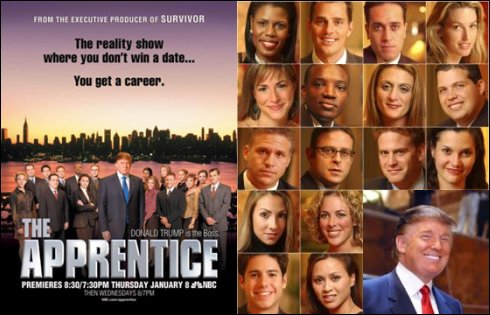
Is it necessary for a woman to be a flirt to get ahead in business? Act a little trampy? Many of us know (from experience) how dangerous an underestimation that can be, yet to watch the hit NBC reality show, "The Apprentice", one would think men are all bumbling idiots compared to the bombshell-sexualized tactics the women have used to lead the men in four straight victories of boys-against-the-girls competition to become Donald Trump’s next protégé.
It got so bad last week that Trump precipitated a "corporate reshuffle" to give the guys a fighting chance at staying alive, mixing the teams up and finally kicking one of the women to the street instead of the suite. Slate had a nice critique of the bump-&-grind tactics employed by the girls to beat the boys at every turn:
-
No one disputes that the women's conduct is effective: The show mostly just proves that prostitution really is the world's oldest and most lucrative profession. But debate rages over whether it's appropriate in today's business world. A Nexis search including the terms "Trump, Apprentice, and sex" reveals that 206 articles on the subject have been written. The breakdown generally goes like this: Male reviewers find the whorish conduct sad but entertaining, older women find it shameful and degrading, and younger women, particularly the cute ones, find it liberating and thrilling. One letter to the New York Times crows: "Sex is power!" Which echoes the sentiments of the show's female contestants who say things like: "If being attractive is wrong, then what we do is wrong."
All this discussion, interesting as it may be, misses the real point of The Apprentice. The gender conflict is a side issue, a distraction. The truly interesting anxiety at work in this show is generational: These women and men are revealing the massive gap between the way young men and women, and older men and older women, think about sex.
Who is having a great time on the set of The Apprentice? The Donald, for one. Trump is having the time of his life because these hot young foxes are falling all over themselves to please him—and doing so in the wee-est of garments. Now, that is good business for him and for his powerful associates—a generation of moguls who can mouth platitudes about equality but still date only preteen models. In one episode Donny Deutsch—the head of an advertising agency—lauds the women's team's efforts to launch an ad campaign—the ads they come up with are so phallic they get named "the testicle ad." As Deutsch hands them the win he cackles delightedly that their presentation (in stewardess costumes) had "set the women's movement back 70 years." This week sees Trump stepping into an elevator with one co-ed team and leering at one of the men: "Nice to have these girls with ya, huh?" Moments later, as the group crowds into George Steinbrenner's office, Steinbrenner greets Trump with a hug and crows lechily, "I knew there would be pretty girls!"
Who else is having a blast on The Apprentice? The girls! They are kicking the men's butts by celebrating their own. They've stolen Ally McBeal's résumé but lost the self-doubt. Their de rigueur business uniform: tight low-rise jeans, belly-button shirts, and stiletto boots. Their giggly delight is about their power, and one hesitates to begrudge them. Sure, they have a moment's misgiving when they meet trump's Italian supermodel girlfriend. You can see it in their eyes: Why fight to work for Trump, when you can get him to work for you? But overall, the sex for power bargain is working for them. They are on their way up. There is a perfect synergy between what the young women want and what the old men have, and all the show's sparks comes from that truth.
I like to wonder what Martha Stewart thinks of this show - if she would approve of using physicality as a short-cut to power-brokering or she's "above all that"...?
Something tells me Martha used every advantage she had at her disposal, just like the girls on the show. But, Martha had real moxie - not just a nice walk. I like it if only for the class conflict - let's hope that, when success comes so easily, the girls on the show won't try to cut corners to get ahead in other ways.
Until then, I like the show - not for any serious lessons about business success really - although it does instruct that it's best to seize every opportunity... each day and with each new challenge, the group gets better at making hay while the sun shines. Let's hope the guys can use some of their assets sooner rather than later and turn tables on the girls - or at least, maybe the girls will learn to use their assets a little more creatively.
- Arik
February 09, 2004
The Battle for M&A Marketshare: Merrill Lynch vs. Goldman Sachs, Morgan Stanley, Citigroup and J.P. Morgan Chase
 As the mergers and acquisitions market comes back around and Merrill Lynch struggles to recover from its scandal-prone past, it’s putting a big push on recovering marketshare against stronger competitors Goldman Sachs and Morgan Stanley as well as upstarts Citigroup and J.P. Morgan Chase. A Reuters excerpt from a couple of weeks ago describes their progress and ongoing challenges:
-
Merrill's top brass credits their tireless discussions with corporate executives over the past three years, when few were interested in doing deals. They also point to a fledgling business model that links investment banking more closely with other products.
Still, analysts and bankers - none of whom wanted to be quoted - say Merrill may have trouble hanging onto its remaining top talent. And rivals like Citigroup and J.P. Morgan Chase & Co., which can lure potential advisory clients with their lending prowess, are not likely to go away.
Merrill Chief Executive Stan O'Neal is hammering home his quest for profits, even if it requires ditching certain products, especially those that will not lead clients to buy other higher-margin offerings. And even if it means the company must sacrifice some market share in a particular area.
"Our first metric is profitability," said Greg Fleming, who shares the top post at Merrill's global markets and investment banking.
Still, he said market share does matter. The company expects to be a top 3 player in higher-margin businesses like M&A and in the top 5 across all of its product lines.
"You can't argue you're an expert in something if you're 11th or 12th in the league tables," Fleming said.
Merrill, which reported a record profit on Wednesday, finished 2003 in third place on global announced merger deals, just a whisker behind No. 2 Morgan Stanley. Merrill worked on 16.7 percent of the global merger deals, up from 13.7 percent the year before, according to Dealogic, which ranked Goldman Sachs first.
Merrill's share was still off significantly from 32.4 percent in 1999, when it ranked second behind Goldman, but the company, like other traditional investment banks, has ceded ground to the new breed of superbanks like Citigroup and J.P. Morgan.
Amid O'Neal's deep cost cuts of the past few years and the various scandals that rocked Wall Street, Merrill lost some key talent, including Casey Safreno, the global head of health care banking, and virtually its entire media team.
Fleming and Steve Baronoff, Merrill's global head of mergers, acknowledge they must fill certain holes. They already brought back Victor Nesi to lead media and telecom banking, and have landed AT&T Wireless as a client.
"From an M&A point of view, most of our industry groups are well covered," Baronoff said, although Merrill is looking to hire bankers in countries like France and Germany.
He said Merrill could selectively add coverage bankers, who help handle all aspects of a client's investment banking needs, in the media, consumer and industrial segments.
Former Merrill bankers said, however, that few star bankers have left because opportunities were limited in the depressed merger market. But with more deals in the works, rivals might poach those who remain, since some are still bitter about the rampant layoffs.
Some Wall Street observers were mildly surprised about Merrill's uptick in advisory work because reports in The New York Times and BusinessWeek have indicated that O'Neal sees less value in the mergers business than the retail side and asset management.
Although strategic advisory work accounts for only about 3.3 percent of Merrill's revenues, O'Neal's reported views about investment banking are still perplexing - and disputed internally - since he came up through the banker ranks, while his predecessor, David Komansky, did not.
"Stan, from my point of view on the M&A side, has been a breath of fresh air," Baronoff said. "Stan is very accessible to clients. He has CEO impact."
While Merrill sounds confident about its merger advisory infrastructure, it will have a tougher time warding off external factors, particularly the encroachment of lending heavyweights like Citigroups.
"The traditional banks want to argue that M&A is a brains business having nothing to do with brawn," said one former banker, "but the financial reality for the clients may be that they can't afford to look at it that way, even if it means they're going to compromise the advice they get."
Although Merrill touts its knack for complicated cross-border deals and hostile takeovers, it is also banking on its own brand of one-stop shopping, including help arranging a wide variety of funding options.
For example, it points to its work with British pub company Spirit Amber, which last year acquired Scottish & Newcastle Plc, the nation's largest brewer. Merrill was sole adviser and bookrunner for a secured debt facility, and it contributed equity to the deal.
"Our vision isn't a single product," Fleming said. "Our vision is driven around developing a relationship with a client, where they will turn to us for any form of investment banking and advisory service they're looking for help on."
Still, Merrill Lynch will need to continue to execute to recover its previous standing in the M&A market, as new rivals Citigroup and J.P. Morgan Chase force market leaders Goldman Sachs and Morgan Stanley to fight even harder. Whether Merrill can avoid getting caught in the middle of that battle for market share will depend on their ability to execute according to their strengths and exploit competitors’ weaknesses.
- Arik
February 08, 2004
Competing in Madison’s Mid-Winter Meltdown Indoor Satellite C.R.A.S.H.-B. Sprints Regatta

Today’s blog is pure fun and games, as my brother Derek (left, above) and I competed in Madison’s Mid-Winter Meltdown Indoor Satellite Regatta for Concept II’s C.R.A.S.H.-B. sprints. I hadn’t done this is almost 15 years – since I was on the UW-Madison Men’s Crew team, in fact, and it was Derek’s first time out ever. Making it all the more remarkable was our relatively strong showing.
We arrived early for the Men’s Heavyweight Open flight and the Men’s Heavyweight Master’s was about to begin, but we hadn’t intended to row TWO 2,000-meter pieces. Still, it’d be a good warm-up if we didn’t kill ourselves and it was awhile until the Open started, so we decided to row it. Now, if you’re not familiar with the Concept II ergometer, pictured behind us in the photo above, competitors row 2,000 meter sprints and try to cross the finish first. This amounts to something between a six minute and nine minute workout, but it’s all-out, pull-as-hard-and-fast-as-one-can to win. It’s a challenge that needs to be trained for to really do well... which I know I didn't really do enough of. ;-)
Of a field of six competitors in the Men’s Heavyweight Master’s flight, Derek took the gold medal with a 6:29.6 final time (that’s a 1:37.4/500-meter split, which is how you pace yourself). To put that in perspective, the world-record time is something substantially south of 6:00 and a 1:25/500-meter pace – those guys are animals. I came in fourth with a 6:58.4 (a 1:44.6 pace, representing Derek’s fitness and leverage superiority over his big brother). ;-)
Next, after recovering and stretching, we were astonished to see the next flight coming up in just minutes, so we got motivated after cheering along a few other sprints – Men’s and Women’s Lights and Heavys as well as Veteran classes and Juniors. Then, it was the Men’s Heavyweight Open race, with eight guys on the deck, counting Derek and I.
Through the pain and sweat, the crowd was fun to listen to as they cheered us on watching the virtual boats on the monitors above us. I lost my pace at about 1,000 meters to go, but recovered and finished with a sixth-place 7:02.4 (a 1:45.6/500-meter split), and Derek won by seconds with a 6:25.6 overall (a speedy 1:36.4/500-meter pace), putting him in the gold medal for a second time the same day. To row two of these sprints the same day is gutsy enough, to win twice within an hour of each race is pretty cool, but to do so on the first day you’ve ever competed in the sport is pretty extraordinary.
As you can all tell, I’m awfully proud of my baby brother. Way to go Derek!
- Arik
 "Competitive Intelligence applies the principles of competition and lessons of intelligence to the need for enterprise awareness and predictability of market risk and opportunity. CI has the power to transform an enterprise from also-ran into real winners with agility enough to create and maintain sustainable competitive advantage."
