March 06, 2004
FDA Approval for Boston Scientific’s Taxus Stent Means War with J&J Cordis’s Cypher

Despite its second-to-market delayed start, some analysts are projecting Boston Scientific could realistically end 2004 with a 60 percent share of the $3.8 billion U.S. market, now that it's competing with Cypher. Taxus will roll out “immediately” according to the company and is sure to be the reasoning behind J&J’s Cordis defensive hatchet-burying business alliance with Guidant just a few days ago.
Drug-eluding stents are a big improvement over bare-metal stents, the little tubes designed to keep clogged arteries open, since the drug coating prevents the arteries from clogging again, reducing the need for repeat procedures. For those new to this area, if you’re curious how stents work read the following article from USAToday.com.
John Putnam, an analyst at Belmont Harbor Capital, an independent research firm, says many doctors believe the stent is easier to implant during surgery, compared with J&J's Cypher. "It was expected, but it's good news. I think it's the better stent of the two that are on the market," he said.
Boston Scientific said on February 23rd it hoped to win 70 percent of the U.S. market within 70 days after launching its device, following up its experience in Europe, where it has already grabbed 70 percent or more from J&J's Cypher. One day later, in a largely defensive competitive manuever, Guidant and J&J/Cordis said they formed a co-marketing pact over Cypher, which would provide J&J with Guidant's convenient delivery device and could protect or even increase sales.
CBS MarketWatch had a nice overview of the battle:
- The arrival of Boston Scientific's stent, called Taxus, marks the beginning of intense competition with archrival Johnson & Johnson for dominance of the estimated $3 billion U.S. market for drug-coated stents. The new devices are expected to significantly improve the outcomes of artery-clearing angioplasty procedures.
The U.S. Food and Drug Administration late Thursday, as expected, granted approval to Boston Scientific's Taxus. The medical-device maker said it's fully prepared to introduce the stent in the United States and said it has "ample inventory in all sizes." The Taxus was approved early last year for use in Europe, where it's been competing with J&J's Cypher drug-coated stent.
J&J last year became the first company to win U.S. approval for a drug-coated stent, and the health-care-products giant has had the market to itself, until now.
Following the FDA's OK for the Taxus stent, Boston Scientific affirmed financial projections it made early last week at a meeting with analysts.
Boston Scientific said at the analysts' meeting it sees 2004 Taxus sales of between $1.7 billion and $2.2 billion, climbing to $2.4 billion to $3.2 billion next year. The company estimated 2006 sales of the device at between $2.2 billion and $3.4 billion.
Cardiologists have for years used stents, tiny mesh devices, to prop open clogged arteries. But the arteries frequently close up again after the angioplasty procedures. Medical-device makers have found they can greatly reduce the chance that arteries will close up again by coating the stents with anti-scarring drugs.
"This approval is a breakthrough event for the treatment of cardiovascular disease in the United States," Boston Scientific Chief Executive Jim Tobin said in a statement.
Some analysts have predicted that Boston Scientific's Taxus could ultimately emerge as the leader in the market for drug-coated stents. But the company faces fierce competition from J&J.
Just last week, J&J and leading medical-device maker Guidant said they would team up to market J&J's drug-coated stent in the United States, a move aimed at intensifying competitive pressure on Boston Scientific.
Meanwhile, former competitors in the stent selling business Guidant and Johnson & Johnson's Cordis agreed to co-promote Cordis' Cypher Sirolimus-eluting coronary stent. Guidant said the agreement gives it immediate entry into the U.S. drug eluting stent market, but what it does for J&J is much more important in light of the Taxus’ approval for Boston Scientific. In addition, Guidant will assist Cordis in the development of a Cypher stent that uses Guidant's Multi-Link Vision stent delivery system.
Both companies agreed to license certain patents and to settle all outstanding patent disputes between the companies. Guidant reiterated its full-year 2004 earnings guidance as a result of this partnership. Likewise, Johnson & Johnson still expects full-year earnings in line with its prior view. Guidant grants Cordis the option to co-promote a fully bioabsorbable stent currently under development by Guidant. Cordis retains clinical, manufacturing and order fulfillment responsibilities for the Cypher stent in the U.S. The companies will both market and sell the Cypher stent, with each company bearing its own marketing and sales costs.
Guidant Chief Executive and President Ronald W. Dollens said, "We believe this strategic agreement will provide significant benefits to both organizations by building upon the strengths of both companies' sales, marketing and product development resources." Cordis President Rick Anderson echoed Dollens' comments, saying the transaction doubles its presence in the "hospital and cath lab."
Guidant's drug eluting stent program, which uses the drug everolimus, will not be affected by the agreement with Cordis. The company expects to launch its Champion Everolimus eluting stent system in Europe in the first quarter of 2005 and in the U.S. in the first quarter of 2006, pending regulatory approvals.
But, whether Taxus, as many think likely, might eventually break away to dominate here in the U.S. as it has in Europe is ultimately a question of how intensely J&J decides to compete to preserve its current stranglehold on the market.
- Arik
March 05, 2004
Non-Compete Agreements & the War Between the States
There was an interesting story in Forbes last month called “The Case for Servitude” all about non-compete agreements that I thought you’d enjoy a few excerpts from:
-
Your new employer shoves a piece of paper under your nose to sign. In it you promise not to work for any competitor for some period of time after leaving this job. Is such a contract, known popularly as a noncompete agreement, a fair deal? Is it enforceable?
Many executives are fans of BreakYourNonCompete.com, a popular site encouraging folks to do just that and pushing the line that noncompetes betoken servitude and inhibit healthy market forces. But economic theory says just the opposite. Noncompete agreements make sense. They are a boon to the economy. Most of the time they are even a boon to the executives constrained by them, and the main problem is not that they sometimes keep such characters from taking jobs they'd love to have, but that the agreements are hard to enforce. Mark Cheskin, a Hogan & Hartson partner who specializes in noncompetes, guesses that only half of the agreements being signed would survive a courtroom showdown.
So, why do we have non-competes if they’re essentially unenforceable – and even illegal in California?
-
The economic argument: Noncompetes give companies incentives to do more for their workers. "The competitive effects of noncompetes are almost totally benign," says David Henderson, an economist at Stanford's Hoover Institution. "The agreements make it possible for employers to invest heavily in talented workers. You just can't make those investments if the talent is free to take the acquired skills and march off to a competitor."
Except for California, which bans all such agreements, every state accepts that companies have "protectable interests" and can defend them via noncompetes. Unfortunately for companies aiming to protect their interests, the states differ wildly about what's required in the agreements. Texas, Georgia and New Jersey are among the states whose courts tend to be suspicious of the agreements and responsive to arguments that they restrain trade.
Connecticut, Florida, Indiana and New York are among the states somewhat more sympathetic to the view that noncompetes are legitimate business tools. The New York State Court of Appeals has broadened the "protectable interest" standard so that it covers what are called "unique individuals," who can be protected even when they have no managerial responsibilities or special customer contacts.
In a national job market, executives who want to break their noncompetes can play off one state against another, and if all else fails, they can skip to California. It really is a nutty system. If the executive is fast on his feet, he will begin his new career--possibly before telling his employer that he's leaving--by going to a California court and asking for a declaratory judgment that the noncompete is invalid. If he dithers even briefly, he's in trouble. Says Jay Warren, who works for Bryan Cave in New York City, specializing in noncompetes: "As soon as the guy walks out the door, I run to a New York court and ask for a temporary restraining order preventing him from going to work in California."
Think of that next time before you hand in your two weeks’ notice.
- Arik
March 04, 2004
AARP Appeals to Big Pharma to Relax Controls on Canadian Drug Reimportation
William Novelli, chief executive of AARP, said yesterday that his group will write to the Pharmaceutical Research and Manufacturers of America in the next few days advocating its position, appealing directly to the pharmaceutical industry to keep cheaper Canadian drugs available to Americans. Here’s an excerpt from Associated Press.
- "The pharmaceutical industry is not easy to convince. We all know that," Novelli said, speaking at the Kaiser Family Foundation. "I don't know if they'll ever come around on importation. The least we can do is get them to not choke off the supply side, and we're working on that."
Thousands of Americans get their prescriptions filled in Canada, where brand-name medicines can cost half the price because of tighter government controls.
Importing drugs is illegal in the United States, but people seeking cheaper prices can find ways to do so on the Internet. The Food and Drug Administration (news - web sites) and the U.S. pharmaceuticals industry oppose the practice, saying they cannot guarantee the safety of imported drugs.
Supporters argue that the industry is just seeking to keep prices high.
At least five drug companies, citing supply and safety concerns, have limited shipments to Canadian pharmacies to keep drugs from being sold to Americans.
Minnesota and Wisconsin, along with Springfield, Mass., and Montgomery, Ala., have given their residents permission to buy drugs from Canadian Internet pharmacies.
- Arik
March 03, 2004
Super Tuesday Over, The Race is On: Kerry vs. Bush
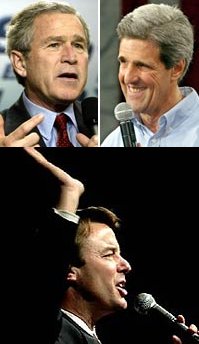
Senator John Kerry blazed to victories in Democratic primaries from New York to California yesterday, effectively capturing his party's presidential nomination and prompting his main rival, Senator John Edwards, to end his campaign.
Kerry defeated Edwards in almost every state - including Ohio and Georgia, where Edwards had been looking for a victory to keep his candidacy alive - in what was shaping up as a nationwide romp. Faced with a staggering night of losses, Edwards flew home to Raleigh to withdraw from the race today.
President Bush called Kerry to congratulate him on his victories. "I said, `I hope we have a great debate about the issues before the country,' " Mr. Kerry said, recounting his conversation with the president.
Scott Stanzel, a Bush campaign spokesman, said the President told Kerry that he had won the nomination against a tough field and that he was looking forward to a spirited race.
Kerry's hope for a 10-state sweep was frustrated not by Edwards but by Howard Dean, his onetime nemesis, who finally won his first primary, in his home state of Vermont, two weeks after he withdrew from the race.
The New York Times recaps:
- Mr. Edwards and Mr. Kerry offered warm words about each other in their speeches last night, just two days after their decidedly unfriendly debate in New York.
"John Edwards brings a compelling voice to our party, great eloquence to the cause of working men and women all across our nation and great promise for leadership for the years to come," Mr. Kerry said of Mr. Edwards, whom many Democrats have pushed as a potential running mate for Mr. Kerry.
But most of all, Mr. Kerry offered a vigorous attack on the White House, previewing what officials in both parties said would be an extraordinarily rough general election campaign.
"I am a fighter," he proclaimed, and proceeded to use the platform of his nationally televised remarks to attack Mr. Bush for proposing a constitutional amendment to outlaw same-sex marriages.
"George Bush, who promised to become a uniter, has become the great divider," he said in Washington, adding: "He proposed to amend the Constitution of the United States for political purposes, and we say that he has no right to misuse the most precious document in our history in an effort to divide this nation and distract us from our goals. We resoundingly reject the politics of fear and distortion."
Mr. Edwards, smiling but appearing weary, addressed supporters at a rally in Georgia, a state chosen in the hope that he could give a victory speech. Instead, Mr. Edwards delivered an address that sounded a farewell note for his campaign.
"We have been the little engine that could, and I am proud of what we've done together, you and I," he said.
He praised Mr. Kerry as "an extraordinary advocate for causes that all of us believe in: more jobs, better health care, a cleaner environment, a safer world."
"These are the causes of our party," he said. "These are the causes of our country and these are the causes we will prevail on come November, you and I together."
With yesterday's balloting, 29 states and the District of Columbia have now passed judgment on the Democratic field. And the party's leaders appear to have accomplished precisely what they were looking for in setting up this calendar: A near-consensus candidate, chosen early and with minimal bloodshed.
Mr. Kerry has now claimed the nomination earlier than any other nonincumbent Democratic presidential candidate in more than 40 years, with the notable exception of Al Gore in 2000.
Advisers to Mr. Kerry sought to avoid appearing overly optimistic, even as they rejoiced in these latest wins. They said Mr. Kerry would campaign through Texas, Mississippi, Louisiana and Florida, the four states where there will be primary voting on March 9.
"We only have one-third of the delegates we need," said Stephanie Cutter, Mr. Kerry's spokesman. "The primaries give voters across the country a chance to get to know John Kerry."
Still, the Kerry campaign was girding for a sea change in the nature of the campaign, moving from the relatively small field of a Democratic primary — and a relatively mild opponent, in Mr. Edwards — to a general election campaign against Mr. Bush, whose aides have promised a fierce campaign. Mr. Kerry moved quickly to set out the themes of his campaign, incorporating lines used by Dr. Dean and Mr. Edwards as he turned full force to the White House.
"Tonight the message could not be clearer. All across our country, change is coming to America," he said, adding: "We have no illusions about the Republican attack machine and what our opponents have done in the past and what they may try to do in the future. But I know that together, we are equal to this task."
The White House appears to be bracing for a strong Democratic threat. Aides to Mr. Bush said he would broadcast his first television advertisements on Thursday night, as he begins spending about $120 million he has raised precisely for this moment. His campaign surrogates appeared on television news programs last night, portraying Mr. Kerry as, among other things, an advocate of tax increases and big government.
It was the year's biggest night of voting for Democrats, with 1,151 delegates being allocated. Going into last night, Mr. Kerry had 562 of the 2,162 delegates needed to win the nomination, compared with 204 for Mr. Edwards.
Delegates in Democratic primaries are allocated based on the percentage of votes each candidate wins, as opposed to the winner-take-all system used by the Republican Party. As a result, Mr. Edwards was under pressure to not only win a number of big states, but win them by substantial margins in order to make up the delegate differences.
That did not come close to happening.
Mr. Kerry posted lopsided victories in New York and California, the two states with the highest number of delegates at stake.
He scored a double-digit victory over Mr. Edwards in Ohio, where Mr. Edwards had campaigned heavily in the calculation that his attacks on Mr. Kerry for voting for the North American Free Trade Agreement would lift him to victory.
He also swamped Mr. Edwards in Maryland, Rhode Island, Connecticut, Minnesota and, to no one's surprise, Massachusetts.
The other two candidates, the Rev. Al Sharpton of New York and Representative Dennis J. Kucinich of Ohio, posted mostly single-digit showings in the voting. Mr. Sharpton and Mr. Kucinich were both on the ballots in their home states; both suffered single-digit showings there as well.
Mr. Edwards's frustration with the turn of events in this campaign was apparent throughout the day.
He visited a polling place in Atlanta in the early morning for a few minutes, grinning and greeting a smattering of voters and supporters. But he did not respond to questions shouted at him and had not made appearances on morning talk shows, as he has done in the past.
Both Mr. Kerry and Mr. Edwards spent part of yesterday in Washington, voting on gun regulation legislation. Before flying to Washington from Georgia, Mr. Kerry stopped by a trucking company depot in Atlanta where he shook hands, and zipped around in a forklift.
"I think we can do a better job on the economy," Mr. Kerry said. "We can fight for an even playing field, and we can sure fight to create more jobs."
Mr. Kerry's huge victories are attributable to voters' anxieties about their own economic futures and, once again, an intense desire to defeat Mr. Bush, according to the polls of voters that were conducted in each state by Edison Media Research and Mitofsky International for a pool of five television networks and The Associated Press.
In Atlanta, Kyle Cole, 43, said he was voting for Mr. Kerry because "he's got experience."
"We live in some dangerous times," Mr. Cole said. "I really like Edwards, but we need someone who knows how Congress works. And the main thing is to get Bush out."
So, there’s the whistle; and the real race is on! It’s gonna be a long nine months.
- Arik
March 02, 2004
DeBeers Diamond Monopoly Poised to Re-Enter U.S. Market, Faces New Scrutiny in Europe

De Beers signaled last year it might agree to plead guilty and pay a fine to settle allegations that date back to shortly after World War II when the Justice Department alleged that it fixed the price of industrial diamonds, which was followed with another suit in 1994.
"We have outstanding legal issues with the Department of Justice and the European Union, and we're working to resolve them," said Lynette Hori, the spokeswoman for DeBeers's diamond trading company. "The U.S. is the biggest market for diamond jewelry - accounting for 50 percent of global retail jewelry sales - and we would really, really like to resolve these issues," she said.
I'll bet.
After 10 years of inactivity in the case, the court in January scheduled an arraignment and plea hearing for March 11th. DeBeers and General Electric were indicted in 1994, accused of fixing prices in the $500 million industrial diamond market. Federal officials alleged that GE and DeBeers, which at the time controlled about 80 percent of the market, told each other about price increases in advance.
A federal judge dismissed charges against General Electric in December 1994, saying the government had failed to prove its case. The suits were filed in Columbus because GE's industrial diamond business was headquartered in the Columbus suburb of Worthington. Industrial diamond is sold to diamond tool manufacturers, who use it to make cutting and polishing tools used in a variety of manufacturing and construction applications.
But, prosecution of DeBeers has proven difficult for the past decade because U.S. officials have no jurisdiction over the company, which is based in South Africa.
That hasn't stopped DeBeers from becoming one of the world's best-known brands and one of the biggest advertisers in the U.S., relentlessly linking diamonds to engagements, weddings and anniversaries with its "A Diamond is Forever" campaign. But DeBeers hasn't had a retail presence in America and its executives are subject to detention if they enter the country. DeBeers only has its own retail stores in London and Tokyo.
DeBeers's 1994 charge is still pending in U.S. District Court in Columbus, Ohio, where the Justice Department is looking for a guilty plea, which might be forthcoming, that a unit of DeBeers was part of the global price-fixing conspiracy with GE. Prosecutors said that they hadn't been given access to needed evidence overseas.
DeBeers's efforts to get the charge dropped were rebuffed by the Clinton administration and, initially, by the current Bush administration. But late last year, the company signaled that it might agree to plead guilty and pay a fine to end the suit, and those discussions are now at an advanced stage, according to people close to the talks.
U.S. officials over the years haven't been eager to help DeBeers because of its history of harsh labor conditions and support for South Africa's apartheid regime. But Justice Department officials apparently have concluded that - having lost their case against DeBeers's co-defendant GE in 1994 - they have little leverage to continue to exclude the company from the U.S. if it is willing to plead guilty, unconditionally, to the 10-year-old charge.
Meanwhile, the European Union is investigating sales tactics of the world's largest diamond dealer, even as its relations with U.S. regulators may be improving. Prompted by complaints of retail jewelers, the EU is probing DeBeers, which controls two-thirds of the world's rough diamond market.
The complaints arose after De Beers moved into the retail end of the diamond business. With emerging competition in the wholesale diamond business from companies like BHP Billiton and Rio Tino, which produce diamonds in Canada, De Beers has tried to become an upmarket jewelry brand through a retail joint venture with French luxury goods company LVMH. EU investigators are studying DeBeers's "supplier of choice" system, in which gems are sold only to a select few.
- Arik
March 01, 2004
Night at the Oscars: One Film to Rule Them All
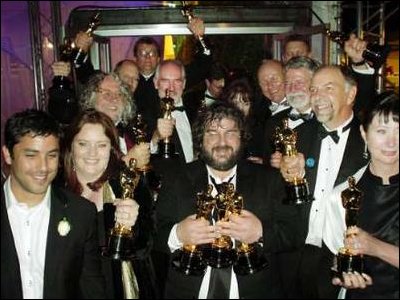
All prognosticating aside, “The Lord of the Rings: The Return of the King” fulfilled my hoped for Oscar outcome with a Best Picture win, alongside the 10 others it was nominated for, sweeping its categories and tying “Ben Hur” and “Titanic” for a best-ever 11 total wins.
The LA Times had a nice recap of the whole evening.
- Arik
 "Competitive Intelligence applies the principles of competition and lessons of intelligence to the need for enterprise awareness and predictability of market risk and opportunity. CI has the power to transform an enterprise from also-ran into real winners with agility enough to create and maintain sustainable competitive advantage."
