February 07, 2004
Jeep vs. Hummer
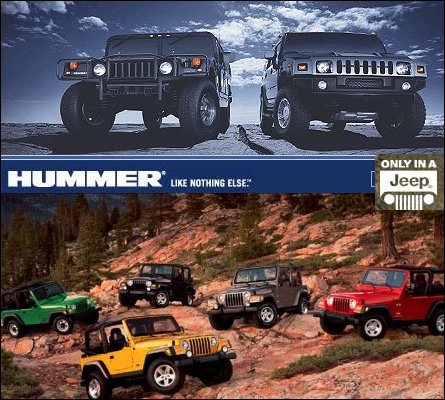
Hummer and Jeep are going at it - with Jeep running an rather risky ad designed to fight back against Hummer's popularity even as the two brands start a somewhat unlikely battle for marketshare - the Hummer based on the latest military vehicle technology, while Jeep's is based on its World War II predecessor. Here's an excerpt from the IHT, detailing the fight between DaimlerChrysler's Jeep and General Motors' Hummer:
-
Jeep, a division of DaimlerChrysler, recently began running a commercial that showed a bunch of children tooting around in toy Jeeps while a fat child struggled to get his go-cart Hummer out of the mud.
"If it's not trail-rated, it's not a Jeep 4x4," a little girl says to the fat child in a cutesy, I-told-you-so tone. The ad, by GlobalHue of Southfield, Michigan, part of Interpublic Group, is a takeoff on a recent Hummer commercial that depicted a naughty child building a soapbox Hummer and then going off road to win a race. The lavish Hummer spot, by Modernista of Boston, was directed by Scott Hicks, who also directed the movie "Shine," and set to the tune of "Happy Jack" by The Who.
Why would Jeep take a swipe at Hummer?
Ever since General Motors began selling a suburbanized, if still steroidal, version of the Hummer in 2002 called the H2, analysts have pondered the effect of a brand based on a new military vehicle on the brand based on an old military vehicle.
DaimlerChrysler went on the offensive against the H2 by suing GM, asserting that the H2's grille too closely resembled a Jeep's grille.
Jeep lost the case, but Hummer still seemed to be on the mind of GM's rivals at the North American International Auto Show this month. Both DaimlerChrysler and Ford showed rugged sport utility vehicle prototypes that seemed to buck the trend toward tamer, carlike sport utilities. Ford displayed a modern version of its defunct Bronco, while Jeep unveiled a new show car, a massive block of a vehicle called the Rescue, with tire diameters of 37 inches, or 94 centimeters, and a chassis width of 80 inches.
Whether either vehicle will actually be produced is not clear, but many at the show said the Rescue's boxy design looked an awful lot like the H2.
Dieter Zetsche, the chief executive of Chrysler Group, dismissed the idea in an interview at the show. "If anything, Hummer tried to penetrate in Jeep's area," Zetsche said. "This is an absolute, original Jeep, the design of the vehicle, everything. Yes, it has the size of a Hummer, that's true. But I don't know whether there are plans to have certain size brackets restricted to certain brands. That would be new to me."
Hummer and Jeep are not easily compared when one looks at the numbers. Jeep, whose sales declined 4 percent last year, according to Autodata, is a far older brand that sold more than 440,000 vehicles last year. About 35,000 Hummers were sold in 2003.
Hummer is also a luxury brand, with the H2 starting around $50,000 and the H1, which closely resembles the Humvee military transport, at around $100,000. That is why the parking lot at the Hummer Driving Academy in South Bend, Indiana, where rich suburbanites come to learn how to drive off-road vehicles, is filled with Jeep Wranglers - the camp's instructors cannot afford Hummers.
Hummer is planning smaller, lower-priced models to fill out its lineup, which will present a broader challenge to Jeep down the road. But that could take years. Jeep plans to redesign its flagship SUV, the Grand Cherokee, this year, and it will offer a bigger version of the Wrangler.
For now, the Hummer's principal threat, many analysts say, is capturing the mystique that Jeep once had.
"Hummer has stolen Jeep's thunder in terms of image," said Peter DeLorenzo, a former Detroit advertising executive who now edits autoextremist.com, a Web site that critiques the industry.
DeLorenzo, who does some consulting work for Chrysler, added: "Jeep is no longer considered the top of the mountain in terms of off-road vehicles. The H2's image has blown past Jeep overnight."
DeLorenzo said the Hummer advertisement "might be considered one of the best car ads of its type of all time" and called the new Jeep ad "a very childish, amateurish spot that pretends to make fun of Hummer when all it does is make them look terrible."
Speaking generally, Clive Chajet, founder of Chajet Consultancy, a corporate identity specialist, said: "I think it's always risky to be negative about a competitor. It is a form of flattery by the knocker to the knockee, because you don't talk about the competition, and you don't bring attention to them."
Strong identities are increasingly important as the market is overrun with sport utilities. Jeep appears to be choosing to play the stud card, with its latest commercial being one in a series touting the brand's "trail-rated" off-road capabilities.
The Hummer driver? In the Jeep commercial, the fat child, labeled an "imitator," is left pounding futilely on his roof with his black gloves.
So, as Hummer continues to appropriate Jeep's 4X4 image in the minds of auto-buyers, whether Jeep can effectively slam its un-named-but-heavily-hinted-at competitor in its ads might determine whether being "trail-rated" can come to mean anything in the American psyche.
- Arik
February 06, 2004
Chinese Private Investigators Toe Fuzzy Legal and Ethical Lines
I read a piece in the Miami Herald a week or so ago about private investigators and their roles in CI practice in China lately. It’s interesting to compare China with the United States in the past 25 years – but I’m not sure how easy it will prove to be to predict the future of CI in China as the field evolves. In the meantime, here’s an excerpt:
-
Out of China's chaotic race to capitalism, an army of private detectives has emerged to find abundant work tracing bogus goods, tailing swindlers and capturing philandering spouses on videotape.
By some estimates, 700 to 1,000 small investigations companies now ply their trade, employing tens of thousands of paid informants, stalkers, disguise artists, cameramen and part-time snoops.
Like much business in China, the industry exists in a legal twilight zone. Banned by the central government in 1993, private-detective agencies became semi-legal again after a 2002 court ruling. Even so, there's no central registry, no federal licensing and only fuzzy legal interpretation about how gumshoes may operate.
"My understanding is that anything that is not specifically banned is legal," said Kang Yongchun, the deputy director of the Kedun Detective Office (www.kedun-detective.com) in Shenyang, an industrial city about 400 miles northeast of Beijing.
Another excerpt points out why this matters to competitive intelligence practice in China:
-
When 150 private detectives, lawyers and other experts gathered in late December in Hangzhou to discuss the outlook for private investigations, much of the talk centered on "competitive intelligence," such as tracing counterfeit goods and identifying thefts of industrial know-how.
U.S. and European security consulting companies are present in China, but they largely stick to insurance fraud and safeguarding foreign products from counterfeiting.
"Most of the work we do is brand protection," said Ewen Turner, the Shanghai-based managing director for northern China for Pinkerton Consulting and Investigations, the 154-year-old security firm headquartered in New York.
Turner said private investigation in China "is still very much a fledgling industry" and local private eyes run the gamut "from legitimate firms to one-man offices to professional informants who go around city-to-city sniffing around markets."
"There are people whose sole purpose is to go follow trucks around," the managing director said.
It's interesting to note how China has been trying adopt more sophisticated CI techniques in recent years however - I've been there twice in the past two years on lecture tours to talk about the legitimized adoption of legal/ethical CI practices over shadier industrial espionage activities that more frequently marked past intelligence forays by Chinese industry – and, in many cases, still does.
- Arik
February 05, 2004
Pixar vs. Disney: Clash of CEOs and the New Competitive Challenges Both Will Face
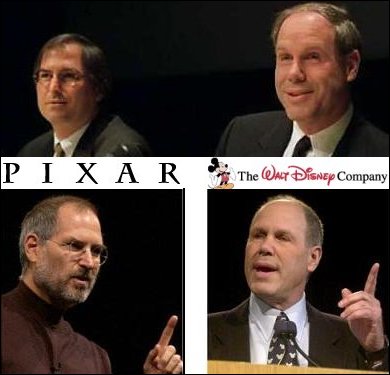
Late last week, 10-month-old talks to renew the pact between Disney and Pixar that produced $2.5 billion in box office over the past few years, broke down as the companies failed to arrive at an agreement to move forward together - instead, they'll move forward as competitors.
Pixar's chief executive, Steve Jobs, who also runs Apple Computer, abruptly ended negotiations with Disney after no progress was made in what Disney and its financial analysts believed was just asking too much, including sole ownership of the films the two had made together under the existing agreement - including hits like "Finding Nemo", "Toy Story" and "Monsters Inc."
"What Pixar has that we don't have is John Lasseter," Eisner said during an investment conference last year. "It's like Walt in a way. He has that quirky sense of humor and understanding. John is unique." This gives Disney two years to nurture or hire its own version of Lasseter - himself a former Disney animator - to compete against future Pixar films.
Eisner faced criticism for having mismanaged one of the most profitable tie-ups in the history of Hollywood and letting Pixar go its own way. "He made them feel like second-class citizens when they were producing the best product in the country," said Stanley Gold, a former board member allied with ex-director Roy Disney who is campaigning for Eisner's ouster. "It was no way to manage talent," added Gold, who is campaigning for shareholders to vote against Eisner and three other board members up for reelection at the March 3rd shareholder meeting in a symbolic protest.
But short-term, analysts said, Disney would benefit, since it was not going to give away any of its profit from the two films left in the current Pixar deal, which had been part of the renegotiation. "Eisner had no other choice in my opinion," said Schwab SoundView analyst Jordan Rohan who estimates Disney would have forgone up to $1 billion in pretax profit over four years. "If my financial projections are correct... then Eisner will be vindicated, the company will be back and Roy Disney will find it hard to effect any change," he said.
Then, yesterday, in an conference call announcing a quadrupling of earnings on the strength of "Finding Nemo" DVD sales, Jobs ended any hope that the companies might continue their partnership by blasting Disney's own animation efforts and blaming the company for refusing to reach a compromise. Jobs said Pixar is now the "most powerful and trusted brand in animation" and is free to work with new partners.
"The truth is that there has been little creative collaboration with Disney for years," Jobs said. "You can compare the creative quality of Pixar's last three films, for example, with the creative quality of Disney's last three animated films and gauge each company's creative abilities for yourself."
"We will truly miss working with Dick Cook and his terrific distribution and marketing teams," Jobs said, referring to the chairman of Walt Disney Studios. "And you would be hard pressed to find anyone who loves the original spirit of Disney more than John Lasseter, Ed Catmull or myself. But after almost a year, it's time to move on." Lasseter, a former Disney animator, is the chief creative force at Pixar. Catmull is Pixar's president.
"Not even Disney's marketing and brand could turn Disney's last two animated films, ‘Treasure Planet’ and ‘Brother Bear’ into successes. Both bombed at the box office," Jobs said. "No amount of marketing will turn a dud into a hit," Jobs said. While Disney must now face Pixar as a competitor, it retains the rights to make video and theatrical sequels and TV shows to the movies covered by the current deal. However, despite retaining the right to make sequels to Pixar films, Disney does not own the underlying technology and must recreate the millions of lines of computer code for each character. "We feel sick about Disney doing sequels because if you look at the quality of their sequels, like ‘The Lion King 1-1/2,’ ‘Peter Pan’ sequels and stuff, it is pretty embarrassing," Jobs added.
Pixar still has two movies to deliver under its current deal, including "The Incredibles," due in theaters in November, and "Cars," which will be released next year.
Disney's studio division contributed 19 percent of the company's overall operating income in 2003 and during the past five years, Pixar contributed more than 50 percent of Disney's studio profits, but if Disney had agreed to Pixar's terms, it would have forfeited hundreds of millions of dollars in profits it is entitled to under the current deal.
One factor in Disney's favor may be that Disney's studio division has found increasing success with live-action films, such as "Pirates of the Caribbean: The Curse of the Black Pearl." Strong box office returns in that area could reduce the company's reliance on Pixar profits and Disney's theme parks, which contribute the bulk of the company's revenues, also have been recovering from several years of lower attendance.
Disney has said it will release its first-ever computer-animated film, "Chicken Little," in 2005 and has several other computer and hand-drawn animated films in the works. But the big challenge for Disney will be to fill the creative vacuum left by the loss of Pixar writers and animators such as Lasseter, Andrew Stanton, the director of "Finding Nemo," and Lee Unkrich, co-director of "Monsters Inc." and several other Pixar films.
Disney has cut back its own feature animation department having earlier this month announced it would close its Orlando animation studio and shed more than 250 jobs. Computer-generated characters will largely replace hand-drawn ones in Disney's restructured animation department.
In a recent interview with The Associated Press, Disney studio chairman Dick Cook said attracting and nurturing creative animation talent is a priority. "There is a group of kids graduating today from CalArts or from UCLA or USC that are bigger, better, faster, smarter than the current group," Cook said. "They have the ability to know what the masters have done before them, and they're better than they are. Attracting that kind of talent, for us, is one of the great priorities."
"Finding Nemo," Pixar's latest film, has earned more than $800 million at the international box office to date, surpassing the record previously held by Disney's 1994 film, "The Lion King." Jobs said every major studio has expressed interest in working with Pixar and negotiations with at least four of them will begin in March and Pixar hopes to have a new deal in place by the fall.
In an e-mail, David Stainton, picked by Eisner last year as Disney's new chief of animation, tried making lemonade: "Given Pixar's demands, this is good news for the company. It is also a great vote of confidence for feature animation - confidence in our talent, our slate, and our future. You all are awesome and ready for your close-up!"
Barron's said Pixar has probably capped its earnings power for the next three years because its next two movies, "The Incredibles" and "Cars," will be released under the existing deal, which effectively gives Disney more than 60 percent of any profits, and the same report cited a Morgan Stanley analyst who said the possibility of negotiating more favorable terms on those two movies is now off the table. And, as Pixar faces Disney as a rival in the increasingly competitive animated film business, Pixar's new partner is unlikely to be as strong as Disney in family entertainment. In the future, starting with its as-yet unnamed 2006 movie, Pixar will probably bear all the production and marketing costs, Barron's said.
So, can Eisner carry on? His instincts appear to be failing him… Several months before last summer's release of "Finding Nemo," Eisner, told his board not to expect a blockbuster and suggested that such a fate might not be all that bad. Eisner said that although Pixar was excited about its film, he was not impressed by early cuts he'd seen, according to people familiar with the matter. Should the movie falter, Eisner said, Disney could gain negotiating leverage in contentious talks to extend its partnership with the highflying animation company. Pixar, Eisner concluded, may be headed for "a reality check." The computer-animated film would, in fact, prove to be a reality check for Eisner, as the critically acclaimed "Finding Nemo" would soon make more money than any animated film in history. Advantage: Pixar.
I think in the end, the real source of competition was probably in the inflated egos of the two firms' CEOs, Eisner and Jobs, both famously strong-willed and who let their personal differences cloud their objectivity in a partnership in which the spoils were evenly split. Jobs felt so slighted that he put an offer on the table designed to make Eisner so angry talks would break down and each company could go their separate ways. Here’s a great backgrounder excerpt from the LA Times, comparing the two leaders:
-
Eisner has been at the helm of Disney for 20 years. He has weathered a number of storms, including poor performance of its stock, deteriorating ratings of its ABC television network, weak sales at its retail stores, and the defection of high-level executives who have found success elsewhere. The Disney chairman is widely known as someone who will not give an inch in his business dealings, whether it's litigating over merchandising royalties for Winnie the Pooh or forcing cable operators to pay escalating fees to air Disney's ESPN network.
The equally tough-minded Jobs has survived his own share of setbacks. In 1985, the legendary Silicon Valley entrepreneur left Apple Computer, the company he co-founded in his father's garage, amid a power struggle over its direction. Like Eisner, he is guarded and intensely protective of his company's brand name. Jobs recently demonstrated his maverick vision and shrewd negotiating skills in persuading executives at Universal Music Group and other labels to sell songs online with few restrictions through Apple's iTunes Music Store. Associates say he wins some battles sheerly on the force of personality. "He is the best salesman in the technology industry, bar none," one Silicon Valley analyst said of Jobs.
The pairing of two men with such combustible personalities may have been destined for a blowup.
The companies first joined in 1991. Back then, Pixar was not an equal partner. The upstart animation company was paid a fee to create digitally animated movies that Disney would market and release.
But after the surprise success of "Toy Story" in 1995, Jobs insisted on changing the financial balance of the relationship. He demanded that Pixar be paid half the profits on the films it wholly created for Disney. When Eisner balked, Jobs nearly walked.
Still, according to sources who know both men, Eisner continued to treat Jobs - known to have a disdain for authority - in a paternalistic fashion. "Steve viewed it as a partnership and he thought Eisner treated him like a hired hand," one source said.
Many say the turning point in the unraveling of their relationship came when Jobs and Eisner collided over the fate of "Toy Story 3" and how sequels figured into their new five-picture deal.
Under the terms of the agreement, sequels would not be counted as part of the five. At the time, Disney was trying to save money and time by making direct-to-video animated sequels. That's how "Toy Story 2" was initially envisioned. But as production proceeded, Jobs could see the financial and creative potential of turning it into a major movie that would be released in theaters.
Although Eisner resisted, Jobs would not give up, according to sources familiar with the dispute. In the end, Jobs' persistence paid off for Pixar and Disney. "Toy Story 2" made more money than the original, raking in a stunning $245 million domestically in 1999.
But because the movie was a sequel, it was not counted under the multipicture deal — a fact that Jobs accepted without making a ruckus. He was not so amenable when it came to plans to make "Toy Story 3."
This time, Jobs was adamant that the sequel be counted as one of the films Pixar owed under the Disney contract. Jobs' view was that "Toy Story 2" was a giant "freebie" for Disney and that Pixar should not be forced to provide another one.
Despite a collaboration that unexpectedly enriched Disney, Eisner insisted on sticking to the letter of the contract. He refused to compromise and publicly bragged about the leverage he had over Pixar.
Jobs was livid, according to a source close to the executive.
Even Walt's nephew Roy Disney couldn't mend the rift after Jobs sought his counsel, following Eisner's 2002 congressional testimony that directly mocking Apple's "Rip. Mix. Burn." slogan exemplifying digital piracy of entertainment content. But Eisner strictly forbid Disney from visiting Pixar to screen his pet short film project "Destino" saying Disney personnel would not mingle with Pixar's during tough contract re-negotiations.
Still, those analysts who'd speculated last week's announcement by Jobs was just a negotiating ploy are left to remember words from last November, while discussing Pixar's third-quarter earnings with analysts: "If we cannot strike a deal with Disney, then we can talk with the rest of these companies and they will know that we're not just talking to them to get a better deal with Disney, because we'll be finished with Disney."
The competitive dynamics get pretty interesting to think about for other players in Hollywood, namely DreamWorks with its upcoming "Shrek II" sequel, following up on the success of "Shrek" – the first film to win Best Animated Feature at the Academy Awards. Other studios will be vying to build out an animation franchise as well, as they spot a weakened competitor in Disney – possibly with Pixar – although they’d need to tolerate the relationship.
In the end, I think Disney thought DreamWorks took the right road by building their own animation machine and this represents largely a revision of history to redeem what was originally an unexpectedly entangling decision to buy rather than build. That said, "Toy Story", the film that started it all, might not have happened without both Disney and Pixar behind the wheel.
- Arik
February 04, 2004
Are Corporations Insane?
 Just in the past week or so I noticed an article on AlterNet about "The Corporation", a new documentary premiering at the Sundance film in January that also won Sundance's World Cinema Documentary Audience Award, based on the premise that corporations are legally programmed to act like psychopaths – that Enron, WorldCom, etc. aren’t the exception… they’re the rule – and the bigger companies become the worst they behave:
-
"The corporation is a paradox," says Mark Achbar, who co-directed and wrote the documentary with Vancouver filmmaker Jennifer Abbott and law professor Joel Bakan. "It generates tremendous wealth, but at tremendous social and environmental cost."
Achbar, best-known for his 1992 documentary "Manufacturing Consent: Noam Chomsky and the Media," says that when he started working on the new film six years ago, it originally was about the anti-globalization movement. But he realized that the growing protests were really against corporate power – and despite the millions of news hours and pages devoted to mergers, acquisitions, marketing strategies and CEO profiles, no one had really examined the history and the character of the corporation itself.
An unlikely subject for a hit film, perhaps. But The Corporation's entertaining mix of interviews, cartoons and old industrial films has already won three "people's choice" prizes at film festivals, including Sundance's World Cinema Documentary Audience Award (sponsored, ironically, by Coca-Cola). In Canada, where "The Corporation" has garnered rave reviews – one compared it to "the best issue of Harper's magazine set to music" – it's currently playing to sold-out theatres across the country.
"Everybody wants to buy their products from a socially responsible corporation, not from some horrible polluter," Achbar says. "The question is, how are we going to resolve this dilemma?"
Here's another excerpt:
-
corporations grew in size and power during the booming 19th century, and their owners wanted to expand their legal rights as well. Since owners or shareholders couldn't be held personally liable, they argued, the corporation itself should be treated as a "person" – thus entitling it to all the protections of the Constitution. The argument was accepted by the U.S. Supreme Court in 1886, in the case of Santa Clara County v. Southern Pacific Railway Company. Consequently, a corporation today has the right to free speech, the right to own property, and the right to due process of law, just as a person does.
So what kind of person is it?
To answer that question, the film ingeniously compares notorious examples of bad corporate behavior to a list of psychiatric symptoms. Nike jumping from sweatshop to sweatshop in ever-poorer countries? That shows an "incapacity to maintain enduring relationships."
Monsanto's refusal to acknowledge the harm caused by Agent Orange? That's an "incapacity to experience guilt." Corporate directors are required by law to do only what's best for the company, regardless of the consequences to anyone else – in other words, a corporation is motivated purely by self-interest. Add up the symptoms, as an FBI consultant does onscreen, and the corporation starts to resemble Ted Bundy.
"The perverse genius of the corporation is not just that it maximizes profit by offloading as many costs (employee education, environmental cleanup) as possible onto the public; it also enables owners and managers to simultaneously claim that each other are ultimately responsible for the company's actions. Even to those at the top, the corporation seems like a monster beyond anyone's control."
I think we all hope corporations are less psychopathic than they seem a lot of the time… but perhaps to truly change the way companies behave, we’ll need to change the legal understanding of what corporations mean to society today.
- Arik
February 03, 2004
The Dumbest Moments in Business
Since it’s my birthday – I’m 34 today – I thought I’d keep it fun and light with Business 2.0’s "101 Dumbest Moments in Business" from its January/February 2004 issue.
If you’re not a subscriber, you can’t get to more than the top 10, but it’s worth it - a tie for first in the Two Greedy Richards gives way to more great stories of stupidity in business – here’s the excerpt:
-
Richard the First - In August, the board of the New York Stock Exchange decides to give CEO Dick Grasso his $139.5 million pension up front, ostensibly to save the estimated $10 million it would cost to deliver the payout at retirement. Grasso offers a succinct if not altogether satisfying explanation: "I'm blessed." When a firestorm erupts over Grasso's payday, he graciously agrees not to take another $48 million he has coming to him. Then, a week later, Grasso "resigns"—and quickly claims he was fired, which entitles him to another $58 million, including the $48 million he had promised to forgo.
Richard the Second - In October, New York attorney general Eliot Spitzer's wide-ranging investigation of the mutual-fund industry reveals that Dick Strong, the founder and chairman of Strong Financial, has made $600,000 - the equivalent of about 60 bucks to a regular working stiff - through market-timing trades contrary to his own company's rules. He's forced to resign and may have to sell his nearly 90 percent stake in the firm, valued at just under $1 billion.
In September, retail chain Urban Outfitters begins peddling Ghettopoly, a Monopoly knockoff. The top hat, shoe, and car are replaced with a machine gun, marijuana leaf, basketball, and rock of crack cocaine. Reacting to protests, Urban Outfitters pulls the game from its stores.
In August, online "social planning destination" Evite sends an apology to its users for having cited Yom Kippur, the Jewish day of atonement, as a "reason to party" in an earlier e-mail newsletter.
In Canada, General Motors is forced to come up with a new name for its Buick LaCrosse sedan after discovering that crosse is a slang term for masturbation in Quebec.
In April, Swedish furniture giant Ikea explains that a children's bunk bed called the Gutvik is named for "a tiny town in Sweden." Announcing that bit of etymology becomes necessary when Germans point out that, in their neck of the woods, the word sounds like a phrase that means "good f***." Ikea yanks the Gutvik from its catalogs in Germany.
In November, Chrysler announces that it will sponsor the Lingerie Bowl, a football game to be played by female models airing as a pay-per-view special during halftime of the Super Bowl. After the carmaker comes under fire for the sexist nature of the event, CEO Dieter Zetsche quickly distances himself from the spectacle, claiming he had no knowledge that it was in the works. The company reportedly pressures the event's producers to change the players' uniforms, demanding that participants wear sports bras and volleyball shorts; then, a week later, it drops the event altogether.
Click the link above to buy the whole book – it’s fun reading. Maybe somebody’ll send it to me for my birthday…?
- Arik
February 02, 2004
The Business Take on Super Bowl XXXVIII: Decent Game Overshadowed by Mostly Tacky Ads & Janet Jackson’s Stupid Publicity Stunt
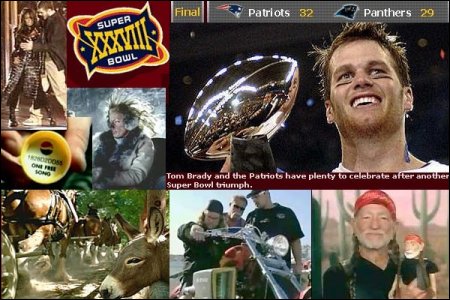
Well, another Super Bowl is behind us and the general consensus is the game was a lot better than the ads were. CNN had a summary of the ads online and all of them let me down fairly uniformly.
Despite the lack of creativity, which AdWeek says there’s a good reason for, the ads are still a relative bargain at $2.25 million per 30-second spot (though AOL might disagree).
One theory for the lack of interesting ads was that Super Bowl advertisers got cold feet because of the critiquing of their ads itself:
-
...sales execs at ABC and Fox (which alternate airing the Super Bowl) and media buyers cited the intense scrutiny of the ads themselves - via next-day water-cooler buzz and published critiques, such as USA Today's annual Super Bowl Ad Meter - as contributing to some advertisers' reluctance to air ads during the game or decision to pull out of commitments.
Among many creative critiques, perhaps the best known is USA Today's Ad Meter, a survey of several hundred viewers who watch the game under the supervision of USA Today officials and rate the Super Bowl in-game commercials. Results are published in the newspaper the next day.
Now in its 16th year, the survey's media coverage has grown. That greater exposure has helped make some would-be advertisers gun shy about spending the $2 million-plus per spot (on top of production costs), only to have the bad reviews published in a national paper.
"The scrutiny ... has driven some advertisers away," said Ed Erhardt, president of ABC/ESPN Sports Customer Marketing and Sales. "The advertisers who finish in the top 30 or 40 percent of the USA Today Ad Meter come out OK, but if they finish below that, their company officers and shareholders begin to question whether the heavy expenditure was worth it."
"It bothers me who these people are, how they are picked, and are they really qualified to judge the creativeness of advertising," said Larry Novenstern, svp and director of national broadcast at Deutsch. "And they tend to pick the same types of commercials every year. Commercials with comedy do well. That's why Budweiser and Pepsi always do well, and auto companies and movie companies do not traditionally do as well."
John Hillkirk, editor of USA Today's Money section, where the Ad Meter results run, defended the survey. "It is not supposed to be the experts' view; it really is the view of the average person watching the game," he said.
In the 2003 Super Bowl Ad Meter, Anheuser-Busch (Budweiser) had six of the Top 10 spots. It is running multiple units in this year's telecast.
Despite the white noise surrounding the Super Bowl, it remains the year's marquee media buy. For example, most major movie studios have purchased at least one spot again this year, though most of their ads finished in the lower half of the meter last year.
Though not everyone thought so, the game was fun to watch. BusinessWeek had a complimentary critique excerpted below:
-
NFL Commissioner Paul Tagliabue had a great night - the game itself actually took center stage. After a lackluster first quarter, it quickly developed into a well-played nail-biter, with rising-star quarterbacks Tom Brady of New England and Jake Delhomme of the Panthers introducing themselves to millions of viewers. And the league even scored with a cute house ad for its new NFL Network. Dallas Cowboys owner Jerry Jones and coach Bill Parcells, plus a cadre of NFL stars including Warren Sapp, Torry Holt, Priest Holmes, and Zach Thomas belt out Tomorrow, already priming football fans for next year.
Another competitive NFL season and thrilling Super Bowl like this one, and football fans will be bursting into song - whether or not they remember any of the big game's ads.
And, Slate’s Ad Report Card had a rich bit of recap:
-
All in all, the New England Patriots, touted as the most efficient and best-prepared team in pro football, took themselves out of four scoring opportunities through unforced errors. Scoring one of those times could have put the game away well before the end, and scoring any two of which could have put the game out of reach before the final 10 minutes.
A Levitra ad, starring spokesman Mike Ditka, compares football to baseball. Not surprisingly, since Levitra is an NFL sponsor and Viagra is endorsed by a baseball star, football comes out on top. Ditka actually says, "Baseball could use Levitra." Translation: Baseball is limp! You can't get it up, baseball! As I have previously shown, Levitra's euphemism for sex is the image of a football being thrown through a tire. In this ad, Ditka throws the football through the tire, and shouts, "You gotta love that!" This forced me to contemplate the thought of a sweaty Ditka, immediately post-coitus, shouting "You gotta love that!" at his partner. Horrifying.
Kids get their mouths washed out with soap - they can't help but curse in disbelief when they see the new line of Chevys. This ad is kind of funny, but what's funnier is that the Linux kid is in it. It's just two commercial breaks later, and already he's gone from grandiose metaphor to kid with soap in mouth. Side note: Shouldn't IBM have some sort of exclusivity clause? They can't be too pleased to see their metaphor hawking cars.
The big Cialis launch! At last, another hard-on pill. The selling point with this one is that it lasts for 36 hours. "If a relaxing moment turns into the right moment, will you be ready?" the ad asks. And it shows several common, everyday moments - like taking a walk, doing the dishes, or soaking in side-by-side outdoor bathtubs perched on the side of a mountain. (The more-interesting-than-usual side-effect warning notes that a nonstop, 4-hour erection merits medical attention. Yipes!) Over all, Cialis' branding seems more woman-friendly, with a lot of tender scenes and intimate looks and not a lot of Mike Ditka shouting, "You gotta love that!"
The lack of celebrity faces in ads this year had a few good reasons behind it, as USATODAY.com explains:
-
The Super Bowl celebrity mill has been upended by a combination of economic, cultural and legal issues that now makes celebrities as much a liability as a benefit in the minds of many marketers.
They're costly. They're risky. They're unpredictable. They're bound to tight schedules. And, too often, the celebrity overshadows the product that's being hawked. As a result, some "everyday folks" found on cable and reality shows replaced big-name celebrities in ads for AOL and Pepsi. And it's why many marquee names from recent Super Bowl commercials - including Michael Jordan, Britney Spears and Celine Dion - are nowhere to be found this year.
Marketers are increasingly risk averse when it comes to the big game. Advertisers paid CBS a record $2.3 million for a 30-second spot and expose their message to nearly 90 million viewers. Most didn't want to rely on risky stars for a hit ad.
That isn't to say there weren't any celebrities. Muhammad Ali is featured in an IBM commercial. Willie Nelson stars in another H&R Block ad. And Homer Simpson shows up in a MasterCard spot. But the hot, "A-list" celebrities are nowhere to be found. Here's why:
• Messy scandals. Scandals, like those around Kobe Bryant, who was recently dropped as a McDonald's endorser, are forcing marketers to reconsider the high risk of putting stars alongside their brands.
"There's Michael Jackson, Britney Spears and Kobe Bryant rub-off," says ad trend watcher Marian Salzman of Euro RSCG Worldwide.
• Exploding costs. Besides the high cost of the broadcast time, the cost to make the ads also has spiraled to the point where some ads cost upward of $1 million to make. "The price has risen to the stratosphere," Salzman says. Then, there's the cost of the celebrity, too, which can add $100,000 to $1 million.
• Celeb confusion. The use of celebrities can be confusing. Some viewers quickly forget what product a celebrity is hawking. Others are so mesmerized by the celebrity, they never make the link in the first place.
"You run the risk of having consumers remember the Celine Dion spot but not remembering what the ad was for," says Kathy Delaney, managing partner at Deutsch, N.Y., with four ads for three clients (Monster.com, Mitsubishi and Expedia). "It's not about out-celebrity-ing the other guy. It's about striking a chord with people through the brand essence."
• Idea first, celebrity second. Pepsi, which has featured everyone from Michael Jackson to Madonna to Mike Tyson in past ads has learned the hard way. And the use of Britney Spears in its Super Bowl spot two years ago failed to boost the brand's image.
Keeping with its current "It's the Cola" ad campaign, Pepsi promotes soft drinks, not superstars. One ad, to launch Pepsi's giveaway of 100 million free downloads from iTunes, features 17 teens sued for allegedly making unauthorized music downloads.
"Use of celebrities always depends on the creative idea," says Dave Burwick, chief marketing officer, Pepsi North America. "You could argue we're using different types of celebrities."
• Unknown appeal. Most Americans don't know the stars of the Discovery Channel's hit show American Chopper. But that's likely to change after Sunday's Super Bowl, when the show's stars - Paul Sr., Paul Jr. and Mikey Teutul - appear in three ads for AOL.
The family's semi-anonymity is part of the appeal. "The Teutuls are on the bubble," says Len Short, executive vice president, brand marketing. "So we avoid the pitfalls of a big star pasted to our message."
And, a few other newsworthy observations on the advertising mix:
- Viewers' favorite ads crude, rude and furry
- Super Bowl ads go low brow
- Laughs Not Enough to Win Super Ad Battle
The other "news" to come out of Super Bowl XXXVIII was the shameless publicity stunt – a desperate cry for attention, in my view – by Janet Jackson and duet-accomplice Justin Timberlake to bare her right breast to 90 million viewers tuning in. To say it was a "wardrobe malfunction" is to insult the intelligence of the American populace – a crime I think best met with a boycott of both "artists" output, hereafter. After the Britney-Madonna-Kissing silliness at the MTV awards and all the rest of the escalating shock-stunts of the past year, isn’t it time we all just said, "Enough, already…?" let’s all just tuned-out and gave them all the attention they deserve, eh?
Well, that probably won’t happen, but there’s no way Janet and Justin should get camera-time at the Grammy’s this Sunday night – especially given the violence with which Timberlake ripped Jackson’s top and then today was nonchalant about the whole episode. I don’t think we want our girls and boys thinking this is acceptable behavior and that’s exactly what they got out of all of this.
It’s not the nudity itself, per se that bothers us – it’s the grandstanding and attention-grabbing and seeming escalation of stunts like this that’s most disturbing. Let’s hope for a mea-culpa from both performers as they own up to the plot – in the meantime, I appreciated AlterNet’s fun but rather over-the-top, anti-business critique:
-
If you’ve been living in a cave since Sunday morning, a quick recap. The Super Bowl halftime show featured a medley of performers including Janet Jackson, P. Diddy, Nelly, Kid Rock and Justin Timberlake. Technically, Jessica Simpson was part of it, but she didn’t actually sing anything. Then again, it didn’t look like any of the other performers actually sang anything either. Lip-synching was the order of the day.
Anyway, Justin and Janet danced a duet, and at the end of it Justin grabbed the leather cup covering Janet’s right breast and ripped it off. If you believe Timberlake, a red liner was supposed to cover Jackson’s skin, but he ripped that off too. For about half a second, if you looked really hard, you could kinda-sorta see Jackson’s breast. But even then, not really – as the Drudge Report later showed in great close-up, Jackson was wearing what I can only describe as a throwing-star nipple ring, which suggests either that she had wisely prepared for the incident or that Janet Jackson wears some really funky jewelry.
The outrage came fast and furious. The NFL announced that MTV wouldn’t be producing another halftime show anytime soon. Deeply offended newspaper columnists wrote articles like The Boston Globe’s "Jackson & Co. sink to new low," which would, in fact, be an interesting thesis to debate.
And inevitably, cultural conservatives saw a prime opportunity to engage in a little fundraising. Both the Family Research Council and the Parents Television Council, headed by right-wing media critic (i.e., nut) Brent Bozell, cranked out high-minded criticisms. Predictably, CBS "deeply" regretted the incident, and Timberlake apologized too. (In my vision of heaven, I dream of having to apologize for ripping off Janet Jackson’s breastplate at halftime of the Super Bowl.)
First, CBS and MTV are both owned by Viacom, which obviously saw a chance to exploit corporate synergy by hiring MTV to produce the halftime show. I don’t know about you, but it warms my heart when massive media corporations try to foist corporate synergy on the unsuspecting public and wind up being investigated by the FCC.
Second, CBS is the company that wouldn’t air an anti-Bush ad by MoveOn.org because it didn’t want to offend the White House and conservatives, just as it spiked a Ronald Reagan mini-series to avoid offending the White House and conservatives. And then it runs a halftime show which offends the White House and conservatives. How quickly all the previous sucking up is forgotten.
Third, let us not forget that this outrage is all about a half-second of partially nipple ring-covered breast. This in an hours-long game of brutal violence – CBS certainly didn't hesitate to show blood spilling from one player's nose in the first quarter – in a sport with a steroid problem, many of whose players have taken to owning unregistered guns, while other players are encouraged to become so obese that they risk dying on the field. Yes, it’s definitely the breast that we should get worked up about.
At least there wasn’t any other female flesh to tempt the God-fearing men of America! No scantily clad, artificially enhanced cheerleaders whom CBS kept using as a segue into and out of commercials, for example. And I’m sure that Visa used the bikini-wearing women’s volleyball team to promote the summer Olympics simply because of its athleticism.
What’s really going on here? Well, American hypocrisy about sex, of course. We run ads for drugs that help men get erections without ever mentioning the word "sex"; we grow irate at an exposed breast amidst an orgy of capitalist decadence. We nurse from the breast as children, but we fetishize it as adults, make it an object of lust and taboo – so that showing a breast, a source of human life, becomes worthy of government investigation.
It is, literally, a clash of human nature versus corporate culture. The Super Bowl has become the first American corporate holiday, a nationwide celebration of capitalism. (We watch it for the ads!) Any element of spontaneity threatens the corporate control of people’s minds and, yes, bodies. That’s why I loved the rebellious symbolism of the guy who streaked across the field (which, of course, CBS wouldn’t show). That’s also why the corporate producers don't mind the lip-synching – mouthing the approved words is the perfect metaphor for this synthetic event, actually preferable to the authentic but imperfect human voice.
Still, the FCC has launched an investigation – officially making a "Federal case out of it":
-
According to the FCC's guidelines, programming can be judged obscene only if it "appeals to the prurient interest," depicts sexual activity in "a patently offensive way," and has zero literary, artistic, political, or scientific value. But the FCC's rules stipulate that indecent material can't be aired during hours when children are likely to be in the audience - specifically, between 6 a.m. and 10 p.m. The infamous breast exposure occurred well before the evening deadline.
Tom Freston, chairman of MTV Networks, said he welcomed the FCC's investigation, which he said will prove that the show's producers and broadcasters had no prior knowledge of the stunt. MTV produced the halftime show. "We were really ripped off. We were punk'd by Janet Jackson," Freston said, referring to MTV's reality show that makes celebrities the butt of practical jokes.
Meanwhile, AOL, which had planned to make the Halftime Show available to members and nonmembers for about two weeks which was expected to generate heavy traffic for the online company, decided to yank its stream of the show, after spending about $10 million to air ads promoting its "Top Speed" Internet service and sponsor show. Hopefully AOL can succeed in getting a refund of at least part of that misguided investment. "While AOL was the sponsor of the Super Bowl Halftime Show, we did not produce it," AOL said in a statement. "Like the NFL, we were surprised and disappointed with certain elements of the show."
Yup. Me too.
- Arik
February 01, 2004
Gibson vs. Fender: Battle of the Axes
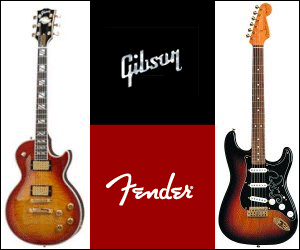
There was an interesting article on The Tennessean Web site about Gibson Guitar Corporation and its chief, Henry Juszkiewicz, who's ambitious goal is to "build the venerable brand, known for its high-end, handcrafted guitars, into a global, highly diversified manufacturer of musical instruments" with $3 billion in revenue.
While the article focused competitive perspective on the company Gibson hopes to benchmark itself with someday - that is, Yamaha, the world’s largest maker of musical instruments, as well as tennis rackets, snow-blowers, golf clubs, car interiors and motorcycles – Gibson’s $250 million in revenues pale in comparison with Yamaha’s $2.7 billion in musical instruments, and another $2.1 billion in other stuff.
The much more obvious direct competitor for Gibson is Fender, from whom Gibson is trying to differentiate itself with the "digital guitar", acclaimed by so many in the press, but with a more pragmatic reception from musicians. Likewise, diversification is part of where Gibson is headed – pianos and drums and bass guitars – alongside its traditional fare, which is also moving downscale with brands like the Chinese-made Epiphone in order to keep the Gibson brand the upscale $3k-plus axe musicians are used to.
Can Gibson grow 1,100% to scale up to meet Yamaha? I think they should focus on leapfrogging past Fender first.
- Arik
 "Competitive Intelligence applies the principles of competition and lessons of intelligence to the need for enterprise awareness and predictability of market risk and opportunity. CI has the power to transform an enterprise from also-ran into real winners with agility enough to create and maintain sustainable competitive advantage."
