January 22, 2004
Philadelphia: Presenting at the Center for Business Intelligence’s 2nd Annual "Competitive Intelligence for Biotechnology & Pharmaceutical Companies" Conference
I was in Philadelphia today, presenting a 45-minute session called "Salesforce CI: Creating Dynamic Two-Way Intelligence Relationships with Sales" at the Center for Business Intelligence 2nd Annual CI for Bio/Pharmaceutical Companies conference. It was a fun event – and about 30% better-attended than last year’s while also housed in a much better venue at the Marriott downtown.
One interesting take-away was a follow-up discussion we had about FDA regulations about salesforce drug comparisons that I think is probably unique to pharma-salesforce-CI: that is, unless there’s been a head-to-head clinical trial to scientifically back up sales comparisons between competitive products (used in sell-against strategy apps and the like) it’s illegal to make comparisons between drugs at all – at least in the United States. We’ll see how that’s reflected in my research for the London version of this event in June, where I’ll give a similar presentation for a European Bio-Pharma audience.
Otherwise, content of the program was very good and the group itself was a lot more eclectic than in the past as well – representing more people from financial community and the generics side of the market – CBI’s really evolved this conference since the last one in January 2003.
My slides are temporarily available for download by clicking here.
- Arik
January 20, 2004
Iowa's 2004 Democratic Caucus Results: Dated Dean, Married Kerry
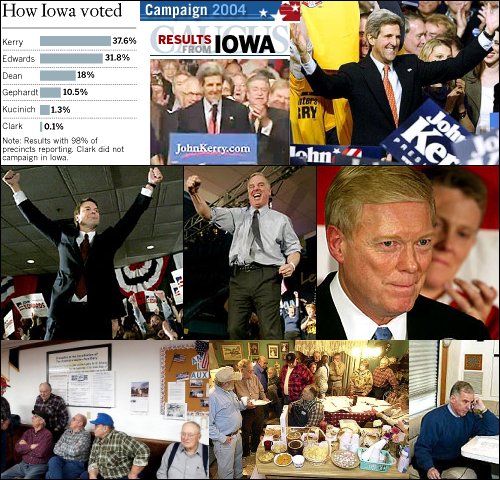
Kerry and Edwards came out of nowhere in the last couple of weeks or so, to eclipse former frontrunner Howard Dean in last night's Democratic Caucus in Iowa, to take most of the state's 45 delegates to the Democratic National Convention later this year. I think it's an interesting study in competition and how candidates differentiate themselves – with Gephardt dropping out entirely after a disappointing fourth place showing.
Dean was bloodied badly and that outcome doesn't necessarily bode well for their ultimate competitors in this march toward November - the Republicans. Widely considered unelectable by Republican intelligentsia, a Dean win in Iowa would have been music to Republican ears. A Kerry-Edwards win is decidedly more competitive to Bush-Cheney '04. Still, Dean’s surreal address following the results was decidedly un-presidential at best, and just plain weird at worst. It hearkened back to the infamous "Monkey Boy" dance of Microsoft’s CEO Steve Ballmer a few years ago.
On the bright side, Kerry’s going to have a lot to live up to in New Hampshire, where Dean can recast himself as a decidedly less-pressured underdog. But, the dark horse in this race is John Edwards – moving down south for primaries in coming weeks should demonstrate how badly we’ve all underestimated the North Carolina Democrat.
As for the media recaps, the LA Times' Ron Brownstein wonders why Dean got whupped and suggests he hurt himself by going negative while misjudging voters' ongoing anger about the war, most of which had already blown over in the wake of Saddam Hussein’s capture. Brownstein also says Kerry "displayed almost equal appeal to men and women, working class and more affluent voters, liberals and moderates" - suggesting very broad-ranging support among a cross-section of influential voters.
Slate's Will Saletan has similar thoughts and adds that the press killed Dean, and only somewhat undeservedly. But, Saletan's analysis of where this leaves Edwards and Clark in the race for second-place – that is, as running-mate – is more interesting:
-
The other significant thing for Edwards is that the winner tonight was Kerry, not Dean. Dean's logical running mate was Clark: the New England domestic policy expert and national security rookie, paired with the Arkansas national security expert and domestic policy rookie. Kerry could go with Clark, too. But Kerry doesn't have to, because he's already got the national security credentials as well as the domestic policy expertise. If the hole in Dean's doughnut, as he once called it, was military experience, the hole in Kerry's doughnut is vitality and a common touch, plus regional appeal in the South or Midwest. I could see a Kerry-Clark ticket (or the reverse), but a Kerry-Edwards ticket (or the reverse) is now conceivable. A Dean-Edwards ticket wasn't.
If I'm Clark in New Hampshire, my task just got more complicated. I'm not just fighting to stay above Kerry so I can have a shot at the presidency. I'm also fighting to stay above Edwards so I can have a shot at the vice presidency.
But, a New York Times news analysis warns not to read too much into the outcomes: of the 13 most recent competitive "nominating processes," 10 have had a different candidate win in New Hampshire than in Iowa. For example, one important candidate from years past who lost Iowa was Ronald Reagan.
There were a couple of other interesting recaps:
- Howard Kurtz: Media Notes - A Flood Of Analysis
- Massachusetts Senator Gets Lift for the Race in New Hampshire
So, it's starting to get a little more exciting with a tightening of the field of Democrats. I personally think Dean will still get the nomination in the end, as the "Democratic Establishment" continues to line up behind him - but, the Iowa loss was a major blow to a campaign that said today it's glad not to be the front-runner anymore.
- Arik
January 19, 2004
Innovation Powerhouse IBM Breaks U.S. Patent Record & Tops the USPTO List for 11th Consecutive Year
American technological competitiveness appears to be in good hands, despite six of the 10 top innovators being Asian rather than American. The 2003 preliminary patent results were reported a week ago by the United States Patent and Trademark Office. As you know, an agency of the U.S. Department of Commerce, the USPTO issues patents, administers the patent and trademark laws of the United States, and advises the administration on intellectual property policy.
IBM broke a record for the number of patents granted in a year with 3,415 in 2003 and the firm has led the U.S. Patent and Trademark Office annual list for the past 11 straight years, making it one tough act to follow.
IBM was far ahead of the number two firm, Canon, which had 1,893 last year. Companies that make IT products held all the top 10 spots; together, those firms acquired 18,121 patents. Besides IBM and Canon, the group includes Hitachi, Matsushita, Hewlett-Packard, Micron Technology, Intel, Philips, Samsung and Sony.
Making its debut on the top 10 list for 2003 was Intel, having jumped up from 15th place in 2002. The chip-maker landed in seventh place with 1,592 patents, compared with the No. 15 spot in 2002. Hewlett-Packard also made a notable rise, moving to the No. 5 position from No. 9 in 2002, recording 1,759 patents in 2003, 374 more than in the previous year.
Still, IBM is the "Innovation Powerhouse".
During the past eleven years, IBM innovations have generated more than 25,000 U.S. patents - nearly triple the total of any U.S. IT competitor during this time and surpassing the combined totals for Hewlett-Packard, Dell, Microsoft, Sun, Oracle, Intel, Apple, EMC, Accenture and EDS.
"IBM's commitment to research and development has driven more than a decade's worth of patent leadership and is a major factor in our emergence as the world's leading IT, services and consulting company," said Nick Donofrio, IBM senior vice president, technology and manufacturing. "That said, we consider patents a starting point on the path to true innovation. What differentiates IBM from other companies is our ability to rapidly apply these inventions to new products and offerings that solve the most pressing business challenges of our clients."
Meanwhile, some of the biggest innovators of years past that no longer appear in the Top 10 include American business titans like Xerox, Lucent, Motorola, Eastman Kodak and General Electric - all firms that have had their share of business problems recently. If you're as curious about prior years as I was, check out the list of Top 10 patent recipients since 1995 below - it's fascinating to see how standings can change so rapidly.
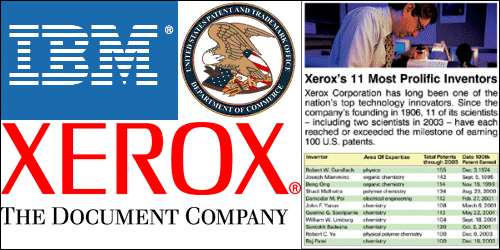
Notably, two Xerox Corporation scientists, Raj Patel and Robert Yu, were awarded their 100th U.S. patents last month. That rare accomplishment capped a year in which Xerox and its subsidiaries earned 628 U.S. utility patents on new materials, new technologies and new ways of processing documents, bringing its total U.S. patents earned to nearly 16,000 - a sum matched by only a handful of the nation's most creative companies.
- Arik
January 18, 2004
Trouble in LEGO-Land: Playing Well, but Not Putting It Together
The name LEGO comes from the Danish words "Leg Godt", which means "Play well". In Latin it means "I put together" or "I assemble". The Danish toy maker, founded in 1932 and whose colored plastic building blocks have been favorite children's toys for decades (including my own), said last week it was expecting a $240 million pretax loss, the worst in the privately held company's 72-year history.
The company fired EVP and COO Poul Plougmann over failed marketing strategies and also dismissed Francesco Ciccolella, who was responsible for product development. The company said it might also lay off some of its 8,000 workers worldwide.
Kjeld Kirk Kristiansen, chief executive and grandson of the company's founder, said Lego's push to develop new products did not generate the results it wanted. Last year was "very, very bad," he said.
Since it reported its first loss of $47.8 million in 1998, Lego has been hit hard by increasing competition from the makers of electronic toys. Under Plougmann, the company reacted by expanding its electronic offerings, including making high-profile deals to use characters from Disney, the Star Wars films and Harry Potter books in its toys. It also developed popular CD-ROM games and its cool Mindstorms series of high-tech robots made of building blocks but programmed with a PC, in effect turning children in programmers plugging in reusable OOP code to control robot activity.
As a result, sales rose but profits stagnated because of the higher cost of producing the new products. The company now plans to stop making the electronics and movie tie-in products and return to its core mission of producing plastic building blocks primarily for pre-school children. "We would rather be in control of our own products, the things that we can decide," Kristiansen said. "We want to go back to our core products, and that is a key part of our future strategy."
Figures for 2003 were not released, but in 2002, Lego posted a 7% increase in sales, to $1.9 billion and a 1% gain in its net profit to $72.5 million. Until 1997, Lego did not release its financial results. The global toy market came to a near standstill in 2003 and caused a deleterious 25 percent sales drop for the company.
It's a real question whether a company like Lego can compete in the high-tech game world kids have become accustomed to. An excerpt from one story explains Lego’s dilemma:
-
[Kristiansen] said the company would now go back to its roots, focusing on building blocks and abandoning its forays into multimedia and film products. "We are returning to Lego's former concept. We're going to focus on building bricks as our main product, concentrating on little kids' eagerness to assemble," he said. "That's why we're pursuing much more aggressive marketing for building bricks, leaving products linked to films such as Star Wars on the back burner," he said.
One key factor for the weak result this year was the poor sales of games based on the Star Wars and Harry Potter films in 2002. Kristiansen acknowledged that Lego's recent attempts to diversify had been a catastrophe. "We tried to follow trends, to have toys that were in fashion, that are 'in' one year and 'out' the next. But it didn't work," he said. "In our efforts to follow the trend, we forgot about our traditional, basic products - the plastic building bricks - and we spent all our efforts on new toys that we launched together with films like Star Wars and Harry Potter".
Other forays included Lego theme parks in England, the United States and Germany, collaboration with the Formula 1 Williams car racing team to get children interested in the sport, and a clothing line bearing the Lego brand.
Facing tough competition from electronic games, Lego also jumped into the fray and began producing in 2002 videos and animated films based on its hugely successful Bionicle series, signing contracts with U.S. companies Creative Capers Entertainment and Miramax Films. Its film "Bionicle Mask and Light", produced in DVD and VHS formats, got off to a strong start when it was launched in the United States and Canada on September 16. Lego is still hoping for similar success in Europe and in the rest of the world.
Children's toy researcher Joern Martin Steenhold said there were several reasons for Lego's poor health. "Lego was not able to follow up on the success it had on its new products. There was a void after the Bionicle, Harry Potter and Star War series," he said. "In addition, Lego was not skillful enough to exploit its 'smart building brick' with an electronic chip, a super product with enormous potential," he added.
Making matters worse, Lego has been hit hard by the weak U.S. dollar. Some 40 percent of its sales are in the United States.
Danish PR guru Martin Lindstroem agreed with Lego chief Kristiansen, saying he believed the company's future lay not in multimedia products, but in the bricks. But he stressed that it "still has a lot of potential, it has one of the best brandnames, recognized in 90 percent of the western world."
Toy researcher Steenhold also said Lego was making the right move by targetting pre-school children. "All research, including my own, shows that computer games and other electronic games take up only 20 to 30 percent of children's play time. Boys play with traditional toys up until the age of eight or 10, and it is in the zero to seven age range that Lego has its niche," he said.
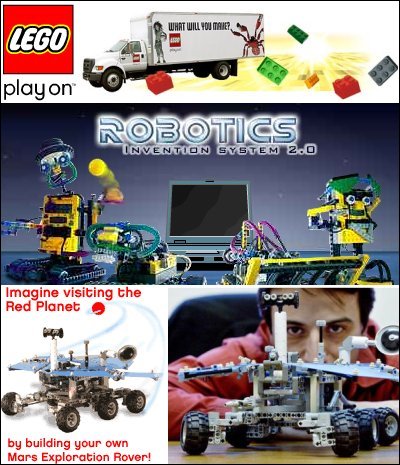
Personally, I think it takes a lot of guts for a company to take risks on product innovations as Lego has, fail miserably, then be able to admit it, dust itself off and take steps to move forward. One bright spot is its new $90 Mars "Spirit" rover 858-piece play set of building blocks – thanks to the successful touchdown of the NASA exploratory space mission, another risky proposition if the mission had failed. "It's on the high end of challenging to put together," said Jeff James, of Lego's community development office in Connecticut.
- Arik
 "Competitive Intelligence applies the principles of competition and lessons of intelligence to the need for enterprise awareness and predictability of market risk and opportunity. CI has the power to transform an enterprise from also-ran into real winners with agility enough to create and maintain sustainable competitive advantage."
