February 19, 2005
ChoicePoint: the Problem with Selling Personal Information... it's a Massive Homeland Security Vulnerability
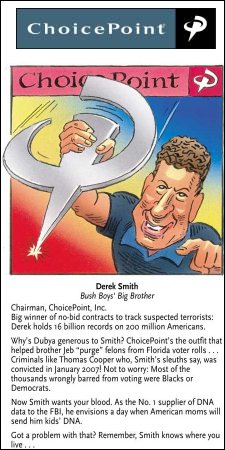 Nice going... ChoicePoint, the Georgia company that boasts it has the deepest database in the nation, said that it had alerted 35,000 Californians that they were vulnerable, as required by state law, but balked at notifying a far larger number of potential victims outside California... about 145,000 in all! Last fall, hackers apparently used stolen identities to create businesses that then opened some 50 ChoicePoint accounts and used their newly-minted access to the world's largest personal information stockpile to steal the identities of at least a few of the people involved.
Do you think maybe these guys have a little too much power here?
Daniel Engber had some advice in Slate.com for those who believe they've been among the unlucky profiles ripped off as a result of ChoicePoint's security lapse:
-
Once your personal information has been stolen, there's no good way to get it back. You just hope the thief will move on to easier targets who haven't done the same paperwork you have. Changing your Social Security number is possible, but very difficult and probably not too helpful. The Social Security Administration "cannot guarantee that a new number will solve your problem." Indeed, you might lose access to your own records, or run into problems for having no credit history at all.
But, the final question we have to ask ourselves - is all this transparency really worth it? Regardless, don't pay for another credit report again - get it free instead, and write your senators and representatives and ask for some regulation in this area. They'll need all the support they can get, when Derek Smith, ChoicePoint's chairman is so well-connected to the Bush administration... and benefited from new homeland security initiatives for doing background checks identifying suspected terrorism suspects.
The most ironic part of that whole situation is that, with all those stolen identities, if terrorists laid their hands on the data, they'd be able to create new IDs that are essentially indistinguishable from anything a real issuing agency might produce - because the phony IDs would contain real, authenticated identity data. In my view, this is a massive vulnerability to homeland security... why ID people at airports anymore, when the real IDs could be counterfeit, right?
For that reason alone, I would argue, ChoicePoint's very existence, and that of the other mega data-warehouses of personal information, is an unacceptable risk to national security and therefore should be heavily regulated from the viewpoint of the damage they could cause.
How ya' like them apples?
Regardless of the homeland security angle, an ounce of prevention might've prevented all the cure that'll be required to put a stop to the fastest-growing crime in the country, having victimized almost 10 million Americans last year alone.
- Arik
February 18, 2005
China Floods the Zone: FBI Details the New Economic Espionage Threat

FBI Assistant Director for Counter-Intelligence David Szady also named Russia, Iran, Cuba and North Korea among countries involved in economic and other espionage against the U.S. "There are 150,000 students from China. Some of those are sent here to work their way up into the corporations," Szady was quoted by CNN as saying. There are about 300,000 Chinese visitors annually, and 15,000 Chinese delegations touring the United States every year, 3,500 of them in the New York area alone, he claimed. CNN said he estimated that about 3,000 false-front Chinese companies operate in the United States, and urged private-sector employers to "partner up" with FBI agents to help protect national security. Meanwhile, Time Magazine did a short piece on how high-tech spying his home, right here in Wisconsin, as the FBI nabbed a pair of naturalized Chinese immigrants working for their former government:
-
Ning Wen and his wife were arrested last fall at their home office in Manitowoc, Wis., for allegedly sending their native China $500,000 worth of computer parts that could enhance missile systems. As these naturalized citizens await trial, similar episodes in Mount Pleasant, N.J., and Palo Alto, Calif., point only to the tip of the iceberg, according to FBI officials keeping tabs on more than 3,000 companies in the U.S. suspected of collecting information for China. A hotbed of activity is Silicon Valley, where the number of Chinese espionage cases handled by the bureau increases 20% to 30% annually. Says a senior FBI official: "China is trying to develop a military that can compete with the U.S., and they are willing to steal to get [it]."
But instead of assigning one well-trained agent to pursue a target, "the Chinese are very good at putting a lot of people on just a little piece and getting a massive amount of stuff home," says a U.S. intelligence official. The number of Chinese snoops is staggering, if only because average civilians are enlisted in the effort. FBI officials say state security agents in China debrief many visitors to the U.S. before and after their trips, asking what they saw and sometimes telling them what to get.
This "flooding the zone" MO for getting LOTS of people working an intel angle is characteristic of Chinese economic spying, especially in Silicon Valley:
-
Suspected espionage cases have been reported from New Jersey on the east coast to California in the west, the weekly magazine reported. The FBI is watching more than 3,000 companies in the United States suspected of collecting information for China, Time magazine reported.
"A hotbed of activity is Silicon Valley (California), where the number of Chinese espionage cases handled by the bureau increases 20 percent to 30 percent annually," Time said, referring to the state's corridor of high-tech companies.
"China is trying to develop a military that can compete with the US, and they are willing to steal to get (it)," a senior Federal Bureau of Investigation official was quoted as saying.
A US intelligence official said: "The Chinese are very good at putting a lot of people on just a little piece and getting a massive amount of stuff home."
Time called the number of Chinese spies "staggering, if only because average civilians are enlisted in the effort."
Chinese nationals are debriefed by state security agents in China before and after their trips to the United States. They are asked what they saw and sometimes told what to get, the magazine said.
A couple of Chinese origin was arrested last year in Wisconsin for allegedly sending to China 500,000 dollars worth of computer parts that could enhance missile systems, Time said. The couple, who are naturalized Americans, are awaiting trial.
The FBI has added hundreds of counter-intelligence agents and put at least one in every US Energy Department research facility, Time said.
It has also begun cooperation initiatives with corporations and considers universities as a soft spot, since there are some 150,000 Chinese studying in the United States, according to the magazine.
The FBI relies heavily on Chinese informants to sort spies from the thousands of Chinese who travel to the United States for work, Time said.
Could this lead to a change in U.S. intelligence policy, where America could follow its foreign rivals in deploying national intelligence resources in a commercial capacity?
-
"The economic viability of the United States we now look at as a counterintelligence problem," he said.
"We now see almost all of the adversaries, the Chinese being a classic example, of using students, delegations, researchers, visitors ... and false-front companies," Szady said.
Another senior FBI official, who spoke anonymously, was more blunt.
"The Chinese are stealing us blind," he said. "The 10-year technological advantage we had is vanishing."
The FBI has been successful, he said, in making some arrests.
"We took down some cases in Milwaukee, Trenton, New Jersey, and Palo Alto. These were false-front companies that were stealing technologies for the Chinese. Every person arrested was a student. They studied here, got their PhD here, and went to work for places like Lockheed, Raytheon, and Northrop."
Szady said spies do not limit espionage activities to large cities, and the Chinese presence is pervasive. "Even as we increase our numbers of agents, we can't possibly totally stop it," he said.
"If you have a little national asset, whatever it is ... they want that little thing that you produce," he said. "And they need it to make their missile fly straight or so they can compete in electronic warfare, and you have that key component."
- Arik
February 17, 2005
Bettman's Real Legacy: The End of Hockey As We Know It
-
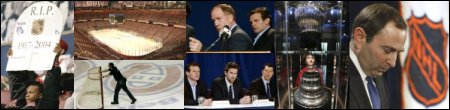
NHL commissioner Gary Bettman spoke like an accountant and looked like a mortician — or maybe it was the other way around — as he directed the final services Wednesday in New York.
He trotted out the numbers that never added up, the plans for salary caps and fixed payrolls that didn't fly, the negotiations that kept breaking down.
With a touch of sincerity, though no emotion, he apologized to fans, saying they deserved better.
"This is a sad, regrettable day that all of us wish could have been avoided," Bettman said.
Eh?
This was a day that absolutely could have been avoided if there had been an ounce of trust among the players toward the owners and their supposedly bloody red accounting books.
It was a day that could have been avoided if the players didn't believe the owners were out to bust the union, not just win a better deal.
It was a day that could have been avoided if both sides had more love for the game than they had for their money. Ah, but we all know it's just a business, cold as a corpse.
Bettman serves at the whim of the NHL Board of Governors, and it's time for that board to look elsewhere for leadership.
He guided the league to unprecedented, unnecessary and unwise expansion. Under Bettman, the NHL made more money and lost more money than any time in its history. He aspired to greatness, took a shot at rapid growth, and wound up flopping.
When a team is losing, the coach is the first to be fired. When the league loses as badly as the NHL just did, the commissioner should be patted on the back and kicked in the butt.
Bettman was a dreamer and schemer, a former NBA marketing whiz who never understood that hockey, for all its history and thrills, didn't have the broad passionate U.S. fan base that could justify his vision of manifest destiny.
Hockey is not McDonald's or Starbucks. It didn't need to supersize itself and post franchises all over the map.
Without rights fees from television, like the ones in the other pro team sports, it couldn't afford to let average salaries skyrocket to $1.8 million last year. NFL players, by comparison, average $1.3 million, and that's with the fattest TV deals in sports.
Figuratively and financially, NHL players are not in the same league with NBA players (averaging $4.9 million) and baseball players ($2.5 million).
The NHL, under Bettman, was run almost like a giant Ponzi scheme, nothing holding it up but hopes and promises and the vague idea that a TV deal would one day bail it out.
Maybe it would have gone on growing if the new generation of owners didn't keep throwing money at the players, and if the players themselves didn't keep undermining the sport at every opportunity.
It wasn't just the crazy stuff that made headlines and police blotters. It was also the way the players, in general, thought they were bigger than their great little game, indestructible and irreplaceable.
Where are they now? Playing in Russia and Sweden and small arenas wherever they can find a cheap skate.
They lost one season and could easily lose another, if the league survives at all.
For young players trying to make their names, lost seasons are serious. For older players trying to keep skating in their 40s, such as Mark Messier, Brett Hull, Steve Yzerman, Ron Francis, Dave Andreychuk and Chris Chelios, there may never be another season.
The player half of Mario Lemieux, 39, wants to skate again, if and when the league resumes, but the owner half didn't want to keep taking losses.
There are losers in every direction from this NHL debacle. Publicly owned arenas, such as those in St. Louis, Detroit and Pittsburgh, will lose millions of dollars in tax revenues. Workers in those arenas will lose income.
Money aside, hockey's die-hard fans are furious that all this had to happen. They are a diminishing cult committed to the game and they hate seeing their beloved sport shrink into insignificance.
For the relatively piddling difference of about $6.5 million per team in the final bargaining positions — the salary of one top-tier player — the two sides couldn't come together and everyone lost.
In the frenzied final days of haggling, Bettman had a chance to exert leadership, to force both sides to yield a tad more. Instead, he stiffened up, stood firm with the owners, and pronounced the season dead.
If you're curious about how this all happened, you have the benefit of AP Sports Columnist Jim Litke's historical breakdown of Bettman's reign:
-
Bettman was not a "hockey guy" — his first real exposure came during pickup games while he was an undergraduate studying labor relations at Cornell in the 1970s. But he was a marketing whiz, and he had a plan.
Viewed strictly from the supply side, that plan was a rousing success. The number of franchises increased from 21 to 30, revenues quadrupled from $400 million to more than $2 billion, and players' salaries more than tripled from $558,000 in Bettman's first season to $1.8 million in the last one.
But all that expansion came at a considerable cost. Bettman locked out the players and wound up canceling almost half the 1994-95 season in a failed bid to get a salary cap and luxury tax. Then, he passed on a chance to opt out of the agreement two more times — in 1995 and 1997 — rather than endanger the league's expansion plans.
New arenas were going up, the Nagano Olympics offered worldwide exposure and multimillion-dollar expansion fees were lining the owners' pockets. It was easy to get swept up in the notion that once the NHL blanketed the U.S. map from coast to coast and locked up a big TV deal, enough money would flow in to cover up all the mistakes.
Not being a "hockey guy," though, Bettman made a fatal miscalculation. He grew the game recklessly and watched his owners lavish profligate contracts on players, assuming that demand would eventually catch up with a suddenly bountiful supply. The opposite turned out to be true.
The NHL landed one big TV contract with ABC/ESPN in 1999 — a five-year, $600-million deal — but ratings were minuscule. That's why the two-year deal with NBC signed in 2004 doesn't include rights fees, only revenue sharing. The flow of cash has slowed to a trickle.
The knocks against hockey when Bettman took over were its fascination with fighting, its limited regional appeal and blue-collar roots, even the fact that the puck is hard to follow on the small screen.
Now, fisticuffs are down. But gone, too, are a handful of franchises in hockey-mad Canada and the wide-open style of play that made Wayne Gretzky a household name. They've been replaced by Sun Belt towns with no hockey roots and little developing affection for the plodding, clutch-and-grab version of the game being peddled.
During the weekend, when Bettman briefly lifted a ban on owners speaking out, one of his staunchest supporters dared wonder whether the rush to expand had come at the expense of the product.
"We might be better off to stop chasing growth and revenue and play just high-quality hockey and let its popularity take care of itself," Peter Karmanos Jr., owner of the Carolina Hurricanes (news), told the New York Times.
"We're not a public corporation," he added. "We don't have to have compounded annual growth."
They won't have to worry about that, at least not for the foreseeable future. No matter when, or in what form the NHL returns, it won't find people clamoring to get back under the tent.
"You hear how certain people believe that the hardcore fan will definitely return, that the damage isn't irreparable," Flyers captain Keith Primeau said in Philadelphia.
"I think that's a huge miscalculation or judgment in error of who and what your fan base is. That, I think, is going to alarm a lot of people when the doors are reopened."
In the words of Rod Brind'Amour, "The game's just suffered an absolute blow it'll never recover from," the Carolina Hurricanes forward said. "They're totally underestimating the damage that's being done." We can only guess what the future might hold:
-
Without an agreement, there can be no June draft. The sport's heralded next big thing, Canadian phenom Sidney Crosby, won't pull on his first NHL sweater anytime soon.
Then there is the parade of aging stars — Mario Lemieux (39), Mark Messier (44), Steve Yzerman (39) Brett Hull (40), Ron Francis (41), Dave Andreychuk (41) and Chris Chelios (43) — whose playing days could be ending on someone else's terms.
"This is a tragedy for the players," Bettman said. "Their careers are short and this is money and opportunity they'll never get back," Bettman said.
Despite being the NHL's best-known star, there was never a chance that Pittsburgh's Lemieux, the first owner-player in modern American pro sports history, would side with the players.
"A few years ago, I thought the owners were making a lot of money and were hiding some under the table, but then I got on this side and saw the losses this league was accumulating," he said Wednesday.
Hockey was already a distant fourth on the popularity scale among the nation's major league sports. The NHL lost the first season of its two-year broadcasting agreement with NBC that was supposed to begin this season, a revenue-sharing deal in which the network is not even paying rights fees.
Taking a year off, or more, will only push the league further off the radar screen.
"The scary part now for hockey is do the fans come back? We're not baseball, we're not the national pastime," Nashville forward Jim McKenzie said.
Between shifts of a pickup game at the Denver rink where the Avalanche used to practice, fan Don Cameron called the cancellation "a shame."
"When they come back, it's not going to be as easy to pay for a $90 season ticket," he said.
Not to mention how difficult it will be for all the ushers, trainers, officials, Zamboni drivers and businesses near arenas that will continue to be affected.
"We profoundly regret the suffering this has caused our fans, our business partners and the thousands of people who depend on our industry for their livelihoods," Bettman said.
"If you want to know how I feel, I'll summarize it in one word — terrible," he said.
Bettman said the sides would keep working toward an agreement.
"We're planning to have hockey next season," he said.
Goodenow stressed that the players had already given a lot of ground. "Every offer by the players moved in the owners' direction," he said.
"Keep one thing perfectly clear," Goodenow said. "The players never asked for more money — they just asked for a marketplace."
Not being a hockey fan myself, I think this is more like watching a trainwreck than anything for most sports fans. We just can't look away when two groups are so determined to get their way, they'll lay waste an entire sport if they can't get it.
One thing's for sure, whether there's a season next year or not... this is end of the NHL as we know it.
- Arik
February 15, 2005
Ben Stein's Last Column
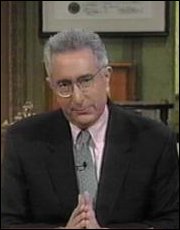 Ben Stein's last column - economist, novelist and comedian - Ben Stein's final column scorns the materialism and hero-worship that is Hollywood and suggests a higher calling:
-
I came to realize that life lived to help others is the only one that matters. This is my highest and best use as a human. I can put it another way. Years ago, I realized I could never be as great an actor as Olivier or as good a comic as Steve Martin... or Martin Mull or Fred Willard--or as good an economist as Samuelson or Friedman or as good a writer as Fitzgerald. Or even remotely close to any of them.
But I could be a devoted father to my son, husband to my wife and, above all, a good son to the parents who had done so much for me. This came to be my main task in life. I did it moderately well with my son, pretty well with my wife and well indeed with my parents (with my sister's help). I cared for and paid attention to them in their declining years. I stayed with my father as he got sick, went into extremis and then into a coma and then entered immortality with my sister and me reading him the Psalms.
This was the only point at which my life touched the lives of the soldiers in Iraq or the firefighters in New York. I came to realize that life lived to help others is the only one that matters and that it is my duty, in return for the lavish life God has devolved upon me, to help others He has placed in my path. This is my highest and best use as a human.
Faith is not believing that God can. It is knowing that God will.
Ah, if only...
- Arik
February 14, 2005
Verizon + MCI; Jilted Qwest Left at the Altar

-
Verizon's purchase of MCI earlier this week will strengthen its business, provide access to lucrative business and government contracts, and, most importantly, prevent rivals from snapping up the Ashburn, Va. company.
In a coup likely to make rivals Qwest Communications International Ltd. and BellSouth Corp. sweat, Verizon Communications Inc. agreed to buy MCI Inc. for $6.7 billion in cash, stock and dividends. The merger follows two telecommunications mega-mergers last year: SBC Communications' acquisition of AT&T Corp. and Sprint Corp.'s purchase of Nextel Communications Inc.
Although MCI had its share of suitors—both Qwest and BellSouth were pursuing the company as well—company executives chose to sell the company to Verizon, despite the fact that Qwest offered a larger incentive package.
Verizon's financial stability as well as synergies in network infrastructure and customer base made the choice of Verizon a sound one, said Taher Bouzayen, vice president and long-distance sector analyst at Atlantic-ACM, a Boston-based research firm.
"Financially, although Verizon has some large debt, it has the financial strength to pay off that debt and a framework that's large enough to absorb a company like MCI, which came out of bankruptcy with very little debt," he said.
Verizon may have pushed so hard to buy MCI simply because others wanted it, noted Sean Hackett, senior analyst at Yankee Group of Boston, Mass. "It was a defensive move," he said. "It was about taking MCI out of play so somebody else couldn't buy it."
The move also allows Verizon to exploit its deep presence in the Northeast and strong branding by cross-selling many of MCI's services. "It helps to be able to take a brand that has been beaten up as much as MCI's has and leverage that brand equity," Hackett said.
But the reason Verizon was so intent on buying MCI may have been for its lucrative business and government contracts—an area where former RBOC Verizon simply didn't have much of a foothold.
Access to business contracts, in fact, also was one of the main reasons why SBC acquired AT&T, Bouzayen noted. "They are all hungry for business customers, because that's where most of the profit is. Those are the accounts where you build your margin."
Now that Verizon has a stronger foothold in the business arena, it would do well to exploit the combined technological strength of the two companies to provide better prices and service for its business customers, Bouzayen said.
"MCI's strength is on the long haul portion of the network, while Verizon has the last mile. Now they can offer end-to-end services at relatively good prices, once they work out some interoperability issues caused by merging two types of networks," he said. Bouzayen predicts that the integration will happen quickly.
In the end, it may be the business customers who really win. Not only will businesses experience less competition in the telecommunications marketplace, but they should expect to see price stabilization, Hackett predicted.
Although experts believe the move was a good one, the road may be less than smooth as consolidation gets underway. In addition to consolidating a host of business processes, Verizon will face the mammoth challenge of integrating MCI's confusing billing system with Verizon's more stable one.
MCI's billing system is a cobbled-together patchwork system that combines bits and pieces of the nearly 50 companies it has acquired over time. Four or five years after an acquisition, it's not unusual for a customer to receive multiple bills from companies owned by MCI instead of one integrated bill, Bouzayen noted.
"Verizon has a great billing platform that is extremely well managed, and if it succeeds in incorporating and integrating MCI's billing system into its platform, it will be a very successful company, but it will take some time," he said.
Despite challenges, analysts expect the combined company to succeed and prosper. Atlantic-ACM predicts that the combined company will generate $18.6 billion in 2005 for long-distance services alone, a number that will grow to $21.6 billion in 2009.
The unanswered question, of course, is what happens to erstwhile suitors Qwest and BellSouth, as well as to Sprint's wireline business.
"It really leaves them hanging. In those businesses that require scale to succeed, such as traditional voice/data-type transport businesses, BellSouth and Qwest will have to decide whether they want to compete," Hackett said.
Given enough time, the market may experience further consolidation, ending up with three or four mega-companies competing with each other, Bouzayen said.
"I could see the wireline business of Sprint combined with Qwest, or perhaps companies like Level 3 or Global Crossing could come into the mix in some fashion," he said. "Maybe we're really reversing the wheel and going back to a pre-1984 RBOC system. Only time will tell."
But watch out Verizon... MCI's a heartbreaker. Just ask Bernie Ebbers. And I still expect Qwest to sweeten their bid enough to either, get MCI and improve their balance sheet, or the worst case scenario is they force Verizon to pay more and take a hit competitively. In short, not a lot of risk in Notebaert moving forward with his offer.
Analysts found the whole deal a no-brainer for both MCI and Verizon and REALLY bad news for Qwest:
-
The deal to buy MCI at what amounts to $20.75 a share is a bargain for Verizon, but MCI accepted the terms because it sees Verizon as a stronger company than Qwest, said Jay Arnold, portfolio manager at Abacus Asset Management.
"I think [Verizon] stole the company," said Arnold of the MCI purchase. "It's a great deal for Verizon. The shareholders of MCI didn't get a great deal, but maybe the combined companies will be more powerful and the returns will offset that."
Arnold said that even though Qwest outbid Verizon by about a billion dollars, MCI made the right move. The reasoning behind MCI's decision is that Qwest carries considerable debt and is somewhat of "a junk-rated Baby Bell," said Arnold.
"MCI felt a Qwest deal would be largely a stock deal and if Qwest shareholders didn't like the deal, they would sell shares, weakening the overall value," he said.
Allan Tumolillo, COO of Probe Financial Associates, said a decision to sell to Qwest would have been a mistake.
"MCI merging with Qwest would have been the end of the whole thing," said Tumolillo. "[MCI President and CEO Michael] Capellas is a smart guy. He may not know telecom all that well, but you look at Qwest and its $17 billion in debt, and you see they are struggling. MCI doesn't need to go into a mess like that. The only purpose for MCI to talk to Qwest was to provoke Verizon and Bell South to take a look at them more seriously."
Without MCI, the future of Qwest is a major question mark, said Tumolillo. "I think Qwest is headed into oblivion," he said.
Fish or Cut Bait?
Although many believe Verizon would have preferred to wait before cutting a deal, or even offer a bid for Sprint instead, the company decided it needed to act once Qwest made its play for MCI. "This is the right deal at the right time," said Verizon Chairman and CEO Ivan Seidenberg. "It is a natural and logical extension of Verizon's strategy to transform our company to serve growth markets and offer broadband technologies."
Seidenberg said he and Capellas had been talking about a possible deal since late summer. He said the two companies match up well, and that he doesn't expect any other bidders. Maybe now that Carly's out at HP, Capellas thought he should strike while the iron was hot and force Verizon into making a move?
Whatever happens, if I were an MCI shareholder, I'd be trying to get that extra billion dollars somehow... can you say "class action lawsuit"?
- Arik
 "Competitive Intelligence applies the principles of competition and lessons of intelligence to the need for enterprise awareness and predictability of market risk and opportunity. CI has the power to transform an enterprise from also-ran into real winners with agility enough to create and maintain sustainable competitive advantage."
