February 11, 2005
Omnicom's Ketchum Puts Spin on the Media for White House with Influencer Relationship Management

-
When the news of the Williams deal became public, Democratic members of Congress took a look at government contracts with PR firms, and the U.S. House Committee on Government Reform produced some quick but startling numbers. In a January report, the committee found that federal agencies spent more than $250 million on contracts with PR agencies between 2001 and 2004 – nearly twice as much as the $128 million that Clinton spent between 1997 and 2001.
“There used to be a time when our government would let the facts speak for themselves,” lamented Richard Durbin, a Democratic senator from Illinois, during one Congressional debate. “It apparently is the position of the Bush administration that the facts in and of themselves are not articulate.”
Two more questionable examples have cropped up since the Williams flap. Conservative columnists Maggie Gallagher, whose writing is distributed by Universal Press Syndicate (which also publishes the Dear Abby column and comic strips like Doonesbury, Calvin & Hobbes and Garfield) and Mike McManus (whose work appears in over 50 newspapers like the Birmingham News in Alabama) were exposed as having been on the payroll of the Department of Health and Human Services.
Both columnists agreed to work on behalf of the Bush Administration efforts to promote marriage.
While President George Bush officially denounced the practice of government agencies paying commentators, it is yet to be seen whether the scandal will lead to any lasting ethical change on the part of some in the PR industry, where the need to identify political and ideological allies is routine practice, or on the part of the government, which has been historically concerned with the need to flash “positive” messages – and propaganda -- into what they perceive as a negative and hostile media landscape. Ketchum and the DoE, for instance, initially defended the Williams arrangement.
According to the House report, companies owned by New York-based Omnicom have a virtual monopoly -- 89 percent -- of government PR contracts awarded between 2001 and 2004. The company, whose headquarters are on Madison Avenue, the heart of the advertising industry, reeled in $8.6 billion in revenue in 2003 from clients like Kodak, Dow Chemical and Heinz ketchup.
Ketchum held $97 million, one-third of the total, followed by the Matthews Media Group ($52 million), Fleishman-Hillard ($41 million) and Porter Novelli ($33 million).
While it is not known how many of these contracts involve practices such as the Williams deal, the government seems to take the scandal seriously. The list of agencies looking into PR contracts, in one way or the other, includes the Government Accountability Office, the Inspector General, the Federal Communications Commission, Congress and the Pentagon.
Ketchum, which has earned numerous Silver Anvils (the industry’s highest honor) from the Public Relations Society of America as well as a 2002 “Agency of the Year” award from PR Week, the popular industry magazine, initially responded to the incident via a January 13 PR Week editorial by Ray Kotcher, chief executive officer of Ketchum. In the editorial, Kotcher put a positive spin on the scandal, calling it a “transformational event.” He referred to Williams' behavior as "an oversight" and implied that the scandal was politically motivated.
“It is no coincidence that this activity occurred in Washington,” Kotcher wrote, “where political divisiveness is at an all-time high."
He also suggested the rise of punditry had something to do with the whole affair:
“Williams' unusual role as both a pundit and information source – through his ad-production firm – would seem to blur the lines that once so clearly defined journalism and news organizations,” Kothcer wrote. “I'm not sure even the media itself can agree anymore on how to strictly define and distinguish journalists and news organizations.”
Ketchum's competitors are up in arms and the PR industry as a whole is in a state of denouncement around Ketchum's practices, with Edelman's CEO saying in his blog how "disappointing" the behavior was.
Meanwhile, this all appears to be a part of a bigger program, called "IRM" or "Influencer Relationship Management" - concentrated on helping corporate clients influence the influencers by cutting them fat checks that Ketchum delivers in unmarked bills in the dead of night. However, the service appears to be on the wane, after having been ripped from Ketchum's Web site. Lucky for us, the Wayback Machine can supply all you need to learn about IRM at your leisure.
Enjoy,
- Arik
February 09, 2005
Sacked: Buck Stops at the Top as HP Dumps Carly Fiorina
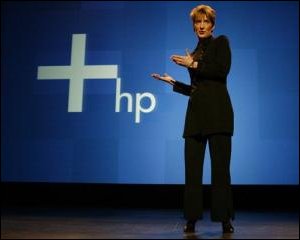 Americans love nothing better than seeing corporate fat-cats get canned.
Today Hewlett-Packard decided it needed to outsource itself a new CEO, not one with a new strategy but one who could execute on it, after Carly Fiorina stepped down at the BoD's behest from the helm of the computer company she's spent the past six years transforming.
Sic Transit Fiorina
Perhaps Fiorina's worst sin was becoming the subject of charges by her lieutenants she'd become a bottleneck, and was interfering with the company’s ability to respond quickly to market changes. But, with a $21 million golden parachute, I wouldn't worry too much about where she'll land.
Surprising? No.
As architect of a controversial merger with Compaq that never produced the results she promised, HP turned in lousy financial results under one of the most powerful women in corporate America. HP was always something of an also-ran when it came to the way computers were bought and sold, but when the halcyon days of high margins departed with the go-go Dot-Com Bubble, so did the ability to get away with that sort of approach. As it stands today, HP trails Dell in PCs, EMC in storage and IBM in services... The only real winner in all of this has been Compaq, which would almost surely have been forced to sell off to Dell at a deep discount if HP hadn't swept in to save the day. The crown jewel of printing and imaging has lost a good deal of its luster as well, and the window of opportunity for a spin-off has narrowed substantially.
The REAL Reason She Got The Boot
Insiders say board dissatisfaction with Fiorina traces back to the November 2002 exit of former President Michael Capellas, who joined HP from Compaq and today heads MCI. Some board members wanted the position re-occupied. Recently, the board became convinced Fiorina would back down from her opposition and accept the appointment of a chief operating officer, given HP's spotty financial returns. "She was adamantly opposed to that," according to Rob Enderle, principal analyst at the Enderle Group. Fiorina's resistance brought the dispute to a crisis and sparked the decision to ask her to leave.
CFO Robert Wayman, who was named interim chief executive on Wednesday, said HP did not plan to reverse the Compaq deal but left the door open, saying the board would not be close-minded on strategy changes once it locates a new CEO. The board said its chief concern was to improve "execution" of strategy, although many on Wall Street hope HP will spin off its printing division, which delivers most of its profit, after Fiorina did the exact opposite by integrating it with the lagging PC division only two weeks ago.
HP shares, which have lost 63 percent of their value since Fiorina became CEO in July 1999, rose as much as 10 percent on Wednesday and closed up nearly 7 percent. Corporate recruiters saw Mike Zafirovski, Motorola's former chief operating officer, as a top contender to become CEO, while others pitched Michael Capellas, current CEO of communications company MCI and former Compaq chief, despite Capellas's link to the merger having been seen as a problem by some. Motorola's CEO, ex-Sun Microsystems exec Ed Zander, is considered another possible choice. Investors uniformly agree that, after dashing their hopes in three of the last nine quarters as it lost market share to Dell and IBM, anybody's got to be better than Carly.
Fiorina said in a statement, "While I regret the board and I have differences about how to execute HP's strategy, I respect their decision. HP is a great company and I wish all the people of HP much success in the future."
Truly, were it not for the ill-fated merger with Compaq, I frankly believe she could've become one of America's legendary corporate leaders - remembered as more Lou Gerstner than Bob Galvin. Maybe the ultimate lesson here is, in the era of mega-mergers, it's usually a bad idea to hang your career on successfully pulling it off.
David Katz, chief investment officer at Matrix Asset Advisors, one of the first HP investors to oppose the Compaq deal, said, "Today's announcement basically is a validation that Walter Hewlett was probably correct, that it was an ill-fated strategy," and added that a printer spinoff was still a possibility.
Meanwhile, Hewlett only said in a statement that he looked forward to HP fulfilling its promise. "HP has been a great company. It is facing a number of challenges." Despite Bear Stearns downgrading its rating on HP, saying Wednesday's gain reflected most of the possible upside from a potential break-up of the company, Wall Street generally liked the move.
Unquestionably, HP has lost its momentum since the Compaq merger, which we can see in hindsight offered hardly any value-add, while occupying huge management attention span in terms of distraction of time and resources. Over the past six years, HP has transitioned from a high-margin to a low-margin company.
Computers are commoditized and the Dell model of selling direct through a low-cost channel (the Web), getting and using the customers' money for a week without building inventory (not to mention paying vendors 45+ days terms) and then helping make experts out of their customers in the process by building a custom rig for everyone, is the only way to play and win the PC game any more.
From a technology standpoint, Itanium, through which HP partnered with Intel and did away with Compaq's older DEC Alpha chip, has been a disaster. It transferred its Precision Architecture to Intel as the basis for Itanium along with its silicon designers and shut down its chip foundries; and all of this was tied into an Itanium partnership that will return nothing to HP, and hardly more than that to Intel, while effectively closing down the chip-making line of business in the process. Sounds to me almost like Intel simply duped HP into putting itself out of business before it did. From that standpoint, the only winner in the 64-bit processor game has been AMD!
Finally, I have lots of friends in Silicon Valley who complain HP's corporate culture had been destroyed by cascading rounds of layoffs, after HP acquired Compaq having cut 16,800 jobs. What's needed to correct the cultural deterioration is an outsider who can come in and reinvigorate what has become a culture more akin to Larry Ellison's Oracle than Bill Gates' Microsoft.
If they don't end up with a value-extracting consolidator at the helm, that is. Stacey Quandt of the Robert Frances Group, said, "The door [is open] for the HP board to hire an executive to sell off pieces of the company, and the server and storage division would likely be on the top of the list. An asset-stripper CEO will most likely be Ms. Fiorina's replacement."
So, while competitors gaze on awaiting their chance to pounce, HP needs to get moving on fulfilling that promise Walter Hewlett is so in love with - the one it's touted to corporate IT customers for the past half-decade and more... As Eric Lundquist said at eWeek.com:
-
The biggest competitor HP now faces is time. Buoyed by a more optimistic economic outlook, corporations are once again spending money for technology purchases. HP's competitors have spent the last several years improving their product lines and service offerings. In the corporate world, technology decisions are now being made for 2005 and beyond, and HP needs to get on that short list of preferred vendors or risk being left behind.
- Arik
February 08, 2005
Super Bowl Ads are for Suckers
 Timothy Noah at Slate.com cites a Broadcasting & Cable magazine experiment that showed the best way to reach your target market during the Super Bowl is to spend that $2.4 mil trying to counter-program against it:
-
It asked an ad agency called Starcom to enter Nielsen ratings data from last year's Super Bowl time slot into a computer to see whether the computer could "beat" a Super Bowl ad buy. The average price of a Super Bowl ad last year was $2.30 per 30-second spot. (The price this year climbed to $2.40 per 30-second spot.) Starcom fed that into the computer, too. Then it set about trying to see whether, by "spending" the same amount on counter-programming that other networks and cable channels ran against the Super Bowl, the computer could exceed the Super Bowl's slice of the audience that advertisers care about: adults between the ages of 18 and 49.
It wasn't even close. The computer's Super Bowl ad buy reached 29 percent of adults 18-49; the computer's counter-programming ad buy reached 47.3 percent of adults 18-49. In essence, buying ad time on various TV shows that were supposedly going unwatched--because "everybody" was watching the Super Bowl--would have enabled advertisers to reach 60 percent more potential customers.
Within the advertising industry, there appears to be an unshakeable belief that Super Bowl ad buys are justified because the ads have a much greater impact than TV commercials usually do. Viewers know that advertisers use the Super Bowl to show off their creativity, and so they've come to regard the Super Bowl as, among other things, a kind of mini-film festival. Some polls actually show that more people watch the Super Bowl for the ads than for the game itself.
And later an indictment of the ad industry itself:
-
So why do advertising agencies tout the wonderfulness of advertising on the Super Bowl? I suspect the answer is that, while the Super Bowl may not be an especially smart forum in which to sell the advertisers' products, it's a great forum for selling the ad agency itself. Ads that attract attention to themselves may not sell consumer goods, but they do provide a wonderful forum for ad agencies to show the world how creative they can be. And it's a lot easier for an ad agency to purchase one very expensive ad slot than it is to match that fat commission through the purchase of hundreds of ads. Add these considerations together and it's hard to avoid the conclusion that ad agencies are driven, perhaps unconsciously, to make suckers of their clients. The clients are receptive because having an ad on the Super Bowl confers an undeniable glamour. But glamour doesn't pay the bills.
Ford, Bud, Volvo, Pepsi, Ameriquest, and most bizarrely of all, Silestone...
Suckers! Every one... plus, Seth Stevensen breaks it down for us on the ads themselves, on NPR.
- Arik
February 07, 2005
GSM/GPRS Treo 650 - Unlocked $599 or $699? Cingular Complains, Price Goes Up
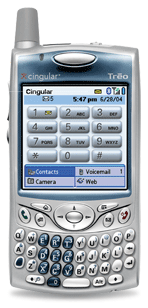 Demand-based pricing takes another giant leap forward as the much coveted "unlocked" GSM version of the new Treo 650 smart-phone jumps $100 overnight, after Cingular apparently got ticked at the competition... not that there was any.
-
The price of the unlocked Treo 650 has increased by a $100, up to $699 from yesterday's price of $599.
According to palmOne Vice President Marlene Somsak, the $599 pricing was "a mistake. For those who got the earlier lower-priced GSM Treo 650's...lucky them!"
Maybe a mistake of anticipated demand?
The unlocked Treo 650 is attractive because it works with almost any GSM/GPRS network worldwide, so you can use it with your existing GSM/GPRS service plan. The unlocked phone also makes it easy to use local SIM cards when traveling internationally.
So, while I was willing to drop $599 on the unlocked version of the quad-band world-phone, $699 somehow seems a little steep. So, I've decided, I'm not going to buy any Treo at all... despite the fact I was going to put Cingular service on that handset anyhow.
So there.
- Arik
February 06, 2005
Super Bowl XXXIX: Patriots Dynasty Official
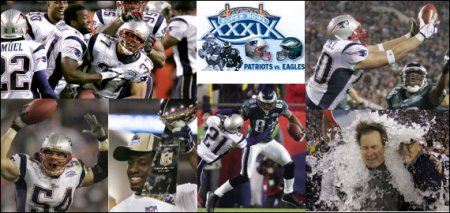
The New England Patriots won the Super Bowl (again!) defeating the Philadelphia Eagles 24-21, making it an official dynasty with a third championship victory in four years. The game's MVP was New England receiver Deion Branch, with 11 receptions for 133 yards, though Eagles receiver Terrell Owens turned in an impressive performance of his own at nine-for-122 - and T.O. was getting screws installed in his ankle a month ago! Here's a recap:
-
This time Brady was, well, Brady. That meant 23-for-33 and 236 yards of passing for two touchdowns. That meant no interceptions. That meant a 9-0 postseason record, to tie Bart Starr from Green Bay's magical days for the most consecutive postseason wins by a quarterback. He is Mr. January. Mr. February. Mr. Super Bowl. At the age of 27.
"It's a relief," he said. "It's been a long year."
This time, the Patriots' defense turned the game with four turnovers, and had to stand its ground with kids, the injury-ravaged secondary down to two rookies and a second-year player in the second half.
"We believe that someone is going to make the play," said safety Rodney Harrison, the veteran glue who had two interceptions.
The Patriots withstood 357 passing yards and three touchdown passes from Donovan McNabb, and nine catches by Terrell Owens, who returned from his injury as he vowed he would.
But they allowed McNabb few spectacular runs, sacked him four times with a pass rush intensified by changing from their usual 3-4 defense to 4-3, and intercepted him three times, the third to finish off Philadelphia's last gasp from its own 4.
"We just had to keep guys coming at him at all times," linebacker Willie McGinest said. "They key was to confuse him."
"I don't look at the touchdowns. I look at the interceptions," said McNabb, who put up 51 passes and completed 30. "This game could have been a blowout. You take away those three interceptions and we're probably ahead two or three touchdowns. It's woulda, coulda, shoulda."
And so the Patriots pile more mystique upon their aura. The 34 wins in two seasons that would set one record. The nine straight postseason wins that would tie another. The three titles in four years, a glowing quadrennial matched only once before, by Dallas in the 1990s.
The Super Bowl Roman numerals come and go and the Patriots supremacy remains the same. Three titles, all won by three points. Only the halftime shows change.
It has been domination, somehow, without perception of many stars, but accomplished by attacking in waves. Overachievers, they were once called.
"We're the most ring-fingered overachievers I've ever seen," said receiver Troy Brown.
"We play Patriots ball," said cornerback Asante Samuel. "All we do is win."
"It sounds almost cliche-ish after awhile," Brady said. "We're a team, we're a team. But after four years, I've never had a receiver complain about not getting a ball, I've never had a running back complain about not getting enough carries."
They needed all their togetherness Sunday in a historically close fight. At 7-7, it was only the second halftime tie ever in the Super Bowl. At 14-14, it was the first Super Bowl to be tied after three quarters.
It was also only the third game in 405 NFL postseason contests to be even at the end of all three periods.
But the tie lasted barely a minute into the fourth quarter, when Corey Dillon's 2-yard touchdown run put the Patriots ahead, 21-14.
The 66-yard drive, a direct response to the Eagles just scoring to tie, was an exhibition of New England purpose.
The last big play on the drive came with Philadelphia's defenders clearly heard on television shouting "Watch out for the screen!"
Brady threw a screen pass, anyway, to Kevin Faulk for 14 yards. The night was beginning to inexorably tilt New England's way after a shaky start. The Patriots did not have a first down their first four possessions.
Moments later, the Patriots were back at the Philadelphia 4, and eventually kicked a field goal for a 24-14 lead.
By the time McNabb threw a 30-yard touchdown pass to Greg Lewis to make it 24-21, there was only 1:48 left. The 79-yard march had taken 13 plays and 3:52. A splendid drive. But not for a team 10 points behind.
But the Eagles are right there with them in what is sure to be a :
-
Philly has most of its best players signed to long-term contracts, including Donovan McNabb, Terrell Owens, Jevon Kearse, Brian Dawkins, Lito Sheppard, Michael Lewis and Sheldon Brown. Kearse was signed as a free agent last year and Owens was acquired in a trade.
Also, the NFC is a mess, with the Eagles far superior to any other contenders. The Patriots don't have that luxury in the stacked AFC.
Eagles owner Jeffrey Lurie styled his organization after such past dynasties as the Cowboys and 49ers. Minus the championships, his franchise is very similar to Kraft's.
"We are the two winningest teams this decade," Lurie said. "Both invested well over $300 million in new stadiums. We each hired coaches in an unorthodox fashion — us a non-coordinator, and Bob trading for Bill.
"Both teams are built around franchise quarterbacks. Both are high-character teams. There are a lot of similar value systems for each team. We each place a high value on the quality of people in our organization. And it's not just high character, but high intelligence — people who like to think outside the box and people willing to make controversial and unpopular decisions. We both understand that decisions need to be made that sustain the long-term excellence of the franchise."
I still wish the Eagles could've pulled it off - after all, they did knock out the Packers - but against a team that believes it will win, that sort of confidence is hard to overcome.
- Arik
 "Competitive Intelligence applies the principles of competition and lessons of intelligence to the need for enterprise awareness and predictability of market risk and opportunity. CI has the power to transform an enterprise from also-ran into real winners with agility enough to create and maintain sustainable competitive advantage."
