February 23, 2005
Can Howard Dean Make the Democrats More Competitive?
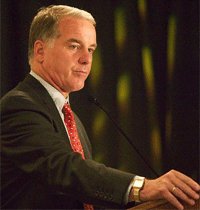 AlterNet thinks Howard Dean "is in a position to make his party more newsworthy and potentially more dangerous than it has been in decades":
-
What's genuinely exciting about the Dean chairmanship is the prospect that the party might come to mirror its new chief's enthusiasm for bold stances and strategies. Dean's best applause line in the race for DNC chair was, "We cannot win by being Republican-lite. We've tried it; it does not work." For all the important talk of rebuilding state parties and using new technologies, what matters most about Dean's election as DNC chair is his recognition that Democrats have to be serious about holding out to Americans the twin promises of reform and progress, and that they are not going to do that by tinkering with the status quo. "We just can't let the Republicans define the debate anymore. We have to be the party of ideas," Randy Roy says from Topeka. "Dean understands that we have to be the party that shakes things up."
Frankly, I agreed with the Dems on the other side that offer advice of a different sort - to embrace the faith-oriented arguments of the evangelicals on the right, but with a more moderate stance that can sell better to Middle America. After all, there are really only two issues in the moral-values argument - gay marriage and abortion. Hilary Clinton has already started inching her way toward the middle... and if anybody thinks Dean can get the rest of the party behind it, the DNC might be sowing the seeds of its own destruction.
Meanwhile, an unlikely advisor has emerged for "disconsolate" Democrats everywhere - Pat Buchanan:
-
A word of counsel to the disconsolate: Suck it up. It is not all that bad. The Right spent years in deserts more barren than thee have ever known. When this writer went to work for Richard Nixon in 1965, Republicans had lost seven of nine presidential elections, held Congress for but four of the previous 35 years and had carried 38 percent of the presidential vote – in a two-man race.
Goldwater had lost 44 states. A massacre had ensued on the Hill, with the GOP ranks reduced to 140 House seats and 38 senators. Nixon was a two-time loser who had, all assumed, committed hara-kiri in his 1962 "last press conference," where he had rounded on the jackal pack that had bedeviled him since the Alger Hiss case. "Think of all the fun you'll be missing," Nixon railed. "You won't have Dick Nixon to kick around anymore."
In 1966, the dark night was suddenly over and the sun came out. The GOP picked up 47 House seats and six senators, and Nixon would go on to lead the party into an era where Republicans would win the presidency five times in six elections, capture both houses of Congress in 1994 and become America's party.
Instead of bewailing their fate, Democrats should study how the Nixon-Reagan new majority displaced FDR's New Deal coalition.
A prerequisite is patience. The conservative case against the Liberal Establishment – its guns-and-butter budgets, its capitulation to urban rioters and campus radicals, its no-win war in Vietnam – had been compelling. But, in 1964, there had not been time enough for Middle America to absorb the consequences of 1960s liberalism.
By 1968, however, the chickens had come home to roost and the Democratic vote collapsed to 43 percent. Nixon and George Wallace had carried 57 percent. How to craft a new majority became clear. Find the issues and employ the rhetoric to sever Wallace-Daley-Rizzo Democrats from the party, and solder them to the Republican base.
To displace a majority party, you must drive wedges through its coalition. This happened to Bush I, when NAFTA nemesis and deficit-hawk Ross Perot won 19 percent in 1992.
Why should Democrats drop the despondency and start to think? First, because Bush won a second term by nothing like the 49-state landslides of Nixon or Reagan – Bush got 31 states. And though he had led America to victory in two wars, a turnaround of 60,000 votes in Ohio would have made him the first president ever rejected in wartime, and he would have lost to an uncharismatic senator from Massachusetts with a voting record to the left of Teddy Kennedy's.
Second, the fruits of the Bush policies – the budget deficits, the falling dollar, the loss of manufacturing jobs, the torpid rise in real incomes, the invasion from Mexico, the Iraq war – have only just begun to sink in with the electorate.
Below the surface serenity of the GOP majority, the tectonic plates could suddenly shift. Like Democrats in '68, Republicans are divided – over abortion, gay rights, the Religious Right, affirmative action, immigration, Big Government, trade, Iraq. They are united only on the proposition that it is best that they stay in power and the Democrats stay out.
But the dilemma Bush presents Democrats is not easy to solve. As a Big Government man, who uses Reaganite rhetoric to mask Rockefeller policies, Bush has left Democrats little running room. With his Great Society knock-offs like No Child Left Behind, faith-based pork, prescription drug benefits for seniors, "affirmative access," more foreign aid and a Wilsonian vision "to end tyranny on earth," Bush has moved the GOP center-left, crowding the Democrats out.
Moreover, the Democrats are too far left on the cultural-moral issues – "God, gays and guns" – to exploit Bush's weakness on the libertarian and populist Right.
What do Democrats need to do? First, be patient. This is Bush's turn at bat, just as 1965-66 was LBJ's turn. Their innings will come. But before they come, Democrats should have answers to the great problems Bush has failed to solve.
Suck it up... it's not so bad... we'll see about that, if Dean has another "I have a scream" moment in him, that future chance at patient change may dry up faster than anyone imagined.
On the bright side, Dean wasn't really a liberal governor in Vermont in the first place and at least he's got the makings of a strategy (i.e., recognition of the need for one) to make Democrats more competitive in closely divided counties, most of which could go either way - Red or Blue - and which, if successful and Bush languishes through his second term, stands a better than average chance of putting a Democrat back in the White House in 2008.
- Arik
February 22, 2005
California Wants to Do Your Taxes: An Idea Intuit and H&R Block Just Hate

The LA Times discusses the proposal that has more than a few business interests a little worried - especially those in the tax preparation business:
-
California's tax agency is moving forward with a revolutionary — some say disturbing — concept: having the government do your taxes for you.
Instead of getting blank forms in the mail this month, a small group of taxpayers selected for a pilot program will receive a tax return that's already filled out. All they'll need to do is sign it, enclose a check if they owe anything, and send it back to the state.
The Ready Return project puts the state in uncharted territory — and in the middle of the national debate over how to improve the way taxes are collected.
Experts are watching with great interest to see whether California is able to implement a system that is in effect in dozens of other countries but nowhere in the United States. It could ultimately be offered to more than 3 million Californians with uncomplicated returns.
"I think it is the most important tax move the state has ever made," said Joseph Bankman, a professor of tax law at Stanford University who is helping the state run the program. "It would make filing a tax return like paying a Visa bill."
Ready Return has sparked an outcry among conservatives and business groups across the country. Opponents call it Big Brother at its worst. They say they want a simpler tax system but don't want the government doing their taxes for them. They worry that if the program takes off here, it could spread nationwide.
Companies in the tax preparation business, such as TurboTax maker Intuit, H&R Block and FileYourTaxes.Com, say the state is overreaching. They have launched an aggressive lobbying campaign to stop the project. Letters denouncing the program as a cynical attempt to inflate people's tax bills are rolling in from as far away as Washington, D.C.
And nearly half the members of the state Assembly have signed a letter to the Franchise Tax Board, California's version of the IRS, saying the initiative — which was launched without lawmakers' consent — is "a dangerous precedent, leading us down a very slippery slope."
The legislators say they have concerns about privacy, taxpayer confusion and the potential for abuse.
"The proposal could have long-term negative effects on California businesses and families, yet is being rushed through with little debate," national anti-tax advocate Grover Norquist said in a letter to Gov. Arnold Schwarzenegger. The activist said the initiative "takes away one of the key taxpayer rights — the right to make financial decisions to reduce one's tax burden."
The program is a pet project of Controller Steve Westly, who heads the Franchise Tax Board. A former EBay executive, he has made it his mission to use technology to render the state tax system easier for Californians to navigate.
With Ready Return, he is picking up on an idea that has long been promoted by tax experts at the federal level but never got off the ground at the Internal Revenue Service, which lacks the technology for it. Currently, the IRS will calculate taxes owed for people whose returns are uncomplicated, but only after they complete most of the tax form.
"We are trying to reform the way we do business," Westly said. "California is the center for technology in the world. It is only natural we lead in this area."
Congress passed a bill in 1998 calling for taxpayers without complicated deductions to be able to avoid filing returns by 2007. After that time, the government would automatically send those people refunds or tax bills. Supporters of the idea note that many countries, including Britain, Germany and Japan, already have such systems in place.
But the initiative stalled in Washington. Experts say it is unlikely that the IRS will put the plan in place within two years — if ever. That leaves California far out in front.
Ready Return is aimed at 50,000 residents with simple returns: single, one job, no dependents, and no tax credits or itemized deductions such as the interest on a home mortgage. Their tax calculation is based on what was withheld by their employer. The reasoning is: The state already has that information; why not fill in the blanks?
Taxpayers who receive the filled-in return are free to toss it in the trash and go ahead doing their taxes the old way. But proponents doubt that many recipients, presented with such a simple procedure, will instead choose to grapple with complicated schedules and tables, and the need to add lines 23 through 34A and subtract line 35 from line 22.
"This is a way to simplify taxes," said William Gale, a policy analyst at the Brookings Institution who has long advocated a return-free federal tax system for those with the simplest tax situations. "I would think people would welcome this."
Several businesses, anti-tax activists and lawmakers do not.
"People who are sent these bills may be put at an unfair advantage," Intuit spokeswoman Julie Miller said. "They may be intimidated and be unlikely to challenge what the government says they owe."
Frankly, it sounds like a good case for having software to check that out... which is already part of the value-prop for tax-prep applications. However, I suspect most of the firms in this business are a little more than worried that, if the government suddenly takes all the headache out of doing taxes, there'll be very little need to apply technology - or an accountant - to the matter on your own.
- Arik
February 21, 2005
USA Next vs. AARP: Competitive Battle Lines Drawn on Social Security Reform

-
Taking its cues from the success of last year's Swift boat veterans' campaign in the presidential race, a conservative lobbying organization has hired some of the same consultants to orchestrate attacks on one of President Bush's toughest opponents in the battle to overhaul Social Security.
The lobbying group, USA Next, which has poured millions of dollars into Republican policy battles, now says it plans to spend as much as $10 million on commercials and other tactics assailing AARP, the powerhouse lobby opposing the private investment accounts at the center of Mr. Bush's plan.
"They are the boulder in the middle of the highway to personal savings accounts," said Charlie Jarvis, president of USA Next and former deputy under secretary of the interior in the Reagan and first Bush administrations. "We will be the dynamite that removes them."
Though it is not clear how much money USA Next has in hand for the campaign - Mr. Jarvis will not say, and the group, which claims 1.5 million members, does not have to disclose its donors - officials say that the group's annual budget was more than $28 million last year. The group, a membership organization with no age requirements for joining, has also spent millions in recent years vigorously supporting Bush proposals on tax cuts, energy and the Medicare prescription drug plan.
So far, the groups dueling over Social Security have been relatively tame, but the plans by USA Next foreshadow what could be a steep escalation in the war to sway public opinion and members of Congress in the days ahead.
Already, AARP is holding dozens of forums on the issue, has sent mailings to its 35 million members and has spent roughly $5 million on print advertisements in major newspapers opposing private accounts. "If we feel like gambling," some advertisements said, "we'll play the slots."
AARP is spending another $5 million on a new print advertising campaign beginning this week.
Later in the piece, Jarvis makes his objectives clear - attracting one million members from AARP, by presenting itself as a conservative, free-market alternative to what USA Next surveys show are the more than 37 percent of AARP members identifying as Republicans. '"We are going to take them on in hand-to-hand combat," said Mr. Jarvis, who is biting in his remarks about AARP, calling the group "stodgy, overweight, bureaucratic and out of touch."'
Regardless, AARP has a powerful new competitor to deal with in USA Next; one that, according to Peter Ferrara's 10 February article in National Review, senior fellow at the Institute for Policy Innovation and director of the Social Security Project for the Free Enterprise Fund, "offers members all the benefits that AARP does. So unless you support high taxes and big government, as AARP does on every issue, there is no longer reason to belong to AARP."
- Arik
February 20, 2005
Do We Need a NID?: Negroponte Nominated for National Intelligence Director
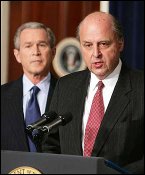 President Bush thinks he's found his man for the job of National Intelligence Director, last week nominating ambassador John Negroponte for what will surely be a challenging job with limited authority - the LA Times sums up:
-
As U.S. ambassador to Iraq for the last eight months, John D. Negroponte deftly maneuvered between warring factions, deadly ambushes and dubious allies in a brutal combat zone.
Negroponte will need those skills and more for the bureaucratic wars he will face in Washington if he is confirmed as the first director of national intelligence.
President Bush's nomination of Negroponte on Thursday ended two months of speculation about who would finally agree to oversee America's demoralized spy services.
But the surprise choice of a veteran diplomat who speaks five languages — but has no known experience working in the shadowy world of espionage — also refueled concerns that the high-profile post entailed vast responsibilities but limited authority and that it may do little to increase the nation's security.
Rep. Jane Harman (D-Venice), the top Democrat on the House Intelligence Committee, said she warned Negroponte in a telephone conversation Thursday that he would be leaving the relative safety of the heavily guarded embassy compound in Baghdad for the uncertainties of Washington politics.
"I said, 'You're leaving the Green Zone for the red zone,' " said Harman, who was a strong proponent of the intelligence reform bill that created the job.
Negroponte supporters argued that his access to the president — and his diplomatic skill in getting incompatible agencies to work together — could outweigh his weak intelligence background.
But a Bush administration official who has worked with the easygoing diplomat described the early stages of the amorphous job as "impossible: no office, no staff, no budget."
"John doesn't have a political bone in his body," said the official, who spoke on condition of anonymity. "He's never worked the political angles. But in this kind of job, he'll need political backing. This isn't just diplomacy anymore."
The official added: "Where's his political backing? In Congress? No. From the Republican Party? No. He's not in the Cabinet. Are Cabinet officers really going to report to him on anything?"
The challenge is immense. For starters, Negroponte would have to balance two often-competing roles. He would be the president's chief intelligence advisor and the leader of a sprawling spying community that is required by law to remain independent of politics.
Moreover, Negroponte must assert control over the disparate leaderships, budgets and priorities of the nation's 15 often-fractious intelligence agencies to force their entrenched bureaucracies — and an estimated 200,000 employees — to work together to prevent attacks.
Once in office, Negroponte would create his job from scratch. The law requires a report on the rewired intelligence system within a year.
He would be expected to prepare a consolidated intelligence budget, overhaul security and technology policies, coordinate priorities for strategic planning and covert operations, monitor agency performance, report to Congress, advise the president and interact with foreign governments.
He would have to mediate a growing turf battle between the CIA and the Pentagon, where Defense Secretary Donald H. Rumsfeld has expanded foreign intelligence-gathering activities by the military, including the use of clandestine teams, that were traditionally undertaken by the CIA.
More important, Negroponte must work with Rumsfeld to decide how and where the estimated $40-billion annual intelligence budget is spent.
About 80% of the money is hidden within the Pentagon's budget, and the two officials must share control of Pentagon-based intelligence agencies. It's far from clear how that would work.
Also unclear is how much power Porter J. Goss, the current CIA chief, must relinquish.
Ever since the CIA was created in 1947, the CIA boss also served as director of central intelligence and was nominally in charge of all other spy services. Although he did not occupy a Cabinet position, he reported to the president. In the future, he would report to Negroponte.
Goss, who was initially considered a strong candidate to become the first national director, said Thursday that he welcomed Negroponte's nomination as a "critical step" to "create even better-coordinated working relationships and communications" between intelligence agencies.
The style Negroponte would bring to thorny problems in Washington has been apparent to many who deal with him in Iraq.
Negroponte's nomination surprised staffers at the U.S. Embassy in Baghdad, one of the largest U.S. missions in the world, with 3,500 employees — many of them security personnel, a testament to the danger of the posting.
Unlike his predecessor in Iraq, civilian administrator L. Paul Bremer III, Negroponte has drawn high marks for his competence and low-key style. His tenure, from his arrival in June as sovereignty was returned to the Iraqis to the United Nations-sanctioned election last month, is viewed far more favorably than Bremer's, despite the widening insurgency.
Frankly, the current mission charter as illustrated by the 911 Commission that created the position is not one for a bureaucrat, but rather for a sort of "meta-analyst" that can bring together all of the resources available to the NID and connect the dots to see the larger trends in the challenge-space.
Coincidentally, I read AlterNet's interview with Dame Stella Rimington, the first woman to head the British intelligence agency MI5, offering some interesting advice for whomever ultimately assumes the new role:
-
A diplomat's wife in New Delhi, bored with thrift sales and amateur dramatics, Rimington wandered into MI5 as a part-time clerk typist and found herself in the middle of the Cold War. When she joined the secret service, women could only hope to be assistants. When she later became the first woman to head MI5 and the first one whose name was publicly announced, her friends and neighbors were stunned.
"All of a sudden the neighbors realized this quiet lady who lived on their street might present a bit of risk, " she laughs. "I remember one neighbor telling me I wish you wouldn't go to work just when I am taking my children to school."
The danger at the time for her and her neighbors came mostly from the threat of IRA attacks. But in the middle of the Cold War the first order of business was espionage. The advantage her generation had, says Rimington, was they knew where their enemy lived. "We knew where the KGB headquarters were, we knew what they were trying to do. Now who knows where the (terrorist) headquarters are."
It's an extremely tough challenge for today's intelligence officers. "The best intelligence comes from human beings, sources deep in the heart of organizations," says Rimington. Today, intelligence services seem to be fishing in the dark for reliable sources, ending up with embarrassing episodes like the faulty warning about a ring of Chinese nationals smuggling a dirty bomb into Massachusetts.
"I was surprised that was made public seemingly before it had been fully investigated," says Rimington. She fears that hasty warnings can backfire, making people paranoid with constant orange alerts.
Ironically, such misconceptions on questions of authority are exactly why so many Competitive Intelligence officers ultimately fail to understand the true nature of their roles... Their real job isn't to be an adminstrator or even really an astute advisor to managerial decision-makers, but to increase their organization's capability for pattern recognition of threats and opportunities as they develop, in real-time and on-demand.
Somehow, I think Bush gets it even if many others don't - "John will make sure that those whose duty it is to defend America have the information we need to make the right decisions," Bush said at the White House. "We're going to stop the terrorists before they strike."
- Arik
 "Competitive Intelligence applies the principles of competition and lessons of intelligence to the need for enterprise awareness and predictability of market risk and opportunity. CI has the power to transform an enterprise from also-ran into real winners with agility enough to create and maintain sustainable competitive advantage."
