February 05, 2005
Ameriquest - Super Bowl Sponsor's Boiler Room Operation
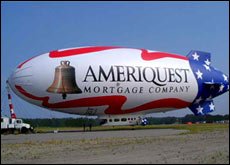 Ameriquest Mortgage, Super Bowl Halftime Show sponsor, has been accused in a sweeping LA Times story of running a boiler-room operation and pressuring business associates into wrongdoing in pursuit of sales.
Appraisers in six states said in interviews that Ameriquest tried to hustle them into inflating home values and even lying about property defects. Now, my father-in-law is a property appraiser and I can tell you, he'd have filed a complaint over that sort of thing. He's cut ties with other lenders for a LOT less questionable ethics than that.
-
In the late 1990s, the company's sub-prime lending drew the attention of a national housing advocacy group, Assn. of Community Organizations for Reform Now, or ACORN. The group's president, Maude Hurd, denounced the company as a collection of "slimy mortgage predators." About the same time, the Federal Trade Commission began an investigation into its lending practices.
In July 2000 Ameriquest worked out a cease-fire with ACORN.
The deal included a commitment to make $360 million in low-interest, low-fee loans to customers in the largely minority neighborhoods where ACORN operates. (Ultimately, according to ACORN, Ameriquest made only a small fraction of those loans because the group found other firms offering better terms for community residents. Ameriquest says it continues to work with ACORN on the program.)
Soon after, the FTC called off its investigation. Fair lending advocates, including the National Community Reinvestment Coalition and the Leadership Conference on Civil Rights, hailed Ameriquest as a progressive force in the sub-prime market.
With its regulatory and image problems behind it, Ameriquest embarked on an all-out marketing offensive that now includes an Internet advertising blitz and two blimps that hover over major sporting events.
According to the ex-loan officers interviewed by The Times, however, the company's growth has been generated more by hard-sell tactics than by slick marketing. They described 10- and 12-hour days punctuated by "power hours" — nonstop cold-calling sessions to lists of prospects burdened with credit card bills; the goal was to persuade these people to roll their debts into new mortgages on their homes.
Employees who put up big numbers, they said, were rewarded with trips to Hawaii and the Super Bowl and, in some cases, with $100,000-plus salaries. No matter how many loans they peddled, however, the pressure rarely eased, ex-employees said.
"I don't think there's a day that went by that I wasn't told I was going to be fired," recalled Omar Ross, who said he was a top producer when he worked for Ameriquest in Grand Rapids in 2003 and 2004, quitting the company that year. "I was told I was going to be fired at least 200 times."
Supervisors didn't let up even when he was meeting his quota, Ross said. "They would tell everybody: 'Omar did 10. How come everybody else can't do 10?' Then in private they would turn around and say: 'Why can't you do more? You're slacking. You're capable of doing more.' "
In such a rabid atmosphere, several ex-employees said, abuses become inevitable.
"You close fast because the longer somebody has to sit and think about it, the longer they have to think about the numbers," said Dave Johnson, a former branch manager in suburban Detroit. "You don't want somebody to get buyer's remorse before they close."
Maybe it's no coincidence that former employees swear that, to fire up and energize them, watching the movie "Boiler Room" was part of their Ameriquest training...?
- Arik
February 03, 2005
Happy Birthday, Aurora - 10-Years-Old Today
 It's been 10 years since I started Aurora WDC in the 12 by 25 feet on the eastern side of my Mom's beauty salon in the small Wisconsin town of Chetek.
Since then, I've learned starting and growing a business is a lot like having a real-life child, something I only came to appreciate first-hand 19-months ago, when my wife Tina gave birth to our son Liam. I witnessed struggle and growth, often more slowly than I'd hoped, sometimes wondering if it was such a good idea in the first place... especially through all those long nights at first... sometimes even failing outright to live up to the father's prideful aspirations.
But, I always realize, whatever the occasional sacrifices invested toward the joy only one's own offspring can offer, I'd gladly do it all again without changing a thing.
Okay, well, maybe there are some things I'd have changed... but not many and only with benefit of 20/20 hindsight.
In the decade past, company and founder alike have benefited from some remarkable contributions from amazingly creative and generous people - you know who you are. I'm forever grateful for the advice and support of everyone, from clients and staff to partners and other advisors, friends and family who've helped make Aurora what it is today. To say I couldn't have done it without you is the most ridiculous of understatements.
I'm looking forward to the next 10 years of blazing new trails together and hope you are too.
Thanks again and best wishes,
- Arik
p.s. - It's also my birthday today - I'm 35... so get me something nice. ;-)
February 01, 2005
MetLife Buys Travelers from CitiGroup
Reversing the strategic changes Sandy Weill undertook in the financial services consolidation of the 1990's, Citigroup dumped its Travelers life and annuity business to redeploy capital to in faster growing markets in Asia and Europe, as MetLife plopped down more than $11.5 billion to become the largest life insurance company in the business:
-
Citigroup, the largest financial institution in the United States, had retained Travelers Life & Annuity in 2002 when it spun off Travelers Property Casualty Corp. in a $5 billion initial public offering. Travelers Property merged with St. Paul Cos. Inc. in 2003 to create The St. Paul Travelers Cos., based in St. Paul, Minn.
The announcement Monday said that Citigroup and MetLife "have entered into 10-year agreements under which MetLife will greatly expand its distribution by making products available through certain Citigroup distribution channels," including Citi branches and its Smith Barney brokerage unit.
It said that Citigroup will receive $1 billion to $3 billion US in MetLife equity securities and the balance in cash, which will result in an after-tax gain of about $2 billion. It added that MetLife may finance the cash portion of the transaction through a combination of cash on hand, debt, mandatory convertible securities and selected asset sales.
In a phone call with analysts, MetLife's chief financial officer, William J. Wheeler, said that the asset sales could include divestiture of MetLife's reinsurance operations. Reinsurance is backup coverage purchased by insurance companies.
MetLife owns about 52 per cent of the Reinsurance Group of America.
Wheeler said asset sales could also include "equity real estate investments and potential other things."
C. Robert Henrikson, MetLife's president and chief operating officer, said the purchase would bring "even more balance" to MetLife's business mix.
MetLife currently earns about 46 per cent of its profits from institutional sales and 30 per cent from individual sales, he said. After the merger, profits from institutional sales should drop to about 43 per cent, while earnings from individual sales should rise to 36 per cent. Other categories are international, seven per cent; auto and home six per cent; and miscellaneous, eight per cent.
Citigroup said that the businesses being acquired by MetLife generated total revenues of $5.2 billion and profits of $901 million in 2004. The business had total assets of $96 billion at year's end, it said.
The transaction announced Monday doesn't directly involve operations in Canada, although the financial ratings of Citigroup's Primerica Life Insurance of Canada along with its parent Primerica were put under review Monday by A.M. Best Co.
A.M. Best also lowered ratings of Travelers Insurance Co and Travelers Life and Annuity, to A-plus superior from A-double-plus superior, reflecting their move out of the Citigroup group of companies.
Metropolitan Life sold the bulk of its Canadian operations in 1998.
The move was the latest by Citigroup to sell off noncore businesses.
Citigroup chief executive Charles Prince said that selling Travelers "sharpens our focus on Citigroup's long-term growth franchises." He did not say how Citigroup would use the proceeds from the sale.
In November, Citigroup sold a truck-leasing operation to General Electric Co. for $4.4 billion. It also sold its European vendor-finance leasing operation for CIT Group Inc.
Although no longer consider strategic, Travelers had played a big part in the creation of Citigroup.
Citigroup chairman Sanford I. Weill acquired the Travelers insurance group in 1993 and Travelers then acquired Shearson in 1993 and Salomon brokerage in 1997; it merged with Citicorp in 1998 to form Citigroup.
Of course, then there's American Express, that in an otherwise seemingly disconnected move, suddenly decided to spin off its personal finance unit, American Express Financial Advisors, to shareholders in the third quarter. Reportedly, the move is being planned so the Minneapolis unit, formerly called IDS back in the day, could "pursue new products, partnerships and expansion without having to compete with credit cards and other businesses for capital." I wonder if it doesn't have more to do with confirming theories about the disintegration of the "integrated financial services" strategy signified by the MetLife/CitiGroup deal...?
-
The financial advisory business provides financial planning and advice, asset management, insurance, annuities and related businesses through a network of more than 12,500 advisors. It generated revenues of about $7 billion and earned about $700 million in 2004.
"This spin-off will create two distinct businesses and allow them to capitalize on their respective growth opportunities," Kenneth I. Chenault, chairman and chief executive officer of American Express, said in a statement.
He said the new company would have greater latitude as an independent company to compete for capital or management resources, and react more quickly to business opportunities.
After the spin-off, American Express will consist of a charge and credit card business and a network that processes more than $400 billion in transactions from merchants throughout the world. It will also operate global travel and Travelers Cheque businesses and an international bank serving wealthy consumers and financial institutions.
Those businesses delivered approximately $22 billion of revenues and net income of $2.7 billion in 2004.
The two companies will be independent, have separate public ownership, boards of directors and management.
The spinoff business will continue to be led by James Cracchiolo as chairman and chief executive.
All this refocusing lends credence to thoughts that consolidation, at least in financial services, has been a failed strategy to create scale across multiple business units. Perhaps it's more a matter of getting the right people in charge - and MetLife looks to be the chief beneficiary of that change in approach.
- Arik
January 30, 2005
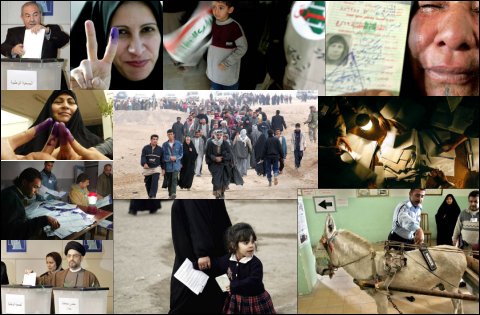
Getting Out the Vote: Election Day in Iraq
-
... Americans finally got a good look at who they are fighting for: millions of average people who have suffered for years under dictatorship and who now desperately want to live in a free and peaceful country. Their votes were an act of courage and faith—and an answer to the question of whether the mission in Iraq remains a just cause.
Fred Kaplan in Slate.com details the defeat the election handed to insurgents, particularly Zarqawi:
-
And yet, is it too romantic to see signs of real hope in today's election? One thing is clear: The day marked a terrible defeat for Abu Musab al-Zarqawi, who had declared democracy to be an "infidel" belief. He and his goons passed out leaflets threatening to kill anyone and everyone who dared to vote; they dramatized their threat by killing dozens of police and poll workers in the days leading up to the election. And yet millions of Iraqis—including a fairly large number of Sunnis who live in Shiite areas—defied their fears and voted. Whatever mayhem they inflict in the coming days, it will be hard for anyone to interpret their actions as reflecting the beliefs of "the street."
In the week before the election, several Sunni leaders said they want to participate in the constitutional process in any case. Do these leaders now regret their calls for a boycott of the election? Seeing how badly Zarqawi failed in his effort to halt or disrupt the election, will they now work more vigilantly to pursue their cause peacefully and to separate their nationalist followers from the foreign terrorists in their midst?
Finally, imagine a Syrian watching Al-Arabiya, seeing Iraqi-born Syrians going to special polling places to elect Iraqi leaders, observing that no Syrians of any sort have the right to elect the leaders of Syria—and perhaps asking himself, "Why?" It is not inconceivable that this flicker of democratic practice in Iraq could ignite a flame of some sort across the Middle East. To what end, and for ultimate good or ill, who knows. But something happened in Iraq today, something not only dramatic and stirring but perhaps also very big.
Election Day in Iraq, where the turnout was unexpectedly high and the mood jubilant. As many as 8 million people, or almost 60 percent of eligible voters, cast ballots, sometimes within earshot of insurgents' repeated mortar, rocket, machine gun, and suicide attacks, which proved less deadly than feared but still killed 44. "The election was a victory of our own making," Iraq's national security chief told the New York Times. "Today, the Iraqi people voted with their own blood."
Or, put another way: "It's like a wedding. I swear to God, it's a wedding for all of Iraq," the director of a polling station in a Sunni area of Baghdad told the Washington Post. "No one has ever witnessed this before. For a half-century, no one has seen anything like it. And we did it ourselves."
Even AlterNet had a few nice things to say:
-
Despite the violence, voters streamed to the polls in relatively small but consistent numbers throughout the day, with a turnout of up to 90 percent in some Shiite neighborhoods, and about 40-50 percent in some Sunni areas in western Baghdad, Milley said. U.S. forces made up a third cordon during the election, giving logistical and protective support, while polling stations were guarded by Iraqi police forces and managed by Iraq's Independent Electoral Commission.
As predicted, Shiite turnout was much higher than for the minority Sunni population, as Shiites make up nearly 60 percent of the country's 26 million people. They were expected to gain a significant powerbase in this vote for a 275-member National Assembly. Sunnis make up 20 percent of Iraq's population and had been told by some of their leaders not to vote. Both the Iraq Islamic Party and the Association of Muslim Scholars threatened to boycott the election, claiming it could not be legitimate and remains a tactic to extend the U.S. occupation.
But many Sunnis disregarded the “fatwa,” or edict, seeing a vote as the only clear way out of the past.
"My father was a general in the Iraqi Army and this is the first time for Iraqis to taste freedom," said 25-year-old Dr. Zeena Hassam, who helped her 80-year-old father drop his ballot into the voting box. Hassem said she and her father paid no attention to calls for a boycott. The day is too important and the waiting was too long, she said. "It is the duty of every Iraqi to vote. We are Sunni, and my relatives and my friends, we all know it is our duty, and it is our honor."
The Sunni boycott, and especially the threats and terrorism, may have frightened off some voters, but others weren't fazed.
Aerial imagery apparently caught voters spitting on and kicking the remains of a suicide bomber as they entered their polling station. Other Iraqis waiting in line in Sadr City came under a mortar attack that hit a man in his leg. They helped the injured man then got back in line to vote, election officials reported.
"Of course we are afraid, but we must do this,” said Suna Sharif as she left a voting station with her son and husband. “We walked for two miles and my husband is sick. We have been preparing to vote for a long time and my son made sure we were here before polls closed.”
A ban on all car traffic encouraged people in some Shiite neighborhoods in northwest Baghdad to pour into the streets to visit and celebrate. Children played soccer and men talked on door stoops.
By nightfall, reports of ongoing attacks were still pouring into the central command station of western Baghdad. Focus was turned to protecting ballots and the days ahead, and helping police forces who were to continue securing polling sites through the night. The police chief took a moment from his organizing to show off his stained finger. An officer with the Iraqi National Guard joined him, holding his blue index finger in the air. They all took photos to remember the moment.
Now, let's hope the retaliation sure to come against Sunnis to get them to back away from negotiations after the votes are counted can be met with equal resistance by the Iraqi people - we'll find out in a couple of weeks what sort of ruling coalition comes to power.
- Arik
 "Competitive Intelligence applies the principles of competition and lessons of intelligence to the need for enterprise awareness and predictability of market risk and opportunity. CI has the power to transform an enterprise from also-ran into real winners with agility enough to create and maintain sustainable competitive advantage."
