December 18, 2004
Gwen Stefani (& the Harajuku Girls) – The New Anti-Diva
 Gwen Stefani - reinventing and rebranding herself as she has to compete with a whole new collection of divas (the best part of the ensemble are the Harajuku Girls), this "anti-diva" finally got a good write-up in Slate.com:
-
This woman has a Madonna complex. The plan is not to make a nice little solo album before returning to the ska-punk circuit with No Doubt. "What You Waiting For?" is a warning shot fired in the direction of Beyoncé, Britney, and J. Lo—not to mention a certain Kabbalah Centre habitué. There's a new competitor in the global pop diva stakes.
There are all kinds of pop divas: tragic-romantic divas in the Piaf-Garland-Holiday mold, ice-bitch MTV divas like Madonna and her followers, even four-octave-range total nut-case divas like Whitney Houston and Mariah Carey. But there's never been a diva clown. Divadom is a deadly serious business. You have to march through your music videos with steely resolve. A certain humorlessness—about yourself and your music—is a prerequisite for the job. (There's a reason why Madonna is Madonna, and Cyndi Lauper is doing guest spots on Deborah Norville Tonight.) However infectious her record is, Gwen Stefani may not quite be able to summon the gravitas we demand of our Queens of Pop.
But then Stefani launched her rebranding campaign, an effort undertaken with such gangling good cheer—and, apparently, without the usual battery of professional stylists and other hired help—that it endeared her to the editors of Jane magazine and other tastemakers who normally cast a jaundiced eye on the careerist machinations of pop divas. First came a cameo singing the chorus on Eve's "Let Me Blow Ya Mind" (2001), a Grammy-winning hip-hop single produced by Dr. Dre, which gave the Orange County skate-betty a ghetto-fabulous makeover. She cashed in her newfound hip-hop credibility on the next No Doubt album, Rock Steady (2001), and the result was a sleek, beat-happy party record. Meanwhile, the glammed-up Stefani strolled down red carpets on two continents and launched her own fashion line, L.A.M.B., which is none-too-subtly plugged in the title of her new record. Later this month, Stefani will make her movie debut as Jean Harlow in Martin Scorsese's The Aviator. All of which leaves Stefani a hit solo album away from a place in the diva firmament.
By all rights, Love. Angel. Music. Baby. should be that album. Stefani has hired a bunch of big-name collaborators (Dr. Dre, the Neptunes, Outkast's Andre 3000, Eve, Nelle Hooper, two members of New Order, and pop-rock hack Linda Perry among others) and made the most gleefully overcooked pop record in recent memory. Love. Angel. Music. Baby. bombards listeners with party chants, vocoder-smudged vocals, superstar cameos, cheesy hip-hop samples—an exhaustive, exhausting grab bag of pop tricks, topped off by the manic presence of Stefani herself, who has always been a kind of one-woman musical shock-and-awe campaign. At a time when production minimalism rules the charts—when producers squeeze hit songs out of little more than a few percussive thumps and a snatch of melody—Stefani has gone in the opposite direction. This is pop maximalism: rococo 'n' roll.
The result is a mess—for the most part, a delightful mess. Critics have sniffed at Love. Music. Angel. Baby. for its promiscuous use of different producers and overall jumbled feel. But rappers regularly put out albums with a different producer on every track and get away with it. It's hard not to suspect that Stefani's critics are falling back on the canard that pop chanteuses are putty in the hands of producer-Svengalis—a charge that has dogged Madonna for two decades and seems particularly wrongheaded in the case of Stefani, who is so audibly in command of this ramshackle album. (Not just any broad could make tracks by Dr. Dre and the Neptunes, those masters of tidy funk, sound so discombobulated.)
So, here's to Gwen, shaking up the music industry in perhaps just the way it needs to be in 2005.
- Arik
December 17, 2004
The Apprentice 2: Kelly Perdew Next in Line for Career Groveling at Feet of Billionaire Trump
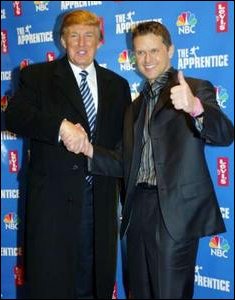 Real estate mogul Donald Trump hired another "apprentice" on Thursday, offering West Point graduate and software executive Kelly Perdew a six-figure salary job in the culmination of the fall season reality show "The Apprentice." Perdew chose to supervise the sprawling Trump Place development on Manhattan's West Side, saying he wanted to be near the mogul's base of operations.
Jennifer Massey, the Harvard Law School graduate and San Francisco attorney often incurred the wrath of her fellow "job applicants" during the NBC series' four-month run, was diplomatic after her loss, saying that "Kelly seems to be the best fit for the Trump organization." But she added that she thought she was the best candidate and deserved to win. Watching the series unfold on television, however, she said that it seemed to "be moving toward a Kelly coronation," and said many of her contributions had been edited out.
While he polled some of his top executives and past contestants on the show, most of whom favored Perdew, Trump said afterward that did not affect his decision, which he said he made only in the final moments. "I really go with my gut," he told reporters. "But I couldn't' have lost with either one. It was a very tough choice."
Frankly, I thought Massey survived more wrath than she deserved to - but, in this second Apprentice outing, the bloom is certainly off the rose a bit from the first season, which I thought was entertaining and original.
Apprentice 2 just seemed a little too forced to be as much fun as the first one.
- Arik
December 16, 2004
Symantec-Veritas Merger – Major Shift in Strategy a Smart Move for Both Companies

But this deal was far from unpredictable - Symantec has long tried to begin applying security principles to storage, first by attempting to buy VMware (eventually bought by EMC) and then following through with the purchase of PowerQuest. And, Symantec has been shoring up its security-software portfolio since the summer of 2002 when the company started a shopping spree that continues here today, acquiring managed-security services provider Riptech for $145 million, intrusion-detection software maker Recourse Technologies for $135 million, and threat-management and security-intelligence provider SecurityFocus for $75 million. The company also acquired security-management software maker Mountain Wave for $20 million in cash that year. Just last week Symantec acquired Platform Logic to strengthen it's weak spot in host-based intrusion prevention and also recently acquired application security consulting firm @stake, as well as anti-spam vendors TurnTide and Brightmail.
Plus, with Microsoft's most serious tactical threat to its platform dominance arising from security questions, getting into the antivirus market would seriously impact Symantec's consumer-driven revenue base. It's been happening already - the Windows XP operating system equipped with Service Pack 2 provides more security features, including a pretty good firewall, than any of Microsoft's other operating systems. Then Thursday, Microsoft acquired anti-spyware company Giant Company Software for an undisclosed sum to build anti-spyware capabilities into its Windows operating system.
-
The leader in storage software and the leader in security software will provide enterprise customers with a more effective way to secure and manage their most valuable asset, their information. The combined company will be uniquely positioned to deliver information security and availability solutions across all platforms, from the desktop to the data center, from consumers and small businesses to large organizations and service providers.
The combined company will operate under the Symantec name. John W. Thompson, Chairman and Chief Executive Officer of Symantec, will continue as Chairman and CEO of the combined company. Gary L. Bloom, Chairman, President and Chief Executive Officer of VERITAS, will be Vice-Chairman and President of the combined company. The board directors of the combined company will include 6 members of Symantec's current board and 4 from VERITAS' current board for a total of 10 members.
"Customers are looking to reduce the complexity and cost of managing their IT infrastructure and drive efficiency with fewer suppliers," said John W. Thompson, Chairman and CEO, Symantec. "The new Symantec will help customers balance the need to both secure their information and make it available, thus ensuring its integrity. We believe that information integrity provides the most cost-effective, responsive way to keep businesses up, running and growing in the face of system failures, Internet threats or natural disasters."
"Our customers have told us that one of their most critical needs is to enable 24x7 access to information. At the same time, they must maintain tight security, comply with all regulatory requirements and operate within their existing budget constraints," said Gary L. Bloom, Chairman, President and CEO of VERITAS Software. "Through our unique portfolio of solutions, Symantec and VERITAS are best positioned to address the ever-growing needs of our customers. Based on IDC data, the total market opportunity for the combined company today is approximately $35 billion and is expected to grow to $56 billion by 2007."
By merging with VERITAS, Symantec will expand its combined revenue base and create an entity with significantly greater financial scale and resources. The aggregate revenue of the combined company is expected to be approximately $5 billion for fiscal year 2006, which begins in April 2005 and ends in March 2006. Approximately 75 percent of the revenue of the combined company is expected to come from the enterprise business and 25 percent from the consumer business. In addition, the combined company will have approximately $5 billion in cash.
The deal will integrate Symantec’s expertise in security, including virus protection, firewall software, and intrusion prevention, with Veritas’ expertise backing up corporate data. In an interview before the Symantec-Veritas deal was announced, Vincent Weafer, Symantec’s senior director of development for the security response division, said the company has been working with partners for some time to develop a unified response to digital threats. “If we saw cyber activity increase, we could dynamically increase the frequency of backups,” said Mr. Weafer.
For Veritas, the deal represents an opportunity to escape a difficult financial history. In 2002, the company restated its revenues and earnings after an internal audit showed its CFO had lied about when expenses occurred and when sales representatives were compensated. The restatement kept Veritas from filing its annual report on time and its stock took a hit.
Although Veritas’ recent earnings have been solid at $470 million on almost $2 billion in annual revenues, analysts worry the company may face increasing market pressure and have trouble growing. In January, Veritas bought Ejasent, a file-management company, for $59 million. In July, it acquired IT automation company Invio for $35 million, and in September, Veritas purchased email archiving company KVault Software for $225 million. Last year the company shelled out $537 million for Precise Software Solutions to augment its data collection capabilities. “It’s probably good technology, but it doesn’t generate a lot of revenue yet,” Dan Cummins, an analyst at UBS Cummins, said of the Precise acquisition.
Problems integrating new technology, along with price competition from EMC, gave Veritas good reason to flirt with potential acquirers. “If you want to get into the storage software business, you either buy Veritas or you’re out,” said Nitsan Hargil, an analyst at Friedman, Billings, Ramsey, & Co. “There’s no halfway to play this.”
ComputerWire had another perspective from an interview with a Symantec exec:
-
In an interview with ComputerWire, Symantec senior vice president for global technology and corporate development, Ajei Gopal, said that, "Veritas is a trusted brand in the enterprise, and so is Symantec. Exactly how we brand [the acquired Veritas products] going forward has not been worked out. What I can say is that we will aim to build on the brand value. If you look historically, for example when we acquired BrightMail we called it Symantec BrightMail and we still do."
Asked whether there is likely to be a significant headcount reduction when the deal closes - likely to be in the second quarter of 2005 - Gopal would say only that, "Both companies are of approximately the same size and scale. We expect to take advantage of the skills of both companies, and in fact we would expect to be able to continue to grow the company. This is not a merger based on the goal of the elimination of cost. It is a deal done for strategic reasons."
One possible conclusion to be drawn from the move is that Symantec is aiming to become more of an infrastructure management company, managing not only security and storage but systems too. It already has some capability in this area thanks to its acquisition of On Technology Corp in October 2003, and it will soon also be able to draw on the provisioning and applications management technology that Veritas acquired by buying Jareva Technologies and Precise Software.
Moving in this direction of course leads it into a head to head battle with the systems management vendors such as IBM-Tivoli, HP, Computer Associates, NetIQ and Evidian. Of these, Computer Associates has the broadest portfolio so far, thanks to its eTrust security management; BrightStor storage; Unicenter enterprise management; CleverPath portal and business Intelligence; AllFusion life cycle management and Advantage data management and application development product lines.
So is Symantec on the road to building out its capability in all of these areas, and in particular building upon its On Technology acquisition in the systems management space? "I think the way to think of this is as an evolution," said Gopal. "We needed to take the company from security into availability, in effect to start to do data integrity. That action is not complete. It is far from complete. But our immediate goal is to absolutely deliver on the promise, and that means our immediate focus is on integration [of Veritas, once the deal closes]. When it all passes compliance and so on we think it will close in April '05. There is a lot of work to be done [on integration]. We need to make sure that we deliver the deal to the marketplace. That means integration."
This deal is a capstone of sorts to Symantec's positioning of itself as a consolidator in the security industry more broadly. Its antivirus software has been a consumer staple, but Thompson has sought to make the company a provider of a broad range of security technologies to corporations, largely through acquisitions. This purchase significantly diversifies the company and helps position Symantec for an emerging competition with a host of technology giants that have been showing increasing interest in the high-growth computer security market, from Microsoft to IBM to Cisco. Their interest reflects their customers' need for tighter defenses amid a rise in attacks and government regulations requiring data security.
Veritas would bring data management pieces that would help Symantec make a case that it can provide companies with a broad set of the security technologies they need today. "It really helps them redefine what the company does and what enterprise security is all about," said Richard Parower, co-manager of the Seligman Global Technology Fund, which owns shares in both Symantec and Veritas. "Stopping attacks is important, but what it comes down to is you want your data to be secure and available all the time."
This new drive for enterprise security has created the IT "assurance" market, where software companies provide products and services that assure availability in a hostile business environment. This concept also could take Symantec to terrain such as data encryption and identity management, or even physical security systems. One other company is pursuing a similar strategy, but from the opposite direction. Computer Associates International has been bulking up its security offerings lately, having last month completed its acquisition of Netegrity, an identity and access management software maker.
The buyout is also attractive to Veritas, as the company is facing tough competition from larger rivals CA and EMC and looking increasingly lonely as the enterprise software industry consolidates. They couldn't continue to be as dependent on the backup business and really needed to grow beyond it; $13.5 billion is apparently the right price to give up going it alone.
Long-range, by putting together the system-management pieces that Symantec and Veritas have acquired recently, together the companies hope to create a dominant presence in the market that would allow them to compete effectively with the likes of IBM, HP, EMC and CA. But, as in all such mega-deals, it comes down to execution - and Symantec is only about average in its track record of successful integrations - back in 2000, when the company acquired firewall, VPN, and intrusion-detection vendor Axent Technologies for $975 million, most of those products just disappeared.
Of course, the stakes are a lot higher for all involved here - and if they can make it succeed, they may just have transformed the security and storage market forever. It essentially proves what users have been saying for quite some time - that traditional perimeter-based security leaves the crown jewels of the corporation vulnerable to compromise when they're inside the firewall spinning around on disk drives. Once completed, this merger may be the proof the industry needs that storage and information security themselves are merging.
- Arik
December 15, 2004
Sprint-Nextel: Tech Challenges Ahead - But CDMA & Qualcomm are the Biggest Winners
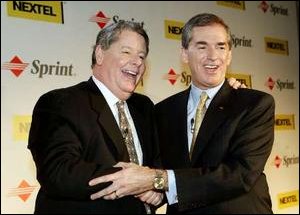 Merger Madness continues this week, following the IBM/Lenovo deal, then Oracle/PeopleSoft, with Sprint and Nextel agreeing to a merger-of-equals that reinforces the third largest mobile telecom provider in the U.S., with a combined 39 million customers - well behind Cingular's 47 million, but within striking distance of Verizon's 42 million - setting the stage for a battle for growth that could pit smaller operators like GSM-based T-Mobile against other CDMA companies such as AllTel in continued consolidation.
Two months after Cingular Wireless announced it would buy AT&T Wireless, Sprint makes a bid for Nextel in a stock and cash deal valued at $35 billion. Sprint CEO Gary Forsee will become CEO of the new company, Nextel CEO Tim Donahue will become chairman, and the company will set up headquarters in Sprint’s Kansas offices. "There is a market that we compete in today that has two very significant, larger players. As we looked at requirements to compete, we liked our prospects by ourselves but thought our prospects together would allow us an even playing field into the future," Forsee told the news conference in New York. Nextel has greater monthly revenue per customer and a lower subscriber cancellation rate than Sprint, but Sprint is ahead of Nextel in developing advanced services and has greater spectrum capacity to support growth.
But, the challenges in this deal come down to the divergent technologies - Nextel's proprietary (and Motorola-dependent) iDEN network is incompatible with Sprint's nationwide CDMA network, so that'll cost billions to upgrade. But it'll help Sprint shed its wireline business and refocus itself on a wireless and business services strategy that appears to be the wisest niche move going forward.
Why'd they do it? Because wireless companies will be partnering with everyone in 2005 — wireline, content, hardware and software companies — and the best opportunities and technologies will go to the ones with the largest market share. So, there's a lot of consolidation potential in the industry due to the huge gravitational pull of Cingular and Verizon.
But alongside the tech challenges, can Sprint-Nextel integrate two different cultures (the product of various consolidations in the past) to compete with Verizon and Cingular? A bigger question exists on whether size really matters anymore? To Sprint, size will matter a lot since it can extract efficiency from consolidation. To Nextel, with an evolving technology gap in radio spectrum, this would accelerate its already successful consumer programs of cell phone as walkie-talkie and an appeal to the youth market. So the synergies are there, but the cultural issues should not be underestimated - 80 percent of M&A deal-failure is due to cultural incompatibliites.
-
Sprint and Nextel are responding to the telecom industry's troubles. Even after the bankruptcies of WorldCom and Global Crossing, and the consolidation of AT&T Wireless and Cingular, there are still too many companies fighting over the same customers. The fixed-line business is profitable but wasting. Cell phone companies bent on growth must engage in fierce promotional cost-cutting or spend billions to convince people they need phones that can take photos and play music. Sprint and Nextel are hoping to find an easier path to greater profits: cost-cutting. In their merger announcement, Sprint and Nextel said that by doing everything from using fewer cell sites to slashing jobs, they could save more than $12 billion.
-
It came as no surprise, then, that Verizon was alarmed. Yesterday, a day before Sprint and Nextel announced the creation of “America’s premier communications company,” the Street was buzzing with rumors that UK’s Vodafone, which owns 45 percent of Verizon, had given the go-ahead for a takeover of Sprint, speculation that was later denied by the companies. But analysts believe that Verizon is worried. “I think Verizon finds itself like the ham in a ham sandwich,” said Lisa Pierce of Forrester Research. “The new company could close the gap really quickly.”
Sprint Nextel has all the makings of an enterprise wireless powerhouse. Nextel provides the business clout: 80 percent of its subscribers are from the enterprise sector. Albert Lin, an analyst at American Technology Research, said that with more businesses opting for bundled wireless and wireline services, the Sprint-Nextel merger would be a significant force as Sprint offers fixed-line and wireless services as part of the same package.
Plus, Sprint gains a focused, vertical sales force that Nextel has arranged along industry lines. In addition to knowing the Nextel offerings, sales team members also understand the issues facing specific vertical markets, the tools they currently use and their data needs and has produced the industry's highest penetration of both, data and enterprise users. But Nextel's superb customer service is something altogether different from Sprint's rep, where a 40-minute wait to talk to a human is not uncommon. But the hidden gem in this deal is, Nextel avoids having to upgrade its network to new bandwidth standards for data services - a use of capital that can now be better used to consolidate the networks to CDMA.
Still, every one of Nextel's handsets will have to be replaced - but that's something the company would have to do anyway in upgrading its network to higher data rates. The biggest challenge in the upgrade will be to preserve the popular Direct Connect push-to-talk feature, a very sticky differentiator for Nextel. It's a feature people don't want to give up and must continue to be supported through the transition if the combination is to be successful.
And don't think Motorola is about to let its biggest customer off the hook that easily. A new PTT technology, called Next Generation Dispatch, is interoperable with CDMA networks, including CDMA 1xRTT and EV-DO data networks, Motorola said. "The Next Generation Dispatch solution will enhance Nextel's high quality PTT services by driving greater network efficiencies and product flexibility," Nextel CTO Barry West said in a statement. "It will also provide the added benefit of more easily bridging multiple radio access technologies such as CDMA or OFDM." So, maybe that MOT sell-off on this news was a little premature after all.
So, with all this consolidation continuing - T-Mobile might be next, despite the weak dollar making Deutsche Telekom's Euros a lot stronger as acquisition capital - what's to halt the inevitable march toward a new wireless version of Ma Bell?
Regulators, that's who.
The FCC continues to examine proposals to break the companies into pieces to promote competition. Under the mandate of the Telecommunications Act of 1996, the agency is required to develop a plan to have major carriers unbundle elements of their networks to be leased to competitors. The FCC put together three plans, all of which have been whacked by the courts, but coinciding with the Sprint-Nextel merger, the issue was back on the agency's agenda at its meeting Wednesday.
Curiouser and curiouser...
Let's hope regulation can save competition for the rest of us - it'd be even nicer to imagine a single network technology for wireless to ride on - GSM being my preference because of its global ubiquity, especially among the fastest-growing markets worldwide... but that's not a likely proposition with the momentum behind CDMA in the U.S. today.
And, if this merger goes through in the second half of 2005 as intended, CDMA has essentially just won the battle for U.S. wireless networks. With our government's affinity toward Qualcomm (guess what flavor network Iraq is building), versus "Old Europe", means GSM, despite powering most of the world's wireless new networks, isn't likely to dominate anytime in the foreseeable future here in the States.
So, maybe the biggest winner in all of this, is Qualcomm?
- Arik
December 14, 2004
Oracle-PeopleSoft: Ellison Prevails
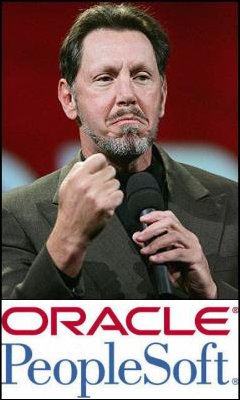 As I'd earlier opined would happen, Larry Ellison and Oracle prevailed, at long last, over PeopleSoft in their pursuit to acquire this most reluctant of prey.
Still, planning is the easy part - execution is where success or failure will be judged. Often criticized for weak integration, Oracle needs to pull demonstrate an executable roadmap that will show skeptical customers, pro and con, exactly what, when and how it will integrate the company and its products to reassure the primary asset being acquired - PeopleSoft's customers - that they're safe staying put. Despite the cultural challenges ahead, at least Wall Street remains optimistic:
-
"PeopleSoft as a standalone entity was probably not worth $20 per share," said John DiFucci, a managing director at Bear, Stearns & Co. Inc. in New York. The pumped-up price reflects Wall Street's faith in Oracle's ability to turn the merged outfit into a lean software machine that will operate with fewer costs and will drive home more revenue, he said.
"I think it's good for Oracle, and it's good for the industry," DiFucci said, because Oracle CEO Larry Ellison has been right all along in saying that the industry has been in need of consolidation.
"Frankly, I don't think we'll see a return to double-digit growth, at least not on a long-term basis, this year or next year," he said. "Assuming all that, and assuming a lot of software companies came about or proliferated during the [dot-com] bubble, you come to the conclusion that we have too many out there, and there has to be a rationalization of the industry."
The deal also sent Oracle stock up almost 10 percent, largely due to the market's love for certainty, according to Tom Burnett, president of New York-based Merger Insight, an affiliate of Wall Street Access. "The market loves getting rid of the uncertainty," he said. "It's a very good move for Oracle. The board distraction was beginning to take a big toll."
Oracle executives have forecast the deal as promising to be 8 cents accretive by next year—in other words, the merger will add 8 cents per share to the bottom line.
The raw translation of that promise means that many PeopleSoft employees will lose their jobs, as Oracle squeezes redundancies out of the merged companies. Donovan Gow, an analyst for American Technology Research, in Greenwich, Conn., predicted that more than a few thousand employees will be considered redundant, and that the bulk of the victims will come from PeopleSoft's ranks.
"There will be massive head-count reduction across the combined firms," he said. "I would presume the bulk will come from the PeopleSoft side."
Of course, many PeopleSoft personnel may jump ship rather than work for the company they have long regarded as a bitter enemy. "Oracle is considered a more aggressive, hard-hitting, less friendly type of corporate culture," Gow said.
"PeopleSoft has been viewed as a nicer place to work: more enjoyable, more camaraderie, more laid-back, less hard-hitting. That's why they brought over [former PeopleSoft CEO] Craig Conway from Oracle: to instill a little more competitiveness to PeopleSoft's environment."
Regardless of Conway's tenure, PeopleSoft still has a different culture that will entail a tough adjustment for of its employees, many of whom will likely leave.
But from a financial perspective, that will work in Oracle's favor, according to DiFucci. "The PeopleSoft culture will be destroyed here," he said. "The Oracle culture will dominate. … That kind of integration, [which is just about rationalizing the industry], is not as risky as a lot of acquisitions.
"You're just buying a customer base, which is reflected by the maintenance stream. … When you're integrating people, that's where the risk comes in: with integrating the culture."
-
Ellison's strategy envisions virtually all of PeopleSoft's customers remaining on board after the acquisition, giving Oracle the opportunity to sell them a variety of other software products while it collects a steady flow of revenue for maintaining and upgrading existing products. Oracle is so confident its strategy will pan out that it has already assured investors the PeopleSoft will boost the company's profit by about $400 million during the fiscal year ending in May 2006.
Yet some surprises seem inevitable. Because of the hostilities underlying the deal, Oracle did not get an insider's view of PeopleSoft until this past weekend when the takeover target finally opened its books for the first time.
"Oracle is coming in with an unusual amount of ignorance about something that just cost them $10.3 billion," said Joshua Greenbaum, a business software consultant who has followed Oracle and PeopleSoft for years.
University of Southern California corporate law professor Ehud Kamar agreed, describing the Oracle takeover as "a deal that looks particularly susceptible to integration difficulties."
To ease the transition, Oracle hopes to retain the brightest engineers among PeopleSoft's 11,500 employees. At the same time, though, Oracle plans to fire thousands of other workers to cut expenses -- a process that threatens to open even more emotional wounds among PeopleSoft workers who skewered Ellison and his lieutenants during the takeover saga.
Ellison already is trying to patch things up. After Oracle announced the deal had been cinched, Ellison sent an e-mail to PeopleSoft's employees to reassure them that they will be treated fairly under his reign.
"One of the biggest risks for Oracle is whether it will be able to retain enough of the right people," said Meta Group analyst David Yockelson.
Silicon Valley's soft labor market should help Oracle by giving alienated PeopleSoft engineers less incentive to leave. PeopleSoft's October firing of its former CEO Craig Conway -- a vitriolic critic of Oracle -- also might have helped cool the tensions during the past two months, Kamar said.
Still, keeping PeopleSoft customers happy might prove even more difficult for Oracle.
PeopleSoft's customers have a huge stake in how the deal progresses because they already have sunk millions of dollars into sophisticated software applications that run everything from their accounting to personnel departments.
"You are talking about big, complex software that's difficult to implement potentially becoming even bigger and more complex," said Michael Lodato, executive vice president for QAD Inc., a smaller software maker in Santa Barbara. "I don't think you will see any of the customers jump ship in the short term, but two or three years down the road they may start spending their money on something else."
Ellison seems to welcome the skepticism about a merger that many analysts predicted would never be consummated. "The conventional wisdom has been wrong consistently in analyzing this deal."
At least PeopleSoft's board managed to get a slightly sweeter deal; but it remains to be seen whether customer retention will make it all worthwhile:
-
The PeopleSoft takeover saga became a foregone conclusion over the weekend, when the prey finally caved. After all, PeopleSoft's arguments—antitrust regulators won't approve it, the price tag wasn't high enough, and we just don't like Oracle—fell away gradually. Especially when you raised the bid to $26.50 a share, from $24.
Now Oracle gets what it really wanted—PeopleSoft's 12,500 customers and the support and maintenance revenue they represent. But the fun is really just beginning. PeopleSoft customers are a wary bunch, and many are making alternative plans just to be safe. Among the customers you will need to win over:
- David Smith, chief executive officer of PSS World Medical, who installed J.D. Edwards enterprise planning software four years ago at the Jacksonville-based medical products distributor. Since PeopleSoft bought J.D. Edwards, service has improved, according to Smith; PeopleSoft was just more responsive. Now that Oracle has PeopleSoft in the loop, however, he doesn't want the software his company depends on to become an afterthought. "I'm afraid," Smith says.
Why the worry? Maybe it was the June 2003 press release from Oracle blasting PeopleSoft's J.D. Edwards acquisition as a tactic just to fend off Ellison & Co.
- Arnold Testa, chief information officer of the Electric Power Research Institute, a nonprofit center for public-interest energy and environmental research. His firm has standardized on PeopleSoft software, and Testa says an Oracle takeover could be a disaster. Why? He doesn't want another implementation to suck up time and costs, and he has IBM as his database provider. No matter how Testa slices the deal, it's likely to be more work for him.
- John Moon, chief information officer at pharmaceutical company Baxter International, whose company is both a PeopleSoft and J.D. Edwards customer. When asked about a potential Oracle takeover at SIMposium Chicago in September, Moon said he was formulating undisclosed plans to deal with the event.
- John Webster, PeopleSoft programs director at Dakota State University in Madison, S.D. "Had Larry Ellison made a different case, it might be different. But his first approach to [PeopleSoft] obviously scared me. And first impressions are what counts," Webster said at PeopleSoft Connect in September.
Oracle will have to win that foursome over, and thousands of other technology executives (read: Oracle customers-to-be) with the same concerns.
Rest assured, these executives are plotting their next move, pondering switches to rivals such as SAP and anxiously awaiting phone calls from their Oracle and PeopleSoft contacts. Maybe you can keep them happy initially, but you'll have to work hard to migrate them to Oracle applications and upgrade accordingly. Their technology road maps will be amended starting today to include escape hatches and possible jumps to other suppliers. Your job: Keep them happy or they'll leave.
You wouldn't want to waste $10.3 billion.
Predictably, SAP wasted no time in weighing in on the mediocre nature of competition in a post-PeopleSoft market:
-
"The era of uncertainty is far from over," said Bill Wohl, SAP's vice president for product marketing, in a telephone interview. He said plenty of questions still remain around how former JD Edwards customers will be supported, how the integration of the two companies will proceed and what the long-term plan will be. "All of those questions and uncertainties bode well for SAP, which looks increasingly like a safe harbor in a stormy sea. ... We're dealing with customer requirements, while the others are focusing on legal battles and now mergers and acquisitions."
SAP, based in Walldorf, Germany, is the biggest business applications player, accounting for 39 percent of the market, compared with 25 percent for PeopleSoft and Oracle together. During the 18 months since Oracle launched its PeopleSoft takeover bid, SAP's market share increased in all its key markets around the world, Wohl said—an increase analysts attribute to the Oracle-PeopleSoft turmoil. In a research note earlier this year Gartner warned that enterprises in the midst of implementing packaged applications face additional risks when their vendors are acquired.
The turmoil will continue for at least another 12 to 18 months while the two companies complete the merger process, Wohl predicted. "You can't minimize the amount of work here to bring the two together. We believe this is a market opportunity for us—it's been that way all along, and it continues today," he said.
He said that even once they complete their integration, Oracle and PeopleSoft will only be "a modest competitor."
According to its president, Oracle has a clear idea of how it's going to slice up PeopleSoft to retain the choicest assets and send the rest to the corporate rendering yard. Click here to read more.
Ex-PeopleSoft CEO Craig Conway once likened the process of adopting SAP software to "pouring concrete," but sales increases are the best answer to such criticisms, Wohl said. "At the small and midsized business level, where flexibility and openness are most required, as well as at the enterprise level, SAP has solutions that are meeting those requirements," he said. "Customers are speaking with their wallets."
Philip Carnelley, research director with U.K. analyst firm Ovum Ltd., agreed that it will be some time before the merger results in a serious competitor to SAP, but he said the combined company should ultimately increase competition. "A stronger, equivalent competitor to SAP... will also be good for the industry and future buyers. SAP really was having things all its own way," Carnelley wrote in a research note.
He said the deal should mean some certainty for PeopleSoft customers. "At least now they'll get some certainty, even if they don't like the outcome, which now seems rather better than they feared," he wrote. IBM, one of PeopleSoft's closest partners and the customer for its largest-ever installation, will be one of the biggest losers from the deal, Carnelley wrote.
Microsoft Corp., which once considered acquiring SAP, said it "remained neutral" toward Oracle-PeopleSoft as it has done throughout the process. The software giant said it remains focused on its existing business applications strategy for small and midsize businesses. "Microsoft has no position concerning today's Oracle announcement," the company said in a statement.
Meanwhile, Microsoft has begun its onslaught to try and capitalize on all that FUD:
-
Just two days after Oracle signed an agreement to buy PeopleSoft Inc., Microsoft issued its first formal overture to PeopleSoft's customers.
Microsoft corporate VP Bill Veghte on Wednesday sent a letter to PeopleSoft users urging them to migrate their Unix-, AS/400-, and mainframe-based PeopleSoft applications to Windows servers. For companies already running PeopleSoft applications on Windows, Veghte pitched increased investment in a broader range of Microsoft technologies, including its .Net Web services, portal software, and analytics tools.
"Extending your current PeopleSoft investment positions you for the future on the Microsoft platform," he wrote.
Microsoft also is encouraging PeopleSoft customers to consider shifting to the enterprise-resource-planning applications sold by its own Microsoft Business Solutions division or those of a partner.
"Migration to another ERP solution, including Microsoft Business Solutions, SAP and other partner ERP solutions on the Microsoft platform are additional options to PeopleSoft customers seeking greater clarity around technology direction and platform choice," Veghte wrote.
That last pitch is a shot across the bow of Oracle, which is spending $10.3 billion to acquire PeopleSoft largely to gain its customer base. Microsoft officials have repeatedly said they don't intend to compete at the high end of the ERP market, but there are many small and midsize accounts where Microsoft Business Solutions could bid against a combined Oracle-PeopleSoft. Microsoft Business Solutions sells four ERP suites, acquired for more than $2 billion over the past three years.
And, it's managed to push middleware vendors into a tighter spot - perhaps sowing the seeds of a broad alliance between the two other giants of the business - IBM and SAP:
-
Oracle's successful bid for PeopleSoft is going to change the face of the enterprise-applications market. It will blur the edges between middleware offerings and applications and force middleware vendors to compete or get pushed into a corner, says Yankee Group analyst Michael Dominy. Middleware suppliers such as BEA Systems, Tibco Software, and webMethods, as well as younger companies such as Blue Titan Software and Sonic Software, "are in danger of being left behind" by the combined impact that an applications and database vendor can have on the middleware space, he says.
One of the middleware's primary roles is to connect applications to database resources. Oracle is about to convert its ability to manage that connection seamlessly into a competitive advantage. And it will be developing that capability for an applications customer base second only to SAP itself.
One possible outcome will be greater cooperation between IBM and SAP, Dominy says. The two companies are longstanding partners on several fronts, and SAP has made its pioneering NetWeaver middleware and application-integration tools interoperable with IBM's WebSphere middleware.
IBM for several years has competed with Oracle by telling third-party application vendors that it won't compete with them on the applications front the way Oracle is willing to. IBM is unlikely at this late date to make a foray into the applications market because that would require it to either buy or build its own product set, observers note.
"IBM has done an amazing job of building professional services," says Niel Robertson, CTO of Newmerix Corp., a supplier of management software for PeopleSoft applications. Part of its IBM Global Services expertise is in moving enterprises onto ERP systems. Now it will lose part of that business as PeopleSoft, with whom IBM was a partner, disappears inside the Oracle fold, Robertson says. Nevertheless, IBM, more than Oracle, "has become master of the middleware infrastructure" with WebSphere, its Tivoli management system, and Rational Software development tools.
PeopleSoft will add to Oracle's strengths in certain areas. It has development, marketing, and sales expertise in human-resource, customer-relationship-management, and supplier management applications--the core of its applications business. It's also adept at selling to state governments, an area where Oracle has sometimes shown a tendency to stumble. For example, Oracle got into a brouhaha with California in 2002 when state officials charged Oracle with over-selling the expected benefits of a $95 million software contract with the state government. That contract was canceled.
"Oracle needs to be sure and retain the people with expertise in those markets," Dominy says. But he added that it's not yet clear that it will know how to do so. Efforts to retain PeopleSoft employees and the company's customer base may have been hurt by Oracle executives' comments about its plans for PeopleSoft in the early days of the takeover attempt, Dominy notes. Now a lot of key personnel inside PeopleSoft may or may not know what the future holds for them. Given that Oracle's efforts to buy out PeopleSoft took 18 months, Dominy says, "you would think Oracle would be ready to flesh out more details of the takeover at this point."
One this is for sure - if Oracle can execute as well as they plan (overlooking SAP's broader opinion that this was a dumb idea from the start) to stem what could be a tidal wave of customers from running to the waiting arms of the competition, the economies of scale the deal provides Oracle are impressive.
In the words of Ellison himself: "This merger gives Oracle even more scale and momentum [in its applications business]... This merger is going to make that applications business bigger and stronger... This merger works because we will have more customers, which increases our ability to invest more in applications development and support."
- Arik
December 13, 2004
IBM’s PC Sale to Lenovo Long Overdue & a Great Entry Point to the China Market
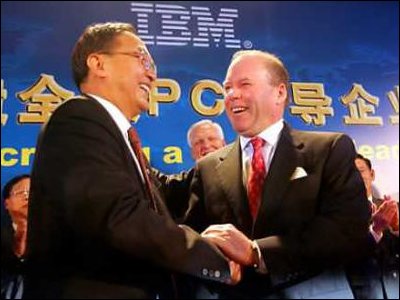
The Chinese company, which has aspired to enter international markets for years, will be able to use IBM's strength in branding, technologies, sales networks, and financing worldwide to achieve its dream, while IBM spins off what has become an increasingly non-core business and builds a closer partnership with a company from China. It is believed to be a perfect match by IBM China Chairman and CEO Henry Chow because of international influences and China's manufacturing strength.
For many, this has seen the end of an era with the IBM news but the decision should not come as too much of a surprise to anyone. In keeping with the company's recent strategy of getting out of less profitable businesses and focusing on higher margin services and software-led operations, the move also creates a powerful capitalization strategy for market-entry into the fast-growth China market for services and software that are sure to accompany PC sales.
IBM's recent acquisitions have focused on software and services markets, including its $3.5 billion acquisition of PricewaterhouseCoopers and $2.1 billion to acquire Rational, both in 2002. Despite good growth from its PC business in recent months, its share of the market is small, compared to bigger rivals such as Dell and Hewlett-Packard and is also not a big income generator for the company.
We'll see how these two powerhouses of the PC market will do competing in ever-lower margins with a branded seller from China:
-
Combined, IBM and Lenovo will stand at third place among PC makers with a projected 7.7 percent of the market and combined sales of $12 billion last year, behind Dell Inc. and Hewlett-Packard Co., which respectively command 16.7 percent and 15 percent of the market.
Even for the industry leaders, though, the business remains one of low margins and low return on investment. In IBM's case, the first nine months of 2004 saw a profit of less than $100 million measured against $9.4 billion in revenue.
Similarly, HP's Personal Systems Group, which represents the company's total sales of laptops, desktops, personal workstations and handhelds, saw a $210 million profit on $24 billion of revenue.
Despite the low ROI, which was seen as a factor in IBM's decision, HP remains committed to the PC market, said Deb Nelson, the company's vice president of marketing worldwide for the Personal Systems Group.
"It's a two-horse race" between HP and Dell, Nelson said. The IBM/Lenovo deal "is a change but not a significant one on the overall market," she added.
"We're not surprised by this move," Nelson said. She agreed that the PC business is one in which low profits are the norm, but she stressed that in HP's case, the PC is just the entry for sales of HP products.
Although HP is also a competitor in the server and support market, as IBM is, Nelson said that fielding PCs "brings a lot of other benefits" aside from unit desktop or laptop sales.
Nelson pointed to a "portfolio" of other items HP markets, such as printers, cameras, MP3 players and servers. These, she said, have higher margins but are sold using HP's PC line as an anchor. In fact, Nelson said, digital entertainment was the focus of the company's August product launches as well as its print and advertising campaigns.
Whether IBM's deal with Lenovo will affect HP's market share in the United States (Lenovo has a long lead over the field of computer manufacturers in China, so much so that Dell decided to abandon the PC field there earlier this year), Nelson said it could induce "some uncertainty in IBM customers," which would be an "opportunity" for HP.
Lionel Menchaca, a spokesperson for Dell, declined to comment directly on the IBM/Lenovo deal. He noted that Dell does not break out profit numbers for desktop and laptop sales, but did note that they were both "profitable." He added that 50 percent of the company's $47 billion of revenue for the past four quarters was due to desktops and 29 percent was attributed to laptops, with the remaining 21 percent coming from servers and storage. Dell has historically been able to retain larger profit margins on its products due in part to its direct-sales model over the Internet.
Menchaca added that Dell is not focused on acquisitions, preferring instead to grow the company "organically." However, Dell has been no stranger to purchasing companies to get a foothold in a market. In 1999, the company made its first acquisition, of storage vendor ConvergeNet, for $340 million. And in 2002, Dell bought services company Plural Inc.
eWEEK's Jim Louderback had another take on the strategy:
-
IBM spent the last few years commoditizing everything below middleware, including the OS and the PC. That explains the fascination with Linux. A commoditized and free OS not only makes Microsoft's key market position obsolete, it also makes the PC itself simply an off-the-shelf component. The consultants at the core of IBM have been recommending non-IBM hardware for years...
In fact, IBM should have gotten out of the PC industry a long time ago. It's been years since the company made memory, hard drives and Token Ring cards—why did they stick it out with PCs? According to ex-CEO Lou Gerstner, it's been "painful and costly for IBM." But he truly believes that the company could have competed. As he said in his 2002 memoirs, "If we had focused on the marketplace and done our homework, there's no reason the IBM PC business today would be looking up the leaderboard at Dell."
Well that time has passed. The corporate desktop looks a lot like a terminal, circa 1985. Interchangeable parts are defined more by what they connect to rather than what's inside. In other words, it's the services they run that are far more important—and they'll run just as well on a Dell.
Most of the PC excitement is happening at home, where Dell, Gateway, HP and others are jockeying for a piece of the media server market. From where I sit, those legacy PC vendors have already lost. Those devices will look a lot more like TiVo or iPod than your standard PC. But IBM hasn't been credible at home since its failed PC JR, so that's no great loss.
My final verdict - an excellent move by IBM, with manifold benefits and little obvious downside.
- Arik
December 12, 2004
Best Business Books of 2004
Christmastime brings with it my list of the best business books of the year, and 2004 certainly had some great ones. While I haven't read them all cover to cover (or perhaps any, for that matter), I've spent more than my fair share of time at Border's reading for free (than they probably had in mind when they came up with that idea) and I do hope to get a copy of each of these for my library eventually. Until then, enjoy! As for the order, it's according to my opinion of the impact of the ideas within.
Let me know if I've missed any,
- Arik
 Confidence : How Winning Streaks and Losing Streaks Begin and End
by Rosabeth Moss Kanter
Rosabeth Moss Kanter will convince you that the goal of winning is not losing two times in a row. In her view, success and failure are not events, they are self-fulfilling tendencies. "Confidence is the sweet spot between arrogance and despair--consisting of positive expectations for favorable outcomes."
 Hardball: Are You Playing to Play or Playing to Win
by George Stalk, Rob Lachenauer
Hardball: Are You Playing to Play or Playing to Win
by George Stalk, Rob Lachenauer
Great companies stumble and fall when they lose it. Highfliers crash when a competitor notices they don't have it. Start-ups shut down if they can't develop it.
"It" is a strategy so powerful and an execution-driven mind-set so relentless that companies use it to gain more than just competitive advantage-- they achieve an industry dominance that is virtually unassailable and that competitors often try to explain away as unfair. In their "hardball manifesto," authors George Stalk and Rob Lachenauer of the leading strategy consulting firm The Boston Consulting Group show how hardball competitors can build or maintain an enviable competitive edge by pursuing one or more of the classic "hardball strategies": unleash massive and overwhelming force, exploit anomalies, devastate profit sanctuaries, raise competitors' costs, and break compromises.
 Confronting Reality: Doing What Matters to Get Things Right
by Larry Bossidy, Ram Charan
Confronting Reality: Doing What Matters to Get Things Right
by Larry Bossidy, Ram Charan
In their 2002 bestseller, Execution: The Discipline of Getting Things Done Larry Bossidy and Ram Charan identify why people don’t get results: they don’t execute. Bossidy and Charan are back with another stellar study on organizational behavior that shows how companies can succeed if they return to reality and examine every part of their business. Confronting Reality is based on a simple concept, but many companies approach strategy and execution in a surprisingly unreal manner and even the simplest of measurement methods, like the business model, are not applied correctly.
Cisco, 3M, KLM, Home Depot, and the Thomson Corporation are just a few of the companies that Bossidy and Charan examine. To demonstrate how to examine a business using the business model, Bossidy and Charan map out external variables, financial targets, internal activities, and an iteration stage (defined as a time to "make tradeoffs, apply and develop business savvy") to prove how a dynamically evolving business model will help improve performance.
 The Daily Drucker : 366 Days of Insight and Motivation for Getting the Right Things Done
by Peter F. Drucker
The Daily Drucker : 366 Days of Insight and Motivation for Getting the Right Things Done
by Peter F. Drucker
Revered management thinker Peter F. Drucker is our trusted guide in this thoughtful, day-by-day companion that offers his penetrating and practical wisdom. Amid the multiple pressures of our daily work lives, The Daily Drucker provides the inspiration and advice to meet the many challenges we face. With his trademark clarity, vision, and humanity, Drucker sets out his ideas on a broad swath of key topics, from time management, to innovation, to outsourcing, providing useful insights for each day of the year.
These 366 daily readings have been harvested from Drucker's lifetime of work. At the bottom of each page, the reader will find an action point that spells out exactly how to put Drucker's ideas into practice. It is as if the wisest and most action-oriented management consultant in the world is in the room, offering his timeless gems of advice. The Daily Drucker is for anyone who seeks to understand and put to use Drucker's powerful words and ideas.
 The Future of Competition: Co-Creating Unique Value with Customers
by C. K. Prahalad, Venkat Ramaswamy
The Future of Competition: Co-Creating Unique Value with Customers
by C. K. Prahalad, Venkat Ramaswamy
Dwindling profit margins caused by intensified competition, a glut of commodity production and knowledgeable, web-empowered consumers will usher in "a new industrial system" characterized by "co-creating value through personalized experiences unique to the individual consumer." Under the new regime, headstrong consumers will "seek to exercise their influence in every part of the business system," and companies will accommodate them by, for example, allowing them to design their own individualized cosmetics and houseboats (an innovation whose benefits include "emotional bonding with... the company" and "a greater degree of self-esteem"). Rather than simply selling their products and services, companies will design "experience environments" that comfort the consumer in any contingency, such as General Motors' On-Star satellite communications system, which can summon help after an accident, open the car doors if the driver is locked out and direct motorists to the nearest Italian restaurant. Beneath the avant-garde terminology, the book mostly boils down to a medley of strategies to make business more consumer-friendly, like flexible pricing schemes, electronic gadgets that are easy to use instead of baffling, options and add-ons, meticulous market research and lavish customer service and support.
 Seeing What's Next: Using Theories of Innovation to Predict Industry Change
by Clayton M. Christensen, Erik A. Roth, Scott D. Anthony
Seeing What's Next: Using Theories of Innovation to Predict Industry Change
by Clayton M. Christensen, Erik A. Roth, Scott D. Anthony
Every day, individuals take action based on how they believe innovation will change industries. Yet these beliefs are largely based on guesswork and incomplete data, and lead to costly errors in judgment. Now, internationally renowned innovation expert Clayton M. Christensen and his research partners Scott D. Anthony and Erik A. Roth present a groundbreaking framework for predicting outcomes in the evolution of any industry. Based on proven theories outlined in Christensen's landmark books The Innovator's Dilemma and The Innovator's Solution, Seeing What's Next offers a practical, three-part model that helps decision-makers spot the signals of industry change, determine the outcome of competitive battles, and assess whether a firm's actions will ensure or threaten future success. Through in-depth case studies of industries from aviation to health care, the authors illustrate the predictive power of innovation theory in action. A unique, "outside-in" perspective on industry change, Seeing What's Next will help executives, analysts, and investors develop invaluable intuition into the future that matters to them.
 The Paradox of Choice: Why More Is Less
by Barry Schwartz
The Paradox of Choice: Why More Is Less
by Barry Schwartz
Whether we're buying a pair of jeans, ordering a cup of coffee, selecting a long-distance carrier, applying to college, choosing a doctor, or setting up a 401(k), everyday decisions -- both big and small -- have become increasingly complex due to the overwhelming abundance of choice with which we are presented.
As Americans, we assume that more choice means better options and greater satisfaction. But beware of excessive choice: choice overload can make you question the decisions you make before you even make them, it can set you up for unrealistically high expectations, and it can make you blame yourself for any and all failures. In the long run, this can lead to decision-making paralysis, anxiety, and perpetual stress. And, in a culture that tells us that there is no excuse for falling short of perfection when your options are limitless, too much choice can lead to clinical depression.
 The Fortune at the Bottom of the Pyramid: Eradicating Poverty Through Profits
by C. K. Prahalad
The Fortune at the Bottom of the Pyramid: Eradicating Poverty Through Profits
by C. K. Prahalad
The world's most exciting, fastest-growing new market? It's where you least expect it: at the bottom of the pyramid. Collectively, the world's billions of poor people have immense entrepreneurial capabilities and buying power. You can learn how to serve them and help millions of the world's poorest people escape poverty.
It is being done-profitably. Whether you're a business leader or an anti-poverty activist, business guru Prahalad shows why you can't afford to ignore "Bottom of the Pyramid" (BOP) markets.
 Got Game
by John C. Beck, Mitchell Wade
Got Game
by John C. Beck, Mitchell Wade
Think video games are kids' stuff? Think again. Provocative new data shows that video games have created a new generation of employees and executives-bigger than the baby boom-that will dramatically transform the workplace. And according to strategists John C. Beck and Mitchell Wade, managers who understand and harness this generation's distinct attributes can leap far ahead of their competition.
Got Game shows how growing up immersed in video games has profoundly shaped the attitudes and abilities of this new generation. Though little-noticed, these ninety million rising professionals, through sheer numbers, will inevitably dominate business-and are already changing the rules.
 Free Prize Inside!
by Seth Godin
Free Prize Inside!
by Seth Godin
Purple Cow taught marketers the value of standing out from the herd, which is how companies like Krispy Kreme and JetBlue made it big. But it left readers hungry for more: How do you actually think up new Purple Cows? And how do you get them adopted by risk-averse Brown Cow companies? Free Prize Inside delivers those answers and much more. It’s a fun guide to doing innovative marketing that really works when the traditional approaches have all stopped working. Thirty years ago, the best way to sell something was to advertise it on television. But today’s consumers are cynical, and your product or service had better be more than just hype and clever advertising. Even better, it ought to come with a market-changing innovation—a free prize inside.
You don’t have to spend a fortune to create something cool that virtually sells itself. Think of simple but powerful innovations like the Tupperware party, Flintstones vitamins, G.I. Joe (a doll just for boys), Lucille Roberts (a gym just for women), and frequent flier miles. Free Prize Inside will teach you how to create those kinds of blockbusters at your own company without a bunch of MBA-brainwashed marketers. You don’t have to be a genius—you just need curiosity, initiative, and a strategy for overcoming resistance when you champion your idea.
 The Art Of The Start
by Guy Kawasaki
The Art Of The Start
by Guy Kawasaki
What does it take to turn ideas into action? What are the elements of a perfect pitch? How do you win the war for talent? How do you establish a brand without bucks? These are some of the issues everyone faces when starting or revitalizing any undertaking, and Guy Kawasaki, former marketing maven of Apple Computer, provides the answers.
The Art of the Start will give you the essential steps to launch great products, services, and companies—whether you are dreaming of starting the next Microsoft or a not-for-profit that’s going to change the world. It also shows managers how to unleash entrepreneurial thinking at established companies, helping them foster the pluck and creativity that their businesses need to stay ahead of the pack. Kawasaki provides readers with GIST—Great Ideas for Starting Things—including his field-tested insider’s techniques for bootstrapping, branding, networking, recruiting, pitching, rainmaking, and, most important in this fickle consumer climate, building buzz.
 Changing Minds
by Howard Gardner
Changing Minds
by Howard Gardner
Minds are exceedingly hard to change. Ask any advertiser who has tried to convince consumers to switch brands, any CEO who has tried to change a company’s culture, or any individual who has tried to heal a rift with a friend. So many aspects of life are oriented toward changing minds—yet this phenomenon is among the least understood of familiar human experiences. Now, eminent Harvard psychologist Howard Gardner, whose work has revolutionized our beliefs about intelligence, creativity, and leadership, offers an original framework for understanding exactly what happens during the course of changing a mind—and how to influence that process.
Drawing on decades of cognitive research and compelling case studies—from famous business and political leaders to renowned intellectuals and artists to ordinary individuals—Gardner identifies seven powerful factors that impel or thwart significant shifts from one way of thinking to a dramatically new one. Whether we are attempting to change the mind of a nation or a corporation, our spouse’s mind or our own, this book provides insights that can broaden our horizons and improve our lives.
 The Wisdom of Crowds
by James Surowiecki
The Wisdom of Crowds
by James Surowiecki
While our culture generally trusts experts and distrusts the wisdom of the masses, New Yorker business columnist Surowiecki argues that "under the right circumstances, groups are remarkably intelligent, and are often smarter than the smartest people in them." To support this almost counterintuitive proposition, Surowiecki explores problems involving cognition (we're all trying to iden?ify a correct answer), coordination (we need to synchronize our individual activities with others) and cooperation (we have to act together despite our self-interest). His rubric, then, covers a range of problems, including driving in traffic, competing on TV game shows, maximizing stock market performance, voting for political candidates, navigating busy sidewalks, tracking SARS and designing Internet search engines like Google. If four basic conditions are met, a crowd's "collective intelligence" will produce better outcomes than a small group of experts, Surowiecki says, even if members of the crowd don't know all the facts or choose, individually, to act irrationally. "Wise crowds" need (1) diversity of opinion; (2) independence of members from one another; (3) decentralization; and (4) a good method for aggregating opinions. The diversity brings in different information; independence keeps people from being swayed by a single opinion leader; people's errors balance each other out; and including all opinions guarantees that the results are "smarter" than if a single expert had been in charge. Surowiecki's style is pleasantly informal, a tactical disguise for what might otherwise be rather dense material. He offers a great introduction to applied behavioral economics and game theory.
 The Medici Effect
by Frans Johansson
The Medici Effect
by Frans Johansson
Why is it that so many world-changing insights come from people with little or no related experience? Charles Darwin, after all, was a geologist when he proposed the theory of evolution. And it was an astronomer who finally explained what happened to the dinosaurs.
Frans Johansson argues that breakthrough ideas most often occur when we bring concepts from one field into new, unfamiliar territory. In this space-which Johansson calls "the Intersection"-established ideas clash and combine with insights from other fields, disciplines, and cultures, resulting in an explosion of totally new ideas. The Medici Effect-referring to a remarkable burst of creativity in Florence during the Renaissance -shows us how to get to the Intersection and how we can turn the ideas we discover there into pathbreaking innovations.
From the insight that created the first Cherokee written language to the ideas that enabled scientists to read the mind of a monkey-The Medici Effect is filled with vivid stories of intersections across domains as diverse as business, science, art, and politics.
Johansson reveals the core principles-including breaking down associative barriers, routinely combining unlike concepts, and executing past your failures-that can enable individuals, teams, and entire organizations to create their own "Medici effects" in any arena of work and life.
 Gurus, Hired Guns, and Warm Bodies
by Stephen R. Barley, Gideon Kunda
Gurus, Hired Guns, and Warm Bodies
by Stephen R. Barley, Gideon Kunda
Over the last several decades, employers have increasingly replaced permanent employees with temporary workers and independent contractors to cut labor costs and enhance flexibility. Although commentators have focused largely on low-wage temporary work, the use of skilled contractors has also grown exponentially, especially in high-technology areas. Yet, almost nothing is known about contracting or about the people who do it. This book seeks to break the silence.
Gurus, Hired Guns and Warm Bodies tells the story of how the market for temporary professionals operates from the perspective of the contractors who do the work, the managers who employ them, the permanent employees who work beside them, and the staffing agencies who broker deals. Based on a year of field work in three staffing agencies, life histories with over seventy contractors and studies of workers in some of America's best known firms, the book dismantles the myths of temporary employment and offers instead a grounded description of how contracting works.
 Strategy Maps
by Robert S. Kaplan, David P. Norton
Strategy Maps
by Robert S. Kaplan, David P. Norton
More than a decade ago, Robert S. Kaplan and David P. Norton introduced the Balanced Scorecard, a revolutionary performance measurement system that allowed organizations to quantify intangible assets such as people, information, and customer relationships. Then, in The Strategy-Focused Organization, Kaplan and Norton showed how organizations achieved breakthrough performance with a management system that put the Balanced Scorecard into action.
Now, using their ongoing research with hundreds of Balanced Scorecard adopters across the globe, the authors have created a powerful new tool-the "strategy map"-that enables companies to describe the links between intangible assets and value creation with a clarity and precision never before possible.
Kaplan and Norton argue that the most critical aspect of strategy-implementing it in a way that ensures sustained value creation-depends on managing four key internal processes: operations, customer relationships, innovation, and regulatory and social processes. The authors show how companies can use strategy maps to link those processes to desired outcomes; evaluate, measure, and improve the processes most critical to success; and target investments in human, informational, and organizational capital.
 Who Stole My Customer?? Winning Strategies for Creating and Sustaining Customer Loyalty
by Harvey Thompson
Who Stole My Customer?? Winning Strategies for Creating and Sustaining Customer Loyalty
by Harvey Thompson
Who's stealing your customers? Why is it happening? How can you stop it? These are the toughest questions facing virtually every enterprise. Who Stole My Customer?? is your complete guide to planning and implementing customer loyalty processes that really work-because they're built around what your customers really want.
Harvey Thompson helps you view your business and its processes through your customer's eyes … and you might be shocked at what you see. You'll systematically discover the real drivers of customer loyalty in your business, so you can focus your customer relationship investments for maximum value. Drawing on his unsurpassed experience at IBM and other world-class enterprises, Thompson shows exactly how to rebuild every touchpoint around your customer's needs … and overcome every obstacle that stands in your way. You won't just improve customer retention for a quarter or two: you'll build resilient customer relationships that resist competition for years to come.
Current customers are up to nine times as profitable as new ones, but keeping customers has never been tougher. Traditional "customer satisfaction" programs and "Have a Nice Day" platitudes won't cut it anymore. It's time you developed a customer-defined, outside-in vision of your business, plus the capabilities and infrastructure to make it real. Who Stole My Customer?? shows you how to do it. Harvey Thompson led customer-focused process improvement at Lou Gerstner's IBM, helping to drive one of the greatest transformations in business history. Drawing on his experiences with IBM and other world-class enterprises, he'll help you discover how your customers have changed, what they're expecting now, which facets of customer satisfaction actually drive loyalty … and where you're most vulnerable.
 What Matters Most
by Jeffrey Hollender, Stephen Fenichell
What Matters Most
by Jeffrey Hollender, Stephen Fenichell
Traditionally, the answer to this question has been straightforward: growth, quarterly profits, and shareholder value. Everything else was an "externality," which is economists' jargon for "someone else's problem." But as Jeffrey Hollender and Stephen Fenichell tell us, the bottom line isn't enough anymore. Not because corporations have suddenly become enamored of losing money, but because consumers, shareholders and the general public are demanding better behavior. They want businesses to be better citizens-to do more to make sure their products are healthy and safe, their manufacturing processes cause as little pollution as possible, and their employment policies are humane and not harmful to local communities. Across the country and the world, there's an evolving consensus that we need new standards to measure and reward business performance.
The emergence of Corporate Social Responsibility is more than just a PR tactic, sales strategy, or management trend. It's the future of business. It's what companies have to do to survive and prosper in a world where more and more of their behavior is under a microscope.
 The Dumbest Moments in Business History
by Adam Horowitz, Mark Athitakis, Mark Lasswell
The Dumbest Moments in Business History
by Adam Horowitz, Mark Athitakis, Mark Lasswell
Business 2.0 magazine publishes an annual cover story called "The 101 Dumbest Moments in Business." Featuring 101 hilarious items about the year’s most unbelievably stupid business blunders, it’s hugely popular with its more than half a million print subscribers—and with the two million people who read it on the Web this year. In The Dumbest Moments in Business History, the editors of Business 2.0 have compiled the best of their first four annual issues plus great (or not so great, if you happen to be responsible) moments from the past.
From New Coke to the Edsel, from Rosie magazine to Burger King’s "Herb the Nerd," the book’s highlights include:
• a Romanian car plant whose workers banded together to eliminate the company’s debt by donating sperm and giving the proceeds to their employer
• the Heidelberg Electric Belt, a sort of low-voltage jockstrap sold in 1900 to cure impotence, kidney disorders, insomnia, and many other complaints
• the time Beech-Nut sold "100% pure apple juice" that contained nary a drop of apple juice
• the Midas ad campaign featuring an elderly customer ripping open her blouse and showing her "mufflers" to the guys in the shop
• a London videogame maker that sought volunteers who would allow the company to place ads on the headstones of deceased relatives
Grouped by theme—bosses gone bad, criminally creative accounting, etc.—The Dumbest Moments in Business History is a fun and funny look at the big-time ways that big-time companies have screwed up through the decades.
 Beyond the Core
by Chris Zook
Beyond the Core
by Chris Zook
All companies must grow to survive-but only one in five growth strategies succeeds. In Profit from the Core, strategy expert Chris Zook revealed how to grow profitably by focusing on and achieving full potential in the core business. But what happens when your core business provides insufficient new growth, or even hits the wall?
In Beyond the Core, Zook outlines an expansion strategy based on putting together combinations of adjacency moves into areas away from, but related to, the core business, such as new product lines or new channels of distribution. These sequences of moves carry less risk than diversification, yet they can create enormous competitive advantage, because they stem directly from what the company already knows and does best.
Based on extensive research on the growth patterns of thousands of companies worldwide, including CEO interviews with twenty-five top performers in adjacency growth, Beyond the Core (1) identifies the adjacency pattern that most dramatically increases the odds of success: "relentless repeatability;" (2) offers a systematic approach for choosing among a range of possible adjacency moves; and 3) shows how to time adjacency moves during a variety of typical business situations.
 The Corporation
by Joel Bakan
The Corporation
by Joel Bakan
Bakan, an internationally recognized legal scholar and professor of law at the University of British Columbia, takes a powerful stab at the most influential institution of our time, the corporation. As a legal entity, a corporation has as its edict one and only one goal, to create profits for its shareholders, without legal or moral obligation to the welfare of workers, the environment, or the well-being of society as a whole. Corporations have successfully hijacked governments, promoting free-market solutions to virtually all of the concerns of human endeavor. Competition and self-interest dominate, and other aspects of human nature, such as creativity, empathy, and the ability to live in harmony with the earth, are suppressed and even ridiculed. Bakan believes that, like Communism, this ideological order cannot last and that corporate rule must be challenged to bring balance and revive the values of democracy, social justice, equality, and compassion.
 Killing The Sale
by Todd Duncan
Killing The Sale
by Todd Duncan
There are approximately 12.2 million salespeople in the United States—that’s about 1 out of every 23 people! Salespeople are everywhere, selling everything imaginable. Some are making a killing, but a greater percentage end up victims of the sales industry—and their own mistakes. Some are normal bumps in the road toward success. Others are more damaging. But many are fatal to a career.
Duncan addresses these catastrophic mistakes with clarity and directness. Whether you’re a seasoned sales professional or someone considering sales as a career, Duncan’s wisdom can help you avoid errors in perception, practice, and performance that could not only kill a sale but also your career.
 On Paradise Drive
by David Brooks
On Paradise Drive
by David Brooks
Take a look at Americans in their natural habitat. You see suburban guys at Home Depot doing that special manly, waddling walk that American men do in the presence of large amounts of lumber; super-efficient ubermoms who chair school auctions, organize the PTA, and weigh less than their children; workaholic corporate types boarding airplanes while talking on their cell phones in a sort of panic because they know that when the door closes they have to turn their precious phone off and it will be like somebody stepped on their trachea.
Looking at all this, you might come to the conclusion that we Americans are not the most profound people on earth. Indeed, there are millions around the world who regard us as the great bimbos of the globe: hardworking and fun, but also materialistic and spiritually shallow.
They've got a point. As you drive through the sprawling suburbs or eat in the suburban chain restaurants (which if they merged would be called Chili's Olive Garden Hard Rock Outback Cantina), questions do occur. Are we really as shallow as we look? Is there anything that unites us across the divides of politics, race, class, and geography? What does it mean to be American?
 Call of the Mall
by Paco Underhill
Call of the Mall
by Paco Underhill
Paco Underhill has a genius for retail. As a follow-up to the bestseller Why We Buy, he has written an arch entertaining ethnography of the shopping mall. Energized by two dripping cinnabons, Underhill guides readers on a walking tour to encounter senior mall walkers, teen jean and hoodie shoppers, shoe fetishists, six second sales greeters, kiosk vendors and food court diners.
He nails our ambivalence about indoor shopping saying, "the mall, like television, is an easy American target for self-loathing. We look at the mall and wonder: is this the best we could do?" He gets the devil in the details with wonderful riffs about global malls, parking spaces, the "free" gift with cosmetics, retail tribalism (Nordstrom versus Ann Taylor, Pac Sun versus Abercrombie) and why CD and bookstores have returned to city streets. But Underhill doesn't whine. When he critiques multiplex theatres, raunchy bathrooms or the absence of coatrooms, he also offers witty suggestions. For example, how to turn a well-appointed restroom into a profit center.
Underhill is convinced that online shopping and fatigued boomer shoppers are leading to the "post-mall era." This kind of prediction makes The Call of the Mall a great read. It is a smart, observant meditation--one that suggests the past and the future of our shopping culture.
 The Naked Corporation
by Don Tapscott, David Ticoll
The Naked Corporation
by Don Tapscott, David Ticoll
If you have to be naked, you had better be buff. We are entering an extraordinary age of transparency, where businesses must for the first time make themselves clearly visible to shareholders, customers, employees, partners, and society. Financial data, employee grievances, internal memos, environmental disasters, product weaknesses, international protests, scandals and policies, good news and bad; all can be seen by anyone who knows where to look. Welcome to the world of the naked corporation. Transparency is revolutionizing every aspect of our economy and its industries and forcing firms to rethink their fundamental values.
 The Keystone Advantage
by Marco Iansiti, Roy Levien
The Keystone Advantage
by Marco Iansiti, Roy Levien
In biological ecosystems, "keystone" species maintain the healthy functioning of the entire system. Why? Because their own survival depends on it. This book argues that business ecosystems work in much the same way-one company's success depends on the success of its partners.
Based on more than ten years of research and practical experience within industries from retail to automotive to software, The Keystone Advantage outlines a framework that goes beyond maximizing internal competencies to leveraging the collective competencies of one's entire network for competitive advantage.
 Does IT Matter? Information Technology and the Corrosion of Competitive Advantage
by Nicholas G. Carr
Does IT Matter? Information Technology and the Corrosion of Competitive Advantage
by Nicholas G. Carr
Expanding his article published in the May 2003 Harvard business review, Carr argues that as information technology has become more powerful and affordable, it has transformed from a proprietary technology used by companies to gain an edge into an infrastructural technology shared by all competitors. He contends IT is now a simple factor of production necessary for competitiveness but insufficient for advantage.
 Predictable Surprises
by Max H. Bazerman, Michael D. Watkins
Predictable Surprises
by Max H. Bazerman, Michael D. Watkins
Bazerman and Watkins, faculty at the Harvard Business School, define predictable surprises as "an event or set of events that take an individual or group by surprise, despite prior awareness of all of the information necessary to anticipate the events and their consequences." They cite as examples the tragedy of 9/11 and Enron's collapse. Insisting theirs is not 20/20 hindsight, they explain how many disasters are preceded by clear warning signals that leaders miss or ignore. Characteristics of predictable surprises include when leaders know a problem exists and that problem does not solve itself and gets worse, the human tendency to maintain the status quo, and the reality of a small vocal minority (special interests) that benefit from inaction. Future predictable surprises include government subsidies, global warming, government's ignoring future financial obligations in medical costs and retirement commitments, and the large obligations airlines have in frequent flyer miles.
 "Competitive Intelligence applies the principles of competition and lessons of intelligence to the need for enterprise awareness and predictability of market risk and opportunity. CI has the power to transform an enterprise from also-ran into real winners with agility enough to create and maintain sustainable competitive advantage."
