December 08, 2004
Kroll Telecom Espionage in Brazil

The company was originally reported to have been hired by the Brazilian investment firm Opportunity to investigate Telecom Italia. Opportunity has been battling with Telecom Italia to gain control of Brasil Telecom, one of the nation's largest telephone companies. Minister of Communications Luiz Gushiken - one of the subjects of Kroll's investigation - called the alleged spying "flagrant disrespect for (Brazil's) constitution." Kroll reportedly obtained copies of emails written by Gushiken in connection with the Telecom Italia efforts to take over Brasil Telecom. Authorities also raided the Rio de Janeiro offices of Opportunity, which controls Brasil Telecom.
-
Marsh & McLennan Cos.' Kroll Inc. took out ads in Brazil's largest newspapers Thursday to defend five employees arrested amid allegations the international security consultant illegally spied in its probe of a bitter corporate dispute.
Kroll, whose offices were raided by police a day earlier, insisted it broke no Brazilian laws and expressed confidence the arrested employees, including two who head the company's Brazil operations, would soon be cleared.
"The company never used practices that break Brazilian laws, such as telephone bugging or hacking," the company announced in an ad on the front page of Folha de S. Paulo that was placed prominently in the Estado de S. Paulo newspaper.
Police investigating Kroll seized computers, documents and "sophisticated electronic eavesdropping equipment" in five cities in an operation dubbed "Operation Jackal."
The searches included Kroll's Sao Paulo offices, firms that do business with Kroll and a major Brazilian Kroll client.
Five Brazilian Kroll workers were arrested on conspiracy charges. Kroll is owned by Marsh & McLennan, the largest U.S. insurance brokerage company, which is engulfed in a a bid rigging and price fixing scandal. Earlier this week, Marsh & McLennan named former Kroll chief executive Michael Cherkasky as its new chief executive, replacing Jeffrey W. Greenberg, who was forced out by the company's board.
In trading Thursday morning, Marsh & McLennan shares were up 28 cents, or 1 percent, at $28.97 on the New York Stock Exchange. The shares are off more than 35 percent since the scandal broke earlier this month.
The Brazilian investigation into Kroll started in February, when police looking into the Brazilian operations of Parmalat SpA learned that Kroll was also probing the disgraced Italian dairy giant, said Romero Menezes, a high-ranking federal police official.
But the police probe shifted to Kroll's work on a corporate telecommunications dispute in July after Folha, Brazil's biggest newspaper, reported the company had obtained copies of e-mails from a top adviser to President Luiz Inacio Lula da Silva before the adviser was appointed.
Kroll was conducting an investigation for Brasil Telecom Participacoes SA, the third largest fixed line operator in Latin America's largest country.
Police also searched the Rio de Janeiro headquarters of Brazil's Opportunity Bank and the offices of Brasil Telecom. Opportunity controls Brasil Telecom.
And they searched the homes of Brasil Telecom chief executive Carla Cico and Opportunity founder Daniel Dantas. The two were not arrested or charged, said Romero Menezes, a high-ranking federal police official.
"We are still sorting through the wealth of documents obtained in the searches," Menezes said. "More arrests could follow."
Kroll is cooperating with authorities, said spokeswoman Jodie Rosenbloom. The arrested employees are being given legal help, and Kroll insisted there was no eavesdropping equipment in its offices, though the company said police may have found devices used to detect eavesdropping equipment.
Communications Minister Luiz Gushiken, a close Silva confident, said in July that he was spied upon before he was appointed. He called the surveillance "illegal" and said it was being investigated by Brazil's Justice Ministry.
Kroll obtained several e-mails written by Gushiken during the firm's investigation of Telecom Italia SpA for Brasil Telecom.
The e-mails were written while Gushiken was working in the private sector, before Silva took office last year. But the minister has long been an important player in Silva's Workers Party.
Kroll also obtained e-mails written by Cassio Casseb, who was also working in the private sector at the time but now heads the government-controlled Banco do Brasil, Brazil's largest bank.
Menezes said authorities found no evidence suggesting Kroll or contractors eavesdropped on any current government officials.
Kroll was hired by Brasil Telecom to come up with proof that it forced by Telecom Italia to pay too much money for the purchase of Brazilian fixed line Companhia Riograndense de Telecomunicacoes, SA, or CRT, in 2000. Telecom Italia has been fighting for years for control of Brasil Telecom.
"The allegations and the police investigation stem from an acrimonious corporate dispute between our client and another corporation," Kroll said.
So, what do you think - do corporate ethics standards run in the family? MMC's new CEO better hope you don't.
- Arik
December 07, 2004
P&G’s Intrinsa: Cautious FDA Says No Approval for Female Testosterone Patch
 P&G’s new Intrinsa testosterone patch for women with low sexual desire just didn’t make the cut in the approvals process recently, leaving millions of under-sexed husbands, which one could suspect as the primary target market for the therapy, wondering when their monastic lives will ever end:
-
A more cautious Food and Drug Administration dealt Procter & Gamble a setback in its bid to be first to market a drug to improve women's sex drive.
An advisory committee of the FDA on Thursday recommended that P&G's female sex-drive drug Intrinsa needs more study before it's approved for U.S. consumers.
Studies indicate that women who take the drug, which is meant to restore sexual desire in women who have undergone hysterectomies during menopause, could face an increased risk of heart attack and stroke.
"It is not an acceptable tradeoff and we cannot allow this to move forward until we have more data," said Dr. Steven Nissen, a cardiologist at the Cleveland Clinic Foundation and a member of the panel.
Several members of the advisory committee said they were not satisfied with the number of women studied so far, the length of the studies and the modest benefits of the drug. The FDA usually follows the recommendations of its advisors.
Eyeing potential blockbuster sales, Cincinnati-based P&G had hoped to get the drug to U.S. women by next year. Company officials said after the panel's unanimous vote they would work with the FDA to determine what additional information was needed. They declined to say how long Intrinsa's launch could be delayed.
"That's purely speculative at this point," said spokesman Tom Millikin. He also declined to comment on whether P&G was concerned about losing its head start to any rival.
FDA appears to be more cautious about new drug approvals since the Vioxx debacle, where the popular pain medication stayed on the market despite evidence of possible lethal side effects.
"We're clearly in a different regulatory environment in light of recent events including the Vioxx withdrawal," Millikin said.
Sena Lund, an analyst with Cathay Financial in New York, said any changes to the approval process will impact all drug companies looking to launch new products.
"The FDA is under pressure right now internally and from the government," he said. "It's going to affect companies with drugs in the pipeline."
Still, he added pharmaceutical companies are accustomed to investing millions of dollars and several years to bring a drug to market, which is part of the reason why new medicines have such high profit margins.
Larry Hess, an analyst with Moody's Investors Service in New York, said P&G wouldn't want to risk its reputation by putting a drug on the market before it's ready but said the panel's decision must be discouraging. Since Intrinsa would have been the first female sex-drive drug on the market, it could have locked up a commanding share.
Pfizer was first to market with a drug addressing men's sexual impotence -- Viagra, now worth more than $1 billion in sales a year -- in the late 1990s. Industry experts have estimated that any drug for female sexual dysfunction could rack up similar sales.
"P&G views medical as a faster growing and more profitable area for the company," Hess said. "The returns are higher and the capital investment isn't as heavy."
Focus on Intrinsa comes as P&G's drug business has helped power its growth in recent years through its osteoporosis drug Actonel and non-prescription heartburn drug Prilosec OTC.
P&G sought to market the testosterone patch Intrinsa to women who lost their libido after their ovaries were removed.
Clinical trials showed that women using Intrinsa had modest sex- life improvements. Women who applied the patch to their abdomen twice weekly had one more "satisfying sexual event" per four weeks, according to the data presented to the panel.
Agency officials noted a lack of controlled safety data for women who had used Intrinsa longer than six months.
About 3 million women whose ovaries were removed would have been eligible to use the Intrinsa patch, according to the company. However, it was widely expected it would have been used off-label by women who wanted to increase their sex drive.
Critics said they were worried months or years of testosterone therapy may be dangerous. The hormones estrogen and progestin were prescribed to women for years following menopause before risks of heart disease and breast cancer came to light. P&G said its research showed Intrinsa, placed on the abdomen and changed twice a week, helped women who were distressed by a lack of sexual desire and produced no serious side effects during 24-week trials. The company has proposed studying Intrinsa's safety for five years after approval. That's an almost laughable approach strategy in the post-Vioxx pharma regulation environment.
P&G studied about 1,000 women who said they were bothered by low sex drive and, on average, reported three satisfying sexual experiences per month. The number increased to five for women who were treated with Intrinsa, but also rose to four for women given a dummy patch. "I don't want to expose several million American women to the risk of a heart attack or a stroke ... in order to have one more sexual experience per month. It is not an acceptable trade-off," said panel member Dr. Steven Nissen, a cardiologist from the Cleveland Clinic. P&G is aiming at a narrow group of about 2 million women who have undergone removal of their ovaries, the source of half the body's testosterone, are taking estrogen and are bothered by a lack of sexual desire. But several panel members were worried the patch would be used much more widely.
So really, what’d they expect after the Vioxx debacle and all the testimony from Dr. Graham about the FDA’s lax approach to drug approvals? Signs of things to come, me thinks… in a world of drug regulation that has been irrevocably altered.
- Arik
December 05, 2004
20 Years After Bhopal: The Yes Men Pull Off Dow Chemical Hoax on the BBC
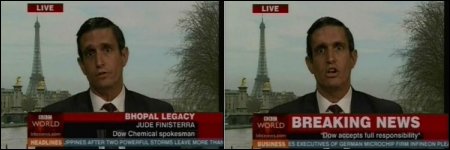
As for the BBC story, the news agency was apparently contacted by a "Mr. Finisterra," who claimed to speak for Dow Chemical and backed up his claim by referring the BBC to a fake website for Dow that "confirmed" his identity. He requested an interview on the anniversary of the Bhopal disaster (which occurred on December 3, 1984), promising to make a "significant announcement" on the show.
The announcement was that, Dow Chemical had decided to take full responsibility for Union Carbide's disaster and pay the families of the victims and the survivors of the tragedy $12 billion (about 25% of Dow's current market cap) in compensation for their losses. Here’s the Yes Men’s statement of what went on and how they pulled it off:
-
On November 29, an email comes in to DowEthics.com: BBC World Television wants a Dow representative to discuss the company's position on the 1984 Bhopal tragedy on this, its 20th anniversary.
Knowing Dow's history of gross negligence on this matter, we think it unlikely they will send a representative themselves—and if they do, he or she will likely only reiterate the old nonsense yet again, which will be depressing for all concerned. Yes, we'd better just do their PR for them.
Since we can't possibly afford to go to London with our pathetic American dollars, we ask to be booked in a studio in Paris, where Andy is living. No problem. Mr. Jude (patron saint of the impossible) Finisterra (earth's end) becomes Dow's official spokesperson.
What to do with the five or so minutes he'll be allotted? We briefly consider embodying the psychopathic monster that is Dow by explaining in frank terms how they (a) don't give a rat's ass about the people of Bhopal and (b) wouldn't do anything to help them even if they did. Which they don't. This would be familiar territory for Andy: he did something similar representing the WTO on CNBC's Marketwrap.
Instead we settle on having the impossible Jude announce a radical new direction for the company, one in which Dow takes full responsibility for the disaster. We will lay out a straightforward ethical path for Dow to follow to compensate the victims, clean up the plant site, and otherwise help make amends for the worst industrial disaster in history.
There are some risks to this approach. It could offer false hope to people who have suffered 20 years because of Dow and Union Carbide. But all hopes are false until they're realized, and what's an hour of false hope to 20 years of unrealized ones? If it works, this could focus a great deal of media attention on the issue, especially in the US, where the Bhopal anniversary has often gone completely unnoticed. Who knows—it could even somehow force Dow's hand.
After all, the real hoax here is Dow's claim that they can't do anything to help. They have conned the world into thinking they can't end the crisis, when in fact it would be quite simple. What would it cost to clean up the Bhopal plant site, which continues to poison the water people drink, causing an estimated one death per day?
We decide to show how another world is possible, and to direct any questions about false hopes for justice in Bhopal directly to Dow.
Another problem we anticipate is that this could result in some backlash for the BBC. This is bothersome, because they have covered Bhopal very well, infinitely better than what we're used to in the US. We would much rather hoax CBS, ABC, NBC, or Fox, but none of those could give that rat's ass about Bhopal, and so none of those has approached us.
In any case, it didn't seem to hurt CNBC when "Granwyth Hulatberi" appeared as WTO spokesperson. It was a simple mistake, and one that anyone could make. Intelligent people will not question the excellence of BBC's overall coverage because of an unavoidable error, especially if it is caught quickly and provides for some interesting discussion that wouldn't have happened otherwise.
Frankly, I think it’s a funny way to get Dow Chemical moving on the matter of Bhopal, but if it works, it’s certainly an interesting and gutsy tactic. We’ll see if the guy is prosecuted for stock manipulation though, as it caused quite a day of volatility and uproar with investors, as one might imagine.
- Arik
 "Competitive Intelligence applies the principles of competition and lessons of intelligence to the need for enterprise awareness and predictability of market risk and opportunity. CI has the power to transform an enterprise from also-ran into real winners with agility enough to create and maintain sustainable competitive advantage."
