December 03, 2004
Target vs. the Salvation Army: Consumer Backlash Coming?
 The Salvation Army, those humble bell-ringers of the holiday season, are no longer welcome outside Target stores this year. So, it would seem a consumer backlash is the least they might expect:
-
A backlash could be brewing against Target Corp. after it decided to ban Salvation Army bell-ringers and their red kettles from its store entrances this holiday season.
The company announced the decision months ago, but the criticism didn't start to mount until Salvation Army officials recently noted the problems it could cause to their fund raising plans, and shoppers noticed the bell ringers' absence.
The latest reaction has come from several national Christian groups, who are denouncing Target's decision.
"For Target to say that the Salvation Army is no longer welcome at the inn should send a message to Christians that perhaps they'd like to do their shopping elsewhere," said Robert Knight, a spokesman for Concerned Women of America, a Christian activist group that claims more than 500,000 members.
The issue dates to last January, when Minneapolis-based Target told the Salvation Army that it would no longer allow its kettles and bell-ringers outside Target's nearly 1,200 U.S. stores.
The Salvation Army has said it raised about $9 million last year from Target shoppers nationwide. But Target felt it no longer could make the Salvation Army the sole exception to a rule banning solicitation at its stores, spokeswoman Carolyn Brookter said.
"It's unfortunate that this is being looked at as something against the Salvation Army," she said. "That's not the way we intended it to be. It's really about us trying to make our policy consistent. We have always respected the Salvation Army's mission and their goals."
Also figuring in the decision, she said, was Target's desire to protect its customers from the potential discomfort of being asked for donations.
"Part of what we offer as a brand experience is a distraction-free shopping experience, and I think that's one reason people like to come here," Brookter said.
What Target is striving to avoid is the "gauntlet effect," said James Tenser, a retail consultant and author in Tucson, Ariz.
"Do you make some customers more comfortable by taking away this gauntlet effect?" Tenser said. "Or do you offend others by taking away from the Salvation Army's goals? They're in a tough spot."
The American Family Association, a Christian activist group based in Tupelo, Miss., this week sent an "action alert" to more than 2.2 million people on its mailing list, alerting them to Target's decision.
While not calling for a boycott of Target, the association asked its members to consider shopping at retailers that support the Salvation Army - such as Target's chief rival, Wal-Mart Stores Inc., which allows bell-ringers at its stores as an exception to its own no-solicitation policy.
"It's very discouraging when a multibillion-dollar organization with millions and millions of dollars of profit to be made won't give one month of their storefront to the Salvation Army," AFA spokesman Randy Sharp said.
Brookter said Target donates more than $100 million a year to charity and already contributes to the Salvation Army through the United Way.
In addition, Target is a member of the Salvation Army's Web shopping site, http: www.kettleshop.org, which generates donations to the Salvation Army based on purchases from participating retailers.
"In the end, we would still like to find a way where we can partner together, but it will have to be in a different manner," Brookter said. "We do that with other nonprofit organizations."
Brian LeVoir of Minneapolis is volunteering as a bell-ringer this year for the first time. A single parent of four boys, he said his sons all took part in recreation programs sponsored by the Salvation Army, and he wanted to give something back.
"The donations have been good," LeVoir said, ringing his bell outside a Cub Foods grocery store. "But I'm hearing a lot of hardhearted comments about Target."
It would seem Target just wants to be Scrooge this Christmas – maybe our humble bell-ringers will fare better over at Wal-Mart?
- Arik
December 02, 2004
Hardees Monster Thinkburger: Fast Food Luxury Differentiation = Five Bucks, 1400 Cals, 107 Grams Fat
 The Hardee's fast food chain has rolled out its new 1400 calorie Monster Thickburger, with 107 grams of fat. The sandwich boasts two one-third-pound slabs of beef, four strips of bacon, three slices of cheese, topped with mayonnaise on a buttered sesame seed bun.
The Monster Thickburger costs five dollars, 49 cents. Or for a little more than seven dollars, you can get fries and a soda. An executive says it's the burger that "everyone would like to get, but not the one you get all the time". Hmmm... I think it’s an interesting approach to competitive product differentiation myself – certainly appealing to the less-healthy customer, and bucking the trend (building a counter-trend?) toward healthier fare by competitors like McDonald’s and Subway, they’re carving out a niche to set themselves apart.
Though you won’t catch me eating one of these monsters, the company must feel secure enough that class action lawsuits by overweight Hardee's customers is probably an unlikely eventuality... even if it happened, they're certainly given everyone fair warning that this thing is just plain bad for you. Taking a page from the tobacco industry, they're declaring this the dietary equivalent of smoking a few packs of cigarettes a day.
- Arik
December 01, 2004
FedEx or H&R Block: Who’s More Embarrassed by “Jeopardy” All-Time Winningest Champ Ken Jennings Wrong Answer?
-
"There’s only one time FedEx has ever been the wrong answer," the ad’s copy opened in block lettering, set in bold for emphasis. Below that, the ad continued: "Congratulations Ken Jennings on your amazing Jeopardy! winning streak. And thanks for mentioning our name. Even if it was the one time you shouldn’t have."
Meanwhile, accounting giant H&R Block was quick to tap into Mr. Jennings’ marketing capital too, issuing a press release the day of the broadcast offering the fallen champion a "lifetime of free tax and financial services."
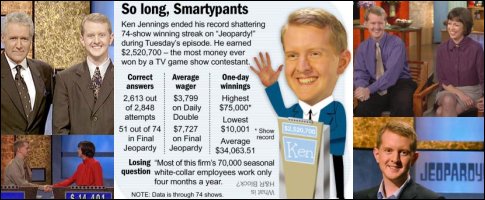
He accepted the tax advice offer and he'll need it: with 74 victories, Jennings walked away with $2,520,700 in cash, in what the syndicated TV show's distributors said was a record for the most money ever won on a television game show, as well as the most victories. That makes him the winningest winner of all time among game show contestants, eclipsing Michigan engineer Kevin Olmstead's previous record of $2.2 million won on "Who Wants To Be a Millionaire" as Jennings fascinated viewers by taking advantage of "Jeopardy!" dropping its long-standing rule requiring champions to depart after five straight wins.
Maybe there're financial rewards to an engineering career after all?
- Arik
November 29, 2004
Kryptonite: Tough World, Tough Luck - Company Drawn Asunder by Bic Ballpoint Pen
 On September 12, 2004, a forum poster at bikeforums.net noted that he could open his Kryptonite lock with a Bic pen. One day later, one of his fellow bikeforums.net forum members posts video of the lock being picked, verifying the claim. Just a few days after the initial forum post, the story leapt into the mainstream media with on September 23 in The New York Times, “The Pen is Mightier Than the Lock,” and only afterwards did the company finally post a statement on their Web site. By then, of course, it was too late - AP and dozens of other media outlets had picked up the scent and the product was ostensibly finished.
The bike-lock maker heard about the problem through an e-mail to its customer service department, but didn't issue a formal statement about the vulnerability until days later. By then, angry and confused customers were flooding the company with questions about their locks. "That was probably the most astounding thing - to see how rapidly this whole thing developed and moved around the world at an amazing speed," says Karen Rizzo, director of marketing at Kryptonite, a division of Ingersoll-Rand.
I learned of the situation myself just a few days ago from an interview with the technique's popularizer, Benjamin Running, in CSO Magazine online:
-
The first time Benjamin Running picked his $90 Kryptonite bike lock with a 10 cent ballpoint pen, it took a few minutes. But after 10 tries, he says, “I had it down to five seconds.” Running, a Brooklyn-based graphic designer, reported this astonishing discovery on his blog, Thirdrate.com. “Bike owners beware, that same bright yellow lock that once said, Don’t screw with me! now screams, Steal me!” Running wrote. He also linked to a video demonstrating how he penned his own lock. It was this video that turned Running into an internationally sought after “hacker.”
Could Kryptonite have avoided the situation? Unlikely – it’s a fundamental design flaw with unforeseen consequences of an innovative and curious guy trying something new. But, they certainly could've reacted more quickly, had they been monitoring the online discussion space. One thing's for sure: pride goes before the fall... nobody had the foresight to think of what might happen if their product is suddenly made useless. As the old CI saying goes, it's rarely direct competitors that jump up and put you out of business - it's usually a threat you'd never heard of.
- Arik
 "Competitive Intelligence applies the principles of competition and lessons of intelligence to the need for enterprise awareness and predictability of market risk and opportunity. CI has the power to transform an enterprise from also-ran into real winners with agility enough to create and maintain sustainable competitive advantage."
