September 11, 2004
Muzak: Elevator Music No More
-
Every day, Muzak is heard by 100 million people, the equivalent of more than a third of the U.S. population.
But if you're straining to remember the last time you heard sleep-inducing orchestrations of the Beatles played in an elevator or grocery-store frozen-food aisle, you have it all wrong. That was the old Muzak.
Today's Muzak is played in the Gap, McDonald's and Barnes & Noble and in homes via the Dish Network, to name a few. It sounds completely different, featuring combinations of upbeat, toe-tapping songs.
And there are words, real words sung by the artists themselves. Muzak has been doing that for decades. If it's a Beatles song, you'll actually hear Ringo, Paul, George and John. Unless, of course, it's a rendition sung by Tori Amos, Aerosmith or Nirvana.
It's, dare we say, hip?
"It's been one heck of a ride," says Alvin Collis, who is head of strategy and branding and joined Muzak 19 years ago. Collis, a thin 52-year-old wearing a dark T-shirt, pants and high-top sneakers, once played in a punk-rock band and admits to being fired as a child by his violin teacher. Not exactly how most people picture the typical Muzak employee.
Yet Collis is one of the people who has orchestrated Muzak's transformation into a much more modern company, an effort that officially began in 1997.
But Muzak's mission is still the same: provide music for offices, restaurants, retailers and other businesses to help maximize productivity, morale and sales. While the company has been successful in its 69 years — more than half of companies that play music play Muzak — it's still fighting the "elevator music" stigma. And Muzak officials have their sights set on the numerous businesses sitting in silence.
"If we have a problem, it's that we haven't told the story loud enough and clear enough," Collis says.
Muzak was founded by Gen. Owen Squier, who during the Great Depression patented the transmission of music over electricity lines. The name Muzak combines the word "music" with "Kodak," Squier's favorite company.
Squier introduced music into typing pools to help boost productivity. In the 1930s, as buildings grew taller and elevators became more prominent, Muzak was piped in to soothe the nerves of riders leery of the new contraptions. Thus, elevator music was born.
In the subsequent decades, Muzak spread into retailers, restaurants and other businesses countrywide. During Eisenhower's administration, Muzak was played in the White House. Astronauts even listened to Muzak in the Apollo lunar spacecraft.
Today, Muzak is a privately held company. The principal owner is ABRY Partners, a Boston-based media investment firm.
Muzak estimates it is heard in about 60% of the U.S. businesses that subscribe to music programming.
Many companies seek Muzak to customize their music, creating a personal soundtrack that can be heard only in their stores.
Moe's Southwest Grill is one of those firms. Not only does the Atlanta-based company want a soundtrack for its 133 casual restaurants to reflect its fun, upbeat style, it has another special request for Muzak: All of the artists must be dead.
"Our music is a tribute to the heroes of the days gone by, the legends who will never be able to enjoy Moe's food," says Carl Griffenkranz, head of marketing at Moe's. The music "creates an energy in our restaurant that we feel makes us successful."
On a recent visit to a Moe's in Charlotte, artists as diverse as Roy Orbison, Johnny Cash, Jimi Hendrix, Frank Sinatra and Marvin Gaye were heard. Griffenkranz says Ray Charles, who died in June, will be added soon.
Even though Muzak had evolved into a modern company, officials realized in the mid-1990s that to most people, Muzak was still, well, Muzak. And the company wasn't helping to change that image. Promotional materials were drab. There was no brand uniformity, be it the business cards or the 1,000 vans driven by technicians across the USA.
It became evident that a radical effort to better promote the brand was needed. Collis says it was a "necessity" from a personal level.
"People would ask, 'Where do you work?' and I wouldn't want to tell them," he says.
Collis, along with Kenny Kahn, head of products and marketing, went on a crusade, hiring a design firm to overhaul the Muzak brand.
A modern, simple logo — an encircled, rounded "M" — emerged, gracing updated business cards and vans. Edgy, oversize brochures were developed, featuring large lettering and examples of well-known, modern clients, with the words, "What does your business sound like?"
The company took its efforts to become modern to a new level at its headquarters, a futuristic-style building located just south of North Carolina's border near Charlotte. It built the 120,000-square-foot building four years ago, when the firm moved from Seattle, in part to take advantage of the South's lower operating costs.
"Once you decide to become a modern brand, you have to live that way," says Kahn, 42, a down-to-earth man who has been with the company seven years.
From the parking lot, visitors can immediately hear music. On a recent day, songs from the "New Grooves" program were being played, a combination of upbeat, jazzy music with a touch of Caribbean flair. It's hard not to bob your head a bit to the beat on your way to the door.
Kahn explains that the building was designed with an Italian city in mind. Near the entrance is the "city center," where employees hold spur-of-the-moment meetings and meet clients. Sometimes the entire staff greets potential clients. When the folks from Red Lobster restaurant came, staff members all wore Red Lobster bibs. Bowling lanes were set up for AMF Bowling Worldwide's visit.
Exposed wires snake across high ceilings, and the floor is solid concrete. There are no offices. Even the CEO doesn't have a door to close. Twenty-five conference rooms are sprinkled about, made of varying materials, including bamboo and plastic. Mailroom workers deliver packages riding an orange bicycle.
And although there is an elevator in the building, it does not have a speaker.
Everyone is dressed casually. On a recent hot day, employees were wearing shorts, jeans, T-shirts and flip-flops. There's not a tie in sight. Collis says employees often bring their families from out of town to see their workspace; he considers that a good sign.
As expected, music can be heard throughout the building. It's played fairly loudly — loudly enough that a visitor is always somewhat aware of what's playing, but somehow remains undistracted. It's a soundtrack to what seems like a fun place to work.
"There's a feeling here that doesn't exist in a lot of places. I see it. I feel it," says Lon Otremba, Muzak CEO for nine months now. He notes that when Muzak recently held a Saturday job fair to fill about 115 spots, 3,000 people showed up. Employees conducted interviews from 8 a.m. until past 10 p.m.
Otremba, 47, is quick to point out that the company is blessed with a long legacy. In its 69 years, Muzak has established itself in the business world. That's where being a household word pays off.
"We have a legacy on which to build; we don't have to create it," Otremba says. "The intention here is not to put a keg of dynamite under it and blow it up.
Yet Otremba knows firsthand there is a Muzak stigma. Last year, when he was wooed from America Online, where he was the executive vice president of the Interactive Marketing Group, the recruiter initially told him everything about the company except for one minor point: the name. She wanted him to listen without any prejudices about Muzak. It wasn't until he had all the information that she finally told him what the company was.
Otremba laughs at the story now, saying he would have considered the job anyway.
Going forward, Muzak will continue to work to fight the elevator-music label, Otremba says. It's taken years to get this far, he says, and it will take many more years to get where they want.
As part of that effort, last month the company unveiled a new Web site design at www.muzak.com, incorporating music, quickly moving pictures and lots of company information, including its seven-decade history.
Company leaders are setting their sights on expansion both in the USA and abroad, where they have 13 offices in places such as Japan, Canada, Mexico and the Netherlands. While they note that Muzak is by far the leader in its industry, many companies still do not subscribe to any music providers. Muzak doesn't plan to enter the consumer market to compete with firms such as XM Satellite Radio, instead choosing to focus on commercial clients.
The challenge is to convince companies that do not play music that life would be better with Muzak, a challenge Otremba says the company is finally ready to tackle.
"I believe we will rewrite the rules again," Otremba says.
- Arik
September 10, 2004
Neiman Marcus vs. Saks Fifth Avenue
 Is a complacent Neiman Marcus about to be schooled by a newly aggressive competitor in Saks Fifth Avenue, as each firm competes for dominion of the $62 billion luxury market?
-
Over the past decade, the Neiman Marcus Group has cornered the market on luxury goods, turning the business of selling expensive handbags, alligator pumps and Chanel suits into a fine art.
Now, its closest rival, Saks Fifth Avenue, which for years had been sidelined by poor management, is trying to make a comeback, setting the stage for a Gucciesque battle that could rock the fashion world.
The contest is poised to take on a uniquely personal twist, pitting two former colleagues — Burton Tansky, the CEO of Neiman Marcus, and Fred Wilson, who holds the corresponding position at Saks — against each other for command of the $62 billion luxury market.
The two men once worked side-by-side, as buyers in the early 1970s for Rike's, a Dayton, Ohio, department store that is part of the Federated Department Store chain.
The similarities end there.
Tansky, who at 66 is considered an elder statesman of the industry, has earned his fashion stripes many times over, first as president of Saks, then as CEO of the Neiman-owned Bergdorf Goodman store, and, now, as chief executive of the group, which includes the namesake department stores, an online business and the Kate Spade and Laura Mercier brands.
Known affectionately in the industry as a big teddy bear, Tansky has also drawn criticism from colleagues, who chastise him for a seeming complacency and old school ways, including a tendency to scold employees for spending too lavishly on lunch.
To his credit, Tansky has taken Neiman ever more upscale, making it the place to shop for the very wealthy, even as other department stores courted the middle market in the 1990s.
He is unapologetic about Neiman's exclusiveness, often remarking, "I like rich people."
Wilson, by contrast, eight years Tansky's junior, is more like a bulldog, compact and coiled with energy. Employees said he willingly throws out old ideas, and spends amply to make a statement, including a planned $150 million renovation of the Fifth Avenue flagship to be designed by Frank Gehry.
After toiling in relative obscurity for 19 years at DFS, the specialty retailing division of LVMH Moet Hennessy Louis Vuitton, Wilson only recently grabbed the attention of the fashion world when he was named CEO of Donna Karan International, another LVMH division, in 2002. He assumed his duties as CEO of Saks in January.
"There's a competitive rivalry that goes back to the days of Rike's," said one executive who knows both men. "Here they are 35 years later going head-to-head. It could be a war zone out there."
Tansky was unavailable to comment.
Wilson would say only that he is too focused on his company to worry about the competition.
Like good ambassadors, both Tansky and Wilson are scheduled to make selected appearances in the tents of Bryant Park for Fashion Week, helping to promote the image of their respective stores and confer with buyers.
Saks has been criticized in the past for lacking a specific viewpoint, a problem Wilson and his team have begun to address, sources said.
In a strategy that more closely mimics Neiman's approach, buyers now have the leeway to stock up on key looks, these people said. In the past, Saks buyers often acted more like accountants, using their spreadsheets rather than their instincts to make decisions.
Some apparel manufacturers said they are noticing a difference.
"I've seen a much more aggressive approach to the Saks Fifth Avenue buys," said Michelle Stein, senior vice president of sales and marketing for Aeffe USA, which sells clothes under the Moschino and Narciso Rodriguez names, among others.
Buoyed by a resurgence in luxury goods, Saks reported a 17.2 percent increase in sales at stores open at least a year in the most recent quarter. Neiman reported a 10.2 percent jump for the comparable period.
Still, observers like retail analyst Maggie Gilliam said the contest remains too close to call.
One major disadvantage facing Saks, observers said, is a sales staff that has become increasingly less service oriented over the years.
By contrast, sales people at Neiman are famed for their ability to woo customers, often calling them at home when new designer shipments arrive in stores.
Neiman executives, for their part, seem unfazed by the changes at Saks.
"Neiman executives think Saks is crazy, making big orders that they'll never sell," said one Neiman insider. "But they're making a mistake in not taking Saks seriously."
- Arik
September 09, 2004
Small ISPs vs. the FCC & Big Cable: In Broadband Era Cable Network Access is Fundamental to Survival
 Small ISPs just can’t buy a break like big cable companies can. The FCC came out in favor of protecting monopoly access to cable networks from what are sure to be deflationary competitive pressure from small ISPs that cannot otherwise provide non-DSL based broadband access to customers.
-
Small businesses looking for more broadband choices are unlikely to get help from the Bush administration, which is taking a hands-off approach to cable regulation.
Despite a federal appeals court ruling overturning their decision, federal regulators are continuing to push their edict that cable companies, unlike telephone companies, do not have to give rival ISPs access to their lines at regulated rates. Administration officials last week asked the U.S. Supreme Court to review the matter.
The case pits the Federal Communications Commission against ISPs that say requiring cable operators to share their lines—much the way telecommunications companies are required to lease lines to competitors at set rates—would result in increased build-out of cable networks and more choices for consumers.
SMBs (small and midsize businesses) and home offices typically have two choices for broadband: cable and DSL. But while DSL offers myriad choices among ISPs, with cable there is typically just one option—the cable provider.
If the government supported access to the cable network by independent ISPs, cable companies would have an incentive to build their networks into downtown business districts, said Mike Jackman, executive director of the California ISP Association, in Sacramento.
"If you plan on being in business in five years, you might want to have the option of having cable," Jackman said.
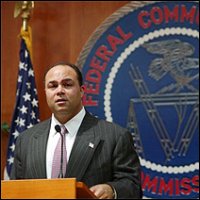
FCC Chairman Michael Powell, meanwhile, lauded the administration for backing the FCC and asking for a Supreme Court review, arguing that if the appeals court's decision isn't reversed, regulatory burdens imposed on traditional telephone companies will have to be applied to cable companies as well.
"This is about ensuring that high-speed Internet connections aren't treated like what they're not: telephones," Powell said. "A successful appeal of this case would ultimately mean lower prices and better service for American consumers."
Independent ISPs disagree.
"If [Powell] could name me an instance where you had more competitors and prices rose, I would be very interested," Jackman said. "There's no technological reason why customers who choose cable shouldn't have a selection among hundreds of ISPs."
Although independent ISPs overall do not have regulated access to cable networks, they consider the issue imperative in the larger matter of broadband competition.
"We're talking about a philosophical battle here," Jackman said. "Do we want true competition, or are we going to give the market to two or three companies?"
ISPs are also concerned that the Supreme Court's review of the case could affect other areas of the broadband service industry. Anticipating that Congress will review the Telecommunications Act of 1996 and that it will face intense lobbying pressure from incumbent phone companies, ISP associations across the country have formed the National Internet Alliance, which plans to debut officially next week.
As a VoIP user running over cable, I’d argue cable companies are very much becoming telcos… plus, after having started a small ISP in the late 1990’s (since spun off, after serving its intended purpose of providing my own company with high-speed Internet access, back in the days before DSL/Cable), I can tell you that ISPs without broadband are sitting ducks.
Finally, having had my office in the only Wisconsin county (Barron, in the west central part of the state) with more than one cable company, I can tell you they tend to sharpen their pencil when the monopoly goes away. Our rates were approximately half that of surrounding counties.
- Arik
September 08, 2004
Novell Reorganizes – Linux & Identity Markets Compact for Two Hybrid Divisions
-
Novell vice chairman Chris Stone on Monday sent staff members an e-mail informing them of the organizational changes. Stone said Novell's future success will be based on two key initiatives: the now-familiar Linux and open-source platforms and related services, and a series of strategic customer solutions based on identity management.
"These are both significant growth opportunities and markets where Novell already has substantial expertise and presence," Stone said in the memo. "In combination, these represent the core strategy of the company.
"In order to align Novell's product development efforts with our corporate strategy and go-to-market model, I am announcing some organizational changes, effective immediately."
Bruce Lowry, Novell's San Francisco-based director of public relations, on Monday confirmed the authenticity of the e-mail, telling eWEEK that Novell "is strategically aligned behind platforms and identity-driven solutions."
"These moves were designed to align product development behind these two major strategic goals," Lowry said.
There are currently four product business units at Waltham, Mass.-based Novell: Nterprise, Secure iServices, Resource Management and SuSE. These four are being morphed into "two major units focused on our two core strategies," Stone said, adding that Identity Services would combine the existing Resource Management and Secure iServices teams, while the Platform and Application Services would now be a combination of the existing Nterprise and SuSE units.
David Patrick will become general manager of the new product business unit for Linux, Open-Source Platforms and Services. Reporting to him will be Markus Rex, vice president for SuSE; Nat Friedman, vice president for the desktop; Angie Anderson, vice president of applications and services; Ed Anderson, vice president of product marketing; and Rob Kain, director of product management.
David Litwack will become general manager of the Identity-Based Solutions business unit, with the following people now reporting to him: Kent Erickson, vice president of identity-based solutions; Frank Auger, vice president of product management and marketing of identity-based solutions; Carlos Montero-Luque, vice president of resource management development; and Alan Murray, director of product management and marketing, resource management.
Stone ended his e-mail by telling Novell employees, "With everyone's help, this new alignment will help drive Novell toward its key strategic goals and future success."
With the formal reorg around the renewed Linux focus, the old saying appears to ring true: When you can’t beat ‘em, join ‘em.
- Arik
September 07, 2004
Quaker Drops Radcliffe After Poor Olympic Showing
-
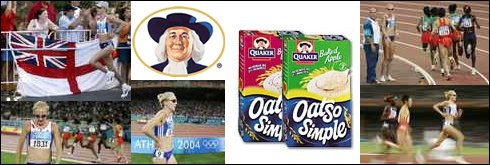
Paula Radcliffe has been dropped from an advertising campaign for porridge because she doesn't fit the advertising slogan.
The 30-year-old Olympic athlete was due to shoot a TV commercial for Quaker's Oatso Simple porridge this week, showing her winning a marathon after eating the cereal.
The advertising slogan was to read: "It helps you go the distance."
But Quaker has pulled out of the idea after Radcliffe's poor showing at the Athens Olympics where she failed to finish both the marathon and the 10,000m.
Radcliffe had been seen as the perfect celebrity to promote the cereal as she says porridge is her favourite pre-race meal, says the Mail on Sunday.
A source linked to the company said: "Although a contract was not in place, the whole advert had been verbally agreed between Paula's agent and Quaker, although it was made clear that it would only go ahead if Paula won the medal."
But agent Sian Masterson said the idea was scrapped because Quaker couldn't get the script approved by the Broadcast Advertising Clearance Centre, which pre-vets commercials, because it contravened regulations.
Radcliffe had been due to sign the contract once she returned from Athens.
Apparently, Quaker can’t go the distance either – except it takes a lot more guts to be the best long-distance runner in the world than it does the world’s greatest bowl of porridge…
- Arik
September 06, 2004
The History of Labor Day
 "Labor Day differs in every essential way from the other holidays of the year in any country," said Samuel Gompers, founder and longtime president of the American Federation of Labor. "All other holidays are in a more or less degree connected with conflicts and battles of man's prowess over man, of strife and discord for greed and power, of glories achieved by one nation over another. Labor Day...is devoted to no man, living or dead, to no sect, race, or nation." Labor Day, the first Monday in September, is a creation of the labor movement and is dedicated to the social and economic achievements of American workers. It constitutes a yearly national tribute to the contributions workers have made to the strength, prosperity, and well-being of our country. I got some background from the U.S. Dept. of Labor:
-
More than 100 years after the first Labor Day observance, there is still some doubt as to who first proposed the holiday for workers. Some records show that Peter J. McGuire, general secretary of the Brotherhood of Carpenters and Joiners and a co-founder of the American Federation of Labor, was first in suggesting a day to honor those "who from rude nature have delved and carved all the grandeur we behold."
But McGuire's place in Labor Day history has not gone unchallenged. Many believe that Matthew Maguire, a machinist, not Peter McGuire, founded the holiday. Recent research seems to support the contention that Matthew Maguire, later the secretary of Local 344 of the International Association of Machinists in Paterson, N.J., proposed the holiday in 1882 while serving as secretary of the Central Labor Union in New York. What is clear is that the Central Labor Union adopted a Labor Day proposal and appointed a committee to plan a demonstration and picnic.
The first Labor Day holiday was celebrated on Tuesday, Sept. 5, 1882, in New York City, in accordance with the plans of the Central Labor Union. The Central Labor Union held its second Labor Day holiday just a year later, on Sept. 5, 1883.
In 1884, the first Monday in September was selected as the holiday, as originally proposed, and the Central Labor Union urged similar organizations in other cities to follow the example of New York and celebrate a "workingmen's holiday" on that date. The idea spread with the growth of labor organizations, and in 1885 Labor Day was celebrated in many industrial centers of the country.
Through the years the nation gave increasing emphasis to Labor Day. The first governmental recognition came through municipal ordinances passed during 1885 and 1886. From them developed the movement to secure state legislation. The first state bill was introduced into the New York legislature, but the first to become law was passed by Oregon on Feb. 21, 1887. During the year four more states -- Colorado, Massachusetts, New Jersey, and New York -- created the Labor Day holiday by legislative enactment. By the end of the decade Connecticut, Nebraska, and Pennsylvania had followed suit. By 1894, 23 other states had adopted the holiday in honor of workers, and on June 28 of that year, Congress passed an act making the first Monday in September of each year a legal holiday in the District of Columbia and the territories.
The form that the observance and celebration of Labor Day should take were outlined in the first proposal of the holiday -- a street parade to exhibit to the public "the strength and esprit de corps of the trade and labor organizations" of the community, followed by a festival for the recreation and amusement of the workers and their families. This became the pattern for the celebrations of Labor Day. Speeches by prominent men and women were introduced later, as more emphasis was placed upon the economic and civic significance of the holiday. Still later, by a resolution of the American Federation of Labor convention of 1909, the Sunday preceding Labor Day was adopted as Labor Sunday and dedicated to the spiritual and educational aspects of the labor movement.
The character of the Labor Day celebration has undergone a change in recent years, especially in large industrial centers where mass displays and huge parades have proved a problem. This change, however, is more a shift in emphasis and medium of expression. Labor Day addresses by leading union officials, industrialists, educators, clerics and government officials are given wide coverage in newspapers, radio and television.
The vital force of labor added materially to the highest standard of living and the greatest production the world has ever known and has brought us closer to the realization of our traditional ideals of economic and political democracy. It is appropriate, therefore, that the nation pay tribute on Labor Day to the creator of so much of the nation's strength, freedom, and leadership -- the American worker.
Which makes it all the more ironic that the Bush administration’s Secretary of Labor decided to cut overtime pay for millions of Americans…
- Arik
September 05, 2004
InBev: Belgium's Interbrew Acquisition of Brazil’s AmBev Surpasses Anheuser-Busch to Become World’s Largest Beer Maker
-
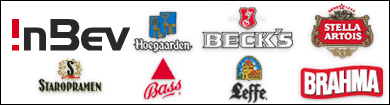
Shareholders voted in favor of the deal at an extraordinary meeting in Brussels, bringing Interbrew one step closer to creating a global behemoth with brands such as Stella Artois, Bass, Beck's, Brahma, Rolling Rock and Skol.
Interbrew shareholders approved the first in a series of resolutions enabling the deal, allowing Interbrew to give AmBev's controlling shareholders 141.7 million shares in the new company in return for their stake in the Brazilian brewer.
The deal, valued at about 8 billion euros ($9.66 billion), will close once AmBev shareholders give it their blessing at a meeting in Sao Paulo.
"The transaction creates a global platform for the combined group to develop its three global flagship brands, Brahma, a top-ten brand worldwide, and what we believe are the two fastest growing international brands, Stella Artois and Beck's,'' Interbrew said in a statement.
The deal allows Interbrew access to Latin America, where it had scant presence in the past. AmBev gains the opportunity to expand outside of the Americas.
European regulators have already approved the deal.
Although Brazil's main Cade anti-trust watchdog has yet to rule on it, its head has said it appeared to pose no competitive threat to rivals.
The approval was expected given that the controlling shareholders of Interbrew and AmBev created with the deal.
They will remain firmly in control of the new company and have equal representation on its 14-member board.
The free float, however, will fall to 26.2 percent from Interbrew's 35 percent and 23 percent at AmBev, also known as Companhia de Bebidas das Americas.
Interbrew Chief Executive John Brock will take on the same job at the new company, to be based in Leuven, Belgium, Interbrew's current headquarters.
Interbrew expects 280 million euros of annual cost savings.
Despite initial skepticism, investors have warmed to the deal, pushing Interbrew shares nearly 10 percent higher since the deal was first announced in March.
AmBev's preferred shares have slumped about 18 percent since early March but its common, or voting stock, has gained some 66 percent over the period.
Interbrew has said it would consider listing the new company on New York Stock Exchange in the next two years.
With the next six months, Interbrew will make a tender offer for AmBev's remaining voting shares at a cost of up to 1.4 billion euros.
Brazilian regulators recently rejected a request by the country's largest pension fund to determine whether the deal would hurt minority shareholders.
- Arik
 "Competitive Intelligence applies the principles of competition and lessons of intelligence to the need for enterprise awareness and predictability of market risk and opportunity. CI has the power to transform an enterprise from also-ran into real winners with agility enough to create and maintain sustainable competitive advantage."
