September 18, 2004
JPMorgan Chase & IBM’s $5 Billion Shrug: Palmisano’s Strategic Collapse or Really No Big Deal?
Back in December 2002, when the financial services company announced the seven-year, $5 billion deal to outsource much of its data processing to the world's largest computer company both companies bragged that the contract - the largest of its kind for IBM - would reduce costs, create value and propel innovation at J.P. Morgan. Today, both companies are downplaying the termination.
IBM put a positive spin on the cancellation, stating that it would actually help its 2005 earnings. JPMorgan Chase likewise said the cancellation would have no material impact on its business. The bank noted that IBM remains a key technology partner and provides IT services and products to a number of its businesses. The functions to be reintegrated back into the bank cited by the two are "the previously outsourced portions of its technology infrastructure, including data centers, help desks, distributed computing, data networks and voice networks." IBM said the cancellation could improve earnings because it was still in the early stages of deployment on the contract. It also said its backlog of services will be revised when it announces its third-quarter earnings. IBM estimated a $118 billion services backlog at the end of the second quarter.
Fewer all-encompassing technology services deals are expected in coming years as competition pushes down the size of these agreements, and customers consider doing more themselves. In turn, services providers like IBM are looking to sign more pacts for individual projects like software or data.
Bank One decided to bring its information technology in-house several years ago and has spent over $1 billion to upgrade its entire technology suite, including building data centers. This philosophy has now taken hold at J.P. Morgan.
Plus, this week JPMorgan's president and chief operating officer, Jamie Dimon, announced the opening of two new data centers in Delaware. The $300 million investment will add 100 jobs and support the bank's national network.
Here's an excerpt with some further detail:
-
Executives at IBM Global Services must have cringed earlier this year upon hearing that J.P. Morgan Chase had tapped Jamie Dimon as its president and chief operating officer. As CEO of Bank One Corp., Dimon scrapped a $2 billion IT outsourcing contract the bank had inked with IBM and AT&T in 1998 under a much-ballyhooed "Technology One" alliance.
Dimon canceled that deal in 2002. Now, he appears to have done it to IBM again.
Industry watchers see Dimon's fingerprints on Chase's decision, announced Wednesday, to cancel the company's $5 billion, 10-year "business-transformation-outsourcing" contract it signed with IBM in late 2002. "After the Bank One experience, he's become a big believer in doing things in-house," an analyst says.
Indeed, Dimon publicly said in 2002 that Bank One's outsourcing experience "hadn't worked out" and that henceforth it needed to "control its own destiny." Dimon joined Chase as a result of its merger with Bank One, which was completed in July.
In a Chase press release issued Wednesday, a statement attributed to CIO Austin Adams uses language similar to Dimon's to explain why Chase nixed its outsourcing contract. "We believe that managing our own technology is best for the long-term growth and success of our company," Adams said in the statement.
Chase says it plans to reel in the 4,000 IT workers it dispatched to IBM under the defunct deal and take back a number of ongoing IT projects.
For its part, IBM is looking to put a positive spin on the news, noting that the contract required substantial up-front investments that would have placed a slight drag on its earnings this year. However, $5 billion in revenue isn't easy to make up. One Wall Street watcher says the loss of the contract should cost IBM about 2 cents per share in annual earnings over what would have been its remaining years. The analyst notes that IBM will enjoy some fees that Chase will be obliged to pay as a result of its decision to cancel the deal.
JPMorgan Chase wanted to get the most out of its newly acquired Bank One assets as well:
-
Spokesmen say the move actually was based on a desire to make full use of IT assets and processes the company acquired through its July merger with Bank One, which "really changed the equation" in terms of effective IT use, says executive VP Charles Costa.
The financial-services company will have access to a state-of-the-art data center that Bank One opened in Wilmington, Delaware, last week at a cost of $150 million, says Costa, J.P. Morgan Chase's executive VP for global technology infrastructure. Among other things, the building features dedicated fiber-optic lines and new server and storage systems. "This didn't exist for us" when J.P. Morgan Chase struck its outsourcing deal with IBM in 2002, Costa says, adding that the company is better served assimilating Bank One's advanced IT assets than turning them over to IBM to manage.
Bank One's IT capabilities also will help J.P. Morgan Chase meet tech-driven business requirements, such as the Check 21 initiative that lets banks process checks using graphic images instead of paper. "That's a big priority that we need to be well positioned for," Costa says. Last year, Bank One rolled out a system that converts consumer checks into electronic debits for next-day settlements using high-speed imaging.
Bank One recently completed a $500 million initiative to standardize and centralize its IT systems, an effort that's expected to shave $200 million from its annual operating costs by, among other things, eliminating 600 software applications and reducing 11 loan systems to six. "The merger really changed the equation, and Bank One's technology infrastructure is a key part of that," Costa says.
In my opinion the deal's falling apart is really a philosophical shift more than anything and this is somewhat of a blow to IBM's grand corporate strategy of providing technology services to companies large and small around the globe. The 2002 contract was the centerpiece of IBM's transformation from a technology manufacturer to a technology manager, a strategy devised and overseen by the chief executive, Sam Palmisano. The contract with JPMorgan was among the largest such outsourcing contracts ever signed; only a $6.9 billion deal won by Electronic Data Systems to manage information technology for the U.S. Navy was larger. Trying to put the contract loss in the best possible light for IBM is still tough. "The combined firm found itself with an abundance of IT assets," an IBM spokesman, James Sciales, said. "This decision was like other business decisions related to the merger."
The announcement makes me (and much more influential analysts) wonder whether IBM's technology outsourcing strategy - its response to what it calls the on-demand era - is as promising or as profitable as the company has led investors to believe.
"This was Palmisano's grand vision, and this was the reference account," said Fred Hickey, editor of The High-Tech Strategist, an investment newsletter in Nashua, New Hampshire. "This whole on-demand strategy kicked off just a couple of years ago was predicated on these kinds of large accounts they were going to win. Now, not very long after starting it, they're pulling it back. You have to question whether this strategy is going to be successful or if services will be, as Sun's Scott McNealy says, the graveyard for old tech companies that can't compete."
There is no denying that IBM's future is heavily reliant on success in Global Services. Revenue from that unit now accounts for half of IBM's sales, which totaled $89 billion in 2003. Hardware revenue was roughly a third of the company's total sales in the first half of 2004, reflecting IBM's recent exit from the disk drive, consumer PC, semiconductor and chip-packaging businesses and software sales accounted for just 15 percent of revenue.
However, after IBM's decade-long push into services, revenue growth in the unit is slowing and services revenue rose only 2 percent in the second quarter of 2004, compared with the prior year's revenue growth of 9.3 percent.
Indeed, throughout 2003, Global Services provided the only bright spot for IBM in revenue growth, after software sales rose only 1.9 percent last year and hardware, financing and enterprise investments all declined. While services dominate IBM's revenue, gross profit margins in the business - at 25 percent in the second quarter - are the lowest at the company.
Sciales said that the cancellation of the deal has not caused great concern at the company over its on-demand strategy, but IBM is not the only company that has encountered problems with long-term contracts. EDS, its chief rival in this business, has struggled with some of its largest contracts and Cap Gemini, a competitor in Europe, has also had some big problems.
Long-term contracts like these are almost impossible for investors to assess for profitability because, under accounting rules, the companies devising the contracts have wide license in the expenses they can assign to the business during a given period. If expenses are underestimated, the contracts look a lot more profitable than they really are.
The final contradiction cannot be avoided… to paraphrase one analyst, IBM has been touting its on-demand strategy and how great their backlog is as a result, but if losing this contract is a good thing, how can getting more of these contracts also be a good thing?
- Arik
September 17, 2004
Sony Beats Time Warner to Take Home MGM
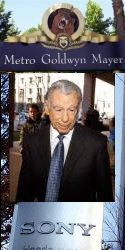 The consortium led by Sony has reached a tentative agreement to buy Metro-Goldwyn-Mayer for about $4.8 billion in cash, snatching it from Time Warner’s clutches at the last moment. The past couple of years, MGM has been hunting for ways to get bigger having made an $11.5 billion all-cash bid for Vivendi Universal Entertainment last year, losing to NBC.
Time Warner had been seen as the front-runner to acquire MGM but Sony raised its offer, setting off a bidding war that Time Warner decided it didn’t want to participate in. "As we pledged to our shareholders, we approach every potential acquisition with strict financial discipline," said Time Warner chairman and CEO Dick Parsons. "Unfortunately, Time Warner could not reach agreement with MGM at a price that would have represented a prudent use of our growing financial capacity."
Sony is expected to shutter MGM's current production, with the likely exception of the "James Bond" franchises. Among MGM's upcoming films are a "Pink Panther" remake with Steve Martin, "Code 46" with Tim Robbins and "The Beauty Shop" with Queen Latifah. MGM has a considerable library of thousands of titles, including the "Rocky" franchise. Analysts have estimated MGM's library will generate $440 million in cash flow in 2004 by exploiting only 1,500, or about 36 percent, of its titles on the newer DVD format. Sony announced a future partnership with cable provider Comcast to establish a video-on-demand content channel with Sony Pictures content along with MGM content and Comcast is may become a minority equity investor in the acquisition. The deals, should they occur, would constitute a major consolidation of content production and distribution. Here's some detail:
-
The deal, which ends an auction that was filled with behind-the-scenes machinations for months, included one last surprise twist: Comcast, the cable giant, joined Sony's consortium as a strategic partner and a possible investor.
The Sony-led group, which includes the buyout firms Providence Equity Partners, Texas Pacific Group and DLJ Merchant Banking Partners, struck the deal with MGM on Monday, just 24 hours before the studio had scheduled a board meeting to approve a deal with Time Warner.
If the transaction is completed, it would be the third time that Kirk Kerkorian, MGM's controlling shareholder, would have sold the company since he first acquired shares in it in 1969.
The deal caps a come-from-behind story for Sony, which originally bid for MGM in April but was unable to complete the deal after becoming bogged down in negotiations with its backers, opening the field to a rival offer from Time Warner.
With the last-minute addition of Comcast to the Sony-led consortium -- a pact that was negotiated over Labor Day weekend in Martha's Vineyard, where executives from Sony and the other investors converged on the summer house of Brian Roberts, Comcast's chairman -- the group decided to raise its bid to $12 per share from $11.23 and to sweeten its offer by offering a nonrefundable $150 million deposit. Time Warner had offered $11 per share and had guaranteed the deal's completion.
The Sony-led group could justify the higher bid because part of its deal with Comcast calls for the creation of several new premium cable channels that will broadcast both Sony and MGM movies, adding revenue for the company.
For Comcast, its participation came with some reluctance. Having lost its hostile bid for the Walt Disney Co. and been derided by investors for even making the offer, Roberts was wary about being part of another potentially unsuccessful bid for a content provider, executives close to the negotiations said. Indeed, he was so insistent about not being on the losing team that he signed onto the deal only as a programming and distribution partner. He indicated to the group that Comcast would become an investor only after the deal is completed. To keep Comcast's role in the deal secret, MGM and even bankers for the Sony-led group were kept in the dark until the very last moment.
Time Warner pulled its offer off the table and decided against a higher bid when it learned early Monday that the Sony-led group appeared to be the winner.
"Although MGM is a valuable asset, we have decided to withdraw our bid," Richard Parsons, Time Warner's chairman and chief executive, said in a statement. "Unfortunately, Time Warner could not reach agreement with MGM at a price that would have represented a prudent use of our growing financial capacity."
While MGM may be famous for making films like "The Wizard of Oz," under the plan being developed by the Sony-led group, most of the movie studio operation would be shut down. Sony would license and distribute MGM's most valuable asset, its library of more than 4,000 films. Only the studio's best- known film series, like James Bond, would continue to be produced under the MGM brand through Sony.
In recent years, Alex Yemenidjian, MGM's chief executive, turned the company around by focusing on its library while shrinking its studio business. As a result of those moves, the company produces an enormous amount of free cash flow compared with its rivals. The company forecasts $150 million to $200 million in free cash flow for 2004.
The arrangement with the consortium was originally conceived and structured by Sony, which already owns the Columbia and TriStar studios, so that it could gain access to MGM's library without having to pay the entire bill and take on additional debt, a requirement of its Japanese parent. MGM's library of films will not only give Sony additional revenue from next- generation DVDs, but also give it added weight in the looming fight over technology standards for those DVDs.
Despite nearly five months of back and forth inside the Sony-led group, the bid was kept alive by Jonathan Nelson, the co-founder of Providence Equity, and Robert Wiesenthal, Sony's executive vice president and chief financial officer, according to participants.
Under the terms still being negotiated, Providence has committed to invest the most money with $450 million. Sony and Texas Pacific Group -- based in Fort Worth with a regional office in San Francisco -- will each invest about $300 million, as will Comcast if the deal is completed. DLJ Merchant Banking Partners, a unit of Credit Suisse First Boston, will invest about $250 million. J.P. Morgan Chase will finance the deal with a $4 billion loan. Quadrangle Partners has been invited to become an investor, the executives said, but has yet to make a commitment.
- Arik
September 16, 2004
Oprah & Pontiac: Over the Top Product Placement and a 276-Car Giveaway
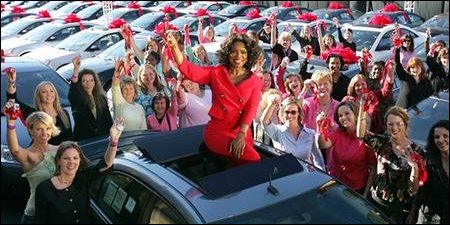
Winfrey spent about half of the show on the Pontiacs - including a taped visit to the factory where they were made - and the giveaway was featured all over the media. Mary Kubitskey, Pontiac's advertising manager, said the company was looking to reach women, who are Winfrey's primary audience.
The company approached Winfrey about doing a giveaway, but the event grew in scope - and Pontiac decided to gamble by spending a chunk of what would have been used on traditional advertising, Kubitskey said. "Quite frankly, we have a car no one has ever heard of. We knew we had to go really big, and she was the holy grail for us," Kubitskey said.
Winfrey's influence with consumers is well documented. When she launched a book club, its selections were virtually guaranteed a spot on bestseller lists. Her personal trainer, Bob Greene, has his own endorsement deals, and her protege, Dr. Phil McGraw, launched his own successful talk show. Winfrey's annual "My Favorite Things" episode - when she distributes bags of goodies to her audience - inspires such hysteria in the crowd that it spawned a spoof on "Saturday Night Live."
"We're calling this our wildest dream season, because this year on the Oprah show, no dream is too wild, no surprise too impossible to pull off," Winfrey said. Making sure the audience was kept in suspense, Winfrey opened the show by calling 11 audience members onto the stage. She gave each of them a car - a Pontiac G6. She then had gift boxes distributed to the rest of the audience and said one of the boxes contained keys to a twelfth car. But when the audience members opened the boxes, each had a set of keys.
"Everybody gets a car! Everybody gets a car! Everybody gets a car!" Winfrey yelled as she jumped up and down on the stage. The audience members screamed, cried and hugged each other - then followed Winfrey out to the parking lot of her Harpo Studios to see their Pontiacs, all decorated with giant red bows.
One woman stepped up onto the frame of a driver's side door, put her head on the roof and hugged the vehicle. Winfrey said the audience members were chosen because their friends or family had written to the show about their need for a new car. One woman's young son said she drove a car that "looks like she got into a gunfight"; another couple had almost 400,000 miles on their two vehicles.
The real question is, did it work?
Web sites operated by Pontiac and Oprah have reaped the benefits of the giveaway with a "massive" increase in website traffic. Web searches for "Oprah" and/or "Pontiac" increased 1000%. Visits to both websites peaked on Tuesday, with the Oprah website seeing an increase of 864% (over 600,000 visitors) and the Pontiac website seeing an increase of 636% (over 140,000 visitors). Visits from the workplace jumped for both sites, with Oprah's site seeing 60% of its visits from people at work (it usually gets 50%) and Pontiac getting 70% (up from 50%).
According to comScore Networks, visits to Pontiac.com increased by 322 percent over the average of the previous four days with about 85,000 logging on to the site that day. Tuesday was even better when around 141,000 visitors browsed Pontiac.com that day, an increase of 636 percent. Visitors dropped in the following days but were still well above pre-stunt averages, at 76,000 on Wednesday, 74,000 on Thursday and 69,000 on Friday. The previous Friday, the site had drawn 33,000 visitors.
The Pontiac stunt illustrates the lengths innovative marketers will go to in order to break through the ad clutter, and nowhere is the competition to do more intense than among domestic automakers.
The estimated value of the 276 new Pontiac G6s given away on Monday’s "Oprah" is $7.7 million. GM retails the cars for $28,000 each and says the expense of the donation was the equivalent of 50 ads on primetime television. A 30-second ad on Oprah typically costs about $75,000.
The promotion was also the best free publicity "Oprah" could ask for, icing on the cake after posting the highest rating for a season premiere since 1996. The episode earned a 10.1 national rating and also helped boost traffic to Oprah.com as well. That Monday, Oprah.com attracted 346,000 visitors, 551 percent higher than the average of the previous four corresponding days. Tuesday was even better for the site, with 634,000 visitors logging on. Traffic then eased but remained well above pre-giveaway levels, dropping to 290,000 on Wednesday, 244,000 on Thursday and 201,000 on Friday. That was still 259 percent higher than the day before the Pontiac giveaway, when the site attracted 56,000 visitors.
- Arik
September 15, 2004
Dark Skies: US Airways Skips Pension Payment as Escape Looks Less Likely
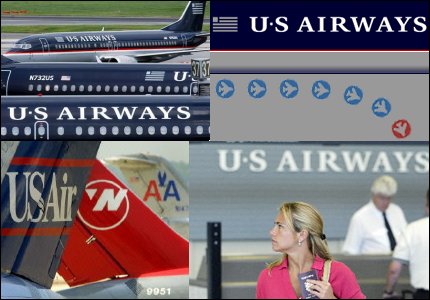
-
The decision to miss the payment to pension plans covering mechanics and flight attendants gives the airline financial breathing room but the judge presiding over the case said he would hold a hearing on the matter Oct. 7.
The No. 7 U.S. airline, which filed for its second bankruptcy in as many years on Sunday, did get permission on Monday to continue operating using a loan it secured last year with the help of a guarantee from the federal Air Transportation Stabilization Board.
The company, which negotiated new relief from the loan board, still owes more than $700 million to the government.
US Airways aims to cut costs in a bid to become more like the discount airlines that threaten its survival, but analysts said the job would be difficult without additional financing.
"With no (debtor-in-possession financing) and with no serious prospect for an equity investor injecting cash into the carrier, you'll need to see a radically different cost structure in place by 2005," said William Warlick, senior credit analyst for Fitch Ratings.
When a company goes bankrupt, its debt ratings shift to default and its stock usually sinks as investors expect shares to be worthless by the end of the bankruptcy process.
US Airways said current management had no plans to liquidate the carrier. "This management team isn't here to preside over a liquidation," US Airways chief bankruptcy lawyer Brian Leitch told the court.
"There is no reason in the world that the plan cannot be successful. We won't ask for unrealistically low costs," Leitch added.
US Airways has said it must cut costs by $1.5 billion -- $800 million of which it hopes to get from labor unions that yielded nearly $2 billion to help the company out of its first bankruptcy.
"We're still talking, we talk every day, we're still working very hard," Chief Executive Bruce Lakefield told reporters outside court about thus-far-unsuccessful efforts to win givebacks from the airline's unions.
US Airways did not rule out the possibility that labor contracts and pension agreements could be rescinded if the talks fail, but the court would have to agree.
US Airways is arguing its case before the same judge, Stephen Mitchell, who approved its initial restructuring in March 2003.
The company told Mitchell it also cannot pay $19 million it owes to its pilots' retirement plan. The previous plan for pilots was terminated during the company's first bankruptcy and replaced with a cheaper plan.
Soaring fuel costs, $300 million higher than expected at US Airways -- and weak sales amid competition from low-cost rivals like Southwest Airlines are at the root of US Airways' problems.
US Airways was the first big U.S. carrier to enter bankruptcy during the industry's worst downturn, accelerated by the Sept. 11, 2001, hijack attacks. It filed its first bankruptcy in August 2002, followed months later by No. 2 United Airlines, which is still in Chapter 11.
Delta Air Lines, the No. 3 U.S. carrier, is fighting to avert a filing.
While Lakefield said discussions with the unions on possible concessions continue, labor groups said the company's plan to skip pension payments could complicate negotiations on concessions.
"US Airways management has thus far demonstrated an overwhelming inability to look beyond labor costs for any means to replenish falling revenues," said Randy Canale, president of the US Airways unit of the International Association of Machinists.
However, the company's financial problems are so daunting that industry experts agree with the company that labor must concede givebacks.
"These workers have chosen not to (take paycuts) voluntarily, so it will be imposed upon them," said Gary Hindes, managing director at Deltec Asset Management where he runs a distressed securities fund. "US Air probably is a goner."
The company listed assets of about $8.8 billion and liabilities of $8.7 billion. It has about $1.45 billion in cash.
Pension fund Retirement Systems of Alabama, which invested $240 million during the last bankruptcy, owns 36 percent of US Airways. The pilots' union, the Air Line Pilots Association, holds a 19 percent stake.
The U.S. government, through its loan guarantee, holds 10 percent. General Electric Co., a supplier of regional jet financing, owns 5 percent.
Despite the dark clouds hanging over the airline, we have to ask ourselves if there’s any way to save the other five of the six majors? To do that, we have to ask why so many airlines are struggling right now. I found a great article on NYTimes.com about it:
-
High fuel prices and the post-9/11 slump have taken a toll, to be sure. But many in the industry - including some of the major-airline executives themselves - say the traditional airlines are finally being brought low by a more fundamental problem of their own creation, one that has been building up for years.
Simply put, they have taught their customers to resent them, and to resist paying the fares they need to make a profit.
"People's expectations for airline service are pretty low," said Peter Cappelli, professor of management at the Wharton School of Business. The situation is so dismal that "things could deteriorate another 20 percent and I'm not sure you could calibrate the difference," he said.
Year after year, under chronic financial pressure, the traditional airlines have made flying less comfortable and less convenient for most passengers. In addition to the cramped seats on crowded planes, with cutbacks or extra charges on nearly ever facet of service from the food to baggage allowances, travelers navigate complicated fare systems that still exact sky-high "full" prices from some passengers while dangling ever-changing discounts before others. These systems, intended to reap as much revenue as possible while still filling the plane, have left consumers feeling that there is no such thing as a fair price for air travel and have encouraged them to game the system.
On top of that, the airlines have added one restriction after another to their tickets in recent years, making it expensive or impossible for passengers to change their travel plans after booking. The chief consolation offered for all these irritations - frequent-flier miles - have been drained of value as the airlines make redemption harder by limiting the available dates and seats.
And in recent months, several of the major airlines have begun charging a $5 fee to buy tickets over the phone and $10 to buy them at an airport counter, where "How can I help you?" used to be free.
Even the airlines' "hub and spoke" route systems became a nuisance for many passengers. Though they brought new air service to many smaller cities, they forced harried throngs of passengers to make connections in crowded hub airports to get where they wanted to go, rather than be able to fly nonstop. Meanwhile, the major airlines set a trap for themselves in the 1990's, when the long economic boom produced some fat years that many executives thought would go on indefinitely.
In an industry already famed for high pay and lavish benefits, companies locked in high, hard-to-cut costs with union contracts that were the envy of the labor movement. The airlines could afford those costs only as long as the public was willing to pay high fares for their reputation and service.
The rapid growth of discount airlines like Southwest and JetBlue, with their bare-bones service and lack of pretensions, shows what many passengers think of that proposition now.
These airlines, which have never held themselves out as anything more than a way to get from here to there, can charge much less than the old majors and still make money because they have avoided the big airlines' big mistakes.
The low-fare airlines' operations are simpler and leaner; their labor costs are much lower; they do not have the financial burden of pension obligations to thousands of retired workers, a major expense for the older carriers; and crucially, they have not annoyed their customers nearly as much.
On the low-fare carriers, passengers are not pampered, but they do not expect to be. People who might be disappointed with the quality of a United meal - or resent being forced to pay extra for one on a Ted flight - do not seem to mind when Southwest gives them just a drink and a bag of peanuts, because that is all Southwest has ever promised them.
While a segment of the market is still willing to pay premium prices for a substantially higher standard of service, it exists now mostly on long-haul and international routes. Flights of just a few hours have become a commodity bought strictly on price, and the market won't bear the fares that the big airlines need to cover their costs. So, in their current form, these companies are not viable any more. The question for the traditional carriers now is whether they can transform themselves into something like the low-fare carriers, or find niches where they can still thrive.
US Airways and Delta have each said in recent weeks that they would drop hubs and eliminate thousands of jobs in an effort to rein in costs. Each hopes to make its operations more like their low-fare rivals. But those hopes depend on the willingness of their workers to accept new cuts in pay and benefits, and investors to pump in more money.
Once the public would have had an emotional investment in the fates of storied names like Delta and United: witness the anguished reaction to Pan Am's closure in 1991. But not now.
There was some sympathy for the airlines in the dark days after Sept. 11, but despite the bailout that Congress approved after the attacks, the industry is still in turmoil, and the continuing drumbeat of bad news has had a numbing effect on customers.
- Arik
September 14, 2004
Packer’s Best Carolina 24-14 in Season Opener
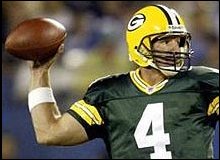 In what was a fun season opener, our beloved Green Bay Packers saw in Brett Favre’s rusty start to his last Monday Night Football appearance an upset as the Packer’s beat the defending NFC champion Panthers on their home turf.
-
The Green Bay Packers dealt the Carolina Panthers the kind of defeat now familiar to Super Bowl losers.
Ahman Green ran up, down and all over the defending NFC champion Panthers, scoring three touchdowns to lead Green Bay to a 24-14 victory Monday night. That made Carolina the sixth straight team to lose in the Super Bowl and drop its ensuing season opener.
"I was surprised at how well we ran the ball," quarterback Brett Favre said. "Our philosophy is we'll wear you down before you wear us down."
The Packers could have had that chance in January, if not for Favre's errant final pass on his first snap in overtime of the divisional playoffs. The pass was intercepted and set up Philadelphia's winning field goal.
Carolina then beat the Eagles to advance to the first Super Bowl in team history.
But the Panthers looked nothing like that team on Monday night.
As Favre said before the game, anything less than the Super Bowl this season is a failure. We’ll see how they do at home against Chicago’s Bears this Sunday… if they get too cocky (i.e., fall victim to forced turnovers) they’re liable to lose.
- Arik
September 13, 2004
Home Depot Opens World’s Largest Home Improvement Store in Manhattan
 The Home Depot had a "board-cutting" ceremony last Friday morning at the new Manhattan location marking the opening of the world's largest home improvement store boasting 105,000 square feet of sales space and merchandise. The multi-level store employs 300 associates, including a full-time concierge and is located at 23rd Street between Fifth and Sixth Avenues. The Home Depot's chairman, president and CEO, Bob Nardelli, said, "Our new Manhattan location is a retail marvel and proof positive that The Home Depot continues to break the mold in how we approach new formats, new markets and new customers."
-
The company will be playing to a more urban crowd at the 105,000-square foot space in Chelsea, an area that already boasts mega-stores like Staples, Best Buy and Bed Bath & Beyond.
Home Depot's first Manhattan store, which opens to the public on Friday, will have a doorman for help in hailing cabs and a concierge to offer information and schedule appointments with designers. It promises same-day delivery of most merchandise, a boon for public transportation-bound urbanites.
"Manhattan is unique, and it has a tremendous customer base opportunity," Robert Nardelli, the company's chairman, chief executive and president said at the store's grand opening on Thursday. "We're confident that with success here, it will give us the opportunity to continue to expand our business."
The store, located on 23rd Street between Fifth and Sixth Avenues in Manhattan, announces itself with orange banners on its facade and features a more classic, homey interior, with white columns and an atrium.
The company says that it has transformed the store for the urban audience through months of working with focus groups and doing customer research.
The store will focus on the upscale, fashionable home items and decor that city dwellers demand, the company said.
"We've got nails. We've got electrical sockets. But we've also got $7,000 rugs," said Tom Taylor, the company's Eastern Division president.
While customers can still buy themselves a miter saw or a cordless drill, those who, for example, don't have room to store large power tools in their studio apartment, can rent tools, which the store will deliver and pick up.
The store will also offer urban-oriented home improvement clinics with names like "Make 500 sq. ft. feel like 5,000 sq. ft." and "How to Create a Garden on a Fire Escape."
Instead of displays of lawn mowers or lumber or sheetrock (which are still available by special order), the Manhattan store has expanded showcases of light fixtures, cabinet hardware and small appliances.
With space at a premium in many Manhattan homes, the new store has focused on storage solutions, offering the help of special closet designers.
There are also down-sized stoves, stackable washer-dryer sets and mini refrigerators, as well as a $2,299 "Gym-In-A-Box" with a treadmill, weightbench and dumbbells that all fold neatly into an armoire. New York-only items include electric fireplaces and 40 one-of-a-kind area rugs.
Home Depot has poured $14 billion into new store construction, store remodeling and technology upgrades over the past four years, Nardelli said.
If they can make it there, maybe they really can make it anywhere…
- Arik
September 12, 2004
"W" is for Winner…?
 The "W is for Wrong" tagline Kerry rolled out in an effort to compete with W's post-convention bounce in the polls has left me wondering if he thinks he's running for president of the seventh grade student council instead of leader of the free world. In what feels like panic with a reshuffle of the campaign team, an analysis suggests that the number of swing states Kerry can compete in has dwindled in recent weeks from 21 to 16 (give or take) has left the Kerry campaign with fewer options and will almost have to win either Ohio or Florida or else win every other contested state but those two. To boost their chances then, they've scaled back operations in less winnable states and reinforced them where it'll count.
Divide in Democrat's Camp (LA Times): Party advisors' discussion on how to forge a 'new direction' for the candidate leads to mixed messages and lost momentum.
Size of Battleground May Be Smaller Than Expected (Washington Post): President Bush's post-convention bounce in state and national polls has left Democratic challenger John F. Kerry with a smaller battlefield upon which to contest the presidential election and a potentially more difficult route to an electoral college victory than his advisers envisioned a few months ago.
Looking Backward - Did Kerry learn the right lesson from Dukakis? (Slate.com): Remember when this was John Kerry's race to lose? Now the question on everyone's minds is whether he's lost it, and if so, what it will take for him to win it back. The Kerry campaign remains stagnant—though improved from where it was a week ago—because, despite claims to the contrary, it hasn't absorbed the lesson of Michael Dukakis' failed presidential bid. Or worse, Kerry might have learned the wrong lesson from 1988.
- Arik
 "Competitive Intelligence applies the principles of competition and lessons of intelligence to the need for enterprise awareness and predictability of market risk and opportunity. CI has the power to transform an enterprise from also-ran into real winners with agility enough to create and maintain sustainable competitive advantage."
