September 04, 2004
Dismantle the CIA?
 Another hair-brained attempt to reorg the nation’s intelligence apparatus again lands hopelessly ignorant of the power that control over one’s own budget conveys in managing intelligence priorities.
The proposal, floated by the chairman of the Senate Intelligence Committee, to reorganize the U.S.'s intel agencies even more radically than recommended by the Sept. 11 commission is being supported by eight other committee Republicans. Chairman Pat Roberts wants to break up the CIA into three pieces that, along with agencies like the Pentagon's NSA, would be placed under the complete control of a new National Intelligence Director.
But, there's little chance anything like it will actually be implemented as is. The Pentagon is likely to guard its intelligence budget with an arsenal of bureaucracy and the Armed Services Committee won't be too keen on losing oversight of that budget, either. While the CIA refused to comment and the White House said only that it would study the proposal, an unnamed senior intelligence official said, "Rather than bringing intelligence disciplines together, it smashes them apart. This proposal is unworkable and would hamper rather than enhance the nation's intelligence operations."
Consensus opinion: It’s dead before it ever hits the ground… Here’s backgrounding on it from:
- Arik
September 03, 2004
Montreal Alouettes Secretly Videotaping League’s Coaches to Steal Signals
 Competitive intelligence…? Maybe. But the Canadian Football League has to decide whether it’s okay:
-
Montreal Alouettes president Larry Smith would not say whether his Canadian Football League team will or will not continue to secretly videotape the league's other coaches as a means of stealing signals.
"Internally, we'll have a chat about it before we make any public statement," Smith said. "But I'm not sure we'll have a public statement, because we look at this as an internal matter.
Last week, the Alouettes were accused of using video to steal signals for the second time in just more than a month. The allegation was made after security staff at Frank Clair Stadium in Ottawa removed a man with a video camera midway through the second quarter of the game between the Hamilton Tiger-Cats and Ottawa Renegades last Thursday. The tape, which was confiscated, showed repetitive close-ups of Ottawa head coach Joe Paopao and assistant Gary Etcheverry as they signaled in plays.
Stadium security identified the camera operator as Serge Brotherton, the same person Winnipeg Blue Bombers assistant coach Less Browne claimed to have seen taping the Blue Bombers' bench during a game at Ottawa in July.
Brotherton, who is listed in the Als' media guide as an equipment volunteer, was apparently wearing a Renegades jersey last Thursday while sitting high in the north stands of the Ottawa stadium. According to security records, Brotherton, who was ejected from the stadium, said he had been taping games for years and was unaware of regulations preventing such a practice.
Smith, however, much like Alouettes head coach Don Matthews, is unapologetic about the incident.
"We're aware there are other teams that gather intelligence," he said. "The issue is how you do it. Competitive intelligence is part of competitive advantage. Is it bad to have competitive advantage?"
CFL commissioner Tom Wright said last week that he discussed the signal-stealing issue with the Alouettes after the July incident and let it be known he considered it inappropriate. He also said he told the club he would "appreciate it if they would review it with their staff so it wouldn't continue."
Yesterday, Smith did not want to discuss the contents of the earlier conversation.
"We talked about a variety of issues and didn't spend much time on that one," Smith said. "But as a former commissioner, I don't discuss what our conversations are about. If [Wright] wants to make public statements, that falls within his prerogative. But this stays between the two of us because we look at this as an internal matter."
While the Renegades, Blue Bombers and other CFL teams seem to be opposed to Montreal's tactics, Smith said it's up to the league to rule on the matter.
"The issue is whether getting competitive information is within the rules of the CFL," Smith said. "That's something that will have to be debated either now or after the season by the commissioner and the governors of the league. If you create a rule, then everyone has to agree. That's how co-operatives or federations work."
"This is not a case of ethics, because the difference between this and kids taping movies in a theatre is that we are not taking the product, we are taking intelligence to make us better."
Wright had no comment yesterday beyond saying he has not received a copy of the tape confiscated by the Renegades.
A matter of ethics or not, in this, as in most other CI issues, the Golden Rule probably applies.
- Arik
September 02, 2004
Conrad Black & the Hollinger Kleptocracy
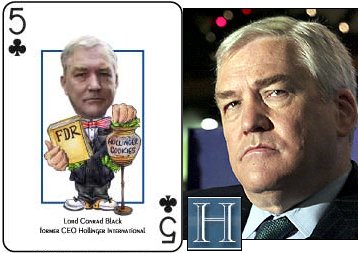
In the wake of the sale of London’s Daily Telegraph, I noticed this Washington Post piece on the ‘kleptocracy’ that was Hollinger International. Not to Mr. Black: comparisons to Dennis Kozlowski should not be considered complimentary...
-
Press tycoon Conrad M. Black and other top Hollinger International Inc. officials pocketed more than $400 million in company money over seven years and Black's handpicked board of directors passively approved many of the transactions, a company investigation concluded.
A report by a special board committee singled out director Richard N. Perle, a former Defense Department official, who received $5.4 million in bonuses and compensation. The report said Perle should return the money to the Chicago company.
The report also criticized the board's audit committee, which includes former Illinois governor James R. Thompson and former ambassador Richard R. Burt, for failing to question Black's large management fees. It said it was reasonable for former secretary of state Henry Kissinger, another independent director, to rely on the audit committee.
Black's holding company said the report was filled with "outright lies."
Black resigned in November after an internal investigation showed that he and associates, mainly chief operating officer F. David Radler, received money that the company should have kept. Hollinger International is suing Black -- a native of Canada who is now a British citizen -- and others for $1.25 billion in damages for their alleged pillaging of the company, which owns the Chicago Sun-Times, the Jerusalem Post and other newspapers. It recently sold London's Daily Telegraph.
The new report, filed with the Securities and Exchange Commission late Monday, added details of what it called the "corporate kleptocracy" Black and Radler created at Hollinger. It said they treated the company as a "piggybank" and fashion accessory, with Black using the prestige of the newspapers to gain access to the wealthy, powerful and royal.
For example, the report said Black and his wife, Barbara Amiel Black, treated the Hollinger corporate jet as a private shuttle between cities such as Chicago and Toronto and vacation spots. They took frequent trips to Palm Springs and one 33-hour round trip to Bora Bora, which cost the company $530,000, the report said. It also said Black charged the company $90,000 to refurbish a Rolls-Royce and used $8 million in company money to buy memorabilia of President Franklin D. Roosevelt, about whom Black wrote a book.
From 1997 to 2003, the report said, Black, Radler and other controlling shareholders steered 95.2 percent of Hollinger's adjusted net income into their personal accounts. Black's Hollinger Inc. has 68 percent voting control of Hollinger International and 18.2 percent equity interest.
"Behind a constant stream of bombast regarding their accomplishments as self-described 'proprietors,' Black and Radler made it their business to line their pockets at the expense of Hollinger almost every day, in almost every way they could devise," said the report, prepared by Richard C. Breeden, a former SEC chairman. "At Hollinger, Black as both [chief executive] and controlling shareholder, together with his associates, created an entity in which ethical corruption was a defining characteristic of the leadership team."
Ravelston Corp. Ltd., Black's holding company, disputed the findings. "The special committee's report is recycling the same exaggerated claims laced with outright lies that have been peddled in leaks to the media and over-reaching lawsuits since Richard Breeden first began his campaign against the founders of Hollinger International," Ravelston said in a written statement. Black filed a defamation suit against Breeden in February. "The report is full of so many factual and tainting misrepresentations and inaccuracies that it is not practical to address them in their entirety here."
The report said Perle "breached his fiduciary duties" as a member of the board's executive committee, signing documents without evaluating or, sometimes, reading them, including those that allowed Black and Radler to evade audit committee scrutiny. Perle received more than $3 million in bonuses and hundreds of thousands of dollars more in compensation from a Hollinger subsidiary that invested in new media companies during the dot-com boom. The report said Hollinger International put $63.6 million into 11 companies Perle recommended and lost nearly $50 million. "Perle was a faithless fiduciary . . . and . . . should not be allowed to retain any of his Hollinger compensation," the report said.
Perle did not return a call to his office and e-mails asking for comment yesterday. He said in an interview in May that any suggestion "that actions or decisions taken by me involved a quid pro quo for compensation I received . . . is absolutely false."
The report said Black and others diverted Hollinger money through Ravelston, which charged management fees when Hollinger sold properties. The audit committee, for example, approved $52 million for Ravelston when Hollinger completed its sale of Canada's National Post newspaper to CanWest Global Communications Corp. in 2001.
Members of the company's audit committee either didn't know or didn't care what Black and Radler were doing, probably because they were too close to Black, the report said. "Black named every member of the board, and the board's membership was largely composed of individuals with whom Black had longstanding social, business or political ties," the report said. "The board Black selected functioned more like a social club or public policy association than as the board of a major corporation, enjoying extremely short meetings followed by a good lunch and discussion of world affairs."
Black said the board's audit committee signed off on his decisions. The report said the audit committee should have pushed Black and Radler for more information.
Laura Jereski, an analyst with minority shareholder Tweedy, Browne Co., which spurred the creation of the special committee, said yesterday's report is "a step in the right direction."
The report is inconclusive about the directors, she said, as it withholds its opinion on how much blame they should receive for the actions of Black and others. "So much money left this company," she said. "The special committee is fully empowered to seek all remedies. We just want our money back."
The report contains e-mails from Black to other company officials about Perle, whom Black called a "trimmer and a sharper" who was profiting from Hollinger's name in establishing his own venture fund.
"I have been exposed to Richard's full repertoire of histrionics, cajolery, and utilization of fine print," Black wrote. "He hasn't been disingenuous exactly, but I understand how he finessed the Russians out of deployed missiles in exchange for non-eventual-deployment of half the number of missiles of unproven design." Perle was an assistant secretary of defense in the Reagan administration.
The report also contains some unexpected humor. When detailing the "Happy Birthday, Barbara" dinner party that Black threw for his wife at New York's La Grenouille restaurant ($42,870), the authors noted: "At least Black's choice of venue for his wife's birthday was less expensive than Dennis Kozlowski's party for his wife on Sardinia that was charged in part to Tyco."
- Arik
September 01, 2004
Foster’s Staggering over U.S. Wine Business

Since I’ve just gotten back from Australia and one of the feedback items on my evals was to have more Aussie examples to share of competitive strategy, I thought it’d be fun to take a look at Foster’s Group (“Australian for Beer”, according to the American ad campaign, although I never did find the lager on tap ANYWHERE in Sydney… I had mostly Tooheys New and VB). It seems Foster’s has hit a rough patch as a result of disappointing results from its former "growth engine" in Beringer wine business.
-
Foster's Group's drifting share price yesterday had its biggest one-day fall in 10 months after the global drinks company told investors to wait until 2006 before its struggling US wine business fully recovered and to expect only moderate earnings growth next year.
The group disappointed investors by announcing a net profit, before significant items, of $469.4 million - down more than 17 per cent on the previous year's $568.1 million. This was below market forecasts of between $479 million and $515 million.
Foster's share price shed 10 ¢ yesterday to close at $4.57, down more than 2 per cent. The weaker profit was propped up by the $329.9 million net gain from the spin-off of its pub assets, Australian Leisure & Hospitality.
Most of the damage was done by the group's Beringer Blass Wine Estates (BBWE) business which cost Foster's $1.5 billion four years ago when it was acquired as the growth engine for what was once a pure brewing company.
BBWE's earnings before interest tax and amortisation and significant items (EBITAS) crashed 32 per cent, falling from $428.8 million in 2003 to $291.7 million.
Like its competitors, BBWE has been forced to sacrifice some of its profit margins in the face of the California grape and wine glut, price wars and US consumers quaffing cheaper wines.
Announcing his first full-year profit result since taking the helm in April, Foster's chief executive Trevor O'Hoy said Beringer's figures were "unacceptable".
Some of the pain was set to continue in the first half of this new financial year, but a significant turnaround in the second six months was expected.
Foster's is counting on radical surgery, unveiled by Mr O'Hoy in June, to overhaul the ailing wine unit. This includes write-downs, reduced inventory levels, increased marketing spending and installing a team of new managers.
Mr O'Hoy said there would be no wine acquisitions for 12 to 18 months, and not before BBWE was fixed. "Clearly we've got to run the businesses we've got well and get towards the optimum performance before we even consider m&a (mergers and acquisitions)," Mr O'Hoy said.
The group's second problem-child, wine clubs and services, is also being overhauled and Mr O'Hoy signalled yesterday that Foster's might jettison the business if it wasn't fixed.
EBITAS for services fell 49.4 per cent to $17.8 million and clubs' EBITAS fell 10 per cent to 44.3 million.
Mr O'Hoy said the aim was to keep these as part of the group, partly because it also provided good competitive intelligence about the market, but the businesses needed to be integrated into the group's operations over the next two years and start generating returns of at least 15 per cent.
"If you can't see a 15 per cent return at the end of that period, it's not a business you would want to hang on to," he said.
The group has forecast single-digit earnings per share growth of between 5 per cent and 9 per cent per cent in 2005 - about half coming from share buybacks - with growth reverting back to 10 per cent-plus levels in 2006.
Australian for beer, indeed; but apparently, not American for wine.
- Arik
 "Competitive Intelligence applies the principles of competition and lessons of intelligence to the need for enterprise awareness and predictability of market risk and opportunity. CI has the power to transform an enterprise from also-ran into real winners with agility enough to create and maintain sustainable competitive advantage."
