July 24, 2004
Stiff Competition in Beer Market Leads Molson & Coors Merger to Create World’s Fifth Largest Brewer
-
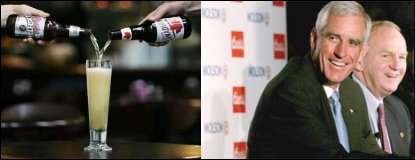
Canada's Molson and US-based Coors announced plans for a "merger of equals" of the two family-controlled brewers creating the world's fifth largest beermaker by volume.
The deal "will create a new company with the operating scale and balance sheet strength to take a leading role in the consolidating global brewing industry," the companies said in a joint statement.
With combined beer production of 60 million hectoliters (51 million US barrels), the company to be named Molson Coors Brewing Company will be the world's fifth largest brewing company by volume, the statement said.
"This transaction allows us to create a stronger company in a consolidating global industry while preserving Molson's rich heritage as North America's oldest beer company and Canada's leading brewer," said Eric Molson, chairman of the Canadian firm.
What's the upside for shareholders? None really, since they're already effectively a combined entity with two joint ventures, one in Canada and one in the U.S.; however, long-term value could be created if the potential combination of Coors and Molson attracts a larger suitor, like Heineken or SABMiller, since as the number five global brewer the company would derive most of its earnings from businesses with a number two market position.
- Arik
July 23, 2004
Merck and Schering-Plough: FDA Approves Vytorin as Potential Cholesterol Blockbuster
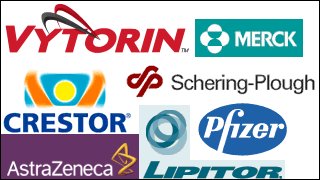
Merck and Schering-Plough enjoyed a big win to celebrate over the weekend, as Vytorin won FDA approval to take on AstraZeneca’s Crestor, Pfizer’s Lipitor and a host of other statins, as they combine Merck’s Zocor, with a non-statin treatment in Schering-Plough’s Zetia.
-
Vytorin combines Zetia, a cholesterol-lowering agent developed at Schering-Plough, with Zocor, the $5 billion cholesterol-lowering medicine marketed by Merck. By itself, Zetia is far less powerful than the cholesterol-lowering medicines known as statins, such as Zocor, Lipitor and Pravachol. But it works differently, and when Zocor and Zetia are used together, they lower bad cholesterol better than any treatment currently on the market.
The U.S. Food and Drug Administration has a deadline of July 24--Saturday for its decision. Analysts expect a decision either today or Monday. In the last quarter, Zetia generated more revenue than Crestor, a new statin sold by AstraZeneca.
"By combining them at a single tablet and offering them at a single price, you obviously create a benefit to the patient," says Richard Milani, head of cardiology at the Ochsner Clinic in New Orleans. The new pill will be cheaper--both because it will cost less than buying Zocor and Zetia separately and because patients will have only a single co-payment for the pill.
Pricing is expected to emerge as a major issue for Vytorin. It must be priced competitively with Lipitor, which has half the cholesterol market and brings in $10 billion annually for drug giant Pfizer. It may, however, be priced more than Crestor.
Barbara Ryan, an analyst at Deutsche Bank, says Vytorin could eventually grab 13% of the cholesterol market, reaching sales of $3.5 billion in 2008. Zetia sales that year will probably be at least $500 million, and the joint venture could contribute $1 billion in profits each to Merck and Schering. That could be a bigger benefit to beaten-down Schering-Plough than to Merck, which will lose patent protection on Zocor in 2006. Ryan rates Schering-Plough a "buy" based on the upside from the drug. Deutsche Bank does investment banking and owns 1% or more of both Merck and Schering-Plough.
Pfizer can be expected to engage in a pitched marketing battle against any competition, perhaps arguing that lowering bad cholesterol with statins has extra, hard-to-measure benefits that doing so with Zetia does not. But the number of people who should be on cholesterol medicines constantly increases. New guidelines may have increased the number of Americans who should receive some kind of therapy to more than 50 million from 36 million. Currently, only about 11 million people do take such drugs. That exploding market can only bode well for Vytorin.
So, with cholesterol seemingly more important than ever, Merck might just have managed to extend the life of its soon-to-expire Zocor in time to blunt the impact of losing a $5 billion drug.
- Arik
July 22, 2004
9/11 Commission (Intelligence) Report: Failure of Imagination or Failure of Incentives?
 The commission's 585-page report indicates much greater failures than imagination in the national intelligence apparatus throughout both the Clinton and Bush presidencies. Slate.com's Fred Kaplan offers up his excellent analysis:
-
The biggest puzzle about the 9/11 commission's report is why Thomas Kean, the panel's chairman, said at the start of his press conference this morning that the U.S. government's failure to stop the attack on the World Trade Center was, "above all, a failure of imagination."
It was a strange comment because the actual report—a superb, if somewhat dry, piece of work—says nothing of the sort. The failure was not one of imagination but rather of incentives. It turns out that many individuals, panels, and agencies had predicted an attack uncannily similar to what happened on Sept. 11, 2001. The problem was that nobody in a position of power felt compelled to do anything about it.
And, in conclusion:
-
Everything that the panel wants to do has been tried, in one way or another, in the past. The government doesn't change in so dramatic a fashion unless the president pushes hard for the change. New priorities mean nothing unless budgets reflect them. New superagencies mean nothing unless their managers have the power to control the purse strings of their constituent parts. Better intelligence means nothing unless the president wants to hear it—and at least seriously considers acting on it.
Will a Cabinet-level intelligence czar be able to sort out all the trouble getting agencies to cooperate? One thing's for sure, that stands a lot better chance than teaching them to be more imaginative.
- Arik
July 21, 2004
SCO Loses DaimlerChrysler Lawsuit

-
SCO suffered its first major defeat Wednesday in its legal wars against Linux-using companies, when DaimlerChrysler was granted all of the important points in its motion to dismiss SCO's case.
Judge Rae Lee Chabot of Oakland County Circuit Court in Michigan all but dismissed The SCO Group Inc.'s case after a hearing, which, according to at least one eyewitness, took only about 20 minutes.
This latest ruling is likely to discourage SCO from suing other Unix licensees that failed to certify their use of the operating system. The DaimlerChrysler suit addressed different issues than those in lawsuits SCO has filed against IBM, Novell, and Linux customer AutoZone, but the impact on these other cases is still up for grabs. Regardless, there was joy in Linux-land, at least for the moment.
- Arik
July 20, 2004
EU Clears the Way for Merger of Sony Music & Bertelsmann

-
European Commission regulators have cleared a merger between the music businesses of Japanese electronics group Sony and German media company Bertelsmann.
EU regulators opened an inquiry into the deal between Sony's music arm and Bertelsmann's music business BMG in February on concerns that a combined group would dominate the market.
If the merger goes ahead, the market will be carved up between four instead of five majors: Vivendi's Universal, the newly-created SonyBMG, Warner and EMI. Together they would share around 80 percent of European recorded music sales.
The European and US competition authorities have run parallel investigations into the merger, which will create the world's largest music company by market share according to 2003 figures.
The merger will bring together Sony stars such as Barbara Streisand and Beyonce and BMG stars, including Elvis Presley and Christina Aguilera.
The Japanese and German parent groups argue that their businesses need to join forces to tackle the crisis in the global music industry faced with both pirate CDs and an explosion of illegal music downloading.
At least Sony got its new music service and MP3 player to market a few weeks ago, or its biggest competitor would be the iPod/iTunes platform. Wait a second... it already is!
- Arik
 "Competitive Intelligence applies the principles of competition and lessons of intelligence to the need for enterprise awareness and predictability of market risk and opportunity. CI has the power to transform an enterprise from also-ran into real winners with agility enough to create and maintain sustainable competitive advantage."
