April 13, 2004
Toyota’s New Scion Brand Launches with Forehead Ads in Times Square

Times Square was awash in young adults adorned with temporary tattoos emblazoned on their foreheads advertising Toyota's Scion and its latest model, the tC coupe. Here's an excerpt from AdAge.com:
- The one-day effort is the brainchild of guerilla marketing firm Cunning, a London-based operation that opened in New York late last year. Cunning recruited approximately 40 young adults, mostly college students, to publicize the Scion message on behalf of client Toyota Motor Sales USA's Toyota division. The auto marketer is unveiling its tC sports coupe today at the New York Auto Show at the Jacob Javits Center.
"This is the first time we've used foreheads," said Brian Bolain, national manager for Scion. The automaker has deployed nontraditional efforts only, developed by its ad agency, Attik of San Francisco, to launch the youth-oriented Scion's initial two models, the xA and the xB. Sales of the latter began last June in California and rolled out in the South, Southeast and East in February.
Despite the fact I think the model above is ugly as sin, Scion expects to sell 60,000 vehicles this year and 100,000 in 2005. The guerilla marketing tattoos are a one-time only effort, for now. Said Scion: "We'll see how it works and take it from there."
- Arik
April 12, 2004
L'Oréal & Armani vs. Louis Vuitton Moët Hennessy & PinaultPrintempsRedoute

It would appear "cosmetics giant L'Oréal and Dubai property developer Emaar have emerged as prime potential partners for Milan luxury group Giorgio Armani as the 69-year-old founder arranges his succession."
The excerpt continues as follows:
- A deal could crystallise the company's value at about e4bn (£2.7bn) and give Armani's favoured partner an entry into the luxury-goods business.
Billionaire Armani, who built his empire on the clothes he designed for Richard Gere in the 1980 movie American Gigolo, says he is looking at ways of preserving the group's independence. One possibility is the sale of a minority stake to an outside investor or to a 'perfume multinational', he was reported as saying.
Communications chief Isabelle Harvie-Watt said Armani was weighing several options but no decision had been taken. 'He is working on creating a strong management team to ensure the business continues to grow,' she added.
Armani's Milan-based fashion empire had sales of e1.3bn last year. While rivals have rushed to float or to be taken over by multinational groups, Armani still owns his business outright and appears determined that it will not fall into the hands of French luxury-goods groups Louis Vuitton Moët Hennessy or PinaultPrintempsRedoute.
L'Oréal, capitalised at e42.7bn, already makes perfumes sold under the Armani brand, is virtually debt-free and needs to find new external growth opportunities. A spokesman declined to comment.
Emaar Properties, the Dubai-based developer with which Armani agreed a massive hotel deal in February and which is building the world's tallest tower in Dubai, has massive financial firepower and a close relationship with Gucci.
It is developing 10 hotels and four holiday resorts in partnership with Armani, which will design the interiors and have a management role.
Armani told an Italian newspaper: 'In three years' time, everything should be in place.'
A one-time medical student and department-store window-dresser, Armani joined Nina Cerruti as a designer in 1961 and launched his own business in 1970. He has made a relaxed easy-to-wear look his trademark while at the same time maintaining meticulous tailoring and manufacturing standards.
It's high time things started getting interesting in luxury, fashion and parfume markets!
- Arik
April 11, 2004
Release of President’s Daily Brief, Lessons for the Intelligence Community
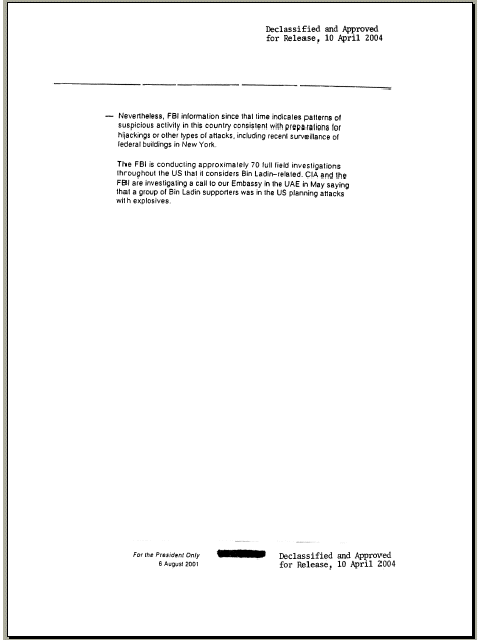
The August 6th President's Daily Brief was released late Saturday, titled, "Bin Ladin Determined To Strike in U.S." The memo did not contain any specific warning of the strikes that occurred only 36 days later but did present fresh evidence that terrorists were planning hijackings and attacks with explosives inside the United States. The Los Angeles Times blows up images of the most ominous paragraphs and reprints them, and I've inserted them below:

Slate summarized newspaper coverage in "Today's Papers":
- The Aug. 6 PDB has been a subject of controversy for years, even more so since Thursday, when National Security Adviser Condoleezza Rice was asked about it during her sworn testimony before the 9/11 commission. Despite Rice's contention "this was a historical memo" that didn't merit special action, the papers all note that the PDB did in fact include some new intelligence, as has been hinted for days. The LA Times goes as far as to speculate, in a separate Page-One analysis, that Rice has damaged her credibility with that statement.
Among the PDB's most non-historical warnings are its two final paragraphs. The first states that, despite being unable to corroborate a 1998 report that Bin Laden was looking to hijack planes,
… FBI information since that time indicates patterns of suspicious activity in this country consistent with preparations for hijackings or other types of attacks, including recent surveillance of federal buildings in New York.
In addition, it continues,
The FBI is conducting approximately 70 full field investigations throughout the US that it considers Bin Ladin-related. CIA and the FBI are investigating a call to our Embassy in the UAE in May saying that a group of Bin Ladin supporters was in the US planning attacks with explosives.
After the White House released the PDB, officials held a conference call with reporters and issued a written rebuttal, which a New York Times news analysis says was twice as long as the PDB itself. "None of the information relating to the 'patterns of suspicious activity' was later deemed to be related to the 9/11 attacks," the document said. Administration officials explained that the suspicious casing of federal buildings was later determined to be "tourist activity" and that the embassy call has never been linked to 9/11. (The NYT's lead and analysis point out that the White House admitted it couldn't rule out a connection, either).
The Washington Post's lead is alone in reporting on the PDB's creation. According to a "U.S. government official," the CIA analyst who prepared the briefing obtained the two final items from the FBI at the last minute, in an effort to sound a more strident alarm about Bin Laden. "The agency doesn't write a headline like that if it doesn't want to get attention," said a separate "former administration official," who sounds an awful lot like Richard Clarke. "The CIA did not believe Bush policymakers were taking the threat to the U.S. seriously."
An accompanying above-the-fold WP article suggests, however, that no one was taking the threat seriously that summer, even after the Aug. 6 briefing. "In a pre-9/11 world, it was like, 'Check it out and see what you find and get back to us after Labor Day,' " said a former Bush aide, "who remains close to White House" but refused to be named to "avoid angering the President and his staff." "It wasn't just the president who was on vacation. It was the whole government. It was the Bureau [FBI] and the Agency [CIA], too. The attention to the threats was above and beyond normal, but it obviously wasn't enough."
According to the NYT's lead, "no White House has ever made public a copy of a President's Daily Brief, a document that has been produced by the C.I.A. for presidents since the 1960's." But the WP disagrees: "PDBs have been released in the past, but current CIA Director George J. Tenet has tried to put them in a non-releasable category." Only the LAT clarifies: "Similar documents from other administrations have been declassified, but years after the presidents they were prepared for left office."
The question now is, if the President had known about this, should he have done something? Or rather, why wasn't this paid attention to? The length of the PDB in this case is unusual on its face, warranting some sort of increased Administration attention span.
- Arik
 "Competitive Intelligence applies the principles of competition and lessons of intelligence to the need for enterprise awareness and predictability of market risk and opportunity. CI has the power to transform an enterprise from also-ran into real winners with agility enough to create and maintain sustainable competitive advantage."
