March 09, 2004
Samsung vs. Motorola: South Korean Handset Maker Gains on U.S. Rival
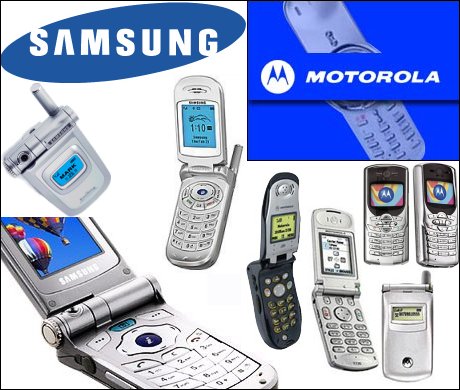
Worldwide cell phone handset market share figures are out for 2003 and Samsung has made some decided progress against competitors in both CDMA and GSM markets, particularly Motorola, although overtaking them for number two will still be a tough hurdle. Here’s an excerpt from a piece comparing the two from the Miami Herald:
- Wireless phones were key to Samsung's transformation from a financially ailing maker of memory chips and cheap microwave ovens into a respected brand. The company ignored the low end of the market, focusing instead on pricier handsets for customers who can afford the latest and coolest gadgets.
Samsung shipped 11 percent of all wireless phones sold last year. The company's share of shipments still trails Motorola's 15 percent, but Samsung is neck and neck with Motorola in sales.
Samsung chalked up $10.6 billion in handset revenues last year compared with Motorola's $11 billion. An average Samsung phone, at $190, is 30 percent more expensive than Motorola's $146 average selling price, according to research firm Yankee Group.
And Samsung's profits are fatter. The company's 18 percent gross margins compare favorably with Nokia's 20-plus percent margins, while Motorola's hover in the single digits.
"Samsung has just played its cards right," said Neil Strother, senior analyst for wireless handsets service at In-Stat MDR.
The conglomerate's swift rise in a business that Motorola pioneered is a lesson in the challenges Motorola faces as new chief executive Edward Zander tries to energize the company.
Motorola, with deep roots in radio and communications technology, is going up against Asian consumer electronics giants, including LG Electronics and Sanyo, that leverage their expertise in digital cameras, color displays and music players in the increasingly popular all-in-one phones.
None has been more successful in muscling into Motorola's biggest business than Samsung, which made its mark by betting on an emerging technology seven years ago.
CDMA, or code division multiple access, was new to North America in 1997 when Samsung introduced CDMA phones with Sprint PCS for the carrier's new all-digital national network.
"Samsung is the classic example of how an Asian handset vendor can expand a toehold," said Yankee Group analyst John Jackson. "And they've done it by being a manufacturer."
Bucking the trend toward specialization, Samsung thrives as a vertically integrated manufacturer. Its biggest factory complex is in Gumi, South Korea's largest inland industrial city.
While Motorola is spinning off its semiconductor division, Samsung continues to buy chips, display screens and other parts from its affiliates. That can be an advantage when sales heat up and industry demand outstrips supplies.
One reason Motorola was late last year in delivering phones to stores was a parts shortage. "Being late in this market costs you," Strother said.
Samsung is blessed by another advantage: South Korea's rabid appetite for all things digital, especially mobile technology.
The country's wireless networks are among the world's most advanced, providing a test kitchen for Samsung's concoctions. Korean consumers, on average, replace their phones every nine to 12 months--three times more often than the world average.
Samsung satisfies their appetite by churning out models at a furious pace.
It introduced 150 models worldwide last year compared with Motorola's 40.
Motorola dramatically reduced the complexity of its product line three years ago to make its cell phone business profitable. By contrast, Samsung appears to thrive on complexity, designing different phones for each carrier to help them side-step cutthroat price competition.
The SGH-e715 camera phone it produced recently for T-Mobile looks and behaves differently, for instance, than comparably priced phones for Sprint.
"If the e-715 is a hit for T-Mobile, we would not like for Sprint to come in and rain on their parade" by offering a similar phone at a lower price, said Muzibul Khan, vice president of product management and engineering at Samsung's wireless terminals division in Richardson, Texas..
The seeds for Samsung's success were planted in the United States in 1997, when Sprint was hunting phones for its new CDMA network.
"Only a few companies had the capability," said Sprint's John Garcia, senior vice president of sales and distribution. "Motorola was skeptical, as was Nokia."
Sony Electronics Co. partnered with Qualcomm Inc. to build Sprint's first CDMA phone, but the carrier needed more.
"We needed more advanced handsets, and we needed a lot of them," Garcia said.
Sprint decided to take a flier on Samsung, whose new CEO, Yun Jong Yong, was leading a radical restructuring. The carrier signed a three-year, $600 million contract--a deal that paid off handsomely for both companies.
"What we thought we would sell in three years, we sold in two," Garcia said.
"Samsung invested heavily to coordinate with our engineers to build customized services in their handsets that work uniquely on our network," Garcia added. "That's one of the things that makes them different."
The Sprint deal provided a "market success," said Peter Skarzynski, senior vice president of Samsung Telecommunications America in Richardson. "Then we expanded a step at a time to other CDMA carriers."
Samsung's phones turned heads.
"They were no longer just another garden variety Asian electronics maker," Strother said. "Their overall quality went up."
So did Samsung's reputation for innovation.
"Among carriers, Samsung is perceived to be more a technology leader than Motorola when it comes to delivering coordinated consumer electronics," said Chris Ambrosio of market research firm Strategy Analytics.
In South Korea, where more advanced networks deliver higher speeds than in the U.S., consumers are watching television on Samsung phones, sending video clips and playing 3D games. These features will arrive soon in Samsung phones for U.S. carriers, Skarzynski said.
Motorola, meanwhile, isn't standing still.
Just as Samsung exploited the growth of CDMA technology, Motorola has an early lead in UMTS (Universal Mobile Telecommunications Service). It's a third-generation standard that delivers faster speeds, opening up new ranges of mobile computing and entertainment possibilities.
Motorola also is betting on its software, called MotoJUIX, to give it an edge against players such as Samsung, which licenses other companies' software.
MotoJUIX is based on Java and Linux, an open standard. Motorola said it would give the company flexibility and speed to handle the explosion of applications coming with third generation networks.
"There are a lot of transitions rippling through the industry that allow a technology innovator to win and take share," said Ray Roman, Motorola's vice president and general manager for North America.
Analysts don't think Samsung will knock Motorola from its perch as the world's second-biggest phonemaker anytime soon.
For one thing, Samsung already has maximized its lead in CDMA, said Chris Ambrosio of Strategy Analystics. For another, Samsung has yet to become a mass-market player, serving up quantities of cheaper phones as well as pricey ones.
But, Samsung has to watch our for its own countrymen – LG Electronics topped the Strategy Analytics ranking in CDMA phones, overtaking BOTH Samsung and Motorola, selling 21.3 million CDMA mobile phones last year, a 21.6 percent share, versus Samsung’s shipments of 20.4 million units during the same period, accounting for a 20.7 percent share.
Both LG and Samsung said the greater market share was largely attributed to more aggressive marketing and diversification strategy. Both companies used to focus primarily on the North American export market, but recently diversified its CDMA handset lines to other emerging markets like Brazil and China. LG's emergence as a top competitor is made more interesting as the company has long been the No. 2 player on the Korean CDMA market after Samsung, which essentially controls the high-end mobile phone market with its strong brand and market power.
Meanwhile, Motorola shipped 19 million CDMA handsets last year, securing an 18 percent share, Nokia ranked fourth, carving out a 12.5 percent share, or 12.3 million units, followed by Kyocera with 10.9 million units (11 percent) and Sanyo with 3.4 million units (3.5 percent).
But Korean handset manufacturers have yet to catch up with other competitors for GSM share. Nokia topped the ranking with 146 million units, or 42.2 percent market share for the global GSM handset market, followed by Siemens with 43.3 million units, or 12.5 percent, Motorola was No. 3 with 38.4 million units, Samsung ranked fourth with 33.8 million units, and LG shipped 6.1 million GSM phones last year.
Most ironic is that less than a decade ago, nobody saw Samsung, or LG for that matter, as a serious handset competitor to relative Motorola’s dominance.
- Arik
March 08, 2004
Martha Stewart, Guilty on All Counts, Meets with Probation Officials; Jury Might Have Acquitted if She’d Testified

Last Friday’s news of felony convictions for Martha Stewart and her former broker left us all talking about how she’ll decorate her cell, but it also sent a strong message to the business world.
Stewart was found guilty of all four counts (obstruction of justice, conspiracy, and making false statements) arising from her sale of a Imclone stock in 2001. (A fifth charge, securities fraud, was thrown out last week.) The broker, Peter Bacanovic, was found guilty of four counts (obstruction, conspiracy, making false statements, and perjury) and was cleared of making false documents. Both will appeal. They each face 20 years in prison at their June 17 sentencing, although most experts think they will get about a year.
Stewart betrayed no emotion, by most accounts, although the Associated Press says she "grimaced and her eyes widened slightly" as the verdict was read, and the Los Angeles Times says she "appeared stunned" as she left the courtroom, while her daughter and one of her lawyers cried. According to one juror, the most damning testimony was that of Stewart's personal assistant, who told the court that Stewart altered a voice mail and a computer log after the feds began investigating. Several jurors criticized Stewart's minimal defense (her lawyers called only one witness) and pointed to her experience as a stockbroker 30 years ago as proof of a sophisticated ability to deceive in 2001 and 2002.
Stewart will "almost certainly" have to step down as a director of her company's board, although she can keep her majority stock ownership. (She resigned as CEO after her indictment.) Stewart still faces civil stock-fraud charges brought by the Securities and Exchange Commission, as well as class-action lawsuits by shareholders. Stewart's statement on her Web site says that she is "obviously distressed by the jury's verdict" but is glad to have personal support and will "continue to fight to clear my name." (However, the LA Times notices that an initial reference to her having "done nothing wrong" was deleted from the site.)
After watching their company's founder attain public ignominy and their company's shares loose a quarter of their value yesterday, the (law-abiding) directors of Martha Stewart Living Omnimedia Inc. released a statement, just to clarify things: "In spite of [today's] disappointment, it is important to recognize the significant contributions that Martha has made to advancing the domestic arts and improving the quality of life in and around our homes." A trademark specialist, quoted in the AP, perhaps put it more succinctly: "This is a terrible tragedy for a great brand."
Widely assailed with a failed defense strategy for their clients, Martha Stewart and Peter Bacanovic’s defense attorneys probably could have improved their chances of acquittal if they’d called a few more witnesses for the defense – especially Stewart herself. An excerpt from today’s New York Daily News:
- Martha Stewart might have saved her skin by taking the witness stand to give her side of the stock-sale deal that's rocked her life, jurors said yesterday.
Six jurors said lawyers for the domestic diva made a huge blunder by mounting virtually no defense and muzzling Stewart, leaving them with little choice but to convict her.
"I was ready to hear her side," juror Dana D'Allessandro told NBC's "Dateline." "No matter who they put on. I wanted to hear from her."
"We just ... were hoping they would put up more of a fight or something," said Jonathan Laskin. "Or give us more to chew on. But it wasn't there."
The TV interview marked the largest gathering of jurors to speak out and the most detailed comments yet from members of the panel that convicted Stewart and her stockbroker Peter Bacanovic on Friday.
Legal analysts say it would have been a huge gamble to put Stewart on the stand because prosecutors could have used cross-examination to rip apart her explanation of her sale of 4,000 shares of ImClone stock.
She would also have risked a perjury conviction if she tripped up under oath, exposing her to a much longer prison stint than the possible 18 months she now faces.
There were also worries that the powerful businesswoman's temper would have flared under tough questioning.
Despite the risks, jurors said they were stunned when defense counsel Robert Morvillo abruptly rested the defense case after one witness.
"We were sitting there going, 'But we saw this and heard that,'" said Rosemary McMahon. "So it was, like, 'We need more.' ... We were waiting. We were hoping."
Without any ammunition from the defense, jurors said, they puzzled over possible explanations for the deal.
But in the end they believed the star prosecution witness, broker's assistant Douglas Faneuil.
The final nails in Stewart's coffin came when her assistant Ann Armstrong said she altered a key phone log, and friend Mariana Pasternak testified Stewart mentioned getting what prosecutors allege was an insider stock tip.
The panel members trembled with emotion and avoided making eye contact with the household queen as they prepared to deliver the stunning guilty verdicts.
"That was tough," said juror Chappell Hartridge. "We knew we were about to change two people's lives forever."
Although some jurors wondered whether Stewart was singled out for being a woman, others insisted she had to pay for breaking the rules.
"Laws were broken and lies were told. And money changed hands through means that were not altogether on the up and up," said Laskin. "It's not nothing. I think it's important."
So, why the conviction? Well, Stewart's defense attorney Robert Morvillo did concede during closing that the celebrity homemaker received a secret stock tip, but supported his argument by saying she was simply too smart to botch the cover-up she’s charged with committing. Admission of guilt? Apparently so. Too smart? I think not.
Still, Martha won’t be in jail long – and might even get probation – although if there are no obvious grounds for appeal, she’s might not get bail before her June sentencing and she can spent the springtime behind bars. Meanwhile, her heretofore-erstwhile business partners are jumping ship like drowning rats from MSO.
Regardless, the verdict sent a strong message of public intolerance of corporate shenanigans when it comes to powerful business moguls pocketing ill-gotten gains no matter how tiny or insignificant. Nobody is above the law. The truth shall set you free. We’re just not going to take it any more – and for Kozlowski and Ebbers, it’s time they get fitted for a tastefully tailored set of tangerine jammies.
- Arik
March 07, 2004
Telcos vs. Cable
I found a good piece in this week’s BusinessWeek magazine “How Telcos Can Fight the Cable Invasion”, all about the expected counterattack from DSL delivering movies and other new services with only minor upgrades.
- One of detractors' most common observations is that telcos can't easily add video services. Their much-trumpeted fiber-to-the-home (FTH) initiative, the plan to deliver voice, video, and broadband services by extending fiber-optic cable to every home, could prove to be prohibitively expensive - to the tune of $1 billion for every million potential subscribers. It also could take more than a decade to implement, making that strategy a very slow boat to profitability.
Telecoms don't need to exactly replicate cable's performance and services, however. Instead, with little additional investment in infrastructure, they can grab extra revenue - as much as $20 a month per customer - by providing innovative video services and content not available today, says Jonathan Hurd, a vice-president at tech consultancy Adventis in Boston. Such a move would represent a hefty addition to phone outfits' bottom lines, which typically reflect revenue per customer in the $30-to-$60 range.
Telcos have already taken their first steps in that direction. Many recently began reselling satellite-TV service - programming that's on par with cable. The largest U.S. telecom operator, Verizon, is offering its users a $6-per-month discount on the service to help get the business off the ground, says Marilyn O'Connell, vice-president for broadband. (Verizon and others won't release subscriber numbers.)
But wouldn't that necessitate costly upgrades to their networks?
- Upgrading the telcos' existing copper networks to handle that bandwidth isn't a big deal. To provide DSL service today, telcos use DSLAM (digital subscriber line access multiplexer) devices, which accumulate bandwidth, then parcel it out to individual homes or neighborhoods via copper wires. Telcos can add special cards relatively easily to the DSLAM boxes for other flavors of DSL, such as VDSL (very high speed DSL), or to provide neighborhoods with more DSLAMs (at a cost of just $50 to $300 per user).
This could greatly increase the bandwidth available to each subscriber home, says Matt Davis, an analyst at tech consultancy Yankee Group. A DSLAM located within 3,000 feet of a customer's home could pump data at rates of 7 megabits per second, far in excess of standard DSL, and more than enough to broadcast TV channels, Davis says.
If they play their cards right, telcos could not only eat into cable revenues, they might also take on such outfits as DVD rental concerns like Blockbuster and Netflix. The average consumer bought 15 DVDs last year - and telcos could potentially grab part of that money by delivering the same content via their networks, says Ken Twist, an analyst with telecom consultancy RHK in San Francisco.
To do that, telcos need to learn a lot more about branding and marketing - neither a strong point, historically. They also will need to strike deals with content providers, roll out new services, and tweak their networks. The phone companies, however, have a huge and loyal customer base, one that might prove both willing and eager to buy discounted bundles of various offerings.
"I think that, at the end of the day, telcos will be able to respond to the [cable] threat," says Walt Megura, general manager of broadband networks business at gearmaker Nortel Networks, which has recently reentered the broadband-access market. Sure, the doomsayers could be right about some players - but maybe not all.
- Arik
 "Competitive Intelligence applies the principles of competition and lessons of intelligence to the need for enterprise awareness and predictability of market risk and opportunity. CI has the power to transform an enterprise from also-ran into real winners with agility enough to create and maintain sustainable competitive advantage."
