August 29, 2003
Vodka Brawling: Grey Goose VS. Belvedere
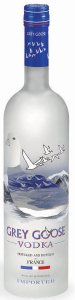 Two of the nation's leading luxury vodkas - Grey Goose and Belvedere - are in a barroom brawl over an advertising campaign. Here's an excerpt from the Minneapolis Star-Tribune:

- "At issue are ads for the French vodka Grey Goose. In the ads, Grey Goose calls itself the world's best-tasting vodka, based on the results of a 1998 taste test by the Beverage Testing Institute. The ads tout Grey Goose's winning score of 96 and list the scores of 31 competing vodkas. Among the brands that scored worse than Grey Goose is Belvedere, the Polish vodka that pioneered the luxury category in 1996. Belvedere scored a 74 in the 1998 test, ranking it near the bottom of the pack. The institute is an independent company in Chicago that conducts and publishes reviews of beer, wine and spirits. Since that 1998 taste test, Belvedere has performed significantly better in two other taste tests by the same organization, posting scores of 90 and 91. Given those higher scores, Belvedere argues, it's not fair for Grey Goose to keep printing the results of its poor showing in 1998. Belvedere took its case to an industry arbitrator, the National Advertising Division (NAD) of the Council of the Better Business Bureaus. That group agreed that Grey Goose should stop running its ads. So did the National Advertising Review Board (NARB), another industry referee. But Grey Goose said it won't abide by the nonbinding decisions of those agencies."
Now, I'm not much of a vodka drinker - I prefer beer myself - but my bet is this ends up in court. The real question is whether Grey Goose should re-submit their product for comparison - which they have not since their 1998 win... and really have no interest in doing so and risk a loss of the earlier rating. Belvedere's been damaged by the ads certainly. But, if the 1996 Yankees won the World Series, should they not be able to cite that championship benchmark? Is it not true that Grey Goose won in 1998 and if they're citing that date in the ads, should Belvedere be able to make them cease and desist?
- Arik
August 28, 2003
Ringtone Piracy Growing in Asia, Highlighting Paradox of "Duplicable Creative" Goods & Failure to Overcome Supply & Demand
 It would seem that one of the latest revenue generators for mobile phone companies and copyright holders alike - downloadable ring-tones - is being scuttled throughout Asia. In what has seemed to be an almost pure-profit business - what's it cost to produce a ring-tone download anyhow? - it seems fortunes are getting skinnier in yet another digital market, thanks to piracy.
This reminded me of the fundamental paradox in all such "duplicable creative" products, and how copyright holders have tried to overcome the iron law of supply and demand. The question is, if products are no longer scarce, does price elasticity still apply to them?
Because of the ubiquity of well-informed buyers in the modern business environment (i.e., they are aware of all competitive alternatives), the chief and only means by which true wealth can be generated by any group or individual entrepreneur today is through the sale of essentially cost-free-to-manufacture goods - in other words, recorded media such as music, movies, written works or software products.
So, the only stuff anybody can make that will have essentially zero manufacturing cost (and therefore unlimited profit margin) must be digital and therefore easy to copy. On the other edge of that sword, the characteristics of being digital mean those goods can be copied esssentially for free, as long as there's someone interested enough to crack the DRM (digital rights management) watermarking that diables copying or performance of that product outside its authentically paid-for copyright license. Okay, Arik, all pretty obvious so far, right?
The point is, what did they expect? That ringtones would never be pirated? What does the motion picture industry expect, following the example of the RIAA's failure so far to stop the erosion of the record industry - a loss of 30 percent of CD sales in the past two years alone. In other words, the business of selling CDs is no longer a business at all, despite the comparative health and popularity of music culturally. Cinema is next... and has already been impacted. What will happen to e-books...? What do you think will happen? Even Apple is seeing its lauded iTunes service affected by customers that are reselling their songs to other users, just to prove a point.
In the end, I think, duplicable creative goods will only be protected in order to compete just like any other commodity... on the economic foundation of supply and demand... the very principle that copyright holders have been trying to overcome in order to create wealth. If a good is no longer scarce (the very definition of cost-free-manufacture) then it no longer has value. Culturally, media consumers have simply woken up to that realization.
- Arik
August 27, 2003
Is a Trade Secret Still a Trade Secret if it’s No Longer Secret? DVD Encryption Safe for Now from First Amendment Arguments for Free Speech

In a Monday ruling, the California Supreme Court decided that distributing the computer code behind the DeCSS app, designed to crack the CSS copy-protection on DVD movies, over the Internet was a violation of trade secret law. In what was an apparent victory for Hollywood, the broader application of trade secret law is the real question. That is, is it still a trade secret if it’s no longer secret?
That was the argument by the Electronic Frontier Foundation in their support of defendant Andrew Bunner, alongside Bunner’s First Amendment rights. "We'll go back down to the court of appeal and present the facts and it will be painfully clear that DeCSS is not a secret," said Cindy Cohn, EFF’s legal director. "It's on T-shirts [ed. the pic here shows the legal one, which you can also buy here]. It's on neckties. It's in thousands of places. Just do a Google search and you'll find it."
So, does that mean that a company’s customer list or secret sauce formula still has protection even if some Norwegian teenager figures out how to post it to the Internet (Jon Johansen, originator of the DeCSS code, was acquitted by Norway of trade secret wrongdoing in January)?
In the end, this wasn't a clear victory for either side - the court made no determination of whether the code was, in fact, a trade secret... It'll be up to a lower court to decide what to do next. Because it's available essentially everywhere - Google it and see - and, it was also likely possible to do the same four years ago, although perhaps with a bit more fuss... Therefore, the code was not secret and would thus not be protected by Calfornia's trade secret law.
That means that if a trade secret is ever published, even if it was misappropriated by hackers or spies or whatever, it's no longer a trade secret. Who's right? Comment here and let us all know what you think.
- Arik
P.S. - check the following links for further info and watch for more on the issue:
August 26, 2003
Honeymoon Over with VoIP & Regulators? ILECs & Bells Sigh Relief
With the notable exceptions of AT&T and Qwest, it would appear the ILECs and Bells have finally managed to lobby through to regulators the idea that VoIP services such as Vonage – which Aurora happens to use extensively for voice communications – should be regulated as phone companies by states. The FCC is still taking a wait-and-see approach.
There’s a great piece on the recent Minnesota PUC decision to try and regulate Vonage, despite the company’s appeal to the contrary; plus, Pulver.com’s coverage of the whole states-vs.VoIP fight is good as well.
- Arik
August 25, 2003
August 14th Northeast Blackout, FirstEnergy and the Consequences of Deregulation
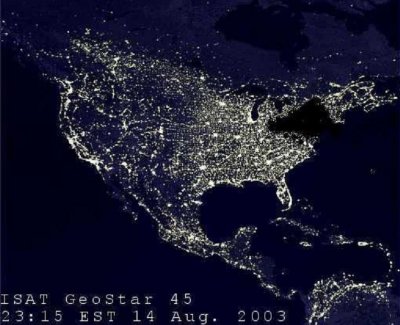
The Geostar snapshot above features a notably darkened Northeast United States, back on August 14th, as everyone struggled to get home on a Thursday evening. While the experience points up the solidarity places like New York City now feel during times of stress in the wake of 9/11, it was still a HUGE inconvenience and affected the whole country, effectively shutting down business for the remainder of the day and into Friday.
In the meantime, I've found a couple of interesting articles in the storm of coverage - the first one from WashingtonPost.com, discussing how competitors are pointing the finger of blame at one another as American Electric Power traces back the collapse to FirstEnergy, a big competitor of theirs. The second one is more interesting (and worthy of excerpts) from CorpWatch that looks at why FirstEnergy (arguably the culprit behind the blackout) will probably escape any regulatory backlash from the Bush Administration:
- The immediate cause of the largest blackout in U.S. history is being traced to FirstEnergy, the Akron, Ohio, energy giant that is a product of the merger of seven utilities: Toledo Edison, Cleveland Electric, Ohio Edison, Pennsylvania Power, Pennsylvania Electric, Metropolitan Edison and Jersey Central Power & Light.
On Aug. 14, FirstEnergy's 550-megawatt, coal-fired Eastlake power plant in Ohio stopped running at 2 p.m. In response, FirstEnergy began to pull roughly 20 percent of its load of electricity out of Michigan to meet its needs. This transfer overloaded several transmission lines, causing them to trip. Non-FirstEnergy plants in Ontario, Canada, began supplying energy to the underpowered Michigan market, which then led to overload on those transmission lines. This movement of power in Canada deprived New York of power it had relied on, which led to the blackouts there.
And here's the critique:
- Bush's energy deregulation is making America vulnerable for two reasons. First, America's transmission system was designed to accommodate local electricity markets, not the large, freewheeling trading of electricity and movement of power over long distances under deregulation. Sending power over a much wider area strains a transmission system designed to serve local utilities. That's why state regulators in the Midwest warned FirstEnergy and other utilities months ago that the transmission network was vulnerable to a blackout. But these concerns were ignored by these energy corporations.
Second, state-based deregulation means utilities are no longer required to reinvest ratepayer money back into the transmission system, as deregulation replaced that orderly planning with reliance on "the market." But the market has been unwilling to make the necessary investments in transmission. In particular, the market has not functioned properly as loopholes were punched in the Public Utility Holding Company Act (PUHCA) over the past decade.
PUHCA, slated for full repeal by the Republicans in both the House and Senate energy bills, is the last federal regulation that requires giant energy companies to disclose crucial financial details and limits the types of non-electricity investments they may make. If PUHCA is repealed, a wave of mergers will likely result, leaving a handful of companies (like Southern Co., ExxonMobil and FirstEnergy) in control of our electricity - with no effective regulators looking over their shoulders.
In the case of the August blackouts, the deregulated wholesale markets of the Midwest and Northeast - typically cited as models for national deregulation by the Federal Energy Regulatory Commission - failed in their ability to provide reliable and affordable power. As a result, wholesale prices remain higher than under regulation, and nearly 96 percent of the 40 million residential consumers in the remaining 15 deregulated states lack access to competitive electricity suppliers.
FirstEnergy's financial problems are the heart of the question, of course. The consequences are that the American taxpayer ultimately will probably have to foot the bill for the energy industry's poor fiscal discipline.
- Arik
August 24, 2003
U.S. Using Former Hussein “Mukhabarat” Intelligence Personnel in Iraq
Sunday’s Washington Post reported that, “occupation authorities have begun a (not-all-that-) covert campaign to recruit and train agents with the once-dreaded Iraqi intelligence service to help identify resistance to American forces here after months of increasingly sophisticated attacks and bombings, according to U.S. and Iraqi officials.”
In the wake of the suicide truck bomb that hit the United Nations headquarters last week, this is seen as a growing recognition that U.S. forces must co-opt their former enemies if they are to prevail against further guerrilla activities directed against them.
Here are a couple of excerpts:
- “The emphasis in recruitment appears to be on the intelligence service known as the Mukhabarat, one of four branches in Hussein's former security service, although it is not the only target for the U.S. effort. The Mukhabarat, whose name itself inspired fear in ordinary Iraqis, was the foreign intelligence service, the most sophisticated of the four. Within that service, officials have reached out to agents who once were assigned to Syria and Iran, Iraqi officials and former intelligence agents say.”
“Of the four security branches, the Mukhabarat was the best-treated and often supplied agents for the other branches. The largest was internal security, known as Amn al-Amm, which focused on domestic intelligence. The third was special security, which protected government officials. These three answered to the presidency. Only military intelligence was nominally independent of Hussein's inner circle and operated within the Defense Ministry. The Baath Party, with membership in the millions, provided a check of sorts, with its almost endless network of informers in every town and village.”
“Within the Mukhabarat, former intelligence officers say, the branches dedicated to Iran, Israel and, during the 1990s, the United Nations were the most important. One officer, a 23-year veteran who spied on the United Nations, said about 100 agents worked on Iran, between 75 and 100 on the United Nations and 50 each on Israel and Syria, in addition to their networks and contacts.”
- Arik
 "Competitive Intelligence applies the principles of competition and lessons of intelligence to the need for enterprise awareness and predictability of market risk and opportunity. CI has the power to transform an enterprise from also-ran into real winners with agility enough to create and maintain sustainable competitive advantage."
