August 15, 2003
Made-in-America, Wal-Mart & the Cheapening of U.S. Consumers
Why do people shop at Wal-Mart? Because it's cheap, that's why. And one of the chief reasons for Wal-Mart's price competitiveness is the $12 billion worth of goods it imported from China last year. To put that in perspective, the U.S. only imported $125 billion altogether from China in 2002; Wal-Mart represents 10 percent of the total!
I found a great article on the subject recently and excerpts are below:
http://www.industryweek.com/CurrentArticles/Asp/articles.asp?ArticleId=1473
- "When asked, most U.S. consumers today will say they prefer to buy American brands and U.S.-made products, but with the influx of foreign goods -- U.S. imports totaled $1.2 trillion in 2002, 11% of U.S. GDP -- buying American is no longer practical in some instances and impossible in many others. Other priorities, such as quality, durability, style and price -- especially price -- often take precedence."
"Younger people who grew up shopping at the Wal-Mart on the outskirts of town may be the least likely to care if the label on their MP3 player says it was made in the U.S.A. or China. They've grown up with the global economy. With ongoing factory closures and layoffs it's increasingly unlikely that they or their parents work for a manufacturing company. Especially considering that less than 15 million people in United States (approximately 10% of the workforce) are employed in manufacturing today. Also, one wonders if it is even possible for a company to rely entirely on U.S.-based suppliers when so much of machinery, telecommunications equipment, packaging, uniforms and other commonplace supplies are coming from overseas."
- Arik
August 14, 2003
A.F.L.-C.I.O. Dials Up Competitive Threat in Verizon Union Fight
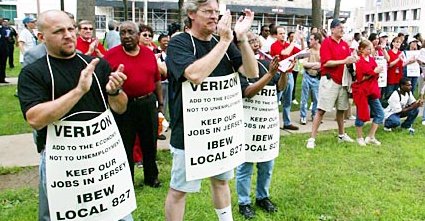
The New York Times reported that Verizon's union is willing to fight dirty to strengthen their negotiating position:
- "The A.F.L.-C.I.O. plans to start by urging roughly 3.5 million people — those from families with union members in five Eastern states where Verizon is the dominant phone company — to log their names, addresses and phone numbers on a Web site, where they could be easily compiled for submission to AT&T."
That's more than 10 percent of Verizon's customer base in the states affected, something AT&T has said they'd both welcome and be able to handle. Since union-sponsored boycotts in the telecom market are tough for unions to promote or enforce, wholesale switching of service providers appears to be the hardball alternative... except for the paradox that, the very act of reducing a customer base to the advantage of a top competitor means fewer union jobs will be needed in the end.
- Arik
August 13, 2003
Jennufleck Schadenfreude - "Gigli" Flops to Our Collective Delight
 The disaster film "Gigli" - whoops, I mean, disastrous film - continued to run in 2,215 theaters this past weekend but pulled in a three-day total of only $678,640, which translates to an average of three people in the theater per screening. Yowza.
There's a good article in the Washington Post about why we're all so delighted about it. Here's a great quote from that piece:
- "Though fascinated by the rich and famous, we also resent their tendency to engage, at the drop of a hat, in wild, romping, bouncing-off-the-walls sex. We resent their threesomes. We are astonished by their fivesomes. We think their sevensomes are completely beyond the pale. We are all too aware that they have a tremendous amount of sex in Jacuzzis, sometimes right there in the Jacuzzi store showroom. Sex on sailboats, sex on mountaintops, sex in vintage automobiles in the cargo hold of sinking ocean liners - they're unstoppable. Why can't they be like ordinary Americans and slowly turn into inert blobs of undifferentiated protoplasm so devoid of erotic allure that gender can only be determined with a chromosome test?"
Here's a toast to all the movies we never see that entertain us by how truly awful (we've heard) they are, than by how much we really like them.
- Arik
August 12, 2003
Fox News vs. Al Franken

While I've always thought Al Franken was entertaining, I never thought he was a brilliant analyst... Can you name one observation this guy has really ever made? Certainly nothing worth being sued over - but that's just what Fox News is about to do.
My instincts tell me Franken's gonna end up laughing all the way to the bank from the loads of publicity this is bound to stir up for what would have otherwise been just another mediocre critique of right-wing journalism. Way to go, O'Reilly... real smart.
- Arik
August 11, 2003
Price Discrimination, the Internet & Buyer's Remorse - Bye-Bye, Privacy; Hello, Negotiation
Price discrimination isn't just for the airline yield management system anymore. So says Andrew Odlyzko of the University of Minnesota's Digital Technology Center.
In an AP story I read wired to my local newspaper over the weekend, I found it ironic and enlightening that, in an era when the Internet was supposed to erode the ability and incentive for companies to discriminate between customers in terms of prices offered for the same goods and services, just the opposite has happened.
In doing a little more research on the subject, I found another intriguing article from BusinessWeek Online that called discriminatory pricing the "holy grail of capitalism". Here are two good quotes from that one:
- Economic theory posits that price discrimination - where companies charge individuals based on their ability to pay and their value as a customer - is desirable since it makes trade more efficient. Yet it rankles consumers, who perceive differential pricing as unfair. The fact that business travelers, whose corporations can arguably afford it, pay more for airline seats than a vacationer has made air travel more popular and routine. At the same time, the price discrimination that charges two people different prices for the same class of service infuriates those who pay more.
- In 2000, Coca-Cola tested a vending machine that would raise prices on a hot, humid day and lower them when temperatures fell. Today, Amazon.com knows what, when, and how often customers buy and is experimenting with offering personalized bundles -- buy two books and get a discount, for example - to induce people to buy more. Twenty years ago, neither experiment would have been possible.
That's why people hate to negotiate - in dealing with used car salesmen, one can't help feeling like something of a "sucker" by the time the transaction is finished. People fear buyer's remorse even more than they fear getting taken for a ride - that fundamental sense of fairness in negotiating power remains truly illusory.
Of course, Priceline.com has set something of a standard on this front, by allowing customers to set their own prices for the stuff they buy; provided, would-be buyers understand the penalties of bidding too low.
It would seem, the carefree days of buying something for the posted price are long gone. And I'm not thrilled at having to negotiate my way to the best deal for every little grocery store purchase the rest of my life either.
- Arik
 "Competitive Intelligence applies the principles of competition and lessons of intelligence to the need for enterprise awareness and predictability of market risk and opportunity. CI has the power to transform an enterprise from also-ran into real winners with agility enough to create and maintain sustainable competitive advantage."
