January 15, 2005
The Sad State of Indiana Basketball
 While the Hoosiers suffer defeat after miserable defeat in the post-Knight era, is Indiana no longer the home of basketball?
-
Indiana University Coach Mike Davis was sitting at his breakfast table one morning last week when his 5-year-old son, Antoine, walked into the kitchen. "Daddy, I had a dream last night," Antoine told him. "I was playing for Purdue and dunked."
"A dream?" Davis asked his son. "That sounds like a nightmare."
Many Indiana residents would argue that playing for either the Hoosiers or Boilermakers would be a nightmare these days. The state that produced legendary figures such as coaches John Wooden and Bob Knight and whose passion for high school basketball was the backdrop for the movie "Hoosiers" is experiencing an unprecedented malaise in its favorite game.
"It's a damn mess," Purdue University Coach Gene Keady said. "We had the magic and we lost the magic."
With a widely anticipated college basketball season in full swing, Indiana's two traditional powers are on the outside looking in. Indiana and Purdue have losing records entering their game here today at Purdue's Mackey Arena, and interest in high school basketball, the state's other passion, also is waning considerably. While the colleges' struggles can be attributed at least in part to changes at the top, interest in the high school game began to dissipate when the state abandoned its one-class, everybody-in, winner-takes-all postseason tournament in favor of a system that divided schools by size.
Basketball in Indiana has long been more than a game. James Naismith, who invented the sport in Springfield, Mass., more than a century ago with a soccer ball and two peach baskets, once said that "basketball may have been born in Massachusetts, but it grew up in Indiana."
From Wooden (he was a Purdue all-American long before he became the "Wizard of Westwood" at UCLA) to Rick "the Rocket" Mount (the first high school player to appear on the cover of Sports Illustrated) to Damon Bailey (the first eighth-grader featured in SI), Indiana's best high school and college players became state-wide icons.
Let's hope Indiana can get it together - after all, if the Pacers are the only alternative for Indiana basketball, then we've all got a lot of mourning to do.
- Arik
January 14, 2005
Apple's PC Strategy & Big Profits Underline Macworld, Dell Declares iPod a Fad, While Creative Says New Shuffle a Big Let Down
-
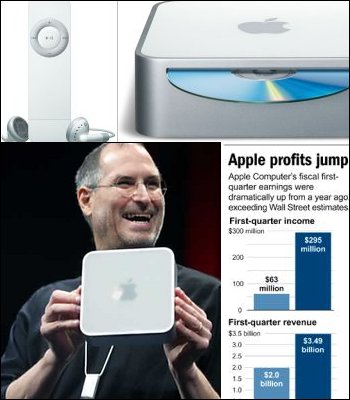
Apple CEO Steve Jobs is taking the concept of "mini" to the Mac computer and a flash-based iPod.
During his keynote Tuesday at the Macworld conference and expo here, Jobs introduced a Mac computer that almost fit into the palms of his hands and that is Apple Computer Inc.'s latest answer for Windows users wanting to switch platforms.
"People understood the iPod mini, and I think they'll understand the Mac mini as well," Jobs said, referring to the 4 GB iPod launched at last year's Macworld.
The Mac mini will be available Jan. 22 in two models that start at $499, Jobs said. It comes without a monitor, keyboard or mouse, instead connecting with a user's existing equipment.
"We supply the computer, and you supply the rest," Jobs said. "We want to price this Mac so that people thinking of switching will have no more excuses."
Apple also is making the iPod even smaller than the iPod mini. Jobs launched the iPod shuffle, Apple's entry into the flash player market that incorporates its song-shuffling technology.
The iPod shuffle began shipping from factories Tuesday. On one end, it includes a USB 2.0 connector that also can be fitted with a lanyard for wearing it around one's neck.
"It is smaller than most packs of gum, and it weighs about same as about four quarters, or under one ounce," Jobs said.
The iPod shuffle comes in a 512 MB and a 1 GB model, priced at $99 and $149, respectively. Along with digital music, it can double as a USB drive and lets users determine how much memory to devote to each function, Jobs said.
Not everything was about miniaturization during Jobs' keynote. He also introduced Apple's productivity suite replacement for AppleWorks in a move that could pit Apple more directly against Microsoft Corp.'s Office suite for the Mac.
The iWork suite builds atop Apple's existing Keynote software for creating presentations by also providing a word processor called Pages. AppleWorks had become outdated because it was developed before the move to Mac OS X and long before Apple's digital-media suite, called iLife, existed.
"We created [iWork] from the ground up to take full advantage of Mac OS X and iLife," Jobs said.
iWork is slated for release on Jan. 22, with pricing at $79. It will include Keynote 2, an update that adds 10 new design themes and expanded animation features.
As for Pages, Jobs called it "word processing with an incredible sense of style."
That's because it not only provides standard word-processing functions but also comes with 40 Apple-designed templates for creating everything from a form letter or brochure to a family newsletter or menu, Jobs said.
In a demonstration, Phil Schiller, Apple's vice president of worldwide product marketing, showed how the templates open with placeholder text, graphics and folders and let users grab photos from iPhoto to insert them into documents. The templates also automatically adjust when users add, move or resize elements.
While announcing few new features for the operating system, he recapped the major changes coming in Tiger, including the Spotlight search capability, Dashboard and an update to QuickTime 7 media player.
Jobs demonstrated some of the information "widgets" planned for Dashboard. Dashboard is a feature that lets user toggle to a display of a range of small applications that can display common information or perform quick tasks.
The widgets included a world clock, dictionary, thesaurus, calculator, measurement converter, and flight and stock trackers. Hundreds of third parties also are creating Dashboard widgets, such as an eBay Inc. auction tracker that Jobs displayed.
"This has evolved into something we think will be a big hit in Tiger," Jobs said of Dashboard.
Discussing Tiger's much-anticipated Spotlight search capabilities, Jobs downplayed the raft of other desktop-search tools hitting the market such as those from major search companies like Google Inc., Yahoo Inc. and Microsoft Corp.s' MSN unit.
Spotlight's key difference, Jobs said, is that it is integrated throughout the Mac OS and into applications such as Apple Mail.
"They're great, but they're nowhere near as great as Spotlight because when you build it into the core OS, you can do things you can't do with a tool sitting to the side," Jobs said.
Meanwhile, stores will open an hour early to support introduction of the new $499 Mac Mini this coming Saturday, when they're introduced, and this might just get PC users like me to make the final switch:
-
That's the hope of Apple whose approximately 100 retail stores are opening an hour early on Saturday as the highly touted and low-priced Mac mini computer and iPod Shuffle portable music player go on sale.
Analysts are betting Apple's mini might just tempt users of rival Microsoft Corp.'s Windows to switch operating systems and go with the Mac and its Mac OS X operating system.
That transition hasn't happened yet despite Apple's "Switch" advertising campaign and in spite of the success of the iPod portable digital music players. More than 10 million have been sold since their introduction more than three years ago. Apple's portion of the worldwide PC market was 2 percent in the fourth quarter, according to preliminary figures from market research firm IDC.
"I believe the Mac mini is actually going to have more of an impact on Apple's market share position than their digital music efforts have so far," said IDC analyst Roger Kay.
Echoing the sentiment, Needham & Co. analyst Charlie Wolf wrote to clients: "The iPod's only failure so far has been its inability to stimulate meaningful purchases of Macintoshes."
With the Mac mini, that could change, and Wolf now estimates that 11 percent of those who have iPods and PCs that use the Windows operating system may shell out the $499 for a Mac mini now that they're available. Before the mini, Wolf had predicted 4 percent could switch.
Apple is opening its stores at 9 a.m. local time on Saturday. Store personnel contacted by Reuters in California, Colorado, Florida and New Jersey said they had been receiving a slew of calls about the mini and the Shuffle.
The Shuffle is Apple's smaller, cheaper version of its market-leading iPod and holds either 120 or 240 songs, costing $99 and $149, respectively.
"Some of this is true demand, but I think some of it's orchestrated, too, by Apple," said Stephen Baker, an analyst at NPD Group.
Apple has long been criticized for pricing itself out of the mainstream with its sleek products, but, now, Apple is changing course.
"The Mac mini opens up lower price points for people who would like to try the Mac platform, and that's long been one of my chief complaints about Apple—the high price," IDC's Kay said.
Steve Jobs, co-founder and chief executive of Cupertino, California-based Apple, said last week, "People who are thinking of switching will have no excuse." Jobs introduced the mini, which comes without a display, keyboard or mouse, at the company's annual trade show on Jan. 11.
Starting at $499, the mini, which is 6.5 inches square and 2 inches tall, is Apple's cheapest computer ever.
Some analysts have said that Apple's blow-out fourth-quarter results offered clear proof of the "halo effect" of iPod sales boosting Mac sales. Kay said he was not so sure.
Apple's fourth-quarter share of the worldwide and U.S. PC markets rose by a mere 0.1 percentage point each, to 2.0 percent and 3.4 percent, respectively.
"That's not a whole lot of share gain, but will the Mac mini help them gain some more?" Kay asked. "I would certainly think so."
But will the new products really gain traction in the marketplace? eWeek's David Coursey thinks so:
-
Here's my immediate reaction:
Mac mini: A $499 Mac ought to be the ultimate "switcher" box. Not that most Windows users actually switch to Macintosh, but many have bought a Mac for use at home. Buy a KVM (keyboard/video/mouse) switch, and the Mac mini can share mouse, keyboard and screen with your PC. This gets users a Mac without a lot of work and for a minimal investment.
Having this machine in the Apple product line allows Mac fanatics to tell their Windows friends that instead of upgrading their Windows machine, they should add a Mac to their desktop or home—and save money in the process.
The downside of the Mac mini may be performance in the graphics-intensive applications toward which Mac users tend to gravitate. I want to see an independent, hands-on review before committing to a final score, but as a preliminary grade, I think an "A" is right on target. I'm about ready to pull out my credit card for this one.
iWork: So, this is the Microsoft Office competitor Apple was rumored to be releasing? Clearly, that's not what this is. But I am looking forward to using iWork nevertheless. First, Keynote is a very useful presentation package, and I've been looking forward to a new version.
Second, the Pages word processor is intended to be a tool that offers more layout options than a word processor without the complexity of desktop publishing. That's a need I often have. For $79, I'd be willing to take a chance on this one. Meanwhile, the Office competitor, if it exists, must wait for another day. A B+ seems appropriate.
iLife '05: Maybe there are features here that I really want and would be willing to pay for, but the Apple Web site isn't very convincing. This looks like Apple's bid to sell customers annual releases of popular software with only minor changes to functionality.
Nevertheless, keep the price low enough, $79 in this case, and some customers will buy. It's hard to upgrade applications whose main virtues are simplicity and a limited feature set, but Apple seems to manage. This one gets a C+, but might be hard-pressed to do better.
iPod shuffle: When I bought my first iPod, it was because the MP3 players available at the time were low-capacity and took a long time to fill with music, thanks to a low connection speed to the desktop.
The iPod Shuffle is low capacity, compared with a "real" iPod, but fortunately it connects at swift USB 2.0 speeds, as well as at the much slower USB 1.1 rate used by the first MP3 players.
Apple is trying to make a virtue out of the fact that the device lacks a screen by making it sound like random playback is an advantage. I don't think so. But I am sure they will sell a zillion of these—just not to me. I give it a C-.
I am sure those still washed in the glow of Steve's keynote will rate all of these products, and especially the iPod shuffle, a full letter grade or higher than I have. But I've been following Apple long enough (and have become cynical enough) that I think I've called these about right.
And now, I am off to order my new Mac mini. Yes, sometimes even I succumb—and at a distance, too.
As for the ongoing controversy over the Think Secret fan site being sued by Think Different, Jim Nash from InformationWeek summed it up nicely in its daily newsletter today:
-
There are missteps that we all make because we don't see something coming, and there are missteps that some of us make because we don't see the big picture. Apple Computer appears to be making the latter in suing a 19-year-old Internet entrepreneur who has the audacity to be a successful journalist.
Harvard undergrad Nicholas M. Ciarelli has for six years operated the Think Secret site, at which he posts product information before Apple wants it released. This is a game that business journalists play with vendors, and more publicity-savvy execs know how to play it well: They do everything in their considerable power to keep secrets secure. When reporters still get the goods, the smarter execs shrug it off and move on.
When Apple subsidizes Macs for schools, it's buying loyalty and, it hopes, market share. But suing a member of that target customer base for being a (perhaps overzealous) Mac enthusiast may send the wrong message to the people Apple wants as customers.
Let's hope that doesn't get in the way of success for an innovative product line. The ThinkSecret.com lawsuit, however, continues to percolate, as 19-year-old Nick Ciarelli seeks out help for his legal defense, including saying, "is that so wrong" to leak previews of tech products, like the rest of the press does with great regularity:
-
Is the technology press abandoning one of its wounded on the battlefield? Where is the righteous indignation on behalf of Nicholas Ciarelli aka Nick dePlume? Mr. Ciarelli is the 19-year old publisher of ThinkSecret.com, a Web site that Apple is suing over an article about a once top-secret $499 Mac. Mr. Ciarelli, a Harvard University student of Cazenovia, N.Y., is now looking for free legal help. He is seeking protection under the First Amendment, although he is not named as a defendant. Going after a member of the press could become a public relations problem for Apple. Technology companies are no strangers to this kind of mildly aggressive journalistic scrutiny.
The technology press has made its bones on breaking stories about not-yet-released products. To a large extent, that's the definition of a breaking story in the tech press. According to Apple, the company is protecting its right to "innovate and surprise and delight people with great products," so they reserve their right to secrecy. But there is also such a thing as freedom of the press. And in the tech world, the two have coexisted fairly well until now. All of the dailies ran the bare bones, just-the-facts wire story of the lawsuit—no editorial comment, no in-house story. Maybe the technology press just needed a moment to catch its breath after having to cover two very exhilarating trade shows back to back.
Meanwhile, Apple's MP3 player rivals were dissing the champ of the category after the screenless Shuffle was announced:
-
The chief executive officer of Creative, the maker of one of the leading contenders to the iPod's crown, has called the iPod shuffle "a big let down", accusing Apple of rehashing "a four year old product… worse than the cheapest Chinese player."
In an interview with Channel NewsAsia, Creative CEO Sim Wong Hoo, claimed the company was not worried about the potential threat posed by Apple's entry into the flash music player market. He called the iPod shuffle "[like] our first generation MuVo One product, without display, just have a shuffle feature."
And, Sim claimed, the product was not likely to impress other competitors. "I think the whole industry will just laugh at it, because the flash people -- it's worse than the cheapest Chinese player. Even the cheap, cheap Chinese brand today has display and has FM. They don't have this kind of thing, and they expect to come out with a fight; I think it's a non-starter to begin with."
According to Apple, the company sold over 4.5 million iPods over the quarter leading up to Christmas, double that of Creative's Zen player – the iPod's nearest competitor. Sim claimed the company was prepared to spend up to $100 million in marketing funds in order to catch up with the iPod.
Plus, there's no love lost between Apple and Dell, as Dell CEO Kevin Rollins called the iPod nothing more than a fad:
-
The chief executive officer of Dell has claimed that the success of the iPod amounts to "a fad", adding that Apple "isn't in the same league" as his own company.
In an interview with Silicon.com, Kevin Rollins claimed the product faced an uphill struggle to capitalize on the success of the iPod and sustain it into the future, drawing parallels with Sony's Walkman. "It's interesting the iPod has been out for three years and it's only this past year it's become a raging success. Well those things that become fads rage and then they drop off. When I was growing up there was a product made by Sony called the Sony Walkman – a rage, everyone had to have one. Well you don't hear about the Walkman anymore. I believe that one product wonders come and go. You have to have sustainable business models, sustainable strategy."
Rollins also claimed that Apple had "done a nice job" with the iPod, but was less impressed with the Mac mini. "It might take some [sales] here and there, but Apple's market share in the global computer business has really shrunk pretty far," he claimed. Despite the number of headlines grabbed by the product, Rollins added, Apple remains a niche player and "isn't in the same league" as Dell.
But all this pales in the glare of Apple's stellar financial results - my brother Derek curses the day I told him to buy AAPL - languishing around 20 a year ago it's in the low 70's today:
-
As the Mac faithful continue to pack the ongoing Macworld Expo in San Francisco, Apple Computer Inc. on Wednesday offered the public some further good news about the company's progress. Boosted by the success of the iPod, the company reported its highest-ever quarterly revenue and net income in its first fiscal quarter.
For the quarter, ended Dec. 25, Apple reported total revenue of $3.49 billion, up from $2.01 billion in the year-ago quarter, a leap of 74 percent. Analysts had forecast revenue of a bit over $3 billion. Apple's net profit grew even more: $295 million, compared with $63 million for the year-ago quarter.
The success of the consumer music player was the difference. Announced by CEO Steve Jobs in his Tuesday keynote address at Macworld, Apple sold about 4.6 million iPods during the quarter, a more than 500 percent rise over the same period last year.
Still, in a conference call with financial analysts Wednesday afternoon, Apple chief financial officer Peter Oppenheimer stressed the positive growth in computer sales.
He said the company shipped 1,046,000 Macintosh units, a 26 percent increase over the year-ago quarter.
The leaders in the CPU field were the iMac and iBook series aimed at consumers and education, up 101 percent and 35 percent compared with the year-ago quarter. Sales of the Power Macintosh G5 rose 7 percent over the previous quarter, while PowerBook G4 sales dropped 29 percent, despite a speed bump in the fall.
The executive said sales to the education market grew 11 percent, bringing its highest quarterly total for that market in seven years.
Questions regarding the success of a "halo," or multiplier effect for CPU sales from its success with the audio player, were posed by analysts. Apple has targeted these "switchers" from the Windows platform in the past several years.
While avoiding a direct answer on the subject, Oppenheimer pointed to the increasing number of such customers in Apple stores. In the quarter, more than 40 percent of Mac buyers in the stores were "new to the Mac," he said.
Best of luck to the Mac-faithful - competition, as we know, is good for innovation, so keep up the good work!
- Arik
January 13, 2005
FBI Virtual Case File = Total Disaster
 The 9/11 commission called a modernized FBI information network "critical to domestic security." But according to officials interviewed for the NY Times lead, "The bulk of the internal reports and documents produced at the [FBI] must still be printed, signed and scanned by hand into computer format each day." Members of the 9/11 commission, along with several senators and even Director Robert Mueller himself, expressed dissatisfaction with the mishandling of the system upgrade, which the FBI claimed would be ready by the end of 2004. (Only 10 percent of the system is now deployed.) The LA Times mentioned one fact the NYT didn't: Since the 9/11 attacks, the FBI has spent $581 million on the ill-fated project.
FBI Director Robert Mueller, members of 9/11 commission and other national security experts agree that success of the effort is critical to domestic security; but the bureau has been criticized for years for not developing a modern system like those developed years ago at Central Intelligence Agency and National Security Agency.
-
The third installment of the Federal Bureau of Investigation's Trilogy technology upgrade program--designed to improve the agency's ability to share information about terrorism and other threats--is looking like anything but a blockbuster. Its Virtual Case File system, the $170 million centerpiece of Trilogy's third phase, lacks the security and overall efficiency required to make it usable, an FBI spokesman says.
"There were inadequacies," an FBI spokesman says. Virtual Case File, originally scheduled for deployment in December 2003, has been plagued by technical problems as the FBI's information sharing needs have evolved over the past few years. In the wake of the Sept. 11, 2001, terrorist attacks, the ability to share information was highlighted as a weakness in the FBI and other agencies. While there were cultural and legal barriers to information sharing, the outdated nature of the FBI's IT systems was also brought to light and cited among the reasons.
The agency in 2001 commissioned government contractor Science Applications International Corp. to build Virtual Case File. The agency will pay the advisory firm Aerospace Corp. to investigate Virtual Case File's problems and determine whether any part of the project can be salvaged. The New York Times reported Thursday that the contract is worth $2 million.
SAIC doesn't accept all the blame for the problems. "The FBI modernization effort involved a massive technological and cultural change agencywide," Duane Andrews, SAIC's chief operating officer, said in a statement. "All parties involved have made mistakes in the way the Trilogy program was handled in the past."
SAIC said it delivered--and the FBI accepted--the first installment of the Virtual File System in December, in what it calls a change in FBI strategy to do the project in a "less-risky, incremental, phased-in" deployment rather than all at once. The FBI has had four different CIOs during the life of Trilogy, SAIC said, and 14 managers on the project that began in 2001, making it "incredibly challenging" to set system requirements.
Part of the problem appears to be that technology is moving faster than the FBI and its contractors. The FBI acknowledges in a document highlighting recent technology improvements that "the pace of technological innovation has overtaken our original vision for VCF, and there are now existing products to suit our purposes that did not exist when Trilogy began."
The FBI in June determined that Virtual Case File wasn't going to meet the agency's needs. Aerospace's job will be to evaluate the project as well as off-the-shelf software and applications designed by other federal agencies to determine how the FBI can best move forward with plans to give agents the ability to better share case-file information.
It hasn't been cheap and won't be getting cheaper anytime soon - an interesting parallel to a lot of the intelligence software deployments in the private sector that haven't planned for changes in needs and technology standards:
-
Since the attacks, Congress has given the FBI a blank check, allocating billions of dollars in additional funding. So far the overhaul has cost $581 million, and the software problems are expected to set off a debate over how well the bureau has been spending those dollars.
The bureau recently commissioned a series of independent studies to determine whether any part of the Virtual Case File software could be salvaged. Any decision to proceed with new software would add tens of millions of dollars to the development costs and render worthless much of a current $170-million contract.
Requests for proposals for new software could be sought this spring, the officials said. The bureau is no longer saying when the project, originally scheduled for completion by the end of 2003, might be finished.
FBI officials have scheduled a briefing today to discuss what a spokesman said was the "current status of FBI information technology upgrades."
A prototype of the Virtual Case File was delivered to the FBI last month by Science Applications International Corp. of San Diego. But bureau officials consider it inadequate and already outdated, and are using it mainly on a trial basis to glean information from users that will be incorporated in a new design.
Science Applications has received about $170 million from the FBI for its work on the project. Sources said about $100 million of that would be essentially lost if the FBI were to scrap the software.
"It would be a stunning reversal of progress," Sen. Judd Gregg (R-N.H.), the chairman of the Senate appropriations subcommittee that oversees funding for the FBI, said in an interview with the Los Angeles Times this week. "If the software has failed … that sets us back a long way.
"This has been a fits-and-starts exercise, and a very expensive one for a very long time," he added. "There are very serious questions about whether the FBI is able to keep up with the expanding responsibility and the amount of new dollars that are flowing into it. We have fully funded it at its requested levels."
A spokesman for Science Applications, Ron Zollars, said via e-mail that the company had "successfully completed" delivery of the initial version of the Virtual Case File software last month. He declined to comment further.
The stripped-down prototype will be running for three months. The bureau plans to then "shut it down, take all the lessons learned and incorporate them in a future case management system," a person familiar with the bureau's plans said.
Science Applications will apparently be no part of that future: Its contract expires at the end of March, and there were no plans to renew it, sources said.
That the software may have outlived its usefulness even before it has been fully implemented did not surprise some computer experts.
An outside computer analyst who has studied the FBI's technology efforts said the agency's problem is that its officials thought they could get it right the first time. "That never happens with anybody," he said.
Some sources sympathetic to the FBI defended the process, and said that what has been learned in designing the software has given the bureau valuable design and user information.
The replacement software may even be called the Virtual Case File, although it is unlikely to bear much resemblance to the product that is being rolled out to about 300 users testing the prototype in New Orleans and Washington. The prototype's main feature allows users to prepare documents and forward them in a usable form.
Eventually, the FBI expects to have software with added features for managing records, evidence and other documents, along with the ability for users to collaborate on documents and share information online.
The move is being engineered by Zalmai Azmi, who has been the FBI's chief information officer for the last year. People familiar with his work say Azmi recognizes that the change in direction is likely to generate political heat but that it will serve the bureau better in the long run.
The development illustrates the problems in keeping up with rapidly changing technology that confront any business, as well as the changing mission of the FBI since the Sept. 11 attacks, among other issues.
Meanwhile, the software troubles continue for the FBI in the wiretapping arena as well:
-
The FBI has effectively abandoned its custom-built Internet surveillance technology, once known as Carnivore, designed to read e-mails and other online communications among suspected criminals, terrorists and spies, according to bureau oversight reports submitted to Congress.
Instead, the FBI said it has switched to unspecified commercial software to eavesdrop on computer traffic during such investigations and has increasingly asked Internet providers to conduct wiretaps on targeted customers on the government's behalf, reimbursing companies for their costs.
The FBI performed only eight Internet wiretaps in fiscal 2003 and five in fiscal 2002; none used the software initially called Carnivore and later renamed the DCS-1000, according to FBI documents submitted to Senate and House oversight committees.
The FBI, which once said Carnivore was ``far better'' than commercial products, said previously it had used the technology about 25 times between 1998 and 2000.
The FBI said it could not disclose how much it spent to produce the surveillance software it no longer uses, saying part of its budget was classified. Outside experts said the government probably spent between $6 million and $15 million.
The congressional oversight reports were obtained last week under the U.S. Freedom of Information Act by the Washington-based Electronic Privacy Information Center, a civil liberties group that criticized the surveillance software after it was first disclosed in 2000.
FBI spokesman Paul Bresson said the bureau moved to popular commercial wiretap software because it was less expensive and had improved in its ability to copy e-mails and other communications of a targeted Internet account without affecting other subscribers.
``We see the value in the commercially available software; we're using it more now and we're asking the Internet service providers that have the capabilities to collect data in compliance with court orders,'' Bresson said.
The FBI said last week it was sending back to the drawing board its $170 million computer overhaul, which was intended to give agents and analysts an instantaneous and paperless way to manage criminal and terrorism cases.
Experts said the life span of roughly four years for the bureau's homegrown surveillance technology was similar to the shelf life of cutting-edge products in private industry.``It's hard to criticize the FBI trying to keep pace with technology,'' said James Dempsey of the Washington-based Center for Democracy and Technology. ``There is just a huge amount of innovation and development going on in the private sector.''
Henry H. Perritt Jr., who led an oversight study of Carnivore in 2000 for the Justice Department, said the FBI originally built its own surveillance system because commercial tools were inadequate. Perritt, a professor at the Chicago-Kent College of Law, said he was unaware of any commercial wiretap software that includes audit features robust enough to convince a federal judge that e-mails from innocent Internet users weren't captured by mistake.
``You'd like to have a package that supervisors within a field office and in Washington could do an audit and make sure they're using the tools compliant with the court order,'' Perritt said.
The FBI laboratory division, which produced Carnivore, was headed by Donald M. Kerr, who left the FBI in August 2001 to become the CIA's chief gadget-maker as head of its science and technology directorate. Kerr told lawmakers in 2000 that Carnivore was ``far better than any commercially-available sniffer.''
Such are, apparently, the risks of deploying intelligence software in the national intelligence community... let's hope the same isn't mirrored in the private sector.
- Arik
January 12, 2005
Search Competitors Gaining on Google
 While Google still reigns supreme, its competitors are on the rebound:
-
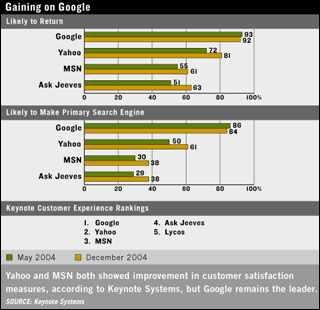
Google’s competitors are showing signs of becoming, well, competitive. Yahoo, MSN, and Ask Jeeves search engines are satisfying more customers, according to a study released by market researcher Keynote Systems, and a growing minority say they plan to make one of those their first stop. This means the race could finally be on in a market where “Google” is synonymous with “search.”
Google is proof that helping users tackle something as simple as finding information online can unlock much bigger opportunities. Yahoo unveiled its own search technology last February, and Microsoft joined the fray last month. Keynote’s study shows MSN pleased users by separating its paid sponsored results from its search results, bringing it in line with Google and Yahoo. That separation has led to fewer advertisement clicks, but more satisfied users that say they will return, said Bonny Brown, director of research and public services at Keynote, based in San Mateo, California.
Some other advances could have influenced the results: Yahoo followed Google and MSN into desktop search earlier this week, and both Yahoo and Ask Jeeves launched local search services, as well as short cuts or smart searches to try to give users more relevant results. My Yahoo and MyJeeves have made searches more personal. MSN also launched MSN Search Beta in November, but it was not used in the Keynote study, which involved 2,000 people selected at random. Four-hundred spent 45 minutes to an hour performing a series of tasks on one site.
Google clearly has a long head start. But the others have been making gains. According to the studies, fewer Google testers—84 percent compared with 86 percent during the first study in May—said they were likely to make Google their primary search. Sixty-one percent of those who used Yahoo said they were likely to make it their primary search, compared with 50 percent in May. MSN went from 30 percent to 38 percent in that category, and Ask Jeeves grew from 29 percent to 38 percent.
But, Google's rivals have a long way to go to catch back up. While actual search results were pretty close, the perceived quality of results leaned toward Google, so that even though they're working on a similar feature set, searchers prefer Google for the customer experience, and that's more about branding than technology. Daniel Read, product management VP at Ask Jeeves said, “We think the technology gap has more or less closed now amongst the four key players. Now the brand gap is what needs to close and you can see that is happening now.” After Google in the overall rankings were Yahoo in second, MSN in third, Ask Jeeves fourth and Lycos fifth. Local search appears to be an opportunity for Yahoo:
-
For all three top Google competitors, the future is looking brighter. That's because they all made strides against Google in key indicators of future usage, Keynote found.
When it comes to the likelihood of users to return to a search site, the likelihood for Yahoo increased 9 percentage points since May to 81 percent. The same measure increased 6 percentage points to 61 percent for MSN and rose 12 percentage points to 63 percent for Ask Jeeves, Keynote reported.
A similar pattern was seen in consumers' likelihood to make the sites their primary search engines. Google still led, with 84 percent of consumers likely to make it their primary site. But Yahoo jumped 11 percentage points to 61 percent in that category, while MSN increased 8 percentage points to 38 percent. Ask Jeeves also reached 38 percent, a 9 percentage point jump from May.
The shifting search numbers point to the tenuous nature of loyalty in the search market. Keynote estimates that half of consumers will turn to another search engine if their expectations are not met.
In the hotly contested local search segment, Yahoo showed strength. All of the major engines, except Microsoft Corp.'s MSN division, have launched sites in the past year for finding business listings and other geographic-specific information.
Yahoo gained enough traction in local search to tie with Google in that category of the study, according to Keynote. That gain came even as 22 percent of users complained that search engines in general are not returning relevant or well-ranked local information.
A shift in the way it deals with paid listings seemed to have paid off for MSN. In July, it reduced the number of sponsored listings appearing atop Web search results and altered design elements to better distinguish paid listings.
As always, competition is a good thing - let's hope the trend continues and a balance of power in the search arena might be sustainable.
- Arik
January 11, 2005
BenQ's Treo Killer
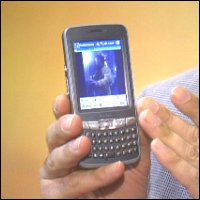 One big product announcement from the Consumer Electronics Show was from BenQ, in the form of its GSM Pocket PC P50, which CNet thinks could just be enough to make otherwise erstwhile Treo 650 buyers reconsider their purchase, because of the integrated Wi-Fi and bigger memory:
-
The product: BenQ may not be well known for its cell phones or its smart phones, but we're betting that that's about to change with the introduction of its P50 series. This Windows Pocket PC smart phone features an integrated keyboard, a 2.8-inch vibrant color screen (262,000 hues), and a 1.3-megapixel camera in a compact, candy bar style. But wait, there's more: It has 64MB of memory, integrated Bluetooth and Wi-Fi, and audio playback (WAV, MP3, WMA, and more). Other goodies include:
- Quad-band GSM 850/900/1800/1900; GPRS; world phone
- SDIO/MMC expansion slot
- Video recording (MPEG-4, WMV, .3GP)
- E-mail, text, and multimedia messaging
- Speakerphone and conference calling
- 64-chord polyphonic ring tones
- Rated talk time of 3 to 5 hours and standby time of 120 hours
The prospects: Can we say Treo killer? Yes, it's been noted before, but we think the BenQ P50 series has what it takes to battle the current smart phone king. The memory and Wi-Fi alone give this puppy an edge over the Treo 650, but we'll have to wait and see how this mobile actually performs in our tests. The P50 series will be available in late Q2 2005, but pricing and carrier have not yet been determined.
I'm still holding out to see how Cingular executes on the Treo 650 - if they fumble the adaptation to the GSM network, it could be enough to make me change my purchase plans.
- Arik
January 10, 2005
Red Herring’s 2004 IPO Market Robust
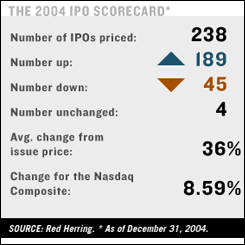 Google was neither the biggest, nor the sharpest pop, but 2004 represented a big rebound in IPO activity, according to Red Herring:
The 10 largest IPOs of 2004
· Genworth Financial ($2.83 billion)
· Assurant ($1.76 billion)
· Semiconductor Mfg International ($1.71 billion)
· Google ($1.67 billion)
· Freescale Semiconductor ($1.58 billion)
· China Netcom Group ($1.03 billion)
· Dex Media ($1.01 billion)
· Assured Guaranty ($882 million)
· NAVTEQ ($880 million)
· DreamWorks Animation SKG ($812 million)
Top 10 sharpest opening-day gains of 2004
· JED Oil (up 103.6 percent)
· Arbinet-thexchange (up 65.7 percent)
· Las Vegas Sands (up 60.6 percent)
· Shopping.com (up 60 percent)
· MarketAxess Holdings (up 59 percent)
· salesforce.com (up 56.4 percent)
· Eyetech Pharmaceuticals (up 54.3 percent)
· PortalPlayer (up 51.8 percent)
· 51job (up 51.1 percent)
· Cogent Systems (up 49.8 percent)
Top IPO industrial sectors for 2004
Companies from 52 industrial sectors priced IPOs during 2004.
Among the top 10 sectors were:
· Technology (including computer, semiconductor, software, and technology): 49 IPOs that raised $8.4 billon. The average opening-day gain was 17.4 percent. On December 31, the average gain was 50.83 percent from their initial offering prices. The 52-week Dow Jones Technology Index was up 1.37 percent.
· Pharmaceuticals: 25 IPOs that raised $1.5 billon. Average opening-day gain: 9.87 percent. On December 31, the average gain from their initial offering prices was 9.42 percent. The 52-week Dow Jones Pharmaceutical Index was down 10.2 percent.
· Internet: 19 IPOs that raised $3.1 billon. Average opening-day gain: 21.96 percent. Average gain at year-end from their initial offering prices: 87.2 percent. The 52-week Dow Jones Internet Services Index was up 60.8 percent.
· Medical equipment: 18 IPOs that raised $1.1 billon. Average opening-day gain: 10.7 percent. On December 31, the average gain was 28.5 percent from their initial offering prices. The 52-week Dow Jones Medical Equipment Index was up 13.7 percent.
· Semiconductors: 15 IPOs that raised $1.1 billon. Average opening-day gain: 7.69 percent. Average gain at year-end from their initial offering prices: 6.03 percent. The 52-week Dow Jones Semiconductor Index was down 21.7 percent.
· The Nasdaq Composite Index was up 8.59 percent for the year.
- Arik
January 09, 2005
Exergaming & Exertainment at CES Cardio PlayZone
 If you’ve decided to lose a few pounds as your New Year’s Resolution, but don’t want to give up video games, there’s a way to do both, as demonstrated at last week’s Consumer Electronics Show in Las Vegas:
-
Company executives insist that "exergaming" or "exertainment" — the marriage of physical exercise and video gaming — is becoming a hot new niche, and the most bullish aficionados say it might even help reduce the nation's obesity epidemic.
The four-day International Consumer Electronics Show, which ended Sunday, sponsored its first-ever "Cardio PlayZone" section for fitness-themed companies.
The PlayZone was tucked into a back corner of a tent outside the main convention center, far from the gargantuan exhibits by Samsung, Sony, Panasonic and other popular brands.
Although scents reminiscent of a gym sometimes wafted out of the zone, the jam-packed area was popular with retailers and analysts. Six exhibitors — many startups new to CES — showed off digital putting greens, optical sensors in miniature dance floors, biofeedback devices and cutting-edge workout contraptions.
One race car simulation contraption — "Kilowatt SPORT" from Laurel, Md.-based startup Powergrid Fitness Inc. — looked similar to a NordicTrack cross-country ski machine hooked up to a wide-screen plasma television.
Moving the hand controls while trying to stand up straight on the $800 machine requires extensive flexing of the muscles in the arms, back, abdominal area and thighs.
But most of the PlayZone devices, often played on PlayStations and Xboxes, didn't feel like exercise at all — exactly what many exertainment companies like to hear.
"The most common question I get is, 'How is this exercise? I just don't see how this is a workout,'" said Abigail Whitting, customer support manager for Kilowatt, which won a CES innovation award. "But it will tone you. It is a workout."
Some exertainment executives say their gizmos can help trim the nation's expanding waistline — especially among children, who might be tricked into working out if they think they're merely playing a video game.
According to the Centers for Disease Control and Prevention, 16 percent of boys and 14.5 percent of girls ages 6 to 11 were obese in 1999 and 2000, the latest years studied. That compares with 4.3 percent of boys and 3.6 percent of girls from 1971 to 1974. A sedentary lifestyle was a big contributor to the increase, the CDC said.
"If anything can get your kids off the couch, this is it," said Shawn Clement, North American sales manager for Electric-Spin Corp., the Canadian maker of the $249 "Golf LaunchPad." "The whole idea is to get physical, not get lazy."
LaunchPad includes a small putting green with optical sensors within the turf and a tethered, regulation-weight ball that players knock off a standard tee. Players use their own clubs.
Its software has a swing analysis to measure the ball's speed, curve path and other statistics based on the club's trajectory. Serious players may disconnect the tether and use a real ball at an outdoor course, then get real-time analysis of each swing from a laptop computer.
"This is a great way to promote activity," Clement said. "It's not just your average video game."
But medical experts are skeptical. Although they applaud manufacturers for getting people off the couch, they caution against relying on technology alone to slim and tone the record number of out-of-shape Americans. They say individuals, communities, private industry and governments should work together to tackle the problem.
"These video games are certainly helpful but they're not going to solve the obesity epidemic because it's simply too overwhelming," said Frank Hu, a professor of nutrition and epidemiology at Harvard.
Hu authored a study published last month of 116,500 women, finding that people who were physically active but obese were almost twice as likely to die as those who were both active and lean. The Harvard report contradicted a popular notion that exercise alone — regardless of weight or diet — is enough to maintain a healthy lifestyle.
But experts' pessimism didn't dampen enthusiasm of Jason Enos, product manager for Konami Digital Entertainment, who soaked through his T-shirt after hours of demonstrating his company's smash hit, "Dance Dance Revolution." Players tap their feet to the correct circle on a floor pad, based on cues on the screen.
Dancing and golf are alright, but they need a version of “Halo” for the XBOX to get me in.
- Arik
 "Competitive Intelligence applies the principles of competition and lessons of intelligence to the need for enterprise awareness and predictability of market risk and opportunity. CI has the power to transform an enterprise from also-ran into real winners with agility enough to create and maintain sustainable competitive advantage."
