November 20, 2004
FDA Whistleblower: Broad Consequences of Merck’s Vioxx Means Overhaul of Drug Approval and Regulatory Process

Back in September, when Merck pulled Vioxx for safety concerns, observers predicted it’d mean a bunch of new investigations into drugs thought to have the same risks attached. So, it really comes as no surprise to see controversy after Senate Finance Committee testimony of the noted FDA safety expert. Graham said the safety profile of a number of currently marketed drugs should be closely examined. Pfizer's COX-2 inhibitor Bextra, similar to Vioxx, was mentioned, as were AstraZeneca's cholesterol-lowering statin Crestor, Roche's acne treatment Accutane, GSK's asthma medicine Serevent and Abbott's weight loss drug Meridia.
The NYTimes.com had the best coverage:
Critics of the F.D.A. have said that studies from as early as 1999 and 2000 showed that Vioxx was a risk to the heart, and many asked why the F.D.A. had not forced the drug's withdrawal earlier.
The critics' case has been bolstered by many e-mail messages from Merck and by company documents disclosed in lawsuits by users of Vioxx. In many of the documents, Merck executives and scientists discussed the possible link between Vioxx and heart damage years before the company publicly admitted that the drug could cause harm.
Merck executives have said the documents are being taken out of context.
Raymond V. Gilmartin, Merck's chief executive, testified Thursday that his company followed a ''rigorous scientific process'' as it examined the risks and benefits of Vioxx.
But Dr. Graham and other witnesses severely criticized Merck, saying the company should have acted years earlier to confirm the risks of Vioxx. Dr. Graham raised his estimates of those in the United States who had suffered heart attacks or stroke as result of taking Vioxx to a range of 88,000 to 139,000, up from 28,000. As many as 40 percent of these people, or about 55,000, died as a result, he said.
Dr. Gurkirpal Singh, an adjunct clinical professor at Stanford University, said at the hearing that Merck scientists had tried to intimidate him after he publicly raised questions about the effects of Vioxx.
Dr. Singh, a rheumatologist and science officer of the Institute of Clinical Outcomes Research and Education in Woodside, Calif., said: ''I was warned that if I continued in this fashion there would be serious consequences for me. I was told that Dr. Louis Sherwood, a Merck senior vice president and a former chief of medicine at a medical school, had extensive contacts within academia and could make life very difficult for me at Stanford and outside.''
Dr. Graham said that in his years at the F.D.A., he had recommended that 12 drugs be withdrawn. Only two are still being sold, he said.
His list of the five most worrisome drugs angered pharmaceutical makers, although objections to most of these drugs have long been known. For instance, Accutane, a drug for severe acne, can cause birth defects. The drug's label has warnings about this risk, and the F.D.A. has long been trying to get physicians to confine prescriptions to those women who cannot become pregnant or who are taking birth control.
Dr. Graham said that the F.D.A. needed to do a better job restricting the drug's sales.
Carolyn Glynn, a spokeswoman for Roche, which makes Accutane, said that her company had worked with the F.D.A. for years to ''address the risk of birth defects.''
Dr. Graham mentioned Crestor because, he said, it was the only cholesterol-lowering drug on the market that caused acute kidney failure. And the drug is more likely to cause a serious muscle-weakening disease than similar drugs, he said.
AstraZeneca introduced Crestor last year, but sales have been disappointing largely because of worries about the drug's safety. Public Citizen, a Washington advocacy group, has called for it to be withdrawn.
''We are confident in the safety profile of Crestor,'' said Rachel Bloom-Baglin, a spokeswoman for AstraZeneca. ''To date, the F.D.A. has not given us any indication of a major concern regarding Crestor.''
But Dr. Kweder of the F.D.A. told the panel that Crestor's risks are ''something that we are in the process of and have been evaluating very, very closely.''
Studies of the painkiller Bextra, also mentioned by Dr. Graham, have shown that it increases the risks of heart attack in patients undergoing cardiac surgery. In rare cases, the drug can also cause a fatal skin reaction. Despite these risks, Bextra, which is similar to Vioxx, has never been proved to be any more effective at reducing pain or protecting the stomach than older medicines like ibuprofen that are a fraction of the price and pose none of these suggested or proven risks.
Susan Bro, a spokeswoman for Pfizer, the maker of Bextra, said that the drug ''has been found to be safe and effective when used as indicated to treat osteoarthritis, rheumatoid arthritis and menstrual pain.'' She said the F.D.A. planned to ask a panel of experts early next year to examine the safety of Bextra and Celebrex, a Pfizer pain drug.
Meridia is a weight-loss pill, made by Abbott Laboratories, that can cause substantial increases in blood pressure in some patients. Public Citizen has called for Meridia's withdrawal because it has been associated with 124 reports of serious cardiovascular problems, including 49 deaths, said Dr. Sidney Wolfe, director of Public Citizen's health research group.
Dr. Graham testified that few patients were able to withstand Meridia's side effects long enough to benefit from its use. ''What's the utility of the drug?'' he asked.
Laureen Cassidy, a spokeswoman for Abbott, said, ''Science continues to support the safe use of Meridia as a treatment for obesity.''
The fifth drug named by Dr. Graham was Serevent, an asthma medication made by GlaxoSmithKline, which stopped a large trial last year after an interim analysis revealed an increased risk of asthma-related deaths and life-threatening episodes among those given the drug.
''We have case reports of people dying clutching their Serevent inhaler,'' Dr. Graham said.
After the study was released, the F.D.A. placed a ''black box'' warning, its most severe, on the drug's label. The agency concluded that the drug's benefits outweighed its risks.
In a statement Thursday, GlaxoSmithKline said that it ''stands firmly behind Serevent, which is safe and effective when used appropriately and in accordance with labeling and treatment guidelines.''
Dr. Galson of the F.D.A. emphasized that the drugs mentioned by Dr. Graham ''are all approved and are safe and effective like other drugs that are approved, recognizing that safe does not mean risk-free.''
Dr. Kweder of the F.D.A. defended the agency's handling of Vioxx and said that Merck had ''acted responsibly'' when it sold Vioxx. She said that Dr. Graham's estimates of Vioxx's toll were simply mathematical guesses and ''not real deaths.'' And she said that it was not unusual when a drug went on the market ''to have ongoing concerns about particular aspects of its safety.''
In his testimony, Mr. Gilmartin of Merck retraced many of the steps his company had undertaken and noted that while some early studies suggested that the drug might be a risk to the heart other studies found no problems. He said he believed so thoroughly in the drug that his wife took it until the day the company withdrew it.
That's a huge swath of drug areas and really illustrates the scope of the situation - could it be that the Vioxx scandal's true consequences are the tearing down and rebuilding of the whole regulatory process for new drugs? Let's hope a way can be found to make sure regulators don't get in the way of promising therapies, but it's obviously necessary for drugs to be proven safe BEFORE they reach the market. And, that's going to be one tall order.
- Arik
November 19, 2004
Mumbai (Bombay) India

- Arik
November 18, 2004
Will Howard Stern Save Satellite Radio & Doom Public Airwaves in the Process?
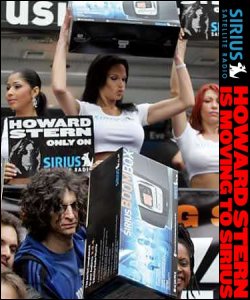 Flanked by strippers and personalities from his show, radio host Howard Stern spoke to thousands gathered in New York's Union Square where 500 Sirius satellite radios were given out, November 18. After years of FCC fines and content controversy, Stern will broadcast his show on the subscription-based Sirius for five years beginning in 2006. And, he's likely to get a lot longer leash from the FCC, as cable has in TV broadcasting. For the newly initiated, PCMag's Lance Ulanoff had a nice rundown:
-
For those unfamiliar with satellite radio, let me explain a bit. It's a now 12-year-old technology that offers 24-hour-a-day, commercial-free listening on dozens of stations that are divided up by genre--not by location. This means you can listen to your favorite country-music station no matter where you are and never lose a signal as you cross state lines. The content is more or less like the hundreds of niche channels available on cable. Want to listen to comedy 24/7? Satellite radio's got you covered. The two main players in the game, Sirius and XM Satellite, have been fighting tooth and nail for years and are finally starting to see some traction. XM surpassed the million-subscribers mark late last year, with Sirius trailing behind with nearly half a million subscribers as of May.
Now Howard Stern, a nationally syndicated radio personality who I've listened to for over 20 years, is leaving the analog radio world (in 2006) to dive—or rocket—head-first onto the Sirius satellite network. Upon hearing the news, I reflexively began investigating buying a satellite radio unit. I'm particularly intrigued by the devices that go from your car stereo system to your desktop like the Delphi XM SKYFi radio and XM's new truly portable MiFi (I'm aware that these devices will not carry Howard, but I hope to find similar capabilities in hardware that supports Sirius). I still have misgivings about the annuity, but I cannot imagine a morning without Stern. The fact that I'm considering shouldering the extra fiscal burden to maintain my auditory connection to a man many people consider vile is remarkable to me and should be heartening news for the satellite radio industry.
On the one hand, I now imagine legions of fearful radio listeners like me preparing for the day Stern leaves the free airwaves, attempting to convince their spouses that the extra expense is worth it and necessary for their well being. On the other hand, Stern may have miscalculated. What if no one follows him?
But, we’ll see if Stern can crush what most Americans call radio on the public airwaves, as he’s vowed to do. Some LA area FM broadcasters requested an obscenity provision October 28, days after Stern announced he was moving to satellite radio. Stern said he's leaving Infinity Broadcasting, the country's No. 2 public radio operator and a Viacom business unit, when his current employment contract expires in part because of the government's recent crackdown on television and radio programming deemed indecent.
In making his announcement, Stern railed against public radio and said he would try to destroy it when he joins Sirius. Broadcasters’ rep Saul Levine told Broadcasting & Cable magazine that he was alarmed by Stern's pledge and "decided to fight back to protect the radio industry" by launching the obscenity provision with the FCC. Looks to me like it's shaping up to be quite a fight.
- Arik
 "Competitive Intelligence applies the principles of competition and lessons of intelligence to the need for enterprise awareness and predictability of market risk and opportunity. CI has the power to transform an enterprise from also-ran into real winners with agility enough to create and maintain sustainable competitive advantage."
