November 05, 2004
Bush Wins, Kerry Concedes – Democrats Enter First Stage of Grief; Ponder Own Future
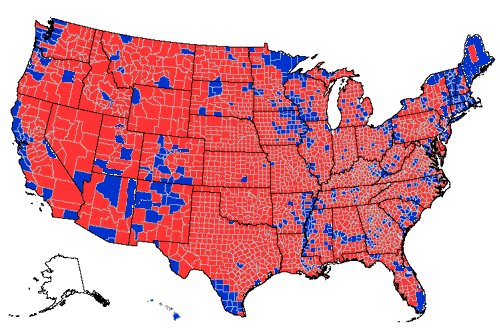
 Bush pulled it out in Ohio the other day and Kerry has finally conceded defeat, rather than await another round of uncertainty a la 2000. But it remains to be seen whether Bush or Kerry was the lesser of two evils. I was mostly interested in the demographic split – take a look at the county-by-county overlay of the 2004 election:
compared with the 2000 swing:
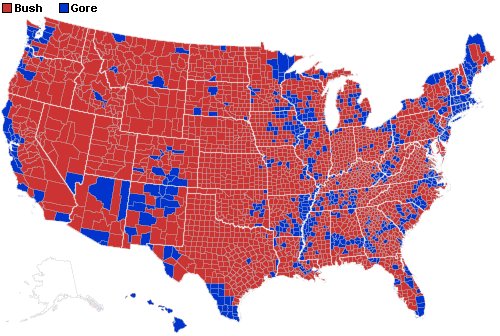
Predictably urban counties went blue, while crimson painted the countryside, but I found it a great comparison of the impasse that presents itself that we need to overcome. Other than that, here’s my list of the most interesting analyses over the past few days on the outcomes and what’s next for the Democrats – the lefties at Alternet seem to be getting gradually more depressed as time wears on:
- Alternet: Election 2004 – Too Close to Call
- Alternet: Election 2004 – The Day After
- Alternet: Election 2004 – The Deepening Divide
- Alternet: Election 2004 – The Unbearable Darkness of Being
- Alternet: Election 2004 – Answers? Do We Have Answers?
- Alternet: Election 2004 – Anatomy of a Crushing Political Defeat
- Alternet: Election 2004 – Mourning in America
- Alternet: Election 2004 – The Values Ploy
- Alternet: Election 2004 – One Country, Two Moralities
But, liberals tend toward navel-gazing in the face of defeat – or is it “progressives” now? – anyhow, we're all probably due at least a little soul-searching… more mainstream sources consider the degree of mandate Bush (and Republicans more generally) received and somewhat more realistic assessments of where Kerry left the rails, but as you’ll see from the URLs below, Slate.com had (at least in my opinion) the very best of it:
- For Bush/GOP: A Validation
- Key Ballot Measures Go Arnold’s Way
- What next for the Democrats
- Victory Bears Out Emphasis on Values
- 11 States Back Bans on Gay Unions; Georgia, Ohio Bar Partner Benefits
- Democratic Values - How to start winning the red states.
- Why Americans Hate Democrats—A Dialogue - Depressed liberals analyze what ails them.
- Whither Liberalism Again - Here comes the usual bad advice.
- Simple but Effective - Why you keep losing to this idiot.
- Why Kerry Lost - He was good, Bush was better.
- Something Nice About Bush - Chatterbox extends an olive branch.
- Brits to America You're Idiots! - Well, 51 percent of you, anyway.
- A crazy British plot to swing Ohio to Kerry – and how it backfired.
- Why Democrats Should Be Thankful - At least they don't have to clean up the Bush fiscal catastrophe.
- Moving to Canada, Eh - Let Slate help you decide if it's really for you.
- The Gay Marriage Myth - Terrorism, not values, drove Bush's re-election.
There’s always 2008. But, as Will Saletan emphasizes, Hilary Clinton shouldn't be the "man" for the job there – despite her speech the other day where she invoked Jesus more times than I can remember in the rest of her public life all together. Jesus apparently sells this election season... But could John Edwards really be the Democrats’ answer to Bush's plainspoken simplicity?
Whatever they decide, I prefer the much more light-hearted and pragmatic Needlenose approach to the “Six Stages of Grief” (as opposed to the more traditional five).
- Arik
November 02, 2004
Vioxx: Even Worse than We Thought
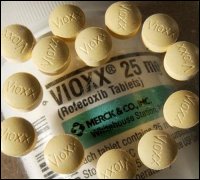 It's even worse than we thought - Merck shareholders take it on the chin again - here's USA Today's rundown:
-
Shares of Merck plunged more than 7% Monday after a report said the pharmaceutical giant apparently hid or denied evidence for years that its blockbuster arthritis drug Vioxx causes heart problems.
Merck, one of the world's top five drug makers, pulled the arthritis and acute pain drug from the market worldwide Sept. 30, saying it was acting in patients' best interest. Vioxx has been taken by about 20 million Americans and accounted for 11% of Merck's total revenue.
On Monday, Merck shares were down 7% after The Wall Street Journal reported that internal e-mails and marketing materials show the company knew as far back as 2000 that Vioxx was linked to an increased risk of heart attack but tried to discredit such evidence.
The newspaper says that a March 9, 2000 e-mail from Merck research director Edward Scolnick to colleagues conceded an elevated risk of heart attack and stroke was "clearly there." Nevertheless, the newspaper says, Merck continued to try to discredit academic researchers critical of the drug.
The Journal reported that one training document from Merck listed potentially difficult questions about the drug and stated in capital letters, "DODGE!"
Ted Mayer, a lawyer representing Merck, told the Journal that the e-mails and marketing materials were "taken out of context" and "do not accurately represent the conduct of Merck and its employees."
Merck shares had been trading in the $45 range until the drug was taken off the market. The stock plunged to the mid $30s that day.
But the BBC mentioned the real evidenciary consequences for Merck in potential class action lawsuits:
-
Merck already faces patient lawsuits, filed after its decision to recall the drug in September. Investors now fear that the picture could be grimmer and the potential costs higher.
The Wall Street Journal quoted internal company e-mails, including one from Merck's head of research Edward Scolnick in March 2000 to colleagues saying that cardiovascular problems with Vioxx "are clearly there".
"If the e-mails actually exist and say what they are purported to say, they appear at least superficially to be a smoking gun that lawyers could pull up as evidence against Merck," said drug industry analyst Trevor Polischuk of Orbimed Advisors.
The result is likely to be more litigation, though he believes it may be difficult for Vioxx users to prove the drug harmed them given that many will have had pre-existing heart problems.
Credit rating agency Standard and Poor's said it may downgrade Merck's credit rating and is seeking a meeting with the firm's management to discuss Merck's "long-term ability to retain its credit strength".
The agency said its actions "reflect Standard and Poor's increasing concern about the magnitude of possible litigation" over Vioxx.
Datamonitor had a great analysis of the situation that looked at competitive implications:
-
With the higher potency, and lower gastrointestinal side effect profile of Vioxx compared to Celebrex (celecoxib) being speculatively linked to its poor cardiovascular side effect profile, physicians may now be reluctant to prescribe the second generation products.
While a significant proportion of existing Vioxx users are expected to switch to another COX-2 product, particularly those that had been prescribed Vioxx as second line therapy after having failed on traditional NSAID therapy, Celebrex is expected to be the key beneficiary of this, and not the newer drugs.
Pfizer itself has reinforced this view, by immediately responding to Merck's announcement by turning the spotlight on Celebrex, re-affirming the drug's safety profile and guaranteeing its availability for current Vioxx users, while making little mention of Bextra. This action is particularly intriguing considering Pfizer's previous strategy had been to position Bextra, not Celebrex, against Vioxx. Perhaps the company feels that in the current environment of heightened safety fears, Celebrex's key marketing message of long-term experience and safety is more appropriate than Bextra's "powerful medicine" tag.
A key uncertainty that remains is to what extent this event will drive physicians to reconsider their use of COX-2 products, which have come under fire recently as many healthcare payors, such as insurance companies in the US and NICE in the UK, have questioned whether their high cost, compared with traditional NSAIDs, is justified. The key defense of leading players Merck & Co and Pfizer has been that the lower incidence of gastrointestinal complications associated with COX-2 products actually increased the cost effectiveness of these medications. With suggestions that Celebrex is inferior to Vioxx in this respect, the removal of Vioxx from the market may see physicians question this defense, and increasingly opt for traditional NSAIDs plus a proton pump inhibitor (PPI) for patients at risk of gastrointestinal side effects.
The views of key opinion leaders have differed widely in this respect, with industry opinion leaders seemingly holding diverse views on the precise impact of Vioxx's withdrawal. This uncertainty is unlikely to be resolved until prescribing data becomes available. Datamonitor expects Celebrex to pick up a significant share of existing Vioxx patients, but anticipates the COX-2 market as a whole to decline, as fewer new patients are prescribed COX-2 products.
Prior to the withdrawal of Vioxx, Datamonitor forecast the COX-2 market (defined as Bextra, Celebrex, Vioxx, Dynastat, Arcoxia, Prexige and Mobic), to grow at a CAGR of 2.8% between 2004 and 2010, reaching sales of $9,099 million. This forecast has now been reduced to $7,056 million in 2010, representing an average annual decline of 0.4% between 2004 and 2010, as a proportion of Vioxx patients leave the COX-2 market, and with lower uptake of premium priced products Bextra and the pipeline COX-2s among new patients now anticipated.
Despite expecting the COX-2 market to remain static, two key COX-2 products are expected to directly benefit from withdrawal of Vioxx. Forecasts of both Pfizer's Celebrex and Abbott/ Boehringer Ingelheim's Mobic (meloxicam) have been increased following this event.
The key factor driving Mobic's success lies in its differentiation from the remainder of the COX-2 market. While the drug has some selectivity for cyclo-oxygenase II, and therefore may be associated with a lower rate of gastrointestinal adverse events than other NSAIDs, it is not a specific COX-2 inhibitor. Abbott and BI may therefore be able to distance the drug from association with cardiovascular side effects in a way that some of the true COX-2s may struggle to. Although this product is expected to suffer from generic competition in 2005, until that time, sales are expected to be boosted by patient switching from Vioxx. Forecasts for 2005 sales for this product are $996 million, compared to the previously forecast $442 million.
In the case of Celebrex, Pfizer's marketing strength will ensure this product is a key beneficiary among those patients currently taking Vioxx that will be switched to another COX-2. The 2005 forecast for this drug has raised from $2,472 million to $3,677 million, as it benefits not only from direct patient switching from Vioxx, but also from reduced competition from Bextra and other new COX-2s.
Initial data, according to a report in the Wall Street Journal, suggests that of the 2.4% of Vioxx users that switched drugs within 24 hours of the announcement, 58% received either Celebrex or Bextra.
Merck & Co.'s ethical revenues amounted to $22,485 million in 2003, and were forecast to decrease at an average annual rate of 0.4% between 2003 and 2010, due to the loss of patent protection of three of its five blockbuster drugs, Zocor (simvastatin), Fosamax (alendronate) and Cozaar (losartan).
With Vioxx off the market, Merck will lose one of its only two blockbuster drugs not to face patent expiry in the short to medium term, with Singulair (montelukast) being the other. Without Vioxx, and with Arcoxia's prospects being significantly reduced, Merck's ethical sales are forecast to fall at a faster CAGR of 1.7% to 2010, recording sales of $20,502 million in 2004, $22,139 million in 2007 and down to $19,969 million in 2010.
Meanwhile, Pfizer's ethical sales forecast has received a boost from this event, and is now forecast a CAGR of 2.7% between 2003 and 2010, taking ethical sales to $47,649 million, up slightly from the previous forecast of 2.6% taking sales to $47,569 million. Pfizer is also expected to suffer from generic competition to several of its major brands over the forecast period, with all of its nine blockbuster products in 2003 facing patent expiry, except for Viagra (sildenafil) and Celebrex. Pfizer will therefore be watching development of the COX-2 market keenly following this event, and will do all it can to protect revenues in its COX-2 franchise.
The competitive positioning of Pfizer and Merck & Co. has diverged over the past few years and the loss of Vioxx will accelerate this process. From being the number one pharmaceutical company in terms of ethical sales in 1999, by 2002, Merck had dropped to third place, $7.9 billion behind GSK and $6.8 billion behind Pfizer. Then, in 2003, a $17 billion gap opened up between Merck and previous nearest rival Pfizer, following the latter's acquisition of Pharmacia. By 2010, Merck was forecast to fall to 7th position, but following the withdrawal of Vioxx, The company is now forecast to drop to 9th position, as a combination of loss of Vioxx and generic competition to its other leading brands takes its toll.
Merck & Co. has historically been resistant to a merger, and as recently as November 2003, it was busy denying rumors that it was to acquire partner Schering-Plough. However, M&A may now be the only way for Merck to achieve growth in the increasingly competitive pharmaceutical market. Schering-Plough, with its ethical sales forecast to grow at a CAGR of 5% between 2003 and 2010 (well above the average of 2.9% for the top 10 pharmaceutical companies), would indeed boost Merck's growth prospects. Whether Merck will be in a position to make any major acquisitions in the light of Vioxx's withdrawal and the likely litigation costs associated with this is another matter.
But I think the whole market is essentially a trainwreck... watch Celebrex and Bextra - there're rumblings about the FDA needing to yank more drugs off the market and that'll have big consequences for everyone in this business. I just wrote an article for SCIP's Competitive Intelligence Magazine about the implications of the Vioxx situation, alongside the Oracle/PeopleSoft consequences, and Section 409 of Sarbanes-Oxley. As always, I'd be interested in any feedback. I'm doing a presentation in a couple of weeks at CBI's Philadelphia "Pharmaceutical Decision Support" Conference on corporate governance, so Merck and SarbOx are very timely topics.
- Arik
November 01, 2004
Washington Redskins Fall to Green Bay Packers (28-14): Could Controversial Outcome Mirror Tomorrow’s Presidential Election
-
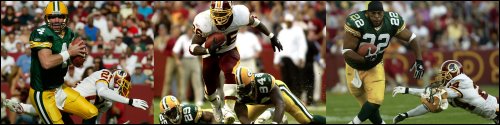
The arcing pass from Mark Brunell fell gently to Clinton Portis in perfect stride as the running back emerged from a fog of bodies, sprinted past the Green Bay defense and launched himself across the goal line for a 43-yard touchdown, leaving the Washington Redskins just an extra point away from taking the lead yesterday afternoon with less than three minutes to play.
Washington had been facing third and eight and trailing 20-14, but as delirium spread through FedEx Field and exhausted offensive linemen chased Portis around the end zone seeking to join in his celebration, the officials were collaborating in the backfield, where a flag had been thrown. This was Washington's biggest play of the season -- the kind of sequence that can propel a middling team on to greater things and re-ignite a stumbling offense -- but in the eyes of the NFL, none of it ever occurred.
The officials called an illegal motion penalty against wide receiver James Thrash, who was in motion on the play, a decision that left the Redskins both confounded and vexed. Brunell (25 of 44 for 218 yards, 2 touchdowns, 2 interceptions), scorned by the crowd throughout the game, was no longer redeemed, and threw an interception on the next play. Green Bay added a touchdown and two-point conversion on that drive to secure a 28-14 win, handing Coach Joe Gibbs another stinging defeat and dropping his team to 2-5, alone in last place in the NFC East.
"Our season was on the verge of just turning around if we win that game," tackle Chris Samuels said. "If Clinton's touchdown was good. But unfortunately they made the call. That's what they thought. There's nothing we can do about that now."
Washington's coaches left the stadium last night unsure of why the officials threw that flag. Gibbs said he was told initially that Portis was observed moving at the line of scrimmage, but the coaches were adamant the runner was set. Another official told Gibbs that Thrash was the culprit and either did not come to a complete stop while in motion or was lurching over the line; Thrash was involved in pass protection on the play and did not go out for a pattern.
"I've got to tell you, it's an absolute mystery to me," Gibbs said of the call. Thrash was similarly confused. "I think [the referee] said the back [Portis] was moving forward, and then he said I was moving forward in motion. To be honest I don't know for sure. . . . I'm not going to say something bad about somebody because I don't know for sure."
Joe Bugel, the assistant head coach-offense, tried to call other officials to the sideline to get a clarification, but said his pleas were ignored. "Nobody gave us a clear definition of it," he said. Don Breaux, the mild-mannered offensive coordinator, berated an official in the corridor outside Washington's dressing room after the game and was still searching for answers an hour later. "I don't know what they called there," he said. "I really don't know." A league official contacted after the game confirmed an illegal motion penalty was called on Thrash but was unable to offer any further explanation on the penalty.
That swing -- from potential game-winning touchdown to loss-clinching interception -- was but one of many twists in this contest, during which several questionable calls did not go the Redskins' way. Packers quarterback Brett Favre, still reeling from the recent death of his brother-in-law and the revelation that his wife has breast cancer, went from completing 14 of 18 passes for 234 yards in the first half to nearly handing the game away with poor decisions in the second half. Washington's top-ranked defense, lacking several vital players, recovered from a slow start to force three turnovers and put the offense in stellar position to win it late.
So, with all the controversial ballot measures impacting the presidential race this election season, whether or not Kerry wins tomorrow in the final score of votes cast, like the Packers did yesterday in terms of points scored, the controversial call that decides the outcome of the contest overall is sure to be mirrored in a fractious battle over rules and legalities in the weeks to come.
- Arik
October 31, 2004
PalmOne Finally Gets It Right: The New Treo 650
 After spending most of October OTR (on the road) – feeling guilty for not having updated my Weblog much over the past few weeks, despite having been given ample opportunity to do so during flyover, I thought I'd at least make mention of some of the more significant October events in business and competition – here's my top 12 list:
- Merck's Vioxx Withdrawal
- Orbitz Acquisition by Cendant
- Virgin Galactic & The X-Prize
- Chiron's Flu Vaccine Debacle
- Fannie Mae's Financial Shenanigans
- Sun Almost Losing Java to Kodak
- Howard Stern Casting Lot with Sirius
- Britney Spears Becoming Britney Federline
- Marsh & McLennan versus Eliot Spitzer
- Sinclair Broadcasting's Cave to Investor Pressure
- Wisconsin's Unreal Football Win Over Purdue
- Boston Red Sox Finally Winning the World Series
Alongside this, I thought I’d leave October behind by blogging the most personally stand-out and interesting event of the month for me – palmOne’s launch of the Treo 650 last week in San Francisco... FINALLY!
After arriving for my second trip to the West Coast this month (Palm Springs last week for Frost & Sullivan) on Sunday 24 October, I checked in at the KMWorld 2004 conference in Santa Clara, gave my pre-conference half-day workshop on CI software applications and connected with friends Steve Barth and Madan Rao to journey in my spaciously appointed Dodge Magnum rental up to the Hilton in San Francisco where Steve slipped us into the press event before the week’s Moscone-HQ’d CTIA Wireless exhibition. (While the Magnum rode nicely, I can’t recommend it for the tight switchbacks and bottoming-out hills and valleys of downtown SF, plus the turning radius is awful… but I digress…)
We got checked into CTIA’s Oktoberfest-themed event – replete with free beer and cheese and sausages – and proceeded to gorge ourselves on equal helpings of German-inspired stand-up cuisine alongside all the wireless hi-tech – software, services, hardware offered up by the titans of the industry across at least 25 demo booths. Besides all the cool GPS and Bluetooth apps, without a doubt the show-stealer was the Treo 650 – available on the Sprint network in November and elsewhere presumably later on.
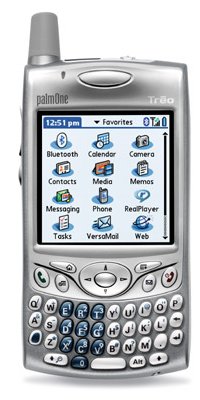
I have to say that, after my pan of the Treo 600 almost a year ago, the 650 fixes virtually all of the most important shortcomings the 600 suffered from – most notably, the replaceable battery problem, which was explained to me as stemming in the earlier model from the lack of uninterruptible, nonvolatile memory… i.e., if the battery was swapped, the handset would lose all of its data and configs and reset back to factory default… which, in hindsight, makes sense. Plus, they added Bluetooth and a mega-pixel digital camera with video capture that, side-by-side with the 600, is vastly superior and with image quality high enough that the average snapshot-taker could discard a separate camera entirely depending only on this. While I’ve heard the biggest problem with the 600 had been the clarity and reception quality of the phone’s voice-calling itself, and I haven’t had the opportunity to try that out in the 650, but if they’ve pulled off the functional part of the equation, then I’ll be looking forward to getting one myself, although I might wait for AT&T Wireless to be somewhat better digested by Cingular before placing my network bets. Here’s a longer and better review from PC Magazine:
-
Because the 600 was such a hit, palmOne has been understandably conservative with the new Treo. Although the Treo 650 looks the same, feels pretty much the same, and runs the same programs as the 600, we think it's a worthy upgrade.
Most notably, palmOne has boosted the Treo's screen resolution from 160 by 160 to 320 by 320. The company also added quad-band support and EDGE high-speed data capability to the GSM version, bumped processor speed up to 312 MHz, incorporated Bluetooth for wireless headsets and HotSyncing, slightly enlarged the keyboard and backlit it, and made the rechargeable battery removable.
EDGE support—which doubles the data speed of the previous GPRS version—and the high-res screen will make this model an even more compelling e-mail and Web browsing device. The Treo 650 will come with Exchange ActiveSync to hook up to Exchange 2003 servers and DataViz Documents To Go 7, an application for reading Microsoft Office documents—and the best document reader for any handheld.
There's no WiFi—this isn't the HP iPAQ h6315, the networking jack-of-all-trades handheld. But if you get a version that runs on AT&T's EDGE network, you may not miss WiFi on such a small device. The Treo 650 runs Palm OS 5.4, not the upcoming Cobalt OS. We're not expecting to see any Cobalt devices until 2005.
We got to play around with a unit a few weeks back and loved what we saw. We can't wait to get a Treo 650 into PC Labs to test. Until then, we'll give a cautious thumbs-up to this definite step forward for Palm smart phones.
While I can’t turn back the clock on October (cue vague daylight savings time reference), here’s hoping November proves an altogether more consistently bloggable month... at least for me. The Treo’s back on everybody’s wish list; only this time, deservedly so.
- Arik
 "Competitive Intelligence applies the principles of competition and lessons of intelligence to the need for enterprise awareness and predictability of market risk and opportunity. CI has the power to transform an enterprise from also-ran into real winners with agility enough to create and maintain sustainable competitive advantage."
