November 01, 2003
Resurrected Napster Going Head-to-Head with iTunes & Apple
 Napster is back at it again. This time, they’re going after iTunes in an attempt to try and win the online music wars.
I’m just waiting for Wal-Mart to come into this market with its low-price guarantee to squeeze any remaining profit out of the music business.
- Arik
October 31, 2003
Robust GDP Growth Might Signal a Real Economic Recovery, But Consumer Spending Slips
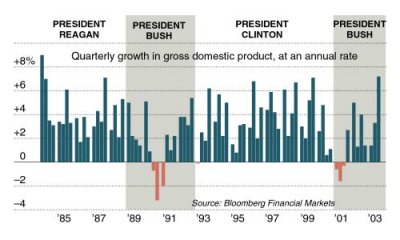
The nation’s economy spiked in the past several weeks, more robustly so than in years! Here're a few URLs to check out:
- Economy Reports Speediest Growth Since the Mid-80's
- Consumer Spending Slips
Whether or not there'll be any JOBS growing out of this is anybody's guess.
- Arik
October 30, 2003
Is Sony Broken…? 20,000 Jobs Lost is One Indicator
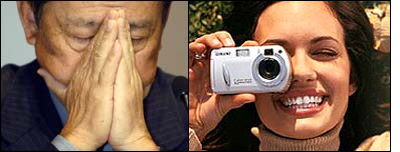
Browsing around this morning, I noticed on the BBC Web site from a couple of days ago an article describing how Sony is being forced to partner with Plasma/LCD-TV competitor Samsung in order to try and recover in an important (and eminently profitable) market that Sony has found itself losing ground in. Likewise, DVD Recorder shipments have suffered at the hands of Matsushita’s Panasonic, who boosted profits 73% in the same quarter Sony’s profits dropped 25%. As a result, some 13% of Sony’s worldwide workforce will be cut over the next three years to try and restructure the company for a future less certain in its reliance on the quintessential consumer electronics brand.
Chief Executive Nobuyuki Idei said last month that Sony was "lacking a sense of urgency". Sony has perhaps gotten too comfortable and complacent – an all-too-familiar story seen countless times with once-high-flying market leaders – trying to sell more of what Sony innovates, rather than what their customers really want to buy. Certainly, Sony’s key challenger these days – Samsung – has such an urgency at work in its enterprise, impacting the marketplace to Sony’s detriment time and time again in multiple sectors – from cell phones to televisions. Other rivals have presented themselves – such as LG – that have overcome Sony’s previous brand image in so many markets – that is, when you choose Sony, you get the best-quality product money can buy. Lower cost competitors have risen to meet that quality bar and in the minds of Sony’s customers, their pricing power (and profitability) has been eroding ever since.
- Arik
October 29, 2003
College Football, Bowl Championships & Anti-Trust: Mid-Size Division I Schools Take It to Capitol Hill
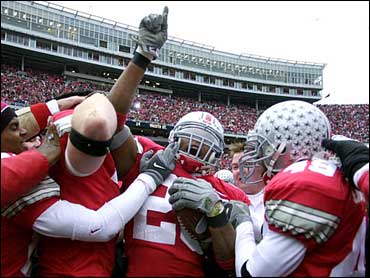
The Buckeyes of Ohio State were Last Season's Champs
 Tulane University president Scott Cowen went to Capitol Hill today to testify before the Senate Judiciary Committee on the allegedly unfair and anticompetitive restrictions and exclusions of the Bowl Championship Series, or BCS, used to determine which Division I football teams compete in postseason collegiate bowl games and ultimately determine the national champion.
Cowen hopes to replace the system when it is scheduled to expire in 2005, but whether the BCS should be the subject of an antitrust action is up for debate. While it’s true that to automatically qualify for an elite BCS bowl game, a team must finish in the top six in the BCS rankings, and in the top 12 just to be eligible, the BCS actually expanded, rather than inhibiting, competition – which will prove to be a key question in federal antitrust legal action. The process certainly favors the nation's six powerhouse football conferences plus Notre Dame, leaving most mid-major teams to fight through and maintain undefeated status to earn even a glimmer of hope at qualifying. And, in a quote from the AP story on the subject, the undefeated Texas Christian University "Horned Frogs" are barely hanging on to hopes of going all the way:
- Now 8-0, the Horned Frogs follow in the footsteps of the Marshall University Thundering Herd and the Tulane University Green Wave before them as "little schools that could," but ultimately could not because they were shut out of the BCS bowls by a process critics say is unduly restrictive and exclusive.
To automatically qualify for an elite BCS bowl game, a team must finish in the top six in the BCS rankings and in the top 12 just to be eligible. The process favors the nation's six powerhouse football conferences and Notre Dame. The Horned Frogs are currently 12th.
It was 1998 when Tulane went through its season undefeated, but had to settle for playing in the Liberty Bowl because the more prestigious bowls were taken by big-name teams, most with losses on their records.
Another excerpt from a USA Today article:
- Officials from BCS conferences have disagreed. Jim Delany, commissioner of the Big Ten, said at last month's House hearings that "the bowl system is more open than it's ever been. Any team can qualify to play in the national championship game."
Others testifying before the Senate committee: NCAA President Myles Brand, Orange Bowl chairman Keith Tribble, Nebraska Chancellor Harvey Perlman as well as retired football coach LaVell Edwards, whose 1984 Brigham Young team was the last national champ from outside the six conferences now in the BCS (in 1984, the first time since 1945 prior to that).
BCS officials have already said they expect the system will change after the current TV contract expires at the end of the 2005 season.
Tom Hansen, commissioner of the Pacific-10, which is a BCS conference, has said that neither a "full" playoff nor the status quo is acceptable, "but everything in between is still up for discussion."
There are plenty of options. Edwards said Monday that he'd "hate" to see the bowl system "destroyed." He suggests they offer satisfying opportunities: "You can go to a bowl and raise your finger like No. 1 and say at least you won the Dotcom Bowl or whatever they're calling it."
Options that have been discussed by BCS schools include keeping the four major bowls but allowing entry to undefeated non-BCS schools and adding a fifth bowl and giving a slot to the highest-rated league champion from outside the BCS.
Cowen also suggests the Big East, which now has an automatic berth that might be lost in the wake of Miami, Virginia Tech and Boston College exiting the conference, might become "natural allies" of anti-BCS forces.
Cowen, who favors a playoff system, says he's not swayed by objections he's heard to that format. Cowen says the notion that a playoff might place undue demands on student-athletes is unconvincing because "basketball is already more intrusive than football."
Cowen also says he's not impressed by worries that a playoff might make college football seem too much like the pros: "I don't think anything could be more commercialized than what we have right now."
So, do you want Congress as the arbiter and regulator of college football championships or would you rather see a few corrupt CEO’s indicted instead?
- Arik
October 28, 2003
Shopping for Faith – Church Growth and the American Marketplace for Spirituality
As we near the time of year for the anniversary of the Reformation, there was an intriguing program on NPR’s "Talk of the Nation" today about the future of churches, competition, differentiation and rather less divine marketplace pressure present in modern American religion. Of course, there's always been competition among various spiritual disciplines through the ages, but the phenomena going on in American faith represents a much more scientific approach to marketing, as best practices from business are cross-pollinated to religion.
The two authors interviewed (biobliography at the top of this post) pointed to the recent trend away from "fire and brimstone" preaching about sin and damnation - especially among Christian churches - and a renewed focus on inclusiveness and community. Tangentially, one part of the discussion focused on the manifestation of gay and lesbian clergy and other leadership in various denominations (as if they weren’t always there, of course), as well as the slick marketing being produced for the likes of the United Methodist Church. Frankly, the gay and lesbian clerical movement seems ready to render asunder the self-same Episcopalian church as congregants jockey for control of the faith tradition they claim to love.
In the end, Christian arguments about inclusiveness boil down to one thing: "Scriptural Inerrancy". If the Bible isn’t true in some matters, then how can we believe in 100 percent of it... right? Is it all just mass-hypnotism perpetrated on the faithful or is there some realistic evidence that people who go to church aren’t just wasting their Sunday mornings? Apparently, many at least would justify the investment of time and energy in the enterprise in purely pragmatic terms: as an entertainment outlet, to provide a sense of community, or at least teach children a sense of "moral pragmatism" (i.e., don't do bad stuff because it's self-destructive and/or counter-productive to one's own individuality or sense of self). Under such a set of eminently self-interested forces, who can argue that going to church is a bad thing, or even without many non-spiritual benefits.
My own feelings are that, forces as diverse as Darwinist Biology, Social Psychology and even Astronomy have been eroding the excuses educated persons have to claim a faith in a higher power; heck, it’s intellectual suicide to say you believe the Adam-and-Eve of Genesis… who but the truly faithful would be so bold as to decide the Bible is the flawless "Mind of God" made manifest on Earth?
The fundamental human factor we're all cursed with is an almost instinctive desire to be our own gods; that's the Christian notion of "Original Sin" at work... the Curse of Adam that follows all the Fallen. Indeed, the Serpent in the Garden asked whether "God really said" all that stuff about staying away from the Tree and the Apples, suggesting God was just jealous and wanted to keep us humans down...
We've always wanted dominion over the world and the classical definition of sin – that is, disobedience of "The Law" – is virtually meaningless to those living in an age when so many of those guidelines are considered strictly a matter of personal choice... some of it not even good advice anymore, let alone law. What did we expect religion to look like in a predominantly self-centered and decadent society?
So in churches today, especially within Judeo-Christian traditions, we see a wealth of competitive posturing and differentiation among and between denominations. The Latter Day Saints (aka, "Mormons") are arguably the fastest growing sect in the U.S. - using a hybrid and proven-effective referral-plus-door-to-door sales strategy - most often at the expense of some more slowly eroding denominations like the Episcopalians, Catholics, Baptists, Lutherans and, especially, the Presbyterians.
The question in my mind, as a person of faith myself is, whether the medium has become the message?
It would seem that, for the sake of growth and vitality in a spiritual body, we've turned our churches into so many shopping malls - places to congregate in search of entertainment, comfort, socio-political networking and, increasingly, consumerism... often with a very precise goal in mind (easing a guilty conscious, meeting nice people to socialize with, just getting good feelings from our illusions of piety or whatever less heavenly needs we seek met), rather than a collective of the faithful gathered humbly for worship of their higher power, acknowledging one's own finite or flawed humanity and the need for God's presence in our lives.
In most of Christian America today, we’ve more or less decided that the SIZE and the INCOME of a congregation is directly proportional to its entertainment value, marketability and, in terms of branding, its future prospects. So, in an effort to remove the bad vibes from the worship experience, the message has undoubtedly been diluted... perhaps, at the expense of the truth.
- Arik
October 27, 2003
The Wild, Wild East: Russia’s Richest Man Arrested for Alleged Tax Evasion & Other Misdeeds
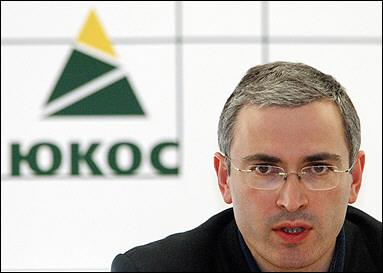
Arguably the leading figurehead of Russia’s recently stabilizing business community, oil tycoon Mikhail Khodorkovsky, was hauled into custody over the weekend, leading to a virtual crash in stock market investments and equity holdings there on Monday. Here’s an excerpt from the Washington Post article:
- As investors rushed to sell Russian holdings, financial regulators tried to stem the tide by suspending trading, and President Vladimir Putin disavowed any plan for a broad revision of the 1990s privatization of state assets. But he defended Khodorkovsky's arrest and said there would be "no bargaining" with the imprisoned billionaire. "I proceed from the assumption that the court had good reasons to take this decision," Putin said at a televised cabinet meeting at midday during the worst of the sell-off. He depicted the Kremlin as removed from the arrest, a view that is widely disputed among Russians. Putin's reassurance that a more expansive campaign against business is not planned appeared to mollify some investors. The benchmark RTS index fell 14 percent by late afternoon before partially recovering to close down 10 percent.
Khodorkovsky, head of the newly merged YukosSibneft , now the world's fourth-largest private oil producer, was arrested on Saturday in Siberia by masked commandos who stormed his private plane. He was charged with tax evasion, fraud and embezzlement and sent to the overcrowded Matrosskaya Tishina prison in Moscow until Dec. 30. His spokesman has dismissed the charges as unfounded and politically motivated.
Khodorkovsky, 40, whose estimated $8 billion fortune makes him Russia's richest man, was transferred Monday to a more comfortable cell with a television and refrigerator in a detention center where the hard-liners who tried to overthrow the Soviet Union's last leader, Mikhail Gorbachev, in 1991 were kept. But Khodorkovsky's Russian attorney was not allowed to see him.
"This is a case that's about the trampling of the constitutional and procedural rights in Moscow throughout the course of the investigation against Mr. Khodorkovsky," Sanford Saunders, a U.S. attorney for Khodorkovsky, said by telephone after holding a news conference in Washington to denounce the arrest. "This appears to be politically motivated and a fight for the future of Russia."
Nonetheless, the case -- seen by many political and corporate figures as a Kremlin campaign to destroy a rival power who has contributed funds to opposition parties -- threatens to sideswipe Russia's racing economy, just as it has finally recovered from the 1998 crash. Capital flight has resumed in the months since the Yukos investigations became public this summer, and some analysts say they believe the arrest has sabotaged a potential multibillion-dollar partnership between YukosSibneft and the U.S. oil company ExxonMobil.
"Khodorkovsky's arrest has become a sign, a watershed which may have serious impact on the business climate in Russia," said Yevgeny Yasin, a former economics minister who now heads Moscow's Higher School of Economics. "Putin says we mustn't generalize, we mustn't be in hysterics, that nothing threatens big business. I would agree with him if I didn't see that the authorities are breaking the law themselves."
Brokers said Russia is entering a period of "market unease," as one put it, that could last through the December parliamentary elections and Putin's widely predicted reelection next March, upsetting the political stability that Putin had fostered.
"I'm having a hard time thinking of a good outcome," said Charles Ryan, chairman of United Financial Group, a Moscow brokerage.
"Forget the oil price," he said, referring to high world prices that have buoyed Russia's economy by increasing revenue from oil sales abroad. "The largest contributor to . . . growth in recent years has been stability and the confidence that has led to investment. So by trying to bring these guys to book, he could undermine the very stability that has been the underpinning of his success."
Other brokers put a more optimistic face on it, recalling that the market recovered strongly after initially dropping when Khodorkovsky's partner, Platon Lebedev, was arrested in July.
Christopher Weafer, chief strategist at Alfa Bank, a large Russian institution, said Putin's remarks Monday helped reassure jittery investors. "People were waiting for a very clear statement from Putin that this is not going to extend to other companies, that this is not the start of a campaign against oligarch-type companies. And they got that." Khodorkovsky and other top business leaders are known as oligarchs.
The oil sector took the biggest hit in the markets Monday, particularly Yukos and Sibneft, which still trade separately. Yukos fell 19 percent after markets opened, prompting the RTS to suspend trading of the company's shares for an hour. The MICEX suspended trading of all stocks for an hour after an early plunge. Yukos finished the day down 15 percent, and shares of Sibneft were 20 percent lower, wiping out a cumulative $8 billion of market value.
While Khodorkovsky waited in prison, another partner, Vasily Shakhnovsky, who was charged this month with tax evasion, sought legal refuge Monday by joining the Federation Council, the upper house of parliament. The appointment could give him some immunity from prosecution if confirmed. Shakhnovsky won the surprise appointment from legislators in the northern region of Evenkia, where the governor is a former Yukos vice president.
"It isn't absolute immunity, but it should give him political weight," said Nikolai Petrov, a political analyst at the Carnegie Moscow Center. "It's a way of showing they are attacking a politician rather than a Yukos official."
So it seems the relatively stable situation that had arisen recently in Russia's economy might be at risk. Let's hope that cooler heads will soon prevail.
- Arik
UPDATE: Thursday 30 October - the Kremlin froze 44 percent of Yukos' capital shares to prevent Khodorkovsky and his oligarch pals from cashing in on their investment - prompting another slide in the RTS today, as well as speculation about a frigid authoritarian trend taking over the Russian economy just as investors were beginning to warm up to the country's opportunities.
October 26, 2003
Field of Dreams: Cubs vs. Red Sox World Series Could Have Revitalized Baseball

Now that all this baseball business is finally over with, I can say with confidence that the 2003 World Series was the most anticlimactic I can recall; that is, compared to the postseason playoffs, rich with the hopes of a Cubs against Red Sox contest that could have revitalized baseball as we know it. This is the chief reason I’m not a baseball fan – at least not during the regular season... all the drama and story are tied up in the unlikeliest (and most romantic) of possible scenarios.
I still think the Chicago and Boston teams should’ve played for third place – it certainly would’ve commanded higher ratings than the Series did, whether MLB sanctioned it or not. Oh well – maybe next season. In the meantime, I have a few great links that looks at the history of this story from NPR’s "Talk of the Nation", as well as thoughts from Slate by a Red Sox fan and what a Chicago win would've done to him. Finally, the tally on television ratings – third-lowest ever!
- Arik
 "Competitive Intelligence applies the principles of competition and lessons of intelligence to the need for enterprise awareness and predictability of market risk and opportunity. CI has the power to transform an enterprise from also-ran into real winners with agility enough to create and maintain sustainable competitive advantage."
