October 10, 2003
No Lawsuit for Grad Student Author of CD Copy Protection Paper
 SunnComm, the company behind the MediaMax CD3 copy-prevention system, decided not to sue Princeton grad student John Halderman after all in civil court under the Digital Millenium Copyright Act, after Halderman published a paper describing how simple it was to defeat, as applied by BMG on the Anthony Hamilton CD he'd released last month. The paper concluded that "most users who would be affected can bypass the system entirely by holding the Shift key every time they insert the CD," an action that prevents the MediaMax drivers from loading. Here’s another excerpt:
-
Since Halderman's paper appeared, SunnComm's shares have slipped precipitously, losing about $10 million in value. The company's stock appears on the Over-the-Counter Bulletin Board and was trading at 11 cents Friday morning.
Without giving specifics, SunnComm's original statement indicated that the company had planned to sue Halderman and claim libel or defamation in addition to the DMCA charges. "No matter what their credentials or rationale, it is wrong to use one's knowledge and the cover of academia to facilitate piracy and theft of digital property," the original statement said. "SunnComm is taking a stand here because we believe that those who own property, whether physical or digital, have the ultimate authority over how their property is used."
So, what's your verdict: is SunnComm a penny-stock with a worthless product that managed to dupe a few record execs into thinking they were the saviors of the record industry? Or were they really unjustly tested and smeared when an ambitious grad student decided to get famous on the back of the hot topic of CD piracy?
- Arik
October 09, 2003
In a Defeat for Big Telecom, Minnesota Federal Judge Says Hands-Off VoIP
 I noticed this story come out yesterday and was thankful my neighboring state has decided to lead by example - thus, perhaps, making it a little more certain the fate of my own VoIP service from Vonage. VoIP has been around for years, but usability and interoperability barriers with the traditional POTS system has made them a non-existent threat to big telephone companies until Vonage made a VoIP call seem a lot more like a regular phone call.
Naturally, the old hard-to-use VoIP services are still around - using essentially the same technology; they just aren't as much of a threat to the installed base of landline customers as Vonage has become - should we regulate IM providers like Yahoo, AOL and MSN, where VoIP is one option of their services?
"We're not suggesting that broadband telephony should never be regulated, but it can't be squeezed into existing regulation," Vonage Chief Financial Officer John Rego said in a recent interview. The link below provides some excellent competitive analysis of the situation - here're some excerpts:
-
Internet phone providers have won the first round in a clash with state regulators, providing needed momentum for the upstart industry.
In ruling from the bench late Tuesday, Minneapolis federal Judge Michael J. Davis permanently barred Minnesota from applying traditional telephone rules to Vonage, a pioneer in technology that lets consumers bypass the traditional phone network by making voice calls over a broadband connection. A written order that explains that the court's rationale is expected by Friday, according to the Minneapolis court clerk's office.
Minnesota Public Utilities Commission (PUC) analyst Stuart Mitchell said Wednesday that for now, the state plans to comply with the court decision and could conclude its proceedings against Vonage as early as Thursday, when the agency is next scheduled to meet.
"We've been told to stop, so we won't be enforcing our order," Mitchell said in an interview Wednesday. "I don't think the commission wants to violate a federal order."
Tuesday's ruling for now frees Vonage to sell its Internet phone service in Minnesota without obtaining a telephone operator's license or paying fees to support 911 services. More importantly, the order is the first to address the authority of a state to oversee so-called voice over Internet Protocol (VoIP) providers and could thus impact efforts by other states to regulate the Net telephony providers.
State regulators had threatened to stall VoIP's growth by forcing providers to follow the same rules as do traditional phone companies. As a result, the Minnesota suit was being closely watched by VoIP industry executives, consumers and traditional phone companies.
In the end, it's clear that, if we're going to regulate VoIP like we do POTS, we need to overhaul the regulatory system for telecom services as a whole; and that's not something you'll see big telecom pushing to have happen either.
- Arik
October 08, 2003
Total Recall: Schwarzenegger Wins; Democrats & Davis Dealt a Surprisingly Strong Blow
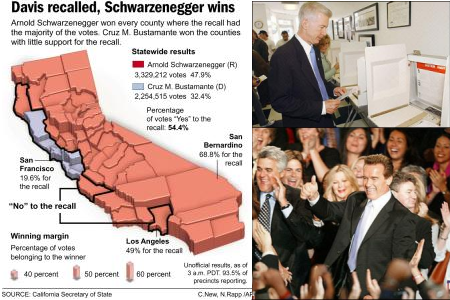
Failing to resist the temptation for Monday-morning quarterbacking alongside a similar yearning to steer away from media hype, I’ve decided the competition over the Governor’s seat in California offers a few takeaways that would be worthwhile examining from a business strategy perspective…
… so, with that…
Bodybuilder-turned-actor-turned-Governor-elect, Arnold Schwarzenegger might be a political rookie, but he’ll get no honeymoon from California state Democrats as he deploys his considerable assets – largely extending from those of political advisor former Governor Pete Wilson, not to mention an economic team formerly headed by billionaire investor Warren Buffett (who fell out of favor after he said Californians should pay higher property taxes) – to the task of fixing the $8 billion California state budget deficit. And, he’s not going to help matters by rolling back the reinstated vehicle registration fees that contributed to his election – that’s a $4 billion added cost if he gets it passed!
But, he did get his mandate, capturing a million-plus more votes than runner-up Cruz Bustamante, whom he’ll now have to work as his Lieutenant Gov.. But, the reason I’m writing about this subject isn’t because it’s just hot news; it’s because the Schwarzenegger campaign took advantage of key strengths on his part, weaknesses on the part of competitors, and dynamics present in the “marketplace” in pulling off what could be called the biggest political surprise in recent memory.
Schwarzenegger was not only well-known, he is well-known as an “action hero” that, despite notable weaknesses in the area of recent accusations of sexual harassment, misconduct and general tawdriness that surfaced as Democrats started to get desperate, is thought of as a “fixer” than can get things done, albeit, primarily on the silver screen if somewhat less so in real life. Likewise, in an era of “politics of dissatisfaction” where we have been consistently disappointed by our political leaders and now seek to kick the bums out, the market was seeking action of a kind they could predict might overcome the general malaise that had seemed to settle over Sacramento. Schwarzenegger is the devil Californians know (or at least think they know) who can, it is believed, get things done; while Davis and Bustamante were just devils, in the eyes of the majority of voters yesterday.
The timing was impeccable and, in my opinion, I don’t foresee a replay of Minnesota’s experience with Arnold’s friend Jesse Ventura, who left a bad taste in the mouth of voters who brought him to office by his apparent disregard of political decorum. I think there’s far too much riding on success to let those lessons go unlearned and Schwarzenegger stands an even chance of being successful in the short term - and is a sure-thing for re-election if (and it’s a big if) he can fix the budget problems faced by his predecessor.
- Arik
 "Competitive Intelligence applies the principles of competition and lessons of intelligence to the need for enterprise awareness and predictability of market risk and opportunity. CI has the power to transform an enterprise from also-ran into real winners with agility enough to create and maintain sustainable competitive advantage."
