April 02, 2005
April Fools: Google Gulp Fakes-Out Investors with Diversification Strategy
 Google put one over on users Friday, pitching a new product called Google Gulp on its home page, a new line of "smart drinks" designed to "maximize your surfing efficiency by making you more intelligent, and less thirsty," Google said.
Naturally, April Fools!
Well, it was original, anyway... and one mightn't doubt their aspirations for other lines of business, when they just can't shake the one-trick-pony label despite all the attempts at diversification.
- Arik
April 01, 2005
Terri Schiavo: Rest in Peace
 Moral/political football no longer, Terri Schaivo's 15-year ordeal, whether you believe she was "in there" all this time or not, deserves ultimate wishes for rest, in peace, now that the pornographic gaze of the media has lost interest in the matter with her anti-climactic declaration of death. Even today as we await word of Pope John Paul's imminent death, half a world away, in some ways, we're grateful this is all now somehow "over".
Meanwhile, a few days ago, Slate.com had a great essay from a woman named Harriet McBryde Johnson, a disability-rights lawyer in Charleston, who shared her dilemma. Comparing her situation to that of Terri Schiavo, "...due to a congenital neuromuscular disease, I am having trouble swallowing, and it's a constant struggle to get by mouth the calories my skinny body needs. For whatever reason, I'm still trying, but I know a tube is in my future. So, possibly, is speechlessness." Here're three of her points of argument that I found absolutely compelling in deciding Ms. Schiavo's fate:
-
3. This is not a case about a patient's right to refuse treatment. I don't see eating and drinking as "treatment," but even if they are, everyone agrees that Ms. Schiavo is presently incapable of articulating a decision to refuse treatment. The question is who should make the decision for her, and whether that substitute decision-maker should be authorized to kill her by starvation and dehydration.
4. There is a genuine dispute as to Ms. Schiavo's awareness and consciousness. But if we assume that those who would authorize her death are correct, Ms. Schiavo is completely unaware of her situation and therefore incapable of suffering physically or emotionally. Her death thus can't be justified for relieving her suffering.
5. There is a genuine dispute as to what Ms. Schiavo believed and expressed about life with severe disability before she herself became incapacitated; certainly, she never stated her preferences in an advance directive like a living will. If we assume that Ms. Schiavo is aware and conscious, it is possible that, like most people who live with severe disability for as long as she has, she has abandoned her preconceived fears of the life she is now living. We have no idea whether she wishes to be bound by things she might have said when she was living a very different life. If we assume she is unaware and unconscious, we can't justify her death as her preference. She has no preference.
Later, she comments, "I hope that I will not outlive my usefulness or my capacity (at least occasionally) to amuse the people around me. But if it happens otherwise, I hope whoever is appointed to speak for me will be subject to legal constraints. Even if my guardian thinks I'd be better off dead—even if I think so myself—I hope to live and die in a world that recognizes that killing, even of people with the most severe disabilities, is a matter of more than private concern."
Ms. McBryde Johnson adds, "The whole society has a stake in making sure state courts are not tainted by prejudices, myths, and unfounded fears—like the unthinking horror in mainstream society that transforms feeding tubes into fetish objects, emblematic of broader, deeper fears of disability that sometimes slide from fear to disgust and from disgust to hatred. While we should not assume that disability prejudice tainted the Florida courts, we cannot reasonably assume that it did not."
Let's just hope all those affiliated with the Schiavo matter moving forward fails to amuse our news media from here on out as much as they apparently have thus far... maybe then, they'll leave them alone to their grief and acceptance of the loss of a daughter, wife and friend.
- Arik
March 28, 2005
The New Sony PSP Handheld: a Clear Victory of Form Over Function
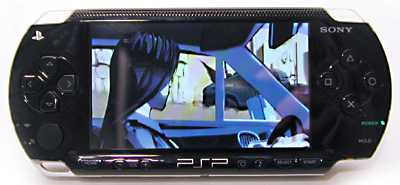
Immersion Corp., a San Jose company who, in a 2002 lawsuit, accused Sony of patent infringement with the Dual Shock controller for the PlayStation and PlayStation2. Dual Shock technology makes the controller shake in rhythm with what's going on in the game. Sony denies that Dual Shock violates Immersion's patents and, while the district court decision included an order to suspend PlayStation sales, that order does not hold while an appeal is being heard so Sony will continue to sell its game machines in the United States.
But the bigger question may be, will anybody buy this thing? The PSP faces tough competition from the Nintendo DS as it sparks a battle for the $4.5 billion global handheld entertainment market, just at a time when Sony's in the midst of a pitched internal battle to get back on its feet after product successes fell short. Then, the PSP launches as more of a legacy product than anything - c'mon guys, the Memory Stick is a big failure and your failure to use non-proprietary technology standards will lead to the ultimate failure of the consumer electronics business in the long-run! I cannot believe you people can't see this!?! Simply stunning. Anyways, Red Herring broke it down for us on how the competitive battle lines are drawn:
-
The PSP’s unique features are console-quality graphics, a 24-title movie lineup, Wi-Fi capabilities, and the amalgamation of games, music, and movies in one gadget. Sony is expected to ship at least 3.7 million units to North America during 2005, according to research firm IDC.
Nintendo, so far, has been the leader in the portable gaming market with the GameBoy Advance and, more recently, the $150 Nintendo DS. The $250 PSP is the “first legitimate competitor to Nintendo’s dominance” in the handheld market, said IDC analyst Shelly Olhava. Other competitors in the market are Nokia’s Ngage portable and Gizmondo Europe’s portable.
David Cole, an analyst with DFC Intelligence, thinks that the PSP could become a long-term product and build a base for Sony for several years. “[Sony] is so strong in the game industry, it should do very well,” said Mr. Cole. “It really satisfies the need of the portable audience.”
The target audience for the PSP is adults between the ages of 18 to 34 rather than the younger audience gaming companies usually target. Nintendo, on the other hand, is more popular with the younger audience. “I think Sony decided that’s where they were really strong,” said Mr. Cole.
The PSP is a black gadget weighing just under 10 ounces with a 4.3-inch widescreen and high-resolution TFT display. It also has digital photo display and supports digital music playback in MP3 and ATRAC formats.
The processor is a high-capacity Universal Media Disk (UMD), which is an optical medium enabling feature films and high-quality games to be played on the portable. The 60-mm disk has a storage capability of 1.8 GB. This format will be utilized across the Sony family of products and is available for outside hardware makers and non-game entertainment content providers to use.
The portable gaming market worldwide was about $4.5 billion in 2004 and is expected to grow to $9 billion in 2009, according to DFC Intelligence. The PSP first launched in Japan on December 12 and has sold 1.18 million units there so far.
Mr. Cole expects the PSP to get a better reception in North America, where Sony plans to ship 1 million units for the launch. Company officials said that most U.S. stores are on their third and fourth waiting lists for the PSP. “The Japan market hasn’t been doing very well in general. Any product tends to do better [in the U.S.],” he said.
European launch uncertain
Analysts are expecting long lines outside stores on the night of the launch in North America. The demand for the PSP has reached such a peak that its European launch, which was scheduled for March 31, could take several more months.
Ms. Olhava said Sony hasn’t been able to handle shipments because of logistical problems. “I have heard that Sony has manufacturing issues,” she said. “It’s a brand-new product and it’s bound to have some hiccups along the way.
One problem could be the $250 price. “It’s an unproven price point and that will be a real challenge,” said Mr. Cole. Early adopters are price-insensitive, he said, but consumers will get tighter with their wallet after the first 1 million sales.
The Nintendo DS has already launched in the three major markets—North America, Europe, and Japan. The DS, which launched in North America on November 21, sold 1.5 million units by February. Company officials have said that Nintendo plans to ship 6 million DS units globally by the end of March.
Analysts feel the 2005 holiday season and the software availability will determine which portable product succeeds. “Both the DS and PSP are excellent portable systems,” said Mr. Cole. “You really will be able to get the analysis going into the holiday season.”
Meanwhile, every review I've read of the device itself leaves me wondering if it's worth the trouble. Jim Louderback has a few backhanded compliments in that regard, "it's going to redefine handheld gaming. But it's not going to be as popular or as successful as everyone claims. If Sony's expecting an iPod killer, this isn't it. Here's what I see as the good and the not-so-good in Sony's latest platform." More of his review is excerpted below:
-
Screen: A standout display, for sure. It's big, wide, and captivating. Colors are rich and detailed. Response rates seemed superb while I was playing Ridge Racer. But there's a downside to all those pulsating pixels, too. First, Sony opted for a very reflective coating. This makes the image look great, but also turns the screen into a mirror in bright light. Even in lower light, the reflections can become annoying in some situations. Don't plan on taking it hiking; this is not a player for the great outdoors.
Graphics: Far better than the competition's, the graphics engine made the smallish screen look much bigger. Although some of the early titles probably won't take advantage of all the power, Ridge Racer at least looked fantastic.
Sound: I have no complaints here. The audio quality was simply stunning on my tests, especially when paired with high-quality headphones. The built in speakers are weak and tinny, as you can imagine, but the top-notch audio—when combined with the zippy screen—creates a truly immersive gaming experience on the go.
Controls: The PSP includes the standard complement of PlayStation 2 controls—although it has only one joystick and one pair of shoulder buttons—and pads that are reasonably easy to use. It has no touch screen, unlike the Nintendo DS, but includes a real portable-gaming breakthrough: a tiny round nub that appears to be the twisted progeny of a joystick and the IBM TrackPoint mouse replacement. Instead of having to be yanked back and forth, this "pointing pad" glides almost effortlessly across a small part of the PSP's surface. It provided a perfect stand-in for a steering wheel in Ridge Racer, and it'll probably become the controller of choice for all but the most precise and demanding tasks.
Games: The PSP's launch library is good for a new platform, with about two dozen titles available now. Over time, expect to see PS2 retreads and brand extensions galore. But those titles will only reinforce one of the PSP's problems: It's a portable version of a home console, but nothing more. The Nintendo DS, with a touch screen, microphone, and unique dual-screen design, offers more potential for breakthrough styles of portable gaming that don't rely on the archetypes established by console games.
Just because you build it, however, doesn't mean they'll come. Even though the DS has been out for four months, only a paltry number of titles are available, and few take much advantage of the unique DS features. The DS has one ace card: It's compatible with the huge library of Game Boy Advance titles too, which makes it a better upgrade for existing Nintendo handheld customers.
Movies: The PSP has also been widely touted as a portable movie player. The device includes a new optical disc format, called UMD (for Universal Media Disc). Each disc is about twice the size of a quarter, and can hold an entire movie. In fact, the first million PSPs here in the U.S. will come bundled with Spider-Man 2 on UMD. Sony's penchant for launching unsuccessful proprietary media formats is legendary (witness Beta, Memory Stick, etc.), and I believe UMD as a broad media storage technology will fail here, too.
Why? First, because it's highly unlikely that many users will purchase movies in a format that works only on portable players—and no one will replace their home DVD player to go with UMDs. Movie availability is likely to be limited to Sony's back catalog and a smattering of other titles at first, so there won't be much to watch. What about rentals? The picture is murky there, too. Shernaz Daver, from Netflix, said that the company "will support any format as long as it becomes popular," but wasn't ready to commit at launch.
The big bugaboo here is that you can't make your own discs. And if Junior can't drop Letterman or the X Games onto a disc at night and watch it the next day, then the idea that any significant number of people are going to buy the PSP to watch videos is moot.
About five years ago, a company called Data Play released a nifty new quarter-sized optical media format. It was recordable, tiny and promised a revolution in media players. But before Data Play could get it to market, tiny hard-drive and flash-based players took off. Data Play sunk without a trace, and even though Sony has far bigger resources to bring to bear, UMD will too.
Oh, one other fundamental drawback for the PSP as a movie and video player: It lacks a kickstand or other way to keep it upright. Playing games is interactive; you want to hold the player while you frag. Watching video is passive and, based on my experience with first-generation portable video systems from Archos and Creative, if it doesn't stand on its own, it just isn't worth carrying.
Music: The PSP has the potential to be a great music player, but unfortunately it relies on a flash-based Memory Stick to store music. The system comes with a 32MB Memory Stick, enough for an hour or so of very compressed music—if you didn't have to share the Memory Stick with saved games. But even if you also picked up a 1GB Memory Stick—for an additional $130—you still wouldn't have enough space for music. I frequently hear iPod Mini users complain that even 4GB isn't enough for them. Sure, you can pick up a 4GB Memory Stick, if you've got a spare $500 lying around. I suggest a Creative Zen Xtra or Apple iPod instead.
In a pinch, the PSP can stand in as a music player. But until you can load 10GB or more onto the system—without spending as much on the memory card as you would on a brand new iPod—few people will use it as their primary music player. To support music and movies, Sony will have to add a mini-hard drive to the PSP, which will only make it heavier and more power-hungry.
Battery Life: Speaking of power, Sony claims you can get six hours of hard-core game play or movie playback on a single charge. If the PSP delivers on that promise, that's good. Based on my own experience with battery-powered devices, though, you're better off cutting that number in half. Even three hours of game play or movie watching is pretty good, except when your batteries cut out during a long flight or a boring class. Better pack a spare battery or two.
Price: $250 for a game-playing, movie-watching, music-playing device is pretty darn good, especially for one with a screen as beautiful as the PSP's. It must cost them more than that to make each one, which means they intend to profit on the games and the movies, instead.
To justify that price, though, the PSP will have to do more than just play games, as Nintendo's offerings cost half as much or less. Many hard-core gamers will certainly pony up, but the jury is out on whether enough casual gamers will adopt it to make it a success. My best guess is no.
Connectivity: Like the DS, the PSP will ship with built-in wireless networking. That's great for group gaming, but why is there no built-in Web browser or e-mail client? And no way to connect your PSP to your PC wirelessly to transfer music and movies to the Memory Stick? All the parts are there, but the whole is sadly lacking. I, for one, would love to see Skype for the PSP—that would have been a real breakthrough!
Reliability: This is the great unknown:. How well will the PSP hold up to months and years of heavy playing and portable jostling? I'm not particularly bullish, especially because that large screen is unprotected. Sure, the PSP comes with a slip-on foam case, but it's so nondescript that I almost lost it five times in one week. In just a few short months, a scratched screen will take much of the luster off of the PSP.
The Nintendo DS's clamshell design makes it much more likely to survive years on the road, especially in the backpacks of all those hyperactive kids and one clumsy journalist. I was almost scared to travel with the fragile-seeming PSP, particularly because we only had one in the entire company.
And how long will the battery last? Regular gamers will probably need a new one every year or so, which creates a tremendous after-market opportunity.
Finally, what about the internal software? Is it robust enough for all the banging—and hacking—that's bound to go on? Will it need regular flash updates? And how do you distribute a flash update to the PSP if you don't have a wireless network? Via UMD? Memory Stick? I don't know about you, but I certainly don't have a memory stick reader for my PC. Fortunately there's also a standard USB 2.0 port. Perhaps you'll download updates off the Web site and send them to the PSP via this port.
All in all, I think the PSP will be extremely popular among hard-core gamers, especially those who spend hours each week banging on their PS2s. I wouldn't buy it for kids, though, because it's too fragile. And I think the lack of robust media playback—non-writable UMD, paltry and expensive Memory Stick storage options—make it less than ideal for casual gamers.
In the end, the PSP excels at just one thing: portable gaming. Casual gamers who already own a satisfactory portable gaming platform, whether it's an old Game Boy Advance or even a game-playing cell phone, have little incentive to switch. And anyone looking for a portable media player that will unseat Apple's iPod needs to keep looking. Because when it comes to everything else, the PSP just doesn't cut it.
And, PC Magazine sums it up even more concisely, a victory of form over function:
-
Those in the target demographic have eagerly awaited its arrival. And even people other than 15- to- 25-year-old males may have more than a passing interest in one of the year's most anticipated pieces of gadgetry: the Sony PSP. Originally conceived as the PlayStation Portable (and now simply called the PSP), the slick, gorgeous device succeeds spectacularly as a portable gaming console. If you view its music- and video-playback capabilities as bonus features, you'll be thrilled; if you were hoping it would be best-in-class at all its endeavors, you'll be slightly disappointed.
Clearly breakthrough product innovation can make or break the company that gets it to market; but there must be a compelling customer value-proposition inherent in the product itself, differentiated in the way it is built/sold/positioned, or it must be disruptive to existing markets for there to be a hope for success. It sounds to me like the Sony PSP falls short on all three counts, despite all the hype and lawsuit PR.
- Arik
March 27, 2005
Cracking the Code on Barry Diller’s Bizarre Ask Jeeves Acquisition: Why and Wherefore

Most importantly, what’s the real reason Barry Diller decided to buy out Ask Jeeves? Because his other sites need the traffic… and, if IAC can generate that traffic quickly enough, Diller should be cash-flow positive even before the search engine’s ad revenues kick in. Here’s a summary of the deal and speculation from InformationWeek.com:
-
IAC/InterActiveCorp, which operates a variety of online and offline businesses, including CitySearch, Expedia, and Ticketmaster, today said it will acquire Ask Jeeves Inc., for $1.85 billon.
Ask Jeeves is the fourth-largest Internet search engine and, by comScore Media Metrix's measure, the ninth-largest Web property.
In a statement, Barry Diller, chairman and CEO of IAC, said, "Ask Jeeves was founded almost 10 years ago based on the idea that simple text search results alone are not sufficient or satisfying--but, rather, that consumers want answers to questions--and questions posed in natural language and answered with spot-on accuracy were especially desired and appealing. Of the many search engines launched during that time, Ask was one of the very few that established itself and we believe that in the future it has the potential to become one of the great brands on the Internet and beyond, and by beyond, we mean in wireless, in the search for anything on any device."
"It does look like there's going to be another major player in this market," says Marianne Wolk, an analyst for Susquehanna Financial Group. "However, we caution that IAC and Ask Jeeves are coming from behind. Ask Jeeves has invested significantly less in geographical expansion, technology expansion, and capital expenditures to reindex the Web, than [have] larger peers such as Google, Microsoft, and Yahoo. And there's going to have to be significant investment made by the combined company to catch up."
The other major search players aren't sitting still either. A Yahoo spokeswoman today confirmed that it plans to buy Ludicorp Research & Development Ltd., which owns Flickr, an online photo-sharing site favored by bloggers. Wolk predicts that America Online, Google, Microsoft, and Yahoo will continue to make significant investments and acquisitions in search-related areas, particularly blogging and social networking.
"This really just emphasizes my point that the major players are aggressively spending to expand overseas, and enter new markets such as blog search, content search, image search, desktop search, and video search," says Wolk. "And Ask Jeeves is way behind in most of those investment areas."
Ask Jeeves' purchase last month of Trustic Inc., the company that runs blog aggregator Bloglines, represents an effort to close that gap. But experts suggest the distance is considerable.
"If you look at the market share of the search portals--Google, Yahoo, MSN, and AOL--Jeeves really has a sliver in comparison to those others," says Kevin Lee, executive chairman of search-engine marketing firm Did-It.com. "Can Jeeves be resuscitated with enough cash and savvy marketing? Perhaps it can. Clearly, Diller and his team have some thoughts with respect to Jeeves that they believe they can add value to Jeeves' current situation and maybe bring Jeeves back."
Lee, like others in the search industry, shares Diller's view that "search for anything on any device" has potential going forward. But he's guarded in his assessment. "I think the whole convergence with wireless is going to continue to move slowly but surely," he says. "Device-agnostic search is going to be there in the future. I'm not sure that any one player has an advantage now given how early that game is. Any momentum any one player has can be eliminated with enough marketing dollars."
The key to understanding this competitive strategy is to understand that, despite all of the momentum behind Google and Yahoo and AOL and MSN, there will never be one big winner in the search engine marketplace. We’ve been fragmented for a decade and there’s little sign of that changing. Eric Chabrow’s blog entry captured this perfectly:
-
Today, Google and Yahoo dominate the search market; they account for nearly 70% of all searches, according to comScore. Internet users conduct about one-quarter of Web searches on sites operated by MSN/Microsoft and AOL/Time Warner. Ask Jeeves accounts for only 5% of searches.
But, as Diller points out, searches represent a very small slice of American media, even less so overseas. He compares the search market to other media, such as cable TV, where no one company dominates but scores of businesses are profitable. Despite its rapid growth, the Internet remains a relatively young industry. And search is even younger.
Appearing on CNBC the other day, Diller addressed the search-engine sector: “It’s the very beginning of its growth. … This is going to be a world, just like the media world, where there will be many players, many people providing service.”
Diller plans to grow Ask Jeeves by placing a search bar on Web pages of IAC’s other sites such as the online travel agency Expedia, Home Shopping Network, Ticketmaster, CitySearch, and Match.com. Diller said IAC sites attract 44 million unique visitors, and expects many of them to use the Ask Jeeves search bar instead of going to another site to conduct a search, such as Google.
Too many people are infatuated with companies like Google. They’re judging this sub-sector by the number of searches. True, search and portal companies do reach out through acquisitions and partnerships to create synergies, but that doesn’t explain how the market got so out of whack. How else could Google have a market cap topping $49 billion on only $3.2 billion in sales last year when IAC generated nearly twice that amount in revenue but has a market cap of $15.4 billion, less than one-third of Google’s?
But in the end, this thing is all about creating a search destination that feeds the rest of the IAC network. According to Michael Stroud:
-
It's about being a portal to every one of the products and services that Diller's IAC/InterActiveCorp provides—including LendingTree, Hotels.com, Ticketmaster, Home Shopping Network, Expedia, and Gifts.com—as well as many products and services that Diller's partners will provide. If he succeeds in driving traffic to those sites, he'll generate cash from Ask Jeeves, even before advertising revenue kicks in.
You can easily see how. Plenty of website owners would be interested in putting an Ask Jeeves button on their websites if, say, Diller offered to pay them a fee every time a customer used Diller's search engine to buy one of his services or those of a partner. Isn't that exactly what Amazon.com does when someone lists their favorite book or DVD on their website and then directs visitors to Amazon.com to buy it?
Similarly, you can see how a partner—whether a retailer or a mobile phone operator—might be willing to give Diller a little cut every time a customer buys an IAC product or a IAC partner's product after discovering it through the IAC portal. That's exactly how Ticketmaster works, after all: buy a ticket, pay a premium to IAC.
Yes, the market can only probably only support a few big search engines, if you're talking about encyclopedic sites that connect you to everything from the Civil War to Martha Stewart. But it doesn't follow that niche search services catering to specific communities—in this case, buyers of products and services—can't flourish.
Newspaper readers, after all, don't flock only to USA Today or the New York Times, while ignoring local papers. Consumers don't choose to watch only CBS, ABC, NBC, and Fox, rather than cable or local channels.
Diller knows all about that reasoning. He was scoffed at almost 20 years ago, when he challenged the Big Three networks by cobbling Fox together from a hodge-podge of local stations. With Ask Jeeves, he's trying a new twist: creating a unifying engine that works across IAC's disparate products and services.
Yahoo and Google do the reverse: they have a unifying engine, and they're seeking the products and services to monetize it. And there's no business on the web like show business, which seduces millions of online shoppers with CDs, DVDs, and other Hollywood products.
It's no accident that Yahoo chairman Terry Semel, Warner Bros.' former chairman and co-CEO, chose to set up his new media division in Santa Monica. Entertainment news on Yahoo is just a mouse click away from Yahoo ads for online vendors of CDs and DVDs, or entertainment products for sale in Yahoo Stores.
So there's no reason why other media companies or big retailers—even specialized ISPs and mobile carriers—can't set up their own search sites, tailored to their own communities. And don't be surprised if some of them say "Powered by Ask Jeeves."
Ah-HA! That’s the secret! The erosion of market share away from the search engine leaders and toward verticals! Why didn’t I think of that?! Diller actually couldn’t have succeed if he’d done things any differently. That’s why Diller is considered one shrewd, dude, though… right?
- Arik
 "Competitive Intelligence applies the principles of competition and lessons of intelligence to the need for enterprise awareness and predictability of market risk and opportunity. CI has the power to transform an enterprise from also-ran into real winners with agility enough to create and maintain sustainable competitive advantage."
