March 18, 2005
Charles Schwab vs. TD Waterhouse: The Grudge Match
 It's been found that the people most likely to complain about a particular advertisement are those who work for a competing company; now, Charles Schwab has filed a trade libel complaint in California state court charging that an ad campaign for TD Waterhouse has falsely labeled Schwab as a high-priced firm with inferior service. Charles Schwab said he tried to persuade the CEO of TD Bank Financial Group, which oversees TD Waterhouse, to abandon the ads before he filed the lawsuit, and that Schwab wants a court order to ban the ads, in addition to unspecified damages:
-
Charles Schwab filed suit against rival TD Waterhouse this week for “a pattern of deceptive, misleading, and patently false advertising” in its ad campaign. The suit, filed on Monday in San Francisco County Superior Court, alleges that TD Waterhouse’s ad campaign creates the impression that Schwab charges the price of a full-service broker like Merrill Lynch and that Schwab doesn’t offer the same level of customer service as TD Waterhouse.
Schwab alleges in its suit that this is false and misleading because, as the innovator of the discount brokerage market, Schwab is “known for excellent service….and has a stellar reputation for low-cost, high-quality financial services.”
Schwab is also seeking damages based on injury to the company’s reputation and loss of potential retail clients. The suit claims that Schwab has suffered “substantial” and “irreparable” damage. “People get impressions about companies they want to use based on ads,” says Schwab spokesperson Greg Gable. “We want them to stop using Schwab’s name in comparative advertising.”
TD’s ad campaign, which launched in November, 2003, features actor Sam Waterston, who plays a prosecutor on TV’s Law & Order, making statements such as: “Switch to TD Waterhouse, the alternative to higher-price brokers like Merrill and Schwab,” and “Why pay all that money to Merrill Lynch or Schwab.”
Schwab claims that it tried to settle the issue out of court in early 2004, when both parties signed an agreement to change the language in the ads. TD Waterhouse agreed to switch its tagline from “TD Waterhouse, the alternative to higher priced brokers like Merrill Lynch and Schwab,” to “TD Waterhouse, the alternative to Schwab and higher priced brokers like Merrill Lynch.” The agreement also was intended to remove language such as “Why pay Merrill or Schwab just to bounce your ideas off them.”
But according to Schwab, Waterhouse didn’t stick by the contract.
TD Waterhouse counters that it did honor the agreement, but that some of the older ads continued to run unbeknownst to them. “We have fully adhered to our agreement with Schwab,” says Kevin Dinino, manager of media relations for TD Waterhouse. “As far as ads that ran in error, they were without our knowledge or consent. We believe Schwab’s complaint is without merit and will defend our reputation.” The ad campaign, meanwhile, is rolling right along and, according to Dinino, and has been a very successful in building the company’s brand with investors—even if they may not be switching from Schwab. “We’re clearly seeing refugees from full commission brokers,” says Dinino.
Just don't ask Chuck what he thinks of the ad-campaign…
- Arik
March 17, 2005
Take Me Out to the Ballgame - Beltway Baseball Rivalry & Ripken’s Side-Switching
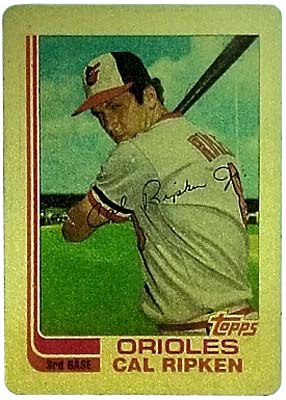 The Washington Nationals are going to war with the Baltimore Orioles in more ways than one - on the playing field and at the box office, while Orioles hero Cal Ripkin heads for the enemy camp, in this piece from BusinessWeek.com:
-
On Apr. 4, the Washington Nationals will officially play ball for the first time -- and the boos from Baltimore promise to be almost as loud as the cheers in the Nation's Capital. The Nats and the Orioles, which will compete 37 miles apart, have already skirmished over the marketing of tickets, their attempts to acquire star slugger Sammy Sosa, and the question of how Birds owner Peter G. Angelos will be compensated -- a calculation that could affect the location and financing of future franchises.
For Orioles fans there's even the frightening possibility of a Baltimore icon, legendary shortstop Cal Ripken, going over to the dark side. This summer, Major League Baseball will select an ownership group out of at least seven partnerships vying for the franchise. Ripken, who declined to be interviewed, has said he might be interested in joining a Nationals group if he also had a hand in running the team.
The competition between baseball's new neighbors will grow more intense after a Nats owner -- expected to pay up to $400 million -- is selected. For now, the Nationals are owned by the 29 MLB team owners, including Angelos. That places the current, MLB-controlled management in a tough spot, trying to avoid even the mildest public disagreements with the Orioles. For example, in the contest to trade for Sosa, baseball sources say the Nats were directed to back off by MLB when Angelos got in the game. Says Nats President Tony Tavares: "Every time we play them, I hope we kick their butts. But do I wake up wondering how I can hurt the Baltimore Orioles' business and enhance mine? Honestly, no."
Selig already seems to be bending over backward for the Orioles. In September the commish's lawyer, Bob Dupuy, began talks with Angelos. Since then, according to baseball sources, MLB has offered several plans to indemnify the Orioles. Terms include guaranteeing them annual revenues of $130 million, just above their estimated revenue at present. Angelos would also be assured of a price tag around $360 million if he were to sell the team. That's a tidy profit over the $173 million that an Angelos-led group paid for the Orioles in 1993. For now, the sticking point in the talks appears to be control over the Nationals' TV broadcast rights.
We'll see if the Nationals can out-draw the Orioles - but they likely can't stop Ripken from heading for the enemy camp.
- Arik
March 16, 2005
Bernie Ebbers Convicted, Ignorance Defense Weakened & JPMorgan Settles… for $2 Billion!
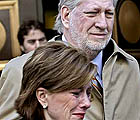 Even as Bernie Ebbers was convicted, the likelihood that the so-called "ignorance defense" likely to be used by CEOs like Richard Scrushy of HealthSouth and Ken Lay and Jeff Skilling of Enron, has been irrevocably undermined:
-
The conviction Tuesday of former WorldCom Inc. chief Bernard J. Ebbers for orchestrating an $11-billion accounting fraud could have deep repercussions for other disgraced executives who claim they were unaware of financial scams taking root beneath them.
A federal jury found Ebbers, 63, guilty of securities fraud, conspiracy and filing false documents with regulators. He was convicted on all nine counts that he faced. It was the government's biggest win yet in a string of victories against top corporate figures, including Silicon Valley financier Frank Quattrone and lifestyles entrepreneur Martha Stewart. He faces a possible prison term of more than 30 years.
There was little hard evidence against Ebbers — no smoking-gun e-mails or paper trails — and the defendant insisted the fraud was masterminded by Scott D. Sullivan, his onetime finance chief who became the federal government's star witness.
But it came down to this: Jurors couldn't see how the man who had built WorldCom from a small phone company in Clinton, Miss., to a global telecommunication colossus could not have known about the accounting scams that triggered the company's 2002 bankruptcy filing — the biggest in U.S. history.
"When you start a company … and you bring it up from nothing, it's hard to convince a jury that you are just too stupid to know what's going on," said Daniel J. Callahan, a veteran litigator. "This see-no-evil, hear-no-evil, speak-no-evil policy just doesn't fly."
Legal experts said the jury's decision boded poorly for toppled executives Kenneth L. Lay of Enron Corp. and Richard Scrushy of HealthSouth Corp., who are employing variations of the above-the-fray defense.
Lay faces trial in Houston in January on fraud and conspiracy counts stemming from Enron's 2001 collapse. Scrushy is on trial in Birmingham, Ala., for an alleged $2.7-billion fraud at HealthSouth.
"These guys are shaking in their boots now," said Andrew Genser, a white-collar criminal defense lawyer at Kirkland & Ellis in New York.
If anyone seemed poised to pull off the "know-nothing" defense, others said, it was Ebbers.
The former high school basketball coach and milkman twice flunked out of college. He disdained e-mail, denying prosecutors a weapon they had used effectively against Quattrone and others. And Ebbers almost never sold his WorldCom shares, testifying that he even had bought $5.3 million in stock a few weeks after he was forced to resign in 2002 under the cloud of a federal investigation.
In an interview, juror Aran Nulty said that the panel weighed the evidence carefully during eight days of deliberations, and did not rely on Sullivan's testimony alone.
The tipping point, she said, was the argument that Ebbers would have to know about WorldCom's troubles because of regular revenue statements and numerous other financial reports.
Ebbers's evasiveness and defensive posture on cross-examination left a lasting impression on jurors hearing his case - the jury clearly concluded that testimony of former chief financial officer Scott Sullivan, the prosecution's star witness, was more credible than that of Ebbers, even though jurors did not fully believe Sullivan either.
Meanwhile, all bets are off at JPMorgan, holding out for a possible acquittal, ended up swallowing a $2 billion settlement charge:
-
JPMorgan Chase & Co., the nation's second largest financial institution, has agreed to pay $2 billion to settle claims from investors who lost money in the collapse of WorldCom Inc.
It was the last major bank to reach a settlement in the class action suit, though other defendants remain.
The federal court supervising the case was told Wednesday that 11 former directors of WorldCom were close to reviving a deal in which they would pay millions of dollars to settle their part in the investor suit.
The JPMorgan Chase settlement came Wednesday, a day after WorldCom's former chief executive, Bernard Ebbers, was found guilty of fraud, conspiracy and false regulatory filings in the $11 billion accounting fraud at WorldCom. The company collapsed in 2002, but has since emerged from bankruptcy to operate under the name MCI Inc.
New York Comptroller Alan Hevesi, representing thousands of WorldCom investors as the court-appointed lead plaintiff, said that the more than a dozen banks and investment banks that have reached settlements have agreed to pay more than $6 billion -- a record in a securities class action case.
"I'm delighted that we are coming to closure," he told reporters. "This is a huge securities case. I think we've made a substantial recovery for the people that we represent."
In addition to JPMorgan Chase, two small investment banks also announced settlements Wednesday. Blaylock & Partners LP agreed to pay $573,000, and Utendahl Capital agreed to pay $234,000. Both are based in New York.
If the case goes to trial, jury selection will begin next week, the court said.
The remaining defendants, in addition to the 11 former directors, are auditing firm Arthur Andersen and former WorldCom board member Bert Roberts.
Judge Denise Cote gave preliminary approval on Wednesday to a number of settlements reached earlier with banks, including Bank of America Corp., which is headquartered in Charlotte, N.C.; Credit Suisse First Boston, a unit of the Zurich-based Credit Suisse Group, and Citigroup Inc.
"Let me give the court's congratulations to the settling parties," Cote said. "This case has been very hard-fought."
The banks were involved in the underwriting or sale of billions of dollars worth of bonds that WorldCom issued in 2000 and 2001.
Investors who purchased the securities argued that the financial institutions should have been aware of ongoing fraud at the company.
The settlement by JPMorgan Chase was second in size only to the $2.58 billion that Citigroup, the nation's largest financial institution, agreed to pay last May to settle its share of the case.
JPMorgan Chase last year rejected a settlement on the same terms as Citigroup, which would have required it to pay $1.37 billion. Hevesi said he considered the difference a "premium."
Crime never pays, eh? Let's hope the message comes across that screwing your shareholders is less profitable than it used to be...
- Arik
March 15, 2005
The Pharmaceutical Sales Force – the Movie, the Conference
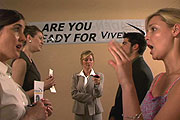 So, I spent the past couple of days in Philadelphia giving a presentation on competitive intelligence sales force effectiveness applications to CBI's "Gaining Physician Access" conference - and, then on the flight home, no kidding, I read in USAToday how one of my fellow Wisconsin Badger alums is releasing a new film on the career track for pharma sales people that rung strikingly true to what I heard in Philly the past couple of days:
-
Kathleen Slattery-Moschkau, a sales representative in the cell phone industry at the time, had a bachelor's degree in political science. The only science course she had ever taken in college was meteorology.
"The irony is then all these years later I'm working for these major pharmaceutical companies telling your doctor how to prescribe drugs for you," says Slattery-Moschkau, a former employee of Bristol-Myers Squibb and Johnson & Johnson. "I did it for 10 years, and I'm almost embarrassed I stayed that long."
An aspiring screenwriter since college, Slattery-Moschkau took notes about her many CandidCamera-type moments on the job. There were the "grinders," in which sales representatives would pair up and rehearse their identical, memorized pitches to doctors. There were the doctors' office staffs bored with yet another free pizza lunch from a drug sales rep. There were the internal conflicts between drug companies' marketing staffs and research scientists.
"I just had this whole stack of these revelations," Slattery-Moschkau says. And they made great icebreakers. "When I would go to parties, and I would meet people I didn't know, people would be really curious about what I did."
Slattery-Moschkau's notes led to Side Effects, an independent film that had its world premiere Saturday at the Cinequest Film festival in San Jose, Calif. The movie "is pretty eye-opening," says Jens Hussey, a Cinequest spokesman.
The film, written and directed by Slattery-Moschkau, will have its Midwest premiere April 2 at the Wisconsin Film Festival in Madison. It will then be released in theaters in Madison, Milwaukee, Dallas, Lincoln, Neb., and possibly other cities, Slattery-Moschkau says.
The timing of Side Effects, which was shot in 18 days last summer on a budget of $190,000, couldn't be better. Stories about the safety and marketing of prescription drugs grabbed headlines and led newscasts in recent months.
"As we were wrapping shooting, I think, the Paxil story was breaking," says Slattery-Moschkau, referring to one of the antidepressants linked to suicides in young people. "Then, shortly afterward, the Vioxx story broke."
Side Effects centers on the launch of an antidepressant called Vivexx. But don't expect an expose à la Michael Moore, who revealed in September, right around the time Merck pulled Vioxx off the market, that he's now taking on the pharmaceutical industry. There's no such drug as Vivexx, and there's no such drug company as Braden-Andrews, which markets it.
Slattery-Moschkau's film is a satirical look at how prescription drugs are marketed, with romance and family relations added to the mix. "I'm not Michael Moore," she says. "I tried to provide some of the counter-arguments for people to be thinking about. We have to look at both sides of the story."
For example, in one scene, Slattery-Moschkau's alter ego, Karly Hert — played by Katherine Heigl, who will appear in ABC's new TV series Grey's Anatomy— defends her profession to her boyfriend. "What about all the patients that are helped?" she asks.
Slattery-Moschkau wonders whether patients also might have been hurt because their doctors depended on drug company sales representatives, a number of whom had been drama or music majors in college, for information. "Basically, you were hired if you were a star athlete or they liked the way you looked," she says. "They wanted to give doctors something that would be a nice break in their day."
Spokesman Jeff Trewhitt says no one with the Pharmaceutical Research and Manufacturers of America, or PhRMA, a trade group for the prescription drug industry, has seen Side Effects. His response is based on a reporter's description of the film.
"This really does sound like fiction, considering that all sales representatives undergo extensive technical training and are prepared to answer questions about new medicines and their characteristics," Trewhitt says. He says drug companies often hire nurses and pharmacists for their sales forces.
Like Karly, Slattery-Moschkau says, she did not suddenly quit her job with a drug company.
"Toward the end, it was this bottom-line financial thing," she says. " 'I've got a house payment. How can I do this job a little while longer and build up my savings?' "
Slattery-Moschkau's — and Karly's — solution: Tell it like it is to the doctors. When a doctor asks Karly why he should prescribe her company's drug, she replies: "You're going to know exactly what your patients are getting with this drug. The good, the bad, the ugly."
To Slattery-Moschkau's surprise, her sales soared. "It was like the more direct and more honest I was, the more they respected what I had to say."
Now, whether or not this is a career option for freshly minted med-school dropouts...? That remains to be seen.
- Arik
March 14, 2005
Dr. Dre's Protégé Formula: The Secret to Aftermath's Hip-Hop Success
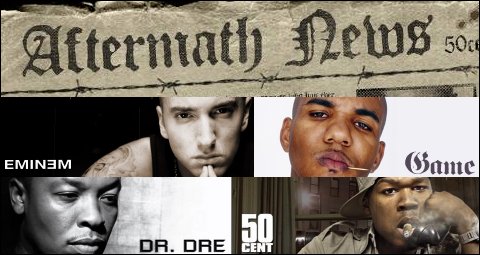
Brendan Koerner broke it down for us in a fascinating analysis on Slate.com of the secret to the success Dr. Dre's formulated at Aftermath Entertainment in grooming protégés like Eminem and 50 Cent to supa-MC-dom... The Game appears to be next up.
-
Dre isn't just consistently good—he's good in a consistent way. No matter if the front man is 50 Cent, Eminem, The Game, or Dre himself, the man's sound is similar from album to album. Dre achieves this by working with up-and-coming talents rather than established MCs who might want too big a say in how the album turns out. Dre was attracted to The Game because of his gangster persona and laid-back vocal style, but a more important factor might have been the young rapper's willingness to subordinate his technique to the Dre formula—the beats come first, and the lyrics are dessert. Meanwhile, ego clashes recently scuppered planned collaborations between Dre and Rakim, and Dre and Ice Cube.
Dre also realizes that once he's created a star, he can no longer exert his preferred level of control. Which may be why he rewards his former protégés with labels of their own (Eminem has Shady Records, 50 Cent has G Unit). It gives them something to do, which frees him up to look for more pliable talent. The end result? A sound that's so consistent the industry's hype artists can bank on it. Magazines and clothing companies can be confident that the pre-release capital they spend plugging Dre's protégés is a safe bet—sort of like buying hip-hop's version of municipal bonds.
When it comes to winning this kind of free, pre-release exposure, Dre has one last trick up his sleeve: He keeps himself scarce. Contrast the Dre approach with that of more prolific beatsmiths. The Neptunes, for example, rent themselves out as hired guns so often that a new Neptunes-produced track is certainly no cause for an XXL cover story. Dre, on the other hand, rarely takes on freelance work for non-Aftermath artists, preferring to keep his creative focus on projects he controls completely. Since 1998, only five albums can truly be considered pure Dre projects—the first two releases from Eminem, the debuts of 50 Cent and The Game, and his own 2001. The scarcity of Dre's work ensures that each release is an event, one that garners lavish media and consumer attention. And as music snobs are forever complaining—and the inexplicable success of Ashlee Simpson's Autobiography proves—exposure is what really propels an album to No. 1.
Ah, yes... invoking the name of Ashlee "Appetite for Humiliation" Simpson in the same piece as Eminem and 50 Cent... what's the world coming to? Still, the lesson of "if you love it, let it go" in constructing a hip-hop dynastic family network serves as an interesting model for spinning off success in promising new acts.
One the rest of the business world might well learn from... step up to get your rep up.
- Arik
March 13, 2005
Hewlett-Packard's Prototype DJammer: A Potentially Revolutionary New Musical "Instrument"
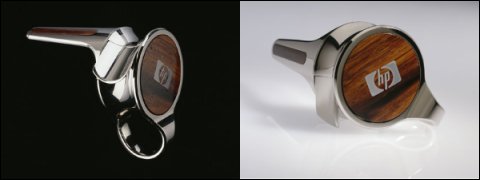
"Invent" - HP's slogan, seems to be ringing true for the first time in the post-Fiorina era, after Wired posted an article about the new DJammer, which the company is calling potentially as significant to the production of modern music as the first electric guitar was to rock-n-roll:
-
HP's DJammer is a prototype handheld gadget DJs can use to mimic the sound of scratching vinyl simply by moving the device around. So, if the operator makes a scratching motion in the air, arrays of internal motion sensors translate movement into music, and the DJammer "scratches" the music as though the DJ were manipulating a record.
Linked to a digital music library, the device can also mix tracks. It finds the entry and end points for tracks, and can cycle through a song collection. And it is wireless, so a DJ can control the music from anywhere in a room.
"The DJammer is the next-generation electric guitar," said Mark Smith, an HP researcher who co-invented the device. "It's the sort of thing where people will be able to become very creative."
The DJammer was created by HP research and development scientist Mat Hans, who began the project in 2002 with New York's Scratch DJ Academy, a school for DJs.
Hans wanted to develop a device that would let digital DJs mix their music just like vinyl DJs do, so he recruited Gavin O'Connor (aka DJ Gawk1) and came up with a wireless handheld controller that could be networked.
"We hooked up with O'Connor, and he showed us how professional DJs interact with turntables and music," said Smith, who also invented the technology behind the optical mouse. "This got us looking at how to match the expectation of the DJ."
O'Connor has demonstrated the device twice in public: at last summer's HP-sponsored MTV Video Music Awards and at the CES show in January.
O'Connor's setup is based on conventional twin decks for vinyl. The DJammer connects to a third line in on the mixing desk and plugs into a Linux-powered control brick that holds the tunes and drives the mixer.
"You are able to control music by air-scratching (and) jumping to different parts of the song ... using sensors built into the device," said the handheld's software designer, April Slayden.
Reaction at the MTV event was immediate, Slayden said. "I was approached by big-name DJs from all over the country who wanted one."
The DJammer's motion sensitivity relies on a 3-D accelerometer that controls the music when the operator shakes the device. It's based on the same technology used in notebooks to raise the head off a hard drive if it's dropped.
Keep it up, HP - as hip-hop goes digital that spirit of garage innovation just might help re-Invent HP in time for a comeback tour.
- Arik
 "Competitive Intelligence applies the principles of competition and lessons of intelligence to the need for enterprise awareness and predictability of market risk and opportunity. CI has the power to transform an enterprise from also-ran into real winners with agility enough to create and maintain sustainable competitive advantage."
