August 30, 2005
Hurricane Katrina: Disaster Impact on Energy Markets
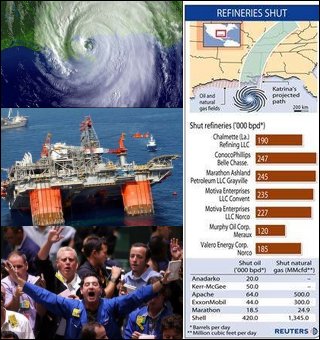 Hurricane Katrina made landfall Monday but avoided a potential "Worst-Case Scenario" for the U.S. energy industry... and, as an extension, for the U.S. economy as a whole.
As crude oil futures on the New York Mercantile Exchange reached $70.80 Sunday night (topping $70/bbl again Tuesday), up $4.67 from Friday, refineries and oil rigs on the Gulf Coast were shut down, and employees evacuated, shrinking oil output and creating more anxiety about fuel. Gasoline prices are expected to climb as refinery capacity is limited by the storm, and the impending storm cut oil production in the Gulf of Mexico by more than 600,000 barrels a day, or more than a third of the area's normal output of 1.5 million barrels a day. Large refining and oil-shipping installations in southern Louisiana shut down for the weekend too, which left energy analysts biting their nails because the Gulf Coast is such a major hub for both oil production and refining. "We are still in the soap-opera phase where everyone is still wondering what is going on," one analyst told the NYT. But the Times also spoke to a super-specialist, a guy who does disaster-risk analysis for refineries, and he didn't seem too bothered. "Usually the refineries fare pretty well, as long as they batten down the hatches and wait it out," he said.
Meanwhile, the White House suggested President Bush is at least open to tapping the U.S.'s strategic petroleum reserve; the only inconsisency in this approach being, the strategic reserve is full of crude oil, while the potential Katrina-caused shortage isn't of crude. As one analyst put it, "The crunch is on refineries." So, if the reserves will just have to queue up for refining, apart from the PR (and market-calming?) effect, how much good would it do to open up the reserves?
The LA Times has great coverage of the energy angle:
Most of the energy facilities in Louisiana, Mississippi and Alabama were shut down as Katrina roared through the region, which accounts for about one-third of the 5.5 million barrels of oil that the United States produces each day and more than 20% of its daily natural gas output.If repairs to damaged Gulf oil platforms, refineries and pipelines take weeks or months, shortages of oil, gasoline and natural gas could develop, sending prices of those commodities even higher and threatening the U.S. economy, analysts said. But it will take time to gauge the full extent of the hurricane's damage, adding uncertainty to the energy markets at a time when oil suppliers struggle to keep pace with rising demand.
"We're in an information vacuum because it's going to be another couple of days until we get a meaningful damage assessment," said David Pursell, a principal at Pickering Energy Partners Inc. in Houston.
The industry's trade group, the American Petroleum Institute, urged consumers to "use energy wisely" in the meantime.
Analysts noted that the region was slow to recover from last year's Hurricane Ivan, in part because damage to underwater pipelines wasn't immediately apparent or easy to fix.
Pipeline damage "is generally more difficult and costly to repair," analyst Doug Leggate of Citigroup Global Markets Inc. said in a note to clients.
The U.S. benchmark grade of crude oil for October delivery shot as high as $70.80 a barrel in overnight electronic trading before closing at $67.20, up $1.07 for the day on the New York Mercantile Exchange. That fell short of the Nymex record close of $67.49 a barrel set Thursday. Adjusted for inflation, oil peaked at more than $90 a barrel in early 1981.
But natural gas and gasoline futures set Nymex records Monday.
Natural gas for September delivery jumped $1.055 to $10.847 per million British thermal units as the winter heating season looms. Natural gas also is used to generate nearly half of California's electricity.
Gasoline futures for September delivery soared 13 cents to $2.061 a gallon. The rally probably means motorists will see pump prices climb even higher.
In California, the average retail price of regular gasoline hit a record $2.77 a gallon in the week ended Monday, up 2 cents from the previous week, the Energy Department said. The price stood 67 cents higher than a year earlier. The U.S. average price slipped two-tenths of a penny to $2.61 a gallon, up 74.4 cents from a year ago.
Still, industry experts found silver linings in the hurricane's clouds. They noted that some refineries continued to operate, albeit at reduced rates. The stock market closed higher, including shares of oil companies that are major players in the Gulf of Mexico, such as Exxon Mobil Corp., Chevron Corp. and Marathon Oil Corp.
Oil giant Saudi Arabia also said it stood ready to boost its daily production by more than 1 million barrels a day, to 11 million, to fill any supply shortages caused by Katrina.
And President Bush didn't immediately release oil from the U.S. Strategic Petroleum Reserve — a storage facility filled with 700 million barrels of oil for national emergencies — signaling that the White House didn't yet expect a major shortage of supplies. The government might use the reserve to make oil loans to refiners facing shortages, government officials said, just as it loaned more than 5 million barrels after Hurricane Ivan.
The reserve "is there for emergency situations, and that would include natural disasters," White House spokesman Scott McClellan said on Air Force One as Bush flew from Texas for appearances in Arizona and Southern California. The administration has rejected calls to release some of the reserve to mitigate high energy prices, saying Bush would consider the move only in response to a major disruption in supplies.
On Capitol Hill, Rep. Joe L. Barton (R-Texas), chairman of the House Energy and Commerce Committee, asked Bush on Monday to take such action if the hurricane "wreaks havoc" on U.S. oil supplies. Sen. Barbara Boxer (D-Calif.) urged the president to immediately tap the reserve to provide "some relief from skyrocketing oil prices."
Although Hurricane Katrina's damage has yet to be tallied, the initial effect appeared to be less than the cataclysm some feared, said Phil Flynn, senior market analyst at Alaron Trading Corp. in Chicago.
After a weekend filled with televised images of Katrina bearing down on the Gulf Coast, "it looks like New Orleans may be spared from annihilation, the levees might hold and the refineries might not be underwater, and that is a big positive for our country," Flynn said.
Still, there was no discounting even the initial pain of Katrina's punch.
Tracking devices on two drilling rigs under contract to Shell Exploration & Production Co., a U.S. arm of Royal Dutch Shell, showed that they had drifted from their normal locations, Shell spokeswoman Darci Sinclair said.
"Until the storm has completely passed and it's safe for us to send out crews and evaluate, we won't know what, if any, damage has occurred," Sinclair said. Shell expected to start sending out crews Monday evening, she added.
Another drilling platform broke free of its mooring in Mobile Bay, Ala., and slammed into a bridge, the Alabama Department of Transportation said. It was uncertain who owned the platform.
The fundamental question of what the price of oil will do, and the resulting pressure on gasoline, natural gas and heating oil prices heading into fall and winter, has more to do with refining capacity (which has just been cut, remember, by Katrina) than with exploration and extraction.
I predict the price of a barrel of light sweet crude will fall back to $40/bbl even while natural gas, heating oil and gasoline goes in the other direction. After all, we'll be in oversupply of rawer materials until refineries can get back online.
- Arik
August 27, 2005
The Long Tail
As I consider myself something of an "insider" on new and emerging trends (doesn't everybody?) I'm almost ashamed to admit that, after having been hearing for the better part of a year about "The Long Tail", Chris Anderson's essay in Wired Magazine (where he's editor-in-chief) from October 2004, I'm only NOW getting around to grasping the idea...
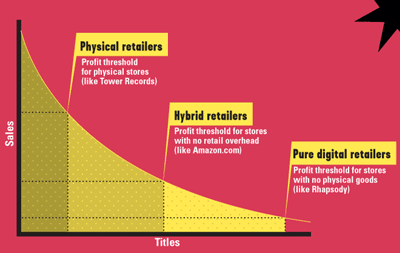
Anderson introduced the concept 'that demand for products not available in traditional bricks and mortar stores is potentially as big as for those that are. In other words, the potential aggregate size of the emerging "niche" market rivals that of the existing "hits" market.' Early next year, he's turning this into a book as well. Here's an excerpt from Anderson's blog that gives the rest of the story:
Traditional retail economics dictate that stores only stock the likely hits, because shelf space is expensive. But virtual retailers (from Amazon to iTunes) can stock everything, and the number of available niche products outnumber the hits by several orders of magnitude. Those millions of niches are the Long Tail, which had been largely neglected to date in favor of the Short Head of hits.When consumers are offered infinite choice, the true shape of demand is revealed. And it turns out to be less hit-centric than we thought. People gravitate towards niches because the satisfy narrow interests better, and in one aspect of our life or another we all have some narrow interest (whether we think of it that way or not).
Our research project has attempted to quantify the Long Tail in three ways, comparing data from online and offline retailers in music, movies, and books.
1) What's the size of the Long Tail (defined as inventory typically not available offline)?
2) How does the availability of so many niche products change the shape of demand? Does it shift it away from hits?
3) What tools and techniques drive that shift, and which are most effective?The Long Tail article (and the forthcoming book) is about the big-picture consequence of this: how our economy and culture is shifting from mass markets to million of niches. It chronicles the effect of the technologies that have made it easier for consumers to find and buy niche products, thanks to the "infinite shelf-space effect"--the new distribution mechanisms, from digital downloading to peer-to-peer markets, that break through the bottlenecks of broadcast and traditional bricks and mortar retail.
And, here are a couple of selected excerpts from the original essay to flesh out the idea for you:
Ask consumers, on the other hand, and they'll tell you that 99 cents is too high. It is, for starters, 99 cents more than Kazaa. But piracy aside, 99 cents violates our innate sense of economic justice: If it clearly costs less for a record label to deliver a song online, with no packaging, manufacturing, distribution, or shelf space overheads, why shouldn't the price be less, too?Surprisingly enough, there's been little good economic analysis on what the right price for online music should be. The main reason for this is that pricing isn't set by the market today but by the record label demi-cartel. Record companies charge a wholesale price of around 65 cents per track, leaving little room for price experimentation by the retailers.
That wholesale price is set to roughly match the price of CDs, to avoid dreaded "channel conflict." The labels fear that if they price online music lower, their CD retailers (still the vast majority of the business) will revolt or, more likely, go out of business even more quickly than they already are. In either case, it would be a serious disruption of the status quo, which terrifies the already spooked record companies. No wonder they're doing price calculations with an eye on the downsides in their traditional CD business rather than the upside in their new online business.
But what if the record labels stopped playing defense? A brave new look at the economics of music would calculate what it really costs to simply put a song on an iTunes server and adjust pricing accordingly. The results are surprising.
Take away the unnecessary costs of the retail channel - CD manufacturing, distribution, and retail overheads. That leaves the costs of finding, making, and marketing music. Keep them as they are, to ensure that the people on the creative and label side of the business make as much as they currently do. For a popular album that sells 300,000 copies, the creative costs work out to about $7.50 per disc, or around 60 cents a track. Add to that the actual cost of delivering music online, which is mostly the cost of building and maintaining the online service rather than the negligible storage and bandwidth costs. Current price tag: around 17 cents a track. By this calculation, hit music is overpriced by 25 percent online - it should cost just 79 cents a track, reflecting the savings of digital delivery.
Putting channel conflict aside for the moment, if the incremental cost of making content that was originally produced for physical distribution available online is low, the price should be, too. Price according to digital costs, not physical ones.
All this good news for consumers doesn't have to hurt the industry. When you lower prices, people tend to buy more. Last year, Rhapsody did an experiment in elastic demand that suggested it could be a lot more. For a brief period, the service offered tracks at 99 cents, 79 cents, and 49 cents. Although the 49-cent tracks were only half the price of the 99-cent tracks, Rhapsody sold three times as many of them.
Since the record companies still charged 65 cents a track - and Rhapsody paid another 8 cents per track to the copyright-holding publishers - Rhapsody lost money on that experiment (but, as the old joke goes, made it up in volume). Yet much of the content on the Long Tail is older material that has already made back its money (or been written off for failing to do so): music from bands that had little record company investment and was thus cheap to make, or live recordings, remixes, and other material that came at low cost.
Such "misses" cost less to make available than hits, so why not charge even less for them? Imagine if prices declined the further you went down the Tail, with popularity (the market) effectively dictating pricing. All it would take is for the labels to lower the wholesale price for the vast majority of their content not in heavy rotation; even a two- or three-tiered pricing structure could work wonders. And because so much of that content is not available in record stores, the risk of channel conflict is greatly diminished. The lesson: Pull consumers down the tail with lower prices.
How low should the labels go? The answer comes by examining the psychology of the music consumer. The choice facing fans is not how many songs to buy from iTunes and Rhapsody, but how many songs to buy rather than download for free from Kazaa and other peer-to-peer networks. Intuitively, consumers know that free music is not really free: Aside from any legal risks, it's a time-consuming hassle to build a collection that way. Labeling is inconsistent, quality varies, and an estimated 30 percent of tracks are defective in one way or another. As Steve Jobs put it at the iTunes Music Store launch, you may save a little money downloading from Kazaa, but "you're working for under minimum wage." And what's true for music is doubly true for movies and games, where the quality of pirated products can be even more dismal, viruses are a risk, and downloads take so much longer.
So free has a cost: the psychological value of convenience. This is the "not worth it" moment where the wallet opens. The exact amount is an impossible calculus involving the bank balance of the average college student multiplied by their available free time. But imagine that for music, at least, it's around 20 cents a track. That, in effect, is the dividing line between the commercial world of the Long Tail and the underground. Both worlds will continue to exist in parallel, but it's crucial for Long Tail thinkers to exploit the opportunities between 20 and 99 cents to maximize their share. By offering fair pricing, ease of use, and consistent quality, you can compete with free.
Here's the conclusion from the same piece:
But Netflix, where 60 percent of rentals come from recommendations, and Amazon do this with collaborative filtering, which uses the browsing and purchasing patterns of users to guide those who follow them ("Customers who bought this also bought ..."). In each, the aim is the same: Use recommendations to drive demand down the Long Tail.This is the difference between push and pull, between broadcast and personalized taste. Long Tail business can treat consumers as individuals, offering mass customization as an alternative to mass-market fare.
The advantages are spread widely. For the entertainment industry itself, recommendations are a remarkably efficient form of marketing, allowing smaller films and less-mainstream music to find an audience. For consumers, the improved signal-to-noise ratio that comes from following a good recommendation encourages exploration and can reawaken a passion for music and film, potentially creating a far larger entertainment market overall. (The average Netflix customer rents seven DVDs a month, three times the rate at brick-and-mortar stores.) And the cultural benefit of all of this is much more diversity, reversing the blanding effects of a century of distribution scarcity and ending the tyranny of the hit.
Such is the power of the Long Tail. Its time has come.
Time to put this one on my Amazon wish list...
- Arik
August 26, 2005
The Greenspan Era Confab in the Tetons: Easy Money & the Real Estate Bubble
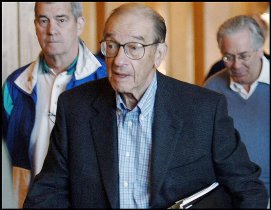 Federal Reserve Chairman Alan Greenspan's warning that the current housing bubble is by no means burst-proof. Home prices could plunge, Greenspan implied, if long-term interests rates go up. Those rates, which are based on finicky international market forces, have been low for some time, in part because investors believe the U.S. economy is healthy and ergo safe for money-lending. But such relatively safe conditions, Greenspan cautioned, are "too often viewed by market participants as structural and permanent."
Speaking at a symposium entitled, "The Greenspan Era: Lessons for the Future," Greenspan went on to praise what he called the "flexibility" of the American economy. Globalization and deregulation have strengthened the markets, he said, leaving them less susceptible to the precipitous boom-bust cycles of the past. What the Post coverage omitted, though, was the chief's noteworthy treatment of the "fear of change," both among American workers and policy-makers. "Increased fear of job-skill obsolescence," he said, has prevented U.S. workers from being competitive in the world labor market—a problem that must "be addressed through education and training."
So, after reading an explanation about how and why real estate agents (not all are "Realtors®" you know!) aren't getting rich with the booming housing bub... er, market, I found it interesting to read remarks by Greenspan about risks to the consumer foundation of the economy. But, first, a couple of choice excerpts from Slate.com's piece about the housing bubble and how real estate agents aren't getting any richer because no barriers to entry into the profession mean there's less to go around for everybody:
One seemingly obvious path to riches is to become a real-estate broker. For many decades, agents have successfully kept their payments steady as a fixed share of the value of the houses they sell. In most cities, the rate is around 6 percent, split between the buyer's and the seller's agents. The lack of price competition has attracted the notice of anti-trust authorities at the Justice Department who are planning to sue the National Association of Realtors over some of their anti-discounting policies. Economically speaking, it's hard to explain why the steady commissions have lasted so long—perhaps agents band together to blacklist competitors who undercut prices, or perhaps the NAR's extensive "education" program for realtors excels at indoctrination.Whatever the explanation, the realtors' reliable cut of 3 percent each means that the housing bubble should be all upside for them. If house prices double, then agents make twice as much. Sell a house for $500,000 and keep $15,000; sell the same house for $1 million and keep $30,000. The agents are Levi Strauss without the copper rivets.
There is just one problem with this—a principle that economists term the "zero-profit condition." In a business with free entry, new participants will keep entering until no money remains. And becoming a real-estate agent is almost free. Most states require applicants to take a short class and a test to get a license. For $99, an online company will prepare you to pass. This kind of entry into the housing market is a lot cheaper than, say, building a steel mill. Every month, thousands of new brokers get certified—more than 8,000 in California in May alone.
With all these new agents swarming onto the scene, the price they charge may remain constant, but the number of houses each sells will not. The zero-profit condition predicts that, in locales where housing prices rise, the number of agents will also rise, and acquiring new clients will become that much more difficult. The occasional star agent will always make a bundle. But the theory suggests that the average agent won't make much more in places where house prices have risen than in places where they haven't.
A recently published study bears this out. Enrico Moretti and Chiang-Tai Hsieh of the University of California, Berkeley, studied the real-estate agent business in 282 metropolitan areas during a 10-year period. They compared agents in inflated markets to agents in flat-lining markets and found overwhelming evidence of the zero-profit condition in action. When housing prices rose, the number of agents did as well, and this, in turn, reduced the number of houses each agent sold by almost exactly the same proportion as the price increase. In Moretti and Hsiesh's data, for example, houses cost 5.9 times more on average in San Francisco than they do in Steubenville, Ohio. But the average full-time agent working in Steubenville sells more than 22 houses per year, whereas the same agent in San Francisco sells less than one-fifth as much.* The average income for real-estate work in the two locales is virtually identical. Moretti and Hsieh found that the direct correlation between housing prices and agent productivity held true across all markets. A rise in housing prices in an area has no significant impact on the average wage of the brokers in that market. It's the oldest line in the economics book: No barriers to entry mean no big profits.
Meanwhile, in Jackson Hole, Greenspan delivered a brief history of 20th century economics and monetary policy, followed by an appreciation for his legacy in an era of asset-value accumulation:
The structure of our economy will doubtless change in the years ahead. In particular, our analysis of economic developments almost surely will need to deal in greater detail with balance sheet considerations than was the case in the earlier decades of the postwar period. The determination of global economic activity in recent years has been influenced importantly by capital gains on various types of assets, and the liabilities that finance them. Our forecasts and hence policy are becoming increasingly driven by asset price changes.The steep rise in the ratio of household net worth to disposable income in the mid-1990s, after a half-century of stability, is a case in point. Although the ratio fell with the collapse of equity prices in 2000, it has rebounded noticeably over the past couple of years, reflecting the rise in the prices of equities and houses.
Whether the currently elevated level of the wealth-to-income ratio will be sustained in the longer run remains to be seen. But arguably, the growing stability of the world economy over the past decade may have encouraged investors to accept increasingly lower levels of compensation for risk. They are exhibiting a seeming willingness to project stability and commit over an ever more extended time horizon.
The lowered risk premiums--the apparent consequence of a long period of economic stability--coupled with greater productivity growth have propelled asset prices higher.5 The rising prices of stocks, bonds and, more recently, of homes, have engendered a large increase in the market value of claims which, when converted to cash, are a source of purchasing power. Financial intermediaries, of course, routinely convert capital gains in stocks, bonds, and homes into cash for businesses and households to facilitate purchase transactions.6 The conversions have been markedly facilitated by the financial innovation that has greatly reduced the cost of such transactions.
Thus, this vast increase in the market value of asset claims is in part the indirect result of investors accepting lower compensation for risk. Such an increase in market value is too often viewed by market participants as structural and permanent. To some extent, those higher values may be reflecting the increased flexibility and resilience of our economy. But what they perceive as newly abundant liquidity can readily disappear. Any onset of increased investor caution elevates risk premiums and, as a consequence, lowers asset values and promotes the liquidation of the debt that supported higher asset prices. This is the reason that history has not dealt kindly with the aftermath of protracted periods of low risk premiums.
Broad economic forces are continuously at work, shaping the environment in which the Federal Reserve makes monetary policy. In recent years, the U.S. economy has prospered notably from the increase in productivity growth that began in the mid-1990s and the enhanced competition engendered by globalization. Innovation, spurred by competition, has nurtured the continual scrapping of old technologies to make way for the new. Standards of living have risen because depreciation and other cash flows generated by industries employing older, increasingly obsolescent technologies have been reinvested to finance newly produced capital assets that embody cutting-edge technologies.
But there is also no doubt that this transition to the new high-tech economy, of which expanding global trade is a part, is proving difficult for a segment of our workforce that interfaces day by day with our rapidly changing capital stock. This difficulty is most evident in the increased fear of job-skill obsolescence that has induced significant numbers of our population to resist the competitive pressures inherent in globalization from workers in the major newly emerging market economies. It is important that these understandable fears be addressed through education and training and not by restraining the competitive forces that are so essential to overall rising standards of living of the great majority of our population. A fear of the changes necessary for economic progress is all too evident in the current stymieing of international trade negotiations. Fear of change is also reflected in a hesitancy to face up to the difficult choices that will be required to resolve our looming fiscal problems.
The developing protectionism regarding trade and our reluctance to place fiscal policy on a more sustainable path are threatening what may well be our most valued policy asset: the increased flexibility of our economy, which has fostered our extraordinary resilience to shocks. If we can maintain an adequate degree of flexibility, some of America's economic imbalances, most notably the large current account deficit and the housing boom, can be rectified by adjustments in prices, interest rates, and exchange rates rather than through more-wrenching changes in output, incomes, and employment.
The more flexible an economy, the greater its ability to self-correct in response to inevitable, often unanticipated, disturbances. That process of correction limits the size and the consequences of cyclical imbalances. Enhanced flexibility provides the advantage of allowing the economy to adjust automatically, reducing the reliance on the actions of monetary and other policymakers, which have often come too late or been misguided.
In fact, the performance of the U.S. economy in recent years, despite shocks that in the past would have surely produced marked economic contraction, offers the clearest evidence that we have benefited from an enhanced resilience and flexibility.
Taking into account both documents above, I tend to agree with the Washington Post analysis of his remarks:
Federal Reserve Chairman Alan Greenspan warned Friday that recent gains in U.S. home prices, stock values and other forms of wealth may be temporary and could easily erode if long-term interest rates rise.Households and businesses have been able to spend more by transforming houses, stock and other assets into cash, he noted. But Americans should not assume that such good times will roll on forever.
"What they perceive as newly abundant [cash] can readily disappear," Greenspan said.
His words followed statements the Fed chief has made in recent months that housing prices in some markets have risen to unsustainable levels and that individuals are taking on increasingly risky mortgages. But Greenspan's comments Friday represent a broader warning, with the Fed chief indicating he believes much of the run-up in housing and stock prices over the past decade has been due to low long-term interest rates, which could rise if global financial conditions shift.
"History has not dealt kindly" with those who underestimate such risks, Greenspan said in remarks delivered at the opening of an economic conference here focused on his 18 years as Fed chief.
Stock prices fell in trading Friday after Greenspan suggested that the value of such assets may be headed lower in the future. Financial markets have responded to Greenspan's warnings in the past, only to shrug them off subsequently. In 1996, he famously warned that "irrational exuberance" might be pumping up stock prices; stocks fell briefly only to climb almost continuously for the following three years.
At the conference's opening session Friday, Greenspan was lauded by current and former colleagues and other analysts for his performance and wisdom as Fed chief. "When the score is toted up, we think he has a legitimate claim to being the greatest central banker who ever lived," wrote former Fed vice chairman Alan S. Blinder and Ricardo Reis, both Princeton University economists, in a paper presented Friday.
The Fed has been raising its benchmark short-term rate for more than a year and has signaled that it probably will keep lifting it in the months to come to keep the lid on inflation. But the Federal Reserve does not set long-term rates, such as those that determine mortgage rates and corporate borrowing costs. Those are affected by international financial markets in response to many factors.
Long-term interest rates remain very low, in part because inflation has remained tame outside of energy costs. Overseas investors have been pouring money into U.S. stocks and bonds, helping dampen long-term rates. But Greenspan said low long-term rates also reflect investors' belief that the U.S. economy is so healthy that there is little risk in lending money here.
Thus, lenders set rates lower because they demand a lower "risk premium," Greenspan said.
"This vast increase in the market value of [stocks, bonds, houses and other assets] is in part the indirect result of investors accepting lower compensation for risk," Greenspan said. "Such an increase in market value is too often viewed by [investors] as structural and permanent."
- Arik
August 25, 2005
Northwest Airlines: Mechanics Strike Will Negatively Impact Future of Organized Labor
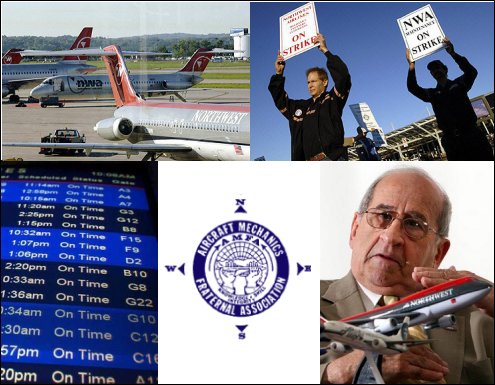
Thanks to savvy planning ahead on the part of Northwest Airlines (thank goodness I'm not traveling much in August) it would appear the mechanics strike is, not only, having minimal impact on operations, but causing significant enough dissent in the ranks of Northwest's other unions (pilots, stewardess, etc.) that fears it could undermine the very character of organized labor - at least in the airline industry - do not go unfounded.
While the AMFA (Aircraft Mechanics Fraternal Organization) would have us avoid flying Northwest because of warnings planes are unsafe under "scab" oversight, the walkoff by 4,400 mechanics, cleaners and custodians appears to be having a somewhat counter-intuitive impact... teaching Northwest (and competing airlines) that it can indeed survive or even thrive without union labor.
No new talks are scheduled between Northwest and the union, which is refusing to take pay cuts and layoffs that would have reduced their ranks by nearly half. The mechanics averaged about $70,000 a year in pay, and cleaners and custodians made around $40,000. The company wants to cut their wages by about 25 percent. AMFA represents about 3,500 mechanics, about 790 cleaners and 75 custodians.
Northwest has said it needs $1.1 billion in labor savings but only pilots have agreed to reductions, accepting a 15 percent pay cut worth $300 million when combined with cuts for salaried employees. It is negotiating with ground workers and flight attendants, and it has said it can reopen talks with pilots once it gets concessions from the other groups.
Company executives credit their contingency plan that took 18 months to create and say the plan to use temporary workers in place of striking workers required extensive analysis, as well as the cooperation of other unions and the federal government - even consulting with White House.
With more than one labor expert observing Northwest's ability to switch to new work routines and keep operating, at last at outset of the labor action, sends an important signal to unions that strikes may have lost their power as tools to fight job losses and other cuts.
- Arik
August 24, 2005
Google Talk: the VoIP/IM Extension and how it will Impact Skype, AOL, MSN & Yahoo
 Back when I heard Google was raising $4 billion more dollars in a second offering I thought one of the targets might be erstwhile viral phenom Skype in order to get into the VoIP space in a big enough way to matter, but with the launch of Google's Talk beta this week, that original estimate appears mistaken. According to the Red Herring:
Granted, a comparison between a one-day-old product with few users and an industry leader with a cult-like following might seem a little odd. Skype, a Luxembourg-based Internet telephony company, has more than 40 million users and adds 155,000 new users every day.However, when the challenger is Google, which has managed to establish a leadership role in the search sector, comparisons are inevitable.
“This isn’t the final product,” said Will Stofega, an analyst with IDC. “There are a lot of options for them as they develop this product further. The other way to think about this is that it’s not just a chat product, it’s a search engine doing a lot of fantastic things.”
The end product could turn out to be a threat to Skype and other companies in the nascent VoIP market, including Vonage, which reportedly has plans to raise $600 million in an initial public offering. Google, which has about $3 billion in cash, is planning to raise another $4 billion through a secondary offering, but has been vague about how it plans to spend the cash.
In July, Google fielded 36.5 percent of all online searches, more than Yahoo or MSN, according to comScore Media Metrix. Its popularity in search has crossed over to other products, such as Google Earth, its mapping service, and Gmail, its email offering.
Analysts believe Google’s brand image and financial resources could help it develop a powerful voice product, one that will easily attract users. But while Google may draw customers from other IM services, it isn’t clear whether it can eat into Skype’s market share.“[Skype has] that same sort of techno-hipness that Google brings to the table,” said Mr. Stofega. “And Skype has this Grateful Dead-type loyal developer community.”
And those developers are working on independent applications—such as a video client—some of which are free while others are sold. They’re hoping their applications and features can potentially draw a larger audience than Skype.
Kazaa Vets
Skype was created by Niklas Zennström and Janus Friis, the founders of Kazaa, a peer-to-peer audio exchange program, two years ago. It has rapidly moved beyond the computer-to-computer space with services such as Skype Out, which allows users to call traditional phone numbers anywhere.
The Google application is, on the other hand, still very limited, pointed out Scott Kessler, an Internet analyst with Standard & Poor’s. And it’s only available to Gmail users at this point.
“It’s uncertain if you’re going to see broad adoption,” said Mr. Kessler. “Google Talk is exceedingly limited, from having to have a Gmail account, to having to have a computer, and having someone you’re in touch with on the same network.”
Then again, Google Talk is free, at least for now. And Mr. Kessler noted that if users asked for a capability to make calls to land-line phones, Google would probably try to provide it. In other words, down the road, Google Talk could eventually become a Skype-killer.
“They’ll compete with each other, and Google might have an advantage, because their business model is not based on this offering,” said In-Stat analyst Keith Nissen. “Skype is ultimately going to have to wonder, ‘Where are we going to get money from?’”
Where could Google really have a competitive impact? By acting as the bridge to IM interoperability!
However, hopes for a consolidation of the marketplace around the Holy Grail of an IM standard which could convey truly disruptive innovation appears elusive:
As the new kid in the instant-messaging market, Google Inc. wants to be friends with everyone, but it's unlikely the seasoned players will let rivals get close to their subscribers.In launching Google Talk , the Mountain View, Calif., search engine called for interoperability with the major networks built by America Online Inc., Microsoft Corp.'s MSN and Yahoo Inc.
"It's the Holy Grail," Joe Wilcox, analyst for JupiterResearch, said of interoperability.
It's unlikely, however, that the granddaddy of IM, AOL, will open up its base of 41.6 million subscribers to competitors. In comparison, Yahoo, which has the second largest network, has less than half the subscribers of AIM at 19.1 million, according to web metrics firm ComScore Networks. MSN has 14.1 million subscribers.
"AOL isn't letting anybody into their network, if they don't have to," JupiterResearch analyst David Card said. "There's no incentive for AOL to cooperate with anyone."
That incentive, however, could come in time, if IM vendors decide to take the service beyond the ability to have immediate text conversations with friends, family and colleagues. The portals have already added PC-to-PC voice calls and have extended IM to cellular phones. They could go much further in developing a communications platform that tightly integrates email, voicemail and IM, making it all accessible through multiple devices.
The heart of such a communications hub would be the contacts directory, Card said. Besides grouping people by their relationship with the IM subscriber, such as a family member, friend or colleague, the directory also establishes whether they are reachable. That could one day be expanded to add how the person wants to be reached, by PC, cellular phone or some other device.
Microsoft, according to Card, is very much focused on IM as a broader communications platform.
While the evolution of IM could be a potential battleground for the major portals, telecommunication companies and wireless carriers, it's more likely that partnerships will occur, and communication networks will open up, much like email is today, Card said.
"It makes everything more valuable, if the network is bigger," he said.
In the meantime, AOL, Yahoo and MSN are connecting IM to more services, such as online music, in order to build loyalty and help keep subscribers. Locking in customers would also be a strategy behind the building of a unified communications platform.
Google Talk, however, is notable in that Google has not linked its IM client to anything but its web mail service GMail. Therefore, it's difficult to see where Google is heading.
"It's very Spartan," Wilcox said of the new product.
Some commentators even wonder if it was such a smart move, to continue the long march toward a world where any context is up for advertising with Google looking over your shoulder:
When does Google start parsing peoples' IM conversations in order to present context-sensitive advertisements?They're already parsing people's Gmail and generating "appropriate" ads based upon the message's content. How can Google possibly resist doing the same for instant messaging?
I'm sorry, but all this Google-looking-over-your-shoulder stuff gives me the creeps. It asks me to trust Google in ways I don't trust, well, anybody. Not that other IM or free-mail services couldn't also be watching content, it's just that Google is provably doing so. And it's reading people's mail merely to present more targeted (and thus more annoying) advertisements. Yech!
Sure, those ads give me free service and I've even been known to click on an "Ads by Google" link occasionally. But, I already pay to make TV and radio ads go away, I buy AccuWeather forecasts minus the ads and also give money to a few other services that offer an ad-free option. I might be willing to pay Google, as well.
Should Google offer a paid, ad-free service?
In deciding that question, you first have to decide whether Google is worth paying for. There was a time when Google was so much better than the other searches that I'd have said "yes." But, before there was Google, I might have said the same thing about Alta Vista.
Today, Google is still the best search engine, but the others, MSN especially, are catching up. Google's biggest challenge, however, is the continued decay of its results.
Google isn't as open as it once was in talking about how it determines placement of its results. I just know that as Google has made moves into several other businesses, its core search business seems sick and hasn't gotten better. People I know are leaving Google for other search engines.
Particularly troublesome are all the sites that show up at the top of Google's rankings that really aren't sites at all, except that they lead you to other search results, auction sites, or whatever. Google ought to be able to get rid of this Internet flotsam but so far has failed to do so.
But, let's imagine Google could find a way to dump this pseudo-content, I still wonder if Google's results haven't become too expansive. I can't prove this at all scientifically but my gut is that Google presents way too much content in its results, having the effect of diluting the "right" content that most people are looking for.
Still the technological underpinnings of Jabber make for some interesting possibilities:
Google's system relies on the XMPP, or Jabber, protocol. That means those favoring operating systems other than Windows or alternative IM clients, including Adium, iChat, GAIM, Psi, and Trillian, can connect to the Google Talk network and send IMs.Because XMPP is an open protocol, developers have an opportunity to add value to the network. "If a game developer or a productivity developer decides they need to have instant messaging in their application," Harik says, "they can just program to the XMPP spec and they'll be able to let people connect to our network using their Gmail IDs but inside the developer's application."
Harik says that Google is committed to open standards and interoperability with other networks. He says support for Session Initiation Protocol (SIP) is likely and notes that Google is already working with EarthLink, which has its own Internet voice service.
According to Harik, talks with AOL, Skype, and Yahoo are already underway. And now that the secret is out, Microsoft can expect a call. "We will shortly start conversations with Microsoft," he says.
Google's goal is a unified, abuse-free messaging network. That's something many IM users will welcome, given the fragmented IM market. According to Internet statistics company comScore Networks, Inc., the leading IM applications were AOL's two offerings -- the subscribers-only AOL Instant Message and AIM standalone application -- along with Yahoo Messenger, and MSN Messenger Service with 41.6 million , 19.1 million, and 14.1 million active users respectively in July.
While Google's grand unification theory may find favor with users tired of IM's historic Balkanization, the company's hope for a network free of misuse seems naive. In July, IM security vendor Akonix Systems Inc. warned that the number of attacks against major IM networks had increased nearly 400% from the first quarter of 2005 to the second. And that's a trend that's likely to accelerate as the networks become better connected, offering malware writers a larger, more tempting pool of potential victims.
Eager to address privacy concerns, Google wants users to know that it does not track the content of IM chats or voice conversations. It does, however, track certain log information to maintain statistics on usage and to improve service.
And Google Talk doesn't display ads.
Still, there's a change of attitude about Google afoot in Silicon Valley and comparisons with Microsoft recently have people wondering about that "Don't be evil" part of the corporate bylaws:
Google's success has already spurred Microsoft to develop its own Internet search engine (a project code-named Underdog), but Google has legions of engineers banging away on a range of projects of its own that, if successful, could dislodge Microsoft from the pre-eminent spot it has enjoyed since the early 1980's.Of course, Silicon Valley has had past pretenders to the throne. Netscape, which went public 10 years ago this month, and its Web browser, Navigator, were supposed to fell Microsoft - but it is Netscape that is no longer in business. And while Google is riding high, those closely following the company caution that it is hardly invincible; an inflated stock price, a desire to compete in too many sectors simultaneously or simple hubris might cause it to stumble, they say. Even Microsoft, after all, has had legal troubles.
Still, similarities between Google and Microsoft are evident to local entrepreneurs including Steven I. Lurie, who worked at Microsoft between 1993 and 1999 but now lives in San Francisco, and Joe Kraus, a founder of the 1990's search firm Excite.
"There's that same 'think big' attitude about markets and opportunities," said Mr. Lurie, who has visited the Google campus in Mountain View many times to see friends who work there. "Maybe you can call it arrogance, but there's that same sense that they can do anything and get into any area and dominate."
To place Google in context, Mr. Kraus offered a brief history lesson. In the 1990's, he said, I.B.M. was widely perceived in Silicon Valley as a "gentle giant" that was easy to partner with while Microsoft was perceived as an "extraordinarily fearsome, competitive company wanting to be in as many businesses as possible and with the engineering talent capable of implementing effectively anything."
Now, in the view of Mr. Kraus, "Microsoft is becoming I.B.M. and Google is becoming Microsoft." Mr. Kraus is the chief executive and a founder of JotSpot, a Silicon Valley start-up hoping to sell blogging and other self-publishing tools to corporations.
Just as Microsoft has been seen over the years as an aggressive, deep-pocketed competitor for talent, Internet start-ups in Silicon Valley complain that virtually every time they try to recruit a well-regarded computer programmer, that person is already contemplating an offer from Google.
"Google is doing more damage to innovation in the Valley right now than Microsoft ever did," said Reid Hoffman, the founder of two Internet ventures, including LinkedIn, a business networking Web site popular among Silicon Valley's digerati. "It's largely that they're hiring up so many talented people, and the fact they're working on so many different things. It's harder for start-ups to do interesting stuff right now."
Google, Mr. Hoffman said, has caused "across the board a 25 to 50 percent salary inflation for engineers in Silicon Valley" - or at least those in a position to weigh competing offers. A sought-after computer programmer can now expect to make more than $150,000 a year.
David C. Drummond, vice president for corporate development at Google, acknowledged that the company was "very competitive" in its pursuit of talent, but added: "We're very sensitive to how everybody is perceiving us. We think the Silicon Valley ecosystem is critical for Google's success."
Google is also making it more difficult for some start-ups to raise funds. In the second half of the 1990's, entrepreneurs frequently complained that the specter of Microsoft hung over their every conversation with venture capitalists. Today, they say the same about Google.
"When I meet with venture capitalists, or if I'm engaged in a conversation about going into partnership with someone, inevitably the question is, 'Why couldn't Google do what you're doing?' " said Craig Donato, the founder and chief executive of Oodle, a site for searching online classified listings more quickly.
"The answer is, 'They could, and they're probably thinking about it, but they can't do everything and do it well,' " Mr. Donato said. "Or at least I'm hoping they can't."
In the end, the only analysis remaining is that Google Talk lays the groundwork for Google to move beyond the Internet and onto the telephone network - while the service can handle only PC-to-PC voice calls, for the moment, if it added the functions of an Internet telephony company such as Skype, it could easily and quickly let Internet callers reach beyond computers to the PSTN. Indeed, in January, the company said it was after a strategic negotiator with experience in "identification, selection, and negotiation of dark-fiber contracts both in metropolitan areas and over long distances as part of the development of a global backbone network."
That leads me to only one possible conclusion: the move confirms that Google's competitive ambitions are even more ravenous than Microsoft's at a similar point in its corporate business development.
- Arik
August 23, 2005
AMD vs. Intel: the Abuse of Monopoly Power & a Dual-Core Chip Challenge
 The grudge-match between AMD and Intel continues - although AMD is the clear aggressor in all of it. This week, in a follow up to AMD's antitrust lawsuit over Intel's "abuse of monopoly power" the guantlet was thrown down for a mano-a-mano in dual core server processors:
Advanced Micro Devices Inc. on Tuesday (August 23) issued a challenge to Intel Corp. to conduct a head-to-head competition of dual-core server microprocessors.AMD's proposed dual-core duel would be a live, public performance evaluation between server platforms based on the dual-core Opteron 800 Series or 200 Series processors and the corresponding Intel product.
Should Intel accept AMD's challenge, the duel would take place at a public venue to be announced in the coming weeks, with testing conducted by a neutral, third-party testing lab.
"Since we launched Dual-Core AMD Opteron processors in April 2005, we've won every major industry-standard benchmark for x86 servers. AMD64 dual-core technology provides industry-leading performance, is easy to upgrade and is energy efficient," said Marty Seyer, corporate vice president and general manager of the Microprocessor Solutions Sector at AMD, in a statement.
"We are giving our competitor a fair and open opportunity to challenge our clear market leadership in a public setting,” he said. “The gauntlet has been thrown down, it is time to cut through the hype, and demonstrate who the industry's leader in x86 dual-core processing is today."
More interesting is that the existence of its monopoly isn't AMD's beef with Intel... it's the fact that they tried to maintain it:
AMD, he said, isn't suing Intel because Intel is a monopoly; it's suing Intel for abusing its monopoly powers to maintain its control of the market. I knew that a distinction of that kind existed, though I'm no lawyer. Still, I had never heard it put so succinctly.The less thoughtful among those inclined toward AMD portray Intel as a beastly megacorporation drunk with wealth and success that deserves to be taken down a peg. AMD's going to storm the castle walls, do or die, so three cheers for the underdog!
It's a pity that view has gotten so much visibility because pundits are mistaking this antitrust case as an effort by AMD to rouse the rabble against the company that's gotten too big.
Those inclined toward Intel tend to portray AMD as a feeble grower of sour grapes, a company with some smart technology that was, in the end, unable to capture the minds and dollars of the PC market during a fair fight. In capitalism, as in nature, there must be winners and losers, diners and dinners. There's no crying in business, and we can't champion those who run to court to protest whenever the market decides against them.
AMD isn't suing Intel for being too big, too profitable, or too stingy to share its wealth. I'm relieved that we're enjoying a respite from the '90s-era knee-jerk disdain for tech companies judged too large or too successful. The arbiters of "too" are always unable to quantify their criteria, but they know it when they see it. And when they see it, these judges of corporate proportionality set about making things right by trashing the player that, according to the secret formula, has more than it deserves.
Microsoft will always be the epitome of the megacorporate pincushion. Every time a Windows or Internet Explorer security hole was found or a Microsoft exec said something stupid, it was flogged as yet another reason for right-thinking people to wish Microsoft failure or harm.
A company or individual who has attained a certain level of success risks having sloppiness and poor decisions reframed as malicious deeds. I'd have no empathy for AMD if it were using the courts to compensate it for ending up with too little pie.
I do have empathy for AMD precisely because AMD isn't suing Intel for being too big, too successful, or too wily a competitor. The question for the court and, if it's not settled before trial, a jury is whether Intel misused the monopoly powers it has acquired to make sure that it maintains its lead. Did Intel come by its wealth and power earnestly? Is Intel in the leadership position in x86 CPUs through dirty dealing? That's worthwhile fodder for discussion, but in AMD v. Intel, Intel's size and success aren't the issue. The question at issue is much easier to define and decide: Did Intel break the law trying to hang onto its control of the PC processor market?
So, what do you think? Is that a valid argument against unfair competition?
- Arik
August 10, 2005
General Motors Success in China Proves Company Can Compete After All (Free of Union Labor, At Least)

General Motors has apparently figured out how to build the right car for the right market - in this case, $5,000 minivans that get 43 miles to the gallon in city driving.
The minivans, which GM builds in a joint venture with a Chinese partner, have a quarter the horsepower of American minivans, weak acceleration and a top speed of 81 miles an hour - but they're selling like hotcakes. The New York Times reported that GM has sold more than 170,000 very small vehicles in China - enough to pass Volkswagen this year in sales in a market that VW has dominated for two decades, becoming, with its Chinese partner Wuling, the top automobile company in China.
The Wuling Sunshine minivan is a far cry from its bigger-is-better image of GM in United States, where it produces some of largest gas guzzlers on market, like Hummers. The minivan's development was led by Philip Murtaugh, the maverick executive who was able to create in China the kind of innovative environment that GM has struggled for decades to achieve in its American operations; but Murtaugh's success in China has led to his departure from company, in what may be telling sign of corporate culture at GM. A good summary comes from IHT:
-
The seats are only a third of the thickness of seats in Western models but look plush compared to similar Chinese cars.
Murtaugh's decision to invest in such practical vehicles went against the grain of a company known in the United States for producing some of the biggest gas-guzzlers on the market, like the Hummer. But in what may be a telling sign of the corporate culture at GM, his success in China led not to promotion, but to his departure from the company.
Meanwhile, the minivans have been a big hit in China, helping GM sell more than 170,000 compact vehicles and pass Volkswagen this year in sales in a market the German manufacturer has dominated for two decades.
They have also helped turn China into GM's biggest center of automotive profit - in contrast to losses in manufacturing operations in the United States - and its second-largest market in terms of the number of vehicles sold, after the United States.
Whether GM can duplicate elsewhere its success in China or even keep its pace here is unclear. But one thing is sure: Murtaugh was able to create a circle of innovation around the Wuling Sunshine minivan, the kind of environment GM has struggled for decades to foster in its American operations.
A genial, soft-spoken man in a company known for autocratic leaders, Murtaugh showed more talent in building a business than arguably any other GM executive of the past quarter century. From his base in Shanghai, he ran the company's China operations for more than nine years.
Yet he repeatedly made the best calls in the industry, only to find himself suddenly unemployed this spring and living in a small community in rural Kentucky.
Murtaugh resigned in March after the rising importance of China to GM prompted senior company executives in Detroit and Asia to intervene and take more direct control of the business. GM has firmly pegged its fortunes in the United States to sales of the biggest gas-guzzlers - the immense Hummers and Chevrolet Suburbans - even as oil prices soar past $60 a barrel and many Americans grow nervous about paying more than $50 for a tank of gas.
But here in China, GM was the only multinational automaker that spotted the potential back in the late 1990s for building lots of small, inexpensive, fuel-sipping cars, minivans and pickups.
"It is impressive, and it is strategically very smart," said Michael Dunne, the president of Automotive Resources Asia, a consulting firm based in Beijing and Bangkok.
GM's reward came in the first half of this year, when demand for utilitarian vehicles in China soared in response to steep gasoline prices and rising prosperity among the peasants and small business owners. GM's sales of spartan minivans and pickups and very small cars have climbed faster than its rivals, to 172,368 in the first half of this year, up 48.7 percent from a year earlier.
GM's Asian and Pacific division - just 5 percent of the company's worldwide sales - are increasingly dominated by the fortunes of its China business. The unit earned $176 million in the second quarter even as the company's overall automotive operations lost $948 million because of heavy losses in North America.
The factory here now runs day and night, six days a week. "When the employees stop for lunch, the maintenance people run in," said Yao Zuo Ping, the chief of manufacturing here.
Murtaugh played a central role in 1996 in setting up the company's main operation in China, a 50-50 joint venture with Shanghai Automotive Industry Corp., or SAIC. Instead of following the usual GM career track of bouncing through assignments around the world every two years, Murtaugh stayed on to run the operation for nearly a decade.
In the late 1990s, he noticed that millions of small business owners and affluent peasants were not prosperous enough to afford the latest Western models. But they were saving enough to acquire more spartan vehicles selling for less than $5,000.
"Essentially, it is his baby," said Stephen Small, the joint venture's GM-appointed chief financial officer.
Murtaugh never learned to speak Chinese, but he was instrumental in setting up the Liuzhou joint venture, which is 34 percent owned by GM and 50.1 percent by SAIC. The rest is held by the Liuzhou Wuling Automotive Co. His personal skills and ability to explain the latest ways to run a factory, often borrowed from Japanese carmakers, made a deep impression with executives here, as did his regular visits.
"Murtaugh himself was actually paying a lot of attention to our facility here," said Shen Yang, the president of the joint venture and a leading executive at the factory for more than a decade before GM invested here.
Murtaugh said by telephone from his home in Cadiz, Kentucky, that he made safety suggestions at the start of his very first visit to the factory in 1999. "We got about 20 paces inside the stamping plant and I said to Shen Yang, 'how many eye surgeries and finger amputations do you perform every year?"'
In early March, GM gave more power to executives in Detroit to oversee design, engineering and various manufacturing disciplines all over the world, including in China. The shift is supposed to allow greater coordination between the now-sprawling operations in China and the rest of GM's businesses.
In late March, Murtaugh resigned, at 49 years old. Murtaugh and the company said that the decision to leave GM was his, and that he was not fired.
But Shen, the president of the joint venture here, becomes visibly emotional at Murtaugh's surprise departure.
"I have a very good relationship with Murtaugh, he is my friend, and seeing him leave is very hard on me," Shen said, his voice catching slightly.
Regardless, it's forced VW to cut prices - according to Financial Times, Auto Asia, up to 14 percent just recently:
-
Responding to a loss of its previously commanding Chinese market share to GM’s Chinese joint venture, one of Volkswagen's two assembly joint ventures operations in China yesterday announced price cuts of up to 14% in its model range. Prices on 10 derivatives of four model families - Gol, Passat, Santana and Santana 3000 - were lowered by between six and 13.7 per cent on 8 August.
However, VW’s other Chinese joint venture, with First Auto Works (FAW), announced yesterday that it would not follow suit, but rather, hold current car prices. It is one of the first occasions since the beginning of China’s automotive market growth spurt that a domestic joint venture partner appears to have forced decisions that may not necessarily accord with the wishes of its Western partner.
VW’s partner in Shanghai VW is the state-controlled SAIC (Shanghai Automotive Industries Corp.), which independently spent £67m last year in acquiring intellectual property from MG Rover’s parent company, but failed last month to secure ownership of the British firm’s remaining assets. SAIC recently announced it will invest independently in a new plant which will make its own-badged cars derived from the Rover 25 and 75 model designs it acquired when considering a joint venture with MG Rover.
As a pioneer of inward investment, VW built up a large lead in the smaller, government fleet-dominated Chinese car market with the Santana, a derivative of the 1970s VW Passat, when cars remained unavailable to private Chinese consumers. Subsequently, the success of GM’s Wuling Sunshine small car, among others such as the Buick Sail, has helped GM overtake VW as China’s biggest-selling car brand, and the country recently became GM’s automotive operations’ largest profit centre.
A price ‘war’ in China could affect the majority of joint venture assembly and supplier firms which have invested heavily in China in recent years; a cooling of the Chinese consumer car market, together with raw materials cost increases, has already halved the Chinese automotive industry’s average profitability in the past half year, according to official sources.
China showed some recovery in demand for new cars in June and July after a pause in market growth; the China Association of Automobile Manufacturers (CAAM) cited stabilising car prices as an important factor in the regrowth of demand.
To build the cars in China, GM rebuilt a former tractor factory in ways that could become a model for automobile production in China for years to come. The assembly process has only one robot, for sealing windshields, relying mostly on workers earning $60 a month, above average for this region. That comes after GM's experience in Shanghai, where it installed four dozen robots for its first assembly line only to find them much costlier and less flexible than people; GM's second assembly line there was built with only four robots.
Still, while a $5,000 vehicle is probably not feasible here in the United States, Americans would no doubt be happy to pay two or three times that much for a vehicle getting that kind of mileage, hard seats and not.
- Arik
 "Competitive Intelligence applies the principles of competition and lessons of intelligence to the need for enterprise awareness and predictability of market risk and opportunity. CI has the power to transform an enterprise from also-ran into real winners with agility enough to create and maintain sustainable competitive advantage."
