June 24, 2005
China on the Prowl: CNOOC Bid for Unocal Must First Overcome Chevron
China's $700+ billion current account surplus is calling out for application to something besides U.S. bonds, so the Chinese state-controlled offshore oil company is bidding to buy Unocal. The $18.5 billion unsolicited takeover proposal is $1.5 billion more than Chevron's proposed deal to buy the company, but analysts think Chevron's offer has other advantages (like not being Chinese) and will ultimately prevail... unless there's a bidding war:
-
One of China's largest state-controlled oil companies made a $18.5 billion unsolicited bid Thursday for Unocal, signaling the first big takeover battle by a Chinese company for an American corporation.
The bold bid, by the China National Offshore Oil Corporation (CNOOC), may be a watershed in Chinese corporate behavior, and it demonstrates the increasing influence on Asia of Wall Street's bare-knuckled takeover tactics.
The offer is also the latest symbol of China's growing economic power and of the soaring ambitions of its corporate giants, particularly when it comes to the energy resources it needs desperately to continue feeding its rapid growth.
CNOOC's bid, which comes two months after Unocal agreed to be sold to Chevron, the American energy giant, for $16.4 billion, is expected to incite a potentially costly bidding war over the California-based Unocal, a large independent oil company. CNOOC said its offer represents a premium of about $1.5 billion over the value of Unocal's deal with Chevron after a $500 million breakup fee.
Moreover, the effort is likely to provoke a fierce debate in Washington about the nation's trade policies with China and the role of the two governments in the growing trend of deal making between companies in the countries.
This week, a consortium of investors led by the Haier Group, one of China's biggest companies, moved to acquire the Maytag Corporation, the American appliance maker, for about $1.3 billion, surpassing a bid from a group of American investors.
Last month, Lenovo, China's largest computer maker, completed its $1.75 billion deal for I.B.M.'s personal computer business, creating the world's third-largest computer maker after Dell and Hewlett-Packard.
After years of attracting billions in foreign investment and virtually turning itself into the world's largest factory floor, China appears to be nurturing the growth of its own corporate giants into beacons of capitalism. China wants to be a player on the world stage, and it is eager to have its own energy resources, its own multinational corporations and its own dazzling corporate names.
And some of China's biggest companies are now on the hunt, trying to snap up global treasures.
"If there's an asset up for sale anywhere in the world, people are looking to China, particularly if there's a manufacturing element involved," said Colin Banfield, who runs the mergers and acquisitions practice at Credit Suisse First Boston in Asia. "And if these two deals go through this year, no one is going to doubt the credibility of the Chinese corporates when it comes to M & A."
The deal making and bidding wars are all the more remarkable because they involve Chinese companies taking on American multinationals in a series of transactions certain to be a boon for Western lawyers and investment bankers, many of whom have been betting hundreds of millions of dollars on China's rise.
Indeed, CNOOC is being advised by an army of bankers from Goldman Sachs, J. P. Morgan Chase and N M Rothschild & Sons of Britain.
In a response, Unocal said in a statement that its board would evaluate the offer, but that its recommendation of the deal with Chevron "remains in effect."
CNOOC's bid faces an uphill battle, with hurdles that probably rise above those usually confronting a corporate bidder. Already, lawmakers in Washington are questioning whether the Bush administration should intervene to block the bid for Unocal, which was founded in 1890 as the Union Oil Company of California.
Two Republican representatives from California, Richard W. Pombo and Duncan Hunter, wrote a letter last week to President Bush, after speculation concerning the deal arose, urging that the transaction be scrutinized on the grounds of national security.
They wrote: "As the world energy landscape shifts, we believe that it is critical to understand the implications for American interests and most especially, the threat posed by China's governmental pursuit of world energy resources. The United States increasingly needs to view meeting its energy requirements within the context of our foreign policy, national security and economic security agenda."
Energy Secretary Samuel W. Bodman said at a meeting of the National Petroleum Council late Wednesday that the government's review of the deal would be "truly a complex matter," according to Reuters.
In Beijing, Liu Jianchao, a spokesman for the Foreign Ministry, told reporters on Tuesday that "this is a corporate issue," according to Bloomberg News. "I can't comment on this individual case," Mr. Liu said, "but I can say we encourage the U.S. to allow normal trade relations to take place without political interference."
TCL, a Chinese company that began by making cassette tapes in 1981, is suddenly the world's biggest television set maker, after its acquisition last July of the television business of Thomson of France, which owned the old RCA brand.
Chinese companies still have a long way to go to become global giants that can compete head-to-head with Toyota, Siemens or General Electric. Most of the China deals are small in value - about $1 billion to $2 billion - when compared with big American or European deals.
Whether CNOOC's bid will succeed on it merits is unclear. It is interested in Unocal, once known for its 76 brand, less for its exploration and production in North America than for its huge reserves in Asia. Twenty-seven percent of Unocal's proven oil reserves and 73 percent of its proven natural gas reserves are in Asia, according to Merrill Lynch.
To succeed, CNOOC will have to persuade Unocal's shareholders to vote against their deal with Chevron. The new deal would then face a shareholder vote.
Even though CNOOC's offer is worth $1.5 billion more than Chevron's, some shareholders could still decide that the regulatory review process and the time required to complete a deal with CNOOC would pose too great a risk, given the size of the offer.
Chevron, which could raise its bid to counter CNOOC, is racing to complete its deal and submit it to a shareholder vote as early as August. The company made no specific comment on the Chinese offer.
CNOOC's all-cash offer values Unocal at $67 a share. Chevron's cash and stock offer values Unocal at $61.26 a share, based on Chevron's closing price on Wednesday of $58.27 a share. Shares of Unocal jumped 2.2 percent, to $64.85, as investors anticipated CNOOC's higher bid.
In CNOOC's letter to Unocal, it went to great lengths to say that its bid was friendly, despite being unsolicited. "This friendly, all-cash proposal is a superior offer for Unocal shareholders," wrote CNOOC's chairman and chief executive, Fu Chengyu.
Trying to assuage concerns of some in Washington, CNOOC pledged to continue Unocal's practice of selling all of the oil and gas produced in the United States back to customers in the United States. The company also said it would retain substantially all of Unocal's employees in the United States.
David Andelman on Forbes.com has a pretty concise analysis of the situation that started yesterday and is sending a few shivers down the spines of those concerned by Chinese competition:
-
Then there's your friendly Maytag repairman, who could soon find his paycheck signed by the folks from China's Qingdao Haier, which is joining Wall Street stalwarts Blackstone Group and Bain Capital to bid for the U.S. appliance-maker.
So what's wrong with that? On the face of it--nothing. After all, the Russians are talking about selling a chunk of Yukos' reserves to China.
Still, a host of issues complicates what should be an arrangement of the open borders, global investing that has so long been a hallmark of the growth of the American capitalist system. Yet, from the nature of the Chinese investments to the goal of the Chinese system, there are a number of priorities that the two nations may not share.
First, the most basic--what do the Chinese want and what are they prepared to pay?
What they seem to want is several things. First and foremost is natural resources--with oil at the top of the shopping list. UNOCAL controls more than 500 million barrels of oil in North America, has large natural gas reserves in Southeast Asia, and a minority stake in a big Azerbaijan oil field.
David Hale, publisher of the Hale China Report wrote last month in the Wall Street Journal that China is investing $1 billon in a nickel mine in Papua New Guinea, joined with BHP in buying into the Australian iron-ore industry, while a quarter of all China's oil needs come from Africa. Why shouldn't UNOCAL be next?
Another top priority is brand names. UNOCAL is a big U.S. brand. Maytag is even bigger--especially in the U.S. And IBM and Think-Pad are all but priceless names everywhere. Compare these with Haier, NCPC, FAW and Broad in appliances, pharmaceuticals, cars and air-conditioning respectively, and it's not hard to see why China's on the cusp of a shopping spree.
As for what they're prepared to pay, the answer is easy. Apparently, whatever it takes. After all, in China's case, the bidders are barely private companies. Certainly, there are private companies in China--even publicly-traded shareholder-owned companies. But in the final analysis, this is not a free capitalist market, not even as free or capitalist as Russia, where the state can step in and confiscate on the flimsiest of motives. Still, until they do so, their money comes from profits, shareholders and the debt markets.
Not so, in China where Chinese companies in any bid could go straight to the mother lode--the Chinese treasury--for more money to win any bid. Even if they are public, in many cases their financing comes at least in part from Chinese banks. And who owns those? In most cases, the state. How can even the wealthiest hedge fund or private equity fund investing state and local retirement dollars beat that? Let's see, the Salem, Ore. school district retirement funds versus the Beijing treasury? Who'd win that one?
Then there're jobs. Why would Qingdao Haier, a big name in appliances in the Orient, want with Maytag? They would, of course, like the Maytag brand name which could suddenly attach itself to Haier products made in its very low-labor cost Chinese factories. At some point down the pike, then, what's to keep more production migrating offshore to China? Or for that matter, design and engineering functions as well? While there may be American money in the Haier-Blackstone-Bain bid, the guys who know the appliance biz are from China.
But there's a lot more afoot and at risk in the growing intertwining of two national economies. The ability of the U.S. government to sustain its deficit, and American consumers to sustain their appetite for Chinese-made goods, both hinge in part on China's willingness to help us finance it. As Andelman says, that's about "$230 billion in U.S. Treasury securities that the central bank has bought (as of April), according to U.S. government records--and that's nearly a third of its entire foreign exchange reserves. These purchases of treasuries has helped underwrite the U.S. trade deficit. Any hint that China was selling off any of those reserves could send shudders through every financial market in every time zone."
Can we deal with it?
Undeniably, there's still tremendous momentum and competitive spirit in U.S. business and industry. But there's also an addiction to consumption that could undo those strengths if we fail to control our appetites. Get ready - the real shock will come when China floats the yuan - and suddenly all that Wal-Mart underwear isn't so cheap anymore.
And, just to put things in perspective, China's US$700 billion in U.S. cash could not only buy UNOCAL - which, by the way, is a "strategic acquisition" that goes far beyond the short-sighted business opportunity Chevron might sacrifice... I think the Chinese government would pay ANYTHING to acquire UNOCAL... hell, they'd DOUBLE the offer if that's what it takes.
In fact, with $700B, they could buy the ENTIRE U.S. petroleum production industry sector (based on current market cap), at a little less than $600 billion! And still have enough left over to buy Boeing, Lockheed-Martin (combined at $81 billion), and the whole U.S. airline industry ($4 billion) long before they ran out of cash.
I believe that, despite any promises offered by Beijing to the contrary, commitments to route UNOCAL's massive oil reserves to the U.S. market are hollow. In fact, if China can acquire this asset, it may even overcome the downside risk of invading Taiwan... the threat of which has only been held at bay by a U.S. commitment to defend the island nation under any such circumstances.
On the flip side of that, UNOCAL could prove to be an ultimately very unwise move on the part of China in their quest for global manufacturing and industrial competitiveness... especially once the House and Senate Armed Services committees have had their way with them.
And now, they've tipped their hand... and it's up to us to refute what is sure to be an overwhelming show of support in the business and economic press to deny protectionist mercantilism on all such issues and let the "invisible hand of the market" do its work (b***s***).
And protectionism is the real red herring in this deal. Fact is, until Beijing allows a U.S. oil company to buy into a Chinese energy firm (which is forbidden as a point of Chinese national interest at the moment) the U.S. will NEVER face a level playing field.
It's up to our nation's leaders to realize this truth, and prevent this deal. To do that, a great deal of courage on the part of the Bush administration and Republicans in Congress will be required to resist business' vested interests and reject the arguments surrounding "the free flow of trade and capital".
There is a new line in the sand. A line that will determine whether China leverages their new wealth for good or ill... and the advantage in economic power that hangs in the balance.
- Arik
June 23, 2005
AMC + Loews = Consolidation Hitting the Slumping Theater Business

AMC Entertainment and Loews Cineplex Entertainment have decided to combine to see if maybe, together, they can beat the biggest moviegoing slump in 20 years. Not that movies, necessarily, are the problem or aren’t popular. It’s just that, the theater distribution channel is obsolete, undifferentiated and destined to become even more so, unless theater chains can create some integrated experience that would warrant fighting the crowds instead of cozying up at home with movies on demand or DVDs by mail, rented or bought outright.
The second and third (respectively) leading theater chains agreed to merge into a 5,900 screen movie-viewing goliath with operations throughout the the country and overseas. The deal is valued roughly at $4 billion and will put them second to Regal Entertainment group, the largest movie entity with 6273 screens in 558 theaters.
What's an even broader reason for the consolidation? Maybe Batman has a shot at saving Hollywood this summer... or maybe, Tom Cruise...?
-
For four months, Hollywood has been waiting for a movie to reverse its grim box-office slump. "Batman Begins" looked like the perfect candidate. A once-beloved franchise that hadn't been in theaters for eight years, the film had been re-imagined by the hip English director Christopher Nolan and was propelled by an ardent fan base, a huge marketing push and numerous rave reviews.
But like so many other recent releases, the tale of the Caped Crusader failed to save the day, further cementing 2005 as the year of the missing moviegoer.
In an era when a pair of movie tickets can cost more than a DVD, and in a season when the films seem like sorry retreads of years past, consumers are leaving one of America's great pastimes.
Compared with last year, box-office receipts have been down every weekend since late February; the last time comparable business was off for such a long span was in 1985.
This summer's movie season has been especially brutal. North American theater attendance from early May to June 19 was off nearly 11% from a year ago, tracking firm Exhibitor Relations Co. estimated Monday. If the year's overall weak admission trend holds, it will mark the lowest number of moviegoers since 1996 and the third consecutive year of decline, a skid that hasn't been seen since 1962.
Even with the price of a ticket exceeding $10 in some big cities, box-office receipts have fallen almost 7% from a year ago, according to Nielsen EDI, which tracks box-office performance.
Although the inescapable culprit may be second-rate storytelling, the weaker-than-expected opening of "Batman Begins" suggests that other factors are contributing to the decline. The expensive flops include pedigreed films such as "Cinderella Man" and "Kingdom of Heaven," as well as what should have been action blockbusters: "XXX: State of the Union" and "Elektra."
Some people attribute the nose dive to the growing popularity of DVDs, which now can come out mere weeks after movies arrive in theaters. More worrisome, executives say, is the industry's penchant for flooding the market on opening weekend, often putting a would-be blockbuster in more than 4,000 theaters. Beyond the added expense of those wide releases, the strategy leaves little time for curiosity to build for good movies and accelerates bad buzz, which can now be passed with viral speed on the Internet.
"Now at midnight on Friday evening, you're dead or alive," said Lucy Fisher, a producer of the upcoming "Bewitched" and a 30-year veteran of the industry. "However long it took to make the movie, by Friday night, except for Academy[-Award-type] movies, your fate gets cast."
Just as home entertainment systems — including plasma screens and surround sound — have become increasingly lavish, the overall moviegoing experience has become a shell of its former self. Even as theaters offer stadium seats and martinis, moviegoers are being bombarded with countless advertisements and coming attractions.
"Going to a movie theater used to be a unique way of seeing a movie and carried with it a romantic notion — it was a special forum you shared with a group of people," said Terry Press, the head of marketing for DreamWorks. Theater advertising is annoying and ruins the value of movie previews, which are a studio's most powerful marketing tool, Press said. "At least at my house I have the ability to fast-forward through the commercials," she said.
Said Richard Zanuck, a producer of the forthcoming "Charlie and the Chocolate Factory": "I don't like [commercials] at all. People come to see the movie. The movie experience is supposed to be that…. They've come to see the film and not to be sold something else."
In fact, 73% of adults prefer watching movies at home, according to an Associated Press-AOL poll released last week. A quarter of those polled said they had not been to a theater in the last year.
Despite bad news on the home front, the studios have seen some of their losses mitigated by international box-office receipts and exploding DVD sales, which have become increasingly important to the overall profit of a film.
But how well a film does in U.S. theaters typically sets the stage for its profitability. And its opening weekend grosses foreshadow its ultimate domestic take. In this equation, studio executives cynically say, quality has become increasingly irrelevant. Whether good or bad, a film can be expected to make three times its opening weekend grosses in the U.S.
If a movie doesn't do well in its first weekend, a studio will often pull the plug on its marketing resources, saving that money for its video release.
"There's not that much separation between the theatrical release and the video release. It suggests that the movie is becoming the trailer for the DVD," said Jeff Berg, chairman and chief executive of International Creative Management, a talent agency. "Because the studios are compressing the release window [between a movie's theatrical release and its DVD release], it's easier for the consumer to wait 12 to 13 weeks to get the DVD and own it."
Although the final accounting for 2005 releases cannot yet be determined, their domestic runs indicate the prospects are decidedly dim.
The $88-million "Cinderella Man" has grossed just $43.9 million in domestic theaters, and the $140-million "Kingdom of Heaven" has sold only $46.7 million worth of tickets domestically (although it has grossed more than $158 million overseas). "Batman Begins," which cost more than $150 million to make, grossed $72.9 million in its first five days of release. (Movie studios typically collect about half the box-office receipts, with the rest going to the theater owners.) The underachievers also include smaller films such as "The Honeymooners" and "Lords of Dogtown."
Many in the business are hoping this is just a temporary downturn. Some say comparisons with last year are unfair because 2004 included Mel Gibson's surprise hit "The Passion of the Christ," which grossed more than $370 million.
Dan Fellman, president of domestic distribution for Warner Bros., which made "Batman Begins," said the film's opening should not be considered weak. And he suggested that this year's slump wasn't a harbinger of more fundamental change in America's moviegoing habits.
"In any business, whether it's the stock market or whatever, you aren't going to have every year exceed the year prior," Fellman said. "Like any business that has a little bit of a downturn, you can't panic because of six months."
Now show business executives are waiting to see whether Steven Spielberg's "War of the Worlds" can save Hollywood when the Tom Cruise sci-fi thriller opens June 29. But it would need to be almost a "Titanic"-size hit to make up the lost ground.
Quite frankly, the only big-screen flick I’d planned to see this summer was “Revenge of the Sith”, which I think reflects a lot of people’s attitudes these days – if the entertainment experience would be diminished on a small screen then it’s probably worth paying fifteen or twenty bucks to go to a movie, spend a nice away from home and crowd into a theater with a bunch of snotty middle schoolers… if not, then hey! I’d rather watch at home.
- Arik
June 21, 2005
Gruner + Jahr Dump Inc. and Fast Company Magazines
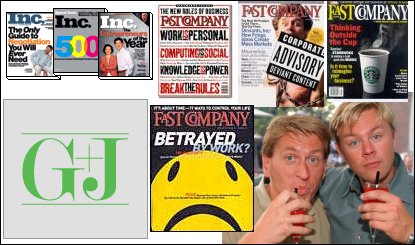
Five years ago Gruner + Jahr paid a total of $571 million for two magazines - Fast Company and Inc. Yesterday they sold them for $35M. Fantastic ROI of -93%. Brilliant. Here's the rundown:
-
Gruner + Jahr, a division of the German media conglomerate Bertelsmann, has reached an agreement to sell its two American business magazines, Inc. and Fast Company, for about $35 million, a fraction of what it paid for the publications, according to a person with knowledge of the deal.
The tentative agreement with Joseph Mansueto, founder of an investment research company, was expected to be announced Tuesday, the person said.
Gruner + Jahr bought both magazines five years ago for $550 million - Inc. from Bernard Goldhirsch for $200 million and Fast Company from Mortimer Zuckerman for $350 million.
Last month, Gruner + Jahr sold its women's magazines - Family Circle, Parents, Child and Fitness - to Meredith Corp. for $350 million. With the sales, the company, troubled by a two-year-old circulation scandal, has effectively shed its American magazines; it retains ownership of a magazine-printing company. As part of the deal last month, if Gruner + Jahr had not been able to sell Inc. and Fast Company by June 30, the two titles would have gone to Meredith.
Initially, about 20 buyers expressed interest in Inc. and Fast Company. The list was eventually narrowed to six: Mansueto, founder of the investment research concern Morningstar; The Economist; Time Inc.; American City Business Journal, owned by the Newhouse family; Alta Communications, a venture capital firm in Boston; and Abry Partners, an equity firm also in Boston that represents managers from Gruner + Jahr.
As of Monday night, only Mansueto and The Economist were still in the hunt. The final decision, the person close to the sale said, hinged on Mansueto's desire to keep the magazines afloat, saving about 100 jobs.
"It was very, very tight," this person said. "There were a number of small things that added up, but Mansueto will continue to publish Fast Company, and The Economist didn't plan to do that."
Mansueto is chairman and chief executive of Morningstar, based in Chicago, which provides a broad array of financial information to individuals and professional investors through newsletters and online services. It was Mansueto as an individual, not the company, that bid for the two titles. He is also a part owner of Time Out Chicago.
Gruner + Jahr drew unwanted publicity in 2003 during a trial between the company and Rosie O'Donnell, a former talk show host, over a failed venture.
TheDeal.com reported yesterday that the Economist actually had the higher bid:
-
While Morningstar founder Joe Mansueto has the inside track in the auction for Inc. and Fast Company magazines, the Economist Group is closing fast, with a deal hinging on a few critical factors that could bring victory to either party, according to a source close to the process.
None of the issues to be resolved are contractual, said the source. Rather, they are deal-specific. For example, Inc. and Fast Company operated as a department within a division (Gruner+Jahr USA) within a corporation (Bertelsmann AG). As such, neither magazine has audited financial results. The question for Mansueto and the Economist Group is: How comfortable do you feel doing a deal without them?
According to the source, the Economist Group actually submitted a richer offer than Mansueto, though neither bid is believed to be much higher than $40 million. But given the strict June 30 deadline, Mansueto's flexibility — he can simply write a check without seeking board approval — gives him an edge.
Mansueto's plan to continue publishing Fast Company, which was widely expected to be shuttered with a change of control, also works in his favor. So, too, does his relationship with auction manager AdMedia Partners Inc., with whom Mansueto worked on taking a 40% stake in Time Out Chicago a few years ago.
But the Economist Group did submit a higher offer than Mansueto and, according to the source, "really, really wants" Inc. and Fast Company. And unlike Mansueto's investment in Time Out Chicago, which is a passive one, re-establishing Inc. and Fast Company as viable consumer magazines will be a massive undertaking that will fall squarely on Mansueto's shoulders.
Best of luck with that... sounds like he'll need it.
- Arik
June 01, 2005
CI for Innovation Conference: Midrand South Africa
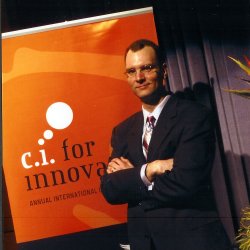 I've just yesterday returned home from a nine-day journey to the Gauteng of South Africa - Pretoria, Johannesburg and Midrand specifically - where I spoke and gave a portion of a workshop on competitive intelligence and its relationship with innovation, both in business processes as well as products.
My primary subject matter and theoretical modeling had to do with an explanation of Clayton Christensen's Disruptive Innovation Theory - let me know and I'll send you the slides. It was the CI for Innovation conference held May 26-27 in Midrand South Africa and was organized by CI consultants IBIS.
The turnout was really magnificent (well over 100, perhaps as many as 200) and it was extensively covered by the local media. As the chairman preparing myself to kick into high-gear organizing programming for next year's SCIP conference in Orlando, I think this outcome describes the value-proposition of such an event approach most appropriately - that is, from the point of view of the PRODUCT of CI, the value proposition of its applied contribution to innovation capabilities within an organization relative to its competitive markets and customer demand, rather than so single-mindedly explaining a PROCESS of how to "do" CI on the ground.
In this respect, there are three consistent demands that come up again and again over the past several years in evaluations of SCIP conferences that have guided me in organizing an event to meet those demands.

The consistent and ongoing pattern I observed in SCIP's conference evaluations, everybody focus was on: 1.) the return on investment metrics (usually impossible and often pointless), 2.) display and explanation of more and more sophisticated analytical tools (like handing a pistol to a five-year old and telling them to go figure out how to apply it to their daily life), and 3.) the ever-popular, case-study explaining the good, bad and ugly experiences of fellow, more seasoned, CI practitioners.
What's the consistent trend this suggests?
That the value proposition CI holds for their organizations is still elusive despite the intuitive sense that every successful organization "does CI" to some extent, formal or otherwise. The sense is that, despite evidence both anecdotal and empirical CI's role in organizations is still a "nice to have" overhead line item in the budget that can be cut at the whim of management. How do you solve a problem so persistent in a field so vital?
We explain that value proposition in terms one's own customers can understand. By focusing on "innovation", for example, a characteristic every firm seeks to foster, enjoy and ultimately profit from, CI's value proposition is clear. From a field-wide point of view then, that's why we reorganized the track structure for SCIP 2006 in Orlando around five simpler to understand areas of emphasis:
- Fundamental Tools & Techniques - all the stuff you must do for CI success that is listed in your job description
- Professional Effectiveness - all the stuff you must do for CI success that is NOT in the job description
- Academic & Scholarly Research - focused on "the new", how to teach, research and legitemize the CI field from an educational and renewal perspective
- Offensive Applications - innovatively growing an organization's market power, profitability and return for shareholders in new markets with new customers and new products - planning for strategic futures
- Defensive Applications - managing risks to the status quo business by protecting, defending and penetrating existing markets to reach customers in a zero-sum fight against competitive forces - executing the tactical present
When we concentrate less on the process of CI and more on its outcomes and products, we get all of those things and more - we get to see them integrated together!
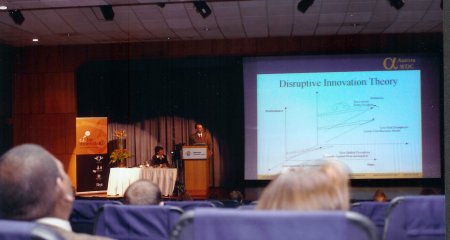
With that, here are a bunch of additional pictures from a weekend in the bushveldt of myself, alongside my good friend and fellow SCIP board of directors member (and next year's president-elect) Dr. Craig Fleisher, professor of management at the University of Windsor (Ontario), who keynoted the conference, plus conference organizers from IBIS, Mr. Mike Kuhn and Ms. Marie-Luce Muller and workshop leader (and photographer of these great pictures below) Albert Cruywagen (head of consultancy Quantum III) and his better half, Rioline. :-) I'll leave it to you to figure out who's whom.
And, lest I forget, Craig and I spent the following week until journeying home lecturing and visiting at various universities in and around the Jo'Burg area - UNISA, TUT, TUX, and Potch. Forgive me if I've forgotten anyone - but working with the faculty and students in higher education really reinforced what it means to be working together in a field as dynamic and interesting as Competitive Intelligence.










Sort of doesn't look like I know what I'm doing with that, eh? Craig seems to have a better idea, and as I recall, he managed to figure out how to cut into this thing. Don't tell me there's no value in a Ph.D!
My summary evaluation for the trip: a truly world-class event organized by IBIS and everyone who participated should be proud of the outcome. Thanks all - and I do hope you make this an annual get-together - despite any forthcoming invitation to present again in South Africa (fingers-crossed), I can't wait to return again for whatever reason!
Regardless of the content of any conference, near or far, it's always the friendships that serve to enrich our lives so much longer. It was an honor. Thank you again for having me.
Cheers 'til next time,
- Arik
 "Competitive Intelligence applies the principles of competition and lessons of intelligence to the need for enterprise awareness and predictability of market risk and opportunity. CI has the power to transform an enterprise from also-ran into real winners with agility enough to create and maintain sustainable competitive advantage."
