May 19, 2005
Star Wars Episode 3: Revenge of the Sith – Bravo!

All I can say is, WOW! Nice job.
Reviews like that are sure exacerbate the so-called “Sith Sick-Out”, ready to sap hundreds of millions of dollars of worker productivity as people stay up until midnight to see the movie and call in sick the next day – or just skip work altogether and see it a bunch more times. The phenomenon is expected to put a spike in worker absenteeism and costs businesses $626 million in lost productivity, according to outplacement firm Challenger, Gray & Christmas. Businesses should expect a wave of sick calls from employees playing hooky Thursday and Friday so that they can take in the movie.
"With opening day falling on a Thursday, instead of the traditional Friday premiere, we are looking at two days of 'Star Wars'-induced absenteeism," John Challenger, the chief executive of the firm, told the New York Post.
Challenger, Gray & Christmas based its estimates on attendance during the first two days of the last "Star Wars," "Episode II - Attack of the Clones," which drew 9.4 million. Assuming that half of those people will be full-time workers with an average per-day salary of $130.60, the two days would run $626.9 million in lost wages and/or productivity.
Meanwhile, entertainment blog called Waxy.org reported the movie has also been illegally leaked onto a Web-based file-sharing network, BitTorrent, allowing users to quickly download large video files and is used by about 2.5 million people each day.
Rumors the movie had been leaked were earlier believed false, but Thursday the blog reported that the movie had in fact been released on BitTorrent, and provided as proof a 19-second clip of the movie taken from the network. Waxy.org reports that the video is time-stamped, indicating it may have come from within the industry rather than from someone who videotaped an advance screening.
"If piracy and those who profit from it are allowed to flourish, they will erode an engine of economic growth and job creation; undermine legitimate businesses that strive to unite technology and content in innovative and legal ways and limit quality and consumer choice," Motion Picture Association of America Inc. president and CEO Dan Glickman said in a statement. The average cost to make and market a movie is $98 million, and less than one in 10 movies recoups its original investment from box offices in the United States, according to the Motion Picture Association of America.
So… great film… best of the new trio of prequels – but probably also the only film I’ll see in a theater this summer. And that, my friends, is going to be a problem for Hollywood box office, but even more so, for theater chains.
Who’d want to watch a great movie on their computer anyhow?! Oh, yeah… pirates.
- Arik
May 17, 2005
Syttende Mai: Entrepreneur of the Year 2005 + 100th Anniversary of Norwegian Independence

I’m honored on this 100th anniversary of Norwegian independence from the oppressive Swedes (just kidding, I might be five-eights Norwegian, but I’m also a quarter Swede and an eighth Dane) to have spent the evening accepting the “Entrepreneur of the Year” Award from the 2005 Entrepreneur Program Class at the University of Wisconsin – Eau Claire, College of Business. I’ve been a guest speaker since back in the day and they keep inviting me back, so naturally I’m very appreciative this year to be blessed with such an honor. Check out their Web site – it’s got the full story on what is one of the most fun volunteering activities I’ve been involved with these past few years.
Sadly, the UWECEP saying goodbye to Jim Pathos, their “Entrepreneur-in-Residence” for the past few years, without whom, the program could never have achieved so much.
Thanks!
I’m so honored in fact, I can’t resist spending just a few lines on the subject of Norwegian independence day (my grandmother would very proud of me) – if you read the story below, you’ll see why, only Norwegians can figure out how to celebrate May 17th 1814, with independence in the year 1905 and then make May 17th 2005 the 100th anniversary!?!?! (Don’t worry, I don’t get it either… it’s a Norwegian thing.)
 Regardless, for a great explanation of why this is so significant, here’s the backstory:
-
Syttende Mai has a similar significance in Norway as July 4th has in the United States of America. It marks the country's declaration of independence and the triumph of constitutional government. This day is also called Constitution Day and National Day and is a great spring festival in Norway.
The following provides some background for why Norwegians place such great emphasis on Syttende Mai. The Norwegians have a proud and independent past, dating from before the time of the Viking era, which was from about 790 to 1050 A.D. when they were very prominent and greatly feared in much of the world. Unknown to many people, the Vikings established the oldest surviving parliament in the world at Iceland over a thousand years ago in 930 A.D. So, many aspects of independence and self-government are part of Norway's history from way back.
During the Viking era, much of present-day Norway was united from many local chieftains and many kings to one king. But, then after the Viking era, many regional leaders claimed the throne. There was over 100 years of civil wars in Norway and soon north German merchants largely controlled the economy. Norway became dependent on them for grain imports. Norway was weakened further until the bubonic plague killed about half to two-thirds of the people in the mid-1300s.
Shortly after the plague, Margrete was the wife of the king of Norway, Haakon VI. She was also the daughter of the King of Denmark. When her father died, Margrete, who was already the queen of Norway, became the ruler of Denmark. Margrete's husband died soon thereafter, and she became the ruler of Norway as well. Then, Margrete was elected to rule Sweden, also. So, Margrete united Norway, Sweden, and Denmark with the power centered in Denmark. But, Sweden broke away after about 125 years in 1448.
Then, Norway grew weaker and Denmark grew stronger. Norway was even declared a Danish province. During the Napoleonic wars, Denmark sided with France against Great Britain. However, Britain was Norway's chief trading partner at the time, so the Norwegians had a very difficult time and many starved. After a while during those wars, the Norwegians began to trade secretly with the British again and began to manage their own affairs.
During those Napoleonic wars, the Swedes were allied with Great Britain and defeated Denmark. Then, Denmark gave Norway to Sweden. However, the Norwegians did not recognize the treaty (of Kiel) that did this and met and drew up a constitution for an independent Norway. That constitution was adopted on May 17, 1814, but Sweden refused it and defeated the Norwegian troops. Then, Norway was forced to accept the king of Sweden as their ruler also.
But, after nearly 100 years of Swedish rule and wars between Norway and Sweden near the end of that time, all but 184 out of 368,392 voters in Norway voted for independence in 1905; and it was granted.
In some respects, Norway being governed by Denmark and then Sweden would be similar to the state of Texas being governed by the state of Oklahoma or Arkansas. Texans would not like that.
It is easier to understand the rivalry between Norway and Sweden because of the imposition governmentally by Sweden on Norway and the wars and other hard feelings between them. Out of that, ethnic sayings became popular, such as "a thousand Swedes, running through the weeds, chased by one Norwegian."
So, from this proud Norwegian, I offer thanks and praise to my ancestral homeland (and, though I’m sure it’s lovely, to my ancestors... for emigrating – do you know what kind of taxes they pay in Norway?!) and to UWEC’s Entrepreneur Program, advisors and students – you have truly been an inspiration to us all.
- Arik
May 05, 2005
Adobe + Macromedia = Domination of Content Creation Market: Can Competition Survive?
Tired of paying $449 for the Professional Version of Adobe's cornerstone Acrobat application? Well, don't expect it to get any cheaper... or to pay less for Flash development tools either - Flash MX Professional will set you back about seven hundred bucks at current levels and that's not liable to move south anytime soon, with the new degree of power the combination gives both companies in their fight to dominate the multimedia and document management landscape.
The fundamental question is, will Adobe's $3.4 billion buyout of Macromedia mean competition survives? Or are they just bulking up to take on Microsoft once Longhorn hits the street?
Anti-trust regulators shouldn't start salivating quite yet... I found a GREAT functional equivalent from ARTS PDF called Nitro PDF for $99 with a 30-day trial that has the potential to be, as advertised, the first real alternative to Acrobat in PDF creation!
Whether Adobe can absorb the acquisition is another question:
-
Computer document company Adobe Systems Inc. said on Monday it agreed to buy multimedia software firm Macromedia Inc. for about $3.4 billion in stock, a move designed to extend its lead in the market for creating and distributing digital documents.
Adobe, best known for its Acrobat document-sharing software, said the deal would help it meet rising customer demand for audio and video options that are compatible with hand-held devices.
Macromedia also gives Adobe access to the dominant animated graphics software on the Internet and which is also aggressively expanding into mobile phones.
The deal is the latest move in the long-anticipated consolidation of the software sector. It was initially welcomed by industry-watchers.
"Management is quite capable, but I think it is quite a big deal to be swallowing," said Robert Sellar, a technology fund manager at the UK's Aberdeen Asset Management, which owns Adobe shares. "$3.4 billion is a lot of money to be spending but (Adobe) are hugely cash generative."
Was this predictable? Of course... but there's a lot of opportunity to be unlocked here as well, including for some of their traditional competitors:
-
Amish Mehta, CEO of Corel Corp., which competes with both Adobe and Macromedia with its CorelDRAW Graphics, described the deal as "no big surprise. Consolidation has been going on for years in the software industry, and this is a continuation of that."
Mehta acknowledged that the deal might lead to decreased competition, but claimed that this might not be bad for existing Macromedia customers.
"At the moment, Macromedia is a one core-technology company. This deal means it will be able to offer more to those customers," he added.
The deal also offers several opportunities to Corel.
According to Mehta, the effective disappearance of Macromedia—the company's brand will vanish after the takeover is completed—leaves Corel as the sole remaining alternative to Adobe in the graphics market.
And for Mac users, the news might lead to some concerns.
"Today if you're Apple, you can't be too excited about this, as it leaves a lot of key software concentrated in a single company. Hence, there's an opportunity for us to say, 'Hey, we're here, let's work together.'"
To read more about what the merger means in the PDF space, click here.
Mehta added that if Adobe decides to divest itself of some of its products in the wake of the deal, Corel might be interested in acquiring them.
"At the right price, all kinds of products become interesting. We'd be interested in anything that complemented the products we already have," he said.
Gavin Drake, marketing director at Quark UK, pointed to the hole that the deal would leave in the competitive landscape of the publishing and design market.
"Lack of competition is not good for customers, and this definitely looks like it could be bad for competition," Drake said. "It'll be interesting to see what Macromedia customers think of the deal."
And the deal may yet have wider ramifications for the software industry, beyond design and publishing.
Joe Wilcox, senior analyst at Jupiter Research, claimed that the acquisition could lead to the emergence of a much tougher competitor for Microsoft in the business market.
"Microsoft should be more worried about Adobe than Google," he said, adding that while the penetration of Windows and Office has reached saturation point, the server market has become much more important as an engine for growth.
"Now along comes Adobe," Wilcox added. "Its pull is that documents are PDFs, which has certain advantages. For example, government departments sometimes insist that documents are submitted in PDF form. Macromedia fills in the Adobe product line, in areas where Microsoft isn't strong."
These areas, Wilcox said, include server products such as Breeze, Central, ColdFusion and Flex, bolstering Adobe's push into the enterprise.
The deal may be better for Adobe than for customers, analysts say. Click here to read more.
This addition of Macromedia products could also lead to Adobe dominating the rich media market: "There's an opportunity around making content in business more accessible and exciting," Wilcox said.
"But what if you then bring in more collaboration—something that's been an Adobe strength. What if Adobe could bridge the gap between static and animated documents?" Wilcox added.
However, Wilcox cautioned that in order to exploit this opportunity, "Adobe needs to hit the ground running. As soon as it closes the deal, it needs to bring out products that start to exploit the merged company."
But some of my favorite commentary includes the translation from PR-speak to real-world intentions offered by the companies in explaining their rationale for the merger, Pam Deziel (responsible for Acrobat strategy execution) figures there's 70 million seats worth of Acrobat software waiting to be sold, and Jim Rapoza at eWeek.com thinks they should open-source the Macromedia castoffs.
Both companies have many competing products, Dreamweaver versus GoLive, FlashPaper versus PDF, Illustrator versus Freehand, ImageReady and Photoshop versus Fireworks... Gary Hein, an analyst with Burton Group Inc. of Midvale, Utah, said, "I think that Adobe plus Macromedia forms a new wild card in some desktop- and graphics-related formats and standards. Both have great installed bases among desktops, and together they'll have much more influence in what happens with interoperable, cross-platform document, graphics and animation formations. It's interesting, to say the least." He added, "Adobe has some interesting technologies but is not as prevalent in the enterprise. Macromedia brings more credibility and a great technology portfolio to Adobe."
But an article by Don Fluckhinger on PDFzone shows some of the upside development possibilities:
-
At times over the years, the two companies have fought in heated rivalries. Who can forget the blood-and-guts Illustrator-versus-FreeHand battles for the designer's dollar in the 1990s? For the most part, however, they've co-existed peacefully.
The last bump in the road came mid-2003, when Flashpaper, an element of Macromedia Contribute 2, looked as though it might give PDF a challenge: While it was simple, Flashpaper seemed sleek, elegant and much less clunky than PDF for uploading documents to the Web.
A subset of Flash, the format never caught on in a huge way. Macromedia adopted an "if you can't beat 'em, join 'em" philosophy and provided a means to deploy PDF and Flashpaper together in subsequent versions of Contribute.
Now that Macromedia and Adobe are under the same corporate roof, though, the fun begins for PDF. You'd think that the merger—which will take place this fall, if things go as planned—would be all about combining competing multimedia applications.
But knowing that Acrobat has become lead dog in the Adobe revenue kennel, it was no surprise that in the press release announcing the merger Chizen didn't mention applications such as Director, DreamWeaver, Premiere or GoLive, but instead spoke of the "complementary functionality of PDF and Flash."
Yeah, that's right. It's all about us. So how exactly does Adobe-Macromedia benefit PDF?
- Is there such a thing as "more ubiquitous?" When you update your Flash Player, guess what? Maybe you should update Reader, too. And vice versa. Reminders should pop up every time either is downloaded; one company owning both pieces of software will help maintain current versions of both out there on nearly every computer hooked up to the Internet. This surely will help cut down on incompatibility headaches, such as when a user takes advantage of Acrobat 7 features in a PDF but a recipient using Reader 3 can't use them. The increased access to everyone's computer also offers the side benefit of making Bill Gates writhe in envy.
- Web PDFs could get smaller. The theory of Flashpaper is great: Get paper documents to the Web in no time flat, and the files are microscopic. There are many uses for a quick-and-dirty technology for users who really need to get a sheet or two of static paper up on the Web. Anyone who's had to suffer through a 5MB PDF download just to read a stupid two-page interoffice missive understands the principle.
- Mobile PDFs could become usable. Can the engineering brain trust of a combined Adobe and Macromedia finally make e-books, maps and manuals decipherable on something smaller than a laptop screen? They can be deployed today, sure, but they could be made much more useful. If this crew can't do it, it's just not possible.
- Multimedia PDFs could get robust. And here's the big one: Macromedia dominates the video and audio stage. Adobe dominates the parallel universe of text and graphics. People who use Macromedia apps want to more easily integrate PDF documents into their presentations. PDF creatives want to simplify implementing video and audio in their files and turn them into must-see content. That's going to happen.
It's a long process that will probably take a couple years before we see much difference. First the two companies have to please the stockholders and the feds by making the merger plan work on paper. Then, a couple new revs of the key applications need to make their way out into the market. After that, people have to figure out how to use all the new features they get in the box.
But just imagine seamless integration of Flash and PDF. I, for one, can't wait to see the rich-media creations that eventually will come out of this merger. On my iPod or cell phone LCD.
So should Microsoft watch out? According to analysts and commentators, Redmond is the biggest potential loser in this deal:
-
Paul Visco, a professor in the digital media arts program at Canisius College in Buffalo, N.Y., said he worries about competition, pricing and the future of graphic design.
"It seems as though much of the recent innovation between the two software giants was brought on by healthy competition. They had an array of software packages that had the same purposes, e.g. GoLive and Dreamweaver, Illustrator and FreeHand, Photoshop and Fireworks. If there is no longer any need to compete, then they might not continue to develop new products. It will effectively create a monopoly in graphic design."
Visco also voiced concerns about pricing. "Adobe can now say $1,000 for Photoshop, and companies and designers won't have any other choice. Look at Microsoft. Once you get really big like that, nothing matters."
Metaliq's Riddell said the branding issue concerns him. "It may be a tougher sell to some of our clients if there's a new brand on an older product. Is it the same thing or better or just rebranded?"
Wilcox talked about what else Adobe gets in this deal: new developers with different skills.
"Every business uses the PDF platform. Most of us just receive them as opposed to building them, but it's a cornerstone of business now," Wilcox said. "What makes this even more important to Adobe is now this exposes them to a whole new brand of developer.
"Microsoft has 48 percent of companies using their products from end to end. But Adobe now has a real opportunity to develop and serve the other 52 percent, the heterogeneous environments. And a whole new set of developers are going to get a chance to work with Flash."
So, despite there being overlapping products, Wilcox said he is convinced that this is a fit that's going to benefit both companies and make Adobe a major player against Microsoft for the heart of the enterprise business. "This acquisition just makes them so much stronger."
I found at least a two other analyses that posit the same competitive dynamics of Adobe versus Microsoft in a Longhorn OS world:
-
The deal marries Adobe’s ubiquitous PDF and Acrobat Reader software with Macromedia’s Flash products for creating media content. Adobe will also have a sizable portfolio of desktop software popular with creative professionals -- including Photoshop, Illustrator, and Macromedia’s Freehand and Dreamweaver.
“I see this as both companies bulking up against Microsoft,” said Steven Brazier, an analyst at Canalys.
The expanded Adobe could create a variety of rich media and Internet applications that use Flash, bumping into areas Microsoft has shown interest in, said Bola Rotibi, an analyst at Ovum. Although Flash is best known to Web surfers as a format for viewing animations, the technology is a powerful development platform, and Adobe said leveraging it will be a “key component” of its strategy for a combined company.
“When you think of where Microsoft is headed with the future of its Media Player and Media Center PCs, this goes head-to-head,” Rotibi said.
Adobe also gains Macromedia’s base of ColdFusion Web developers. RedMonk analyst James Governor predicted that dynamic forms that allow users to create, change, and share information online will be one of the first products of the marriage. Graphics automation is also in the cards. Both of these capabilities would fly in the face of Microsoft’s plans.
“Adobe’s ambition in this acquisition looks like a bit of a Longhorn-killer to me,” Governor said.
Microsoft has been working on dynamic-form technologies and a graphics system called Avalon as part of its upcoming Longhorn OS. By moving into these areas, Adobe may be trying to cut the software giant off at the pass, analysts said.
Clearly, it's a win/win for both Adobe and Macromedia; but if you're a customer of, developer for or competitor with the combined company's products, you've got a new dose of uncertainty to try and digest.
And that pretty much includes all the rest of us.
- Arik
May 04, 2005
Broadband Muni Wireless Networks: The Next Public Utility?

The past few days has seen the latest attack on metropolitan telecom and cable operators manifest itself in Philadelphia, where authorities from municipalities around the world gathered to discuss and plot the future of broadband wireless networks as a public utility - just like water, sewer and garbage service. The last mile is no longer safe from public sector competition, especially with the likes of Intel pushing WiMax out to market over the next couple of years.
This is no small matter - a lot of comfortable, safe (i.e., free from competition) operators have billions invested in keeping prices high and service levels relatively lethargic. A new era of public sector competition is sure to get them to wake up to a new set of competitive realities. Here's a summary of what's going on:
-
Philadelphia Mayor John Street and Dianah Neff, the city's chief information officer, will welcome technology professionals from some 33 cities, as well as counties, states and municipal coalitions, to their city next week as representatives from Dallas to Shanghai gather for the Digital Cities Convention there.
Sponsored by the Wireless Internet Institute, the convention promises to provide three days of brainstorming, analysis and consensus-building among representatives of wireless and mesh networking providers and the city, state and international representatives interested in implementing their solutions.
Stephen Rayment, chief technology officer of BelAir Networks, specialist in wireless mesh networks, who is chairing a solutions panel on the technology's impact on city social and economic development, expects the conference's focus to extend well beyond contentious plans to provide free and low-cost Internet access to city residents.
Those plans have prompted heated political debates at the state level, where telecoms have sought legislation that would prohibit cities from offering municipal service.
Rayment will focus on the question: "How do you make the business case make a lot more sense than just giving away free Internet access?"
Rayment said he was encouraged that Philadelphia has expanded its plan beyond simply providing free access and is outsourcing the build-out and maintenance of its network to third parties.
"Initially what they wanted to do was just provide Wi-Fi stuff," said Rayment. "But there are a lot of other applications that can run on public networks." Among them, he cited public safety, surveillance and inter-departmental communications.
"You need to think about multiservices and network architectures that can scale to grow and accommodate that type of thing."
The conference is proving to be a magnet for vendors with metro wireless and mesh networking solutions.
Intel Corp. heads to the convention hot off a demonstration of its WiMax base station platform at the International Basestation Conference in London this week. The company, which began shipping WiMax chips this month, expects the chip to be installed in notebooks and available to the public by 2006.
Intel has already begun developing markets in Europe. This week, Intel officials announced plans to open a technology center in Moscow this summer to promote the company's broadband wireless WiMax technology.
Nomadix Inc., a supplier of public-access network solutions, and its partner Firetide, a wireless mesh networking specialist, will be exhibiting a public access gateway optimized for metro deployments.
The solution, said Scott Zumbahlen, director of marketing at Nomadix, is designed to centralize and resolve security and billing, allowing municipalities to outsource those functions to the Nomadix network.
"If someone has to take a trouble call, there's no cost model [for cities] that justifies that," said Zumbahlen. "We make sure the user gets onto the network quickly, and the operation is designed so that they do not have to call for support."
But what's a cable or telecom monopoly to do now, in this era of competitive dynamics? Naturally, as one might imagine, they're not at all fired up about it!
-
A number of U.S. cities are becoming giant wireless "hot spots" where Internet users will be able to log on from the beach or a bus stop, a trend that is triggering a fierce backlash from telecom and cable giants.
"We look at this as another utility just like water, sewer, parks and recreation, that our communities should have," said St. Cloud, Florida, Mayor Glen Sangiovanni, who hopes to provide free wireless service to the entire city by the fall.
At a conference this week, officials from dozens of local governments compared notes, listened to pitches from vendors and discussed ways to counter the lobbying of telecommunications giants that have sought to block them at the state level.
Free or discounted wireless service can spur economic development, improve police patrols and other city services and encourage Internet use in poorer neighborhoods, they said.
Slightly more than 100 U.S. cities—as big as Philadelphia and as small as Nantucket, Massachusetts—are setting up wireless networks now. Conference organizer Daniel Aghion said close to 1,000 local governments worldwide have plans in the works.
The trend has prompted an intense backlash from the large telecom and cable providers that sell most broadband access in the United States. At their request, 13 states have passed laws restricting cities setting up their own networks, and several others are considering such bans.
"With so many other issues challenging municipalities today, why on earth should cities waste millions of taxpayer dollars to compete with carriers already offering high speed Internet service?" said Allison Remsen, spokeswoman for the U.S. Telecom Association, which represents incumbents like SBC Communications Inc. and Verizon Communications.
City officials said they don't want to compete head on with commercial providers but aren't going to be held hostage to their profit concerns.
Providers have shown no interest in setting up broadband wireless service or offering free or discounted rates, they said. Sometimes they refuse to provide any broadband service at all.
"We begged them to deliver the service—we didn't want to be in this business," said Scottsburg, Indiana, Mayor Bill Graham, who said local businesses threatened to leave his town before it set up its own wireless network.
The legal battles seem to have only increased interest among city officials, especially after squabbles over a Pennsylvania state law made national headlines last year.
"It helped to bring to light what the telecommunications industry was attempting to do," said Philadelphia technology manager Dianah Neff.
Others said the threat of a ban at the state level has spurred them to action.
"We're acting pretty quickly for a municipality of our size, because we don't like to be pre-empted," said Lindy Fleming McGuire, a Chicago City Council staffer.
Smaller wireless startups are rushing to provide the equipment and expertise needed to run city networks.
"Munis don't want to own this at all, they just want the service," said Robert Ford, chief executive of NextPhase Wireless, a service provider.
Rio Rancho, New Mexico, brought in wireless provider OttawaWireless because incumbents didn't reach many areas, assistant city administrator Peggy McCarthy said. Now that the network is up and running, the incumbents' service has grown more competitive, she said.
"The lethargy and apathy with which we had been given DSL and cable have both changed," she said.
Some cities, including Spokane, Washington, found they could easily set up wireless service when they upgrade their emergency communications networks with a little help from the Homeland Security Department. The federal department awarded $925 million last year for communications upgrades.
So, whether cities should be in this business or not, it's gotten the commercial interests to sharpen up their customer service and marketing skills in recent weeks - and will probably cause them to sharpen their pencil a bit as well. I think we'll look back on this as having been good for everybody involved.
For those of you interested in helping push things along, check out MuniWireless.com and the Wireless Internet Institute.
- Arik
May 03, 2005
New Auburn Ingenuity: Wisconsin High School Team Wins National Rube Goldberg Applied Engineering Championship
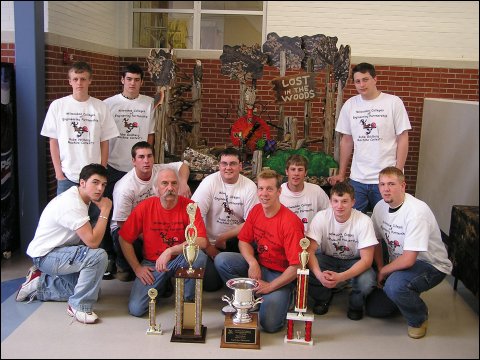
The guys in the picture above are the 2005 Rube Goldberg Contest Applied Engineering Champions of the Universe, hailing from tiny New Auburn High School (less than 100 students!) where I volunteer with Junior Achievement every year. They walked into the contest last week and took home the prize beating the best of the best from around the country with a TRULY original concept and the dedicated help of their teachers and advisors.
I've uploaded a video taken from my phone while there on Tuesday this week (3gp format, playable in RealPlayer with the latest software update) that you can watch if you're curious how the thing works - I must admit, it's really genius! Here's the press release:
-
“Can of Corn” was the driving spirit behind the positive attitude that earned New Auburn High School’s Technology/Engineering (Shop) and Mathematics/Concepts of Engineering class 1st place in the prestigious state and national “Rube Goldberg Machine” engineering contest held Friday, April 29, 2005, at Wisconsin State Fair Park, West Allis, Wisconsin.
Each year students across the nation are asked to complicate a simple task by the National Rube Goldberg Committee out of New York City and the Milwaukee Colleges of Engineering Partnerships. This years assignment from the national office in New York City: construct a machine that will remove old batteries from a two battery flashlight, install new batteries and turn on the flashlight in 20 or more steps.
The machines, following in the spirit of drawings of Rube Goldberg, the late Pulitzer Prize-winning cartoonist and amateur engineer, turned the floor of the Wisconsin State Fair Exposition Center into a jumble of pipes, strings, boards, pulleys, levers, and chutes, all held together by a variety of materials.
At the end of the competition when the last lever tripped, the last toy car rolled, the last adapted mouse trap snapped, and the last battery tumbled into its flashlight, New Auburn High School was declared champion gadget maker and National Champions of “Applied Engineering.”
The journey for the New Auburn-engineering students began last October. Instructors Jim Skuban and Tim Lambele developed an integrated Concepts of Engineering Program for the high school. One of the goals of the program was to win the national championship of the Rube Goldberg Machine Contest. New Auburn was the state champion in 2001. Students Brandon Baldry, Eric Gass, Tony Bischel, Garrett Stilley, Andy DeWilde, Merrit Super, Espen Grindhaug, and Max Mukhtarov began formulating the plan for their machine. The emphasis for the class was problem solving using engineering principles. Each student had to design and construct a five-function machine. Computer aided drafting fundamentals was stressed. Two teams then competed at the UW-Stout Leadership and Skills Competition in Team Problem Solving. The result was the gold medal in Team Problem Solving: Mechanisms.
By this time student teacher Pat Rufledt was on board and oversaw the fabrication and construction of the project. The student team met and brainstormed ideas and then finalized the design of the machine. The machine went from design sheet to actual life beginning in the first week in March. Project and construction time included class time, after school, weekends, and spring break and totaled approximately 1,000 man-hours.
The New Auburn machine had a boot that kicked a steel ball down a ramp that activated a plunger that knocked a stick into a mouse trap that released a wooden deer. A mousetrap was sprung pulling a pin that released tension on a bent fishing pole. And twenty steps later two old flashlight batteries were removed and replaced with two new batteries and the light was activated. The machine functioned perfectly.
At the competition New Auburn was placed in a sectional with five other school for the preliminary round. The schools were Anitgo, Chilton, Racine J.I. Case, Reedsburg, and Stoughton. The tension was gut-wrenching as the judges methodically critiqued each machine. New Auburn emerged as sectional champion.
Six winners emerged from the sectionals to advance to the final round to decide the state champion. Winners other than New Auburn were Cuba City, Athens, El Puente, Burlington, and Kiel. After another gut-wrenching session in front of the judges who were engineers from Harley-Davidson, Briggs & Stratton, and Rockwell International, the New Auburn team was awarded the state championship. Burlington was second place, and Cuba City was third.
That sent the New Auburn Trojans and Burlington to the first round to determine the National Champion. New Auburn was against the Michigan state champs East Jordan High School, Whiteford Agriculture, and state champ Kadoka High of South Dakota. New Auburn emerged as the champ of the round and was pitted against two other schools for the title of National Champions. These schools were the Illinois state champ Morgan Park Academy and Charleviox High from Michigan.
In contest finals just like the preliminary rounds, the machine must be set at the beginning and run perfectly without human intervention in the final step, and New Auburn’s machine functioned flawlessly for the sixth straight time. The judges awarded the title of National Champs to the New Auburn Concepts of Engineering Program.
The eight students received a state permanent trophy, a state traveling cup, a national permanent trophy, and large national traveling trophy.
When asked about the importance of the entire process of the project, New Auburn Technology/Engineering Instructor, Jim Skuban said, “It’s true engineering. The kids are problem solving and trouble-shooting constantly, all striving to achieve their goal. It is an outstanding team activity.” Skuban added, “What an honor for the kids, community, and region. The competition was a first-class operation. The Milwaukee Colleges of Engineering Partnerships (UW-Milwaukee and Marquette University) did and extraordinary job organizing the one-day event that cost in excess of $45,000.”
Instructor, Pat Rufledt experienced the competition for the first time and commented, “It was a great team effort. The competition was intense. The kids kept their goals high and stayed motivated for the whole process.”
The math instructor, Tim Lambele, stated, “I was proud of our kids, and without the support of our administration and school board, we would not be able to provide opportunities for out students like this.”
Everything worked perfectly: “Can of Corn”.
We're all proud of you guys - keep up the good work and best wishes defending your title next year!
- Arik
May 02, 2005
Throwing in the Towel: Verizon "Wins" Qwest for MCI

Verizon will acquire MCI for $8.35 billion after Qwest capitulated, saying the bidding process was "permanently skewed" against it. Verizon won its costly, 11-week fight to acquire MCI on Monday after Qwest bitterly withdrew from the bidding war deciding the long-distance company "never intended to negotiate in good faith." The final blow came when MCI said some of its biggest customers just don’t want to do business with Qwest, so Qwest "qwit" a few hours later.
The best part of the deal for Qwest is, it cost its rival a billion dollars (almost) more than it'd originally intended, perhaps having the desired effect the company had been seeking all along. Here's a rundown of the bloodbath from the Washington Post:
-
Though marred by one of the largest accounting scandals in U.S. history and a shrinking business of providing long-distance service for consumers, MCI still sports a valuable stable of corporate and government customers that Verizon and the much smaller Qwest sought in order to compete in the new environment. MCI also operates an extensive chunk of Internet "backbone," the network that carries data traffic around the world.
For Washington area MCI employees, the buyout probably will bring more pain and uncertainty after several years of steady layoffs.
In February, when they first made plans to team up, Verizon and MCI said the acquisition would save about $1 billion a year and result in the loss of 7,000 jobs from a merged workforce of about 250,000. The firms have not said how many of those jobs might be in the region, where they employ roughly 3,500 people.
In choosing Verizon's sweetened bid over the weekend, MCI's board spurned for a third time higher offers from Qwest. Qwest lashed out at its takeover target upon hearing the news yesterday but said it would end its pursuit.
"It is no longer in the best interests of shareowners, customers and employees to continue in a process that seems to be permanently skewed against Qwest," the Denver-based phone company said in a news release.
"It is only fair to conclude that MCI is more interested in bending to Verizon's will than serving its shareholders."
If the AT&T and MCI takeovers are approved by the Federal Communications Commission and the Department of Justice, they will all but eliminate the independent long-distance business that flowered after regulators forced phone companies to share their lines.
Today, regional phone giants such as Verizon and SBC can offer long-distance service bundled at attractive prices with local service, while their wireless divisions offer free long-distance service.
Internet telephone service also is growing, with some plans including low-cost calls to Canada and parts of Europe.
Verizon's latest bid for MCI, totaling roughly $8.5 billion in cash and stock, is less than Qwest's latest offer of roughly $9.74 billion. But MCI's directors reasoned that the much larger Verizon is less burdened by debt, has an extensive wireless business and could take better advantage of MCI's assets than Qwest.
"From the standpoint of risk versus reward, Verizon's revised offer presents MCI with a stronger, superior choice," said MCI Chairman Nicholas deB. Katzenbach.
Under Verizon's latest offer, MCI shareholders would receive about $26 per share, $5.60 of which would be in cash and the rest in Verizon stock. The total price tag of the deal could rise depending on the price of Verizon stock.
Overall, Verizon's offer is about $900 million more than its previous bid.
Qwest's offer would have netted MCI shareholders about $30 a share, with about $16 in cash and $14 in stock.
MCI said in a news release that "a large number" of its business clients said they preferred an acquisition by Verizon and requested the right to terminate their contracts if Qwest were the buyer. MCI did not name the customers.
Some large MCI shareholders, who had helped keep the bidding war alive, continued to criticize the company's board for consistently embracing lower Verizon bids.
"No one jumped for joy" when Verizon revealed its latest offer, said David Ahl, an independent telecommunications consultant who is advising several of MCI's biggest shareholders. "No one said 'Oh, we're saved.' "
Ahl, who also personally owns stock in MCI and Qwest, said the new Verizon bid appeared designed primarily to bring other MCI shareholders up to par with Mexican financier Carlos Slim Helu, who had been the company's largest owner.
As the prospect of a proxy war for the company grew, Verizon secured a 13.4 percent stake in MCI by buying Helu's shares for $25.72 each, higher than its bid for the company at the time.
Ahl speculated that Qwest might still urge MCI shareholders to reject the Verizon deal.
But Steven M. Cohen, chief investment officer of Kellner Dileo Cohen & Co., a New York hedge fund that holds MCI stock, said it appears to him that Qwest is abandoning its pursuit.
"I'm disappointed in the MCI board," which "repeatedly has given its blessing to a lower-priced Verizon bid," Cohen said.
A Qwest spokeswoman declined to comment about the company's plans beyond its written statement. "The proposed industry mega-mergers will undoubtedly reduce consumer choice," the company said. "These issues will need to be addressed during the regulatory approval process for the Verizon/MCI and SBC/AT&T mergers."
Qwest already has told regulators it opposes the SBC-AT&T combination.
Of course, the fix was in a while back from the shareholder lobby. Three weeks ago, Mexican billionaire Carlos Slim Helu sold his shares of MCI to Verizon for more than $25.72 per share, which, with contingencies factored in, amounts to more than $27.00 per share. Since then, a number of MCI’s shareholders have been openly critical of MCI’s board, saying that it was creating two classes of shareholders by accepting any Verizon bid below what Slim was getting.
Still, Qwest stuck it to Verizon in the end - and the biggest winners in all of this are MCI's shareholders. Carlos Slim alone netted several hundred million dollars profit from those MCI bonds he bought on the cheap a few years back in the post-Worldcom fiasco. And that's real money.
- Arik
May 01, 2005
Sour Apple: The New Evil Empire Strikes Again, Retaliating Against Publisher of Unauthorized Steve Jobs Bio
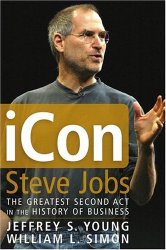 Last week, the evilest empire since Microsoft extended an open hand to open source, Cupertino's own Apple Computer, thought differently about the new unauthorized biography of iCEO Steve Jobs, That is, at least, a little differently from publisher John Wiley & Sons, and asked the publisher to hold off release of the book, which Wiley respectfully declined.
Apple's response was to take their ball and go home (more or less) kicking ALL books from the publisher off the shelves of a hundred Apple retail stores in retaliation for the apparent blasphemy... punishing instead the horde of authors endlessly toiling away writing ever more "(fill in the blank) for Dummies" books.
The book, "iCon Steve Jobs: The Greatest Second Act in the History of Business
-
Lightning never strikes twice, but Steve Jobs has, transforming modern culture first with the Macintosh and more recently with the iPod. He has dazzled and delighted audiences with his Pixar movies. And he has bedeviled, destroyed, and demoralized hundreds of people along the way. Steve Jobs is the most interesting character of the digital age.
What a long, strange journey it has been. With the mainstream success of the iPod, Pixar's string of hits and subsequent divorce from Disney, and Steve's triumphant return to Apple, his story is better than any fiction. Ten years after the leading maverick of the computer age and the king of digital cool, crashed from the height of Apple's meteoric rise, Steve Jobs rose from ashes in a Machiavellian coup that only he could have orchestrated-and has now become more famous than ever.
In this encore to his classic 1987 unauthorized biography of Steve Jobs - a major bestseller - Jeffrey Young examines Jobs' remarkable resurgence, one of the most amazing business comeback stories in recent years. Drawing on a wide range of sources in Silicon Valley and Hollywood, he details how Jobs put Apple back on track, first with the iMac and then with the iPod, and traces Jobs' role in the remarkable rise of the Pixar animation studio, including his rancorous feud with Disney's Michael Eisner.
Otherwise, AP breaks down the book-yanking story for us:
-
Apple Computer Inc. has retaliated against the publisher of an upcoming unauthorized biography about chief executive Steve Jobs by removing dozens of other technology books sold by the publisher from Apple stores around the world.
Apple removed the books last week from all 104 of its stores after failing in a month-long attempt to persuade John Wiley & Sons not to release ``iCon Steve Jobs: The Greatest Second Act in the History of Business,'' which is to go on sale within the next six weeks, the publisher said.
The book-spurning is only the latest attempt by Apple executives to crack down on writers who publish or distribute unauthorized or secret information about the computer maker. It's a strategy that experts in brand management say is likely to backfire, only adding to the notoriety of Apple's critics and encouraging sales in countless other bookstores.
``Pulling books off the shelf is a little draconian,'' said Rob Frankel, a brand consultant. ``It reeks of repression.''
``This is not the first time anybody has said anything good or bad about Steve Jobs,'' Frankel added. ``He has a much better public brand image than one book could ever dispel.''
The book's author, Jeffrey Young, says Jobs has nothing to fear from ``iCon.'' It's a chronicle of Jobs' rise as an innovator and entrepreneur and includes details about his personal life such as his divorce and fight with cancer, he said.
``I thought the book was pretty positive and laudatory,'' Young said. ``It covers his personal life and there is something about his illness. I wouldn't call any of it outrageous. I'm totally bewildered.''
Young said Wiley & Sons sent a manuscript to Apple two weeks ago and the company responded by demanding that the publisher halt the release. Wiley & Sons decided instead to stand behind its author.
Apple spokesman Steve Dowling said company executives were declining to comment.
Lori Sayde, a spokeswoman for the publisher, says the company will publish the biography in its entirety.
``We're hoping that they will re-evaluate their position because we have worked very hard to establish a good relationship with Apple,'' Sayde said. ``We're empathetic to all our tech authors who will lose out in this but we support our publisher's decision to publish this book.''
Sayde did not know how much money Wiley & Sons could lose as a result of Apple's refusal to sell the publisher's books.
Cupertino-based Apple is known for aggressively protecting its intellectual property, as well as its image.
In December, Apple sued 25 unnamed individuals - presumed to be Apple employees - who allegedly leaked confidential product information in violation of nondisclosure agreements and California's Uniform Trade Secrets Act.
Apple then subpoenaed the Internet providers of three online reporters who wrote about the secret products, seeking to identify their sources. The reporters, backed by major media companies including The Associated Press, said Apple's efforts could erode the media's ability to report in the public's interest.
In January, Apple sued a 19-year-old publisher of another Web site that revealed trade secrets about the $499 Mac mini computer.
Defendants in that case include Harvard University student Nicholas Ciarelli, a Mac enthusiast who publishes the Web site ThinkSecret, and unnamed sources who tipped him off two weeks before Apple officially introduced the mini on Jan. 11.
In fact, Apple's clumsy handling is such a public relations "disaster" that it makes me wonder about its UN-authenticity... all this free PR could make the book so successful that, assuming all the stuff above about it being largely positive, maybe this is a clever maneuver to get us all to buy the book that Jobs (supposedly!) wants to repress. Ah-HA! We're onto you now, Steve... that IS crafty!
- Arik
 "Competitive Intelligence applies the principles of competition and lessons of intelligence to the need for enterprise awareness and predictability of market risk and opportunity. CI has the power to transform an enterprise from also-ran into real winners with agility enough to create and maintain sustainable competitive advantage."
