April 22, 2005
40th Anniversary of Moore’s Law Heralded by Introduction of Dual Core Chips by Competitors AMD and Intel
Even as AMD launched the Opteron dual-core, we’re reminded of the words by Gordon Moore, co-founder of Intel Corporation and father of Moore’s Law, “No exponential lasts forever. But forever can be postponed.”
It was April 1965 when Moore made history by publishing an article in that month's issue of Electronics Magazine titled 'Cramming More Components Onto Integrated Circuits' which later became known as Moore's Law.
-
It has been 40 years since Gordon Moore first posited what would one day come to be known as Moore's Law. Today, we take many of the benefits of Moore's Law for granted. Yet if you look behind the curtains of the new breakthrough sciences, as well as many of the mundane, you will find semiconductors working. Much would not be possible without the relentless progress of the semiconductor industry doubling performance for the same price every two years or so, and that is what Moore's Law is all about.
In 1964, Electronics magazine asked Moore, then at Fairchild Semiconductor, to write about what trends he thought would be important in the semiconductor industry over the next 10 years for its 35th anniversary issue. ICs (integrated circuits) were relatively new. Many designers didn't see a use for them and worse, some still argued over whether transistors would replace tubes. A few even saw integrated circuits as a threat: if the system could be integrated into an IC, who would need system designers? The article, titled "Cramming more components into integrated circuits," was published by Electronics in its April 19, 1965, issue.
Moore's paper proved so long-lasting because it was more than just a prediction. The paper provided the basis for understanding how and why integrated circuits would transform the industry. Moore considered user benefits, technology trends, and the economics of manufacturing in his assessment. Thus he had described the basic business model for the semiconductor industry -- a business model that lasted through the end of the millennium.
From a user perspective, his major points in favor of ICs were that they had proven to be reliable, they lowered system costs, and they often improved performance. He concluded, "Thus a foundation has been constructed for integrated electronics to pervade all of electronics." From a manufacturing perspective, Moore's major points in favor of ICs were that integration levels could be systematically increased based on continuous improvements in largely existing manufacturing technology. He saw improvements in lithography as the key driver. From an economics perspective, Moore recognized the business import of these manufacturing trends and wrote, "Reduced cost is one of the big attractions of integrated electronics, and the cost advantage continues to increase as the technology evolves toward the production of larger and larger circuit functions on a single semiconductor substrate. For simple circuits, the cost per component is nearly inversely proportional to the number of components, the result of the equivalent package containing more components." The essential economic statement of Moore's Law is that the evolution of technology brings more components and thus greater functionality for the same cost. Computing power improves essentially for free, driving productivity in the economy, and thus fueling demand for more semiconductors. This is why the growth in transistor production has been so explosive. Lower cost of production has led to an amazing ability to not only produce transistors on a massive scale, but to consume them as well.
The economic value of Moore's Law is that it has been a powerful deflationary force in the world's macro-economy. Inflation is a measure of price changes without any qualitative change -- so if price per function is declining, it is deflationary. This effect has never been fully accounted for in government statistics. The decline in price per bit has been stunning.
In 1954, five years before the IC was invented, the average selling price of a transistor was $5.52. Fifty years later, in 2004, this had dropped to 191 nanodollars (a billionth of a dollar). If the semiconductor were fully adjusted for inflation, its size in 2004 would have been 6 million-trillion dollars. That is many orders of magnitude greater than Gross World Product. So it is hard to understate the long-term economic impact of the semiconductor industry.
So what makes Moore's Law work? There are three primary technical factors: reductions in feature size, increased yield, and increased packing density. The first two are largely driven by improvements in manufacturing and the latter largely by improvements in design methodology.
-
Intel beat AMD to the punch earlier in the week with the launch of its first dual-core processor, which was aimed at the high-end gamer and workstation market segments. In AMD's case, it has announced availability of the Dual-Core AMD Opteron 800 Series processor for four- and eight-way servers. In addition, it announced that the 200 Series for two-way servers will ship in May.
According to AMD, the new processors deliver up to a 90 per cent performance improvement for application servers over single-core AMD Opteron processors. For the desktop PC user segment, AMD announced the Athlon 64 X2 Dual-Core processor brand that the company stated will enable true multi-tasking capabilities for richer computing experiences.
"Just as AMD led the industry to pervasive 64-bit computing, AMD is now leading the industry to the performance and power benefits of multi-core processors," said Marty Seyer, corporate vice president and general manager, Microprocessor Business Unit, Computation Products Group, AMD, in a statement. "We have flawlessly executed manufacturing AMD64 processors, which is why today we are announcing the world's only broad dual-core client and server processor line-up, well ahead of our announced schedule. Because our non-disruptive dual-core architecture is designed to fit in today's existing infrastructure and provide leading-edge performance, enterprise customers can rapidly adopt AMD64 dual-core processors for servers and workstations today and for client platforms in June."
Several of AMD's OEM partners have also announced AMD dual-core server products. Sun Microsystems, HP and IBM have all announced dual-core platforms that will take advantage of the AMD64 technology.
According to AMD, dual-core processors are the next evolution of the company's AMD64 Direct Connect Architecture, and the processors were designed from the ground up to directly connect two cores on a single die, along with memory, I/O and dedicated caches. The company stated that the processors were also designed for easy and seamless migration. AMD's "non-disruptive upgrade path" allows users to upgrade single-core-based systems to dual-core-based systems because the dual-core processors were designed to work in the same power envelope and infrastructure as the single-core processors.
But Red Herring thinks it's advantage-AMD:
-
Advanced Micro Devices began selling the dual-core version of its Opteron chip on Thursday, giving AMD a slim advantage over Intel in a race to provide better processors for servers.
The single-core Opteron showed up in the marketplace two years ago, delivering a stunning blow to Intel. Opteron allowed business customers to use both the existing and more advanced software down the road. Intel’s server chips either didn’t have such capability or required expensive upgrades for companies that used servers with Intel processors.
More recently, Intel and AMD have competed hard on their dual-core products, which represent a departure from the old way of designing processors.
The dual-core chip has two processing units on the same piece of silicon. At a lower speed than a single-core processor, the dual-core chip can divvy-up the tasks and process more information at the same time while using less power.
In the past, chip engineers increased processor performance by increasing clock speed. To do so, they had to cram smaller and more transistors into a single-core chip, and such an approach ran into overheating problems.
Intel introduced a dual-core Pentium chip on Monday, but that processor isn’t designed for servers. So the dual-core version of Opteron gives AMD another advantage. Hewlett-Packard and IBM already plan to market servers and work stations featuring the new Opteron.
“Our customers say they want a product that retains the same power envelope, same wattage… but also offers the same performance. And the way to do that is through dual-core,” said Gina Longoria, Opteron product manager.
The news had been anticipated by Wall Street, and the stocks of both companies rose in recent trading as technology stocks rebounded from recent declines. Intel shares rose $0.42 to $23.08, while AMD shares climbed $0.20 to $14.85.
Intel’s high-end Pentium chip will power desktop computers favored by gamers and graphic artists. Intel plans to begin selling a computer processor for the masses, Pentium D, later this quarter.
AMD plans to start selling dual-core processors for desktop PCs in June and has given the PC processor a new brand name, Athlon 64 X2. Computers with Athlon 64 X2 will be good for handling multimedia tasks, such as photo editing.
Meanwhile, AMD will continue to sell single-core Athlon 64, believing that some consumers may not care to spend more money for souped-up computers.
And, AMD’s CEO, Hector Ruiz, is in firm agreement in his recent interview with EETimes:
-
Advanced Micro Devices this week rolled out its dual-core Opteron processor as part of its drive to usurp market share from Intel by developing a distinct product advantage. Hector Ruiz, AMD's CEO, discussed how Opteron will shape the Sunnyvale, Calif., chip maker's battle with Intel to win the hearts of minds of systems builders in an interview with CRN Editor In Chief Michael Vizard and Senior Editor Ed Moltzen.
CRN: When do you think dual-core Opteron systems will make an impact in the market?
RUIZ: I divide it into two parts. It will be rather dramatic in that it will force people to rethink their designs, but it will take some time to get things started. So the volume impact for us will probably be next year.
CRN: Given that, how much of an advantage do you think AMD now has over Intel, which is expected to roll out its dual-core offerings next year?
RUIZ: Intel is strong company and very capable. We just think this requires a lot more than a desire to do it. I don't know if you can retain their existing bus architecture and change it enough to get the level of performance and value that we have. If they change the architecture, that is not a trivial thing, so it will take them longer. And customers are already making an investment in the enterprise and are not just tip-toeing in the water.
CRN: Do you think software vendors are on board when it comes to pricing their applications based on a dual-core rather than a single-processor approach?
RUIZ: This is just starting, but the pressure is insurmountable in terms of going in this direction. Microsoft has taken the first step, and everybody will follow. Sun Solaris is the same way. We have major players signed up. At the dual-core level, I don't think this will be an issue. When we get to quad core, that could create a disruption.
CRN: When will that happen?
RUIZ: I'm perfectly confident that we will see engineering samples in 2007.
CRN: Over the last year, Intel has taken more of a platform approach to the market, which seems to be much different than AMD's approach. How much of a difference is there in the two companies' go-to-market strategies?
RUIZ: The good news is that you have a differentiated approach to the market, so channel partners now have a choice. How Intel and AMD are approaching the market is clearly different. We believe Intel's platform strategy is designed to continue their domination and control the market. But you can pick any three-year period [over] the last three years, and it shows that Intel generates all the profit and everybody else loses money. We believe that's crazy.
Systems makers want people to buy their brand because it has good value in it, not because it has Intel inside it. I think this is giving us an opportunity to go to customers that are becoming more interested in getting state-of-the-art CPUs from AMD and state-of-the-art motherboards from Foxconn to create a best-in-class system with their name on it. Our strategy is to continue to offer customers the option of not being marginalized. Any system builder that thinks warming up to the Intel platform brand is anything other than giving their soul away is nuts. They're naive.
CRN: Would you ever consider building your own chipsets?
RUIZ: I have not closed the door on that. If we do that, it would not be to create a platform. It would be to create a reliable source of supply rather than trying to marginalize the customer brand.
CRN: Most recently, AMD has experienced some profitability issues, especially as it relates to the flash memory business that the company is now preparing to spin off. When do you think AMD will return to profitability?
RUIZ: I didn't give any guidance to that. Profitability is important, but our No. 1 goal was to get the businesses positioned so they could develop a life of their own. The fact that the flash memory market went to hell is a temporary disruption. I'm not worried about how we're going to be profitable there. I was worried about microprocessors because in 2000 we had a phenomenal year, and we didn't make money then. It took a lot of changes and modifications over the years to get the microprocessor business to be consistently profitable over the last few quarters. We are on solid footing.
As the flash unit gets ready to spin off, it's pretty well-positioned. Last quarter, Intel had about $100 million more in flash sales than we did, but they lost $225 million on it. Our flash unit lost $39 million. We have better structure in the flash unit than any competitor. As the market recovers, we have a solidly positioned organization. I am pleased that we have been able to get the microprocessor business profitable and the flash business on solid footing.
CRN: Do you think Intel exacerbated the situation in the flash memory market to cut off a source of revenue for AMD's microprocessor business?
RUIZ: Funny how 999 people out of 1,000 actually think that.
CRN: Are you worried that Intel will try to use pricing on its single-core offerings as a tool to keep AMD at bay?
RUIZ: There are spots where they could choke us, but we think customers are warming up to the idea of having a viable, strong alternative. We're building the strength and momentum where pricing is not as effective as it once would have been.
CRN: How vital of a role does the channel play in your strategy?
RUIZ: The channel has always been a great partner for us when it comes to any product that we introduce. What is going to be different is that there are quite a few people in the channel playing a much bigger role in servers. Channel partners are starting to play a much bigger role in the enterprise. The help that we will get from the channel quickly will be pretty evident there. The people that we worked with that have been successful are people who really value creating a differentiated solution. We think single-core and dual-core Opterons strengthen that ability.
CRN: Are you going to spend a lot more money helping those partners market that differentiation?
RUIZ: We're going to have to change that, so this year we need to do something quite different. We obviously can't spend $2.1 billion on marketing. But we are going to work on that with partners. But what we spend will be an order of magnitude less than what our competitor spends.
The real question for consumers who only care about having the latest, fastest components in their box boils down to which is faster. On this front, at least according to reviewer Jason Cross at ExtremeTech.com – AMD wins handily:
-
A couple of weeks ago, we gave you a sneak peak at the performance of the new dual-core Pentium 4 processors from Intel. The chips, which are now shipping, are the first dual-core CPUs to hit the market. What's more, Intel started their push into multiple cores with desktop chips, rather than CPUs for servers.
AMD has been talking about dual-core chips for quite some time, and for awhile, was expected to be the first to the market with this technology. Accelerated plans from Intel changed all that, but the company is finally ready to ship dual-core chips. In contrast with Intel, AMD debuts their dual-core technology in their Opteron line, made for servers and workstations.
AMD's thinking is pretty simple: Server and workstation applications are more likely to be multithreaded than desktop PC apps. A dual-core processor would benefit those applications almost from day one. Intel is playing a different game, believing that the heavy multitasking environment in today's PC desktops will get a benefit. Both are right, in a sense, and both are playing to their relative strengths.
We recently got our hands on a dual-core Opteron test kit from AMD, and decided to pit it against the Pentium 4 840 Extreme Edition we previewed recently. These are not chips aimed at exactly the same markets, but the Opteron is so architecturally similar to an Athlon 64 in that it provides a reasonable facsimile of Athlon 64 desktop performance. There are differences, of course—Athlon 64 CPUs don't have as many hypertransport links for multi-CPU systems, typically ship at faster clock speeds, and don't use registered RAM—but the core architecture is nearly identical. Rather than test it as a pure server platform, we used a uniprocessor system and a desktop graphics card to see how a dual-core desktop Athlon 64 might perform.
The dual-core battle is far from over, of course. Intel is shipping dual-core desktop CPUs now, but the quantities aren't real high. The real battle will come later this year, as AMD releases Athlon 64 CPUs for desktops that feature two cores, and Intel's dual-core shipments ramp up. For now, let's take a look at how the two competing technologies stack up.
This is primarily a performance preview, but before we get into the numbers, we should take a quick look at the platform itself.
The test hardware we received from AMD consisted of two Opteron 875 CPUs, which are expected to sell for about $2,649 in lots of 1,000. That's AMD's most expensive chip—a dual core Opteron made for systems with up to eight CPUs together. Opteron dual-core chips will also ship in the 200 series, made for workstations and servers with only two CPUs. The model 275, suitable for two-socket systems, is priced at $1,299. The model 175, targeted at single socket servers and workstations, goes for $999. All are socket 940 processors requiring registered, buffered DDR memory.
The Opteron x75 ships at a clock speed of 2.2GHz. This is a significant reduction from the fastest single-core Opteron, model x52, which runs at 2.6GHz. Even with the transition to a 90nm manufacturing process, both Intel and AMD have to make significant reductions in clock speed to keep these dual-core chips from running too hot and eating up too much power. This allowed AMD to keep the thermal envelope at around 95W, which is better suited for server environments.
There are significant architectural differences between AMD and Intel's dual-core chips. Looking at the following two block diagrams, you can see that the primary difference is how each core interfaces with the rest of the system. Each of the two CPU cores on the Model 840 shares a front side bus to the memory controller hub (MCH) of the 945/955X chipset. AMD's dual core architecture also uses a single memory controller, which is on-die. Memory arbitration in AMD's case is handled through a crossbar switch that also has independent access to the HyperTransport links. In other words, each of Intel's cores must go "off chip" to talk to each other, while AMD's cores have a more direct line of communication.
AMD's dual-core products include the improvements made with the new "E4" stepping single-core Athlon 64 and Opteron CPUs. That is, they are made on a 90nm SOI (Silicon on Insulator) manufacturing process, have added support for SSE3, and a tweaked memory controller. It's a large chip, about 199mm2 and 233 million transistors, which makes it roughly equivalent in size to the Pentium 4 840 Extreme Edition. The thermal rating is 95 watts, considerably lower than the Pentium 4 840 EE's maximum thermal rating of 125 or 130 watts (we've heard both numbers out of Intel).
... later on, Cross gets to the point ...
-
There's really no other way to say it—this is a huge win for AMD. We expected major improvement in multi-threaded applications and multi-tasking tests, but at only 2.2GHz we weren't sure it would actually perform better than Intel's dual-core Pentium Extreme Edition 840. There are a couple of tests—usually single-threaded tests—where the Opteron 875 doesn't keep pace, but in the vast majority of benchmarks, AMD comes out ahead.
My own verdict? I’d personally rather have Dell launching my processor (Pentium 4 Extreme Edition) on its workstations, servers and (eventually all of) its PCs, than IBM’s Opteron commitment for the LS20 blade… although Lenovo will be nobody to sneeze at, for Intel either…
The battle for the future of the microprocessor has only just begun.
- Arik
April 21, 2005
The Apprentice 3: All Downhill from Here for Trump-Burnett Franchise

So exactly when Donald Trump’s “The Apprentice” franchise jumped the shark and became nothing more than product placement and some engineered strife between earnest young go-getters I can’t say, but I can say, it’s just a train wreck for me now. I actually liked the first season, but tonight’s episode really scraped bottom despite the understandable pleasure Staples is enjoying from its new (and apparently sold-out) Desk Apprentice device the winning-er team designed for them. A revolution in product development, you ask? Maybe, if you’re into all the drama (so five minutes ago); here it is from MSNBC’s Reality TV rundown:
-
A similarly surprising turn of events came during the boardroom on "The Apprentice." Alex's sheer incompetence as a team leader — he literally phoned in major portions of the task — made him the obvious choice to go, but Bren's unwillingness to fight back and admission of a fault left him at the pointing end of Donald Trump's index finger. Although he didn't quit as dramatically as Janu, Bren clearly gave up.
Can you hear me now?
As the thinned-out teams of "The Apprentice 3" worked to create a new office product for Staples, Alex decided to have a meeting with the store's executives. Idiotically deciding that they weren't very important ("they're not a client, they're just judges, right?"), Alex decided against a face-to-face meeting. Instead, he called them using a cell phone. When bad reception caused the call to break up, Alex admitted "that was a screw-up." Then he did nearly the same thing again.
On the other team, Magna's Kendra and Tana learned what customers wanted by accosting a man at Staples. They rifled through his shopping cart, later laughably referring to that encounter as a "focus group." But they did gather useful information that ultimately helped them construct the winning product.
Alex, however, instructed Bren to cold-call office managers and survey them over the phone. This focus-group plan didn't go over well, either with Bren ("Are you kidding me?") or with the equally incredulous people he reached on the phone. Thus, the product Alex and Bren invented came from their wickedly creative lawyer imaginations.
While Magna created a functional product that's now for sale (the Desk Apprentice), Alex and Bren constructed a product that Bren described as "a little table to help clean up the office clutter that plagues America." Alex was convinced that they "knocked the ball so far out of the park" with the desk that Magna would burst into tears and fall to their knees in awe when Bren and Alex entered the room.
Alas, they created a product that Trump called both a "piece of crap" and a "monstrosity." It was a side table with a translucent surface. Underneath the hinged glass lid, they hung In and Out baskets. Of course, as the executives and others pointed out, getting to those two baskets would require clearing the top of the table and then lifting the awkward lid. With the exception of storage space for an electric stapler, the desk was otherwise unadorned.
Boardroom bedlam
In the boardroom, Alex and Bren both defended their lame product.
George asked why they didn't just add easily accessed drawers, but neither would admit their product was flawed. Trump was clearly disappointed with Alex's performance as project manager, and was about to send him on a journey to locate his credibility.
"I thought you were a star and you're not really a star. You're not a star, and I'm disappointed," Trump said.
But then Bren admitted that he wasn't a risk-taker. Admitting a fault to Donald Trump in the boardroom is like jumping in a tank at Sea World, running a cheese shredder up and down your arm, and then waving at a shark.
Sensing Bren's misstep, Alex suddenly sprang to life, listing off all the dreadfully boring ways that he takes risks. Bren just listened, and Donald Trump was appalled.
Castigating Bren for not returning Alex's attacks, Trump found a way to gnaw on the long-decomposed carcasses of FOX's "The Rebel Billionaire," Richard Branson's reality show, and ABC's "The Benefactor," Mark Cuban's series. He said, "Branson went after me, I killed him. Cuban went after me, I killed him."
Bren wasn't willing to "kill" Alex, or even grab him by the ears and head-butt him. Instead, Bren told Trump, "I could have stayed at home with a job that I absolutely loved, be with a wife and kids that I'd much rather be with than being in here getting my ass chewed on."
With that, he signaled defeat. Alex was saved, and Donald Trump made Bren's firing official. "You might be a very good lawyer, but you're really very far behind."
While Janu on "Survivor Palau" seemed to give up before she even arrived on the island, Bren at least stayed competitive until that final boardroom. In his cab ride of shame, Bren admitted that he'd realized "The Apprentice" wasn't for him. "The truth is, I'm exhausted and I'm tired, and I don't really think that I had the hunger in me for this job that Alex does," he said. "I came up here wanting one thing, and in the process realizing that what I really wanted was back home under my nose the entire time."
That realization alone is easily worth more than $250,000 and a year with the Trump Organization.
Now, c’mon Donald… “killed” is a little over the top, don’t you think? Dang, how people could want this guy as their boss just escapes me… why tolerate that kind of bull?
- Arik
April 19, 2005
New Pope Benedict XVI Means the Re-Evangelization of Europe
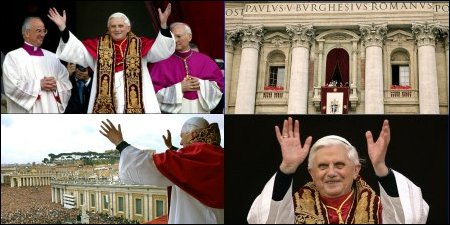
Alright, I’m not Roman Catholic (Lutheran, thanks!) so the perception by the American media that somehow we all must be interested in the story about the new Pope is a little more true than I’d care to admit… From more of a predictive point of view, what does this bode for the future of the Roman Catholic enterprise?
Most likely it will mean a smaller, “more devout” (or at least, less backsliding) flock and, rather than an abandonment of the growth markets for the church, a re-invigoration – re-EVANGELIZATION, in truth – of its core market – that is, Europe.
In my entirely secular, growth-oriented view, despite overlooking clear advantages to placing a developing-world, “southerner” in the seat of the Papacy, the right choice of a consolidator and evangelist to his countrymen was more appropriate for the goals Rome has in mind. But for those of you who’d like to compare my notes yourself, the newspaper summary below is a good place to start:
-
Everybody leads with the new pope, Cardinal Joseph Ratzinger, or as he now prefers, Benedict XVI. "After the great Pope John Paul II, the cardinals have elected me, a simple, humble worker in the Lord's vineyard," said Benedict, a 78-year-old German, who was Pope John Paul II's enforcer for ideology.
Benedict has long inveighed against what he sees as lax standards on morality, doctrine, and the primacy of Catholicism. He's disciplined priests who've pushed for reform, in the 1980s purging liberation theologists; in a letter he issued in 2000, titled Dominus Jesus, he dubbed other faiths "gravely deficient;" and as the Los Angeles Times editorial page details, he wrote that pro-choice politicians should be denied communion.
As the New York Times puts it, Ratzinger was "briefly and unenthusiastically" a member of the Hitler Youth. Membership was mandatory. He was later drafted into the army and eventually deserted. Meanwhile, Jewish groups praised the new pope, who apparently was at the forefront of the Vatican's recent efforts to make nice with Jewish leaders.
Ratzinger's views are widely considered to have been shaped by his experience with Nazism and later by the student revolts of the 1960s. As one biography of him, quoted in the NYT, put it: "Having seen fascism in action, Ratzinger today believes that the best antidote to political totalitarianism is ecclesiastical totalitarianism."
Regarding the priest abuse scandal, Benedict said in 2002: "I am personally convinced that the constant presence in the press of sins of Catholic priests, especially in the United States, is a planned campaign, as the percentage of these offences among priests is not higher than in other categories, and perhaps it is even lower."
The crowd hanging in the Vatican gave a mixed response once Ratzinger was named. One teacher jumped onto a plastic chair and screamed, "This is the gravest error!" Slate's Jack Miles (excerpted below) has a similar reaction. Meanwhile, Andrew Sullivan did a kind of intellectual history of Ratzinger in 1988, concluding: "His bleakness, while theologically a way in which the extremity of grace can be radically described, is—once in power—a recipe for authoritarianism."
Despite his hardline positions, many describe Ratzinger as kinda a softie in person. "A simple guy, with almost a simple smile on his face, as if he's scared to hurt anybody," said one priest in the LAT.
An op-ed in the NYT, by an AEI theologian, argues that Ratzinger has been widely misunderstood: "He may be much more willing to let go of institutions he considers only tepidly Catholic than people expect. And more serious about the life of the soul." Ratzinger also opposes the death penalty.
Theologian Jack Miles’ analysis in Slate.com is worth reading:
-
Today, the election of Ratzinger—a German and a conservative—is a clear answer to two questions asked as John Paul II slowly succumbed to Parkinson's disease. First, would the next pope's election prove comparable in geopolitical boldness to the choice of John Paul II? The news of John Paul II's election echoed with electrifying clarity from Lithuania to Croatia. The election of a Latin American, African, or even a Middle Eastern or Asian cardinal today could have equally electrified regions that are even more important to the church's future. But the cardinals chose instead to elect another European.
The second question was whether the church would soon take the step of allowing artificial contraceptives—as it came close to doing in the mid-1960s, before Humanae Vitae. The encyclical reaffirmed ultraconservative sexual morality and reversed a trend toward collegiality in church government. Today, condoms have helped to slow the spread of AIDS in Brazil and elsewhere. But in Africa, where the AIDS crisis is worst, the church is identified more than ever with the most adamant opposition to the condom and church governance remains tightly centralized. The election of Joseph Ratzinger announces that the status quo will remain unchanged.
How will ordinary Catholics greet the election of an elderly, conservative, European pope? I find myself thinking back to 1979. When John Paul II made a typically spectacular visit to Chicago that year, I heard a sad little story from my mother. A cousin of mine, a widow with five children whose life was a long struggle with poverty, had been thrilled to hear that she would be among the lay Eucharistic ministers who would distribute Holy Communion when the pope celebrated an outdoor Mass at Soldier Field, Chicago's football stadium. For years, she had cherished nothing more than her weekly role in the liturgy. Every Sunday morning, reality receded for an hour as she put on a white surplice and assisted the priest in distributing the consecrated bread and wine. Doing this at the papal Mass, she said, would be the greatest moment of her life. But then a heartbreaking message arrived: In deference to the pope's sensibilities, no woman would be allowed to take part.
Television loves a star and is only too ready to turn the Catholic Church into a star vehicle. Television paid no attention to our cousin or to any of the other excluded women, much less to their children. The media in general blur "the faithful," a phrase they dearly love, into a single, undifferentiated, uniformly loyal mass, brushing aside dissent as a minor irritant. Yet 26 years of such snubs begin to add up. I am reminded, recalling this small episode, of a moment in the Gospel of Luke when Jesus prays: "I bless you, Father, Lord of heaven and of earth, for hiding these things from the learned and the clever and revealing them to little children." The Chicago hierarchy surely had clever and learned reasons why the women of the city could not be permitted to perform the same function in the presence of the pope that they would resume performing as soon as he left. But God may have revealed to those women and their children something about the church and its pope that he concealed from the archdiocesan authorities.
Miles continues later, "by issuing ever more absolute prohibitions that are ever more widely ignored, the pope may consolidate his power over fewer and fewer. Benedict XVI, as we now know, has a lovely singing voice for a man of his years. But the question surely does arise: Is he singing to the choir?"
Vatican vows of secrecy notwithstanding, the NYT, LAT, and Washington Post get a bit of the backstory on the conclave where Benedict gathered lots of early backing, including from a few key Opus Dei men, causing liberal cardinals, who were divided, quickly retreated in the face of his strong initial showing. Then there was the expectations game. "The newspapers were telling us that Cardinal Ratzinger was a favorite," said one cardinal. "The Holy Spirit may even speak through the newspapers."
Then those wild and crazy cardinals proceeded to get down and get the celebration started: "Later Tuesday night, the cardinals joined the new pope for a dinner of soup, veal cordon bleu and ice cream for dessert. They toasted the new pope with glasses of Asti spumante."
Who says this is going to be a conservative Papacy? Those dudes know how to PAR-TAY!
- Arik
April 10, 2005
SCIP 2005 Trip Report – the 20th Annual SCIP International Conference & Exhibition in Chicago
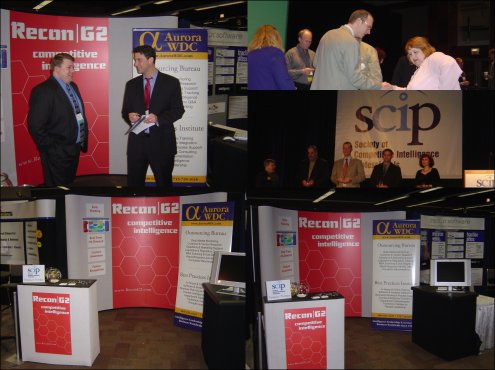
Now that I’m home from Chicago, it’s good to look back on a week when blogging turned out far more challenging than I’d ever thought it might be… so, if you like, share my week with me below – starting from saying goodbyes to the family until returning back to them again a week hence.
I spent Saturday 2 April hanging out with Tina and Liam and just spending a non-work day together, now that all the preparations are done and there’s nothing more to do but get to the conference and execute our mission there. That being, to give good speeches, be a good steward as member of the Board of Directors, accept my Catalyst Award, hopefully convince a few new clients we’re worthy of try-outs while wining-and-dining our current customers with Chicago nightlife, sleep more than three hours a night, steer clear of too much beer, and spend the time in between having a few hundred substantively intellectual conversations with some of the smartest people in the world.
Simple, right?
After Church on Sunday morning, my family had brunch together, said our good-byes for the week and I was on the road for Madison where I arrived toward nightfall, at Derek’s place, crashing fairly early as we had a bunch of tasks to accomplish in the AM together. Monday morning went well and we got all of our priorities lined up for the next several days, including all the 10-hour research and analysis bureau vouchers we were raffling off to lucky business-card-droppers in our fishbowl at the booth throughout the week, as well as getting a 20-inch LCD monitor bought, Internet in the booth (at the last minute), another break-down table to rent (at the last minute), and making sure all of our USB-Flash drives were loaded with the digital version of our collateral materials (ATLM… natch!). It was mid-afternoon by the time I hit the road for Chicago, but the lime-green Mustang served me well around O’Hare’s toll-ways, as people stopped to stare at the car, I slipped in and out of traffic faster than I otherwise might. Finally in around dusk, I got checked in, hauled my stuff upstairs and had a steak with John Prescott – one of the “Ancient Ones” who originally helped form SCIP, WAY BACK 20-odd years ago, and who now, tirelessly it seems, serves again on the SCIP Board of Directors. John’s cool.
Tuesday was all SCIP Board of Directors meeting – things looking VERY good indeed for a rejuvenated organization, Tim Kindler from Kodak presiding, saying our thank-yous to a departing President Emeritus Melanie Wing from JPMorganChase, greeting the President-Elect Craig Fleisher from University of Windsor and watching Dale Fehringer’s (now retired from Visa) impressive video presentation the he and SCIP’s Education Director, Liz Reed-Martinez, put together to commemorate the 20th anniversary (no kidding, it gave me goosebumps, it was so good!). Good stuff! Beers after our planning meeting for the European Conference coming up in November, people started arriving for the conference – mostly vendors, like me – tonight and it was tempting to stay out later than I should. So, I pretty much did… tonight’s the only real night I can afford to do that, after all.
Wednesday was primarily booth setup day for exhibitors – Derek rolled in and spent a frustrating afternoon trying to get his 20-inch LCD panel to work, never did, went out and bought ANOTHER ONE at the last minute, met up with William Black from Autonomy, who was in our booth for the next couple of days doing demos of the spookiest software available today – practically THINKS for itself! No kidding… But before that, I moderated the Buyer’s Panel this afternoon, putting three CI corporate practitioners on the spot to answer vendors’ questions about how to better sell to them. These three brave souls, Kimberly from Microsoft, Anne Marie from JPMorganChase, and Tom from Sprint, performed brilliantly and I heard lots of great comments from the vendors in attendance that it was a valuable series of insights into what these customers want to buy and how to better serve them. Afterwards, it was down to exhibits to join Derek, our newest research analyst Ryan Dunn, and William Black from Autonomy at booth 228 to kick off with the 5:00 reception. Although the Internet connections for pretty much all of the vendors were on the fritz (still not cleared up by Thursday morning, by the way) we were able to at least make use of the hard-won LCD Derek acquired with the Autonomy presentation running circuits and seeing a TON (no kidding, like 100) clients that first couple of hours on the trade show floor. Since this was probably my only major block of time in the booth, the opening reception was definitely well worth it. Derek, Ryan and William took most of the rest of the week from there. Tonight I joined the Chapter Coordinators meeting for dinner and presentation and later got some beers with Ryan, Derek and a couple of clients at the Big Bar before getting an early night in.
Thursday was the opening of the conference and also the opening keynote – with Tim Kindler leading things off, Melanie said a tearful goodbye and Bob Galvin (ex-CEO, retired from Motorola 15 years ago) took the stage. Though clearly a frail and old little fellow physically, his mind was like a steel trap and the power of his ideas had most of the crowd transfixed – truly wisdom of the ages and I got a real sense of “where he’d been” throughout his long life – including friendships such as Sony’s founder and chairman, service on the intelligence oversight committees to presidents, and a lifetime of raising a family and being raised in one. Then, Dale’s stunning video montage, and my good friend Kirk Tyson was given his Meritorious Award, then we adjourned following Galvin for picture-taking, before heading into conference sessions for the rest of the day… not that I really got to see many… I sat in on a couple but was mostly was running around observing Dale and helping out where I could, stopping and having one of the 500-odd great conversations with many people I only ever get to see at this event every year. Close of business toward the end of the day boiled down to heading for the Cabaret-style party up on the top of the AON building – going long, and it was tough to hear the Fellows Awards for all the talking and room layout – I served on that selection committee and it was a tough field to choose from, so congrats to Paul Dishman, Mark Little and Vernon Prior! Otherwise, Derek introduced me to a BUNCH of research and analysis clients I’d never had the chance to meet, as well as getting intros to some of our business partners’ customers as well, so it was some work to be done, but it was all fun.
Friday was the biggest of the days of the conference for me – after getting Derek and Ryan and William underway at the booth during breakfast and spending a little time there myself, it was time for the opening of Day Two of the conference and the keynoter was a guy named Jim Carroll, who came on after the Catalyst awards were given out – I got a nice little crystal obelisk – and, Craig Fleisher gave the SCIP remarks. Immediately after getting our pictures taken and all before I had to rush out to give my Innovation in Practice talk on Sarbanes-Oxley Section 409. It went extremely well and the subject was VERY well received by pretty much everybody – including the other folks I know who’ve done work on the subject. Afterwards, we broke up and I got a bite to eat at the booth and did what would be our second-to-last schmoozing session, then connected with Jordan Frank from Traction Software for the afternoon session prep in the same room I’d been in earlier, and we proceeded to do our “Collaborative Early Warning” workshop for the next two hours, spending some time on the fundamentals principles and then very quickly moving into the “TAM-3 Inhibitor” Scenario on Nearsightedness – really great stuff! The audience really dug it too and we walked away with a bunch of very interesting relationship possibilities for the future – including a couple of requests to work this into an in-house one-day workshop to be delivered onsite for clients. Finally after we broke up and let people go, collecting our business cards and heading down to the exhibit hall for the closing reception, it was our final shot at client meetings. We mostly said our goodbyes and established our followup schedules, but everyone really knew, we’d just had what will be remembered as the best SCIP conference in at least five years. My booth team started their breakdown and departures for home, while I hit the Presidential Suite for the President’s Reception party for the next couple of hours. Well done to all – in particular the committee, led by Dale – as well as the incomparable SCIP staff – good job guys. Final beers with a few of our business partners at the Big Bar, after seeing off William and Ryan and Derek for home – great couple of days, gents – we’re changing the CI business forever, guys!
Saturday the 9th was all postlude… still tired despite a restful night’s sleep and a dash off to introduce Ken Sawka’s SCIP Institute workshop at 8:00, then relaxing with SCIP Staff and Board members before people started setting off for home, I sat in on the Staff meeting with Dale and his leadership committee – Tony Wilson and Michael Sperger – doing their Monday-morning-quarterbacking of the way the week had gone and what needed to change for next year in Orlando. Generally speaking everybody agreed it was the best conference in recent memory, and I was already looking forward to a speedy trip home to the family tonight!
But first discussion of what needs to change for next year? In terms of speakers and content, quite frankly, we’re still not “casting a large enough net” to draw in people from OUTSIDE the CI field with ideas we can benefit from.
I use the analogy of a children’s football team – the team from the school with 3000 kids is going to beat the team from the school with 300 kids virtually every time… not because of any inherently beneficial demographics that size can afford, but simply because the talent pool to draw from is bigger and, therefore, mathematically deeper than that of the smaller sample. In casting a wider net, as I say, we can bring in ideas from related fields – from security to market research to risk management and even product development, M&A and strategy realms. The biggest thing CI needs to move the field forward is a shot in the arm of controversial ideas. We need to change the tone. We need to make content selection more competitive.
So why, you might ask, would I care so much? Because I’m chairing the next conference in Orlando and I expect us to put together a conference program that’ll draw you, dear reader, down for the event! Mark your calendar now – 26-29 April 2006 at the Disney Coronado Springs Resort in Orlando, Florida.
Cheers for now, great seeing you all in Chicago and best wishes until we meet again (Orlando?)!
- Arik
April 02, 2005
April Fools: Google Gulp Fakes-Out Investors with Diversification Strategy
 Google put one over on users Friday, pitching a new product called Google Gulp on its home page, a new line of "smart drinks" designed to "maximize your surfing efficiency by making you more intelligent, and less thirsty," Google said.
Naturally, April Fools!
Well, it was original, anyway... and one mightn't doubt their aspirations for other lines of business, when they just can't shake the one-trick-pony label despite all the attempts at diversification.
- Arik
April 01, 2005
Terri Schiavo: Rest in Peace
 Moral/political football no longer, Terri Schaivo's 15-year ordeal, whether you believe she was "in there" all this time or not, deserves ultimate wishes for rest, in peace, now that the pornographic gaze of the media has lost interest in the matter with her anti-climactic declaration of death. Even today as we await word of Pope John Paul's imminent death, half a world away, in some ways, we're grateful this is all now somehow "over".
Meanwhile, a few days ago, Slate.com had a great essay from a woman named Harriet McBryde Johnson, a disability-rights lawyer in Charleston, who shared her dilemma. Comparing her situation to that of Terri Schiavo, "...due to a congenital neuromuscular disease, I am having trouble swallowing, and it's a constant struggle to get by mouth the calories my skinny body needs. For whatever reason, I'm still trying, but I know a tube is in my future. So, possibly, is speechlessness." Here're three of her points of argument that I found absolutely compelling in deciding Ms. Schiavo's fate:
-
3. This is not a case about a patient's right to refuse treatment. I don't see eating and drinking as "treatment," but even if they are, everyone agrees that Ms. Schiavo is presently incapable of articulating a decision to refuse treatment. The question is who should make the decision for her, and whether that substitute decision-maker should be authorized to kill her by starvation and dehydration.
4. There is a genuine dispute as to Ms. Schiavo's awareness and consciousness. But if we assume that those who would authorize her death are correct, Ms. Schiavo is completely unaware of her situation and therefore incapable of suffering physically or emotionally. Her death thus can't be justified for relieving her suffering.
5. There is a genuine dispute as to what Ms. Schiavo believed and expressed about life with severe disability before she herself became incapacitated; certainly, she never stated her preferences in an advance directive like a living will. If we assume that Ms. Schiavo is aware and conscious, it is possible that, like most people who live with severe disability for as long as she has, she has abandoned her preconceived fears of the life she is now living. We have no idea whether she wishes to be bound by things she might have said when she was living a very different life. If we assume she is unaware and unconscious, we can't justify her death as her preference. She has no preference.
Later, she comments, "I hope that I will not outlive my usefulness or my capacity (at least occasionally) to amuse the people around me. But if it happens otherwise, I hope whoever is appointed to speak for me will be subject to legal constraints. Even if my guardian thinks I'd be better off dead—even if I think so myself—I hope to live and die in a world that recognizes that killing, even of people with the most severe disabilities, is a matter of more than private concern."
Ms. McBryde Johnson adds, "The whole society has a stake in making sure state courts are not tainted by prejudices, myths, and unfounded fears—like the unthinking horror in mainstream society that transforms feeding tubes into fetish objects, emblematic of broader, deeper fears of disability that sometimes slide from fear to disgust and from disgust to hatred. While we should not assume that disability prejudice tainted the Florida courts, we cannot reasonably assume that it did not."
Let's just hope all those affiliated with the Schiavo matter moving forward fails to amuse our news media from here on out as much as they apparently have thus far... maybe then, they'll leave them alone to their grief and acceptance of the loss of a daughter, wife and friend.
- Arik
 "Competitive Intelligence applies the principles of competition and lessons of intelligence to the need for enterprise awareness and predictability of market risk and opportunity. CI has the power to transform an enterprise from also-ran into real winners with agility enough to create and maintain sustainable competitive advantage."
