March 28, 2005
The New Sony PSP Handheld: a Clear Victory of Form Over Function

Immersion Corp., a San Jose company who, in a 2002 lawsuit, accused Sony of patent infringement with the Dual Shock controller for the PlayStation and PlayStation2. Dual Shock technology makes the controller shake in rhythm with what's going on in the game. Sony denies that Dual Shock violates Immersion's patents and, while the district court decision included an order to suspend PlayStation sales, that order does not hold while an appeal is being heard so Sony will continue to sell its game machines in the United States.
But the bigger question may be, will anybody buy this thing? The PSP faces tough competition from the Nintendo DS as it sparks a battle for the $4.5 billion global handheld entertainment market, just at a time when Sony's in the midst of a pitched internal battle to get back on its feet after product successes fell short. Then, the PSP launches as more of a legacy product than anything - c'mon guys, the Memory Stick is a big failure and your failure to use non-proprietary technology standards will lead to the ultimate failure of the consumer electronics business in the long-run! I cannot believe you people can't see this!?! Simply stunning. Anyways, Red Herring broke it down for us on how the competitive battle lines are drawn:
-
The PSP’s unique features are console-quality graphics, a 24-title movie lineup, Wi-Fi capabilities, and the amalgamation of games, music, and movies in one gadget. Sony is expected to ship at least 3.7 million units to North America during 2005, according to research firm IDC.
Nintendo, so far, has been the leader in the portable gaming market with the GameBoy Advance and, more recently, the $150 Nintendo DS. The $250 PSP is the “first legitimate competitor to Nintendo’s dominance” in the handheld market, said IDC analyst Shelly Olhava. Other competitors in the market are Nokia’s Ngage portable and Gizmondo Europe’s portable.
David Cole, an analyst with DFC Intelligence, thinks that the PSP could become a long-term product and build a base for Sony for several years. “[Sony] is so strong in the game industry, it should do very well,” said Mr. Cole. “It really satisfies the need of the portable audience.”
The target audience for the PSP is adults between the ages of 18 to 34 rather than the younger audience gaming companies usually target. Nintendo, on the other hand, is more popular with the younger audience. “I think Sony decided that’s where they were really strong,” said Mr. Cole.
The PSP is a black gadget weighing just under 10 ounces with a 4.3-inch widescreen and high-resolution TFT display. It also has digital photo display and supports digital music playback in MP3 and ATRAC formats.
The processor is a high-capacity Universal Media Disk (UMD), which is an optical medium enabling feature films and high-quality games to be played on the portable. The 60-mm disk has a storage capability of 1.8 GB. This format will be utilized across the Sony family of products and is available for outside hardware makers and non-game entertainment content providers to use.
The portable gaming market worldwide was about $4.5 billion in 2004 and is expected to grow to $9 billion in 2009, according to DFC Intelligence. The PSP first launched in Japan on December 12 and has sold 1.18 million units there so far.
Mr. Cole expects the PSP to get a better reception in North America, where Sony plans to ship 1 million units for the launch. Company officials said that most U.S. stores are on their third and fourth waiting lists for the PSP. “The Japan market hasn’t been doing very well in general. Any product tends to do better [in the U.S.],” he said.
European launch uncertain
Analysts are expecting long lines outside stores on the night of the launch in North America. The demand for the PSP has reached such a peak that its European launch, which was scheduled for March 31, could take several more months.
Ms. Olhava said Sony hasn’t been able to handle shipments because of logistical problems. “I have heard that Sony has manufacturing issues,” she said. “It’s a brand-new product and it’s bound to have some hiccups along the way.
One problem could be the $250 price. “It’s an unproven price point and that will be a real challenge,” said Mr. Cole. Early adopters are price-insensitive, he said, but consumers will get tighter with their wallet after the first 1 million sales.
The Nintendo DS has already launched in the three major markets—North America, Europe, and Japan. The DS, which launched in North America on November 21, sold 1.5 million units by February. Company officials have said that Nintendo plans to ship 6 million DS units globally by the end of March.
Analysts feel the 2005 holiday season and the software availability will determine which portable product succeeds. “Both the DS and PSP are excellent portable systems,” said Mr. Cole. “You really will be able to get the analysis going into the holiday season.”
Meanwhile, every review I've read of the device itself leaves me wondering if it's worth the trouble. Jim Louderback has a few backhanded compliments in that regard, "it's going to redefine handheld gaming. But it's not going to be as popular or as successful as everyone claims. If Sony's expecting an iPod killer, this isn't it. Here's what I see as the good and the not-so-good in Sony's latest platform." More of his review is excerpted below:
-
Screen: A standout display, for sure. It's big, wide, and captivating. Colors are rich and detailed. Response rates seemed superb while I was playing Ridge Racer. But there's a downside to all those pulsating pixels, too. First, Sony opted for a very reflective coating. This makes the image look great, but also turns the screen into a mirror in bright light. Even in lower light, the reflections can become annoying in some situations. Don't plan on taking it hiking; this is not a player for the great outdoors.
Graphics: Far better than the competition's, the graphics engine made the smallish screen look much bigger. Although some of the early titles probably won't take advantage of all the power, Ridge Racer at least looked fantastic.
Sound: I have no complaints here. The audio quality was simply stunning on my tests, especially when paired with high-quality headphones. The built in speakers are weak and tinny, as you can imagine, but the top-notch audio—when combined with the zippy screen—creates a truly immersive gaming experience on the go.
Controls: The PSP includes the standard complement of PlayStation 2 controls—although it has only one joystick and one pair of shoulder buttons—and pads that are reasonably easy to use. It has no touch screen, unlike the Nintendo DS, but includes a real portable-gaming breakthrough: a tiny round nub that appears to be the twisted progeny of a joystick and the IBM TrackPoint mouse replacement. Instead of having to be yanked back and forth, this "pointing pad" glides almost effortlessly across a small part of the PSP's surface. It provided a perfect stand-in for a steering wheel in Ridge Racer, and it'll probably become the controller of choice for all but the most precise and demanding tasks.
Games: The PSP's launch library is good for a new platform, with about two dozen titles available now. Over time, expect to see PS2 retreads and brand extensions galore. But those titles will only reinforce one of the PSP's problems: It's a portable version of a home console, but nothing more. The Nintendo DS, with a touch screen, microphone, and unique dual-screen design, offers more potential for breakthrough styles of portable gaming that don't rely on the archetypes established by console games.
Just because you build it, however, doesn't mean they'll come. Even though the DS has been out for four months, only a paltry number of titles are available, and few take much advantage of the unique DS features. The DS has one ace card: It's compatible with the huge library of Game Boy Advance titles too, which makes it a better upgrade for existing Nintendo handheld customers.
Movies: The PSP has also been widely touted as a portable movie player. The device includes a new optical disc format, called UMD (for Universal Media Disc). Each disc is about twice the size of a quarter, and can hold an entire movie. In fact, the first million PSPs here in the U.S. will come bundled with Spider-Man 2 on UMD. Sony's penchant for launching unsuccessful proprietary media formats is legendary (witness Beta, Memory Stick, etc.), and I believe UMD as a broad media storage technology will fail here, too.
Why? First, because it's highly unlikely that many users will purchase movies in a format that works only on portable players—and no one will replace their home DVD player to go with UMDs. Movie availability is likely to be limited to Sony's back catalog and a smattering of other titles at first, so there won't be much to watch. What about rentals? The picture is murky there, too. Shernaz Daver, from Netflix, said that the company "will support any format as long as it becomes popular," but wasn't ready to commit at launch.
The big bugaboo here is that you can't make your own discs. And if Junior can't drop Letterman or the X Games onto a disc at night and watch it the next day, then the idea that any significant number of people are going to buy the PSP to watch videos is moot.
About five years ago, a company called Data Play released a nifty new quarter-sized optical media format. It was recordable, tiny and promised a revolution in media players. But before Data Play could get it to market, tiny hard-drive and flash-based players took off. Data Play sunk without a trace, and even though Sony has far bigger resources to bring to bear, UMD will too.
Oh, one other fundamental drawback for the PSP as a movie and video player: It lacks a kickstand or other way to keep it upright. Playing games is interactive; you want to hold the player while you frag. Watching video is passive and, based on my experience with first-generation portable video systems from Archos and Creative, if it doesn't stand on its own, it just isn't worth carrying.
Music: The PSP has the potential to be a great music player, but unfortunately it relies on a flash-based Memory Stick to store music. The system comes with a 32MB Memory Stick, enough for an hour or so of very compressed music—if you didn't have to share the Memory Stick with saved games. But even if you also picked up a 1GB Memory Stick—for an additional $130—you still wouldn't have enough space for music. I frequently hear iPod Mini users complain that even 4GB isn't enough for them. Sure, you can pick up a 4GB Memory Stick, if you've got a spare $500 lying around. I suggest a Creative Zen Xtra or Apple iPod instead.
In a pinch, the PSP can stand in as a music player. But until you can load 10GB or more onto the system—without spending as much on the memory card as you would on a brand new iPod—few people will use it as their primary music player. To support music and movies, Sony will have to add a mini-hard drive to the PSP, which will only make it heavier and more power-hungry.
Battery Life: Speaking of power, Sony claims you can get six hours of hard-core game play or movie playback on a single charge. If the PSP delivers on that promise, that's good. Based on my own experience with battery-powered devices, though, you're better off cutting that number in half. Even three hours of game play or movie watching is pretty good, except when your batteries cut out during a long flight or a boring class. Better pack a spare battery or two.
Price: $250 for a game-playing, movie-watching, music-playing device is pretty darn good, especially for one with a screen as beautiful as the PSP's. It must cost them more than that to make each one, which means they intend to profit on the games and the movies, instead.
To justify that price, though, the PSP will have to do more than just play games, as Nintendo's offerings cost half as much or less. Many hard-core gamers will certainly pony up, but the jury is out on whether enough casual gamers will adopt it to make it a success. My best guess is no.
Connectivity: Like the DS, the PSP will ship with built-in wireless networking. That's great for group gaming, but why is there no built-in Web browser or e-mail client? And no way to connect your PSP to your PC wirelessly to transfer music and movies to the Memory Stick? All the parts are there, but the whole is sadly lacking. I, for one, would love to see Skype for the PSP—that would have been a real breakthrough!
Reliability: This is the great unknown:. How well will the PSP hold up to months and years of heavy playing and portable jostling? I'm not particularly bullish, especially because that large screen is unprotected. Sure, the PSP comes with a slip-on foam case, but it's so nondescript that I almost lost it five times in one week. In just a few short months, a scratched screen will take much of the luster off of the PSP.
The Nintendo DS's clamshell design makes it much more likely to survive years on the road, especially in the backpacks of all those hyperactive kids and one clumsy journalist. I was almost scared to travel with the fragile-seeming PSP, particularly because we only had one in the entire company.
And how long will the battery last? Regular gamers will probably need a new one every year or so, which creates a tremendous after-market opportunity.
Finally, what about the internal software? Is it robust enough for all the banging—and hacking—that's bound to go on? Will it need regular flash updates? And how do you distribute a flash update to the PSP if you don't have a wireless network? Via UMD? Memory Stick? I don't know about you, but I certainly don't have a memory stick reader for my PC. Fortunately there's also a standard USB 2.0 port. Perhaps you'll download updates off the Web site and send them to the PSP via this port.
All in all, I think the PSP will be extremely popular among hard-core gamers, especially those who spend hours each week banging on their PS2s. I wouldn't buy it for kids, though, because it's too fragile. And I think the lack of robust media playback—non-writable UMD, paltry and expensive Memory Stick storage options—make it less than ideal for casual gamers.
In the end, the PSP excels at just one thing: portable gaming. Casual gamers who already own a satisfactory portable gaming platform, whether it's an old Game Boy Advance or even a game-playing cell phone, have little incentive to switch. And anyone looking for a portable media player that will unseat Apple's iPod needs to keep looking. Because when it comes to everything else, the PSP just doesn't cut it.
And, PC Magazine sums it up even more concisely, a victory of form over function:
-
Those in the target demographic have eagerly awaited its arrival. And even people other than 15- to- 25-year-old males may have more than a passing interest in one of the year's most anticipated pieces of gadgetry: the Sony PSP. Originally conceived as the PlayStation Portable (and now simply called the PSP), the slick, gorgeous device succeeds spectacularly as a portable gaming console. If you view its music- and video-playback capabilities as bonus features, you'll be thrilled; if you were hoping it would be best-in-class at all its endeavors, you'll be slightly disappointed.
Clearly breakthrough product innovation can make or break the company that gets it to market; but there must be a compelling customer value-proposition inherent in the product itself, differentiated in the way it is built/sold/positioned, or it must be disruptive to existing markets for there to be a hope for success. It sounds to me like the Sony PSP falls short on all three counts, despite all the hype and lawsuit PR.
- Arik
March 27, 2005
Cracking the Code on Barry Diller’s Bizarre Ask Jeeves Acquisition: Why and Wherefore

Most importantly, what’s the real reason Barry Diller decided to buy out Ask Jeeves? Because his other sites need the traffic… and, if IAC can generate that traffic quickly enough, Diller should be cash-flow positive even before the search engine’s ad revenues kick in. Here’s a summary of the deal and speculation from InformationWeek.com:
-
IAC/InterActiveCorp, which operates a variety of online and offline businesses, including CitySearch, Expedia, and Ticketmaster, today said it will acquire Ask Jeeves Inc., for $1.85 billon.
Ask Jeeves is the fourth-largest Internet search engine and, by comScore Media Metrix's measure, the ninth-largest Web property.
In a statement, Barry Diller, chairman and CEO of IAC, said, "Ask Jeeves was founded almost 10 years ago based on the idea that simple text search results alone are not sufficient or satisfying--but, rather, that consumers want answers to questions--and questions posed in natural language and answered with spot-on accuracy were especially desired and appealing. Of the many search engines launched during that time, Ask was one of the very few that established itself and we believe that in the future it has the potential to become one of the great brands on the Internet and beyond, and by beyond, we mean in wireless, in the search for anything on any device."
"It does look like there's going to be another major player in this market," says Marianne Wolk, an analyst for Susquehanna Financial Group. "However, we caution that IAC and Ask Jeeves are coming from behind. Ask Jeeves has invested significantly less in geographical expansion, technology expansion, and capital expenditures to reindex the Web, than [have] larger peers such as Google, Microsoft, and Yahoo. And there's going to have to be significant investment made by the combined company to catch up."
The other major search players aren't sitting still either. A Yahoo spokeswoman today confirmed that it plans to buy Ludicorp Research & Development Ltd., which owns Flickr, an online photo-sharing site favored by bloggers. Wolk predicts that America Online, Google, Microsoft, and Yahoo will continue to make significant investments and acquisitions in search-related areas, particularly blogging and social networking.
"This really just emphasizes my point that the major players are aggressively spending to expand overseas, and enter new markets such as blog search, content search, image search, desktop search, and video search," says Wolk. "And Ask Jeeves is way behind in most of those investment areas."
Ask Jeeves' purchase last month of Trustic Inc., the company that runs blog aggregator Bloglines, represents an effort to close that gap. But experts suggest the distance is considerable.
"If you look at the market share of the search portals--Google, Yahoo, MSN, and AOL--Jeeves really has a sliver in comparison to those others," says Kevin Lee, executive chairman of search-engine marketing firm Did-It.com. "Can Jeeves be resuscitated with enough cash and savvy marketing? Perhaps it can. Clearly, Diller and his team have some thoughts with respect to Jeeves that they believe they can add value to Jeeves' current situation and maybe bring Jeeves back."
Lee, like others in the search industry, shares Diller's view that "search for anything on any device" has potential going forward. But he's guarded in his assessment. "I think the whole convergence with wireless is going to continue to move slowly but surely," he says. "Device-agnostic search is going to be there in the future. I'm not sure that any one player has an advantage now given how early that game is. Any momentum any one player has can be eliminated with enough marketing dollars."
The key to understanding this competitive strategy is to understand that, despite all of the momentum behind Google and Yahoo and AOL and MSN, there will never be one big winner in the search engine marketplace. We’ve been fragmented for a decade and there’s little sign of that changing. Eric Chabrow’s blog entry captured this perfectly:
-
Today, Google and Yahoo dominate the search market; they account for nearly 70% of all searches, according to comScore. Internet users conduct about one-quarter of Web searches on sites operated by MSN/Microsoft and AOL/Time Warner. Ask Jeeves accounts for only 5% of searches.
But, as Diller points out, searches represent a very small slice of American media, even less so overseas. He compares the search market to other media, such as cable TV, where no one company dominates but scores of businesses are profitable. Despite its rapid growth, the Internet remains a relatively young industry. And search is even younger.
Appearing on CNBC the other day, Diller addressed the search-engine sector: “It’s the very beginning of its growth. … This is going to be a world, just like the media world, where there will be many players, many people providing service.”
Diller plans to grow Ask Jeeves by placing a search bar on Web pages of IAC’s other sites such as the online travel agency Expedia, Home Shopping Network, Ticketmaster, CitySearch, and Match.com. Diller said IAC sites attract 44 million unique visitors, and expects many of them to use the Ask Jeeves search bar instead of going to another site to conduct a search, such as Google.
Too many people are infatuated with companies like Google. They’re judging this sub-sector by the number of searches. True, search and portal companies do reach out through acquisitions and partnerships to create synergies, but that doesn’t explain how the market got so out of whack. How else could Google have a market cap topping $49 billion on only $3.2 billion in sales last year when IAC generated nearly twice that amount in revenue but has a market cap of $15.4 billion, less than one-third of Google’s?
But in the end, this thing is all about creating a search destination that feeds the rest of the IAC network. According to Michael Stroud:
-
It's about being a portal to every one of the products and services that Diller's IAC/InterActiveCorp provides—including LendingTree, Hotels.com, Ticketmaster, Home Shopping Network, Expedia, and Gifts.com—as well as many products and services that Diller's partners will provide. If he succeeds in driving traffic to those sites, he'll generate cash from Ask Jeeves, even before advertising revenue kicks in.
You can easily see how. Plenty of website owners would be interested in putting an Ask Jeeves button on their websites if, say, Diller offered to pay them a fee every time a customer used Diller's search engine to buy one of his services or those of a partner. Isn't that exactly what Amazon.com does when someone lists their favorite book or DVD on their website and then directs visitors to Amazon.com to buy it?
Similarly, you can see how a partner—whether a retailer or a mobile phone operator—might be willing to give Diller a little cut every time a customer buys an IAC product or a IAC partner's product after discovering it through the IAC portal. That's exactly how Ticketmaster works, after all: buy a ticket, pay a premium to IAC.
Yes, the market can only probably only support a few big search engines, if you're talking about encyclopedic sites that connect you to everything from the Civil War to Martha Stewart. But it doesn't follow that niche search services catering to specific communities—in this case, buyers of products and services—can't flourish.
Newspaper readers, after all, don't flock only to USA Today or the New York Times, while ignoring local papers. Consumers don't choose to watch only CBS, ABC, NBC, and Fox, rather than cable or local channels.
Diller knows all about that reasoning. He was scoffed at almost 20 years ago, when he challenged the Big Three networks by cobbling Fox together from a hodge-podge of local stations. With Ask Jeeves, he's trying a new twist: creating a unifying engine that works across IAC's disparate products and services.
Yahoo and Google do the reverse: they have a unifying engine, and they're seeking the products and services to monetize it. And there's no business on the web like show business, which seduces millions of online shoppers with CDs, DVDs, and other Hollywood products.
It's no accident that Yahoo chairman Terry Semel, Warner Bros.' former chairman and co-CEO, chose to set up his new media division in Santa Monica. Entertainment news on Yahoo is just a mouse click away from Yahoo ads for online vendors of CDs and DVDs, or entertainment products for sale in Yahoo Stores.
So there's no reason why other media companies or big retailers—even specialized ISPs and mobile carriers—can't set up their own search sites, tailored to their own communities. And don't be surprised if some of them say "Powered by Ask Jeeves."
Ah-HA! That’s the secret! The erosion of market share away from the search engine leaders and toward verticals! Why didn’t I think of that?! Diller actually couldn’t have succeed if he’d done things any differently. That’s why Diller is considered one shrewd, dude, though… right?
- Arik
March 26, 2005
Lexar Wins $464 Million Trade Secret Suit Against Toshiba for its Backstabbing Partnership with SanDisk
 Mighty Toshiba succumbed to the legal assault of smaller Lexar, ultimately being ordered to pay almost half a billion dollars for a partnership backstabbing involving accusations Toshiba disclosed trade secrets to Lexar’s arch-rival SanDisk:
-
Lexar Media’s stock doubled in value Thursday after a California jury awarded the company $380 million in a trade secret lawsuit against Toshiba. After the market closed, the jury added another $84 million in punitive damages for a total of $464 million.
Lexar, one of the largest makers of memory cards and USB drives, contended that Toshiba stole its NAND flash memory inventions while partnering with the company, only to turn around and begin to work with Lexar Media’s arch rival, SanDisk.
Eric S. Whitaker, vice president of corporate strategy and general counsel for Lexar, said the financial penalties were just punishment for Toshiba.
"You've got to be able to trust your partners,” he said. “Toshiba was on our board, talking about more partnerships, and meanwhile they were planning to work with SanDisk. We thought Toshiba was going to be our partners for the long term."
Toshiba had no comment while the case is pending, said company spokeswoman Keisuke Ohmori.
Lexar’s stock closed up $3.15 at $6.32 per share before the jury decided on the punitive damage award. More than 127 million shares traded hands, more than 40 times the average daily volume of 3.1 million during the last 50 days.
Punitive award hearing
The jury granted the initial reward on Wednesday, then returned to hear arguments from both sides before deciding on the punitive award.
“We accept the fact that you found Toshiba breached a fiduciary duty,” Toshiba attorney Alan “A.C.” Johnston told the panel. “If the issue is, ‘Did we get the message?’ I can assure you, you were heard, in the upper levels” of Toshiba’s management.
But Lexar’s attorney, Matthew Power, decried Toshiba’s actions as “malicious,” and claimed Toshiba planned to “sustain Lexar” only long enough to take its inventions. Regarding the initial $380 million award, Mr. Power said: “That’s just money they should have paid Lexar to begin with.”
Power asked for $1 billion in punitive damages “to punish Toshiba… and to (prevent) conduct like this by Toshiba or someone else.”
After hearing both attorneys, the jury took less than two hours to decide on the punitive award. “Ten out of 12 of the jurors agreed with most of the outcome,” said one woman on the jury, who declined to be identified.
Toshiba and SanDisk, based in Sunnyvale, California, have a joint venture to produce memory chips for making memory cards for storing photos and music files. But SanDisk was not a defendant in the suit.
“We’ve never received any Lexar trade secrets,” said Lori Barker, SanDisk’s director of investor relations. “Certainly we weren’t involved in this action. Presumably if they had a case against us they would have filed it. We are a patent-intensive company, with $180 million from royalty revenues.”
Mr. Whitaker said Lexar, based in Fremont, California, is also asking the court to bar Toshiba from selling, in the United States, memory chips and memory card products that were made using Lexar’s patents. That hearing is scheduled for April 13. Lexar also is pursuing a federal patent case pending against Toshiba.
Lexar previously announced preliminary fourth-quarter net revenues are expected to be in a range of approximately $255 million to $260 million. That compares with $177.5 million in the same period last year. However, it has delayed reporting final results, citing volatility in the retail market for digital media products.
But don’t count Toshiba down for the count just yet:
-
Toshiba Corp. vowed Friday (March 25) to fight a jury verdict in California earlier this week in favor of U.S. plaintiff Lexar Media Inc. The decision makes Toshiba liable for $465.4 million in fines related to alleged misappropriation of NAND flash memory trade secrets.
Toshiba's response follows a jury verdict in a lawsuit brought by Lexar (Frement, Calif.) in California Superior Court in San Jose. The jury found Toshiba and its U.S. subsidiary, Toshiba America Electronics Components Inc. (TAEC), liable for the penalties in connection with the alleged misappropriation of NAND flash trade secrets.
"Toshiba believes that the verdict rendered by the jury was in error, and we plan to pursue all available legal avenues to correct it," the company said in a statement. "Toshiba invented NAND flash memory technologies and has been a pioneer throughout its development."
Toshiba's stock price dropped 2 percent Friday from the previous day's close.
NAND flash is one of mainstays of Toshiba's chip business. It completed a 300-mm wafer fab last February at its Yokkaichi plant to boost NAND flash production. "Toshiba will continue pursuing technologies that enable it to scale down flash memories and enable it to go ahead of competitors on the market," said Toshiba President Tadashi Okamura said at the fab opening.
To retain its position as a major NAND flash supplier, analysts here said Toshiba would wage an aggressive legal counter attack against Lexar.
Toshiba’s just got too much riding on this not to counter-attack and hit back harder… it’ll be interesting to see what twists and turns the assault promises to take, since Lexar essentially wants to put them out of business… the U.S. memory business anyhow. At least SanDisk doesn’t seem too worried… that makes one of us.
- Arik
March 25, 2005
50 Cent vs. The Game – Staged PR Controversy?
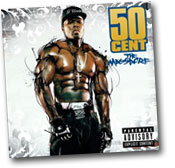 Jody Rosen postulates about the key success factors in 50 Cent's rise to power, while observing how unusual and, almost, STAGED it felt that 50 Cent and The Game, members of the same posse who's respective entourages broke into gunfire over back-and-forth dissing, when on March 9th, they buried the hatchet; it certainly would've been a publicity stunt of violent proportions that seemed to have worked - 50's album "The Massacre" sold 1.14 million copies in its first four days of release. Rosen's argument in Slate.com cracks the code by analyzing the approach strategy and patterns 50's used to overcome his handicaps as MC – that is, picking fights with higher-profile rival rappers and riding their coat-tails to success:
-
50 Cent learned the value of a well-picked fight six years ago, when he released his debut single, "How To Rob," a hilarious song that depicted the upstart MC on a crime spree against a string of A-list rappers and R & B singers: "I'll snatch Kim and tell Puff, 'You wanna see her again?'/ 'Get your ass down to the nearest ATM'… I caught Blackstreet on a back street in a black jeep/ One at a time, get out and take off your shine." Several top MCs—Sticky Fingaz, Big Pun, Ghostface, and the King of New York himself, Jay-Z—rose to the bait, answering 50 Cent's jokey insults. In a flash, the little-known rapper from Queens was on the map.
"How To Rob" introduced 50 Cent as a kind of trickster-insurgent, firing potshots at "industry niggas," and established the principle that has guided him to this day: When in doubt, dis. On his 2003 debut album Get Rich Or Die Tryin' (and on a series of much-hyped bootleg releases that preceded it), 50 Cent took aim at the pint-sized rapper Ja Rule. The target was well-chosen: Ja Rule was a hugely successful but patently weak MC with a gravelly voice that 50 Cent memorably compared to the Cookie Monster's. Supposedly, the rappers' beef had roots in a mugging back in Queens, but in songs like "Back Down," 50 Cent's motives seemed careerist: He was clambering into the spotlight on the back of a high-profile rapper, casting himself as a hard-core alternative to Ja Rule's bubblegum rap. ("You's a pop tart sweetheart, you soft in the middle/ I eat ya for breakfast.") By the end of 2003, 50 Cent was hip-hop's newest multiplatinum superstar, Ja Rule a virtual laughingstock
The dirty little secret of rap fans is this: Beneath the Sean John hoodies and thuggish scowls, they're more gossip-obsessed than Cindy Adams and a roomful of her girlfriends. (Don't believe it? Surf on over to Allhiphop, Rapdirt, or any of dozens of other Web sites.) The rise of glossies like the Source and XXL, BET's 106th and Park, and other hip-hop-centric media has created an echo chamber for rap rumors and fundamentally altered a rapper's career calculus. More than ever, hip-hop is a political game, steeped in cults of personality. New stars may rise on the strength of beats and rhymes, but a rapper's longevity depends upon his or her ability to adapt to fashion and keep themselves in the news. 50 Cent navigates this matrix better than anyone. Take his recent dust-up with The Game. Plenty of rappers dis their rivals, but who besides 50 would appear live on the radio to denounce a member of his own posse while two of their duets were perched in the top 10?
The irony of 50 Cent's serial beefing is he doesn't really have the skills to support the habit. The songs on The Massacre offer simple, visceral pleasures: catchy singsong choruses, minor-key synthesizer hooks, and 50 Cent's trademark slurred voice, trailing languidly behind the beat. But 50 Cent has never had the lyrical depth of great MC's like Jay-Z or Eminem, and on The Massacre, his rhymes have become brutally generic: "Shorty's hips is hypnotic She moves it so erotic/ But watch—I'm a watch her bounce that ass, girl." Pumped up like Jose Canseco, drawling on about getting it crunk and making it thump, 50 cuts a lumbering, stolid figure. In his own way, he's as much of a pop-rap caricature as Ja Rule ever was.
We'll see if Judakiss gets 50 to accept the $1-million challenge for a live, pay-per-view hip-hop cage match on cable...
- Arik
March 18, 2005
Charles Schwab vs. TD Waterhouse: The Grudge Match
 It's been found that the people most likely to complain about a particular advertisement are those who work for a competing company; now, Charles Schwab has filed a trade libel complaint in California state court charging that an ad campaign for TD Waterhouse has falsely labeled Schwab as a high-priced firm with inferior service. Charles Schwab said he tried to persuade the CEO of TD Bank Financial Group, which oversees TD Waterhouse, to abandon the ads before he filed the lawsuit, and that Schwab wants a court order to ban the ads, in addition to unspecified damages:
-
Charles Schwab filed suit against rival TD Waterhouse this week for “a pattern of deceptive, misleading, and patently false advertising” in its ad campaign. The suit, filed on Monday in San Francisco County Superior Court, alleges that TD Waterhouse’s ad campaign creates the impression that Schwab charges the price of a full-service broker like Merrill Lynch and that Schwab doesn’t offer the same level of customer service as TD Waterhouse.
Schwab alleges in its suit that this is false and misleading because, as the innovator of the discount brokerage market, Schwab is “known for excellent service….and has a stellar reputation for low-cost, high-quality financial services.”
Schwab is also seeking damages based on injury to the company’s reputation and loss of potential retail clients. The suit claims that Schwab has suffered “substantial” and “irreparable” damage. “People get impressions about companies they want to use based on ads,” says Schwab spokesperson Greg Gable. “We want them to stop using Schwab’s name in comparative advertising.”
TD’s ad campaign, which launched in November, 2003, features actor Sam Waterston, who plays a prosecutor on TV’s Law & Order, making statements such as: “Switch to TD Waterhouse, the alternative to higher-price brokers like Merrill and Schwab,” and “Why pay all that money to Merrill Lynch or Schwab.”
Schwab claims that it tried to settle the issue out of court in early 2004, when both parties signed an agreement to change the language in the ads. TD Waterhouse agreed to switch its tagline from “TD Waterhouse, the alternative to higher priced brokers like Merrill Lynch and Schwab,” to “TD Waterhouse, the alternative to Schwab and higher priced brokers like Merrill Lynch.” The agreement also was intended to remove language such as “Why pay Merrill or Schwab just to bounce your ideas off them.”
But according to Schwab, Waterhouse didn’t stick by the contract.
TD Waterhouse counters that it did honor the agreement, but that some of the older ads continued to run unbeknownst to them. “We have fully adhered to our agreement with Schwab,” says Kevin Dinino, manager of media relations for TD Waterhouse. “As far as ads that ran in error, they were without our knowledge or consent. We believe Schwab’s complaint is without merit and will defend our reputation.” The ad campaign, meanwhile, is rolling right along and, according to Dinino, and has been a very successful in building the company’s brand with investors—even if they may not be switching from Schwab. “We’re clearly seeing refugees from full commission brokers,” says Dinino.
Just don't ask Chuck what he thinks of the ad-campaign…
- Arik
March 17, 2005
Take Me Out to the Ballgame - Beltway Baseball Rivalry & Ripken’s Side-Switching
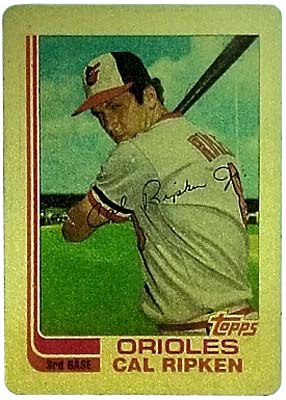 The Washington Nationals are going to war with the Baltimore Orioles in more ways than one - on the playing field and at the box office, while Orioles hero Cal Ripkin heads for the enemy camp, in this piece from BusinessWeek.com:
-
On Apr. 4, the Washington Nationals will officially play ball for the first time -- and the boos from Baltimore promise to be almost as loud as the cheers in the Nation's Capital. The Nats and the Orioles, which will compete 37 miles apart, have already skirmished over the marketing of tickets, their attempts to acquire star slugger Sammy Sosa, and the question of how Birds owner Peter G. Angelos will be compensated -- a calculation that could affect the location and financing of future franchises.
For Orioles fans there's even the frightening possibility of a Baltimore icon, legendary shortstop Cal Ripken, going over to the dark side. This summer, Major League Baseball will select an ownership group out of at least seven partnerships vying for the franchise. Ripken, who declined to be interviewed, has said he might be interested in joining a Nationals group if he also had a hand in running the team.
The competition between baseball's new neighbors will grow more intense after a Nats owner -- expected to pay up to $400 million -- is selected. For now, the Nationals are owned by the 29 MLB team owners, including Angelos. That places the current, MLB-controlled management in a tough spot, trying to avoid even the mildest public disagreements with the Orioles. For example, in the contest to trade for Sosa, baseball sources say the Nats were directed to back off by MLB when Angelos got in the game. Says Nats President Tony Tavares: "Every time we play them, I hope we kick their butts. But do I wake up wondering how I can hurt the Baltimore Orioles' business and enhance mine? Honestly, no."
Selig already seems to be bending over backward for the Orioles. In September the commish's lawyer, Bob Dupuy, began talks with Angelos. Since then, according to baseball sources, MLB has offered several plans to indemnify the Orioles. Terms include guaranteeing them annual revenues of $130 million, just above their estimated revenue at present. Angelos would also be assured of a price tag around $360 million if he were to sell the team. That's a tidy profit over the $173 million that an Angelos-led group paid for the Orioles in 1993. For now, the sticking point in the talks appears to be control over the Nationals' TV broadcast rights.
We'll see if the Nationals can out-draw the Orioles - but they likely can't stop Ripken from heading for the enemy camp.
- Arik
March 16, 2005
Bernie Ebbers Convicted, Ignorance Defense Weakened & JPMorgan Settles… for $2 Billion!
 Even as Bernie Ebbers was convicted, the likelihood that the so-called "ignorance defense" likely to be used by CEOs like Richard Scrushy of HealthSouth and Ken Lay and Jeff Skilling of Enron, has been irrevocably undermined:
-
The conviction Tuesday of former WorldCom Inc. chief Bernard J. Ebbers for orchestrating an $11-billion accounting fraud could have deep repercussions for other disgraced executives who claim they were unaware of financial scams taking root beneath them.
A federal jury found Ebbers, 63, guilty of securities fraud, conspiracy and filing false documents with regulators. He was convicted on all nine counts that he faced. It was the government's biggest win yet in a string of victories against top corporate figures, including Silicon Valley financier Frank Quattrone and lifestyles entrepreneur Martha Stewart. He faces a possible prison term of more than 30 years.
There was little hard evidence against Ebbers — no smoking-gun e-mails or paper trails — and the defendant insisted the fraud was masterminded by Scott D. Sullivan, his onetime finance chief who became the federal government's star witness.
But it came down to this: Jurors couldn't see how the man who had built WorldCom from a small phone company in Clinton, Miss., to a global telecommunication colossus could not have known about the accounting scams that triggered the company's 2002 bankruptcy filing — the biggest in U.S. history.
"When you start a company … and you bring it up from nothing, it's hard to convince a jury that you are just too stupid to know what's going on," said Daniel J. Callahan, a veteran litigator. "This see-no-evil, hear-no-evil, speak-no-evil policy just doesn't fly."
Legal experts said the jury's decision boded poorly for toppled executives Kenneth L. Lay of Enron Corp. and Richard Scrushy of HealthSouth Corp., who are employing variations of the above-the-fray defense.
Lay faces trial in Houston in January on fraud and conspiracy counts stemming from Enron's 2001 collapse. Scrushy is on trial in Birmingham, Ala., for an alleged $2.7-billion fraud at HealthSouth.
"These guys are shaking in their boots now," said Andrew Genser, a white-collar criminal defense lawyer at Kirkland & Ellis in New York.
If anyone seemed poised to pull off the "know-nothing" defense, others said, it was Ebbers.
The former high school basketball coach and milkman twice flunked out of college. He disdained e-mail, denying prosecutors a weapon they had used effectively against Quattrone and others. And Ebbers almost never sold his WorldCom shares, testifying that he even had bought $5.3 million in stock a few weeks after he was forced to resign in 2002 under the cloud of a federal investigation.
In an interview, juror Aran Nulty said that the panel weighed the evidence carefully during eight days of deliberations, and did not rely on Sullivan's testimony alone.
The tipping point, she said, was the argument that Ebbers would have to know about WorldCom's troubles because of regular revenue statements and numerous other financial reports.
Ebbers's evasiveness and defensive posture on cross-examination left a lasting impression on jurors hearing his case - the jury clearly concluded that testimony of former chief financial officer Scott Sullivan, the prosecution's star witness, was more credible than that of Ebbers, even though jurors did not fully believe Sullivan either.
Meanwhile, all bets are off at JPMorgan, holding out for a possible acquittal, ended up swallowing a $2 billion settlement charge:
-
JPMorgan Chase & Co., the nation's second largest financial institution, has agreed to pay $2 billion to settle claims from investors who lost money in the collapse of WorldCom Inc.
It was the last major bank to reach a settlement in the class action suit, though other defendants remain.
The federal court supervising the case was told Wednesday that 11 former directors of WorldCom were close to reviving a deal in which they would pay millions of dollars to settle their part in the investor suit.
The JPMorgan Chase settlement came Wednesday, a day after WorldCom's former chief executive, Bernard Ebbers, was found guilty of fraud, conspiracy and false regulatory filings in the $11 billion accounting fraud at WorldCom. The company collapsed in 2002, but has since emerged from bankruptcy to operate under the name MCI Inc.
New York Comptroller Alan Hevesi, representing thousands of WorldCom investors as the court-appointed lead plaintiff, said that the more than a dozen banks and investment banks that have reached settlements have agreed to pay more than $6 billion -- a record in a securities class action case.
"I'm delighted that we are coming to closure," he told reporters. "This is a huge securities case. I think we've made a substantial recovery for the people that we represent."
In addition to JPMorgan Chase, two small investment banks also announced settlements Wednesday. Blaylock & Partners LP agreed to pay $573,000, and Utendahl Capital agreed to pay $234,000. Both are based in New York.
If the case goes to trial, jury selection will begin next week, the court said.
The remaining defendants, in addition to the 11 former directors, are auditing firm Arthur Andersen and former WorldCom board member Bert Roberts.
Judge Denise Cote gave preliminary approval on Wednesday to a number of settlements reached earlier with banks, including Bank of America Corp., which is headquartered in Charlotte, N.C.; Credit Suisse First Boston, a unit of the Zurich-based Credit Suisse Group, and Citigroup Inc.
"Let me give the court's congratulations to the settling parties," Cote said. "This case has been very hard-fought."
The banks were involved in the underwriting or sale of billions of dollars worth of bonds that WorldCom issued in 2000 and 2001.
Investors who purchased the securities argued that the financial institutions should have been aware of ongoing fraud at the company.
The settlement by JPMorgan Chase was second in size only to the $2.58 billion that Citigroup, the nation's largest financial institution, agreed to pay last May to settle its share of the case.
JPMorgan Chase last year rejected a settlement on the same terms as Citigroup, which would have required it to pay $1.37 billion. Hevesi said he considered the difference a "premium."
Crime never pays, eh? Let's hope the message comes across that screwing your shareholders is less profitable than it used to be...
- Arik
March 15, 2005
The Pharmaceutical Sales Force – the Movie, the Conference
 So, I spent the past couple of days in Philadelphia giving a presentation on competitive intelligence sales force effectiveness applications to CBI's "Gaining Physician Access" conference - and, then on the flight home, no kidding, I read in USAToday how one of my fellow Wisconsin Badger alums is releasing a new film on the career track for pharma sales people that rung strikingly true to what I heard in Philly the past couple of days:
-
Kathleen Slattery-Moschkau, a sales representative in the cell phone industry at the time, had a bachelor's degree in political science. The only science course she had ever taken in college was meteorology.
"The irony is then all these years later I'm working for these major pharmaceutical companies telling your doctor how to prescribe drugs for you," says Slattery-Moschkau, a former employee of Bristol-Myers Squibb and Johnson & Johnson. "I did it for 10 years, and I'm almost embarrassed I stayed that long."
An aspiring screenwriter since college, Slattery-Moschkau took notes about her many CandidCamera-type moments on the job. There were the "grinders," in which sales representatives would pair up and rehearse their identical, memorized pitches to doctors. There were the doctors' office staffs bored with yet another free pizza lunch from a drug sales rep. There were the internal conflicts between drug companies' marketing staffs and research scientists.
"I just had this whole stack of these revelations," Slattery-Moschkau says. And they made great icebreakers. "When I would go to parties, and I would meet people I didn't know, people would be really curious about what I did."
Slattery-Moschkau's notes led to Side Effects, an independent film that had its world premiere Saturday at the Cinequest Film festival in San Jose, Calif. The movie "is pretty eye-opening," says Jens Hussey, a Cinequest spokesman.
The film, written and directed by Slattery-Moschkau, will have its Midwest premiere April 2 at the Wisconsin Film Festival in Madison. It will then be released in theaters in Madison, Milwaukee, Dallas, Lincoln, Neb., and possibly other cities, Slattery-Moschkau says.
The timing of Side Effects, which was shot in 18 days last summer on a budget of $190,000, couldn't be better. Stories about the safety and marketing of prescription drugs grabbed headlines and led newscasts in recent months.
"As we were wrapping shooting, I think, the Paxil story was breaking," says Slattery-Moschkau, referring to one of the antidepressants linked to suicides in young people. "Then, shortly afterward, the Vioxx story broke."
Side Effects centers on the launch of an antidepressant called Vivexx. But don't expect an expose à la Michael Moore, who revealed in September, right around the time Merck pulled Vioxx off the market, that he's now taking on the pharmaceutical industry. There's no such drug as Vivexx, and there's no such drug company as Braden-Andrews, which markets it.
Slattery-Moschkau's film is a satirical look at how prescription drugs are marketed, with romance and family relations added to the mix. "I'm not Michael Moore," she says. "I tried to provide some of the counter-arguments for people to be thinking about. We have to look at both sides of the story."
For example, in one scene, Slattery-Moschkau's alter ego, Karly Hert — played by Katherine Heigl, who will appear in ABC's new TV series Grey's Anatomy— defends her profession to her boyfriend. "What about all the patients that are helped?" she asks.
Slattery-Moschkau wonders whether patients also might have been hurt because their doctors depended on drug company sales representatives, a number of whom had been drama or music majors in college, for information. "Basically, you were hired if you were a star athlete or they liked the way you looked," she says. "They wanted to give doctors something that would be a nice break in their day."
Spokesman Jeff Trewhitt says no one with the Pharmaceutical Research and Manufacturers of America, or PhRMA, a trade group for the prescription drug industry, has seen Side Effects. His response is based on a reporter's description of the film.
"This really does sound like fiction, considering that all sales representatives undergo extensive technical training and are prepared to answer questions about new medicines and their characteristics," Trewhitt says. He says drug companies often hire nurses and pharmacists for their sales forces.
Like Karly, Slattery-Moschkau says, she did not suddenly quit her job with a drug company.
"Toward the end, it was this bottom-line financial thing," she says. " 'I've got a house payment. How can I do this job a little while longer and build up my savings?' "
Slattery-Moschkau's — and Karly's — solution: Tell it like it is to the doctors. When a doctor asks Karly why he should prescribe her company's drug, she replies: "You're going to know exactly what your patients are getting with this drug. The good, the bad, the ugly."
To Slattery-Moschkau's surprise, her sales soared. "It was like the more direct and more honest I was, the more they respected what I had to say."
Now, whether or not this is a career option for freshly minted med-school dropouts...? That remains to be seen.
- Arik
March 14, 2005
Dr. Dre's Protégé Formula: The Secret to Aftermath's Hip-Hop Success
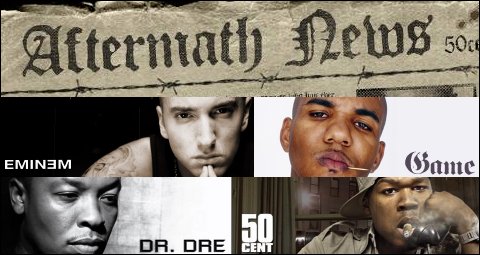
Brendan Koerner broke it down for us in a fascinating analysis on Slate.com of the secret to the success Dr. Dre's formulated at Aftermath Entertainment in grooming protégés like Eminem and 50 Cent to supa-MC-dom... The Game appears to be next up.
-
Dre isn't just consistently good—he's good in a consistent way. No matter if the front man is 50 Cent, Eminem, The Game, or Dre himself, the man's sound is similar from album to album. Dre achieves this by working with up-and-coming talents rather than established MCs who might want too big a say in how the album turns out. Dre was attracted to The Game because of his gangster persona and laid-back vocal style, but a more important factor might have been the young rapper's willingness to subordinate his technique to the Dre formula—the beats come first, and the lyrics are dessert. Meanwhile, ego clashes recently scuppered planned collaborations between Dre and Rakim, and Dre and Ice Cube.
Dre also realizes that once he's created a star, he can no longer exert his preferred level of control. Which may be why he rewards his former protégés with labels of their own (Eminem has Shady Records, 50 Cent has G Unit). It gives them something to do, which frees him up to look for more pliable talent. The end result? A sound that's so consistent the industry's hype artists can bank on it. Magazines and clothing companies can be confident that the pre-release capital they spend plugging Dre's protégés is a safe bet—sort of like buying hip-hop's version of municipal bonds.
When it comes to winning this kind of free, pre-release exposure, Dre has one last trick up his sleeve: He keeps himself scarce. Contrast the Dre approach with that of more prolific beatsmiths. The Neptunes, for example, rent themselves out as hired guns so often that a new Neptunes-produced track is certainly no cause for an XXL cover story. Dre, on the other hand, rarely takes on freelance work for non-Aftermath artists, preferring to keep his creative focus on projects he controls completely. Since 1998, only five albums can truly be considered pure Dre projects—the first two releases from Eminem, the debuts of 50 Cent and The Game, and his own 2001. The scarcity of Dre's work ensures that each release is an event, one that garners lavish media and consumer attention. And as music snobs are forever complaining—and the inexplicable success of Ashlee Simpson's Autobiography proves—exposure is what really propels an album to No. 1.
Ah, yes... invoking the name of Ashlee "Appetite for Humiliation" Simpson in the same piece as Eminem and 50 Cent... what's the world coming to? Still, the lesson of "if you love it, let it go" in constructing a hip-hop dynastic family network serves as an interesting model for spinning off success in promising new acts.
One the rest of the business world might well learn from... step up to get your rep up.
- Arik
March 13, 2005
Hewlett-Packard's Prototype DJammer: A Potentially Revolutionary New Musical "Instrument"
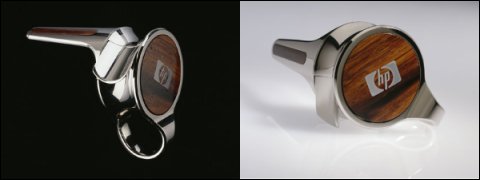
"Invent" - HP's slogan, seems to be ringing true for the first time in the post-Fiorina era, after Wired posted an article about the new DJammer, which the company is calling potentially as significant to the production of modern music as the first electric guitar was to rock-n-roll:
-
HP's DJammer is a prototype handheld gadget DJs can use to mimic the sound of scratching vinyl simply by moving the device around. So, if the operator makes a scratching motion in the air, arrays of internal motion sensors translate movement into music, and the DJammer "scratches" the music as though the DJ were manipulating a record.
Linked to a digital music library, the device can also mix tracks. It finds the entry and end points for tracks, and can cycle through a song collection. And it is wireless, so a DJ can control the music from anywhere in a room.
"The DJammer is the next-generation electric guitar," said Mark Smith, an HP researcher who co-invented the device. "It's the sort of thing where people will be able to become very creative."
The DJammer was created by HP research and development scientist Mat Hans, who began the project in 2002 with New York's Scratch DJ Academy, a school for DJs.
Hans wanted to develop a device that would let digital DJs mix their music just like vinyl DJs do, so he recruited Gavin O'Connor (aka DJ Gawk1) and came up with a wireless handheld controller that could be networked.
"We hooked up with O'Connor, and he showed us how professional DJs interact with turntables and music," said Smith, who also invented the technology behind the optical mouse. "This got us looking at how to match the expectation of the DJ."
O'Connor has demonstrated the device twice in public: at last summer's HP-sponsored MTV Video Music Awards and at the CES show in January.
O'Connor's setup is based on conventional twin decks for vinyl. The DJammer connects to a third line in on the mixing desk and plugs into a Linux-powered control brick that holds the tunes and drives the mixer.
"You are able to control music by air-scratching (and) jumping to different parts of the song ... using sensors built into the device," said the handheld's software designer, April Slayden.
Reaction at the MTV event was immediate, Slayden said. "I was approached by big-name DJs from all over the country who wanted one."
The DJammer's motion sensitivity relies on a 3-D accelerometer that controls the music when the operator shakes the device. It's based on the same technology used in notebooks to raise the head off a hard drive if it's dropped.
Keep it up, HP - as hip-hop goes digital that spirit of garage innovation just might help re-Invent HP in time for a comeback tour.
- Arik
March 12, 2005
iWin: Apple's Blogger Trade Secret Judgment Skirts Question of Bloggers-As-Journalists
 Yesterday a judge in California ordered three online "reporters" to reveal their sources to Apple Computer after the company brought a lawsuit against the bloggers demanding they reveal who leaked information to them about new music software the company planned to introduce that Apple considers a trade secret.
This was particularly disappointing for most onlookers to the case who had wanted to see what it would mean for online reporters and bloggers in the future, especially in a state like California with a so-called "sheild law" that protects journalists from revealing the identities of their confidential sources. An initial ruling about whether bloggers and other part-time, amateur or hobbyist writers are in fact bona fide members of the Fourth Estate would have surely brought about much consternation throughout the rest of the journalistic enterprise... instead, the judge skirted the issue by equating the release of proprietary information to stealing:
-
The ruling came in the three-month-old lawsuit brought by Apple against the unnamed individuals, presumably Apple employees, who reportedly leaked information about new music software, code-named Asteroid, which the company said constituted a trade secret. Under California law, divulging trade secrets is subject to civil and criminal penalties.
That information was published on three Apple enthusiast Web sites, Apple Insider, Think Secret and PowerPage. The Web sites were not named in the suit.
In the course of discovery, Apple served a subpoena on Nfox.com, the e-mail service provider for PowerPage, seeking information and documents that might identify the source of the disclosure of Apple's new product. The Web sites sought to block that subpoena.
The case has been closely watched for its potential impact on the publishers of Web sites and bloggers, who say the privilege of reporters to protect their confidential sources should extend to online writers.
But Judge Kleinberg wrote that assuming Apple's accusations are true, the information is "stolen property, just as any physical item, such as a laptop computer containing the same information on its hard drive (or not) would be."
He went on to say that "the right to keep and maintain proprietary information as such is a right which the California Legislature and courts have long affirmed and which is essential to the future of technology and innovation."
As for Jason O'Grady, the publisher of PowerPage, and his claim to a journalist's privilege to protect confidential sources, the ruling said, "whether he fits the definition of a journalist, reporter, blogger or anything else need not be decided at this juncture for this fundamental reason: there is no license conferred on anyone to violate valid criminal laws."
Judge Kleinberg also said: "Defining what is a 'journalist' has become more complicated as the variety of media has expanded. But even if the movants are journalists, this is not the equivalent of a free pass."
The Electronic Frontier Foundation, the civil liberties organization that represented the Web sites, called the ruling a blow to "constitutional rights," and said it would appeal. The organization argued that authors of Web sites were protected by California's shield law, which protects journalists who refuse to divulge sources.
Kurt Opsahl, staff lawyer with the foundation, said the ruling could have serious consequences on the rights of all journalists, not only those who write for Web sites.
"I had hoped the court would see it was important to protect the confidentiality of sources," he said. "It's very easy for a company to contend that any piece of information is a trade secret."
The organization has seven days to file an appeal with the California Court of Appeals, after which Apple would have 10 days to respond, Mr. Opsahl said. If the appellate court rules for Apple, he said, Electronic Frontier will try to have the case heard by the California Supreme Court. "Given the constitutional nature of the case, I would hope the California Supreme Court would decide this is important," Mr. Opsahl said.
Apple declined to comment on the ruling, except to repeat Judge Kleinberg's opinion that the publishing of Apple's confidential information was illegal. "The judge ruled that there is no license conferred on anyone to violate valid criminal laws," said Steve Dowling, a spokesman for Apple.
But to many technology industry experts, the prospect of Apple fighting the bloggers is peculiar.
"Apple suing its most enthusiastic fans is like the Grateful Dead suing its concert bootleg tape makers," said Paul Saffo, director of the Institute for the Future in Palo Alto, Calif. Fan recordings have fueled that band's popularity over the years. Mr. Saffo said the rumor mill had only helped Apple in the last 20 years.
Well... okay. Despite the failure to address the issue of bloggers as journalists (or not) it will surely engender great speculation on the future of the issue... one that, in an era where jailing "real" journalists like Judith Miller and Matthew Cooper in the Valerie Plame case (related to violation of the Intelligence Identities Protection Act of 1982) could take place if they don't reveal their sources. I agree with BusinessWeek's recent op-ed on the matter:
-
...the imminent jailing of two journalists from Time magazine and The New York Times for protecting what is widely said to be a Bush Administration source who leaked the name of a CIA agent requires action. Some 31 states have shield laws for journalists. It's now time for a federal shield law as well.
America grants legal exemptions to its citizens reluctantly, but it does grant them. Lawyer-client, clergy-laity, doctor-patient, and husband-wife relationships are all protected under the law, with limits on what testimony prosecutors can compel. Journalists claim the same treatment for their relationship with sources under the First Amendment, arguing that a greater good for society comes from their freedom to investigate matters in the public interest.
The Supreme Court has never recognized a First Amendment privilege, but Justice Dept. guidelines do instruct prosecutors not to go after reporters except under extreme circumstances. That's precisely the nature of the state shield laws. The severity of the crime and the availability of other sources determine whether journalists must testify. The privileges under state shield laws are not absolute.
This reasonable balance test of the public interest should now be extended to the federal level. It may very well be that even under a federal shield law, Time magazine writer Matthew Cooper and Times reporter Judith Miller could be called to testify before a grand jury if someone's life had been placed in jeopardy. But this appears not to be the case. It's not even clear that a crime was committed. The prosecution of Cooper and Miller fails to meet the balance test.
A "Federal Shield Law" that includes the class of bloggers that covered the national political conventions could make the whole question moot.
- Arik
March 11, 2005
Dan Rather Steps Down from CBS Evening News Presenting Opportunity for Media Innovation

Dan Rather's last night as anchor of the CBS Evening News, leaving 24 years to the day after taking over from predecessor (and only the second anchor in the history of the broadcast) Walter Cronkite, came and went with a touch of drama and sadness, despite the fact I've never considered him much of a "news man". Here's hoping, as he wished himself in an interview, that his best days are indeed ahead of him.
The larger question now is, wither the CBS Evening News? In an era when the whole genre is encountering shrinking viewership and increasing dependence on the wrong demographics, this presents some startlingly interesting opportunities for CBS to effect change - and, with it, competitive advantage - in revamping the medium for the modern era. Slate.com's media critic, Jack Shafer, offered up some cool ideas:
-
CBS should worry less about who anchors its evening news ship than what the ship looks like. Any of the current CBS doofuses will do as an anchor. It's not like Brian Williams and Peter Jennings light my charisma candle. CBS could steal a march on NBC and ABC and the cable networks by designing a program that reflects changing viewer habits. It needs to break the code of why viewers have turned off the news.
First, CBS should target serious news consumers, the sort of devotees who follow breaking news all day through news radio, cable, and the Web. Dedicate the program to breakingest of breaking news and ditch the news-you-can-use and heart-warming features unless they're stupendous. Produce a program that's worldly and doesn't waste time. The BBC World News, which airs on many PBS affiliates, is a good model, even if it is excessively chatty for my tastes.
Next, reduce the number of commercials. Right now, about eight of the 30 minutes of an evening news slot are ads, which makes the program too short and too frequently interrupted to be compelling. The Journalism.org study asserts that one reason the network's morning "news" programs have gained viewers steadily since 1998 is that viewers have realized that they often program big blocks—up to 20 minutes—free of commercial interruption. Advertise the CBS Evening News as the program that gives hardcore news consumers two minutes more news per half hour. Cutting ads will reduce revenue, of course, but it will build audience, which is the longterm problem the program faces.
Swing a deal with CNN to rebroadcast a refreshed version of the CBS Evening News in the 10 p.m. slot. One reason behind the evening news fade is that it's still scheduled for an era when moms stayed at home and cooked for dad, who didn't have a long commute. How many 30-year-olds do you know who would watch the evening news at 6:30 p.m. or 7 p.m. if you paid them? The network's morning shows have benefited by giving busy viewers a two-hour window through which to watch. Nobody expects them to watch the whole thing. A 10 p.m. cable slot for the CBS Evening News would similarly appeal to busy people. Sharing news resources with CNN, which has been on the table before, would be an excellent idea to add quality and scope to CBS's coverage.
Next, CBS News should partner with a premier daily newspaper—the New York Times, the Washington Post, the Los Angeles Times, or the Wall Street Journal—to give viewers a taste of tomorrow's news tonight. The networks already use the morning New York Times as a cheat sheet for the evening program. Why not use it as a preview of tomorrow's news? The New York Times already does a two-minute show based on this idea for the Discovery Times cable channel at 10 p.m., so W. 43rd Street might not be keen on partnering. What's in it for the newspaper to partner? The Web sites for both the Post and the Los Angeles Times already draw more readers nationally than they do locally. CBS News could steer additional eyes to those Web pages.
Next, hire a brainy and thoughtful commentator. Eric Severeid (good), Bill Moyers (bad), and Bill Bradley (uneven) once delivered interesting commentaries on CBS Evening News. In our increasingly opinionated world, CBS would seem futuristic by going retro and including a video columnist.
TiVo and other technologies have destroyed the concept of "appointment viewing." CBS should respond by putting the goddamn broadcast on the Web. Computers and television aren't converging—they've converged—and I want to watch the news 1) when I want to watch it and 2) on whatever monitor I'm looking at. CBS could start by streaming the program onto the Web at the same time it broadcasts the show. Then it should video-podcast it. Other time-shifting opportunities await. Monetize the evening program by putting it on the various cable video-on-demand services. Do the same with the CBS News archives. Wired Editor Chris Anderson's "long tail" thesis implies that there's money in all of those old documentaries, news magazines, and news casts. Thomas W. Hazlett of the Manhattan Institute urges CBS to allow viewers to personalize the Web version of the news and suggests that it be the first network to bring television news video to capable cell phones.
George Washington University professor of journalism Mark Feldstein thinks a network should abandon the traditional evening news time slot and program an hourlong news show starting at 8 p.m. Producing a money-making news program in prime time will become economically feasible if network entertainment ratings continue to decline. Ceding the 6:30 p.m. or 7 p.m. slot back to the affiliates would make them very happy (because it will make them money).
Arizona State University professor of journalism Craig Allen, author of News Is People: The Rise of Local TV News and the Fall of News From New York, suggests that one of the networks will eventually euthanize the program. Eliminating an early evening program from a network line-up was one of Rupert Murdoch's bright ideas when he started Fox. Instead of battling the other networks for profits in an overpopulated news slot, Murdoch programmed entertainment at the local level and put his energies into producing an hourlong local program at 10 p.m. for the various Fox affiliates that he owned.
The woolly mammoth was far too specialized—and too dumb—a beast to adapt to its changing environment. The producers at CBS News may be specialized, but they're not stupid. But if they continue to play by the current set of evening news rules, they're destined to to lose. Unless they want future news archaeologists to find them frozen alive in pack ice, they need to stop thinking about who is going to be their next anchor and start changing the news environment. Without subscribing to his news values, they need to ask themselves, What would Rupert Murdoch do?
Indeed! Murdoch might have objectionable politics for some, but he seems to know how to appeal to the marketplace with exactly what people want to watch. Taking a page from his competitive strategy seems like the best idea CBS has gotten in... oh, I dunno... about 24 years.
- Arik
March 10, 2005
Gates Gets His Groove On: Fulfilling Upgrade Value-Prop Strategy for Longhorn & Office in 2006
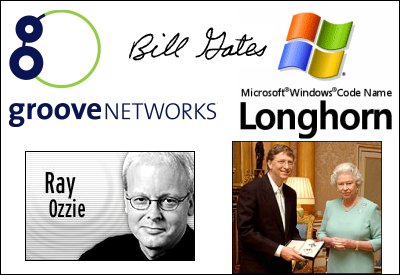
Fresh from his recent knighthood with the Queen, this morning's announcement that Microsoft would acquire Ray Ozzie's Groove Networks was viewed with broad optimism by most as the father of Lotus Notes, Microsoft Exchange's biggest competitor and, later on, an ultimate victim of Redmond's unrelenting competitive strategy, is set to become Chief Technology Officer at Microsoft in the process. Here's a good summary of what went down:
-
Terms of the deal weren't disclosed. Groove will continue to be run out of its Beverly, Mass., headquarters and will become part of Microsoft's Information Worker Business. Ozzie will report directly to Microsoft Chairman and Chief Software Architect Bill Gates.
Founded in 1997, Groove develops peer-to-peer software called Virtual Office that enables ad hoc workgroups to collaborate seamlessly in realtime.
Groove's software complements Microsoft's SharePoint Services and SharePoint Portal Server. Groove has worked closely with Microsoft on its collaboration technologies since its founding. In October, Microsoft invested $51 million in Groove, acquiring a 20 percent stake in the ISV. Redmond, Wash.-based Microsoft later was part of $38 million investment in Groove after the company had layoffs and a restructuring. Overall, Groove has received $155 million in financing since its founding.
Ozzie is best known for his creation of Lotus Notes. He left Lotus after the company was acquired by IBM and launched Groove as a dedicated Microsoft ISV. Lotus Notes competes directly with Microsoft Exchange. But in 1994, Microsoft named Ozzie a "Windows Pioneer," a rank given to only seven people, Microsoft said.
However, this wasn't all that surprising... Here's a summary of the technology and business implications:
-
Industry observers have long predicted that the two companies would combine forces because of Microsoft's substantial investment in Groove and the latter's innovative offline, peer-to-peer (P2P) and authentication capabilities, which enable ad hoc workgroups across firms to collaborate with outside partners, suppliers and customers.
Gates formally announced the agreement to acquire Groove on Thursday, saying that the Beverly, Mass.-based company's technology would be tightly integrated with Microsoft's next generation of Windows, code-named Longhorn, and Microsoft Office 12, including SharePoint. Other company executives said the "trifecta" of Office/SharePoint, Microsoft's Live Communications Server 2005 realtime platform and Groove's Virtual Office will extend Microsoft's lead in the collaboration space. They also hinted that Groove's technology would be integrated with Microsoft Business Solutions (MBS) offerings that support customer business processes.
"The way people work across locations and different organizations requires new technologies, and the Groove product has fantastic and unique features we want to fit into the Office system," Gates said in a conference call Thursday from Microsoft's Redmond, Wash., headquarters. "The P2P and authentication capabilities Groove built into their apps, we want to take the equivalent things we've been incubating at Microsoft and bring them in to strengthen the platform. One big thing about Longhorn will be its peer-to-peer capabilities."
Microsoft has long struggled with P2P technology and had invested in a Windows XP P2P development kit, but little became of that effort. Besides giving Microsoft's collaboration strategy a boost, Gates said the company's deal to buy Groove also fulfills a longtime dream of hiring Lotus Notes creator Ray Ozzie, the chairman, CEO and founder of Groove. Ozzie will serve as one of Microsoft's three CTOs, reporting directly Gates.
Ozzie's contributions as one of the early application developers on DOS and Windows and later on Lotus Notes and Groove's Virtual Office make him an ideal candidate for Microsoft's senior leadership team, according to Gates. "For me, I've thought about hiring Ray and his team for a long time. It's a big day for me that is finally taking place," he said.
The Groove acquisition will accelerate Microsoft's ambitions in the collaboration space, especially against rival IBM, said David Via, CEO of Wolcott Systems Group, a Fairlawn, Ohio-based solution provider. "It's a huge coup for Microsoft. Ray [Ozzie] is one of the most respected figures in the industry," Via said. "It could be to Groove what IBM's acquisition of Lotus was back in '95, a huge accelerator."
Other Microsoft partners also expressed enthusiasm, noting that Groove's software fills a big hole in Microsoft's collaboration lineup. The deal is plus for all partners in Microsoft's Information Worker division, noted Ted Dinsmore, president of Conchango, a New York-based solution provider.
"This fills in a hole in the office to back-office position for Microsoft. The offline feature is the hole, and Groove's peer-to-peer [software] allows better fits between Windows SharePoint Services and SharePoint Portal Server [SPS]," Dinsmore said. "With this acquisition, there are no competitors that have this depth, a full suite of collaborative [applications]. The question then becomes, what will IBM do now?"
Another Microsoft partner agreed. "We love it," said Ken Winell, managing executive at Vis.align, a West Chester, Pa.-based solution provider that recently acquired collaboration services provider Econium. "[The Groove deal] gives Microsoft the ability to tackle the offline and mobility piece of collaboration that has been missing in their stack. One of the key issues that enterprises encounter with SharePoint is the ability to move and work on documents while not connected. Users can check documents out; however, the extra steps required are not as intuitive as the Groove Mobility workspace for SPS. It allows me to select which documents and folders I want to bring with me, and then when I connect it seamlessly syncs."
Groove's technology also will integrate with and leverage Microsoft's instant-messaging and realtime communication platforms, Winell added.
Gates said the ability for Microsoft customers to immediately build on their current investment in SharePoint with Virtual Office--and enhance that later--made Groove a compelling buy for Microsoft. Groove's file-sharing technology, for example, lets users insert sharing, synchronization and conversation icons directly into Windows Explorer. That enables every Windows folder to have an attached Groove button that can turn the folder into a SharePoint workspace, allowing users to share the folder with people inside or outside the company and have chats and conversations within that folder. Groove's Virtual Office 3 upgrade, announced last summer, for the first time targeted the company's software at small and midsize businesses, extending the vendor's traditional base of enterprise and government customers.
Michael Cocanower, president of ITSynergy, a Phoenix-based SMB solution provider, said he currently doesn't deploy Groove software but held a seminar this week about SharePoint's value to lower-midmarket customers. The integration of Groove's technology and Microsoft's collaboration platform and SharePoint Workspaces can only be a good thing for the SMB space, he said.
"It seems to me that their product/feature set will ultimately become integrated in the SharePoint platform," Cocanower said. "This [acquisition] announcement seems to only enforce that making an investment in SharePoint is a good investment for the future."
Yet one Groove competitor in the SMB space disagreed. "By announcing its acquisition of Groove Networks, Microsoft has made a move but still finds itself with a complicated, peer-to-peer collaboration technology that does not address the massive SMB space," Rick Faulk, CEO of Intranets.com, said in a statement. "Unlike Groove's technology, we believe that professionally managed and hosted Web-based solutions--available from anywhere with an Internet connection--are the best way to serve this market.
Ozzie and Microsoft Information Worker Group Vice President Jeff Raikes also participated in the acquisition announcement from Groove's Beverly headquarters. "[Groove's software] will influence how collaborative technology can be broadly used across Microsoft applications and business proceses," Raikes said.
The integration of the two companies' platforms and peer-to-peer distributed capabilities will enable Microsoft to extend its lead in Office and SharePoint collaboration outside the firewall, Ozzie said. With the deal, Ozzie said he will "set up a life in Redmond" but also retain his home in the Boston area. "I'll be spending a lot of time on planes," he quipped. As a Microsoft CTO, Ozzie will serve alongside Craig Mundie, senior vice president and CTO of advanced strategies and policy, and David Vaskevitch, senior vice president and CTO of Microsoft's business platform.
After the announcement, Groove President and COO David Scult said there are no plans for any layoffs at Groove, which employs 200. He declined to comment on financial aspects of the deal, terms of which weren't disclosed. Microsoft already owns roughly 40 percent of privately held Groove in the wake of several investments since the collaboration software vendor's founding in 1997, including an initial $51 million funding in 2001.
The Groove operation will continue to be run out of Groove's Beverly headquarters, according to Microsoft. Though Ozzie will serve as a Microsoft CTO, he and Scult will continue to oversee the Groove operation, a Groove spokesman confirmed.
Groove runs a consulting services arm as a nonprofit support center for enterprise customers, and recently the company began developing a partner channel for the Virtual Office 3 upgrade, Scult said. The consulting unit serves as a "trusted adviser" to customers, Scult said. He declined to say if Groove's consultants will be folded into Microsoft Consulting Services or if Groove's handful of channel partners will be inducted into Microsoft's partner program.
News of the Groove acquisition comes on the heels of Microsoft's Convergence 2005 conference for the MBS division. At the event, Microsoft took the wraps off its next-gen, realtime collaboration suite, including the Office Communicator 2005 client--formerly code-named Istanbul--and Microsoft Office Live Communications Server 2005 Service Pack, as well as Microsoft Office Live Meeting 2005. Also this week, Groove announced the Virtual Office 3.1 update.
Of course, for a company who's biggest competitor seems lately to be itself, with its installed base of software users already on Office and Windows witnessing diminishing returns from the upgrade path coming up in 2006, the Groove acquisition provides a good reason to consider the upgrade, especially in the enterprise:
-
The deal poses some interesting questions for how both companies will weave in Groove's collaboration software with two critical releases expected from Microsoft in 2006, namely the long-awaited next version of Windows, code-named Longhorn, as well as the next version of Office designed to fully exploit Longhorn.
"Microsoft has two big releases coming next year in Longhorn and Office 12, which are radically different from their predecessors. They both have millions of lines of code, hundreds of developers, and programming teams well into their development phases. It is going to be hard to take a step back and stitch new technology and strategies into those products," said Nate Root, a vice president with Forrester Research, in Cambridge Mass.
Root and other analysts said they had been expecting the acquisition for some time, and generally think it makes strategic sense.
"Microsoft and Groove have been outstanding partners. Microsoft has been able to kick a lot of business Groove's way because Groove fills in a gap that Microsoft does not have any technology in, the off-line collaboration market. It is a smart move," Root said. "The one downside is, it might be a smart move that is happening a little later than what would have been ideal," he added.
The fact Microsoft is making Ozzie CTO is sending signals to some observers that the latter's role will be more than one of just shepherding the deal through to completion. Some believe Ozzie will play an integral role in shaping Microsoft's overall collaboration strategies with new products.
"It looks like they want Ray to be around for the long haul to make some other paradigm changing inventions like Notes and Groove. You can imagine some pretty far out conversation over a cup of coffee or a beet between those two," Root said.
In a prepared statement Microsoft group vice president in charge of the company's Information Worker Business unit, said the deal makes sense because the companies have a shared vision for collaboration. He said Groove complements Microsoft's collaboration products "by helping us better serve businesses with mobile workers and remote offices and will assist Microsoft in being able to offer both small and large companies more integrated collaboration software and services.
Currently Microsoft has Office SharePoint Portal Server and Windows SharePoint Services that allow IT shops to create and manage shared spaces for groups of information workers within an IT-based network. Just this past week the company introduced Office Live Communications Server and Microsoft Office Live Meeting that together reportedly offer a unified communications infrastructure for information workers.
One thing's for sure - whether you think Ozzie crossed over to the Dark Side or not, the powerful collaborative tools that can come out of the combination will help ensure Microsoft's continued dominance in the OS and Productivity sides of the software marketplace at least through the next release of Windows.
That's something everyone from Apple to the Linux community, and a good many other competing platform ISVs with stakes in either market, wish would've been a tad harder as Microsoft would've likely spent the rest of 2005 and 2006 convincing enterprise customers the upgrade was worth the time, expense and attention-span.
- Arik
March 09, 2005
Oracle vs. SAP: The Battle for Retek & Retail's Supply Chain Infrastructure
 Larry's playing spoiler again and defending his territory, going after SAP's latest acquisition target, Retek, an acquisition by SAP originally designed specifically to tweak Oracle's nose in its retail-industry stronghold:
-
“Acquiring Retek brings a whole new level of industry focus and technical ability to SAP’s product lineup,” says Scott Langdoc, analyst for AMR Research Inc., adding that SAP appears willing to acquire additional retail industry software application vendors.
SAP gains strong capabilities in web-based demand forecasting, demand-driven replenishment and retail planning, and will be able to offer multi-channel capability in order management, Langdoc says. Retek also brings clients like Gap Inc., A&P and Nordstrom Inc., who could benefit from SAP’s strength in enterprise software implementations, he adds.
Minneapolis-based Retek provides an integrated suite of retail software applications and serves more than 200 companies in 20 countries. It posted $174.2 million in revenue last year. Under the terms of the acquisition agreement, Retek will merge with SAP’s U.S. unit, SAP America Inc., and the two companies will decide over the next several weeks whether to keep the Retek name and other brands, a spokeswoman says. The $496 million price is based on an all-cash offering of $8.50 per share of Retek, representing a 42% premium for Retek shareholders.
Henning Kagermann, CEO of SAP, said the Retek acquisition enables SAP to offer a comprehensive set of applications extending from POS systems to supply chain management applications as it seeks to expand in the retail market. “The global retail industry represents a significant growth opportunity for SAP,” he said.
SAP also faces challenges in capturing more of the retail software market with Retek, analysts say. Several existing SAP and Retek applications, including financial planning and supply chain management, directly compete with each other in the retail industry, and SAP will have to decide which of these it will support over the long term, says Paula Rosenblum, director of retail research at AberdeenGroup Inc.
Until now, Oracle Corp. has been the source of the preferred back-end financial software integrated with the Retek suite, but retailers may now be expected to migrate from Oracle to SAP, a move many retailers are unlikely to accept willingly, Rosenblum says. “Retailers are as unlikely to want to take the time and resources to move from Oracle to SAP as they are to move from PeopleSoft to Oracle,” she says. “A different financial package will not help any retailer win the hearts and minds of consumers.”
Rosenblum adds that SAP will also have to address the difficulties retailers have faced in upgrading Retek applications as well as in installing SAP applications. She adds that retailers’ demand for quick returns on investment from software implementations may favor, at least in the short term, niche players like merchandise optimization software vendor ProfitLogic and supply chain software providers Logility Inc. and New Generation Computing Inc.
In making the original acquisition announcement, SAP said the retail industry is entering a new phase of packaged software adoption, as retailers start considering IT a strategic weapon to drive competitive differentiation and business growth.
"SAP has been much more successful moving from one manufacturing industry to another manufacturing industry because there are many more common core set of attributes there," says Mike Dominy, a senior analyst with the Yankee Group. "This is a good acquisition for SAP, because it gives them a significant increase in market share and represents a renewed interest in being a major player in that industry."
AMR Research analysts Scott Langdoc, Robert Garf and Jim Shepherd predict, in an Alert Highlight "the combination of SAP and Retek will become a very difficult competitive challenge for existing enterprise retail software players. For nearly a year, it has been rumored that Oracle was interested in Retek as a way of heading off the growing competitive threat in retail from SAP. Oracle will need to push its relationship with Tomax as a way of offering industry applications beyond the core Oracle capabilities. JDA Software, in the midst of delivering its long-delayed .NET integrated retail systems, loses a longstanding competitor but will struggle even more mightily against the resources and abilities of the Retek-infused SAP."
And, Oracle's just sweetened the pot for Retek shareholders to reconsider the SAP offer:
-
In a blocking move against application rival SAP, Oracle will make a bid Wednesday morning to acquire Retek Inc., a leading supplier of retail-management applications, for $9 a share.
Oracle's move comes just one week after SAP said its North American subsidiary, SAP America Inc., had signed a definitive agreement to acquire Retek for $8.50 per share, or approximately $496 million.
"We have the largest application business in North America, with about 23,000 customers, and [we] intend to defend the No. 1 position," Oracle CEO Larry Ellison said in a conference call Tuesday.
An SAP spokesman declined to comment on Oracle's bid until SAP has had a chance to review the Oracle offer.
On Monday and Tuesday, Oracle purchased 5.5 million shares of Retek common stock, representing about 10% of its total shares outstanding, according to Oracle. Oracle spokesmen said Tuesday that the company planned to follow up that move Wednesday with a tender offer to purchase all outstanding shares at $9 a share.
Oracle delivered a letter to the Retek board of directors Tuesday that said Oracle could finance the purchase from its existing cash balances, and its offer "is not subject to any financing conditions."
In the letter, Ellison claimed Oracle was matching the terms and conditions of the SAP offer "but at a higher price." During the conference call, he said Oracle began considering making a bid for Retek in September.
Can SAP afford to let Retek go? And the bigger question, can Oracle? While this won't be another PeopleSoft fight to the finish, I wouldn't be surprised if it's at least a bloody-enough battle for all three companies... regardless, the real winners in this horse race are likely to be Retek's shareholders.
- Arik
March 08, 2005
Witty Anti-Smoking Ads Strike at the Heart of Teen Status
Boring, preachy anti-smoking ads have always seemed to fall on deaf ears when teens contemplate lighting up. But, the new ad campaign from Truth and the American Legacy Foundation, called "Fair Enough" (which you've GOT to see, if you haven't yet) matches wits with teens and shows tobacco companies as fundamentally evil, out to make fools of them by suckering them into getting hooked on tobacco using shady marketing tactics.
Memos and planning documents are highlighted alongside the online versions of a fictionalized sit-com in which Big Tobacco execs brainstorm product marketing ideas to get more teens to smoke. A "gumball" form factor of chewing tobacco?! Now that would require a level of either immaturity or idiocy (both mortal sins in teendom) as cornerstone customer demographics in order to introduce for the first time... but, as the slogan of the campaign says, "it might be funnier if it wasn't true".
In my view, it's a surprisingly effective message, as Seth Stevenson points out in his Slate.com review of the ads, it appeals to teens' insecurities to apply pressure in getting them to steer clear of tobacco in all its forms:
-
What's most interesting about these spots is their underlying strategy. The ads aren't saying: "Hey kids, don't smoke! It gives you cancer, it makes your breath stink, and you'll have to talk through that buzzy voice-box thing because you'll have no larynx." (Such were the constant messages of my day—along with tips on resisting peer pressure.)
Instead, these new ads seem to say: "Hey kids, tobacco companies are evil! And you're a tool if you get duped by their manipulative marketing techniques. Do you want to be a tool, kids?"
This tack feels right to me. For, in the end, what does the teen fear most? Is it bad breath? Is it dying? No. (And dying's further down the list than bad breath.)
In fact, the ultimate adolescent nightmare is to appear in any way unsavvy—like an out-of-it rookie who doesn't know the score. These "Fair Enough" ads isolate and prey on that insecurity, and they do a great job. With a dead-on, rerun sitcom parody (jumpy establishing shot; upbeat horn-section theme song ending on a slightly unresolved note; three-wall, two-camera set; canned laugh track), the ads first establish their own savvy, knowing coolness before inviting us to join them in ridiculing big tobacco's schemes. The spots are darkly comic, just the way teens like it. And rather than serving up yet more boring evidence that smoking is deadly (something that all teens, including the ones who smoke, already know) the ads move on to the far more satisfying step: kicking big tobacco in the groin.
Here the campaign preys on another ingrained teen trait—defying authority. The ads construct this logic: Big tobacco is the man; now tell the man to go suck it. An early set of "Truth" ads made this theme even clearer, as kids attacked tobacco company headquarters with bullhorns and protests and street stunts. These looked like outtakes from a Michael Moore movie.
Will teenagers find it more rebellious not to smoke than they ever did to light up in the first place? We'll see... but to be made a fool of is about the least appealing thing teens could ever suffer... and if peer pressure can take this to the next level - getting other teens to buy into the idea and using it as a way to ridicule those suckers who fall for the marketing schemes - then permanent damage may have been done to the tobacco industry.
The last bastion of smoking's coolness will have been neutralized... and with it, their (domestic, at least) customer pipeline. The real trick will be taking that messaging to Asia, where tobacco use is actually on the rise.
- Arik
March 07, 2005
Sony Shakeup: Sacking Idei, Appoints Welshman Successor
One of these things is not like the other...
The picture above presents a much happier collection of Sony execs as Idei (second from right) today gave way to a somewhat surprising Western successor in Sir Howard Stringer (guess who...) as the Japanese company's next Chairman and CEO.
In an emergency board meeting, Sony's current CEO, Nobuyuki Idei, stepped down a year earlier than his planned retirement (next year is Sony's 60th birthday) after a series of setbacks for the company and a general lagging performance in the consumer electronics business. The new CEO, Howard Stringer, who was once a producer at CBS News and is currently the head of Sony Corporation of America, is considered an unorthodox choice because he doesn't have an engineering background nor can he speak Japanese.
It seems Stringer's rise to the top and Sony's quest for reinvention have intersected at a point where the former television news journalist, who revived Sony's struggling music and movie businesses, takes the helm of a company badly in need of competitive differentiation as continued lost ground to stalwart rivals ranging from Chinese and South Korean electronics companies as well as rebounding American competitors like Apple damages Sony's long term ability to compete in an increasingly commoditized global consumer electronics market place.
NYTimes.com has a good summing-up:
-
It is also a recognition of the turnaround in Sony's entertainment businesses, which are among the most profitable parts of the company, riding blockbuster movies like "Spider-Man." And it underscores the changes that are sweeping Japan, once ascendant in the world economy, but suffering through a decade of little or no growth.
In a statement issued from Sony's Tokyo headquarters, Sir Howard hinted at future efforts to integrate the entertainment and electronics focuses of the company. "We look forward to joining our twin pillars of engineering and technology with our commanding presence in entertainment and content creation to deliver the most advanced devices and forms of entertainment to the consumer," Sir Howard said.
Sir Howard, a charismatic 63-year-old who does not speak Japanese, was born in Cardiff, Wales, and is an American citizen who splits his time between New York and his family's home in London. Before joining Sony in 1997, he worked for 30 years as a journalist, at CBS, at one point as a producer for Dan Rather at CBS, and ultimately went on to run that network.
Sir Howard was knighted by Queen Elizabeth in 1999 and has become known for being a likeable consensus builder, comfortable negotiating with both Hollywood divas as well as eccentric engineers and managers in Japan.
"Forgive the awful pun, but he has kind of oriented himself to his Japanese colleagues," said Peter G. Peterson, chairman and co-founder of The Blackstone Group and a former board member at Sony who helped recruit Sir Howard to the company. "It's a great achievement. They trust him. He's a harmonizer."
Mr. Idei, 67, was the first nonengineer to run Sony, and his departure will come two years into his three-year plan to overhaul the company. During his 10-year tenure, Mr. Idei used his background in marketing to reshape Sony into a more media-focused company.
Sir Howard, of course, is hardly an engineer himself. But in recent years he has taken an increasing interest in Sony's electronics business, particularly in areas that relate to music and movies. Sir Howard, who is also vice chairman of Sony's board, has tried to break through the bureaucratic logjams that have kept Sony - the company that invented the Walkman - from competing effectively against Apple's iPod, the dominant digital music player. And he has taken a key role in negotiating with other Hollywood studios to get support for the new Blu-Ray disk format, which Sony supports.
More recently, Sir Howard has been increasingly outspoken within Sony that the company has to break down its balkanized structure in order to move much more quickly in the marketplace. In a provocative speech to Sony managers in January he declared that "the business of Sony has become management not product design."
Sir Howard joins a small club of foreign executives who have taken the helm of major Japanese companies. This includes Carlos Ghosn of Nissan and Rolf Eckrodt, a German who led a failed effort to turn around Mitsubishi Motors.
Sir Howard does not keep a home in Tokyo, but he is expected to spend more time in Japan, a Sony executive said.
Still, he has shown that he can build bridges to all sides of that company.
"Howard is the ultimate diplomat," said Vic Pacor, the former head of Sony's television and home audio division in the United States. "He is even handed and will bring the kind of stability that the company needs," said Mr. Pacor, who is now president of D&M Holdings, a Japanese-American electronics company.
Allowing a foreigner to take over the reins of Sony would be one of the boldest moves a Japanese company could make. Most Japanese boards and executive ranks are filled with lifetime employees who win those spots more through their loyalty than through their creativity.
Yet in appointing a foreigner to its top spot, Sony's management appears to be completing a course originally set out in the 1950's by its co-founder, Akio Morita.
He recognized then that Sony had the potential to become a global powerhouse if it not only sold products overseas, but incorporated foreign thinking in its products, its brand and even its management.
We'll see whether Stringer can sharpen Sony's pencil enough to be competitive again - change can't hurt, after the Idei era, maneuvering a global powerhouse like Sony is no mean feat.
- Arik
March 03, 2005
Titan War-Gaming with Junior Achievement & UW Eau Claire's Entrepreneur Program

I don't look that jet-lagged in the picture above... do I?
Considering I'd flown the red-eye back from SFO to MSP the night before (11:45 PM Pacific departure with 8:30 AM Central arrival) and then drove back to Eau Claire (stopping at a rest area on the way to brush my teeth and throw on a suit and tie) for a three-quarter day of war gaming using JA's 'Titan' scenario with 48 high school teams from around western Wisconsin.
Sponsored by Junior Achievement, and heavily supported by UW Eau Claire's undergrad Entrepreneur Program - both of which I'm active with on a pro-bono volunteer basis - the game was based on the Titan scenario from JA and achieving success is challenging to say the least - particularly with such a fragmented market (C'mon, 48 competitors?! That's almost as bad as the CI business...) - click here to take a swing yourself, if you think you're so smart and can do any better. Truly though, it warms my heart knowing we're prepping America's business leaders of tomorrow using tools like Titan.
While my team from Alma Center finished middle of the pack, we had fun getting there, deploying an "experience curve" strategy of massive R&D and capital investment, good marketing spend and a mid- to low-end price point in order to grab market share. We just didn't capture share as fast as some other teams did... we should've spent a bit more wildly, I'm afraid. But the point got across.
Despite my single hour of sleep, we all had a competitively-inspired time... and thanks for all the chocolate milk.
- Arik
 "Competitive Intelligence applies the principles of competition and lessons of intelligence to the need for enterprise awareness and predictability of market risk and opportunity. CI has the power to transform an enterprise from also-ran into real winners with agility enough to create and maintain sustainable competitive advantage."
