February 23, 2005
Can Howard Dean Make the Democrats More Competitive?
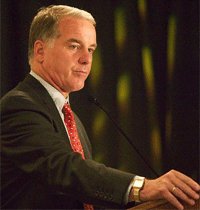 AlterNet thinks Howard Dean "is in a position to make his party more newsworthy and potentially more dangerous than it has been in decades":
-
What's genuinely exciting about the Dean chairmanship is the prospect that the party might come to mirror its new chief's enthusiasm for bold stances and strategies. Dean's best applause line in the race for DNC chair was, "We cannot win by being Republican-lite. We've tried it; it does not work." For all the important talk of rebuilding state parties and using new technologies, what matters most about Dean's election as DNC chair is his recognition that Democrats have to be serious about holding out to Americans the twin promises of reform and progress, and that they are not going to do that by tinkering with the status quo. "We just can't let the Republicans define the debate anymore. We have to be the party of ideas," Randy Roy says from Topeka. "Dean understands that we have to be the party that shakes things up."
Frankly, I agreed with the Dems on the other side that offer advice of a different sort - to embrace the faith-oriented arguments of the evangelicals on the right, but with a more moderate stance that can sell better to Middle America. After all, there are really only two issues in the moral-values argument - gay marriage and abortion. Hilary Clinton has already started inching her way toward the middle... and if anybody thinks Dean can get the rest of the party behind it, the DNC might be sowing the seeds of its own destruction.
Meanwhile, an unlikely advisor has emerged for "disconsolate" Democrats everywhere - Pat Buchanan:
-
A word of counsel to the disconsolate: Suck it up. It is not all that bad. The Right spent years in deserts more barren than thee have ever known. When this writer went to work for Richard Nixon in 1965, Republicans had lost seven of nine presidential elections, held Congress for but four of the previous 35 years and had carried 38 percent of the presidential vote – in a two-man race.
Goldwater had lost 44 states. A massacre had ensued on the Hill, with the GOP ranks reduced to 140 House seats and 38 senators. Nixon was a two-time loser who had, all assumed, committed hara-kiri in his 1962 "last press conference," where he had rounded on the jackal pack that had bedeviled him since the Alger Hiss case. "Think of all the fun you'll be missing," Nixon railed. "You won't have Dick Nixon to kick around anymore."
In 1966, the dark night was suddenly over and the sun came out. The GOP picked up 47 House seats and six senators, and Nixon would go on to lead the party into an era where Republicans would win the presidency five times in six elections, capture both houses of Congress in 1994 and become America's party.
Instead of bewailing their fate, Democrats should study how the Nixon-Reagan new majority displaced FDR's New Deal coalition.
A prerequisite is patience. The conservative case against the Liberal Establishment – its guns-and-butter budgets, its capitulation to urban rioters and campus radicals, its no-win war in Vietnam – had been compelling. But, in 1964, there had not been time enough for Middle America to absorb the consequences of 1960s liberalism.
By 1968, however, the chickens had come home to roost and the Democratic vote collapsed to 43 percent. Nixon and George Wallace had carried 57 percent. How to craft a new majority became clear. Find the issues and employ the rhetoric to sever Wallace-Daley-Rizzo Democrats from the party, and solder them to the Republican base.
To displace a majority party, you must drive wedges through its coalition. This happened to Bush I, when NAFTA nemesis and deficit-hawk Ross Perot won 19 percent in 1992.
Why should Democrats drop the despondency and start to think? First, because Bush won a second term by nothing like the 49-state landslides of Nixon or Reagan – Bush got 31 states. And though he had led America to victory in two wars, a turnaround of 60,000 votes in Ohio would have made him the first president ever rejected in wartime, and he would have lost to an uncharismatic senator from Massachusetts with a voting record to the left of Teddy Kennedy's.
Second, the fruits of the Bush policies – the budget deficits, the falling dollar, the loss of manufacturing jobs, the torpid rise in real incomes, the invasion from Mexico, the Iraq war – have only just begun to sink in with the electorate.
Below the surface serenity of the GOP majority, the tectonic plates could suddenly shift. Like Democrats in '68, Republicans are divided – over abortion, gay rights, the Religious Right, affirmative action, immigration, Big Government, trade, Iraq. They are united only on the proposition that it is best that they stay in power and the Democrats stay out.
But the dilemma Bush presents Democrats is not easy to solve. As a Big Government man, who uses Reaganite rhetoric to mask Rockefeller policies, Bush has left Democrats little running room. With his Great Society knock-offs like No Child Left Behind, faith-based pork, prescription drug benefits for seniors, "affirmative access," more foreign aid and a Wilsonian vision "to end tyranny on earth," Bush has moved the GOP center-left, crowding the Democrats out.
Moreover, the Democrats are too far left on the cultural-moral issues – "God, gays and guns" – to exploit Bush's weakness on the libertarian and populist Right.
What do Democrats need to do? First, be patient. This is Bush's turn at bat, just as 1965-66 was LBJ's turn. Their innings will come. But before they come, Democrats should have answers to the great problems Bush has failed to solve.
Suck it up... it's not so bad... we'll see about that, if Dean has another "I have a scream" moment in him, that future chance at patient change may dry up faster than anyone imagined.
On the bright side, Dean wasn't really a liberal governor in Vermont in the first place and at least he's got the makings of a strategy (i.e., recognition of the need for one) to make Democrats more competitive in closely divided counties, most of which could go either way - Red or Blue - and which, if successful and Bush languishes through his second term, stands a better than average chance of putting a Democrat back in the White House in 2008.
- Arik
February 22, 2005
California Wants to Do Your Taxes: An Idea Intuit and H&R Block Just Hate

The LA Times discusses the proposal that has more than a few business interests a little worried - especially those in the tax preparation business:
-
California's tax agency is moving forward with a revolutionary — some say disturbing — concept: having the government do your taxes for you.
Instead of getting blank forms in the mail this month, a small group of taxpayers selected for a pilot program will receive a tax return that's already filled out. All they'll need to do is sign it, enclose a check if they owe anything, and send it back to the state.
The Ready Return project puts the state in uncharted territory — and in the middle of the national debate over how to improve the way taxes are collected.
Experts are watching with great interest to see whether California is able to implement a system that is in effect in dozens of other countries but nowhere in the United States. It could ultimately be offered to more than 3 million Californians with uncomplicated returns.
"I think it is the most important tax move the state has ever made," said Joseph Bankman, a professor of tax law at Stanford University who is helping the state run the program. "It would make filing a tax return like paying a Visa bill."
Ready Return has sparked an outcry among conservatives and business groups across the country. Opponents call it Big Brother at its worst. They say they want a simpler tax system but don't want the government doing their taxes for them. They worry that if the program takes off here, it could spread nationwide.
Companies in the tax preparation business, such as TurboTax maker Intuit, H&R Block and FileYourTaxes.Com, say the state is overreaching. They have launched an aggressive lobbying campaign to stop the project. Letters denouncing the program as a cynical attempt to inflate people's tax bills are rolling in from as far away as Washington, D.C.
And nearly half the members of the state Assembly have signed a letter to the Franchise Tax Board, California's version of the IRS, saying the initiative — which was launched without lawmakers' consent — is "a dangerous precedent, leading us down a very slippery slope."
The legislators say they have concerns about privacy, taxpayer confusion and the potential for abuse.
"The proposal could have long-term negative effects on California businesses and families, yet is being rushed through with little debate," national anti-tax advocate Grover Norquist said in a letter to Gov. Arnold Schwarzenegger. The activist said the initiative "takes away one of the key taxpayer rights — the right to make financial decisions to reduce one's tax burden."
The program is a pet project of Controller Steve Westly, who heads the Franchise Tax Board. A former EBay executive, he has made it his mission to use technology to render the state tax system easier for Californians to navigate.
With Ready Return, he is picking up on an idea that has long been promoted by tax experts at the federal level but never got off the ground at the Internal Revenue Service, which lacks the technology for it. Currently, the IRS will calculate taxes owed for people whose returns are uncomplicated, but only after they complete most of the tax form.
"We are trying to reform the way we do business," Westly said. "California is the center for technology in the world. It is only natural we lead in this area."
Congress passed a bill in 1998 calling for taxpayers without complicated deductions to be able to avoid filing returns by 2007. After that time, the government would automatically send those people refunds or tax bills. Supporters of the idea note that many countries, including Britain, Germany and Japan, already have such systems in place.
But the initiative stalled in Washington. Experts say it is unlikely that the IRS will put the plan in place within two years — if ever. That leaves California far out in front.
Ready Return is aimed at 50,000 residents with simple returns: single, one job, no dependents, and no tax credits or itemized deductions such as the interest on a home mortgage. Their tax calculation is based on what was withheld by their employer. The reasoning is: The state already has that information; why not fill in the blanks?
Taxpayers who receive the filled-in return are free to toss it in the trash and go ahead doing their taxes the old way. But proponents doubt that many recipients, presented with such a simple procedure, will instead choose to grapple with complicated schedules and tables, and the need to add lines 23 through 34A and subtract line 35 from line 22.
"This is a way to simplify taxes," said William Gale, a policy analyst at the Brookings Institution who has long advocated a return-free federal tax system for those with the simplest tax situations. "I would think people would welcome this."
Several businesses, anti-tax activists and lawmakers do not.
"People who are sent these bills may be put at an unfair advantage," Intuit spokeswoman Julie Miller said. "They may be intimidated and be unlikely to challenge what the government says they owe."
Frankly, it sounds like a good case for having software to check that out... which is already part of the value-prop for tax-prep applications. However, I suspect most of the firms in this business are a little more than worried that, if the government suddenly takes all the headache out of doing taxes, there'll be very little need to apply technology - or an accountant - to the matter on your own.
- Arik
February 21, 2005
USA Next vs. AARP: Competitive Battle Lines Drawn on Social Security Reform

-
Taking its cues from the success of last year's Swift boat veterans' campaign in the presidential race, a conservative lobbying organization has hired some of the same consultants to orchestrate attacks on one of President Bush's toughest opponents in the battle to overhaul Social Security.
The lobbying group, USA Next, which has poured millions of dollars into Republican policy battles, now says it plans to spend as much as $10 million on commercials and other tactics assailing AARP, the powerhouse lobby opposing the private investment accounts at the center of Mr. Bush's plan.
"They are the boulder in the middle of the highway to personal savings accounts," said Charlie Jarvis, president of USA Next and former deputy under secretary of the interior in the Reagan and first Bush administrations. "We will be the dynamite that removes them."
Though it is not clear how much money USA Next has in hand for the campaign - Mr. Jarvis will not say, and the group, which claims 1.5 million members, does not have to disclose its donors - officials say that the group's annual budget was more than $28 million last year. The group, a membership organization with no age requirements for joining, has also spent millions in recent years vigorously supporting Bush proposals on tax cuts, energy and the Medicare prescription drug plan.
So far, the groups dueling over Social Security have been relatively tame, but the plans by USA Next foreshadow what could be a steep escalation in the war to sway public opinion and members of Congress in the days ahead.
Already, AARP is holding dozens of forums on the issue, has sent mailings to its 35 million members and has spent roughly $5 million on print advertisements in major newspapers opposing private accounts. "If we feel like gambling," some advertisements said, "we'll play the slots."
AARP is spending another $5 million on a new print advertising campaign beginning this week.
Later in the piece, Jarvis makes his objectives clear - attracting one million members from AARP, by presenting itself as a conservative, free-market alternative to what USA Next surveys show are the more than 37 percent of AARP members identifying as Republicans. '"We are going to take them on in hand-to-hand combat," said Mr. Jarvis, who is biting in his remarks about AARP, calling the group "stodgy, overweight, bureaucratic and out of touch."'
Regardless, AARP has a powerful new competitor to deal with in USA Next; one that, according to Peter Ferrara's 10 February article in National Review, senior fellow at the Institute for Policy Innovation and director of the Social Security Project for the Free Enterprise Fund, "offers members all the benefits that AARP does. So unless you support high taxes and big government, as AARP does on every issue, there is no longer reason to belong to AARP."
- Arik
February 20, 2005
Do We Need a NID?: Negroponte Nominated for National Intelligence Director
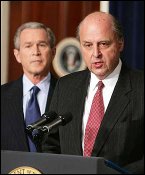 President Bush thinks he's found his man for the job of National Intelligence Director, last week nominating ambassador John Negroponte for what will surely be a challenging job with limited authority - the LA Times sums up:
-
As U.S. ambassador to Iraq for the last eight months, John D. Negroponte deftly maneuvered between warring factions, deadly ambushes and dubious allies in a brutal combat zone.
Negroponte will need those skills and more for the bureaucratic wars he will face in Washington if he is confirmed as the first director of national intelligence.
President Bush's nomination of Negroponte on Thursday ended two months of speculation about who would finally agree to oversee America's demoralized spy services.
But the surprise choice of a veteran diplomat who speaks five languages — but has no known experience working in the shadowy world of espionage — also refueled concerns that the high-profile post entailed vast responsibilities but limited authority and that it may do little to increase the nation's security.
Rep. Jane Harman (D-Venice), the top Democrat on the House Intelligence Committee, said she warned Negroponte in a telephone conversation Thursday that he would be leaving the relative safety of the heavily guarded embassy compound in Baghdad for the uncertainties of Washington politics.
"I said, 'You're leaving the Green Zone for the red zone,' " said Harman, who was a strong proponent of the intelligence reform bill that created the job.
Negroponte supporters argued that his access to the president — and his diplomatic skill in getting incompatible agencies to work together — could outweigh his weak intelligence background.
But a Bush administration official who has worked with the easygoing diplomat described the early stages of the amorphous job as "impossible: no office, no staff, no budget."
"John doesn't have a political bone in his body," said the official, who spoke on condition of anonymity. "He's never worked the political angles. But in this kind of job, he'll need political backing. This isn't just diplomacy anymore."
The official added: "Where's his political backing? In Congress? No. From the Republican Party? No. He's not in the Cabinet. Are Cabinet officers really going to report to him on anything?"
The challenge is immense. For starters, Negroponte would have to balance two often-competing roles. He would be the president's chief intelligence advisor and the leader of a sprawling spying community that is required by law to remain independent of politics.
Moreover, Negroponte must assert control over the disparate leaderships, budgets and priorities of the nation's 15 often-fractious intelligence agencies to force their entrenched bureaucracies — and an estimated 200,000 employees — to work together to prevent attacks.
Once in office, Negroponte would create his job from scratch. The law requires a report on the rewired intelligence system within a year.
He would be expected to prepare a consolidated intelligence budget, overhaul security and technology policies, coordinate priorities for strategic planning and covert operations, monitor agency performance, report to Congress, advise the president and interact with foreign governments.
He would have to mediate a growing turf battle between the CIA and the Pentagon, where Defense Secretary Donald H. Rumsfeld has expanded foreign intelligence-gathering activities by the military, including the use of clandestine teams, that were traditionally undertaken by the CIA.
More important, Negroponte must work with Rumsfeld to decide how and where the estimated $40-billion annual intelligence budget is spent.
About 80% of the money is hidden within the Pentagon's budget, and the two officials must share control of Pentagon-based intelligence agencies. It's far from clear how that would work.
Also unclear is how much power Porter J. Goss, the current CIA chief, must relinquish.
Ever since the CIA was created in 1947, the CIA boss also served as director of central intelligence and was nominally in charge of all other spy services. Although he did not occupy a Cabinet position, he reported to the president. In the future, he would report to Negroponte.
Goss, who was initially considered a strong candidate to become the first national director, said Thursday that he welcomed Negroponte's nomination as a "critical step" to "create even better-coordinated working relationships and communications" between intelligence agencies.
The style Negroponte would bring to thorny problems in Washington has been apparent to many who deal with him in Iraq.
Negroponte's nomination surprised staffers at the U.S. Embassy in Baghdad, one of the largest U.S. missions in the world, with 3,500 employees — many of them security personnel, a testament to the danger of the posting.
Unlike his predecessor in Iraq, civilian administrator L. Paul Bremer III, Negroponte has drawn high marks for his competence and low-key style. His tenure, from his arrival in June as sovereignty was returned to the Iraqis to the United Nations-sanctioned election last month, is viewed far more favorably than Bremer's, despite the widening insurgency.
Frankly, the current mission charter as illustrated by the 911 Commission that created the position is not one for a bureaucrat, but rather for a sort of "meta-analyst" that can bring together all of the resources available to the NID and connect the dots to see the larger trends in the challenge-space.
Coincidentally, I read AlterNet's interview with Dame Stella Rimington, the first woman to head the British intelligence agency MI5, offering some interesting advice for whomever ultimately assumes the new role:
-
A diplomat's wife in New Delhi, bored with thrift sales and amateur dramatics, Rimington wandered into MI5 as a part-time clerk typist and found herself in the middle of the Cold War. When she joined the secret service, women could only hope to be assistants. When she later became the first woman to head MI5 and the first one whose name was publicly announced, her friends and neighbors were stunned.
"All of a sudden the neighbors realized this quiet lady who lived on their street might present a bit of risk, " she laughs. "I remember one neighbor telling me I wish you wouldn't go to work just when I am taking my children to school."
The danger at the time for her and her neighbors came mostly from the threat of IRA attacks. But in the middle of the Cold War the first order of business was espionage. The advantage her generation had, says Rimington, was they knew where their enemy lived. "We knew where the KGB headquarters were, we knew what they were trying to do. Now who knows where the (terrorist) headquarters are."
It's an extremely tough challenge for today's intelligence officers. "The best intelligence comes from human beings, sources deep in the heart of organizations," says Rimington. Today, intelligence services seem to be fishing in the dark for reliable sources, ending up with embarrassing episodes like the faulty warning about a ring of Chinese nationals smuggling a dirty bomb into Massachusetts.
"I was surprised that was made public seemingly before it had been fully investigated," says Rimington. She fears that hasty warnings can backfire, making people paranoid with constant orange alerts.
Ironically, such misconceptions on questions of authority are exactly why so many Competitive Intelligence officers ultimately fail to understand the true nature of their roles... Their real job isn't to be an adminstrator or even really an astute advisor to managerial decision-makers, but to increase their organization's capability for pattern recognition of threats and opportunities as they develop, in real-time and on-demand.
Somehow, I think Bush gets it even if many others don't - "John will make sure that those whose duty it is to defend America have the information we need to make the right decisions," Bush said at the White House. "We're going to stop the terrorists before they strike."
- Arik
February 19, 2005
ChoicePoint: the Problem with Selling Personal Information... it's a Massive Homeland Security Vulnerability
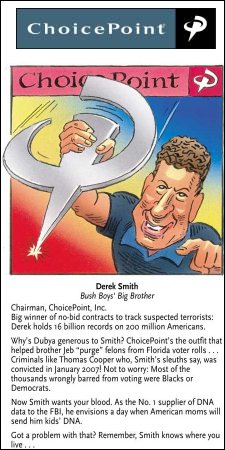 Nice going... ChoicePoint, the Georgia company that boasts it has the deepest database in the nation, said that it had alerted 35,000 Californians that they were vulnerable, as required by state law, but balked at notifying a far larger number of potential victims outside California... about 145,000 in all! Last fall, hackers apparently used stolen identities to create businesses that then opened some 50 ChoicePoint accounts and used their newly-minted access to the world's largest personal information stockpile to steal the identities of at least a few of the people involved.
Do you think maybe these guys have a little too much power here?
Daniel Engber had some advice in Slate.com for those who believe they've been among the unlucky profiles ripped off as a result of ChoicePoint's security lapse:
-
Once your personal information has been stolen, there's no good way to get it back. You just hope the thief will move on to easier targets who haven't done the same paperwork you have. Changing your Social Security number is possible, but very difficult and probably not too helpful. The Social Security Administration "cannot guarantee that a new number will solve your problem." Indeed, you might lose access to your own records, or run into problems for having no credit history at all.
But, the final question we have to ask ourselves - is all this transparency really worth it? Regardless, don't pay for another credit report again - get it free instead, and write your senators and representatives and ask for some regulation in this area. They'll need all the support they can get, when Derek Smith, ChoicePoint's chairman is so well-connected to the Bush administration... and benefited from new homeland security initiatives for doing background checks identifying suspected terrorism suspects.
The most ironic part of that whole situation is that, with all those stolen identities, if terrorists laid their hands on the data, they'd be able to create new IDs that are essentially indistinguishable from anything a real issuing agency might produce - because the phony IDs would contain real, authenticated identity data. In my view, this is a massive vulnerability to homeland security... why ID people at airports anymore, when the real IDs could be counterfeit, right?
For that reason alone, I would argue, ChoicePoint's very existence, and that of the other mega data-warehouses of personal information, is an unacceptable risk to national security and therefore should be heavily regulated from the viewpoint of the damage they could cause.
How ya' like them apples?
Regardless of the homeland security angle, an ounce of prevention might've prevented all the cure that'll be required to put a stop to the fastest-growing crime in the country, having victimized almost 10 million Americans last year alone.
- Arik
February 18, 2005
China Floods the Zone: FBI Details the New Economic Espionage Threat

FBI Assistant Director for Counter-Intelligence David Szady also named Russia, Iran, Cuba and North Korea among countries involved in economic and other espionage against the U.S. "There are 150,000 students from China. Some of those are sent here to work their way up into the corporations," Szady was quoted by CNN as saying. There are about 300,000 Chinese visitors annually, and 15,000 Chinese delegations touring the United States every year, 3,500 of them in the New York area alone, he claimed. CNN said he estimated that about 3,000 false-front Chinese companies operate in the United States, and urged private-sector employers to "partner up" with FBI agents to help protect national security. Meanwhile, Time Magazine did a short piece on how high-tech spying his home, right here in Wisconsin, as the FBI nabbed a pair of naturalized Chinese immigrants working for their former government:
-
Ning Wen and his wife were arrested last fall at their home office in Manitowoc, Wis., for allegedly sending their native China $500,000 worth of computer parts that could enhance missile systems. As these naturalized citizens await trial, similar episodes in Mount Pleasant, N.J., and Palo Alto, Calif., point only to the tip of the iceberg, according to FBI officials keeping tabs on more than 3,000 companies in the U.S. suspected of collecting information for China. A hotbed of activity is Silicon Valley, where the number of Chinese espionage cases handled by the bureau increases 20% to 30% annually. Says a senior FBI official: "China is trying to develop a military that can compete with the U.S., and they are willing to steal to get [it]."
But instead of assigning one well-trained agent to pursue a target, "the Chinese are very good at putting a lot of people on just a little piece and getting a massive amount of stuff home," says a U.S. intelligence official. The number of Chinese snoops is staggering, if only because average civilians are enlisted in the effort. FBI officials say state security agents in China debrief many visitors to the U.S. before and after their trips, asking what they saw and sometimes telling them what to get.
This "flooding the zone" MO for getting LOTS of people working an intel angle is characteristic of Chinese economic spying, especially in Silicon Valley:
-
Suspected espionage cases have been reported from New Jersey on the east coast to California in the west, the weekly magazine reported. The FBI is watching more than 3,000 companies in the United States suspected of collecting information for China, Time magazine reported.
"A hotbed of activity is Silicon Valley (California), where the number of Chinese espionage cases handled by the bureau increases 20 percent to 30 percent annually," Time said, referring to the state's corridor of high-tech companies.
"China is trying to develop a military that can compete with the US, and they are willing to steal to get (it)," a senior Federal Bureau of Investigation official was quoted as saying.
A US intelligence official said: "The Chinese are very good at putting a lot of people on just a little piece and getting a massive amount of stuff home."
Time called the number of Chinese spies "staggering, if only because average civilians are enlisted in the effort."
Chinese nationals are debriefed by state security agents in China before and after their trips to the United States. They are asked what they saw and sometimes told what to get, the magazine said.
A couple of Chinese origin was arrested last year in Wisconsin for allegedly sending to China 500,000 dollars worth of computer parts that could enhance missile systems, Time said. The couple, who are naturalized Americans, are awaiting trial.
The FBI has added hundreds of counter-intelligence agents and put at least one in every US Energy Department research facility, Time said.
It has also begun cooperation initiatives with corporations and considers universities as a soft spot, since there are some 150,000 Chinese studying in the United States, according to the magazine.
The FBI relies heavily on Chinese informants to sort spies from the thousands of Chinese who travel to the United States for work, Time said.
Could this lead to a change in U.S. intelligence policy, where America could follow its foreign rivals in deploying national intelligence resources in a commercial capacity?
-
"The economic viability of the United States we now look at as a counterintelligence problem," he said.
"We now see almost all of the adversaries, the Chinese being a classic example, of using students, delegations, researchers, visitors ... and false-front companies," Szady said.
Another senior FBI official, who spoke anonymously, was more blunt.
"The Chinese are stealing us blind," he said. "The 10-year technological advantage we had is vanishing."
The FBI has been successful, he said, in making some arrests.
"We took down some cases in Milwaukee, Trenton, New Jersey, and Palo Alto. These were false-front companies that were stealing technologies for the Chinese. Every person arrested was a student. They studied here, got their PhD here, and went to work for places like Lockheed, Raytheon, and Northrop."
Szady said spies do not limit espionage activities to large cities, and the Chinese presence is pervasive. "Even as we increase our numbers of agents, we can't possibly totally stop it," he said.
"If you have a little national asset, whatever it is ... they want that little thing that you produce," he said. "And they need it to make their missile fly straight or so they can compete in electronic warfare, and you have that key component."
- Arik
February 17, 2005
Bettman's Real Legacy: The End of Hockey As We Know It
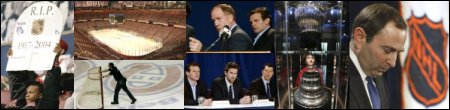
-
NHL commissioner Gary Bettman spoke like an accountant and looked like a mortician — or maybe it was the other way around — as he directed the final services Wednesday in New York.
He trotted out the numbers that never added up, the plans for salary caps and fixed payrolls that didn't fly, the negotiations that kept breaking down.
With a touch of sincerity, though no emotion, he apologized to fans, saying they deserved better.
"This is a sad, regrettable day that all of us wish could have been avoided," Bettman said.
Eh?
This was a day that absolutely could have been avoided if there had been an ounce of trust among the players toward the owners and their supposedly bloody red accounting books.
It was a day that could have been avoided if the players didn't believe the owners were out to bust the union, not just win a better deal.
It was a day that could have been avoided if both sides had more love for the game than they had for their money. Ah, but we all know it's just a business, cold as a corpse.
Bettman serves at the whim of the NHL Board of Governors, and it's time for that board to look elsewhere for leadership.
He guided the league to unprecedented, unnecessary and unwise expansion. Under Bettman, the NHL made more money and lost more money than any time in its history. He aspired to greatness, took a shot at rapid growth, and wound up flopping.
When a team is losing, the coach is the first to be fired. When the league loses as badly as the NHL just did, the commissioner should be patted on the back and kicked in the butt.
Bettman was a dreamer and schemer, a former NBA marketing whiz who never understood that hockey, for all its history and thrills, didn't have the broad passionate U.S. fan base that could justify his vision of manifest destiny.
Hockey is not McDonald's or Starbucks. It didn't need to supersize itself and post franchises all over the map.
Without rights fees from television, like the ones in the other pro team sports, it couldn't afford to let average salaries skyrocket to $1.8 million last year. NFL players, by comparison, average $1.3 million, and that's with the fattest TV deals in sports.
Figuratively and financially, NHL players are not in the same league with NBA players (averaging $4.9 million) and baseball players ($2.5 million).
The NHL, under Bettman, was run almost like a giant Ponzi scheme, nothing holding it up but hopes and promises and the vague idea that a TV deal would one day bail it out.
Maybe it would have gone on growing if the new generation of owners didn't keep throwing money at the players, and if the players themselves didn't keep undermining the sport at every opportunity.
It wasn't just the crazy stuff that made headlines and police blotters. It was also the way the players, in general, thought they were bigger than their great little game, indestructible and irreplaceable.
Where are they now? Playing in Russia and Sweden and small arenas wherever they can find a cheap skate.
They lost one season and could easily lose another, if the league survives at all.
For young players trying to make their names, lost seasons are serious. For older players trying to keep skating in their 40s, such as Mark Messier, Brett Hull, Steve Yzerman, Ron Francis, Dave Andreychuk and Chris Chelios, there may never be another season.
The player half of Mario Lemieux, 39, wants to skate again, if and when the league resumes, but the owner half didn't want to keep taking losses.
There are losers in every direction from this NHL debacle. Publicly owned arenas, such as those in St. Louis, Detroit and Pittsburgh, will lose millions of dollars in tax revenues. Workers in those arenas will lose income.
Money aside, hockey's die-hard fans are furious that all this had to happen. They are a diminishing cult committed to the game and they hate seeing their beloved sport shrink into insignificance.
For the relatively piddling difference of about $6.5 million per team in the final bargaining positions — the salary of one top-tier player — the two sides couldn't come together and everyone lost.
In the frenzied final days of haggling, Bettman had a chance to exert leadership, to force both sides to yield a tad more. Instead, he stiffened up, stood firm with the owners, and pronounced the season dead.
If you're curious about how this all happened, you have the benefit of AP Sports Columnist Jim Litke's historical breakdown of Bettman's reign:
-
Bettman was not a "hockey guy" — his first real exposure came during pickup games while he was an undergraduate studying labor relations at Cornell in the 1970s. But he was a marketing whiz, and he had a plan.
Viewed strictly from the supply side, that plan was a rousing success. The number of franchises increased from 21 to 30, revenues quadrupled from $400 million to more than $2 billion, and players' salaries more than tripled from $558,000 in Bettman's first season to $1.8 million in the last one.
But all that expansion came at a considerable cost. Bettman locked out the players and wound up canceling almost half the 1994-95 season in a failed bid to get a salary cap and luxury tax. Then, he passed on a chance to opt out of the agreement two more times — in 1995 and 1997 — rather than endanger the league's expansion plans.
New arenas were going up, the Nagano Olympics offered worldwide exposure and multimillion-dollar expansion fees were lining the owners' pockets. It was easy to get swept up in the notion that once the NHL blanketed the U.S. map from coast to coast and locked up a big TV deal, enough money would flow in to cover up all the mistakes.
Not being a "hockey guy," though, Bettman made a fatal miscalculation. He grew the game recklessly and watched his owners lavish profligate contracts on players, assuming that demand would eventually catch up with a suddenly bountiful supply. The opposite turned out to be true.
The NHL landed one big TV contract with ABC/ESPN in 1999 — a five-year, $600-million deal — but ratings were minuscule. That's why the two-year deal with NBC signed in 2004 doesn't include rights fees, only revenue sharing. The flow of cash has slowed to a trickle.
The knocks against hockey when Bettman took over were its fascination with fighting, its limited regional appeal and blue-collar roots, even the fact that the puck is hard to follow on the small screen.
Now, fisticuffs are down. But gone, too, are a handful of franchises in hockey-mad Canada and the wide-open style of play that made Wayne Gretzky a household name. They've been replaced by Sun Belt towns with no hockey roots and little developing affection for the plodding, clutch-and-grab version of the game being peddled.
During the weekend, when Bettman briefly lifted a ban on owners speaking out, one of his staunchest supporters dared wonder whether the rush to expand had come at the expense of the product.
"We might be better off to stop chasing growth and revenue and play just high-quality hockey and let its popularity take care of itself," Peter Karmanos Jr., owner of the Carolina Hurricanes (news), told the New York Times.
"We're not a public corporation," he added. "We don't have to have compounded annual growth."
They won't have to worry about that, at least not for the foreseeable future. No matter when, or in what form the NHL returns, it won't find people clamoring to get back under the tent.
"You hear how certain people believe that the hardcore fan will definitely return, that the damage isn't irreparable," Flyers captain Keith Primeau said in Philadelphia.
"I think that's a huge miscalculation or judgment in error of who and what your fan base is. That, I think, is going to alarm a lot of people when the doors are reopened."
In the words of Rod Brind'Amour, "The game's just suffered an absolute blow it'll never recover from," the Carolina Hurricanes forward said. "They're totally underestimating the damage that's being done." We can only guess what the future might hold:
-
Without an agreement, there can be no June draft. The sport's heralded next big thing, Canadian phenom Sidney Crosby, won't pull on his first NHL sweater anytime soon.
Then there is the parade of aging stars — Mario Lemieux (39), Mark Messier (44), Steve Yzerman (39) Brett Hull (40), Ron Francis (41), Dave Andreychuk (41) and Chris Chelios (43) — whose playing days could be ending on someone else's terms.
"This is a tragedy for the players," Bettman said. "Their careers are short and this is money and opportunity they'll never get back," Bettman said.
Despite being the NHL's best-known star, there was never a chance that Pittsburgh's Lemieux, the first owner-player in modern American pro sports history, would side with the players.
"A few years ago, I thought the owners were making a lot of money and were hiding some under the table, but then I got on this side and saw the losses this league was accumulating," he said Wednesday.
Hockey was already a distant fourth on the popularity scale among the nation's major league sports. The NHL lost the first season of its two-year broadcasting agreement with NBC that was supposed to begin this season, a revenue-sharing deal in which the network is not even paying rights fees.
Taking a year off, or more, will only push the league further off the radar screen.
"The scary part now for hockey is do the fans come back? We're not baseball, we're not the national pastime," Nashville forward Jim McKenzie said.
Between shifts of a pickup game at the Denver rink where the Avalanche used to practice, fan Don Cameron called the cancellation "a shame."
"When they come back, it's not going to be as easy to pay for a $90 season ticket," he said.
Not to mention how difficult it will be for all the ushers, trainers, officials, Zamboni drivers and businesses near arenas that will continue to be affected.
"We profoundly regret the suffering this has caused our fans, our business partners and the thousands of people who depend on our industry for their livelihoods," Bettman said.
"If you want to know how I feel, I'll summarize it in one word — terrible," he said.
Bettman said the sides would keep working toward an agreement.
"We're planning to have hockey next season," he said.
Goodenow stressed that the players had already given a lot of ground. "Every offer by the players moved in the owners' direction," he said.
"Keep one thing perfectly clear," Goodenow said. "The players never asked for more money — they just asked for a marketplace."
Not being a hockey fan myself, I think this is more like watching a trainwreck than anything for most sports fans. We just can't look away when two groups are so determined to get their way, they'll lay waste an entire sport if they can't get it.
One thing's for sure, whether there's a season next year or not... this is end of the NHL as we know it.
- Arik
February 15, 2005
Ben Stein's Last Column
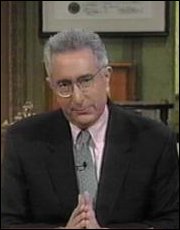 Ben Stein's last column - economist, novelist and comedian - Ben Stein's final column scorns the materialism and hero-worship that is Hollywood and suggests a higher calling:
-
I came to realize that life lived to help others is the only one that matters. This is my highest and best use as a human. I can put it another way. Years ago, I realized I could never be as great an actor as Olivier or as good a comic as Steve Martin... or Martin Mull or Fred Willard--or as good an economist as Samuelson or Friedman or as good a writer as Fitzgerald. Or even remotely close to any of them.
But I could be a devoted father to my son, husband to my wife and, above all, a good son to the parents who had done so much for me. This came to be my main task in life. I did it moderately well with my son, pretty well with my wife and well indeed with my parents (with my sister's help). I cared for and paid attention to them in their declining years. I stayed with my father as he got sick, went into extremis and then into a coma and then entered immortality with my sister and me reading him the Psalms.
This was the only point at which my life touched the lives of the soldiers in Iraq or the firefighters in New York. I came to realize that life lived to help others is the only one that matters and that it is my duty, in return for the lavish life God has devolved upon me, to help others He has placed in my path. This is my highest and best use as a human.
Faith is not believing that God can. It is knowing that God will.
Ah, if only...
- Arik
February 14, 2005
Verizon + MCI; Jilted Qwest Left at the Altar

-
Verizon's purchase of MCI earlier this week will strengthen its business, provide access to lucrative business and government contracts, and, most importantly, prevent rivals from snapping up the Ashburn, Va. company.
In a coup likely to make rivals Qwest Communications International Ltd. and BellSouth Corp. sweat, Verizon Communications Inc. agreed to buy MCI Inc. for $6.7 billion in cash, stock and dividends. The merger follows two telecommunications mega-mergers last year: SBC Communications' acquisition of AT&T Corp. and Sprint Corp.'s purchase of Nextel Communications Inc.
Although MCI had its share of suitors—both Qwest and BellSouth were pursuing the company as well—company executives chose to sell the company to Verizon, despite the fact that Qwest offered a larger incentive package.
Verizon's financial stability as well as synergies in network infrastructure and customer base made the choice of Verizon a sound one, said Taher Bouzayen, vice president and long-distance sector analyst at Atlantic-ACM, a Boston-based research firm.
"Financially, although Verizon has some large debt, it has the financial strength to pay off that debt and a framework that's large enough to absorb a company like MCI, which came out of bankruptcy with very little debt," he said.
Verizon may have pushed so hard to buy MCI simply because others wanted it, noted Sean Hackett, senior analyst at Yankee Group of Boston, Mass. "It was a defensive move," he said. "It was about taking MCI out of play so somebody else couldn't buy it."
The move also allows Verizon to exploit its deep presence in the Northeast and strong branding by cross-selling many of MCI's services. "It helps to be able to take a brand that has been beaten up as much as MCI's has and leverage that brand equity," Hackett said.
But the reason Verizon was so intent on buying MCI may have been for its lucrative business and government contracts—an area where former RBOC Verizon simply didn't have much of a foothold.
Access to business contracts, in fact, also was one of the main reasons why SBC acquired AT&T, Bouzayen noted. "They are all hungry for business customers, because that's where most of the profit is. Those are the accounts where you build your margin."
Now that Verizon has a stronger foothold in the business arena, it would do well to exploit the combined technological strength of the two companies to provide better prices and service for its business customers, Bouzayen said.
"MCI's strength is on the long haul portion of the network, while Verizon has the last mile. Now they can offer end-to-end services at relatively good prices, once they work out some interoperability issues caused by merging two types of networks," he said. Bouzayen predicts that the integration will happen quickly.
In the end, it may be the business customers who really win. Not only will businesses experience less competition in the telecommunications marketplace, but they should expect to see price stabilization, Hackett predicted.
Although experts believe the move was a good one, the road may be less than smooth as consolidation gets underway. In addition to consolidating a host of business processes, Verizon will face the mammoth challenge of integrating MCI's confusing billing system with Verizon's more stable one.
MCI's billing system is a cobbled-together patchwork system that combines bits and pieces of the nearly 50 companies it has acquired over time. Four or five years after an acquisition, it's not unusual for a customer to receive multiple bills from companies owned by MCI instead of one integrated bill, Bouzayen noted.
"Verizon has a great billing platform that is extremely well managed, and if it succeeds in incorporating and integrating MCI's billing system into its platform, it will be a very successful company, but it will take some time," he said.
Despite challenges, analysts expect the combined company to succeed and prosper. Atlantic-ACM predicts that the combined company will generate $18.6 billion in 2005 for long-distance services alone, a number that will grow to $21.6 billion in 2009.
The unanswered question, of course, is what happens to erstwhile suitors Qwest and BellSouth, as well as to Sprint's wireline business.
"It really leaves them hanging. In those businesses that require scale to succeed, such as traditional voice/data-type transport businesses, BellSouth and Qwest will have to decide whether they want to compete," Hackett said.
Given enough time, the market may experience further consolidation, ending up with three or four mega-companies competing with each other, Bouzayen said.
"I could see the wireline business of Sprint combined with Qwest, or perhaps companies like Level 3 or Global Crossing could come into the mix in some fashion," he said. "Maybe we're really reversing the wheel and going back to a pre-1984 RBOC system. Only time will tell."
But watch out Verizon... MCI's a heartbreaker. Just ask Bernie Ebbers. And I still expect Qwest to sweeten their bid enough to either, get MCI and improve their balance sheet, or the worst case scenario is they force Verizon to pay more and take a hit competitively. In short, not a lot of risk in Notebaert moving forward with his offer.
Analysts found the whole deal a no-brainer for both MCI and Verizon and REALLY bad news for Qwest:
-
The deal to buy MCI at what amounts to $20.75 a share is a bargain for Verizon, but MCI accepted the terms because it sees Verizon as a stronger company than Qwest, said Jay Arnold, portfolio manager at Abacus Asset Management.
"I think [Verizon] stole the company," said Arnold of the MCI purchase. "It's a great deal for Verizon. The shareholders of MCI didn't get a great deal, but maybe the combined companies will be more powerful and the returns will offset that."
Arnold said that even though Qwest outbid Verizon by about a billion dollars, MCI made the right move. The reasoning behind MCI's decision is that Qwest carries considerable debt and is somewhat of "a junk-rated Baby Bell," said Arnold.
"MCI felt a Qwest deal would be largely a stock deal and if Qwest shareholders didn't like the deal, they would sell shares, weakening the overall value," he said.
Allan Tumolillo, COO of Probe Financial Associates, said a decision to sell to Qwest would have been a mistake.
"MCI merging with Qwest would have been the end of the whole thing," said Tumolillo. "[MCI President and CEO Michael] Capellas is a smart guy. He may not know telecom all that well, but you look at Qwest and its $17 billion in debt, and you see they are struggling. MCI doesn't need to go into a mess like that. The only purpose for MCI to talk to Qwest was to provoke Verizon and Bell South to take a look at them more seriously."
Without MCI, the future of Qwest is a major question mark, said Tumolillo. "I think Qwest is headed into oblivion," he said.
Fish or Cut Bait?
Although many believe Verizon would have preferred to wait before cutting a deal, or even offer a bid for Sprint instead, the company decided it needed to act once Qwest made its play for MCI. "This is the right deal at the right time," said Verizon Chairman and CEO Ivan Seidenberg. "It is a natural and logical extension of Verizon's strategy to transform our company to serve growth markets and offer broadband technologies."
Seidenberg said he and Capellas had been talking about a possible deal since late summer. He said the two companies match up well, and that he doesn't expect any other bidders. Maybe now that Carly's out at HP, Capellas thought he should strike while the iron was hot and force Verizon into making a move?
Whatever happens, if I were an MCI shareholder, I'd be trying to get that extra billion dollars somehow... can you say "class action lawsuit"?
- Arik
February 11, 2005
Omnicom's Ketchum Puts Spin on the Media for White House with Influencer Relationship Management

-
When the news of the Williams deal became public, Democratic members of Congress took a look at government contracts with PR firms, and the U.S. House Committee on Government Reform produced some quick but startling numbers. In a January report, the committee found that federal agencies spent more than $250 million on contracts with PR agencies between 2001 and 2004 – nearly twice as much as the $128 million that Clinton spent between 1997 and 2001.
“There used to be a time when our government would let the facts speak for themselves,” lamented Richard Durbin, a Democratic senator from Illinois, during one Congressional debate. “It apparently is the position of the Bush administration that the facts in and of themselves are not articulate.”
Two more questionable examples have cropped up since the Williams flap. Conservative columnists Maggie Gallagher, whose writing is distributed by Universal Press Syndicate (which also publishes the Dear Abby column and comic strips like Doonesbury, Calvin & Hobbes and Garfield) and Mike McManus (whose work appears in over 50 newspapers like the Birmingham News in Alabama) were exposed as having been on the payroll of the Department of Health and Human Services.
Both columnists agreed to work on behalf of the Bush Administration efforts to promote marriage.
While President George Bush officially denounced the practice of government agencies paying commentators, it is yet to be seen whether the scandal will lead to any lasting ethical change on the part of some in the PR industry, where the need to identify political and ideological allies is routine practice, or on the part of the government, which has been historically concerned with the need to flash “positive” messages – and propaganda -- into what they perceive as a negative and hostile media landscape. Ketchum and the DoE, for instance, initially defended the Williams arrangement.
According to the House report, companies owned by New York-based Omnicom have a virtual monopoly -- 89 percent -- of government PR contracts awarded between 2001 and 2004. The company, whose headquarters are on Madison Avenue, the heart of the advertising industry, reeled in $8.6 billion in revenue in 2003 from clients like Kodak, Dow Chemical and Heinz ketchup.
Ketchum held $97 million, one-third of the total, followed by the Matthews Media Group ($52 million), Fleishman-Hillard ($41 million) and Porter Novelli ($33 million).
While it is not known how many of these contracts involve practices such as the Williams deal, the government seems to take the scandal seriously. The list of agencies looking into PR contracts, in one way or the other, includes the Government Accountability Office, the Inspector General, the Federal Communications Commission, Congress and the Pentagon.
Ketchum, which has earned numerous Silver Anvils (the industry’s highest honor) from the Public Relations Society of America as well as a 2002 “Agency of the Year” award from PR Week, the popular industry magazine, initially responded to the incident via a January 13 PR Week editorial by Ray Kotcher, chief executive officer of Ketchum. In the editorial, Kotcher put a positive spin on the scandal, calling it a “transformational event.” He referred to Williams' behavior as "an oversight" and implied that the scandal was politically motivated.
“It is no coincidence that this activity occurred in Washington,” Kotcher wrote, “where political divisiveness is at an all-time high."
He also suggested the rise of punditry had something to do with the whole affair:
“Williams' unusual role as both a pundit and information source – through his ad-production firm – would seem to blur the lines that once so clearly defined journalism and news organizations,” Kothcer wrote. “I'm not sure even the media itself can agree anymore on how to strictly define and distinguish journalists and news organizations.”
Ketchum's competitors are up in arms and the PR industry as a whole is in a state of denouncement around Ketchum's practices, with Edelman's CEO saying in his blog how "disappointing" the behavior was.
Meanwhile, this all appears to be a part of a bigger program, called "IRM" or "Influencer Relationship Management" - concentrated on helping corporate clients influence the influencers by cutting them fat checks that Ketchum delivers in unmarked bills in the dead of night. However, the service appears to be on the wane, after having been ripped from Ketchum's Web site. Lucky for us, the Wayback Machine can supply all you need to learn about IRM at your leisure.
Enjoy,
- Arik
February 09, 2005
Sacked: Buck Stops at the Top as HP Dumps Carly Fiorina
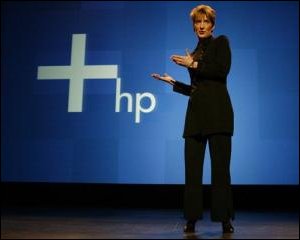 Americans love nothing better than seeing corporate fat-cats get canned.
Today Hewlett-Packard decided it needed to outsource itself a new CEO, not one with a new strategy but one who could execute on it, after Carly Fiorina stepped down at the BoD's behest from the helm of the computer company she's spent the past six years transforming.
Sic Transit Fiorina
Perhaps Fiorina's worst sin was becoming the subject of charges by her lieutenants she'd become a bottleneck, and was interfering with the company’s ability to respond quickly to market changes. But, with a $21 million golden parachute, I wouldn't worry too much about where she'll land.
Surprising? No.
As architect of a controversial merger with Compaq that never produced the results she promised, HP turned in lousy financial results under one of the most powerful women in corporate America. HP was always something of an also-ran when it came to the way computers were bought and sold, but when the halcyon days of high margins departed with the go-go Dot-Com Bubble, so did the ability to get away with that sort of approach. As it stands today, HP trails Dell in PCs, EMC in storage and IBM in services... The only real winner in all of this has been Compaq, which would almost surely have been forced to sell off to Dell at a deep discount if HP hadn't swept in to save the day. The crown jewel of printing and imaging has lost a good deal of its luster as well, and the window of opportunity for a spin-off has narrowed substantially.
The REAL Reason She Got The Boot
Insiders say board dissatisfaction with Fiorina traces back to the November 2002 exit of former President Michael Capellas, who joined HP from Compaq and today heads MCI. Some board members wanted the position re-occupied. Recently, the board became convinced Fiorina would back down from her opposition and accept the appointment of a chief operating officer, given HP's spotty financial returns. "She was adamantly opposed to that," according to Rob Enderle, principal analyst at the Enderle Group. Fiorina's resistance brought the dispute to a crisis and sparked the decision to ask her to leave.
CFO Robert Wayman, who was named interim chief executive on Wednesday, said HP did not plan to reverse the Compaq deal but left the door open, saying the board would not be close-minded on strategy changes once it locates a new CEO. The board said its chief concern was to improve "execution" of strategy, although many on Wall Street hope HP will spin off its printing division, which delivers most of its profit, after Fiorina did the exact opposite by integrating it with the lagging PC division only two weeks ago.
HP shares, which have lost 63 percent of their value since Fiorina became CEO in July 1999, rose as much as 10 percent on Wednesday and closed up nearly 7 percent. Corporate recruiters saw Mike Zafirovski, Motorola's former chief operating officer, as a top contender to become CEO, while others pitched Michael Capellas, current CEO of communications company MCI and former Compaq chief, despite Capellas's link to the merger having been seen as a problem by some. Motorola's CEO, ex-Sun Microsystems exec Ed Zander, is considered another possible choice. Investors uniformly agree that, after dashing their hopes in three of the last nine quarters as it lost market share to Dell and IBM, anybody's got to be better than Carly.
Fiorina said in a statement, "While I regret the board and I have differences about how to execute HP's strategy, I respect their decision. HP is a great company and I wish all the people of HP much success in the future."
Truly, were it not for the ill-fated merger with Compaq, I frankly believe she could've become one of America's legendary corporate leaders - remembered as more Lou Gerstner than Bob Galvin. Maybe the ultimate lesson here is, in the era of mega-mergers, it's usually a bad idea to hang your career on successfully pulling it off.
David Katz, chief investment officer at Matrix Asset Advisors, one of the first HP investors to oppose the Compaq deal, said, "Today's announcement basically is a validation that Walter Hewlett was probably correct, that it was an ill-fated strategy," and added that a printer spinoff was still a possibility.
Meanwhile, Hewlett only said in a statement that he looked forward to HP fulfilling its promise. "HP has been a great company. It is facing a number of challenges." Despite Bear Stearns downgrading its rating on HP, saying Wednesday's gain reflected most of the possible upside from a potential break-up of the company, Wall Street generally liked the move.
Unquestionably, HP has lost its momentum since the Compaq merger, which we can see in hindsight offered hardly any value-add, while occupying huge management attention span in terms of distraction of time and resources. Over the past six years, HP has transitioned from a high-margin to a low-margin company.
Computers are commoditized and the Dell model of selling direct through a low-cost channel (the Web), getting and using the customers' money for a week without building inventory (not to mention paying vendors 45+ days terms) and then helping make experts out of their customers in the process by building a custom rig for everyone, is the only way to play and win the PC game any more.
From a technology standpoint, Itanium, through which HP partnered with Intel and did away with Compaq's older DEC Alpha chip, has been a disaster. It transferred its Precision Architecture to Intel as the basis for Itanium along with its silicon designers and shut down its chip foundries; and all of this was tied into an Itanium partnership that will return nothing to HP, and hardly more than that to Intel, while effectively closing down the chip-making line of business in the process. Sounds to me almost like Intel simply duped HP into putting itself out of business before it did. From that standpoint, the only winner in the 64-bit processor game has been AMD!
Finally, I have lots of friends in Silicon Valley who complain HP's corporate culture had been destroyed by cascading rounds of layoffs, after HP acquired Compaq having cut 16,800 jobs. What's needed to correct the cultural deterioration is an outsider who can come in and reinvigorate what has become a culture more akin to Larry Ellison's Oracle than Bill Gates' Microsoft.
If they don't end up with a value-extracting consolidator at the helm, that is. Stacey Quandt of the Robert Frances Group, said, "The door [is open] for the HP board to hire an executive to sell off pieces of the company, and the server and storage division would likely be on the top of the list. An asset-stripper CEO will most likely be Ms. Fiorina's replacement."
So, while competitors gaze on awaiting their chance to pounce, HP needs to get moving on fulfilling that promise Walter Hewlett is so in love with - the one it's touted to corporate IT customers for the past half-decade and more... As Eric Lundquist said at eWeek.com:
-
The biggest competitor HP now faces is time. Buoyed by a more optimistic economic outlook, corporations are once again spending money for technology purchases. HP's competitors have spent the last several years improving their product lines and service offerings. In the corporate world, technology decisions are now being made for 2005 and beyond, and HP needs to get on that short list of preferred vendors or risk being left behind.
- Arik
February 08, 2005
Super Bowl Ads are for Suckers
 Timothy Noah at Slate.com cites a Broadcasting & Cable magazine experiment that showed the best way to reach your target market during the Super Bowl is to spend that $2.4 mil trying to counter-program against it:
-
It asked an ad agency called Starcom to enter Nielsen ratings data from last year's Super Bowl time slot into a computer to see whether the computer could "beat" a Super Bowl ad buy. The average price of a Super Bowl ad last year was $2.30 per 30-second spot. (The price this year climbed to $2.40 per 30-second spot.) Starcom fed that into the computer, too. Then it set about trying to see whether, by "spending" the same amount on counter-programming that other networks and cable channels ran against the Super Bowl, the computer could exceed the Super Bowl's slice of the audience that advertisers care about: adults between the ages of 18 and 49.
It wasn't even close. The computer's Super Bowl ad buy reached 29 percent of adults 18-49; the computer's counter-programming ad buy reached 47.3 percent of adults 18-49. In essence, buying ad time on various TV shows that were supposedly going unwatched--because "everybody" was watching the Super Bowl--would have enabled advertisers to reach 60 percent more potential customers.
Within the advertising industry, there appears to be an unshakeable belief that Super Bowl ad buys are justified because the ads have a much greater impact than TV commercials usually do. Viewers know that advertisers use the Super Bowl to show off their creativity, and so they've come to regard the Super Bowl as, among other things, a kind of mini-film festival. Some polls actually show that more people watch the Super Bowl for the ads than for the game itself.
And later an indictment of the ad industry itself:
-
So why do advertising agencies tout the wonderfulness of advertising on the Super Bowl? I suspect the answer is that, while the Super Bowl may not be an especially smart forum in which to sell the advertisers' products, it's a great forum for selling the ad agency itself. Ads that attract attention to themselves may not sell consumer goods, but they do provide a wonderful forum for ad agencies to show the world how creative they can be. And it's a lot easier for an ad agency to purchase one very expensive ad slot than it is to match that fat commission through the purchase of hundreds of ads. Add these considerations together and it's hard to avoid the conclusion that ad agencies are driven, perhaps unconsciously, to make suckers of their clients. The clients are receptive because having an ad on the Super Bowl confers an undeniable glamour. But glamour doesn't pay the bills.
Ford, Bud, Volvo, Pepsi, Ameriquest, and most bizarrely of all, Silestone...
Suckers! Every one... plus, Seth Stevensen breaks it down for us on the ads themselves, on NPR.
- Arik
February 07, 2005
GSM/GPRS Treo 650 - Unlocked $599 or $699? Cingular Complains, Price Goes Up
 Demand-based pricing takes another giant leap forward as the much coveted "unlocked" GSM version of the new Treo 650 smart-phone jumps $100 overnight, after Cingular apparently got ticked at the competition... not that there was any.
-
The price of the unlocked Treo 650 has increased by a $100, up to $699 from yesterday's price of $599.
According to palmOne Vice President Marlene Somsak, the $599 pricing was "a mistake. For those who got the earlier lower-priced GSM Treo 650's...lucky them!"
Maybe a mistake of anticipated demand?
The unlocked Treo 650 is attractive because it works with almost any GSM/GPRS network worldwide, so you can use it with your existing GSM/GPRS service plan. The unlocked phone also makes it easy to use local SIM cards when traveling internationally.
So, while I was willing to drop $599 on the unlocked version of the quad-band world-phone, $699 somehow seems a little steep. So, I've decided, I'm not going to buy any Treo at all... despite the fact I was going to put Cingular service on that handset anyhow.
So there.
- Arik
February 06, 2005
Super Bowl XXXIX: Patriots Dynasty Official
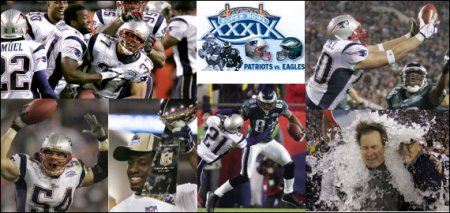
The New England Patriots won the Super Bowl (again!) defeating the Philadelphia Eagles 24-21, making it an official dynasty with a third championship victory in four years. The game's MVP was New England receiver Deion Branch, with 11 receptions for 133 yards, though Eagles receiver Terrell Owens turned in an impressive performance of his own at nine-for-122 - and T.O. was getting screws installed in his ankle a month ago! Here's a recap:
-
This time Brady was, well, Brady. That meant 23-for-33 and 236 yards of passing for two touchdowns. That meant no interceptions. That meant a 9-0 postseason record, to tie Bart Starr from Green Bay's magical days for the most consecutive postseason wins by a quarterback. He is Mr. January. Mr. February. Mr. Super Bowl. At the age of 27.
"It's a relief," he said. "It's been a long year."
This time, the Patriots' defense turned the game with four turnovers, and had to stand its ground with kids, the injury-ravaged secondary down to two rookies and a second-year player in the second half.
"We believe that someone is going to make the play," said safety Rodney Harrison, the veteran glue who had two interceptions.
The Patriots withstood 357 passing yards and three touchdown passes from Donovan McNabb, and nine catches by Terrell Owens, who returned from his injury as he vowed he would.
But they allowed McNabb few spectacular runs, sacked him four times with a pass rush intensified by changing from their usual 3-4 defense to 4-3, and intercepted him three times, the third to finish off Philadelphia's last gasp from its own 4.
"We just had to keep guys coming at him at all times," linebacker Willie McGinest said. "They key was to confuse him."
"I don't look at the touchdowns. I look at the interceptions," said McNabb, who put up 51 passes and completed 30. "This game could have been a blowout. You take away those three interceptions and we're probably ahead two or three touchdowns. It's woulda, coulda, shoulda."
And so the Patriots pile more mystique upon their aura. The 34 wins in two seasons that would set one record. The nine straight postseason wins that would tie another. The three titles in four years, a glowing quadrennial matched only once before, by Dallas in the 1990s.
The Super Bowl Roman numerals come and go and the Patriots supremacy remains the same. Three titles, all won by three points. Only the halftime shows change.
It has been domination, somehow, without perception of many stars, but accomplished by attacking in waves. Overachievers, they were once called.
"We're the most ring-fingered overachievers I've ever seen," said receiver Troy Brown.
"We play Patriots ball," said cornerback Asante Samuel. "All we do is win."
"It sounds almost cliche-ish after awhile," Brady said. "We're a team, we're a team. But after four years, I've never had a receiver complain about not getting a ball, I've never had a running back complain about not getting enough carries."
They needed all their togetherness Sunday in a historically close fight. At 7-7, it was only the second halftime tie ever in the Super Bowl. At 14-14, it was the first Super Bowl to be tied after three quarters.
It was also only the third game in 405 NFL postseason contests to be even at the end of all three periods.
But the tie lasted barely a minute into the fourth quarter, when Corey Dillon's 2-yard touchdown run put the Patriots ahead, 21-14.
The 66-yard drive, a direct response to the Eagles just scoring to tie, was an exhibition of New England purpose.
The last big play on the drive came with Philadelphia's defenders clearly heard on television shouting "Watch out for the screen!"
Brady threw a screen pass, anyway, to Kevin Faulk for 14 yards. The night was beginning to inexorably tilt New England's way after a shaky start. The Patriots did not have a first down their first four possessions.
Moments later, the Patriots were back at the Philadelphia 4, and eventually kicked a field goal for a 24-14 lead.
By the time McNabb threw a 30-yard touchdown pass to Greg Lewis to make it 24-21, there was only 1:48 left. The 79-yard march had taken 13 plays and 3:52. A splendid drive. But not for a team 10 points behind.
But the Eagles are right there with them in what is sure to be a :
-
Philly has most of its best players signed to long-term contracts, including Donovan McNabb, Terrell Owens, Jevon Kearse, Brian Dawkins, Lito Sheppard, Michael Lewis and Sheldon Brown. Kearse was signed as a free agent last year and Owens was acquired in a trade.
Also, the NFC is a mess, with the Eagles far superior to any other contenders. The Patriots don't have that luxury in the stacked AFC.
Eagles owner Jeffrey Lurie styled his organization after such past dynasties as the Cowboys and 49ers. Minus the championships, his franchise is very similar to Kraft's.
"We are the two winningest teams this decade," Lurie said. "Both invested well over $300 million in new stadiums. We each hired coaches in an unorthodox fashion — us a non-coordinator, and Bob trading for Bill.
"Both teams are built around franchise quarterbacks. Both are high-character teams. There are a lot of similar value systems for each team. We each place a high value on the quality of people in our organization. And it's not just high character, but high intelligence — people who like to think outside the box and people willing to make controversial and unpopular decisions. We both understand that decisions need to be made that sustain the long-term excellence of the franchise."
I still wish the Eagles could've pulled it off - after all, they did knock out the Packers - but against a team that believes it will win, that sort of confidence is hard to overcome.
- Arik
February 05, 2005
Ameriquest - Super Bowl Sponsor's Boiler Room Operation
 Ameriquest Mortgage, Super Bowl Halftime Show sponsor, has been accused in a sweeping LA Times story of running a boiler-room operation and pressuring business associates into wrongdoing in pursuit of sales.
Appraisers in six states said in interviews that Ameriquest tried to hustle them into inflating home values and even lying about property defects. Now, my father-in-law is a property appraiser and I can tell you, he'd have filed a complaint over that sort of thing. He's cut ties with other lenders for a LOT less questionable ethics than that.
-
In the late 1990s, the company's sub-prime lending drew the attention of a national housing advocacy group, Assn. of Community Organizations for Reform Now, or ACORN. The group's president, Maude Hurd, denounced the company as a collection of "slimy mortgage predators." About the same time, the Federal Trade Commission began an investigation into its lending practices.
In July 2000 Ameriquest worked out a cease-fire with ACORN.
The deal included a commitment to make $360 million in low-interest, low-fee loans to customers in the largely minority neighborhoods where ACORN operates. (Ultimately, according to ACORN, Ameriquest made only a small fraction of those loans because the group found other firms offering better terms for community residents. Ameriquest says it continues to work with ACORN on the program.)
Soon after, the FTC called off its investigation. Fair lending advocates, including the National Community Reinvestment Coalition and the Leadership Conference on Civil Rights, hailed Ameriquest as a progressive force in the sub-prime market.
With its regulatory and image problems behind it, Ameriquest embarked on an all-out marketing offensive that now includes an Internet advertising blitz and two blimps that hover over major sporting events.
According to the ex-loan officers interviewed by The Times, however, the company's growth has been generated more by hard-sell tactics than by slick marketing. They described 10- and 12-hour days punctuated by "power hours" — nonstop cold-calling sessions to lists of prospects burdened with credit card bills; the goal was to persuade these people to roll their debts into new mortgages on their homes.
Employees who put up big numbers, they said, were rewarded with trips to Hawaii and the Super Bowl and, in some cases, with $100,000-plus salaries. No matter how many loans they peddled, however, the pressure rarely eased, ex-employees said.
"I don't think there's a day that went by that I wasn't told I was going to be fired," recalled Omar Ross, who said he was a top producer when he worked for Ameriquest in Grand Rapids in 2003 and 2004, quitting the company that year. "I was told I was going to be fired at least 200 times."
Supervisors didn't let up even when he was meeting his quota, Ross said. "They would tell everybody: 'Omar did 10. How come everybody else can't do 10?' Then in private they would turn around and say: 'Why can't you do more? You're slacking. You're capable of doing more.' "
In such a rabid atmosphere, several ex-employees said, abuses become inevitable.
"You close fast because the longer somebody has to sit and think about it, the longer they have to think about the numbers," said Dave Johnson, a former branch manager in suburban Detroit. "You don't want somebody to get buyer's remorse before they close."
Maybe it's no coincidence that former employees swear that, to fire up and energize them, watching the movie "Boiler Room" was part of their Ameriquest training...?
- Arik
February 03, 2005
Happy Birthday, Aurora - 10-Years-Old Today
 It's been 10 years since I started Aurora WDC in the 12 by 25 feet on the eastern side of my Mom's beauty salon in the small Wisconsin town of Chetek.
Since then, I've learned starting and growing a business is a lot like having a real-life child, something I only came to appreciate first-hand 19-months ago, when my wife Tina gave birth to our son Liam. I witnessed struggle and growth, often more slowly than I'd hoped, sometimes wondering if it was such a good idea in the first place... especially through all those long nights at first... sometimes even failing outright to live up to the father's prideful aspirations.
But, I always realize, whatever the occasional sacrifices invested toward the joy only one's own offspring can offer, I'd gladly do it all again without changing a thing.
Okay, well, maybe there are some things I'd have changed... but not many and only with benefit of 20/20 hindsight.
In the decade past, company and founder alike have benefited from some remarkable contributions from amazingly creative and generous people - you know who you are. I'm forever grateful for the advice and support of everyone, from clients and staff to partners and other advisors, friends and family who've helped make Aurora what it is today. To say I couldn't have done it without you is the most ridiculous of understatements.
I'm looking forward to the next 10 years of blazing new trails together and hope you are too.
Thanks again and best wishes,
- Arik
p.s. - It's also my birthday today - I'm 35... so get me something nice. ;-)
February 01, 2005
MetLife Buys Travelers from CitiGroup

Reversing the strategic changes Sandy Weill undertook in the financial services consolidation of the 1990's, Citigroup dumped its Travelers life and annuity business to redeploy capital to in faster growing markets in Asia and Europe, as MetLife plopped down more than $11.5 billion to become the largest life insurance company in the business:
-
Citigroup, the largest financial institution in the United States, had retained Travelers Life & Annuity in 2002 when it spun off Travelers Property Casualty Corp. in a $5 billion initial public offering. Travelers Property merged with St. Paul Cos. Inc. in 2003 to create The St. Paul Travelers Cos., based in St. Paul, Minn.
The announcement Monday said that Citigroup and MetLife "have entered into 10-year agreements under which MetLife will greatly expand its distribution by making products available through certain Citigroup distribution channels," including Citi branches and its Smith Barney brokerage unit.
It said that Citigroup will receive $1 billion to $3 billion US in MetLife equity securities and the balance in cash, which will result in an after-tax gain of about $2 billion. It added that MetLife may finance the cash portion of the transaction through a combination of cash on hand, debt, mandatory convertible securities and selected asset sales.
In a phone call with analysts, MetLife's chief financial officer, William J. Wheeler, said that the asset sales could include divestiture of MetLife's reinsurance operations. Reinsurance is backup coverage purchased by insurance companies.
MetLife owns about 52 per cent of the Reinsurance Group of America.
Wheeler said asset sales could also include "equity real estate investments and potential other things."
C. Robert Henrikson, MetLife's president and chief operating officer, said the purchase would bring "even more balance" to MetLife's business mix.
MetLife currently earns about 46 per cent of its profits from institutional sales and 30 per cent from individual sales, he said. After the merger, profits from institutional sales should drop to about 43 per cent, while earnings from individual sales should rise to 36 per cent. Other categories are international, seven per cent; auto and home six per cent; and miscellaneous, eight per cent.
Citigroup said that the businesses being acquired by MetLife generated total revenues of $5.2 billion and profits of $901 million in 2004. The business had total assets of $96 billion at year's end, it said.
The transaction announced Monday doesn't directly involve operations in Canada, although the financial ratings of Citigroup's Primerica Life Insurance of Canada along with its parent Primerica were put under review Monday by A.M. Best Co.
A.M. Best also lowered ratings of Travelers Insurance Co and Travelers Life and Annuity, to A-plus superior from A-double-plus superior, reflecting their move out of the Citigroup group of companies.
Metropolitan Life sold the bulk of its Canadian operations in 1998.
The move was the latest by Citigroup to sell off noncore businesses.
Citigroup chief executive Charles Prince said that selling Travelers "sharpens our focus on Citigroup's long-term growth franchises." He did not say how Citigroup would use the proceeds from the sale.
In November, Citigroup sold a truck-leasing operation to General Electric Co. for $4.4 billion. It also sold its European vendor-finance leasing operation for CIT Group Inc.
Although no longer consider strategic, Travelers had played a big part in the creation of Citigroup.
Citigroup chairman Sanford I. Weill acquired the Travelers insurance group in 1993 and Travelers then acquired Shearson in 1993 and Salomon brokerage in 1997; it merged with Citicorp in 1998 to form Citigroup.
Of course, then there's American Express, that in an otherwise seemingly disconnected move, suddenly decided to spin off its personal finance unit, American Express Financial Advisors, to shareholders in the third quarter. Reportedly, the move is being planned so the Minneapolis unit, formerly called IDS back in the day, could "pursue new products, partnerships and expansion without having to compete with credit cards and other businesses for capital." I wonder if it doesn't have more to do with confirming theories about the disintegration of the "integrated financial services" strategy signified by the MetLife/CitiGroup deal...?
-
The financial advisory business provides financial planning and advice, asset management, insurance, annuities and related businesses through a network of more than 12,500 advisors. It generated revenues of about $7 billion and earned about $700 million in 2004.
"This spin-off will create two distinct businesses and allow them to capitalize on their respective growth opportunities," Kenneth I. Chenault, chairman and chief executive officer of American Express, said in a statement.
He said the new company would have greater latitude as an independent company to compete for capital or management resources, and react more quickly to business opportunities.
After the spin-off, American Express will consist of a charge and credit card business and a network that processes more than $400 billion in transactions from merchants throughout the world. It will also operate global travel and Travelers Cheque businesses and an international bank serving wealthy consumers and financial institutions.
Those businesses delivered approximately $22 billion of revenues and net income of $2.7 billion in 2004.
The two companies will be independent, have separate public ownership, boards of directors and management.
The spinoff business will continue to be led by James Cracchiolo as chairman and chief executive.
All this refocusing lends credence to thoughts that consolidation, at least in financial services, has been a failed strategy to create scale across multiple business units. Perhaps it's more a matter of getting the right people in charge - and MetLife looks to be the chief beneficiary of that change in approach.
- Arik
 "Competitive Intelligence applies the principles of competition and lessons of intelligence to the need for enterprise awareness and predictability of market risk and opportunity. CI has the power to transform an enterprise from also-ran into real winners with agility enough to create and maintain sustainable competitive advantage."
