January 30, 2005
Getting Out the Vote: Election Day in Iraq

-
... Americans finally got a good look at who they are fighting for: millions of average people who have suffered for years under dictatorship and who now desperately want to live in a free and peaceful country. Their votes were an act of courage and faith—and an answer to the question of whether the mission in Iraq remains a just cause.
Fred Kaplan in Slate.com details the defeat the election handed to insurgents, particularly Zarqawi:
-
And yet, is it too romantic to see signs of real hope in today's election? One thing is clear: The day marked a terrible defeat for Abu Musab al-Zarqawi, who had declared democracy to be an "infidel" belief. He and his goons passed out leaflets threatening to kill anyone and everyone who dared to vote; they dramatized their threat by killing dozens of police and poll workers in the days leading up to the election. And yet millions of Iraqis—including a fairly large number of Sunnis who live in Shiite areas—defied their fears and voted. Whatever mayhem they inflict in the coming days, it will be hard for anyone to interpret their actions as reflecting the beliefs of "the street."
In the week before the election, several Sunni leaders said they want to participate in the constitutional process in any case. Do these leaders now regret their calls for a boycott of the election? Seeing how badly Zarqawi failed in his effort to halt or disrupt the election, will they now work more vigilantly to pursue their cause peacefully and to separate their nationalist followers from the foreign terrorists in their midst?
Finally, imagine a Syrian watching Al-Arabiya, seeing Iraqi-born Syrians going to special polling places to elect Iraqi leaders, observing that no Syrians of any sort have the right to elect the leaders of Syria—and perhaps asking himself, "Why?" It is not inconceivable that this flicker of democratic practice in Iraq could ignite a flame of some sort across the Middle East. To what end, and for ultimate good or ill, who knows. But something happened in Iraq today, something not only dramatic and stirring but perhaps also very big.
Election Day in Iraq, where the turnout was unexpectedly high and the mood jubilant. As many as 8 million people, or almost 60 percent of eligible voters, cast ballots, sometimes within earshot of insurgents' repeated mortar, rocket, machine gun, and suicide attacks, which proved less deadly than feared but still killed 44. "The election was a victory of our own making," Iraq's national security chief told the New York Times. "Today, the Iraqi people voted with their own blood."
Or, put another way: "It's like a wedding. I swear to God, it's a wedding for all of Iraq," the director of a polling station in a Sunni area of Baghdad told the Washington Post. "No one has ever witnessed this before. For a half-century, no one has seen anything like it. And we did it ourselves."
Even AlterNet had a few nice things to say:
-
Despite the violence, voters streamed to the polls in relatively small but consistent numbers throughout the day, with a turnout of up to 90 percent in some Shiite neighborhoods, and about 40-50 percent in some Sunni areas in western Baghdad, Milley said. U.S. forces made up a third cordon during the election, giving logistical and protective support, while polling stations were guarded by Iraqi police forces and managed by Iraq's Independent Electoral Commission.
As predicted, Shiite turnout was much higher than for the minority Sunni population, as Shiites make up nearly 60 percent of the country's 26 million people. They were expected to gain a significant powerbase in this vote for a 275-member National Assembly. Sunnis make up 20 percent of Iraq's population and had been told by some of their leaders not to vote. Both the Iraq Islamic Party and the Association of Muslim Scholars threatened to boycott the election, claiming it could not be legitimate and remains a tactic to extend the U.S. occupation.
But many Sunnis disregarded the “fatwa,” or edict, seeing a vote as the only clear way out of the past.
"My father was a general in the Iraqi Army and this is the first time for Iraqis to taste freedom," said 25-year-old Dr. Zeena Hassam, who helped her 80-year-old father drop his ballot into the voting box. Hassem said she and her father paid no attention to calls for a boycott. The day is too important and the waiting was too long, she said. "It is the duty of every Iraqi to vote. We are Sunni, and my relatives and my friends, we all know it is our duty, and it is our honor."
The Sunni boycott, and especially the threats and terrorism, may have frightened off some voters, but others weren't fazed.
Aerial imagery apparently caught voters spitting on and kicking the remains of a suicide bomber as they entered their polling station. Other Iraqis waiting in line in Sadr City came under a mortar attack that hit a man in his leg. They helped the injured man then got back in line to vote, election officials reported.
"Of course we are afraid, but we must do this,” said Suna Sharif as she left a voting station with her son and husband. “We walked for two miles and my husband is sick. We have been preparing to vote for a long time and my son made sure we were here before polls closed.”
A ban on all car traffic encouraged people in some Shiite neighborhoods in northwest Baghdad to pour into the streets to visit and celebrate. Children played soccer and men talked on door stoops.
By nightfall, reports of ongoing attacks were still pouring into the central command station of western Baghdad. Focus was turned to protecting ballots and the days ahead, and helping police forces who were to continue securing polling sites through the night. The police chief took a moment from his organizing to show off his stained finger. An officer with the Iraqi National Guard joined him, holding his blue index finger in the air. They all took photos to remember the moment.
Now, let's hope the retaliation sure to come against Sunnis to get them to back away from negotiations after the votes are counted can be met with equal resistance by the Iraqi people - we'll find out in a couple of weeks what sort of ruling coalition comes to power.
- Arik
January 29, 2005
IBM Acquires Corio
 IBM decided to place a bet on a money-losing ASP from days of old, acquiring Corio for $182 million:
-
At first glance, IBM's biggest challenge will be making Corio's operations profitable. In the first nine months of 2004, the company posted a net loss of $10.4 million. IBM, however, obviously sees potential in the business. Its per-share offer of $2.82 for each Corio share is a 38% premium over Monday's close of $2.05. In late-day trading, Corio shares were up more than 35% to $2.78.
Mike Riegel, director for On Demand Strategy at IBM, says the purchase price, in part, reflects the value of Corio's intellectual property. Specifically, Riegel says Corio's technology and methodologies for rapidly deploying enterprise applications in hosted environments will boost the appeal of IBM's hosting offerings. "Customers now want access to new applications in minutes or hours, not weeks or months, and Corio excels at that," Riegel says.
Meanwhile, at least one Corio competitor says the deal could help boost prices in the ASP market. "Some of the smaller players in the market pursued market share at unsustainable prices. We expect IBM will be a more disciplined competitor," says Andrew Stern, CEO of USinternetworking Inc., which is backed by Bain Capital. Stern says that USi could itself eventually seek a buyer, or issue public stock, but says no immediate plans are in the works.
We'll see if IBM can make a winner out of Corio yet.
- Arik
January 28, 2005
P&G + Gillette = One Winning Combination!

Under the terms of the agreement, P and G will issue 0.975 shares of its common stock for each share of Gillette common stock, putting an 18-percent premium on Gillette shares since closing prices on Thursday - this is not an insignificant consequence, especially for investor Buffett as BusinessWeek explains:
-
Now, with his Jan. 28 backing of Procter & Gamble Co's (PG ) novel two-step, tax-free deal for Gillette Co. (G ), Buffett is again seizing an opportunity to exit a position without triggering a giant tax bill. Berkshire's gain on the 96 million Gillette shares it has held since 1989: $4.3 billion. Yet because it is plowing all of that gain into shares of the new company, Uncle Sam will have to wait for his piece of the profits.
Exactly who suggested the deal structure is not clear. Neither Buffett, Gillette's largest shareholder, nor the investment bankers involved would comment. Given Buffett's well-known aversion to taxes, though, bankers most likely devised the structure to satisfy him while also preventing an all-stock deal from drastically watering down P&G's earnings. Just as important, the ingenious structure could become a Wall Street model for future mergers and acquisitions. At the same time it comes with a lesson about what investors can and can't learn from watching Buffett.
Think of the deal as a two-step jig: The first movement makes Buffett happy, while the unusual second step pleases P&G. First, P&G will pay for Gillette with nothing but stock, issuing 0.975 shares of its common stock for each Gillette share. Gillette investors will owe no tax since they're exchanging one stock for another. If, instead, P&G had paid for Gillette with cash, Berkshire alone would have faced a whopping $1.5 billion tax bill thanks to the 35% corporate rate it pays.
Problem is, all that new stock will dilute the value of the shares P&G's current investors hold and slash its earnings per share. So as part of the deal P&G announced that it will spend $18 billion to $22 billion over the next 12 to 18 months buying back some of the stock it just issued for Gillette. The result, says P&G, is the same as if it had paid for Gillette with a package of 60% stock and 40% cash.
This isn't the first time P&G's gone after Gillette - just five years back, a failed run during a very different market climate taught both firms a lesson - now the first of five business lessons of branding, "Innovate, Innovate, Innovate":
-
Why would P&G tinker with Tide? Long the detergent leader, Tide would seem best left alone, a profitable annuity on years of mass-market flogging in the '60s, '70s, and '80s. But P&G has tinkered nonetheless, combining strong technology and consumer research to push sales up 2.6% over the last year in a category that is growing less than 1%. The secret: a widening family of detergents and cleaners that now includes everything from Tide Coldwater, for cold-water washing, to Tide Kick, a combination measuring cup and stain penetrator.
Innovation isn't always built from scratch. P&G is a master at transferring technologies from one brand to another. Tide StainBrush, a new electric brush for removing stains, uses the same basic mechanism as the Crest Spinbrush Pro toothbrush -- also a P&G brand. Gillette, too, is adept at cross-pollination. Its latest winner is the battery-operated M3Power, the result of a collaboration between the company's razor, Duracell battery, and Braun small-appliance units. Despite a 50% price premium over what Gillette charged for its previous top-of-the-line razor, the M3Power has captured a 35% share of the U.S. razor market in seven months.
Overall thought, the best impact analysis was at CMO Magazine on the P&G Gillette deal, with a critique that the deal is a strong one and could inject considerable growth by consolidating a women's brand with a men's brand holding great promise for generating new demand in consumer products companies, which could even prove beneficial for their competitors in the long run:
-
Consumers yearn for the peace of mind and the feeling of security that a favored brand can give. They enjoy the sense of self-definition that comes from choosing and using products that reflect their personalities, and they crave a feeling of connection to others. Consumers also have budgets, schedules, and the need to juggle both in an increasingly complicated world. So consumers, like businesses, want more streamlining and ease of use in the products and services they buy.
Our research has documented at least a dozen patterns of demand innovation in consumer markets. One of them is what we call the "from professional to do-it-yourself" pattern. The penchant to do it yourself has swept through a variety of consumer sectors. Internet- and software-based technologies make it relatively easy to turn complex procedures and knowledge into easily used tools; hence, the success of Turbotax by Intuit and Photoshop by Adobe, which have provided tremendous value for consumers.
In the packaged goods world, this pattern has been deployed masterfully by P&G with its Crest Whitestrips. Teeth whitening was the fastest growing dental procedure during the 1990s and now represents the most common elective procedure. P&G's big idea was to commercialize a drapeable strip that could adhere to teeth and to put a proven bleaching agent like peroxide directly in contact with teeth—essentially bringing home for consumers at a much lower price what was previously available only through the dentist. As a result, Whitestrips helped Crest to replace Colgate as the leading oral care brand in North America.
P&G's success with Whitestrips lies not just in an excellent product, but also in how the company identified and deployed various intangible assets. For example, P&G found superior film and bonding technology hidden within another part of the organization. It also tapped its existing network of 45,000 dentists, selling Whitestrips through dental offices before the nationwide launch.
Identifying and leveraging intangible assets to create other new streams of growth like Whitestrips is the central challenge for a merged P&G and Gillette. For example, the new company could pursue the "integrated solutions" pattern - combining an array of goods and services into a bundle that solves a customer's problem. Kraft, building on its acquisition of Oscar Meyer, has done this admirably with its Lunchables line of meal kits, which addresses a daily hassle for time-pressed working parents. Kids love the convenience and recreational aspect of the tray of snacks, and the Lunchables line gave Kraft a highly profitable new stream of revenues.
With Gillette's shaving products added to the P&G mix, one can envision an integrated travel kit containing makeup, skin lotion, shaving accessories, and other travel essentials. And acquiring Gillette's solid Braun brand, which includes small kitchen appliances, hair dryers, and electric shavers, could lead to opportunities to create a kitchen management system as well as an integrated hair salon offering that combines Pantene and Wella hair products with Braun grooming appliances. P&G might even consider opening a chain of Braun salons or consult to existing salons.
Interestingly, BusinessWeek covered the gadgetizing of P&G's product line a scant couple of days before the merger was announced, which I thought prescient. Plus, it sets the combined company up for true dominance in FCMG. An interview with P&G CEO Lafley himself breaks it down.
- Arik
January 25, 2005
Early Warning Workshop at CBI's Predictive Intelligence in Philadelphia

- Arik
January 19, 2005
Intel Reorgs Itself... Again!
 Intel's reorganization follows a year-long trending away from processors and toward solutions and, on Monday, Intel announced that it was reorganizing the company into five business units that will target platforms rather than silicon. It was a move away from the traditional two business units it had been operating with - the Intel Architecture Group, which handled the bulk of the company's processors, including Pentiums and Xeons, and the Intel Communications Group.
The reorganization continues Intel's evolution beyond processors and chip speed. The company started moving away from chip frequency last year kicking off a new processor-naming scheme to de-emphasized gigahertz.
The new business units will include the Mobility Group, led by Sean Maloney and Dadi Perlmutter to focus on mobile devices, notebook computers cell phones and handhelds. In was in the area of mobile computing that Intel in 2003 made its first step toward becoming more platform-focused, with the launch of Centrino. The mobile platform not only offered a processor, but also a chip set and wireless access component designed to work best together.
Two other units include the Digital Enterprise Group, led by Pat Gelsinger and Abhi Talwalkar, and Digital Home Group, headed by Don MacDonald. Like the mobility unit, these groups will focus on creating complete computing and communication platforms for businesses and homes. The final two units are the Digital Health Group, led by Louis Burns, and the Channel Products Group, headed by Bill Siu.
eWeek's Dave Coursey was skeptical:
-
As many times as Intel has reorganized lately—four times since 1997 according to published accounts—I have to wonder whether it really matters how the company is structured. About the time the old order is out and the new order is in the new order becomes the old order and the process starts anew.
This year's model is an Intel based around market opportunities rather than technologies, which is about as clear an admission as you're going to get that we have plenty of technology running around but not enough interesting uses for it.
This reorganization is supposed to better connect Intel with the marketplace. The goal is finding new uses for as many MIPS as possible. The perfect innovation, from Intel's perspective, is something that causes customers to buy lots of new processors, either as upgrades or in completely new types of devices. But Intel is also extending its silicon offerings to include features not directly related to the CPU, such as wireless technology.
Touted as an example of Intel "done right" is the supposed "success" of the Centrino mobile processor set, a new version of which has just been introduced. I have not looked at the numbers, but it's hard for me to get excited over Centrino, best-known for forcing 802.11b wireless on customers just as 802.11g became affordable.
In my view, if Centrino really had been successful, customers would have dumped their old notebooks just to get a new Centrino-based machine. I haven't seen a lot of that happening.
If Centrino kept hardware OEM's buying Intel instead of AMD that alone would make it a success by some measures. But that doesn't fulfill the mission of convincing customers to buy new CPU's they wouldn't have bought anyway.
The reorg is a tacit admission that Intel is going to have to do more product R&D if chip demand is to increase. I am talking about real products, such as home entertainment or medical devices that could be built around specialized Intel chip sets. Already Intel has been shifting its focus away from the "speeds and feeds" of old toward feature sets enabled by additional Intel silicon.
The company has been doing this sort of work almost forever, but its latest output has been kind of depressing. Think Media Center PC's and iPod-ish video players as examples of Intel innovation. And Centrino, of course.
None have ignited a marketplace sensation. The next opportunity seems to be 64-bit processing, though it's barely on most customers' radar. The challenge of getting customers to shorten their PC and server replacement cycles has gone unmet.
This problem isn't Intel's alone. Microsoft, as I've commented before, faces the same issue: There's no shortage of better ways to do things, but getting from here to there presents a tremendous challenge. Especially while maintaining significant backward compatibility and reducing risk to acceptable levels.
But, only five months until Paul Otellini takes over as CEO for a retiring Craig Barrett, Intel still faces the same challenge as before - coordinating the work of different business units so that it can deliver products that work well. Organizing businesses with the end market in mind, as opposed to distribution along product lines, is a generally good idea of modern management... especially for huge companies. However, it will be a while before the company can start reaping any benefits in terms of sales, although the move should also make it easier to spin off maturing business units.
This is a prelude of things to come as the Otellini era of Intel's management takes over where Barrett, and Grove before him, left off.
- Arik
January 17, 2005
The Liberal Blogger Indictment
 Chris Suellentrop indicts liberal bloggers for selling out to the Democrats:
-
Moulitsas' crime isn't taking money from Howard Dean. He, too, can get away with a suspended sentence for insufficiently disclosing his role in the Dean campaign once he was off the payroll. The hanging offense is that Moulitsas took money from other, undisclosed, political clients. And while he may have disclosed—in 2003—that he wouldn't disclose them, that's not good enough. DailyKos raised money for a dozen congressional candidates this past election. Which, if any, of them paid Moulitsas for the honor of directing his grassroots minions to part with their wallets? If you gave one of Moulitsas' preferred candidates money, wouldn't you like to know if Moulitsas' endorsement was purchased?
Political campaigns and consultants are becoming increasingly skillful at manipulating the mainstream press by planting stories in the blogosphere. Despite this, the mainstream press remains credulous about blogging. During South Dakota's U.S. Senate race between Tom Daschle and John Thune, the Thune campaign put two local political bloggers on its payroll. One got $27,000, the other $8,000. Their anti-Daschle reports trickled up into South Dakota newspapers.
The lesson for a campaign is obvious: Got a story you can't convince a mainstream reporter to run? Leak it anonymously to a blog on your payroll. Then get a local reporter to write a story on the controversial, gossipy, local political blog. Soon everyone in town will be talking about the story you leaked to the blog. Voila! Eventually a mainstream news organization will run a story on the rumor that "everyone is talking about." Or they'll do a "what people are buzzing about on the Internet" piece. And no one will know that the blog post was a paid placement until after the election.
If Moulitsas takes money from political candidates in 2006 and 2008 without telling you who's paying him, stop giving his recommended candidates your dollars. Here's what Moulitsas wrote about payola pundit Armstrong Williams' assertion that "There are others" on the government dole: "Until names are named, we can assume every conservative pundit is on the White House's payola rolls." That's questionable logic, but let's take Moulitsas up on his challenge: Until names are named, we can assume every Daily Kos candidate this past election wrote him a check for his consulting work.
Not that the Republicans are innocent, but this is sort of an "I-told-you-so" opportunity than anything else...
- Arik
January 16, 2005
Social Security's PR Plan
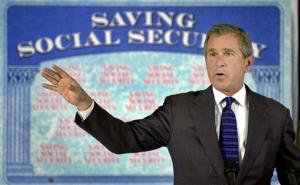 The NYT leads with word that Social Security is gearing up to publicize the system's allegedly dire finances. The agency has a tactical plan to promote the notion that without immediate action, Social Security will go bankrupt. Agency officials say that educating the public is part of their job, but some employees believe President Bush is using scare tactics to push the idea of private accounts. "Trust fund dollars should not be used to promote a political agenda," said one employee representative. We'll see if Congress agrees with the president that the nation's most successful social program cannot be saved without a radical overhaul.
- Arik
January 15, 2005
The Sad State of Indiana Basketball
 While the Hoosiers suffer defeat after miserable defeat in the post-Knight era, is Indiana no longer the home of basketball?
-
Indiana University Coach Mike Davis was sitting at his breakfast table one morning last week when his 5-year-old son, Antoine, walked into the kitchen. "Daddy, I had a dream last night," Antoine told him. "I was playing for Purdue and dunked."
"A dream?" Davis asked his son. "That sounds like a nightmare."
Many Indiana residents would argue that playing for either the Hoosiers or Boilermakers would be a nightmare these days. The state that produced legendary figures such as coaches John Wooden and Bob Knight and whose passion for high school basketball was the backdrop for the movie "Hoosiers" is experiencing an unprecedented malaise in its favorite game.
"It's a damn mess," Purdue University Coach Gene Keady said. "We had the magic and we lost the magic."
With a widely anticipated college basketball season in full swing, Indiana's two traditional powers are on the outside looking in. Indiana and Purdue have losing records entering their game here today at Purdue's Mackey Arena, and interest in high school basketball, the state's other passion, also is waning considerably. While the colleges' struggles can be attributed at least in part to changes at the top, interest in the high school game began to dissipate when the state abandoned its one-class, everybody-in, winner-takes-all postseason tournament in favor of a system that divided schools by size.
Basketball in Indiana has long been more than a game. James Naismith, who invented the sport in Springfield, Mass., more than a century ago with a soccer ball and two peach baskets, once said that "basketball may have been born in Massachusetts, but it grew up in Indiana."
From Wooden (he was a Purdue all-American long before he became the "Wizard of Westwood" at UCLA) to Rick "the Rocket" Mount (the first high school player to appear on the cover of Sports Illustrated) to Damon Bailey (the first eighth-grader featured in SI), Indiana's best high school and college players became state-wide icons.
Let's hope Indiana can get it together - after all, if the Pacers are the only alternative for Indiana basketball, then we've all got a lot of mourning to do.
- Arik
January 14, 2005
Apple's PC Strategy & Big Profits Underline Macworld, Dell Declares iPod a Fad, While Creative Says New Shuffle a Big Let Down
-
Apple CEO Steve Jobs is taking the concept of "mini" to the Mac computer and a flash-based iPod.
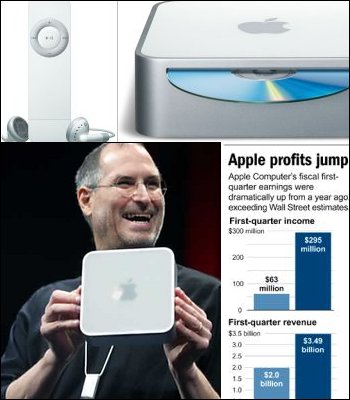
During his keynote Tuesday at the Macworld conference and expo here, Jobs introduced a Mac computer that almost fit into the palms of his hands and that is Apple Computer Inc.'s latest answer for Windows users wanting to switch platforms.
"People understood the iPod mini, and I think they'll understand the Mac mini as well," Jobs said, referring to the 4 GB iPod launched at last year's Macworld.
The Mac mini will be available Jan. 22 in two models that start at $499, Jobs said. It comes without a monitor, keyboard or mouse, instead connecting with a user's existing equipment.
"We supply the computer, and you supply the rest," Jobs said. "We want to price this Mac so that people thinking of switching will have no more excuses."
Apple also is making the iPod even smaller than the iPod mini. Jobs launched the iPod shuffle, Apple's entry into the flash player market that incorporates its song-shuffling technology.
The iPod shuffle began shipping from factories Tuesday. On one end, it includes a USB 2.0 connector that also can be fitted with a lanyard for wearing it around one's neck.
"It is smaller than most packs of gum, and it weighs about same as about four quarters, or under one ounce," Jobs said.
The iPod shuffle comes in a 512 MB and a 1 GB model, priced at $99 and $149, respectively. Along with digital music, it can double as a USB drive and lets users determine how much memory to devote to each function, Jobs said.
Not everything was about miniaturization during Jobs' keynote. He also introduced Apple's productivity suite replacement for AppleWorks in a move that could pit Apple more directly against Microsoft Corp.'s Office suite for the Mac.
The iWork suite builds atop Apple's existing Keynote software for creating presentations by also providing a word processor called Pages. AppleWorks had become outdated because it was developed before the move to Mac OS X and long before Apple's digital-media suite, called iLife, existed.
"We created [iWork] from the ground up to take full advantage of Mac OS X and iLife," Jobs said.
iWork is slated for release on Jan. 22, with pricing at $79. It will include Keynote 2, an update that adds 10 new design themes and expanded animation features.
As for Pages, Jobs called it "word processing with an incredible sense of style."
That's because it not only provides standard word-processing functions but also comes with 40 Apple-designed templates for creating everything from a form letter or brochure to a family newsletter or menu, Jobs said.
In a demonstration, Phil Schiller, Apple's vice president of worldwide product marketing, showed how the templates open with placeholder text, graphics and folders and let users grab photos from iPhoto to insert them into documents. The templates also automatically adjust when users add, move or resize elements.
While announcing few new features for the operating system, he recapped the major changes coming in Tiger, including the Spotlight search capability, Dashboard and an update to QuickTime 7 media player.
Jobs demonstrated some of the information "widgets" planned for Dashboard. Dashboard is a feature that lets user toggle to a display of a range of small applications that can display common information or perform quick tasks.
The widgets included a world clock, dictionary, thesaurus, calculator, measurement converter, and flight and stock trackers. Hundreds of third parties also are creating Dashboard widgets, such as an eBay Inc. auction tracker that Jobs displayed.
"This has evolved into something we think will be a big hit in Tiger," Jobs said of Dashboard.
Discussing Tiger's much-anticipated Spotlight search capabilities, Jobs downplayed the raft of other desktop-search tools hitting the market such as those from major search companies like Google Inc., Yahoo Inc. and Microsoft Corp.s' MSN unit.
Spotlight's key difference, Jobs said, is that it is integrated throughout the Mac OS and into applications such as Apple Mail.
"They're great, but they're nowhere near as great as Spotlight because when you build it into the core OS, you can do things you can't do with a tool sitting to the side," Jobs said.
Meanwhile, stores will open an hour early to support introduction of the new $499 Mac Mini this coming Saturday, when they're introduced, and this might just get PC users like me to make the final switch:
-
That's the hope of Apple whose approximately 100 retail stores are opening an hour early on Saturday as the highly touted and low-priced Mac mini computer and iPod Shuffle portable music player go on sale.
Analysts are betting Apple's mini might just tempt users of rival Microsoft Corp.'s Windows to switch operating systems and go with the Mac and its Mac OS X operating system.
That transition hasn't happened yet despite Apple's "Switch" advertising campaign and in spite of the success of the iPod portable digital music players. More than 10 million have been sold since their introduction more than three years ago. Apple's portion of the worldwide PC market was 2 percent in the fourth quarter, according to preliminary figures from market research firm IDC.
"I believe the Mac mini is actually going to have more of an impact on Apple's market share position than their digital music efforts have so far," said IDC analyst Roger Kay.
Echoing the sentiment, Needham & Co. analyst Charlie Wolf wrote to clients: "The iPod's only failure so far has been its inability to stimulate meaningful purchases of Macintoshes."
With the Mac mini, that could change, and Wolf now estimates that 11 percent of those who have iPods and PCs that use the Windows operating system may shell out the $499 for a Mac mini now that they're available. Before the mini, Wolf had predicted 4 percent could switch.
Apple is opening its stores at 9 a.m. local time on Saturday. Store personnel contacted by Reuters in California, Colorado, Florida and New Jersey said they had been receiving a slew of calls about the mini and the Shuffle.
The Shuffle is Apple's smaller, cheaper version of its market-leading iPod and holds either 120 or 240 songs, costing $99 and $149, respectively.
"Some of this is true demand, but I think some of it's orchestrated, too, by Apple," said Stephen Baker, an analyst at NPD Group.
Apple has long been criticized for pricing itself out of the mainstream with its sleek products, but, now, Apple is changing course.
"The Mac mini opens up lower price points for people who would like to try the Mac platform, and that's long been one of my chief complaints about Apple—the high price," IDC's Kay said.
Steve Jobs, co-founder and chief executive of Cupertino, California-based Apple, said last week, "People who are thinking of switching will have no excuse." Jobs introduced the mini, which comes without a display, keyboard or mouse, at the company's annual trade show on Jan. 11.
Starting at $499, the mini, which is 6.5 inches square and 2 inches tall, is Apple's cheapest computer ever.
Some analysts have said that Apple's blow-out fourth-quarter results offered clear proof of the "halo effect" of iPod sales boosting Mac sales. Kay said he was not so sure.
Apple's fourth-quarter share of the worldwide and U.S. PC markets rose by a mere 0.1 percentage point each, to 2.0 percent and 3.4 percent, respectively.
"That's not a whole lot of share gain, but will the Mac mini help them gain some more?" Kay asked. "I would certainly think so."
But will the new products really gain traction in the marketplace? eWeek's David Coursey thinks so:
-
Here's my immediate reaction:
Mac mini: A $499 Mac ought to be the ultimate "switcher" box. Not that most Windows users actually switch to Macintosh, but many have bought a Mac for use at home. Buy a KVM (keyboard/video/mouse) switch, and the Mac mini can share mouse, keyboard and screen with your PC. This gets users a Mac without a lot of work and for a minimal investment.
Having this machine in the Apple product line allows Mac fanatics to tell their Windows friends that instead of upgrading their Windows machine, they should add a Mac to their desktop or home—and save money in the process.
The downside of the Mac mini may be performance in the graphics-intensive applications toward which Mac users tend to gravitate. I want to see an independent, hands-on review before committing to a final score, but as a preliminary grade, I think an "A" is right on target. I'm about ready to pull out my credit card for this one.
iWork: So, this is the Microsoft Office competitor Apple was rumored to be releasing? Clearly, that's not what this is. But I am looking forward to using iWork nevertheless. First, Keynote is a very useful presentation package, and I've been looking forward to a new version.
Second, the Pages word processor is intended to be a tool that offers more layout options than a word processor without the complexity of desktop publishing. That's a need I often have. For $79, I'd be willing to take a chance on this one. Meanwhile, the Office competitor, if it exists, must wait for another day. A B+ seems appropriate.
iLife '05: Maybe there are features here that I really want and would be willing to pay for, but the Apple Web site isn't very convincing. This looks like Apple's bid to sell customers annual releases of popular software with only minor changes to functionality.
Nevertheless, keep the price low enough, $79 in this case, and some customers will buy. It's hard to upgrade applications whose main virtues are simplicity and a limited feature set, but Apple seems to manage. This one gets a C+, but might be hard-pressed to do better.
iPod shuffle: When I bought my first iPod, it was because the MP3 players available at the time were low-capacity and took a long time to fill with music, thanks to a low connection speed to the desktop.
The iPod Shuffle is low capacity, compared with a "real" iPod, but fortunately it connects at swift USB 2.0 speeds, as well as at the much slower USB 1.1 rate used by the first MP3 players.
Apple is trying to make a virtue out of the fact that the device lacks a screen by making it sound like random playback is an advantage. I don't think so. But I am sure they will sell a zillion of these—just not to me. I give it a C-.
I am sure those still washed in the glow of Steve's keynote will rate all of these products, and especially the iPod shuffle, a full letter grade or higher than I have. But I've been following Apple long enough (and have become cynical enough) that I think I've called these about right.
And now, I am off to order my new Mac mini. Yes, sometimes even I succumb—and at a distance, too.
As for the ongoing controversy over the Think Secret fan site being sued by Think Different, Jim Nash from InformationWeek summed it up nicely in its daily newsletter today:
-
There are missteps that we all make because we don't see something coming, and there are missteps that some of us make because we don't see the big picture. Apple Computer appears to be making the latter in suing a 19-year-old Internet entrepreneur who has the audacity to be a successful journalist.
Harvard undergrad Nicholas M. Ciarelli has for six years operated the Think Secret site, at which he posts product information before Apple wants it released. This is a game that business journalists play with vendors, and more publicity-savvy execs know how to play it well: They do everything in their considerable power to keep secrets secure. When reporters still get the goods, the smarter execs shrug it off and move on.
When Apple subsidizes Macs for schools, it's buying loyalty and, it hopes, market share. But suing a member of that target customer base for being a (perhaps overzealous) Mac enthusiast may send the wrong message to the people Apple wants as customers.
Let's hope that doesn't get in the way of success for an innovative product line. The ThinkSecret.com lawsuit, however, continues to percolate, as 19-year-old Nick Ciarelli seeks out help for his legal defense, including saying, "is that so wrong" to leak previews of tech products, like the rest of the press does with great regularity:
-
Is the technology press abandoning one of its wounded on the battlefield? Where is the righteous indignation on behalf of Nicholas Ciarelli aka Nick dePlume? Mr. Ciarelli is the 19-year old publisher of ThinkSecret.com, a Web site that Apple is suing over an article about a once top-secret $499 Mac. Mr. Ciarelli, a Harvard University student of Cazenovia, N.Y., is now looking for free legal help. He is seeking protection under the First Amendment, although he is not named as a defendant. Going after a member of the press could become a public relations problem for Apple. Technology companies are no strangers to this kind of mildly aggressive journalistic scrutiny.
The technology press has made its bones on breaking stories about not-yet-released products. To a large extent, that's the definition of a breaking story in the tech press. According to Apple, the company is protecting its right to "innovate and surprise and delight people with great products," so they reserve their right to secrecy. But there is also such a thing as freedom of the press. And in the tech world, the two have coexisted fairly well until now. All of the dailies ran the bare bones, just-the-facts wire story of the lawsuit—no editorial comment, no in-house story. Maybe the technology press just needed a moment to catch its breath after having to cover two very exhilarating trade shows back to back.
Meanwhile, Apple's MP3 player rivals were dissing the champ of the category after the screenless Shuffle was announced:
-
The chief executive officer of Creative, the maker of one of the leading contenders to the iPod's crown, has called the iPod shuffle "a big let down", accusing Apple of rehashing "a four year old product… worse than the cheapest Chinese player."
In an interview with Channel NewsAsia, Creative CEO Sim Wong Hoo, claimed the company was not worried about the potential threat posed by Apple's entry into the flash music player market. He called the iPod shuffle "[like] our first generation MuVo One product, without display, just have a shuffle feature."
And, Sim claimed, the product was not likely to impress other competitors. "I think the whole industry will just laugh at it, because the flash people -- it's worse than the cheapest Chinese player. Even the cheap, cheap Chinese brand today has display and has FM. They don't have this kind of thing, and they expect to come out with a fight; I think it's a non-starter to begin with."
According to Apple, the company sold over 4.5 million iPods over the quarter leading up to Christmas, double that of Creative's Zen player – the iPod's nearest competitor. Sim claimed the company was prepared to spend up to $100 million in marketing funds in order to catch up with the iPod.
Plus, there's no love lost between Apple and Dell, as Dell CEO Kevin Rollins called the iPod nothing more than a fad:
-
The chief executive officer of Dell has claimed that the success of the iPod amounts to "a fad", adding that Apple "isn't in the same league" as his own company.
In an interview with Silicon.com, Kevin Rollins claimed the product faced an uphill struggle to capitalize on the success of the iPod and sustain it into the future, drawing parallels with Sony's Walkman. "It's interesting the iPod has been out for three years and it's only this past year it's become a raging success. Well those things that become fads rage and then they drop off. When I was growing up there was a product made by Sony called the Sony Walkman – a rage, everyone had to have one. Well you don't hear about the Walkman anymore. I believe that one product wonders come and go. You have to have sustainable business models, sustainable strategy."
Rollins also claimed that Apple had "done a nice job" with the iPod, but was less impressed with the Mac mini. "It might take some [sales] here and there, but Apple's market share in the global computer business has really shrunk pretty far," he claimed. Despite the number of headlines grabbed by the product, Rollins added, Apple remains a niche player and "isn't in the same league" as Dell.
But all this pales in the glare of Apple's stellar financial results - my brother Derek curses the day I told him to buy AAPL - languishing around 20 a year ago it's in the low 70's today:
-
As the Mac faithful continue to pack the ongoing Macworld Expo in San Francisco, Apple Computer Inc. on Wednesday offered the public some further good news about the company's progress. Boosted by the success of the iPod, the company reported its highest-ever quarterly revenue and net income in its first fiscal quarter.
For the quarter, ended Dec. 25, Apple reported total revenue of $3.49 billion, up from $2.01 billion in the year-ago quarter, a leap of 74 percent. Analysts had forecast revenue of a bit over $3 billion. Apple's net profit grew even more: $295 million, compared with $63 million for the year-ago quarter.
The success of the consumer music player was the difference. Announced by CEO Steve Jobs in his Tuesday keynote address at Macworld, Apple sold about 4.6 million iPods during the quarter, a more than 500 percent rise over the same period last year.
Still, in a conference call with financial analysts Wednesday afternoon, Apple chief financial officer Peter Oppenheimer stressed the positive growth in computer sales.
He said the company shipped 1,046,000 Macintosh units, a 26 percent increase over the year-ago quarter.
The leaders in the CPU field were the iMac and iBook series aimed at consumers and education, up 101 percent and 35 percent compared with the year-ago quarter. Sales of the Power Macintosh G5 rose 7 percent over the previous quarter, while PowerBook G4 sales dropped 29 percent, despite a speed bump in the fall.
The executive said sales to the education market grew 11 percent, bringing its highest quarterly total for that market in seven years.
Questions regarding the success of a "halo," or multiplier effect for CPU sales from its success with the audio player, were posed by analysts. Apple has targeted these "switchers" from the Windows platform in the past several years.
While avoiding a direct answer on the subject, Oppenheimer pointed to the increasing number of such customers in Apple stores. In the quarter, more than 40 percent of Mac buyers in the stores were "new to the Mac," he said.
Best of luck to the Mac-faithful - competition, as we know, is good for innovation, so keep up the good work!
- Arik
January 13, 2005
FBI Virtual Case File = Total Disaster
 The 9/11 commission called a modernized FBI information network "critical to domestic security." But according to officials interviewed for the NY Times lead, "The bulk of the internal reports and documents produced at the [FBI] must still be printed, signed and scanned by hand into computer format each day." Members of the 9/11 commission, along with several senators and even Director Robert Mueller himself, expressed dissatisfaction with the mishandling of the system upgrade, which the FBI claimed would be ready by the end of 2004. (Only 10 percent of the system is now deployed.) The LA Times mentioned one fact the NYT didn't: Since the 9/11 attacks, the FBI has spent $581 million on the ill-fated project.
FBI Director Robert Mueller, members of 9/11 commission and other national security experts agree that success of the effort is critical to domestic security; but the bureau has been criticized for years for not developing a modern system like those developed years ago at Central Intelligence Agency and National Security Agency.
-
The third installment of the Federal Bureau of Investigation's Trilogy technology upgrade program--designed to improve the agency's ability to share information about terrorism and other threats--is looking like anything but a blockbuster. Its Virtual Case File system, the $170 million centerpiece of Trilogy's third phase, lacks the security and overall efficiency required to make it usable, an FBI spokesman says.
"There were inadequacies," an FBI spokesman says. Virtual Case File, originally scheduled for deployment in December 2003, has been plagued by technical problems as the FBI's information sharing needs have evolved over the past few years. In the wake of the Sept. 11, 2001, terrorist attacks, the ability to share information was highlighted as a weakness in the FBI and other agencies. While there were cultural and legal barriers to information sharing, the outdated nature of the FBI's IT systems was also brought to light and cited among the reasons.
The agency in 2001 commissioned government contractor Science Applications International Corp. to build Virtual Case File. The agency will pay the advisory firm Aerospace Corp. to investigate Virtual Case File's problems and determine whether any part of the project can be salvaged. The New York Times reported Thursday that the contract is worth $2 million.
SAIC doesn't accept all the blame for the problems. "The FBI modernization effort involved a massive technological and cultural change agencywide," Duane Andrews, SAIC's chief operating officer, said in a statement. "All parties involved have made mistakes in the way the Trilogy program was handled in the past."
SAIC said it delivered--and the FBI accepted--the first installment of the Virtual File System in December, in what it calls a change in FBI strategy to do the project in a "less-risky, incremental, phased-in" deployment rather than all at once. The FBI has had four different CIOs during the life of Trilogy, SAIC said, and 14 managers on the project that began in 2001, making it "incredibly challenging" to set system requirements.
Part of the problem appears to be that technology is moving faster than the FBI and its contractors. The FBI acknowledges in a document highlighting recent technology improvements that "the pace of technological innovation has overtaken our original vision for VCF, and there are now existing products to suit our purposes that did not exist when Trilogy began."
The FBI in June determined that Virtual Case File wasn't going to meet the agency's needs. Aerospace's job will be to evaluate the project as well as off-the-shelf software and applications designed by other federal agencies to determine how the FBI can best move forward with plans to give agents the ability to better share case-file information.
It hasn't been cheap and won't be getting cheaper anytime soon - an interesting parallel to a lot of the intelligence software deployments in the private sector that haven't planned for changes in needs and technology standards:
-
Since the attacks, Congress has given the FBI a blank check, allocating billions of dollars in additional funding. So far the overhaul has cost $581 million, and the software problems are expected to set off a debate over how well the bureau has been spending those dollars.
The bureau recently commissioned a series of independent studies to determine whether any part of the Virtual Case File software could be salvaged. Any decision to proceed with new software would add tens of millions of dollars to the development costs and render worthless much of a current $170-million contract.
Requests for proposals for new software could be sought this spring, the officials said. The bureau is no longer saying when the project, originally scheduled for completion by the end of 2003, might be finished.
FBI officials have scheduled a briefing today to discuss what a spokesman said was the "current status of FBI information technology upgrades."
A prototype of the Virtual Case File was delivered to the FBI last month by Science Applications International Corp. of San Diego. But bureau officials consider it inadequate and already outdated, and are using it mainly on a trial basis to glean information from users that will be incorporated in a new design.
Science Applications has received about $170 million from the FBI for its work on the project. Sources said about $100 million of that would be essentially lost if the FBI were to scrap the software.
"It would be a stunning reversal of progress," Sen. Judd Gregg (R-N.H.), the chairman of the Senate appropriations subcommittee that oversees funding for the FBI, said in an interview with the Los Angeles Times this week. "If the software has failed … that sets us back a long way.
"This has been a fits-and-starts exercise, and a very expensive one for a very long time," he added. "There are very serious questions about whether the FBI is able to keep up with the expanding responsibility and the amount of new dollars that are flowing into it. We have fully funded it at its requested levels."
A spokesman for Science Applications, Ron Zollars, said via e-mail that the company had "successfully completed" delivery of the initial version of the Virtual Case File software last month. He declined to comment further.
The stripped-down prototype will be running for three months. The bureau plans to then "shut it down, take all the lessons learned and incorporate them in a future case management system," a person familiar with the bureau's plans said.
Science Applications will apparently be no part of that future: Its contract expires at the end of March, and there were no plans to renew it, sources said.
That the software may have outlived its usefulness even before it has been fully implemented did not surprise some computer experts.
An outside computer analyst who has studied the FBI's technology efforts said the agency's problem is that its officials thought they could get it right the first time. "That never happens with anybody," he said.
Some sources sympathetic to the FBI defended the process, and said that what has been learned in designing the software has given the bureau valuable design and user information.
The replacement software may even be called the Virtual Case File, although it is unlikely to bear much resemblance to the product that is being rolled out to about 300 users testing the prototype in New Orleans and Washington. The prototype's main feature allows users to prepare documents and forward them in a usable form.
Eventually, the FBI expects to have software with added features for managing records, evidence and other documents, along with the ability for users to collaborate on documents and share information online.
The move is being engineered by Zalmai Azmi, who has been the FBI's chief information officer for the last year. People familiar with his work say Azmi recognizes that the change in direction is likely to generate political heat but that it will serve the bureau better in the long run.
The development illustrates the problems in keeping up with rapidly changing technology that confront any business, as well as the changing mission of the FBI since the Sept. 11 attacks, among other issues.
Meanwhile, the software troubles continue for the FBI in the wiretapping arena as well:
-
The FBI has effectively abandoned its custom-built Internet surveillance technology, once known as Carnivore, designed to read e-mails and other online communications among suspected criminals, terrorists and spies, according to bureau oversight reports submitted to Congress.
Instead, the FBI said it has switched to unspecified commercial software to eavesdrop on computer traffic during such investigations and has increasingly asked Internet providers to conduct wiretaps on targeted customers on the government's behalf, reimbursing companies for their costs.
The FBI performed only eight Internet wiretaps in fiscal 2003 and five in fiscal 2002; none used the software initially called Carnivore and later renamed the DCS-1000, according to FBI documents submitted to Senate and House oversight committees.
The FBI, which once said Carnivore was ``far better'' than commercial products, said previously it had used the technology about 25 times between 1998 and 2000.
The FBI said it could not disclose how much it spent to produce the surveillance software it no longer uses, saying part of its budget was classified. Outside experts said the government probably spent between $6 million and $15 million.
The congressional oversight reports were obtained last week under the U.S. Freedom of Information Act by the Washington-based Electronic Privacy Information Center, a civil liberties group that criticized the surveillance software after it was first disclosed in 2000.
FBI spokesman Paul Bresson said the bureau moved to popular commercial wiretap software because it was less expensive and had improved in its ability to copy e-mails and other communications of a targeted Internet account without affecting other subscribers.
``We see the value in the commercially available software; we're using it more now and we're asking the Internet service providers that have the capabilities to collect data in compliance with court orders,'' Bresson said.
The FBI said last week it was sending back to the drawing board its $170 million computer overhaul, which was intended to give agents and analysts an instantaneous and paperless way to manage criminal and terrorism cases.
Experts said the life span of roughly four years for the bureau's homegrown surveillance technology was similar to the shelf life of cutting-edge products in private industry.``It's hard to criticize the FBI trying to keep pace with technology,'' said James Dempsey of the Washington-based Center for Democracy and Technology. ``There is just a huge amount of innovation and development going on in the private sector.''
Henry H. Perritt Jr., who led an oversight study of Carnivore in 2000 for the Justice Department, said the FBI originally built its own surveillance system because commercial tools were inadequate. Perritt, a professor at the Chicago-Kent College of Law, said he was unaware of any commercial wiretap software that includes audit features robust enough to convince a federal judge that e-mails from innocent Internet users weren't captured by mistake.
``You'd like to have a package that supervisors within a field office and in Washington could do an audit and make sure they're using the tools compliant with the court order,'' Perritt said.
The FBI laboratory division, which produced Carnivore, was headed by Donald M. Kerr, who left the FBI in August 2001 to become the CIA's chief gadget-maker as head of its science and technology directorate. Kerr told lawmakers in 2000 that Carnivore was ``far better than any commercially-available sniffer.''
Such are, apparently, the risks of deploying intelligence software in the national intelligence community... let's hope the same isn't mirrored in the private sector.
- Arik
January 12, 2005
Search Competitors Gaining on Google
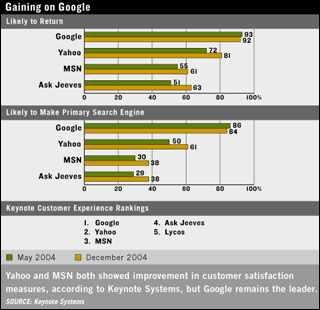 While Google still reigns supreme, its competitors are on the rebound:
-
Google’s competitors are showing signs of becoming, well, competitive. Yahoo, MSN, and Ask Jeeves search engines are satisfying more customers, according to a study released by market researcher Keynote Systems, and a growing minority say they plan to make one of those their first stop. This means the race could finally be on in a market where “Google” is synonymous with “search.”
Google is proof that helping users tackle something as simple as finding information online can unlock much bigger opportunities. Yahoo unveiled its own search technology last February, and Microsoft joined the fray last month. Keynote’s study shows MSN pleased users by separating its paid sponsored results from its search results, bringing it in line with Google and Yahoo. That separation has led to fewer advertisement clicks, but more satisfied users that say they will return, said Bonny Brown, director of research and public services at Keynote, based in San Mateo, California.
Some other advances could have influenced the results: Yahoo followed Google and MSN into desktop search earlier this week, and both Yahoo and Ask Jeeves launched local search services, as well as short cuts or smart searches to try to give users more relevant results. My Yahoo and MyJeeves have made searches more personal. MSN also launched MSN Search Beta in November, but it was not used in the Keynote study, which involved 2,000 people selected at random. Four-hundred spent 45 minutes to an hour performing a series of tasks on one site.
Google clearly has a long head start. But the others have been making gains. According to the studies, fewer Google testers—84 percent compared with 86 percent during the first study in May—said they were likely to make Google their primary search. Sixty-one percent of those who used Yahoo said they were likely to make it their primary search, compared with 50 percent in May. MSN went from 30 percent to 38 percent in that category, and Ask Jeeves grew from 29 percent to 38 percent.
But, Google's rivals have a long way to go to catch back up. While actual search results were pretty close, the perceived quality of results leaned toward Google, so that even though they're working on a similar feature set, searchers prefer Google for the customer experience, and that's more about branding than technology. Daniel Read, product management VP at Ask Jeeves said, “We think the technology gap has more or less closed now amongst the four key players. Now the brand gap is what needs to close and you can see that is happening now.” After Google in the overall rankings were Yahoo in second, MSN in third, Ask Jeeves fourth and Lycos fifth. Local search appears to be an opportunity for Yahoo:
-
For all three top Google competitors, the future is looking brighter. That's because they all made strides against Google in key indicators of future usage, Keynote found.
When it comes to the likelihood of users to return to a search site, the likelihood for Yahoo increased 9 percentage points since May to 81 percent. The same measure increased 6 percentage points to 61 percent for MSN and rose 12 percentage points to 63 percent for Ask Jeeves, Keynote reported.
A similar pattern was seen in consumers' likelihood to make the sites their primary search engines. Google still led, with 84 percent of consumers likely to make it their primary site. But Yahoo jumped 11 percentage points to 61 percent in that category, while MSN increased 8 percentage points to 38 percent. Ask Jeeves also reached 38 percent, a 9 percentage point jump from May.
The shifting search numbers point to the tenuous nature of loyalty in the search market. Keynote estimates that half of consumers will turn to another search engine if their expectations are not met.
In the hotly contested local search segment, Yahoo showed strength. All of the major engines, except Microsoft Corp.'s MSN division, have launched sites in the past year for finding business listings and other geographic-specific information.
Yahoo gained enough traction in local search to tie with Google in that category of the study, according to Keynote. That gain came even as 22 percent of users complained that search engines in general are not returning relevant or well-ranked local information.
A shift in the way it deals with paid listings seemed to have paid off for MSN. In July, it reduced the number of sponsored listings appearing atop Web search results and altered design elements to better distinguish paid listings.
As always, competition is a good thing - let's hope the trend continues and a balance of power in the search arena might be sustainable.
- Arik
January 11, 2005
BenQ's Treo Killer
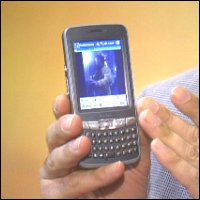 One big product announcement from the Consumer Electronics Show was from BenQ, in the form of its GSM Pocket PC P50, which CNet thinks could just be enough to make otherwise erstwhile Treo 650 buyers reconsider their purchase, because of the integrated Wi-Fi and bigger memory:
-
The product: BenQ may not be well known for its cell phones or its smart phones, but we're betting that that's about to change with the introduction of its P50 series. This Windows Pocket PC smart phone features an integrated keyboard, a 2.8-inch vibrant color screen (262,000 hues), and a 1.3-megapixel camera in a compact, candy bar style. But wait, there's more: It has 64MB of memory, integrated Bluetooth and Wi-Fi, and audio playback (WAV, MP3, WMA, and more). Other goodies include:
- Quad-band GSM 850/900/1800/1900; GPRS; world phone
- SDIO/MMC expansion slot
- Video recording (MPEG-4, WMV, .3GP)
- E-mail, text, and multimedia messaging
- Speakerphone and conference calling
- 64-chord polyphonic ring tones
- Rated talk time of 3 to 5 hours and standby time of 120 hours
The prospects: Can we say Treo killer? Yes, it's been noted before, but we think the BenQ P50 series has what it takes to battle the current smart phone king. The memory and Wi-Fi alone give this puppy an edge over the Treo 650, but we'll have to wait and see how this mobile actually performs in our tests. The P50 series will be available in late Q2 2005, but pricing and carrier have not yet been determined.
I'm still holding out to see how Cingular executes on the Treo 650 - if they fumble the adaptation to the GSM network, it could be enough to make me change my purchase plans.
- Arik
January 10, 2005
Red Herring’s 2004 IPO Market Robust
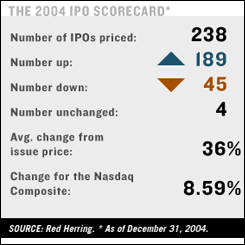 Google was neither the biggest, nor the sharpest pop, but 2004 represented a big rebound in IPO activity, according to Red Herring:
The 10 largest IPOs of 2004
· Genworth Financial ($2.83 billion)
· Assurant ($1.76 billion)
· Semiconductor Mfg International ($1.71 billion)
· Google ($1.67 billion)
· Freescale Semiconductor ($1.58 billion)
· China Netcom Group ($1.03 billion)
· Dex Media ($1.01 billion)
· Assured Guaranty ($882 million)
· NAVTEQ ($880 million)
· DreamWorks Animation SKG ($812 million)
Top 10 sharpest opening-day gains of 2004
· JED Oil (up 103.6 percent)
· Arbinet-thexchange (up 65.7 percent)
· Las Vegas Sands (up 60.6 percent)
· Shopping.com (up 60 percent)
· MarketAxess Holdings (up 59 percent)
· salesforce.com (up 56.4 percent)
· Eyetech Pharmaceuticals (up 54.3 percent)
· PortalPlayer (up 51.8 percent)
· 51job (up 51.1 percent)
· Cogent Systems (up 49.8 percent)
Top IPO industrial sectors for 2004
Companies from 52 industrial sectors priced IPOs during 2004.
Among the top 10 sectors were:
· Technology (including computer, semiconductor, software, and technology): 49 IPOs that raised $8.4 billon. The average opening-day gain was 17.4 percent. On December 31, the average gain was 50.83 percent from their initial offering prices. The 52-week Dow Jones Technology Index was up 1.37 percent.
· Pharmaceuticals: 25 IPOs that raised $1.5 billon. Average opening-day gain: 9.87 percent. On December 31, the average gain from their initial offering prices was 9.42 percent. The 52-week Dow Jones Pharmaceutical Index was down 10.2 percent.
· Internet: 19 IPOs that raised $3.1 billon. Average opening-day gain: 21.96 percent. Average gain at year-end from their initial offering prices: 87.2 percent. The 52-week Dow Jones Internet Services Index was up 60.8 percent.
· Medical equipment: 18 IPOs that raised $1.1 billon. Average opening-day gain: 10.7 percent. On December 31, the average gain was 28.5 percent from their initial offering prices. The 52-week Dow Jones Medical Equipment Index was up 13.7 percent.
· Semiconductors: 15 IPOs that raised $1.1 billon. Average opening-day gain: 7.69 percent. Average gain at year-end from their initial offering prices: 6.03 percent. The 52-week Dow Jones Semiconductor Index was down 21.7 percent.
· The Nasdaq Composite Index was up 8.59 percent for the year.
- Arik
January 09, 2005
Exergaming & Exertainment at CES Cardio PlayZone
 If you’ve decided to lose a few pounds as your New Year’s Resolution, but don’t want to give up video games, there’s a way to do both, as demonstrated at last week’s Consumer Electronics Show in Las Vegas:
-
Company executives insist that "exergaming" or "exertainment" — the marriage of physical exercise and video gaming — is becoming a hot new niche, and the most bullish aficionados say it might even help reduce the nation's obesity epidemic.
The four-day International Consumer Electronics Show, which ended Sunday, sponsored its first-ever "Cardio PlayZone" section for fitness-themed companies.
The PlayZone was tucked into a back corner of a tent outside the main convention center, far from the gargantuan exhibits by Samsung, Sony, Panasonic and other popular brands.
Although scents reminiscent of a gym sometimes wafted out of the zone, the jam-packed area was popular with retailers and analysts. Six exhibitors — many startups new to CES — showed off digital putting greens, optical sensors in miniature dance floors, biofeedback devices and cutting-edge workout contraptions.
One race car simulation contraption — "Kilowatt SPORT" from Laurel, Md.-based startup Powergrid Fitness Inc. — looked similar to a NordicTrack cross-country ski machine hooked up to a wide-screen plasma television.
Moving the hand controls while trying to stand up straight on the $800 machine requires extensive flexing of the muscles in the arms, back, abdominal area and thighs.
But most of the PlayZone devices, often played on PlayStations and Xboxes, didn't feel like exercise at all — exactly what many exertainment companies like to hear.
"The most common question I get is, 'How is this exercise? I just don't see how this is a workout,'" said Abigail Whitting, customer support manager for Kilowatt, which won a CES innovation award. "But it will tone you. It is a workout."
Some exertainment executives say their gizmos can help trim the nation's expanding waistline — especially among children, who might be tricked into working out if they think they're merely playing a video game.
According to the Centers for Disease Control and Prevention, 16 percent of boys and 14.5 percent of girls ages 6 to 11 were obese in 1999 and 2000, the latest years studied. That compares with 4.3 percent of boys and 3.6 percent of girls from 1971 to 1974. A sedentary lifestyle was a big contributor to the increase, the CDC said.
"If anything can get your kids off the couch, this is it," said Shawn Clement, North American sales manager for Electric-Spin Corp., the Canadian maker of the $249 "Golf LaunchPad." "The whole idea is to get physical, not get lazy."
LaunchPad includes a small putting green with optical sensors within the turf and a tethered, regulation-weight ball that players knock off a standard tee. Players use their own clubs.
Its software has a swing analysis to measure the ball's speed, curve path and other statistics based on the club's trajectory. Serious players may disconnect the tether and use a real ball at an outdoor course, then get real-time analysis of each swing from a laptop computer.
"This is a great way to promote activity," Clement said. "It's not just your average video game."
But medical experts are skeptical. Although they applaud manufacturers for getting people off the couch, they caution against relying on technology alone to slim and tone the record number of out-of-shape Americans. They say individuals, communities, private industry and governments should work together to tackle the problem.
"These video games are certainly helpful but they're not going to solve the obesity epidemic because it's simply too overwhelming," said Frank Hu, a professor of nutrition and epidemiology at Harvard.
Hu authored a study published last month of 116,500 women, finding that people who were physically active but obese were almost twice as likely to die as those who were both active and lean. The Harvard report contradicted a popular notion that exercise alone — regardless of weight or diet — is enough to maintain a healthy lifestyle.
But experts' pessimism didn't dampen enthusiasm of Jason Enos, product manager for Konami Digital Entertainment, who soaked through his T-shirt after hours of demonstrating his company's smash hit, "Dance Dance Revolution." Players tap their feet to the correct circle on a floor pad, based on cues on the screen.
Dancing and golf are alright, but they need a version of “Halo” for the XBOX to get me in.
- Arik
January 08, 2005
Wither The New York Times?: Life in the Era of News as Product or Credibility as Service

-
Since 1896, four generations of the Ochs-Sulzberger family have guided The New York Times through wars, recessions, strikes, and innumerable family crises. In 2003, though, Arthur Ochs Sulzberger Jr., the current proprietor, faced what seemed to be a publisher's ultimate test after a loosely supervised young reporter named Jayson Blair was found to have fabricated dozens of stories. The revelations sparked a newsroom rebellion that humiliated Sulzberger into firing Executive Editor Howell Raines. "My heart is breaking," Sulzberger admitted to his staff on the day he showed Raines the door.
It turns out, though, that fate was not finished with Arthur Sulzberger, who also is chairman of the newspaper's corporate parent, New York Times Co. The strife that convulsed The New York Times's newsroom under the tyrannical Raines has faded under the measured leadership of his successor, Bill Keller, but now its financial performance is lagging. NYT Co.'s stock is trading at about 40, down 25% from its high of 53.80 in mid-2002 and has trailed the shares of many other newspaper companies for a good year and a half. "Their numbers in this recovery are bordering on the abysmal," says Douglas Arthur, Morgan Stanley's (MWD.) senior publishing analyst.
Meanwhile, the once-Olympian authority of the Times is being eroded not only by its own journalistic screw-ups -- from the Blair scandal to erroneous reports of weapons of mass destruction in Iraq -- but also by profound changes in communications technology and in the U.S. political climate. There are those who contend that the paper has been permanently diminished, along with the rest of what now is dismissively known in some circles as "MSM," mainstream media. "The Roman Empire that was mass media is breaking up, and we are entering an almost-feudal period where there will be many more centers of power and influence," says Orville Schell, dean of the University of California at Berkeley's journalism school. "It's a kind of disaggregation of the molecular structure of the media."
Can the Times adapt? It appears to be working on doing just that:
-
New York Times Digital (which includes Boston.com as well as NYTimes.com) netted an enviable $17.3 million on revenues of $53.1 million during the first half of 2004, the last period for which its financials have been disclosed. All indications are that the digital unit is continuing to grow at 30% to 40% a year, making it NYT Co.'s fastest-revving growth engine.
Advertising accounts for almost all of the digital operation's revenues, but disagreement rages within the company over whether NYTimes.com should emulate The Wall Street Journal and begin charging a subscription fee. Undoubtedly, many of the site's 18 million unique monthly visitors would flee if hit with a $39.95 or even a $9.95 monthly charge. One camp within the NYT Co. argues that such a massive loss of Web traffic would cost the Times dearly in the long run, both by shrinking the audience for its journalism and by depriving it of untold millions in ad revenue. The counterargument is that the Times would more than make up for lost ad dollars by boosting circulation revenue -- both from online fees and new print subscriptions paid for by people who now read for free on the Web.
Sulzberger declines to take a side in this debate, but sounds as if he is leaning toward a pay site. "It gets to the issue of how comfortable are we training a generation of readers to get quality information for free," he says. "That is troubling."
What's a platform agnostic to do? The New York Times, like all print publications, faces a quandary. A majority of the paper's readership now views the paper online, but the company still derives 90% of its revenues from newspapering. "The business model that seems to justify the expense of producing quality journalism is the one that isn't growing, and the one that is growing -- the Internet -- isn't producing enough revenue to produce journalism of the same quality," says John Battelle, a co-founder of Wired and other magazines and Web sites.
Today, Sulzberger faces an even bigger challenge than when he took charge of the Times in the mid-1990s. Can he find a way to rekindle growth while preserving the primacy of the Times's journalism? The answer will go a long way toward determining not only the fate of America's most important newspaper but also whether traditional, reporting-intensive journalism has a central place in the Digital Age.
So, we’ll see if the Gray Lady can bring the ship about and adapt. After all, NYT isn’t really selling the news – its real product is credibility.
- Arik
January 07, 2005
Taser vs. Stinger: Troubled Stun-Gun Maker Defends Against Competitor Amid Insider Selling Rumors

Then again, Taser has had a rough time of things recently. Amnesty International estimated in a November 30 report that Tasers contributed to the deaths of more than 70 people. Some medical experts say Taser shocks might trigger heart failure in cases where people are agitated, under the influence of drugs or have health problems. Taser says its guns are not lethal.
Taser said Stinger makes claims about being certified by the Bureau of Alcohol, Tobacco and Firearms, as well as claims that its device was the first ATF-certified weapon. Taser said the ATF does not certify less-lethal weapons, it regulates them, and also said it now owns a product that has been regulated by the ATF since the 1970's. Stinger's Robert Gruder, said his company believes Taser's claims serve to give Stinger more legitimacy in the marketplace. "We think these allegations are not only fictitious, but ridiculous," Gruder said. Taser also alleges that Stinger made false claims about being listed on a Nasdaq market, about its patent, its corporate history, as well as other aspects of its products' performance.
My favorite barb was, Gruder’s line "If he thinks we have a fictitious gun, I'd be happy to challenge him to a duel with our fictitious gun at 30 feet," referring to the superior range of his product versus the Taser product. "This just proves that Taser's management considers Stinger Systems a competitive threat. I would be happy to publicly demonstrate our weapon against the Taser at any time. We stand by our claims. Taser is just trying to impede competition." Here’s more from Stinger’s hometown media:
-
Stun-gun producer Stinger Systems Inc. is countering legal claims by Taser International Inc., which has accused the Charlotte company of making misleading statements about Stinger products.
"We intend to aggressively and vigorously defend our weapon and our company in the media, the trade press and in the courts from Taser's allegations, which are clearly aimed at silencing and stifling a competitive marketplace," says Robert Gruder, Stinger chief executive.
Toward that end, video footage of the company's flagship product, the Stinger, was broadcast Tuesday night in a news report by WSOC-TV, the ABC affiliate in Charlotte.
That report "unequivocally proves both the existence and operation of our weapon, contrary to allegations issued by Taser's management," Gruder says.
Taser recently filed a lawsuit against Stinger in U.S. District Court, contending the local company is using false advertising and unlawful patent marking in violation of federal statutes.
Among its allegations, Scottsdale, Ariz.-based Taser says Stinger is falsely claiming its products are certified by the Bureau of Alcohol, Tobacco and Firearms and its facilities are ISO 9001 certified.
Both companies make stun guns and other nonlethal weapon systems for use by law-enforcement agencies and other customers.
Stinger's ads use false information to claim its products are better - and less expensive - than Taser's, the complaint contends.
In a press release, Gruder maintains Stinger's products are viable and says Taser's claims are off target.
"We look forward to providing the law-enforcement community a choice in projectile stun technology and believe, in the end, the better product will win," he says. "I believe that product will be the Stinger."
And, Stinger has certainly been going full-frontal in their assault on the market leader. Their Taser Trade-In program and other differentia make a compelling competitor into a real threat to Taser’s long-term business prospects. Stinger's single cartridge weapon is almost half the price of Taser's X26 and yet it shoots farther and is supposedly more accurate – according to the trade-in program, any organization using either the M or X series from Taser, will get a discount on the Stinger single cartridge gun of $100 and two cartridge model $150 if they make the switch to Stinger.
That is, if Taser survives that long - a story out on Friday mentions the SEC will begin looking into insider trading at the company, as the stock tumbled toward the end of an otherwise bubble-like year in 2004. My theory is, the execs bailed out, when Stinger competition looked like it'd hurt the stock and sold shares on privileged information to try and lock in some of their gains before the company tanked.
Shocking... I'm stunned. (Sorry, I just couldn't resist.)
- Arik
January 06, 2005
Blacklisted: The Struggle Over Retail Return Abuse
 Even as stores rung up a decent holiday sales season, they’re working hard to stop “thieves” that buy merchandise and then return it for apparently no good reason. In fact, it’s possible to see patterns in such people, both within store chains, as well as across the retail landscape and retailers have a new weapon in the fight against return-abuse:
-
The tactics vary, from “free customer rentals”—where someone purchases an outfit, wears it to an event, and then returns it the next day—to those who purchase two items that look similar but are priced very differently and then switch the boxes so they return the cheaper item and get the refunded money from the higher-priced item.
The issue is anything but trivial for retailers. A Harris Poll released this week found that 91 percent of consumers interviewed considered return policies and processes as important to their decision about where to make a purchase. It also found that almost one-fifth of U.S. adults have held onto unwanted merchandise four or more months, before trying to return it to the retailer, according to the survey sponsored by Newgistics.
“It’s an issue that a lot of consumers care about,” said Blake Zeff, communications director for U.S. Sen. Charles Schumer (D-NY), who “wants retailers to cut down on these (return) policies, these excessive policies.”
A California-based company called The Return Exchange looked at the situation and saw an opportunity to use a standard Windows-based SQL Server database approach to apply customized rules to identify customers whose buying patterns made them look like return abusers.
Here’s how it’s supposed to work: A customer walks in and attempts to return a product. The clerk asks for identification and enters that into the system so that all of that customer’s purchases can be linked.
The identification information and the return data is automatically sent (either using dial-up, a broadband VPN or a direct T1 connection) to a database that The Return Exchange has set up exclusively for that particular retail chain. That database can be accessed—on The Return Exchange’s server—by anyone in that company’s IT department.
When that database (called Verify-1) sees what it considers to be a return abusive pattern, it will reject that return, in the same way that a POS would reject a stolen credit card. The clerk then would give the customer an 800 number to The Return Exchange, which would then investigate the case.
Retailers are reporting billions of dollars of annual losses from return abuses and The Return Exchange sees this as a way to combat such fraud.
But U.S. Senator Schumer sees it differently. He held a news conference this week in front of an East Side Sports Authority store and identified them and a handful of other retailers—including Express, KayBee Toys, The Sports Authority and Guess—as essentially blacklisting customers who return a bit too much.
“There’s a familiar saying this time of year ‘many happy returns’ but sadly, in some stores, that just isn’t the policy,” Schumer said. “We all know the disappointment of buying a friend or family member a gift only to find out they already have one or don’t want it. But some of us aren’t being extended the right to return any more gifts – and the least the stores can do is tell us why.”
That “tell us why” part is the essence of the controversy. Schumer plans on introducing legislation in the Senate next month that will require retailers to prominently disclose their precise return prohibition formula before customers can make purchases.
Mark Hammond, the chairman and CEO of The Return Exchange, said his clients include about one-dozen of the nation’s 100 largest retail chains.
Schumer said those chains “have adopted secret store blacklists that were never announced and have unpublished rules, yet nonetheless stop people who make so-called excessive returns from returning extra goods. These unwritten policies could unknowingly prevent shoppers from returning gifts, wreaking havoc on the Christmas gift giving season.”
Beyond trying to pass a law forcing the disclosures, Schumer has asked the Federal Trade Commission to investigate “this blacklisting practice.”
At least now we know a few places where NOT to shop, if we don't want to end up on the blacklist. But, just like when Target banned the Salvation Army, Wal-Mart's going to figure a way to make hay from this.
- Arik
January 05, 2005
Apple vs. Think Secret: Trade Secret Disclosure Steals Macworld Thunder
 Apple decided it’s had enough of fan sites blowing the cover on its product development initiatives and decided to sue one of them to get them to stop disclosing trade secrets:
-
Apple Computer Inc. filed another lawsuit in the Superior Court of Santa Clara County on Tuesday against a Web site alleged to have posted proprietary information or trade secrets.
This follows a filing in December by Apple, of Cupertino, Calif., which asked the court to subpoena sites in order to reveal the identities of individuals who allegedly placed such information on message boards related to similar sites.
This later suit differs from the December one in that it is not seeking to reveal the identity of anonymous or pseudonymous posters, but rather is claiming damages from articles filed and published by the owners of the site ThinkSecret.com.
In Apple's claim, it says recent Think Secret articles contained trade secrets.
In the past week, Think Secret has published articles claiming to reveal an upcoming Apple productivity suite, named iWork, as well as a sub-$500 Macintosh desktop computer.
Apple's action was based on the Uniform Trade Secrets Act as defined in California Civil Code 3426.1. This states that if a company takes reasonable measures to protect its information and the information derives value from being kept secret, California courts should rule that such information, even if it is commonplace, should be afforded protection as a trade secret. Common examples of such data are corporate minutes and customer lists.
Under this statute, misappropriation, which is defined as the acquisition of information via improper means or the use or disclosure of trade secrets, is prosecutable.
"Trade secret cases are fairly common," said Kurt Opsahl, a staff attorney for the Electronic Frontier Foundation, a nonprofit group interested in protecting digital rights.
Opsahl noted that there might be a jurisdictional issue in the case as Apple filed under the California Uniform Trade Secrets Act (most states have their own version of the statute), while the company that owns the ThinkSecret Web site is based in New York. However, Opsahl said, this is a minor issue and one Apple says is moot.
He said he thought Apple's suit was ill-advised since it is essential that a news organization be able to maintain confidentiality of sources.
"[ThinkSecret] may not have the same physical characteristics as a newspaper, but there is no way to make a strong distinction between these and online sites," Opsahl said. "To deny a site like that the status of a news operation is inappropriate."
In the December suit, Apple asked for subpoenas against Think Secret in order to discover the true identity of a poster on the AppleNova message boards.
However, despite a link to the latter on the former's front page, there is no business or editorial connection between the two.
In past years, Apple has sent cease-and-desist letters to many Web sites that have purported to have inside information on upcoming Apple products.
Such rumors have traditionally ramped up as the company's annual trade show Macworld approached. Many Mac watchers have noted that such furor, even when fueled by threatened legal actions by Apple, has only served to increase the marketing buzz around the company and its products.
The next such conference is scheduled to begin Jan. 10 in San Francisco. Parts of the city have already been covered with posters for the company's popular iPod MP3 player.
Whether Apple can stop the rumor-mongering or not, the disadvantage of having rabid fans as customers means they're so starved for news, it creates demand for the sort of secret-swapping Think Secret is all about.
- Arik
January 04, 2005
Newspapers Struggle to Compete with Craigslist

-
Online classifieds site Craigslist costs the Bay Area's traditional newspapers, and their online divisions, between $50 and $65 million annually in revenues from employment ads alone, according to a report by Bob Cauthorn, former digital media VP at SFGate.com, the site for the San Francisco Chronicle.
Cauthorn put together the report, part of a package called "Competing with Craig," for research group Classified Intelligence. While Cauthorn didn't reveal the details of his methodology, he said he estimates the average recruitment ad in a metro daily would be worth $700. Craigslist charges $75.
"Craig is pulling out of this market alone somewhere north of $7 million to $8 million dollars, and probably closer to $10," said Cauthorn. "That's for recruitment alone."
In the report, Cauthorn says Bay Area newspaper executives can only blame themselves for losing their leadership position, "because they took no action and listened instead to the arguments inspired by fear, lack of vision, and short-sighted greed."
According to the study, Craigslist had 12,200 active job listings on its San Francisco site the week of November 21, 2004. In contrast, the San Francisco Chronicle had 1,500; the Oakland Tribune had 734; the San Jose Mercury News had an estimated 1,700; and the Contra Costa Times had around 1,000.
Cauthorn suggests that to compete with Craigslist, newspapers should begin offering free online classifieds, and promote the offer in their print publications. They should also offer easy, self-service tools to let users post ads online, and include anonymous Craigslist-style e-mail aliases.
One advantage newspapers have, the study says, is businesses find it easier to work with them than with Craigslist. Cauthorn also points to Craigslist's customer support structure as an area of weakness.
"It's not a fatal flaw, and Craigslist will certainly work it out," Cauthorn writes. "But this problem, and Craigslist's weakness in dealing with institutional customers, provide enough of a gap for other smart publishers to flood the gap while Craigslist sorts itself out."
In another section of the package, 23-year-old Craigslist user Avi Zollman also offers suggestions for traditional newspapers' online divisions: provide RSS feeds of listings, post ads immediately, and let users have all the space they need, including for photos.
"Obviously they have to reach a younger audience, whether it's going to be in the newspaper or in RSS feeds sent to wireless devices with new forms of classified ads," said Peter Zollman, founding principal of Classified Intelligence and father of Craigslist user Avi. "The short answer is that it's going to have to be all of those if they want to stay in the business."
So, the message to the newspapers is, adapt or die. Craig Newmark is bringing his list to your town and he's gonna steal your lunch money.
- Arik
January 03, 2005
Gartner Buys META: Consolidating Analysts Search for Security
 Gartner bought-out META Group at the end of the year and, having failed to blog it right away, just couldn't let it go past withough a few thoughts. The primary implications, in my view, boil down to significantly less choice for IT leaders looking for analytical research and consulting. The $162 million cash acquisition leaves just two big research firms in Gartner and Forrester, with IDC as a lagging third choice, but the real story is that, the squeeze on IT budgets over the past several years, along with the growth of the Internet as an information resource, has led to decreasing revenue for information service companies across the board.
This is primarily an opportunity for Gartner to buy into faster growth, cut operations and admin costs to increase profitability, having reported $638 million in revenue through the first nine months of 2004, up 4% from 2003, but with net income declining 30% to a measily $12 million. But, since IT managers often come to rely on the particular analysts covering a technology sector or business issue important to them, the combined firms' clients will be most concerned about what happens to that person after the acquisition. An exodus of those analysts could scuttle the point of buy-out, if cultures don't mesh, but Gartner says the addition of META's sales team will enhance Gartner's ability to increase revenue in coming years, while also driving operational efficiency given the complementary nature of the two companies. Gartner CEO Gene Hall weighed in with his own (brief) opinion of the deal:
-
I am delighted to share with you the news that Gartner, Inc. has reached an agreement to acquire META Group. Upon completion of the transaction, the combined company's professional staff of research analysts and consultants will be able to provide an even greater scope of independent, objective counsel to help senior IT and business executives leverage information technology to meet their strategic objectives.
META Group represents an outstanding strategic fit with Gartner. The acquisition of META Group allows us to expand our ability to deliver the broadest, deepest, most timely advice and consulting on information technology.
We expect the transaction, which is subject to customary closing conditions, including regulatory approvals, and approval by META Group's stockholders, to close in the second quarter 2005. We will keep you informed of developments as they occur. As Gartner moves forward, I want to thank you for allowing us to be your partner. We look forward to continuing and growing our relationship with you in the future.
Since both firms are based in Stamford Connecticut, at least there won't be many office changes, but a continued the lack of differentiation - plus the relatively low $162 million selling price (in my opinion) reflects that lack of value many IT constituents find in the advice of such firms, in an age when strategic advice is rather easier to come by.
The Red Herring commented that, $162 million would have gone a lot farther invested in a place like India, shipping those high-priced analyst jobs off-shore, rather than consolidating with a competitor at home. One thing's for sure - if differentiation remains this hard to establish, Indian competitors will continue their march on North American shores, and already rapid price commoditization will certainly accelerate.
Is there any upside? At least the two analyst teams might be able to sync up on growth forecasts - I always found it puzzling the 5-year CAGR on any given component or technology could easily be off by 100 percent, making the reliability with which a client entrusted the analysts to predict the future a bit less certain than they'd hoped.
- Arik
January 02, 2005
Virgin Galactic: Branson’s Final Frontier

-
The dream of opening space to the general public was given a tremendous boost in 2004 with SpaceShipOne’s prize-winning suborbital jaunt and congressional legislation to help establish a space travel industry in the United States. But even the biggest champions of commercial spaceflight acknowledge that a vital space tourism market is still years from becoming reality.
On June 21, Mike Melvill made aviation history as the first person to pilot a privately financed vehicle into space. Sitting at the controls of SpaceShipOne, the 62-year-old civilian test pilot jockeyed the air-launched vehicle to an altitude of 100 kilometers, climbing above the Earth’s atmosphere for a few moments before gliding to a runway landing in the Mojave desert.
The record-setting flight put Burt Rutan and Paul Allen’s SpaceShipOne in the lead to win the Ansari X Prize, a $10 million purse offered to the first team to launch a spacecraft to 100 kilometers with a pilot and the weight equivalent of two passengers on board, return safely to Earth and repeat the feat in the same vehicle within two weeks.
Three months later, Melvill flew again, this time carrying the required passenger ballast to 102.9 kilometers. Five days after that, on Oct. 4, pilot Brian Binnie took the controls of SpaceShipOne and flew the craft to 112 kilometers. More than eight years after the St. Louis-based X Prize Foundation first announced the $10 million purse, a winner finally emerged from the field of 27 contenders. And not a moment too soon. To fund the purse, X Prize founder Peter Diamandis took out an insurance policy that was set to expire on Jan. 1, 2005. Had no one won the prize, the $10 million purse would have disappeared and the insurer would have pocketed the premium paid for the policy.
Now that the details are worked out, January's Wired magazine had the best run-down of how the cash-flow will develop:
-
The upshot is Virgin Galactic, the world's first off-the-planet private airline. Under a deal still being negotiated with SpaceShipOne's owners - Microsoft cofounder Paul Allen and legendary Mojave airplane designer Burt Rutan - Virgin will pay up to $21.5 million for an exclusive license to SpaceShipOne's core design and technologies. Another $50 million will go to Rutan's company Scaled Composites to build five tricked-out passenger spaceships. An equal amount will be invested in operations, including a posh Virgin Earth Base somewhere in the California desert. Total outlay: $121.5 million. Business plan: 50 passengers a month, paying $200,000 each. Core product: a two-hour flight to an apex beyond Earth's atmosphere, wrapped in a three-day astronaut experience. Lift off: T-minus three years.
Of course, Virgin Galactic is a tiny bit riskier than the typical Branson venture. For starters, the first passenger-carrying Virgin spaceship - already dubbed VSS Enterprise - is still just a glow on Rutan's computer screen. No one knows how big the market for seats into space might be. And what happens to the business model when a ship full of amateur astronauts fails to make it back to Mojave in one piece?
But look at the upside. The total price tag is half the cost of a single Airbus A340-600 - and Virgin Atlantic ordered 26 of those last summer. In return, Branson gets bragging rights to one of the cooler breakthroughs of the early 21st century, with rocket-powered marketing opportunities that could fuel excitement - and sales - in his entire 200-company holding group.
For the happy-go-lucky tycoon, though, there's something else at stake: Virgin Galactic is his chance to climb off that 747's wing and into the history books with the first airline - make that the first brand - on the final frontier. "Affordable private space travel opens a new era in human history," he tells reporters at a mini press event for the reality show in LA. "We'll go into orbit; we'll go to the moon. This is a business that has no limits."
Virgin Galactic isn't just about seizing first-mover advantage in space - it's about opening space to a wave of other entrepreneurs who will follow if Branson succeeds. Commercial spaceships will lead the way for private investment in what has been a government-funded vacuum, bringing a new physics of market forces to outer space. If Branson and his Virginauts can attract even a quarter of the customers they believe are out there, they'll rally today's alt.space backwater of wild dreamers, cranky engineers, and rich geeks to launch an era of glittery, out-of-this-world-class new businesses. "If we can make space fun," Branson says, "the rest will follow."
While I don’t have $200K to drop on a few minutes of weightlessness, I’m sure, like all things cutting edge, that price will come down a bit. Whether in the future, or even during my lifetime, space tourism will become commonplace remains to be seen. In the meantime, Branson is getting as much great PR out of the deal as anything for his current businesses in the present. If the stewardesses are anything like the one’s on Branson’s airliners, he probably won’t have much trouble eventually filling the seats.
- Arik
January 01, 2005
Ukraine's Revolution for Independence

The election was observed by a record 12,000 international monitors. One observer group has said the election was marked by peace and order, in contrast to the fraud, intimidation, and abuses of power that marred the previous two elections. Whatever the case, Ukraine has a new motto, as demonstrated New Year's Eve, and described in the Slate piece I read on the New Year's celebrations in Kiev - "Together we are many, we will not be defeated!"
-
In the 13 years since the Soviet Union collapsed (it officially ceased to exist at the end of Dec. 31, 1991), three of its 15 republics—the Baltic states—have joined the European Union. Two—Turkmenistan and Belarus—quickly restored ruthless dictatorships, while the remaining 10 countries have floated somewhere in between, gradually drifting toward restoring old-style bureaucratic tyrannies. In recent years, Russia has taken giant steps back, cracking down on freedoms inside the country, rejuvenating Soviet-era imperial rhetoric, and increasingly meddling in the affairs of its former satellites. Georgia (though its post-revolutionary year has been fraught with problems) was the first to say no to this pattern, and Ukraine has proved that Georgia doesn't have to be the exception. Now the people who organized both revolutions say they will help their allies in other former Soviet republics do the same. Many name Belarus as the next target.
Dancing in Independence Square last night, my friends and I made a date to celebrate next New Year's in Minsk, the capital of Belarus. When it turned out that the four young people with whom we were jumping around a leafless tree, holding hands and passing around a bottle of champagne, were also from Russia, one of my friends said: "It's going to happen for us, too! In a couple of years!" The young people—they must have been college students—hesitated for a second, probably because this is not the sort of thing one would presume to say to strangers in Moscow, and then shouted, "Hooray!"
Good luck in that, as Russia will not quickly let Ukraine leave its sphere of influence for the waiting arms of the EU and NATO anytime soon. As for the rest of us, best wishes for a very happy, healthy and prosperous New Year in 2005!
- Arik
 "Competitive Intelligence applies the principles of competition and lessons of intelligence to the need for enterprise awareness and predictability of market risk and opportunity. CI has the power to transform an enterprise from also-ran into real winners with agility enough to create and maintain sustainable competitive advantage."
