November 29, 2004
Kryptonite: Tough World, Tough Luck - Company Drawn Asunder by Bic Ballpoint Pen
 On September 12, 2004, a forum poster at bikeforums.net noted that he could open his Kryptonite lock with a Bic pen. One day later, one of his fellow bikeforums.net forum members posts video of the lock being picked, verifying the claim. Just a few days after the initial forum post, the story leapt into the mainstream media with on September 23 in The New York Times, “The Pen is Mightier Than the Lock,” and only afterwards did the company finally post a statement on their Web site. By then, of course, it was too late - AP and dozens of other media outlets had picked up the scent and the product was ostensibly finished.
The bike-lock maker heard about the problem through an e-mail to its customer service department, but didn't issue a formal statement about the vulnerability until days later. By then, angry and confused customers were flooding the company with questions about their locks. "That was probably the most astounding thing - to see how rapidly this whole thing developed and moved around the world at an amazing speed," says Karen Rizzo, director of marketing at Kryptonite, a division of Ingersoll-Rand.
I learned of the situation myself just a few days ago from an interview with the technique's popularizer, Benjamin Running, in CSO Magazine online:
-
The first time Benjamin Running picked his $90 Kryptonite bike lock with a 10 cent ballpoint pen, it took a few minutes. But after 10 tries, he says, “I had it down to five seconds.” Running, a Brooklyn-based graphic designer, reported this astonishing discovery on his blog, Thirdrate.com. “Bike owners beware, that same bright yellow lock that once said, Don’t screw with me! now screams, Steal me!” Running wrote. He also linked to a video demonstrating how he penned his own lock. It was this video that turned Running into an internationally sought after “hacker.”
Could Kryptonite have avoided the situation? Unlikely – it’s a fundamental design flaw with unforeseen consequences of an innovative and curious guy trying something new. But, they certainly could've reacted more quickly, had they been monitoring the online discussion space. One thing's for sure: pride goes before the fall... nobody had the foresight to think of what might happen if their product is suddenly made useless. As the old CI saying goes, it's rarely direct competitors that jump up and put you out of business - it's usually a threat you'd never heard of.
- Arik
November 27, 2004
2004 David Busta Benefit Raises Over $30,000 for UW-Madison Waisman Center & Spinal Cord Research
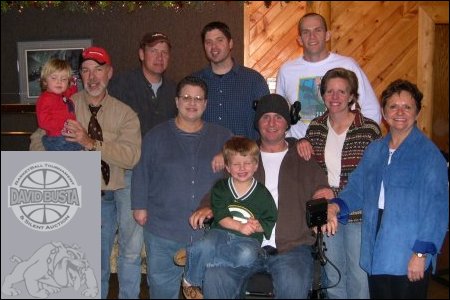
- Arik
November 26, 2004
$8 Billion Black Friday Starts Christmas Retail Shopping Season Smartly, Except for Wal-Mart
 Wal-Mart was alone among retailers in cutting its sales forecast, as the luxury trend took over and consumers increased spending from last year:
-
Americans spent more in stores at the start of holiday shopping than a year ago, according to figures released on Saturday, but retailers' hopes for the key season were curbed as titan Wal-Mart cut its November sales forecast.
Consumers lined up to grab early-bird specials as stores opened from 5 a.m. on the Friday after Thanksgiving, which is one of the year's biggest shopping days, known as Black Friday as it used to be the day retailers got into profit. Retailers now report profits throughout the year.
Black Friday used to be the biggest shopping day of the year, but now it competes with the Saturday before Christmas for top sales. Black Friday was the biggest shopping day in 2003.
Early sales data from analyst ShopperTrak showed Black Friday sales rose 10.8 percent from a year ago to $8 billion, while Visa USA said spending on its cards rose 15.5 percent to $4.1 billion with sales up but plastic also more widely used.
We'll see if the bounce continues and watch as Wal-Mart sharpens its pencil even more in what will surely be a move to suck more oxygen out of the room in a market where only Wal-Mart can hold its breath the longest.
- Arik
November 21, 2004
Sears & Kmart: Can Two Wrongs Make a Right?
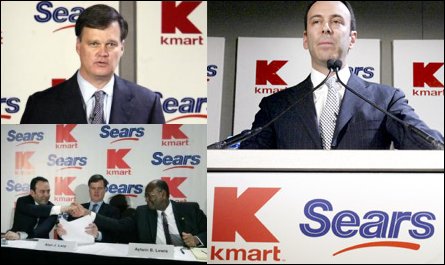
-
Kmart Holding Corp., the discount chain pulled from bankruptcy by hedge fund operator Edward Lampert, will buy Sears, Roebuck & Co. for $10.85 billion in a bold play to revive two of America's best-known, but long-struggling, retail brands.
The deal, the fourth-biggest retail merger ever, will form the third-largest U.S. retailer by sales. Known as Sears Holdings, it will have $55 billion in annual revenue, nearly 3,500 retail stores and 394,000 employees. Both company names will be used on stores, but some Kmart stores will convert to the venerable Sears nameplate.
Shares of the two companies, both former No. 1's in the U.S. retail industry, surged as they outlined plans to stem sliding sales and battle rivals like Wal-Mart Stores Inc., now the world's biggest retailer.
Some analysts said the deal could set off a wave of consolidation in the retail sector, where smaller players are struggling to survive against the industry leaders.
"This will trigger a lot of activity in the retail sector, with toys and possibly home furnishing companies coming together to become stronger," said Gary Ruffing, head of retail services at management consulting group BBK Ltd.
Others were skeptical that two flagging retail giants, which appear long past their prime, could join forces and challenge such a dominant competitor as Wal-Mart.
"The problem is they are missing a key ingredient -- sales growth," Darrell Rigby, head of the retail practice at consulting firm Bain & Co. "They haven't been able to solve their sales problems separately. Can they solve them jointly?"
The merger was the work of Kmart's billionaire chairman, Edward Lampert, whose ESL Investments Inc. hedge fund is the largest shareholder in both Kmart and Sears. Lampert told an investors' meeting that Sears was as good a company as its rivals but needed to be moved out of malls and into free-standing stores.
"Sears in a Kmart box...ought to do very, very well," said Lampert, who will be chairman of Sears Holdings.
He sees Sears, with its 1,971 stores and annual revenue of $41 billion, as the stronger of the two brands, with Kmart struggling to differentiate its 1,504 stores from other discounters but boasting a cash-rich, debt-free business.
Sears Chief Executive Alan Lacy said several hundred Kmart stores could be converted into off-the-mall Sears Grand stores, accelerating a new one-stop-shopping concept where Sears offers foods as well as apparel and home appliances.
The merger, which should be completed by next March if shareholders approve, is expected to lead to annual savings of $500 million within three years and maybe some real estate sales, the companies said. No details were given on job cuts. Sears employs 250,000 people and Kmart about 144,000.
Under terms of the deal, Kmart shareholders will receive one share of Sears Holdings stock for each Kmart share. Sears shareholders will have the right to choose either $50 in cash or 0.5 share of Sears Holdings for each of their shares.
Lampert has built up a huge cash pile by selling off some Kmart real estate since taking the company out of bankruptcy in May 2003, even selling about 50 stores to Sears as it tried to move away from malls where it has 870 of its stores.
Even so, analysts were divided over the motive for the merger and questioned the merit of combining two ailing companies.
"This entire deal is designed to pile up cash, and Lampert will then liquidate his position or buy something else and do the same thing all over," said Erik Gordon, a marketing professor at Johns Hopkins University, expressing skepticism over the future of Sears Holdings.
"Whether putting together two struggling retailers will create enough value and synergies to make a good retailer is a major question," UBS analyst Gary Balter wrote in a note to clients.
Sales at Kmart fell 14 percent in its fiscal third quarter, the company said on Wednesday. Sales at stores open at least a year -- a key gauge of retail strength known as same-store sales -- rose 1.9 percent in October after six straight months of declines. Sears is battling to keep its No. 1 slot in appliance sales against Home Depot and Lowe's Co.
Kmart, which sells brands like Martha Stewart Everyday and Jaclyn Smith and has annual revenue of about $19 billion, on Wednesday posted a 12.8 percent drop in third-quarter sales.
But investors welcomed the deal. Sears shares rose 17.2 percent to $52.99 on the New York Stock Exchange on Wednesday, while Kmart gained 7.7 percent to $109 on the Nasdaq. Wal-Mart shares slipped 1.1 percent to $56.24.
Shares of Martha Stewart Living Omnimedia Inc. rose 6.3 percent to $18.49. Cross-merchandising between Kmart and Sears will boost the number of outlets selling Martha Stewart goods.
Standard & Poor's said it will likely cut its ratings on Sears debt to "junk" after the deal, down from "BBB," the second-lowest investment-grade rating, at present. S&P said both Sears and Kmart "lag their peers in terms of store productivity and profitability."
Sears shares have rocketed in the past two weeks following news that real estate investment trust Vornado Realty Trust Inc. had acquired a 4.3 percent stake in the company, which highlighted the value of Sears' vast property holdings.
Lampert said Vornado had not been involved in the deal.
Lacy will be chief executive of Sears Holdings, while Kmart Chief Executive Aylwin Lewis will become CEO of Sears Retail.
So, unless some sales growth gets underway, whether Lampert can put “Sears in a Kmart box” and do well, is up for grabs.
- Arik
November 20, 2004
FDA Whistleblower: Broad Consequences of Merck’s Vioxx Means Overhaul of Drug Approval and Regulatory Process

Back in September, when Merck pulled Vioxx for safety concerns, observers predicted it’d mean a bunch of new investigations into drugs thought to have the same risks attached. So, it really comes as no surprise to see controversy after Senate Finance Committee testimony of the noted FDA safety expert. Graham said the safety profile of a number of currently marketed drugs should be closely examined. Pfizer's COX-2 inhibitor Bextra, similar to Vioxx, was mentioned, as were AstraZeneca's cholesterol-lowering statin Crestor, Roche's acne treatment Accutane, GSK's asthma medicine Serevent and Abbott's weight loss drug Meridia.
The NYTimes.com had the best coverage:
Critics of the F.D.A. have said that studies from as early as 1999 and 2000 showed that Vioxx was a risk to the heart, and many asked why the F.D.A. had not forced the drug's withdrawal earlier.
The critics' case has been bolstered by many e-mail messages from Merck and by company documents disclosed in lawsuits by users of Vioxx. In many of the documents, Merck executives and scientists discussed the possible link between Vioxx and heart damage years before the company publicly admitted that the drug could cause harm.
Merck executives have said the documents are being taken out of context.
Raymond V. Gilmartin, Merck's chief executive, testified Thursday that his company followed a ''rigorous scientific process'' as it examined the risks and benefits of Vioxx.
But Dr. Graham and other witnesses severely criticized Merck, saying the company should have acted years earlier to confirm the risks of Vioxx. Dr. Graham raised his estimates of those in the United States who had suffered heart attacks or stroke as result of taking Vioxx to a range of 88,000 to 139,000, up from 28,000. As many as 40 percent of these people, or about 55,000, died as a result, he said.
Dr. Gurkirpal Singh, an adjunct clinical professor at Stanford University, said at the hearing that Merck scientists had tried to intimidate him after he publicly raised questions about the effects of Vioxx.
Dr. Singh, a rheumatologist and science officer of the Institute of Clinical Outcomes Research and Education in Woodside, Calif., said: ''I was warned that if I continued in this fashion there would be serious consequences for me. I was told that Dr. Louis Sherwood, a Merck senior vice president and a former chief of medicine at a medical school, had extensive contacts within academia and could make life very difficult for me at Stanford and outside.''
Dr. Graham said that in his years at the F.D.A., he had recommended that 12 drugs be withdrawn. Only two are still being sold, he said.
His list of the five most worrisome drugs angered pharmaceutical makers, although objections to most of these drugs have long been known. For instance, Accutane, a drug for severe acne, can cause birth defects. The drug's label has warnings about this risk, and the F.D.A. has long been trying to get physicians to confine prescriptions to those women who cannot become pregnant or who are taking birth control.
Dr. Graham said that the F.D.A. needed to do a better job restricting the drug's sales.
Carolyn Glynn, a spokeswoman for Roche, which makes Accutane, said that her company had worked with the F.D.A. for years to ''address the risk of birth defects.''
Dr. Graham mentioned Crestor because, he said, it was the only cholesterol-lowering drug on the market that caused acute kidney failure. And the drug is more likely to cause a serious muscle-weakening disease than similar drugs, he said.
AstraZeneca introduced Crestor last year, but sales have been disappointing largely because of worries about the drug's safety. Public Citizen, a Washington advocacy group, has called for it to be withdrawn.
''We are confident in the safety profile of Crestor,'' said Rachel Bloom-Baglin, a spokeswoman for AstraZeneca. ''To date, the F.D.A. has not given us any indication of a major concern regarding Crestor.''
But Dr. Kweder of the F.D.A. told the panel that Crestor's risks are ''something that we are in the process of and have been evaluating very, very closely.''
Studies of the painkiller Bextra, also mentioned by Dr. Graham, have shown that it increases the risks of heart attack in patients undergoing cardiac surgery. In rare cases, the drug can also cause a fatal skin reaction. Despite these risks, Bextra, which is similar to Vioxx, has never been proved to be any more effective at reducing pain or protecting the stomach than older medicines like ibuprofen that are a fraction of the price and pose none of these suggested or proven risks.
Susan Bro, a spokeswoman for Pfizer, the maker of Bextra, said that the drug ''has been found to be safe and effective when used as indicated to treat osteoarthritis, rheumatoid arthritis and menstrual pain.'' She said the F.D.A. planned to ask a panel of experts early next year to examine the safety of Bextra and Celebrex, a Pfizer pain drug.
Meridia is a weight-loss pill, made by Abbott Laboratories, that can cause substantial increases in blood pressure in some patients. Public Citizen has called for Meridia's withdrawal because it has been associated with 124 reports of serious cardiovascular problems, including 49 deaths, said Dr. Sidney Wolfe, director of Public Citizen's health research group.
Dr. Graham testified that few patients were able to withstand Meridia's side effects long enough to benefit from its use. ''What's the utility of the drug?'' he asked.
Laureen Cassidy, a spokeswoman for Abbott, said, ''Science continues to support the safe use of Meridia as a treatment for obesity.''
The fifth drug named by Dr. Graham was Serevent, an asthma medication made by GlaxoSmithKline, which stopped a large trial last year after an interim analysis revealed an increased risk of asthma-related deaths and life-threatening episodes among those given the drug.
''We have case reports of people dying clutching their Serevent inhaler,'' Dr. Graham said.
After the study was released, the F.D.A. placed a ''black box'' warning, its most severe, on the drug's label. The agency concluded that the drug's benefits outweighed its risks.
In a statement Thursday, GlaxoSmithKline said that it ''stands firmly behind Serevent, which is safe and effective when used appropriately and in accordance with labeling and treatment guidelines.''
Dr. Galson of the F.D.A. emphasized that the drugs mentioned by Dr. Graham ''are all approved and are safe and effective like other drugs that are approved, recognizing that safe does not mean risk-free.''
Dr. Kweder of the F.D.A. defended the agency's handling of Vioxx and said that Merck had ''acted responsibly'' when it sold Vioxx. She said that Dr. Graham's estimates of Vioxx's toll were simply mathematical guesses and ''not real deaths.'' And she said that it was not unusual when a drug went on the market ''to have ongoing concerns about particular aspects of its safety.''
In his testimony, Mr. Gilmartin of Merck retraced many of the steps his company had undertaken and noted that while some early studies suggested that the drug might be a risk to the heart other studies found no problems. He said he believed so thoroughly in the drug that his wife took it until the day the company withdrew it.
That's a huge swath of drug areas and really illustrates the scope of the situation - could it be that the Vioxx scandal's true consequences are the tearing down and rebuilding of the whole regulatory process for new drugs? Let's hope a way can be found to make sure regulators don't get in the way of promising therapies, but it's obviously necessary for drugs to be proven safe BEFORE they reach the market. And, that's going to be one tall order.
- Arik
November 19, 2004
Mumbai (Bombay) India

- Arik
November 18, 2004
Will Howard Stern Save Satellite Radio & Doom Public Airwaves in the Process?
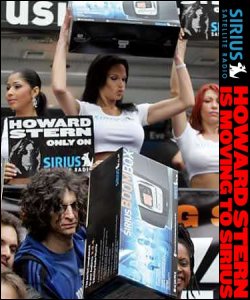 Flanked by strippers and personalities from his show, radio host Howard Stern spoke to thousands gathered in New York's Union Square where 500 Sirius satellite radios were given out, November 18. After years of FCC fines and content controversy, Stern will broadcast his show on the subscription-based Sirius for five years beginning in 2006. And, he's likely to get a lot longer leash from the FCC, as cable has in TV broadcasting. For the newly initiated, PCMag's Lance Ulanoff had a nice rundown:
-
For those unfamiliar with satellite radio, let me explain a bit. It's a now 12-year-old technology that offers 24-hour-a-day, commercial-free listening on dozens of stations that are divided up by genre--not by location. This means you can listen to your favorite country-music station no matter where you are and never lose a signal as you cross state lines. The content is more or less like the hundreds of niche channels available on cable. Want to listen to comedy 24/7? Satellite radio's got you covered. The two main players in the game, Sirius and XM Satellite, have been fighting tooth and nail for years and are finally starting to see some traction. XM surpassed the million-subscribers mark late last year, with Sirius trailing behind with nearly half a million subscribers as of May.
Now Howard Stern, a nationally syndicated radio personality who I've listened to for over 20 years, is leaving the analog radio world (in 2006) to dive—or rocket—head-first onto the Sirius satellite network. Upon hearing the news, I reflexively began investigating buying a satellite radio unit. I'm particularly intrigued by the devices that go from your car stereo system to your desktop like the Delphi XM SKYFi radio and XM's new truly portable MiFi (I'm aware that these devices will not carry Howard, but I hope to find similar capabilities in hardware that supports Sirius). I still have misgivings about the annuity, but I cannot imagine a morning without Stern. The fact that I'm considering shouldering the extra fiscal burden to maintain my auditory connection to a man many people consider vile is remarkable to me and should be heartening news for the satellite radio industry.
On the one hand, I now imagine legions of fearful radio listeners like me preparing for the day Stern leaves the free airwaves, attempting to convince their spouses that the extra expense is worth it and necessary for their well being. On the other hand, Stern may have miscalculated. What if no one follows him?
But, we’ll see if Stern can crush what most Americans call radio on the public airwaves, as he’s vowed to do. Some LA area FM broadcasters requested an obscenity provision October 28, days after Stern announced he was moving to satellite radio. Stern said he's leaving Infinity Broadcasting, the country's No. 2 public radio operator and a Viacom business unit, when his current employment contract expires in part because of the government's recent crackdown on television and radio programming deemed indecent.
In making his announcement, Stern railed against public radio and said he would try to destroy it when he joins Sirius. Broadcasters’ rep Saul Levine told Broadcasting & Cable magazine that he was alarmed by Stern's pledge and "decided to fight back to protect the radio industry" by launching the obscenity provision with the FCC. Looks to me like it's shaping up to be quite a fight.
- Arik
November 05, 2004
Bush Wins, Kerry Concedes – Democrats Enter First Stage of Grief; Ponder Own Future
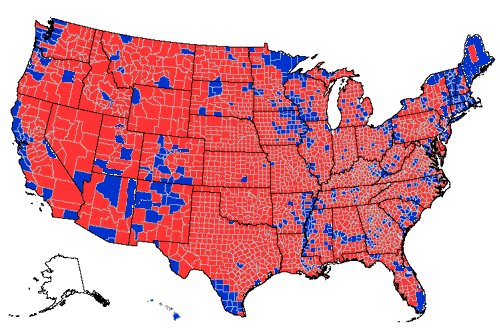
 Bush pulled it out in Ohio the other day and Kerry has finally conceded defeat, rather than await another round of uncertainty a la 2000. But it remains to be seen whether Bush or Kerry was the lesser of two evils. I was mostly interested in the demographic split – take a look at the county-by-county overlay of the 2004 election:
compared with the 2000 swing:
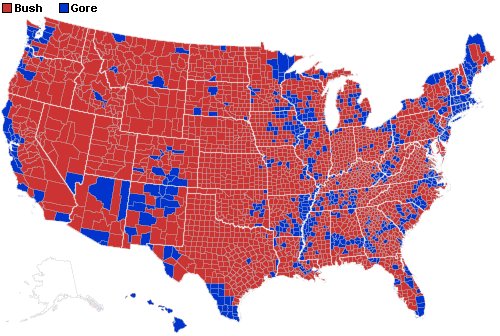
Predictably urban counties went blue, while crimson painted the countryside, but I found it a great comparison of the impasse that presents itself that we need to overcome. Other than that, here’s my list of the most interesting analyses over the past few days on the outcomes and what’s next for the Democrats – the lefties at Alternet seem to be getting gradually more depressed as time wears on:
- Alternet: Election 2004 – Too Close to Call
- Alternet: Election 2004 – The Day After
- Alternet: Election 2004 – The Deepening Divide
- Alternet: Election 2004 – The Unbearable Darkness of Being
- Alternet: Election 2004 – Answers? Do We Have Answers?
- Alternet: Election 2004 – Anatomy of a Crushing Political Defeat
- Alternet: Election 2004 – Mourning in America
- Alternet: Election 2004 – The Values Ploy
- Alternet: Election 2004 – One Country, Two Moralities
But, liberals tend toward navel-gazing in the face of defeat – or is it “progressives” now? – anyhow, we're all probably due at least a little soul-searching… more mainstream sources consider the degree of mandate Bush (and Republicans more generally) received and somewhat more realistic assessments of where Kerry left the rails, but as you’ll see from the URLs below, Slate.com had (at least in my opinion) the very best of it:
- For Bush/GOP: A Validation
- Key Ballot Measures Go Arnold’s Way
- What next for the Democrats
- Victory Bears Out Emphasis on Values
- 11 States Back Bans on Gay Unions; Georgia, Ohio Bar Partner Benefits
- Democratic Values - How to start winning the red states.
- Why Americans Hate Democrats—A Dialogue - Depressed liberals analyze what ails them.
- Whither Liberalism Again - Here comes the usual bad advice.
- Simple but Effective - Why you keep losing to this idiot.
- Why Kerry Lost - He was good, Bush was better.
- Something Nice About Bush - Chatterbox extends an olive branch.
- Brits to America You're Idiots! - Well, 51 percent of you, anyway.
- A crazy British plot to swing Ohio to Kerry – and how it backfired.
- Why Democrats Should Be Thankful - At least they don't have to clean up the Bush fiscal catastrophe.
- Moving to Canada, Eh - Let Slate help you decide if it's really for you.
- The Gay Marriage Myth - Terrorism, not values, drove Bush's re-election.
There’s always 2008. But, as Will Saletan emphasizes, Hilary Clinton shouldn't be the "man" for the job there – despite her speech the other day where she invoked Jesus more times than I can remember in the rest of her public life all together. Jesus apparently sells this election season... But could John Edwards really be the Democrats’ answer to Bush's plainspoken simplicity?
Whatever they decide, I prefer the much more light-hearted and pragmatic Needlenose approach to the “Six Stages of Grief” (as opposed to the more traditional five).
- Arik
November 02, 2004
Vioxx: Even Worse than We Thought
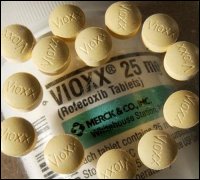 It's even worse than we thought - Merck shareholders take it on the chin again - here's USA Today's rundown:
-
Shares of Merck plunged more than 7% Monday after a report said the pharmaceutical giant apparently hid or denied evidence for years that its blockbuster arthritis drug Vioxx causes heart problems.
Merck, one of the world's top five drug makers, pulled the arthritis and acute pain drug from the market worldwide Sept. 30, saying it was acting in patients' best interest. Vioxx has been taken by about 20 million Americans and accounted for 11% of Merck's total revenue.
On Monday, Merck shares were down 7% after The Wall Street Journal reported that internal e-mails and marketing materials show the company knew as far back as 2000 that Vioxx was linked to an increased risk of heart attack but tried to discredit such evidence.
The newspaper says that a March 9, 2000 e-mail from Merck research director Edward Scolnick to colleagues conceded an elevated risk of heart attack and stroke was "clearly there." Nevertheless, the newspaper says, Merck continued to try to discredit academic researchers critical of the drug.
The Journal reported that one training document from Merck listed potentially difficult questions about the drug and stated in capital letters, "DODGE!"
Ted Mayer, a lawyer representing Merck, told the Journal that the e-mails and marketing materials were "taken out of context" and "do not accurately represent the conduct of Merck and its employees."
Merck shares had been trading in the $45 range until the drug was taken off the market. The stock plunged to the mid $30s that day.
But the BBC mentioned the real evidenciary consequences for Merck in potential class action lawsuits:
-
Merck already faces patient lawsuits, filed after its decision to recall the drug in September. Investors now fear that the picture could be grimmer and the potential costs higher.
The Wall Street Journal quoted internal company e-mails, including one from Merck's head of research Edward Scolnick in March 2000 to colleagues saying that cardiovascular problems with Vioxx "are clearly there".
"If the e-mails actually exist and say what they are purported to say, they appear at least superficially to be a smoking gun that lawyers could pull up as evidence against Merck," said drug industry analyst Trevor Polischuk of Orbimed Advisors.
The result is likely to be more litigation, though he believes it may be difficult for Vioxx users to prove the drug harmed them given that many will have had pre-existing heart problems.
Credit rating agency Standard and Poor's said it may downgrade Merck's credit rating and is seeking a meeting with the firm's management to discuss Merck's "long-term ability to retain its credit strength".
The agency said its actions "reflect Standard and Poor's increasing concern about the magnitude of possible litigation" over Vioxx.
Datamonitor had a great analysis of the situation that looked at competitive implications:
-
With the higher potency, and lower gastrointestinal side effect profile of Vioxx compared to Celebrex (celecoxib) being speculatively linked to its poor cardiovascular side effect profile, physicians may now be reluctant to prescribe the second generation products.
While a significant proportion of existing Vioxx users are expected to switch to another COX-2 product, particularly those that had been prescribed Vioxx as second line therapy after having failed on traditional NSAID therapy, Celebrex is expected to be the key beneficiary of this, and not the newer drugs.
Pfizer itself has reinforced this view, by immediately responding to Merck's announcement by turning the spotlight on Celebrex, re-affirming the drug's safety profile and guaranteeing its availability for current Vioxx users, while making little mention of Bextra. This action is particularly intriguing considering Pfizer's previous strategy had been to position Bextra, not Celebrex, against Vioxx. Perhaps the company feels that in the current environment of heightened safety fears, Celebrex's key marketing message of long-term experience and safety is more appropriate than Bextra's "powerful medicine" tag.
A key uncertainty that remains is to what extent this event will drive physicians to reconsider their use of COX-2 products, which have come under fire recently as many healthcare payors, such as insurance companies in the US and NICE in the UK, have questioned whether their high cost, compared with traditional NSAIDs, is justified. The key defense of leading players Merck & Co and Pfizer has been that the lower incidence of gastrointestinal complications associated with COX-2 products actually increased the cost effectiveness of these medications. With suggestions that Celebrex is inferior to Vioxx in this respect, the removal of Vioxx from the market may see physicians question this defense, and increasingly opt for traditional NSAIDs plus a proton pump inhibitor (PPI) for patients at risk of gastrointestinal side effects.
The views of key opinion leaders have differed widely in this respect, with industry opinion leaders seemingly holding diverse views on the precise impact of Vioxx's withdrawal. This uncertainty is unlikely to be resolved until prescribing data becomes available. Datamonitor expects Celebrex to pick up a significant share of existing Vioxx patients, but anticipates the COX-2 market as a whole to decline, as fewer new patients are prescribed COX-2 products.
Prior to the withdrawal of Vioxx, Datamonitor forecast the COX-2 market (defined as Bextra, Celebrex, Vioxx, Dynastat, Arcoxia, Prexige and Mobic), to grow at a CAGR of 2.8% between 2004 and 2010, reaching sales of $9,099 million. This forecast has now been reduced to $7,056 million in 2010, representing an average annual decline of 0.4% between 2004 and 2010, as a proportion of Vioxx patients leave the COX-2 market, and with lower uptake of premium priced products Bextra and the pipeline COX-2s among new patients now anticipated.
Despite expecting the COX-2 market to remain static, two key COX-2 products are expected to directly benefit from withdrawal of Vioxx. Forecasts of both Pfizer's Celebrex and Abbott/ Boehringer Ingelheim's Mobic (meloxicam) have been increased following this event.
The key factor driving Mobic's success lies in its differentiation from the remainder of the COX-2 market. While the drug has some selectivity for cyclo-oxygenase II, and therefore may be associated with a lower rate of gastrointestinal adverse events than other NSAIDs, it is not a specific COX-2 inhibitor. Abbott and BI may therefore be able to distance the drug from association with cardiovascular side effects in a way that some of the true COX-2s may struggle to. Although this product is expected to suffer from generic competition in 2005, until that time, sales are expected to be boosted by patient switching from Vioxx. Forecasts for 2005 sales for this product are $996 million, compared to the previously forecast $442 million.
In the case of Celebrex, Pfizer's marketing strength will ensure this product is a key beneficiary among those patients currently taking Vioxx that will be switched to another COX-2. The 2005 forecast for this drug has raised from $2,472 million to $3,677 million, as it benefits not only from direct patient switching from Vioxx, but also from reduced competition from Bextra and other new COX-2s.
Initial data, according to a report in the Wall Street Journal, suggests that of the 2.4% of Vioxx users that switched drugs within 24 hours of the announcement, 58% received either Celebrex or Bextra.
Merck & Co.'s ethical revenues amounted to $22,485 million in 2003, and were forecast to decrease at an average annual rate of 0.4% between 2003 and 2010, due to the loss of patent protection of three of its five blockbuster drugs, Zocor (simvastatin), Fosamax (alendronate) and Cozaar (losartan).
With Vioxx off the market, Merck will lose one of its only two blockbuster drugs not to face patent expiry in the short to medium term, with Singulair (montelukast) being the other. Without Vioxx, and with Arcoxia's prospects being significantly reduced, Merck's ethical sales are forecast to fall at a faster CAGR of 1.7% to 2010, recording sales of $20,502 million in 2004, $22,139 million in 2007 and down to $19,969 million in 2010.
Meanwhile, Pfizer's ethical sales forecast has received a boost from this event, and is now forecast a CAGR of 2.7% between 2003 and 2010, taking ethical sales to $47,649 million, up slightly from the previous forecast of 2.6% taking sales to $47,569 million. Pfizer is also expected to suffer from generic competition to several of its major brands over the forecast period, with all of its nine blockbuster products in 2003 facing patent expiry, except for Viagra (sildenafil) and Celebrex. Pfizer will therefore be watching development of the COX-2 market keenly following this event, and will do all it can to protect revenues in its COX-2 franchise.
The competitive positioning of Pfizer and Merck & Co. has diverged over the past few years and the loss of Vioxx will accelerate this process. From being the number one pharmaceutical company in terms of ethical sales in 1999, by 2002, Merck had dropped to third place, $7.9 billion behind GSK and $6.8 billion behind Pfizer. Then, in 2003, a $17 billion gap opened up between Merck and previous nearest rival Pfizer, following the latter's acquisition of Pharmacia. By 2010, Merck was forecast to fall to 7th position, but following the withdrawal of Vioxx, The company is now forecast to drop to 9th position, as a combination of loss of Vioxx and generic competition to its other leading brands takes its toll.
Merck & Co. has historically been resistant to a merger, and as recently as November 2003, it was busy denying rumors that it was to acquire partner Schering-Plough. However, M&A may now be the only way for Merck to achieve growth in the increasingly competitive pharmaceutical market. Schering-Plough, with its ethical sales forecast to grow at a CAGR of 5% between 2003 and 2010 (well above the average of 2.9% for the top 10 pharmaceutical companies), would indeed boost Merck's growth prospects. Whether Merck will be in a position to make any major acquisitions in the light of Vioxx's withdrawal and the likely litigation costs associated with this is another matter.
But I think the whole market is essentially a trainwreck... watch Celebrex and Bextra - there're rumblings about the FDA needing to yank more drugs off the market and that'll have big consequences for everyone in this business. I just wrote an article for SCIP's Competitive Intelligence Magazine about the implications of the Vioxx situation, alongside the Oracle/PeopleSoft consequences, and Section 409 of Sarbanes-Oxley. As always, I'd be interested in any feedback. I'm doing a presentation in a couple of weeks at CBI's Philadelphia "Pharmaceutical Decision Support" Conference on corporate governance, so Merck and SarbOx are very timely topics.
- Arik
November 01, 2004
Washington Redskins Fall to Green Bay Packers (28-14): Could Controversial Outcome Mirror Tomorrow’s Presidential Election
-
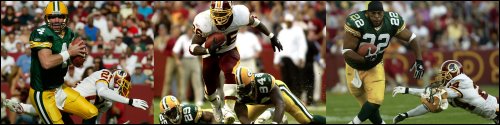
The arcing pass from Mark Brunell fell gently to Clinton Portis in perfect stride as the running back emerged from a fog of bodies, sprinted past the Green Bay defense and launched himself across the goal line for a 43-yard touchdown, leaving the Washington Redskins just an extra point away from taking the lead yesterday afternoon with less than three minutes to play.
Washington had been facing third and eight and trailing 20-14, but as delirium spread through FedEx Field and exhausted offensive linemen chased Portis around the end zone seeking to join in his celebration, the officials were collaborating in the backfield, where a flag had been thrown. This was Washington's biggest play of the season -- the kind of sequence that can propel a middling team on to greater things and re-ignite a stumbling offense -- but in the eyes of the NFL, none of it ever occurred.
The officials called an illegal motion penalty against wide receiver James Thrash, who was in motion on the play, a decision that left the Redskins both confounded and vexed. Brunell (25 of 44 for 218 yards, 2 touchdowns, 2 interceptions), scorned by the crowd throughout the game, was no longer redeemed, and threw an interception on the next play. Green Bay added a touchdown and two-point conversion on that drive to secure a 28-14 win, handing Coach Joe Gibbs another stinging defeat and dropping his team to 2-5, alone in last place in the NFC East.
"Our season was on the verge of just turning around if we win that game," tackle Chris Samuels said. "If Clinton's touchdown was good. But unfortunately they made the call. That's what they thought. There's nothing we can do about that now."
Washington's coaches left the stadium last night unsure of why the officials threw that flag. Gibbs said he was told initially that Portis was observed moving at the line of scrimmage, but the coaches were adamant the runner was set. Another official told Gibbs that Thrash was the culprit and either did not come to a complete stop while in motion or was lurching over the line; Thrash was involved in pass protection on the play and did not go out for a pattern.
"I've got to tell you, it's an absolute mystery to me," Gibbs said of the call. Thrash was similarly confused. "I think [the referee] said the back [Portis] was moving forward, and then he said I was moving forward in motion. To be honest I don't know for sure. . . . I'm not going to say something bad about somebody because I don't know for sure."
Joe Bugel, the assistant head coach-offense, tried to call other officials to the sideline to get a clarification, but said his pleas were ignored. "Nobody gave us a clear definition of it," he said. Don Breaux, the mild-mannered offensive coordinator, berated an official in the corridor outside Washington's dressing room after the game and was still searching for answers an hour later. "I don't know what they called there," he said. "I really don't know." A league official contacted after the game confirmed an illegal motion penalty was called on Thrash but was unable to offer any further explanation on the penalty.
That swing -- from potential game-winning touchdown to loss-clinching interception -- was but one of many twists in this contest, during which several questionable calls did not go the Redskins' way. Packers quarterback Brett Favre, still reeling from the recent death of his brother-in-law and the revelation that his wife has breast cancer, went from completing 14 of 18 passes for 234 yards in the first half to nearly handing the game away with poor decisions in the second half. Washington's top-ranked defense, lacking several vital players, recovered from a slow start to force three turnovers and put the offense in stellar position to win it late.
So, with all the controversial ballot measures impacting the presidential race this election season, whether or not Kerry wins tomorrow in the final score of votes cast, like the Packers did yesterday in terms of points scored, the controversial call that decides the outcome of the contest overall is sure to be mirrored in a fractious battle over rules and legalities in the weeks to come.
- Arik
 "Competitive Intelligence applies the principles of competition and lessons of intelligence to the need for enterprise awareness and predictability of market risk and opportunity. CI has the power to transform an enterprise from also-ran into real winners with agility enough to create and maintain sustainable competitive advantage."
